Elections Commission processes 20,000 forms, as thousands queue to re-register

The Elections Commission (EC) has processed 20,000 voter re-registration forms, and is still serving a queue of thousands of tickets taken before yesterday’s 4:30pm deadline.

65,000 people re-registered to vote ahead of the September 7 election, which was annulled last week by the Supreme Court. With little over a week remaining before the rescheduled October 19 vote, the court at midnight on October 10 ordered the EC to collect voter fingerprints and restart the entire re-registration process from scratch.

The announcement of a 24 hour deadline for registration saw hundreds of volunteers in political party outposts working right through the night of October 11 in an effort to re-register thousands of voters. The largest party, the Maldivian Democratic Party (MDP) which obtained 45.45 percent of the popular vote in the annulled first round, said it had re-registered more than 33,000 people.

A system crash around 2:30pm Sunday afternoon due to the large volume of data saw the EC begin manually entering data to continue processing while the system was restarted. An official told Minivan News the problem was fixed two hours later at 4:30pm, however some people reportedly became upset as the manual process meant they were unable to be immediately issued with a confirmation slip. 2500 tickets remained at the time of the crash, the official noted.

Boisterous Progressive Party of the Maldives (PPM) and its allied Maldives Development Alliance (MDA) supporters in the queue quickly accused the EC of attempting to rig the election, while soon after 7:00pm police had arrived at the EC’s registration building and begun removing people from the waiting area.

By 9:00pm police had deployed barricades outside separating the MDP and PPM supporters, while the Elections Commission had begun calling numbers again and was stamping temporary receipts, with official receipts to be provided on Tuesday.

Elections Commissioner Fuwad Thowfeek told Minivan News on Friday evening that the EC had received threats that the voter registration section would be attacked, and that “people would throw stones at the windows and burn things there.”

“When we received that information we wrote to the police and Maldives National Defence Force (MNDF) requesting protection of our office. It’s very sad. There are a group of people who want to block this [vote], those who know they may not do well, so they are trying to buy time and make the election difficult. But I hope these things can be handled by the police and MNDF. The whole world is watching and wants this election,” he told Minivan News.

PPM presidential candidate Abdulla Yameen has meanwhile reportedly called on the EC to verify the fingerprints on all registration forms submitted, despite no organisation in the Maldives having the capacity to do this.

Foreign reporters to require business visas

The Immigration Department, which operates under the Ministry of Defence, has meanwhile declared that foreign reporters and camera crew must now apply for business visas and be vetted by the Ministry of Foreign Affairs.

Visiting journalists have previously entered the country on tourist visas, as business visas (costing MVR750/US$50 for three months) have required the sponsorship and collection of the visiting person from the airport by a local company or organisation.

“Up until now, we issue visas based on a list provided by the Elections (Commission). We cannot allow them to enter on a tourist visa and cover the election. We have communicated this to the relevant authorities,” Immigration Controller Dr Mohamed Ali told local media.

The procedure under which foreign media would be approved and sponsored was unclear, although Foreign Ministry Spokesperson Mohamed Najeel suggested that this would be processed through the ministry.

‘Death threat’ phone lines suspended

The Communications Authority of the Maldives (CAM) has informed local media that it has suspended 15 phone numbers accused of issuing death threats against Elections Commission officials.

The death threats received by the EC’s permanent staff and polling station officials prompted the commission to file a report with police following the Supreme Court’s controversial suspension of the second round of polling, and subsequent annulment of the first round.

CAM CEO Ilyas Ahmed told local media that police had also filed cases regarding several numbers.

“We only take action if there’s a serious problem with a number, and after filing the case to the police. This is a criminal offence and there is a judicial procedure to be completed, so we’re filing them to the police,” he told Sun Online.

Likes(1)Dislikes(0)

Q&A: “There are people who want to block this vote” – Elections Commission Chairperson Fuwad Thowfeek

The Maldives’ Supreme Court issued an injunction on September 23 to indefinitely delay the presidential election’s second round until a verdict was reached in the Jumhooree Party (JP)’s case against the Elections Commission (EC).

Ultimately the Supreme Court ruled to annul the first round of the 2013 presidential elections, held September 7, citing a secret police report on alleged electoral irregularities, despite unanimous positive assessment of the polling by more than a thousand local and international election observers. The apex court’s verdict issued around midnight on October 8 included 16 point guidelines the EC was to follow to hold new presidential elections before October 20.

Giving it just 11 days to prepare for the next round of the presidential election, the Supreme Court has also issued subsequent rulings dictating managerial and administrative tasks the EC must undertake while preparing for the repeat first round.

With the October 19 repeat first round less than a week away, Minivan News discusses some of the challenges faced by the commission with Fuwad Thowfeek, Chairperson of the country’s first independent Elections Commission (EC).

Leah R Malone: In a previous interview you noted that the EC would normally require 45-60 days of preparation to hold a presidential election in accordance with the Maldives’ constitution, presidential and general elections law. Will the Elections Commission be able to hold the presidential election’s repeat first round on October 19, given the limited preparation time available? Are you satisfied with how preparations are proceeding?

Fuwad Thowfeek: The Maldivian people have so much trust and faith in the Elections Commission. Our future, our democratic country, depends on how we act and react at this time.

240,000 voters believe in our work, and for the sake of the people coming to keep up the democratic process and rule of law we are sacrificing ourselves to get these things done in the short time given.

People everywhere I go tell me “Thank you for your work, don’t quit, don’t do anything to take us back [to dictatorship], don’t step down, don’t resign”. So many people are so worried [the election will not take place]. They have so much faith [in us], we should not and cannot let the Maldivian people down. We are not going to accept defeat. The election will be conducted, the votes counted, and the results released.

The EC’s staff are ready go ahead [with the election], they will give their maximum 100 percent support. This is the time we all have to sacrifice our holidays and our pleasure for the people of the country. Rarely will a person get a chance to do that for their nation.

We have been working very hard day and night with no break, there are three staff shift rotations [so the commission is working 24 hours a day, 7 days a week]. We also have to work through the Eid holidays.

We are making it possible for people of the country [to exercise their right to vote]. If this was only for our personal benefit we would not be [sacrificing so much].

Progressive Party of Maldives (PPM)’s Vice Chair Abdul Raheem Abdulla said he thinks it is impossible to hold the election October 19, so we will make the impossible possible.

(Recent videos on social media show PPM MP Abdul Raheem Abdulla using obscene language against Speaker Abdulla Shahid and insulting his mother during disorderly protests in Parliament by MPs of the government-aligned PPM and Jumhooree Party (JP).)

Death threats continuing

LRM: Has any progress been made regarding the investigation into the death threats received by Elections Commission officials? Or identifying who set fire to the lot next to your home?

FT: There has been no progress in identifying the individuals sending death threats to EC officials or determining who set fire to the lot next to my home.

LRM: Are Elections Commission officials still receiving death threats?

FT: I have not received any additional threats about being stabbed, but general threats against the Elections Commission are continuing. This evening (October 11) we received a threat that the voter registration section would be attacked, people would throw stones at the windows and burn things there.

When we received that information we wrote the police and Maldives National Defense Force (MNDF) requesting protection of our office.

It’s very sad. There are a group of people who want to block this [vote], those who know they may not do well, so they are trying to buy time and make the election difficult.

But I hope these things can be handled by the police and MNDF. The whole world is watching and wants this election.

Police elections role

LRM: Supreme Court’s verdict in the Jumhooree Party’s case against the Elections Commission mandates that the police should play a substantive role in handling the logistics and security of the election and ballot papers. However, after receiving the EC’s complaint that the security forces had ‘hijacked’ the EC the evening before the presidential elections scheduled second round, the Prosecutor General’s Office stated it will take any necessary action to ensure the constitution is upheld.

In this context, can police play an impartial role while adhering to the Supreme Court’s verdict, or does their involvement compromise the electoral process?

FT: We were told there should be more of a police presence from printing [ballot papers] until voting takes place. This time a police officer will accompany Elections Commission officials for every movement [of the ballot boxes].

Police officers still must adhere to 100 foot rule during polling and counting. Police should not be present [within a 100 foot radius of the ballot boxes] during counting. [After counting] once the boxes are in a certain place, police will then guard them.

The way the police reacted on the 27th [of September] was quite unfriendly… but we are trying to cooperate and I hope they will also give cooperation because this Supreme Court case has ordered the EC and all government institutions to follow the verdict.

(The EC was forced to postpone the presidential election’s second round, scheduled to take place September 28, due to a lack of state cooperation that prevented the commission from holding a “free and fair vote without intimidation, aggression, undue influence or corruption”. The announcement was made September 27, shortly before the EC secretariat was surrounded by Special Operations police with orders from Police Commissioner Abdulla Riyaz to take over the building and ballot papers should it proceed with election preparations.)

LRM: Was the EC ever provided the details of the police intelligence report that the Supreme Court’s verdict to annul the presidential election’s first round was primarily based on?

FT: The EC had not received the police intelligence prior to the Supreme Court verdict, but two days after the verdict was issued we were sent some documents and files. The document the EC received was “another analytical report based on the lists [in the police intelligence report] sent to the Supreme Court”.

We have still not been given the original police report based on their intelligence findings and observations. That report was passed between the Maldives Police Service, the Attorney General and President Waheed before being given to the Supreme Court. The Supreme Court based their verdict on these claims, not the EC’s records.

We are going to review the Department of National Registration (DNR) data ourselves and will verify if the data [in the police report] is true or false and differentiate between whether it is five percent or 100 percent accurate. We will analyse it as soon as there is time, but right now there is no time to verify and cross check.

(The police intelligence report has not been made public and was not shown to the Election Commission’s defence lawyers).

Supreme Court guidelines

LRM: How have the Supreme Court guidelines impacted the EC’s preparations for the presidential election’s repeat first round?

FT: I have been speaking with the Supreme Court Chief Justice to get clarifications regarding the verdict’s guidelines for the EC.

A difficulty is our ballot box officials will not be able to keep their cell phones, so one polling station official will have to remain 100 feet away with their cell phone. If any incident occurs a ballot box official will then have to walk over to the polling station official so they can call for assistance.

Another difficulty is that there are nine days of public holidays for Eid [and government institutions will be closed during that period].

Registration

LRM: How has the Supreme Court ruling issued October 11 that ordered the commission to restart the entire elections re-registration process impacted preparations?

FT: We understand from the Supreme Court that [in their order] they were referring to old forms without fingerprints [being invalid].

65,000 people previously registered on the ‘dhaftharu’ [the special registry for Male’ residents who are from other islands]. They have to re-register because there was no thumb print on their registration forms. They need to fill the registration form in the presence of two witnesses and all three must thumbprint the form. Although there is no way for the EC to verify the authenticity of their thumbprints.

I believe by cancelling over 65,000 [people’s voter registration] we will not be able to provide the opportunity to register many of them within the limited time. So many people will not be able re-register within the one-and-a-half days and although they will have the option to travel [back to their home islands to vote] it will be a burden for them: time and money.

For overseas voters, the one way to email their registration is after they fill the form, with two witnesses, and the necessary thumbprints they can then send it via email to someone who will then need to physically bring it to a Maldives Embassy. For example, if a Maldivian voter lives in Scotland, after filling the voter registration form, he or she can email it to a friend in London, who will then need to take it to the [Maldives] Embassy in London.

(The Elections Commission opened a 24-hour re-registration window – that ended at 4:30pm October 12 – for all eligible voters, after the Supreme Court ordered the EC to disregard re-registration efforts for the annulled presidential elections, and restart the entire process with fingerprinted forms for all voters who wish to vote in a location other than their permanent address.)

LRM: With the High Court ruling that it no longer has jurisdiction to hear election related cases, due to the Supreme Court’s verdict, how can individuals seek redress?

FT: I’m sure there will be so many complaints because ID cards [names and addresses] will have slight variations compared to the DNR’s voters list.

Now if an individual wants to seek redress regarding their complaints, they must file the case with the Criminal Court. Because of the Supreme Court verdict, the special consideration for the High Court to see to all election related matters is no longer valid.

Government Institutions

LRM: The Election’s Commission previously cited lack of state cooperation as one of the reasons it was prevented from holding a “free and fair [second round] vote without intimidation, aggression, undue influence or corruption” on September 28 as constitutionally-mandated. Are government institutions currently cooperating to re-hold the presidential election’s first round on October 19?

FT: The Elections Commission has been promised all government institutions will provide whatever they can [for the election to take place].

We have also been in contact with the acting Finance Minister and acting Home Minister to get input as well as the Maldives National Defence Force (MNDF), Maldives Police Service (MPS), the Department of National Registration (DNR), the National Center for Information Technology (NCIT), the Civil Service Commission (CSC), the Maldives National University (MNU) and the Prosecutor General’s Office (PGO).

MNU staff from the Faculty of Education and different sections because we need more people to do the work in they very limited time [before October 19], so we are asking them to come here [to the EC]. Some work has been delegated, for example the DNR is assisting with photo formatting.

LRM: The Supreme Court guidelines also require government institutions to enhance the commission’s database security, so how is the EC protecting its data from external influences?

FT: The EC’s data is still secured. We are using the NCIT’s expertise in areas where risk to data security is not involved. For example, the format of voters’ photos and attachments are different at the DNR and EC, so NCIT is converting the photo formatting and providing support in different technical areas.

Commission member resignation

LRM: With commission member Ibrahim ‘Ogaru’ Waheed resigning last week due to health reasons, when will the EC seek a replacement?

FT: We will seek a replacement after the presidential election, because the process takes time. The president has to call for applications, then send nominees to the ‘Majlis’ [‘Parliament’], and in many cases the names submitted will not be accepted.

To establish the current commission, and select the five members, the whole process took four to five months. It would probably take at least two months to find a replacement for Waheed.

International observers returning

LRM: What international election observers will be returning for polling on October 19?

FT: I’ve had friendly conversations with the German, American, and UK Ambassadors by phone to provide them updates. Right now the German Ambassador is here and we recently met in Male’ and the US Ambassador will be arriving from Colombo.

One of my colleagues in Brussels called to ask about EU observer teams coming and I said they are most welcome to come observe the election. The Indian High Commission has said a team of Indian observers are coming and the Commonwealth is also coming with a team.

We are very delighted to have them here and have sent written invitations to all the countries and organisations that came to observe polling on September 7, which included Japan, Thailand, India, Pakistan, the UK, US, Commonwealth, and EU.

Hopefully everyone will return to observe the election.

Likes(1)Dislikes(0)

Translation: September 15’s secret police report on election

This translation first appeared on Dhivehi Sitee. Republished with permission.

Shortly before midnight on 7 October 2013, four of the seven judges on the Maldives Supreme Court Bench put out a majority verdict annulling the first round of the 2013 Presidential Election held on 7 September 2013. The election was heralded as free, fair and largely free of errors by both local and international observers. The four judges ignored this consensus and, instead, chose to rely heavily on a ‘secret report’ compiled by a team of ‘forensic experts’ from the Maldives Police Service as the main evidence to support claims of Jumhooree Party, the complainant in the case. The report was so secret that it was not shared even with lawyers of the defendant, the Elections Commission, depriving them of the essential undeniable right of reply.

The following is a translation of another secret report the so-called expert forensic team compiled on 15 September 2013, the same day the Jumhooree Party filed its case at the Supreme Court. It was leaked on the internet yesterday. Although it is not the secret report which the Supreme Court ordered from the police after the case began, it is among the documents the court considered, and gives a taste of the quality of the greater report these experts later prepared. Hopefully, this latter report will also be soon made available for public perusal by a concerned citizen, as it should rightly be.

Read original (Dhivehi)

***************************************

Maldives Police Service,

Male’

Maldives

J2 (A)/2013/926

Issues noted in the Eligible Voters Registry used in first round of the presidential election & other problems with the election

Introduction

This report is [to] verify whether or not the allegations being made by political parties and political figures about validity of the results of the presidential election held on 7 September 2013 have any provable basis. Thus, this report compares and includes discrepancies noted in: the ‘Presidential Election 2013 — Eligible Voters List’ published by the Elections Commission on 30 May 2013 in the Government Gazette Vol.42, No.94 and “Amendments made to the Presidential Election 2013 Eligible Voters List published in Government Gazette on 30 May 2013 based on complaints received” that appeared in Government Gazette Vol.42, No.101 of 29 June 2013, and citizen information records kept at the Department of National Registration.

This report is based on multiple comparisons of a large number of records. Moreover, as the Elections Commissions has not even up to this day made public any list or registry of those of who voted in the presidential election on 7 September 2013, any discrepancies in the lists or registries used in the activity will enter this report also. However, it is believed that such an error-margin will be extremely slim. As this report regards the Department of National Registration Database as its main source, any incorrect information in it would also naturally enter this report. If the Elections Commission omitted listing the district when entering someone’s address, this report does not consider it as a problem or a discrepancy in address. Nor does it consider variations in spelling a person’s name as a discrepancy.

Points of Note:

In examining the Eligible Voters List, or Voter, and the records received from the Live Link of the Department of National Registration, several discrepancies were noted. They are listed below:

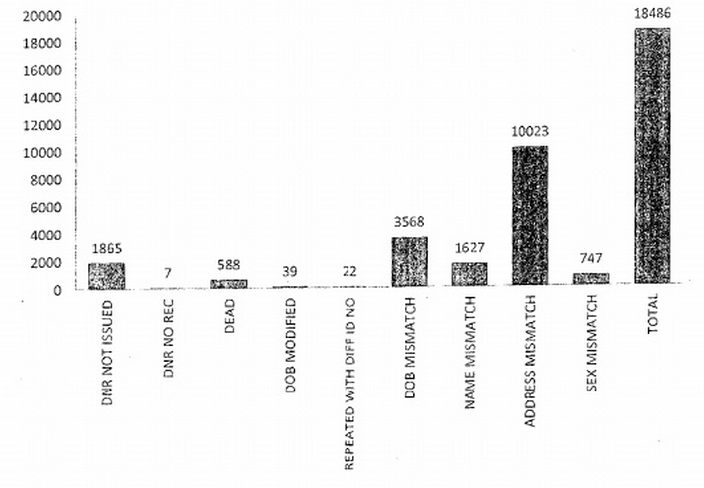
1865 people who were not given ID cards by the Department of National Registration were included in the Elections Commission’s Voter Registry. Information regarding those persons is included in Annex 01 of this Report

07 people whose information is not found in the Department of National Registration records were included in the Voter Registry. This information is included in Annex 02 of this report. One of these persons has made a Maldivian Passport.

588 who are believed to be now dead are included in the Elections Commission Registry. These dead people’s information is in Annex 03.

39 children who, according to the Department of National Registration Database, were not 18 years of age by 7 September 2013 were included (by modifying their date of birth) in the Elections Commission Registry. Annex 04 contains information on the children whose dates of birth are believed to have been altered.

Voter Registry shows 22 records of people who were on two ID card numbers. Annex 05 contains details of such people.

3568 people were noted whose Date of Birth on the Elections Commission Registry was different from that on their ID cards. Such persons are listed in Annex 06.

1627 people were noted as having discrepancies in their names. Their details are in Annex 07

10020 people’s records were found whose address on the National Registration Database did not match with their address in the Elections Commissions Registry. Their details are in Annex 08

747 people were found whose male female sex did not match[sic]. Their details are included in Annex 09. It is believed that the following problems arose as a result of mismatched sex:

  • According to the Registry gazetted by the Elections Commission a total of 5 women were registered to vote in Z.43.1.1 Lux Resort. It can be seen from the results announced on the Elections Commission website that 6 women voted in this box. Therefore, it must be believed that 1 woman more than was registered voted here.
  • 502 women were registered to vote in Ballot Box No. NT.0.2 for Thaa Atoll in Male’. Results published on the Elections Commission website shows that 517 women voted in this box. Therefore, it is known that 15 women more than were registered voted here.
  • 79 men were registered to vote in Box No.Z.50.1.1 placed on Robinson Club Maldives Resort. It is known from the results published on the Elections Commission website that 81 men voted here. Therefore, it is known that 2 men more than were registered voted here.
  • 1 woman was registered to vote in Box No. Z.51.1.1 placed on Jumeirah Dhevanfushi Resort. It is known from the results published on the Elections Commission website that 2 women voted in this box. Therefore, 1 woman more than was registered voted in this box.

But, no votes were cast in these boxes more than the total numbers registered to vote there. Problems in votes cast in these boxes can be found in Annex 10. Detailed information about these will be found in Annex 10.

Below is a graph based on information listed above including the total number of problems found:

PoliceReportGraph

Problems that could arise with reference to points noted above:

In considering what has been noted in the Voter Registry, it is seen that there is some opportunity for fraud and rigging. Whether the problems in the Registry are intentional or otherwise, there is ample room to form the view that this could create opportunity for some people to vote illegally. Although the issues noted cannot be confirmed without first verifying them against the list checked at the polling booths, it must be accepted that even children under the age of 18 were allowed to vote. There is also room to say that people without a national identity card had the opportunity to create a card that is not valid and use it to vote. The view can also be formed that since there were 02 ID card numbers, one person could have had the opportunity to vote 02 times.

Other points of note:

Even though the Elections Commission acted according to Article 9 (a) of the General Elections Act which requires it to publish the Eligible Voters Registry in the Government Gazette at least 45 days (forty five days) prior to the election, it cannot be seen that the Commission published the information on their website as required. And, while second round of the 2013 Presidential Election is scheduled for 28 September 2013, the information still does not appear on the Elections Commission website.

Information has been received that Retired Judge Johan Griegler [sic] sent to the Maldives by the UN on request of the Elections Commission has not been given the opportunity to work there. Information has also been received that UN made a plea at the National Complaints Bureau to use his expertise. But, information has been received that he was not given the opportunity to work there that day.

It was also noted that even though Intelligence received information that the Elections Commission’s web server was hacked a few days before the election, and this information was relayed to the Commission, nothing was done about this for days. Even though it cannot be said for certain that information that could be ‘compromised’ was released as a result of hacked web server, it is believed that the server does contain such information. And, given that remote access has been granted to the server, it is certain that anyone who knows the password of that server will be able to access it from anywhere in the world. It was also discovered that it is this server which fetches the information and graphs needed for the Elections Commission website.

Because there is no one to take responsibility for the IT Department of the Elections Commission, that work has been assigned to Aminth Majda responsible for voter registration. That person works as Assistant Director of voter registration. Since most of the problems with this election is related to technology and registration, it is necessary for those investigating this to have information that it is one person responsible for these two things.

Although it was announced that arrangements were made for Indian citizens working in the Elections Commission to be absent from office on that day, information has been received that they were inside the premises on that day.

It was noted that, although percentage of voters was connected through net books assigned to those boxes through a web service, the link was broken at 15:00 on 7 September 2013 and could not be updated. Some people say that it was 71% of eligible voters who had voted at this stage. Information has also been received that, to ensure as many people as possible could vote in relation to this problem President of the Elections Commission Fuad Thowfeeq met with leaders of Jumhooree Party at 15:45 of that day. [The sentence structure is the Forensic Experts’, not mine.] And, the figure remained unchanged as voting continued until it showed a voter turnout of 88% at dawn. 2008 was a year when a lot of people voted, wanting a change. In comparison, unlike that time, various poll results showed that there were a large number of undecided voters. Even in the second round of the 2008 presidential election when citizens wanted a change, the voter turnout was 86%. Therefore, questions can be raised that there would be an 88% turnout this time.

While only one candidate, No.1 Qasim Ibrahim had a photo beside their name in the ballot papers used in the presidential election this time, some voters in Addu City saw ballot papers with photos of all candidates. In this regard, 4 people from Addu City have said they received this kind of ballot paper for voting.

Before the election, a person who played a lead role for a political party’s canpaign [sic] in Haa Dhaal Kulhudhuffushi printed some ballot papers similar to those used in this presidential election. This person and someone else were arrested in relation to this, and are being investigated.

Intelligence received reports sometime in the middle of this year that some people had got some ID cards printed abroad and were going to use it to voter registry using these cards, and investigations began to check the extent of truth in this information. Details about dead people were gathered through notes sent to various councils, and Intelligence began checking if any dead person had been included in the voter registry. But this work had to be brought to a halt temporarily because political actors and councils did not extend much co-operation to this work, Voter Registry was made public, media sources raised questions about this action by the police, and because of the extra work related to security of the election.

Some people are saying that when some people went to the voting stations to vote votes had already been cast in their names.

Proposals:

  1. It is proposed that since investigations so far reveal problems with the Voter Registry, the Voters Lists used at polling stations on that day must be made public.
  2. It is important that an audit be conducted of the server connected to the laptops at the polling booth, the server used in this work, and the system where the Voter Registry is kept.
  3. Because some people are saying that when they arrived at the polling booth votes had already been cast in their names, this information must be collected. It is also the view that file information on how the records were updated on netbooks used must be checked, and how polling duty was changed must also be checked.
  4. Given that the above noted problems can create more problems in the second round and could result in loss of peace, and given that even the work done up to now reveals a lot of problems that should not, relatively, exist in the voter registry, and because this creates the room for various parties to create doubts over the current preparations being done by the Elections Commission, and to ensure that people’s trust in elections preparations are upheld, and to seek public confidence in the results of the presidential election, it is the view that validity of the election must be proved to the public even if through government intervention.
  5. When the points above are considered, there are problems that can affect the results of this presidential election. Therefore, it is the view that re-counting the vote boxes a second time will erase the doubts about the election in people’s hearts and reduce potential unrest related to this.
  6. It is the view that because different people are saying that they saw different kinds of ballot papers, the ballot papers must be checked even if through random sampling.
  7. It is proposed that in the future arrangements should be made to prevent foreign technicians from having access inside the Elections Commission. It is also proposed that, in circumstances where foreign technicians and experts are necessary, this information should be given to the public before people raise questions about something like that.
  8. It cannot be accepted that registering voters through political parties is the best thing to do in the infancy of the Maldivian democracy. Therefore, it is the view that arrangements must be made so that everything to do with voter registration is done by the Elections Commission, and mechanisms established for easy registration.
  9. This election has revealed the importance of recruiting staff to work at the polling stations well ahead of time so that it is assured such people are not affiliated with any political party.
  10. It is the view that, to give people certainty and confidence, a security future [sic] be included in the ballot paper when they are being prepared. In circumstances where such a future [sic] is not included, and if a vote-related problem later arises where it has to be checked, then, if the only security futures [sic] it possesses are only futures [sic] that can be checked via a machine, it will be very time consuming and contains the potential for technical problems. It is the view, therefore, that some security futures [sic] visible to the naked eye be included in the ballot papers used in the election.

15 September 2013

Directorate of Intelligence

Likes(3)Dislikes(1)

US “deeply concerned” about legal actions potentially delaying Maldives’ October 19 election

New voters and voters who wish to vote from a location other than their home island must submit the NEW fingerprint re-registration form by 4:30pm Saturday October 12, in line with Thursday night’s Supreme Court ruling. People who re-registered prior to the Sept 7 election will need to complete the process again, or may be unable to vote. Fingerprint forms submitted on Oct 9-10 will still be valid.

Forms are available at all island council offices, Addu City Council departments, party offices, diplomatic missions and at www.elections.gov.mv. In Malé forms will be accepted at the Elections Commission’s registration center on Handhuvaree Hingun.

Check your registration by SMSing 1414 ‘VIS ID#’, call the hotline on the same number, or visit http://elections.gov.mv/index2715.html

The US has said it is “deeply concerned” about continued legal actions “that could further delay the Maldivian presidential election”.

The Supreme Court opened at midnight on Thursday in response to a petition from the Progressive Party of the Maldives (PPM), and ordered the Elections Commission to redo the entire voter re-registration process, despite previously ordering polls to be held before October 20.

Earlier in same day the PPM had sought to file another petition to bar former President Mohamed Nasheed from the polls on the grounds of him being “irreligious” and critical of the judiciary, although this appeared to stall following dissent within the party.

“It is important that the [election] go forward unimpeded in a fair, inclusive and transparent way,” said Deputy Spokesperson for the US State Department, Marie Harf, in a statement.

“The basis of any democracy is for citizens to choose their government, for political differences to be decided at the ballot box in an environment free of violence and for election results to be respected,” the statement read.

“We continue to urge a peaceful political process that is inclusive of all candidates in order to ensure the Maldivian election that will meet international standards of an elected, legitimate democracy,” it concluded.

The statement followed UK Foreign Secretary William Hague’s urging of presidential candidates “to act in line with the interests of the people of Maldives”.

“It is imperative that there are no further delays and the elections be free, fair and inclusive, and that international observers are invited,” the Foreign Secretary said.

“Cynical attempt to delay election”: MDP

Nasheed’s Maldivian Democratic Party (MDP) has meanwhile begun the task of re-registering tens of thousands of voters, in line with the Supreme Court order. Re-registration is required for new voters or people wishing to vote at a location other than their home island, with almost 65,000 people re-registering in the annulled first round – almost 30 percent of the voter turnout.

At the same time the MDP condemned Thursday’s ruling, warning that it risked further delaying the elections.

“The MDP is extremely concerned that the Supreme Court is interfering in the electoral process for political reasons, issuing unconstitutional rulings and acting with impunity,” said the MDP in a statement.

“The MDP fears that the PPM is seeking to delay the elections and also disenfranchise overseas and resort-based voters, who will now likely have to re-register and who tend to vote overwhelmingly in favour of President Nasheed,” the party stated.

“This is a cynical attempt by the PPM and the Supreme Court to prevent elections from taking place next week,” said the party’s spokesperson, MP Hamid Abdul Ghafoor.

“The PPM is running scared of the voters because they know they will lose a free and fair election., and the Supreme Court is facilitating the subversion of the democratic process.”

The party reaffirmed its confidence in the embattled Elections Commission, and called on security forces and the international community to ensure the Commission’s protection.

PPM MP Ahmed Nihan meanwhile told Minivan News last night that he believed the Supreme Court’s latest order would mean additional delays to the voting, currently scheduled for October 19.

Likes(3)Dislikes(1)

Comment: Maldives’ judiciary an impediment to democratic consolidation

This article first appeared on Dhivehi Sitee. Republished with permission.

In September 2003, 30-year dictator Maumoon Abdul Gayoom declared a state of emergency after the dictatorships guards killed an inmate named Evan Naseem in Maafushi jail. Security services on duty resorted to the use of firearms to defuse the revolt, killing three others and injuring 17.

The riots that erupted forced Gayoom to initiate a reform agenda. The security forces and the judiciary came to the forefront of the discourse on democratic transition. The constitutional assembly, which proposed democratic restructuring of the system of governance and the report published by legal expert Professor Paul Robinson in 2004, highlighted these reforms needed for the criminal justice system. Professor Robinson concluded that “the reforms needed [for the Maldivian judiciary] are wide-ranging, and that without dramatic change the system and its public reputation are likely to deteriorate further.”

The Constitution ratified in August 2008, which paved way for the first democratic elections won by Mohamed Nasheed in October that year, consisted of a mechanism to re-appoint sitting judges during the interim period from August 2008 to 2010 and ensure judicial independence for the first time in Maldives’ history.

During the interim period, in accordance with sub-article (b) of Article 285 of the Constitution, the Judicial Service Commission (JSC) was mandated to ascertain whether all sitting judges possess mandatory characteristics and standards prescribed under Article 149. Aishath Velezinee, former JSC member appointed by Nasheed, who publicly spoke out about JSC’s failures, claims that judges appointed during Gayoom’s regime secured their positions on the bench through a “Failed Silent Coup” in 2010 which subverted the Constitutional processes to re-appoint judges. In January 2011, her criticism of the manipulation of the Constitution by judicial actors made her the victim of a knife attack.

The interim Supreme Court judges, who were also subject to Article 285, wrote to the Nasheed administration as early as June 2010, declaring that they would permanently remain on the bench. Velezinee recalled the appointments to the Supreme Court as a “grave blunder.” The JSC defied Article 285, declaring it “symbolic” and swore-in all sitting judges, securing their tenure for life. A report published by the International Commission of Jurists in February 2011, also raises concerns about “the politicisation of the judicial vetting process.”

Coup to undo democratic gains

The first democratically elected government of Nasheed was forcefully brought to an end on 7 February 2012 by a televised coup d’état, led by loyalists of dictator Gayoom’s regime, and facilitated by Nasheed’s deputy Mohamed Waheed. The international community was quick to recognise the post-coup government headed by Waheed. A Commission of National Inquiry [CoNI] backed by the Commonwealth declared the chaotic transfer of power “lawful”.

The CoNI report published at the end of August 2012 was heavily criticised by the MDP, and with good reason, claiming that the inquiry selectively ignored evidence that did not fit its contrived conclusion.

International legal experts also echoed MDP’s concerns with regard to the report. The MDP, however, accepted the report with reservations as it acknowledged police brutality on 6, 7, and 8 February 2012. To date its recommendations regarding police brutality have not been implemented, resulting in impunity for Special Operations officers who were involved in the violent crackdown in early February 2012.

During the onset of the political turmoil, MDP maintained that elections should be held that same year, without letting the post-coup regime “entrench itself.” International community supported calls for an early election in 2012, although Waheed’s administration stated that “earliest an election could be held under the Maldivian constitution was July 2013.”

In July 2012, MDP’s presidential candidate Nasheed was prosecuted for the arrest of chief judge of the Criminal Court, whom the Judicial Service Commission (JSC) failed to take any action against despite his prior criminal record and misconduct in 2011.

Nasheed also faced proceedings against him at the Civil Court over allegations of defamation made against him by dictator-loyalists Minister of Defence Mohamed Nazim and Commissioner of Police Abdulla Riyaz who led Nasheeds ouster. Over 20 MDP parliamentarians and some 800 active members and supporters were also subjected to various politically motivated criminal proceedings against them. In hindsight, the period leading up to elections was used by the post-coup regime to create shock and awe among the electorate, characterised by manufactured incidents and political persecution of MDP supporters in order to dissuade them from taking part in political activity and deflect attention away from the disputed legitimacy of the regime.

The juridical system continues to act as the means by which the regime achieves these ends under a democratic façade. Without a constitutional mandate to regulate lawyers, the Supreme Court issued a resolution for all practicing lawyers and prosecutors in April 2012. The resolution restricted lawyers’ freedom of expression, ordering that lawyers shall not discuss or criticise judicial proceedings or judges.

Lawyers were pressured to sign the resolution since the courts refused right of audience to those who didn’t. Ahmed Abdul Afeef who was part of Nasheed’s legal team was not able to represent him in court since he had protested the resolution and remained without signing it.

The muzzling of lawyers didn’t end there; Abdullah Haseen who represents a huge number of pro-democracy protestors was suspended for appearing on a TV show on Raajje TV disseminating information of the law.  Although there is no legislation that prohibits sketching inside the courthouse, a lawyer named Shafaz Wajeeh was fined by the Supreme Court for his sketch. Lawyer and MDP parliamentarian Imthiyaz Fahmy is currently being prosecuted for contempt of court due to remarks he has made against the judiciary, although his comments are in line with international bodies such as the United Nations Human Rights Committee.

Nasheeds prosecution further revealed the state of Maldives’ judiciary to the international community. Trial observer Blinne Ní Ghrálaigh from Bar Human Rights Committee of England and Wales noted in her report that the panel of judges in the Hulhumale Magistrates’ Court was “cherry-picked for their likelihood to convict by a highly politicised JSC.”

The 2012 report by United Nations Special Rapporteur on Independence of Judges and Lawyers Gabriela Knaul detailed the crisis Maldives’ criminal justice system is faced with. The report expressed concerns over the “politicised and inadequate” JSC, noting that “the concept of independence of the judiciary has been misconstrued and misinterpreted in the Maldives, including amongst judicial actors” to benefit judges, enabling a culture of unaccountability. The UN Special Rapporteur also questioned legitimacy of the Hulhumale Magistrates’ Court since it contravened the Judicature Act 2010 and was declared invalid by a parliamentary oversight committee in November 2012.

The selective manner in which the JSC has taken disciplinary measures against judges suggests that the judicial watchdog refrains from taking action where it suits its political needs to shield loyalists of the former regime. In 2009, then Chief Judge of the High Court was removed from his position, and the JSC suspended a Civil Court judge for sexual misconduct. In 2013, a Criminal Court judge was suspended for sexually harassing a public prosecutor and Chief Judge of the High Court who was hearing Nasheeds appeals was also suspended.

However, it has not occurred to the JSC to take any form of action against Justice Ali Hameed of the Supreme Court whose scandalous escapade in Colombo with three prostitutes have become public knowledge with leaked video footage of him doing the deed. The Bar Association of Maldives called for the immediate suspension of Justice Hameed back in July 2012. JSC’s inconsistency in penalizing  Justice Hameed is left unscathed so he can sit in the Supreme Court hearing the motions filed by Qasim Ibrahim who has close family ties to Gayoom’s family. It is also worth remembering the motion filed by Gayoom’s half-brother Abdulla Yameen Abdul Gayoom at the Supreme Court.

Ballots to restore democracy
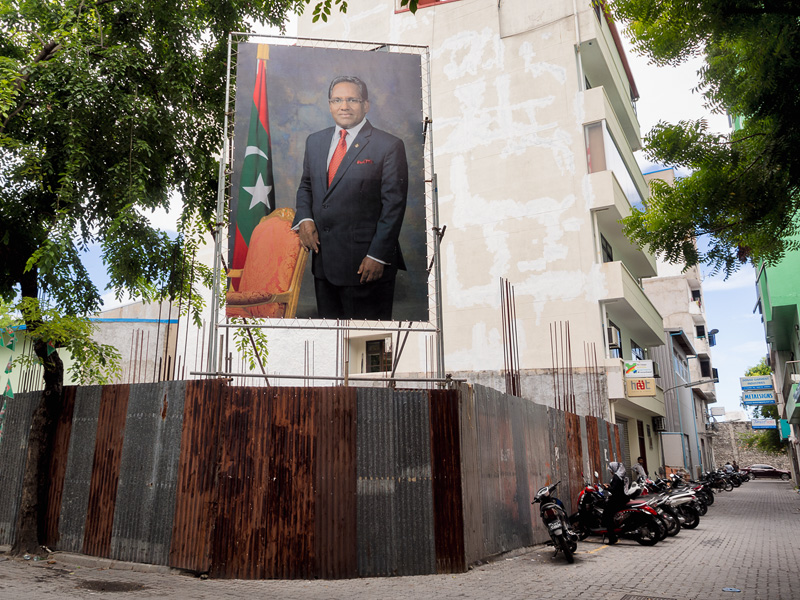
One of many gigantic posters of incumbent Mohamed Waheed put up across Male' ahead of 7 September polls. Waheed got 5%. Photo: Aznym

One of many gigantic posters of incumbent Mohamed Waheed put up across Male’ ahead of 7 September polls. Waheed got 5%. Photo: Aznym

February this year, the Elections Commission of the Maldives (EC) announced the presidential election to be held on 7 September 2013. On 28 July 2013 the EC officially announced the order of the candidates on the ballot paper, after approving the candidacy of all four candidates; Qasim Ibrahim with his Jumhooree Party (JP) and Islamist party Adhaalath (AP) coalition; Dr Waheed, independent, incumbent president, endorsed then, by Dhivehi Rayyithunge Party (DRP); Abdulla Yameen Abdul Gayoom from the Progressive Party of Maldives (PPM) in a coalition with Maldivian Development Alliance (MDA); and Nasheed from Maldivian Democratic Party (MDP).

Foreign and local observers such as the Commonwealth, the European Union, Transparency Maldives, Human Rights Commission of the Maldives declared that the first round of polls were “peaceful and inclusive” with a markedly high voter turnout of 88%. Transparency Maldives, which observed the election across the country, stated “none of the incidents reported on Election Day would have a “material impact on the outcome of the election”.

The chair of the Commonwealth observer group, former Prime Minister of Malta Dr. Lawrence Gonzi stated, “the vote count at the polling station was highly transparent with media monitors, party observers, and national and international observers able to scrutinize the process closely.”

In accordance with sub-article (a) of Article 111 of the Constitution and sub-article (a) of Article 19 of the Presidential Elections Act 2008, the EC began preparations for the presidential election’s runoff as none of the four candidates secured 50% of the votes; Nasheed had 45%, Waheed an embarrassing 5% and Qasim who had 24% came closely behind Abdul-Gayoom who secured 25%. The third place JP coalition refused to accept the first round of elections, and filed a motion at the Supreme Court requesting annulment of first round of polls. The JP also filed a motion at the High Court, requesting the Court to release the voters’ list.

JP produced three documents as evidence for their motion at the High Court, which indicated three lists of alleged discrepancies in the voters’ registry. Out of the first list that JP claimed consisted of deceased people who appeared on the registry, only seven were found on the original voters’ registry, and five were found to be alive. The other list consisted of allegedly repeated names of eligible voters. The EC’s legal counsel later proved in court that these were not repeated names but in reality different people with different national identification numbers and dates of birth. The third list consisted of people who were on Male Municipality’s Special Register who have mailing addresses registered in the capital. The High Court decided that there was no evidence of fraudulent activity with regard to the motion. However, it allowed supervised viewing of the electoral registry.

Supreme tyranny of the electoral process
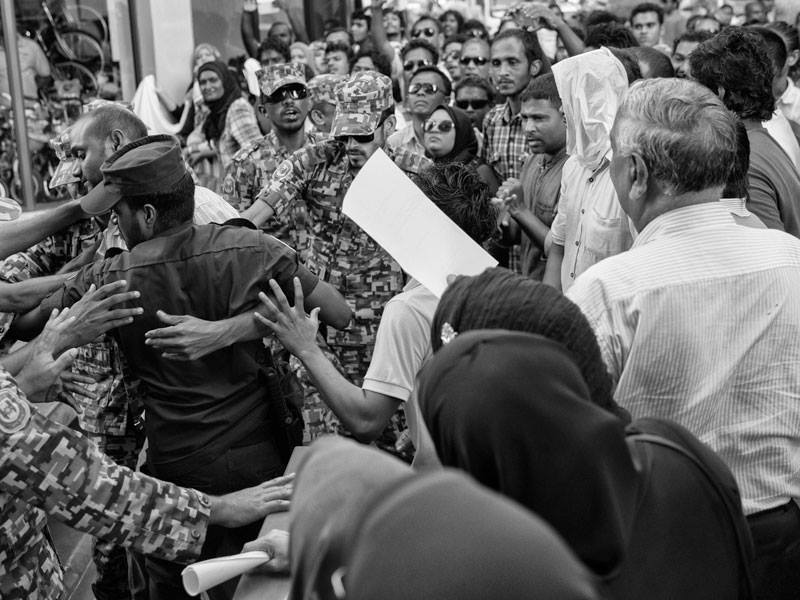
Protests near the Supreme Court in Male' as it deliberated JP's case to annul 7 September election Photo: Aznym

Protests near the Supreme Court in Male’ as it deliberated JP’s case to annul 7 September election Photo: Aznym

Article 172 of the Constitution indicates that the High Court has the appellate jurisdiction for electoral motions, while Article 113 states the Supreme Court shall have final jurisdiction over such motions. Regardless, JP filed their motion directly at the apex court. MDP, the Attorney General (AG) and PPM made inter-partes claims to the motion, with PPM supporting JP’s claim and with the AG calling for the Court to order the Prosecutor General and Maldives Police Service (MPS) to investigate the alleged “irregularities” in the electoral registry.

The request by the AG is contrary to electoral laws and the Maldives Constitution, which clearly outlines the forum and mechanism to investigate and adjudicate on disputed results of an election. Sub-article (b) of Article 64 of the Elections Act 2008 states that if electoral laws have been violated, only the EC has the legal authority to initiate criminal proceedings through the Prosecutor General. Article 62 stipulates that the electoral complaints mechanism shall be established by the EC, and if a party is not satisfied with the recourse given by the complaints bureau, he or she may file a case at the High Court in accordance with sub-article (a) of Article 64.

The EC’s lawyer, former AG Husnu Al Suood noted an astounding lack of evidence to back JP’s claims. Suood also claimed that any delay could result in a constitutional void, citing US Supreme Court case Bush v. Al Gore 2000. MDP’s lawyers Hisaan Hussein and Hassan Latheef expressed concern at the lack of substantial evidence to claim electoral fraud, and stated that JP had not submitted complaints to the EC regarding the registry when the EC had publicly requested for complaints with regard to the publicized list of eligible voters.

JP’s lawyer and its presidential candidate Qasim’s running mate Hassan Saeed stated that the JP had thirteen reasons for annulment, reiterating claims made at the High Court. At the proceedings Saeed requested that; the security services oversee a fresh round of elections after nullifying the first round and for the Court to issue an injunction halting the EC’s work to hold the runoff dated 28 September 2013. The AG Azima Shakoor echoed JP’s criticism over the EC, but refrained from vocally supporting an annulment. The international best practice where either a public prosecutor or state attorney does not support actions of a state institution would be to refrain from commenting.

It is of importance to note such procedural irregularities that took place during the proceedings for this extraordinary motion. Despite the case being deemed a constitutional matter by the Supreme Court, and anonymous witnesses whose identities are protected by courts are only very rarely admitted in serious criminal cases, the apex court acted as a court of first-instance, admitting 14 witnesses submitted by JP who gave their testimonies in secrecy. Out of the three witnesses submitted by the EC, only one was admitted.

The AG also withheld certain evidence and this was left unquestioned by the Court. The AG’s office requested to submit a police intelligence report as “confidential” evidence – solely submitted as evidence to the Court’s Bench. The Chief Justice responded on behalf of the Bench, inquiring whether the intelligence report (or at least parts relevant) should be disclosed to the EC since their lawyers requested it. In her response to the Chief Justice, the AG stated that she will not submit the police intelligence report if the contents of the report would be disclosed to the EC.

“Where is my vote?”
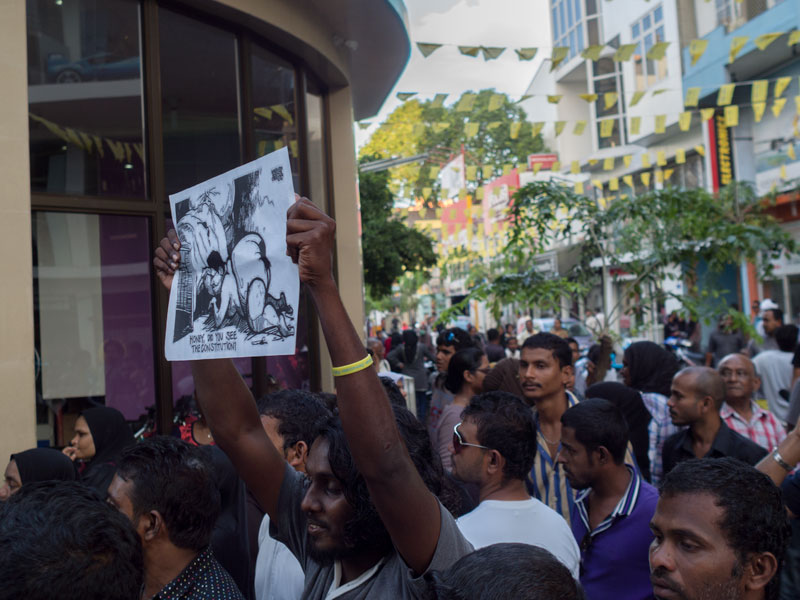
Protesters near Supreme Court hold up cartoons making fun of disgraced Justice Ali Hameed Photo: Aznym

Protesters near Supreme Court hold up cartoons making fun of disgraced Justice Ali Hameed Photo: Aznym

At approximately 8:00 pm on 23 September 2013, four justices from the apex court signed and issued a stay order indefinitely postponing the runoff election until the court reaches a verdict. After the issuance of the stay order, the Commonwealth, European Union, Transparency Maldives, Human Rights Commission of Maldives, the United Kingdom, United States of America, Canada, Russia, and India all expressed concern over the postponement of the second round, calling Maldivian authorities to hold the second round according to the timescales stipulated under the Maldivian constitution.

At the proceedings the next day, the Supreme Court ejected and suspended lawyers Suood representing the EC, Hussein and Latheef representing MDP as a third party to the case, claiming that they were in contempt of court for their comments on social media regarding the Court’s stay order. Subsequently the MDP revoked its inter-partes claim to the case, claiming that the Court cannot guarantee the rights of over 95,000 of its supporters.

MDP’s chairperson Moosa Manik sent an open letter to the Chief Justice, criticizing the apex court’s contravention of the Constitution by denying fundamental right of reply and issuing a stay order indefinitely suspending sub-article (a) of Article 111 of the Constitution. The chairperson also called on the Chief Justice to restrain the Court to the “legal ambit of the Constitution” and “uphold Article 8 of the Constitution, which states that all powers of the State shall be exercised in accordance with the Constitution.”

After weeks of countrywide protests against indefinite postponement of the runoff election, the four Justices; Abdullah Saeed, Ali Hameed, Adam Mohamed Abdullah and Ahmed Abdullah Didi who infamously legitimised the Hulhumale Magistrates’ Court earlier this year, also issued the stay order halting elections, and on 7 October 2013 decided to annul the first round of elections held on 7 September 2013. Chief Justice Ahmed Faiz and Justices Abdullah Areef and Ahmed Muthasim Adnan gave dissenting judgments, which claimed that the Court has adjudicated based on “inadmissible evidence” which the EC, the respondent in the motion, was not privy to, and questioned the Court’s jurisdiction in accepting the motion prior to the High Court.

The confrontations the judiciary continue to have with the legislature and executive from 2008 to present day is proof that elements within the Maldives’ judiciary is adamant on holding onto the power structures that existed during the former dictator Gayoom’s regime. The dregs of dictatorship continue to impede realisation of democratic governance in Maldives as envisioned in the Constitution.

The final chance to consolidate democracy through universal suffrage is at risk due to justices in the Supreme Court who have assumed supreme powers unto themselves, in order to benefit those politicians who unequivocally support their tenure, and are against overhauling or reforming the judiciary.

Mushfique Mohamed is a former Public Prosecutor and a member of MDP’s Electoral Complaints Committee. He has an LLB & a MScEcon in Post-colonial Politics from Aberystwyth University.

All comment pieces are the sole view of the author and do not reflect the editorial policy of Minivan News. If you would like to write an opinion piece, please send proposals to [email protected]

Likes(0)Dislikes(1)

Supreme Court orders Elections Commission to restart re-registration process

The Supreme Court opened at midnight on Thursday to issue a ruling ordering the Elections Commission (EC) to restart the entire elections re-registration process.

“[The Supreme Court] orders the Elections Commission to start anew the process of compiling the voter registry and abide by the Supreme Court guidelines in the re-registration process for those who individuals who wish to vote in a location other than their place of domicile, and start anew re-registration process according to new procedures, disregarding previous re-registration,” read a verdict posted on the Supreme Court’s website.

The court also ordered the Elections Commission to give candidates the choice whether to stay on the ballot paper or withdraw from the election, contrary to the EC’s previous announcement.

“Elections Commission’s announcements (A) EA-2013/539 and (A) EA-2013/540 [concerning the re-registration process] contravene the guidelines put forth in the Supreme Court Verdict no 2013/SC-C/42,” read the ruling, signed by Chief Justice Ahmed Faiz.

“The Elections Commission must without further justifications proceed according to the guidelines put forth in the Supreme Court Verdict no 2013/SC-C/42,” the ruling stated.

The PPM today sought an order at the Supreme Court blocking Nasheed’s legitimacy to contest the election on the grounds of his criticising the judiciary and being “irreligious”, although this appeared to split the party, with State Foreign Minister Dunya Maumoon declaring it was “not the right time”.

According to local media, the PPM also requested the court order the annulment of the voters’ list used in the first round on September 7, threatening that the party would not accept the result if the existing list was used. Prior to the first round, the PPM had called on the Elections Commission to make the voter registration process “more lenient”, requesting the EC not to reject voter registration forms missing details such as the name of a voter’s parents or a phone number, that could not be verified during random checks.

The 17 member Commonwealth election observation team in particular praised the final voter registry, describing it as “accurate and robust”.

“Fears expressed by some political parties regarding possible large numbers of deceased voters and voters registered in the wrong geographic area seem to be unfounded, based on the low incidence of election day complaints,” said the group’s head, former Prime Minister of Malta Dr Lawrence Gonzi.

The verdict

In its verdict on the Jumhooree Party’s case annulling the first round of the election, the court ordered the EC to hold an election by October 20, requiring the commission to prepare for polls as the government shuts down for the Eid al-Adha break.

The EC scheduled the election for Saturday October 19, sending the ballots for printing on October 9 and opening the list on October 10 for re-registration.

In a statement on October 9, Transparency Maldives noted that the Elections Commission had yet to receive the details of the Supreme Court verdict regarding the supposed discrepancies noted in the secret police report, between the voter registry and voting records (such as the claimed ID card number mismatches, permanent address mismatches, and name mismatches).

The Supreme Court’s majority ruling this week to annul the first round contradicted the positive assessments of more than a thousand local and international election observers, and hinged on a confidential police report submitted to the court claiming that 5623 votes were ineligible.

The report has not been made public and the legal counsel of the Elections Commission was never given the opportunity to present a counter argument.

In the majority verdict, Supreme Court Judge Dr Ahmed Abdulla Didi also declared that if a new president was unable to be sworn in on conclusion of the presidential term on November 11, the “principle of continuity of legitimate government would override any repercussions faced by failure to adhere to constitutional deadlines.”

The latest Supreme Court ruling follows a statement from UK Foreign Secretary William Hague stating that “It is imperative that there are no further delays and the elections be free, fair and inclusive, and that international observers are invited.”

“ It is important now that the democratic process proceeds in accordance with the Constitution,” Hague stated, calling on presidential candidates to respect the democratic process “and create conditions for free, fair elections.”

PPM MP Ahmed Nihan told Minivan News that he believed the latest order would mean additional delays to the voting, currently scheduled for October 19.

With growing international pressure for voting to take place without further delay, Nihan claimed that the party believed that the 24 hours for re-registration provided by the EC would have been a “disaster” for the election.

“Even here in Male’ no one was aware of what was going on [regarding re-registration],” he said, adding that the occasion of the Eid holidays had meant voters were expected to be more likely to want to vote on different islands from where they were registered: “I am sure it is important to let everyone else have the right to vote in free and fair elections. The verdict clearly says the EC has to perform within guidelines,” he said.

Nihan claimed the views of various international groups such as the UN and Commonwealth reflected the MDP’s stronger connections with foreign governments, whom he accused of believing the views of the opposition party without listening to others.

“The international community are champions of democracy and we have to thank them for efforts to spread it throughout all corners of the globe,” he said. “However, the EU and Commonwealth must make sure they are getting the proper and full information from all sides including the government and opposition as well.”
Meanwhile earlier today Sun Online reported that one of the five EC members, Ogaru Ibrahim Waheed, had suddenly resigned.

According to Sun no reason was given, although ongoing death threats received by the Elections Commission (EC)’s permanent staff and polling station officials have prompted the commission to file a report with the Maldives Police Service (MPS).

Likes(3)Dislikes(0)

Imperative no further delays in polls: UK Foreign Secretary Hague

UK Foreign Secretary William Hague has called on presidential candidates in the Maldives to respect the democratic process “and create conditions for free, fair elections.”

“I note the Supreme Court’s annulment of the first round of Presidential election results in Maldives, despite the assessment by both international and domestic monitors that proceedings were transparent, fair and credible,” said Hague, in a statement.

“The Elections Commission has now confirmed that the first round will be re-run on 19 October. It is important now that the democratic process proceeds in accordance with the Constitution. It is imperative that there are no further delays and the elections be free, fair and inclusive, and that international observers are invited,” the Foreign Secretary added.

Hague urged presidential candidate “to act in line with the interests of the people of Maldives”, and expressed hope “that the process will enable the President elect to be inaugurated by 11 November, in line with the constitutional framework.”

The Foreign Secretary said he was “worried by recent reports of intimidation, violence, arrests and arson attacks which have taken place in the past days.”

“We are deeply concerned that Transparency Maldives, as a domestic election monitoring mission, should not be subject to an unwarranted investigation and threats of dissolution. I further call on all parties to take action to create conditions which are conducive to free, fair and transparent elections,” he added.

UK Foreign Office Minister Alistair Burt has previously said the country was “extremely concerned” when the Supreme Court ordered the second round of presidential elections delayed.

“I recognise the right of the Maldivian courts to ensure legitimate allegations of electoral malpractice are investigated appropriately. However, it is vital to avoid any unnecessary disruptions to the national electoral process, and for representatives from all sides to be represented during any legal proceedings,” Burt stated, prior to the court’s annulment of the first round’s results.

Presidential election should be “fully inclusive, credible and peaceful”: Commonwealth

The Commonwealth Secretary-General’s Special Envoy to Maldives, Sir Donald McKinnon, has also “noted” the Supreme Court’s decision to annul the first round of the election.

“A Commonwealth Observer Group was present in Maldives from 31 August – 14 September and reported positively on the credibility of the electoral process,” McKinnon stated.

“I encourage all Maldivians again to ensure that the Presidential election is fully inclusive, credible and peaceful, so that the people of Maldives are free to choose their President from among those candidates already officially approved, and the inauguration can take place on November 11,” the Special Envoy urged in a statement today.

He also “acknowledged positively” the preparations being undertaken by the Elections Commission to enable a new election to be held on October 19, 2013.

The international community expressed alarm over the Maldives’ sudden suspension of the second round of presidential elections, initially scheduled for September 28. The election was later annulled by the Supreme Court in a 4:3 majority decision over allegations of electoral impropriety, despite unanimous positive assessments of the process by more than 1000 local and international election observers.

The majority verdict hinged on a secret police report alleging 5600 improper votes – evidence dismissed by the dissenting judges as the report was not shown to the Elections Commission, which was therefore unable to present a counter argument.

The judges also challenged the court’s jurisdiction to hear the case, and the rationale for annulling the entire election, rather than just the allegedly affected boxes.

The petition was filed by third-placed candidate Gasim Ibrahim who sought annulment of the first round in which he received 24.07 percent of the vote, alleging that he received at least 20,000 more before declaring that “God Willing, Gasim will be President on November 11″.

Travel advisory updated

Protests and strikes followed the suspension of the second round of elections, prompting countries including the UK, Australia, Canada and China to issue travel advisories to their nationals visiting the luxury holiday destination.

The UK updated its travel advisory yesterday, noting that “the first round of the Presidential elections will now be re-run on 19 October. There have been frequent demonstrations in the capital, Malé, and on some non-resort islands. These have led to arrests, attacks on private and commercial property, including arson, and limited violence. Further demonstrations are possible. Friday afternoons are potential flashpoints.”

Likes(3)Dislikes(0)

Civil Court upholds JSC’s “indefinite suspension” of High Court Chief Judge

Civil Court ruled yesterday (October 9) that there are no grounds to annul the the Judicial Service Commission’s (JSC) decision to suspend High Court Chief Judge Ahmed Shareef, reports local media.

Shareef filed a lawsuit at the Civil Court for a second time against the JSC on June 20, 2013, challenging his indefinite suspension by the judicial watchdog.

The initial suspension came just hours after the High Court had temporarily halted the hearings of a case lodged by former President Mohamed Nasheed against the JSC.

Nasheed had accused the judicial watch-dog of exceeding its mandate when appointing the three-member judges panel to the Hulhumale Magistrate Court currently hearing a criminal case against him.

According to the JSC Chair Justice Adam Mohamed Abdulla, the suspension of Shareef – amongst the three judges presiding over Nasheed’s case – was a “precautionary” measure while investigation of the complaint was proceeding.

JSC Chair and Supreme Court insisted at the time that the disciplinary action had no relation to the former president’s case.

On June 17, the first case submitted by Shareef – requesting the court issue an injunction halting the suspension – was dismissed by Civil Court Judge Hathif Hilmy after the claimant did not attend the hearing and failed to provide the court with a valid reason for his absence.

The Civil Court ruling stated that Shareef’s suspension did not violate Supreme Court rulings, Article 141 of the constitution, Article 38 of the Judges Act, or the JSC Act according to local media.

Additionally, the court ruling stated that it is not mandatory for the JSC to establish investigation committees in response to complaints, referring to Article 23 (a) of the JSC Act.

Likes(0)Dislikes(0)

Parliament’s security services oversight committee summons Police Commissioner

Police Commissioner Abdulla Riyaz has been summoned to Parliament’s Security Services Committee for the second consecutive day, reports local media.

The Parliamentary committee, mandated in constitutional article 241, summoned Riyaz to appear at 11:ooam today over a complaint by Addu City Council. Addu City Mayor Abdullah Sodig and the Addu police-in-charge were also contacted to attend the meeting.

Riyaz was also summoned to appear at 11:15am yesterday (October 9) to provide the parliamentary committee with a status update regarding the murder investigation of former Ungoofaaru MP Dr Afrasheem Ali.

Security service committee meetings are closed to the public and media, however Sun Online has claimed that the committee “expressed frustration” over the delay of Dr Afrasheem’s murder investigation and requested Riyaz provide a date when the investigation will be concluded.

Earlier this year, Riyaz declared that police officers would only attend the 241 committee and would not appear before parliament’s Executive Oversight Committee (EOC) unless the Supreme Court orders police to do so. The Police Commissioner claimed that the decision was based on advice from Attorney General Azima Shukoor.

In March 2011, the Supreme Court ruled both the Police and the Maldives National Defence Force (MNDF) should be answerable to parliament whenever requested.

The Supreme Court in the ruling stated that, according to article 99 (a) and (b) of the constitution, it was clear that parliament was obliged to supervise every action of the security services and ensure their actions are within the constitution and law.

Likes(0)Dislikes(0)