Council will respect sister-city agreement with Taiwanese city of Kaosiung: Mayor Manik

Male City Council Mayor Ali Manik has said the council will respect its sister-city agreement with Kaosiung City in Taiwan, despite the government’s denouncement of the move.

Following the signing of the agreement in Male’ on June 9 with a delegation from Kaosiung, the Maldives’ Ministry of Foreign Affairs issued a statement reaffirming its “commitment and support to China’s national unity and to the one-China Policy.”

“The Maldives’ firm conviction of one-China policy is guided by the principles of respect for sovereignty, territorial integrity and non-interference in the internal affairs of states and considers Taiwan as an integral part of the People’s Republic of China,” the government stated.

“This is an agreement between cities, not countries,” said Mayor Manik. “Our constitution does not say anything about not being able to make such agreements.”

“The attorney general has said we need to get permission from the president. This is not true. We don’t have to get permission. That is not in the constitution,” he added.

Following the signing of the sister-city agreement and the delegations inspection of Male, Manik said Kaosiung would report on the kind of assistance the city would be able to provide, such as technical assistance with waste management, roads, infrastructure, education and training.

“We ask the government not to obstruct us from doing something that is for the benefit of Male. [The agreement] is not illegal,” Manik said.

The agreement came about after the council met Kaosiung officials, including the Deputy Mayor, during a local councils conference held in Hyderabad in India last year.

That led to an invitation for a delegation from Male’ City Council to visit Kaosiung in November 2012, for which the host city provided tickets and accommodation, Manik said.

Male City Council is dominated by the opposition Maldivian Democratic Party (MDP), the leader of which contends he was ousted in a coup on February 7 2012 by current President Mohamed Waheed. The bitter political polarisation has put the council at loggerheads with the Maldivian government for more than a year.

The Taiwanese Ministry of Foreign Affairs (MOFA) has meanwhile disputed allegations that the Maldivian government’s decision to reject the agreement was made under Chinese pressure.

During a MOFA press conference reported by the China Post, spokesperson Anna Kao noted that Taiwanese cities had established sister-city ties with cities around the world without incident, and suggested that politics should not interfere with such exchanges.

“We urge the Maldivian government to respect its cities’ efforts to advance ties and business and people-to-people exchanges with Taiwanese cities,” said Kao.

Likes(0)Dislikes(0)

US interest in Maldives affects Sri Lanka: Daily Mirror

Sri Lankan  Defence Secretary Gotabaya Rajapaksa has warned that any establishment of a base by the United States in the Maldives could change the complexion of the sub-continent region by aligning it more with India, reports the Daily Mirror.

The Defence Secretary pointed out that it was essential to further strengthen the existing cordial relationships with powerful nations such as China and Russia, which have permanent seats on the United Nations Security Council and could influence any international action on Sri Lanka more significantly than other nations.

“Issues between India and Pakistan, and the issues between India and China are particularly sensitive in this regard. With the rise of China as a world economic leader, there is a widespread belief that India feels insecure and is seeking to align itself with the other powers that seem similarly threatened by China’s ascendancy,” he added.

Mr Rajapaksa said although the likelihood of events such as the Arab Spring transpiring in Sri Lanka is minimal as a result of it being a democratic nation with an extremely popular political leadership that enjoys a very large electoral majority, the possible trend needs to be monitored.

Read more

Likes(0)Dislikes(0)

Judiciary the Maldives’ weakest link: Eurasia Review

The judiciary continues to be the weakest link in Maldives in its march towards democracy, writes Dr S Chandrasekharan for the Eurasia Review.

Except for the opposition MDP, no other political party appears to be concerned by the poor performance of the judiciary. What is more, the judicial commission, which is supposed to be the “watch dog” over functioning of the judiciary, appears to be highly politicised.

The rot started with the judicial commission allowing incompetent judges with inadequate qualifications to continue under the new constitution and the judicial commission itself is packed with representatives who had and continue to have political leanings.

On 28th of May, the Deputy leader of Jumhooree party Dr. Hussein Rasheed Hassan in one of the public meetings, defined ‘good governance’ as one where there is absolute rule of law, sound and professional, financial and political management, accountable, effective and transparent public institutions and in public spending.

But what Dr. Hassan failed to mention was that for good governance one needs a competent and independent judiciary packed with people of absolute integrity. Hassan’s own chief Gasim Ibrahim is a member of the judicial commission and is also an aspiring presidential candidate. It is no surprise therefore that there are allegations that some of the decisions of the Judicial Commission are “politically motivated”.

The case of suspension of the Chief Judge of High Court Ahmed Shareef by the Judicial Service Commission as a “precautionary” measure long after the supposed act, is yet another case and this only confirms that the rot that has set in the judicial system of the country cannot easily be eradicated.

The suspended High Court Chief Judge Ahmed Shareef filed a case challenging the suspension handed over to him by the JSC and sought an injunction. In the civil case filed, the Judge’s lawyer Husnu Suood, a former Attorney General in Nasheed’s regime has cited procedural irregularities including the presence at the meeting of the Judicial commission of a dishonoured Civil service Commission (CSC) President Mohamed Fahmy Hassan and the newly appointed Attorney General Aisahath Bisham whose appointment was yet to receive the approval of the parliament.

The High Court Judge who has been suspended had done his duty in temporarily halting of the hearings of the court against former President Nasheed who had accused the judicial Commission in exceeding its mandate in appointing the three member judges panel to the Hulumale Magistrate court that is hearing his case.

In a press conference the lawyer of Nasheed accused of the Commission of political motives behind the decision to suspend the Judge. The decision could also be perceived as a way to prevent a further delay of the case file by Nasheed.

In the same press conference, Suood further claimed that the presidential candidate of PPM, Abdulla Yameen Abdul Gayoom, the deputy speaker of Parliament and PPM MP Ahmed Nazim and reitred Supreme Court Judge Mujthaz Fahmy have long been in the business of influencing the judges and the verdicts they had been issuing.

Suood made an open accusation in the presence of the press corps that the “entire judiciary is under the influence of retired Judge Mujthaaz Fahmy. In a bid to serve the interests of two politicians ( he had named openly) the JSC was planning to juggle judges from court to court and even planned to give salary increments to certain judges.

Another instance cited by the amnesty international was the selective fast tracking of cases against the supporters of the opposition MDP. It alleged that throughout the year the authorities are said to have had “political bias” in fast tracking the procedure in the prosecution of opposition supporters accused of criminal behaviour during rallies while failing to prosecute the police and other suspected of committing human rights abuses during the same protests.

There is a fear and a justified one that some of the vested interests of present regime and its “behind the scene supporters” may ensure that the “judicial process is used to prevent former president Nasheed from contesting. This needs to be watched.

Read more

Likes(0)Dislikes(0)

No satellite communications, no rescue tug, contaminated fuel: the final voyage of the MV Asian Express

A Maldivian cargo ship that sunk of the coast of Kochi was on its final voyage, reports Indian media.

The 35 year-old Lily Enterprises vessel, MV Asian Express, was travelling from Port Md Bin Qasim in Karachi to Male when it encountered engine trouble, reportedly after being fuelled with contaminated oil.

“Captain Ahmed Shakir told coast guard officials that the fuel filled from Port Bin Qasim could have been contaminated, which caused the vessel’s turbocharger to pack up, resulting in engine shutdown,” reported Indian newspaper The Hindu.

“For two days we were in deep trouble,” Captain Ahmed Shakir told the Indian Express. As per the original schedule, we were supposed to reach Maldives by June 10,” Shakir said.

“Adding to his troubles was the two-to-three-metre vertical crack on the starboard side of the ship below waterline and failure of the communication system,” reported the Deccan Chronicle.

According to marine tracking reports, the Indian Coast Guard ship Varuna arrived to assist but was forced to abandon attempts to fix the engines because of rapidly deteriorating weather conditions, with wind gusting at up to 50 kilometres an hour.

Commanding officer of the CGS Varuna, K M Arun Kumar, told the Hindu the rescue effort was also hampered by heavy swell and poor visibility.

“To top it all, Asian Express had no satellite phone and a message was relayed to it through a nearby vessel, MV Golden Shui, before we reached the area,” Kumar told the paper.

“The vessel’s agent, in the meantime, informed that tug Villa-2 which had been asked to tow the vessel to safety had not yet started from Male. In any case, the tug would not have reached the site before the morning of July 14. Meanwhile, the master informed us that the three hatches of the ship were flooded up to 10 metres after a wide crack on its starboard side.

“Soon, he said they would be abandoning the vessel and was instructed to use the life boats. However, the two lifeboats were non-operational and had to be pulled manually, even as the drifting vessel and the heavy swell posed a real danger to Varuna itself. It was already dark when every crewmember of the vessel in distress was taken on board Varuna and given food and medicines.”

Instead the coast guard evacuated all 22 crew members, including 18 Maldivians and four Indian nationals and transferred them to Kochi.

Its crew rescued, the vessel sank with its cargo of 4000 tons of cement and 2400 tons of sand.

The MV Asian Express was carrying aggregate imported from Pakistan, after a shortage began impacting the Maldives’ construction industry.

Aggregate was previously imported to the Maldives from India under a special quota, however this was temporarily revoked on February 15 amid a breakdown in the country’s relationship over the government’s eviction of Indian infrastructure giant GMR and ongoing mistreatment of Indian nationals working in the country.

Likes(0)Dislikes(0)

Maamendhoo Island Council calls for football funding to combat violence, drug abuse

A lack of support from the Ministry of Youth and Sports for youth activities, particularly football, on Maamendhoo Island in Laamu Atoll has resulted in violence and drug use according to the island council’s president.

“The government has not provided funds for youth sports or activities here, it’s very sad,” Maamendhoo Island Council President Ali Shifaz told Minivan News, during a visit to the island.

“Football, and other sports, are very important because we need our youth to be away from bad habits,” Shifaz explained.

“Youth getting involved in drugs and fighting is a big issue, but normally football players don’t get involved in those things,” he continued. “They have no other time for drugs and fights.”

“For the last two or three months there have been no fights because of football. It’s a good way to compete and Maamendhoo is very peaceful as a result,” Shifaz noted.

Ultimately, problems ebb and flow depending on the support for youth activities the island receives, explained Shifaz.

“Eighty percent of the island’s youth play football, therefore we need to have a big effort to support them,” he added.

Unfortunately, fighting between youth from Maamendhoo with young people of nearby islands has become a problem because positive activities are not being funded and supported on those islands either, according to Shifaz.

In early 2012 Nasheed pledged to flatten football ground, put up fences, build a basketball court behind the stadium, and a bashee court for the women, explained Shifaz.

The football ground was recently built on Maamendhoo, however the island has also requested a youth centre – with ‘garlando’ (foosball) and billiards – be built so other youth who do not play football will have activities that prevent them from engaging in ‘bad habits’.

“I’m involved with an NGO here and I hate to say it but now our NGOs are not working properly, because they are not getting what they need to function in a proper way,” Shifaz lamented.

Lack of footballs

“They have very good players, I was very impressed,” former Victory Sports Club coach Abul ‘Abjee’ Jaleel told Minivan News.

“If youth team wants anything we discuss with the Island Council and they call the Ministry of Youth and Sports,” said Maamendhoo football player Mohamed ‘Kalho’ Nasheed.

“Before during [former President Mohamed] Nasheed’s time the ministry provided funding, but now we don’t get anything,” he explained.

“To buy balls the players contributed their own money. The sports team really collaborates,” he continued.

Previously the Maamendhoo football players only had one ball, but have managed to buy eight. They have also arranged a coach to come about three times a week, but there are no funds for his equipment either.

“There also used to be an atoll football competition, but this year there has been nothing,” Kalho lamented.

Youth and Sports Ministry response

“Maamendhoo happens to be the first island we helped after we assumed office early last year,” Youth and Sports Minister Mohamed Hussein ‘Mundu’ Shareef told Minivan News.

“The ministry contributed MVR 80,000 (US$5200) for the construction of the Maamendhoo football ground which was completed last year,” said Shareef. “So the allegations [that Maamendhoo is not receiving support from the Ministry] are rubbish.”

“Rather than complaining they should be pleased,” he added. “It was a long-pending pledge by Nasheed to develop the football ground which was not delivered.”

“It is a petty political problem or they have a short term memory,” said Shareef. “There are no pending requests from Maamendhoo, if there were it would be a different story.”

Shareef explained that he made it a point to review and implement all the pending pledges and corresponding paperwork for the sake of continuity.

“It’s not the fault of the youth that the government changed,” said Shareef. “We don’t differentiate between big and small islands or look at the political leanings of the island councils.”

In the past 15 to 16 months the Youth and Sports Ministry has helped 87 islands, which account for half the population, according to Shareef.

“There is not a single island we have not touched,” he declared.

The entire Youth and Sports Ministry’s budget for the past year was MVR 60 million (US$3,911,340), with MVR 20 million (US$ 1,303,780) allocated to associations – of which 19 are sports associations, according to Shareef.

Previously, MVR 2 million (US$ 130,378) was the total infrastructure budget, which the government quadrupled to MVR 8 million (US$ 521,512) this year, Shareef claimed.

Island football grounds are legally properties of the respective island councils and the Ministry funds the island councils, which are ultimately responsible for the development and maintenance of the grounds, Shareef explained.

Likes(1)Dislikes(0)

Indian coastguard rescues crew of Maldivian cargo vessel

The Maldivian cargo ship MV Asian Express sank on Wednesday evening 300 kilometres west of Kochi, after its hull reportedly cracked below the waterline.

The ship, which was travelling to the Maldives from Pakistan carrying a cargo of sand and cement, suffered an engine failure on Tuesday evening and began drifting, reported IBN Live.

According to marine tracking reports, the Indian Coast Guard ship Varuna arrived to assist but was forced to abandon attempts to fix the engines because of rapidly deteriorating weather conditions.

The Indian coast guard subsequently evacuated all 22 crew members, including 18 Maldivians and four Indian nationals.

The Maldives National Defence Force (MNDF) confirmed it had received the first distress reports, and said the Maldivian crew were being transferred to Kochi following total loss of the vessel.

The MV Asian Express was carrying aggregate imported from Pakistan, after a shortage began impacting the Maldives’ construction industry.

Aggregate was previously imported to the Maldives from India under a special quota, however this was temporarily revoked on February 15 amid a breakdown in the country’s relationship over the government’s eviction of Indian infrastructure giant GMR and ongoing mistreatment of Indian nationals working in the country.

Likes(0)Dislikes(0)

‘Surfers against sewage’ shame city council over night market littering

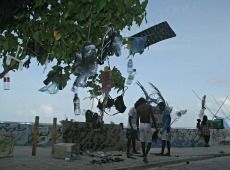
Appalled by excessive amounts of garbage littering streets, nearby parks, and sea due to the Male’ night market, local surfers have staged a creative protest using the rubbish to pressure the city council into action.

The night market is held annually before Ramazan to provide people a plethora of affordable goods. Locally referred to as the ‘Ungulhey Bazaar’ – literally meaning the ‘rub up against someone market’ – the 10 day event draws dense crowds, and this year has a record-breaking 765 stalls representing 450 groups, according to local media.

Thousands of people shopping and eating amidst the hundreds of densely packed stalls generates enormous amounts of waste, which is pitched onto the streets or into the adjacent sea since there are no trash cans.

For the past three years the market has been located near ‘raalhugandu’, Male’s surf point, adjacent to the Tsunami Monument in Henviru ward.

Fed up with the pollution the “surfers against sewage” decided to take action.

“There are no dustbins so the rubbish ends up in the ocean and we don’t want that,” local surfer and Maldives Surfing Association (MSA) Spokesperson Ibrahim Riffath told Minivan News yesterday (June 11).

“It’s very bad, like a real slum,” said Riffath. “The Maldives is one of the most beautiful countries, but the sh*ttiest place.”

The wind carries the waste into the water and spreads it through the streets, so the bad storm that wreaked havoc on Male’ and the night market earlier this week exacerbated the problem, Riffath explained.

The surfers were in good spirits walking through the empty market stalls to collect trash – which was strewn over the ground – to reuse for their protest.

An impromptu improvisation about the waste management problem, sung by local surfer Ibrahim Aman to the tune of Pink Floyd’s the Wall, with accompanying lyrics “we don’t need no trash around us”, made the rubbish hunt a lively affair.

As did Aman’s poetry about inserting trash into a bin: “My name is dustbin and I’m always empty. My girlfriend’s name is garbage…”

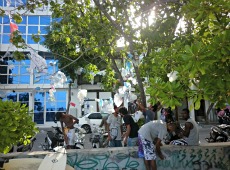
The random rubbish pieces were arranged along the sea wall, hung from trees in the small park near ‘raalhugandu’, and piled next to protest boards in an artistic fashion.

Witty signs, banners, and graffiti expressed their frustration with the waste management problem: “Is this a pretty picture? Is this heaven on earth? Is this the garbage area? For an independent Dhivehi Raajje (Maldives) we need a clean Dhivehi Raajje.”

The lone trash can located near the park at the night market’s entrance was adorned with graffiti saying “What is this?”, while other ironic messages saying “thank you city council”, “welcome to paradise”, “sunny side” and “carbon neutral 2013”.

While most of the “surfers against sewage” are MSA members, their protest was not conducted as an official MSA initiative, but was rather spontaneous collective effort.

“MSA’s president wrote to the city council this year, but we have not yet received a reply,” said Riffath.

“The city council is saying they will have dustbins, but they have not yet done it and no one is coming to collect the trash,” he continued.

“They told us that this place, [the raalhugandu park], is not the road so it’s not part of their mandate to clean,” claimed Riffath.

“We are doing this for ourselves, the public and the environment,” he added. “People aren’t educated about why littering is so harmful.”

Be green and clean

“It’s not nice or hygienic,” local surfer Hamd Abdul Hadhi told Minivan News yesterday.

“Each stall should be responsible for keeping their area clean, daily,” he suggested. “If we were rich we would have bought the dustbins ourselves.”

“Most of the pollution from the market ends up in the sea,” he explained. “The trash hurts the fishes and corals, plus when we’re surfing and get a plastic bag stuck to our faces then we’re in trouble.”

Raising awareness about the link between human and environmental health is necessary to stop people from haphazardly throwing their garbage everywhere, which is why the surfers are leading by example, Hadhi noted.

“People are damaging mother nature so much with rubbish,” he said. “As surfers, we understand more than others and want to show people that it is good to be clean.”

“We clean the park and surrounding area two or three times a week, but no one else bothers,” Hadhi lamented. “And every night market we put up notices saying ‘do not litter here’.”

“It’s not just for our benefit, waste management is important for the whole country,” he said. “We are one of the smallest countries, so it’s crazy we can’t manage waste properly.”

“No one listens to us, so this [protest] is all we can do,” he declared.

Male’ City Council

“Of course this is a problem at the night market,” Male’ City Council (MCC) Mayor Ali ‘Maizan’ Manik told Minivan News today (June 12).

“I move around every day early morning and my goodness I know how bad it is,” said Manik.

“My secretary general will be arranging a meeting for this afternoon with the [protest] organisers and we will discuss waste management how we can reach a solution and solve this issue,” he added.

Manik explained that the Environment Ministry has been handling the waste management problem, but has not kept the MCC informed of what they are doing.

“Given the Anti Corruption Commission (ACC) investigation into the [Tatva] contract we were asked to stop [waste management activities] until the inquiry was completed,” said Manik.

“I spoke with the Environment Minister and they are already approved to sign the [new] Tatva agreement, but before the council signs we have to know the changes they have made to the contract,” he noted.

“The Tatva discussion was already held and the original agreement was signed in November 2010,” he continued.

“Changes were already made to the agreement by the International Finance Corporation (IFC) and World Bank, so there shouldn’t be [additional] changes, but the Environment has Ministry altered the contract,” Manik said.

“This is the kind of government we have, doing this to disturb us,” he added. “The waste management agreement should be made to benefit the public.”

Likes(4)Dislikes(0)

Government scuttles Male City Council’s Taiwanese sister city agreement, pledges support for “one-China policy”

The government has issued a statement denouncing Male’ City Council’s decision to become sister cities with Kaosiung City in Taiwan, and pledging the Maldives’ support for the “one-China policy”.

“The Government of Maldives reaffirms its commitment and support to China’s national unity and to the one-China Policy,” said the Foreign Ministry in a statement, shortly after the opposition Maldivian Democratic Party (MDP) dominated Male City Council signed the sister city agreement with a Taiwanese delegation on Sunday.

“The Maldives’ firm conviction of one-China policy is guided by the principles of respect for sovereignty, territorial integrity and non-interference in the internal affairs of states and considers Taiwan as an integral part of the People’s Republic of China,” the government stated.

An official from Taiwan’s Ministry of Foreign Affairs told the Taipei Times this was “the first time a local government’s efforts to establish sister-city ties with a foreign city had been thwarted due to apparent pressure from China.”

Mayor of Male City Council Ali Manik visited Kaohsiung in November 2012 after the city was assigned to mentor Male’ in sustainability by the international organisation of which both are members, Local Governments for Sustainability (ICLEI).

A statement from the Greater Kaohsiung government revealed the delegation had shared Taiwanese experience in the management of drainage pipeline networks, waste disposal, offshore submerged breakwaters, plant diseases, pest control and solar power development.

“The delegation also conducted a field study of Male’s construction of a rainwater sewer system, erosion-prone sea embankment and how it deals with waste disposal and processes raw kitchen waste,” reported the Taipei Times.

Mayor Manik said sister city agreements were “normal” and something almost every city in the world participated in, to promote cultural development. The Male-Kaosiung agreement, Manik said, involved “training in fields such as agriculture, mariculture, education in waste management and health related fields.”

Changing demographics

Chinese visitors now constitute 25 percent of all tourism arrivals to the Maldives, a figure that has in the past several years eclipsed the Maldives’ traditional European markets.

Resorts have had to quickly adapt to the new demographic, with resort managers noting the market heavily favours excursions and shopping over food and beverage offerings traditionally targeted towards the European audience.

Some properties have underestimated the market. In March calls for a tourism boycott of the Maldives exploded across Chinese social media networks, after allegations of discrimination against guests from China at one resort were widely circulated.

Dismissed Chinese employees of the Beach House Iruveli resort – formerly Waldorf Astoria – posted allegations on the Chinese forum Tianya that guests from the country were receiving inferior treatment to Europeans, despite paying the same prices.

The staff alleged that this discrimination extended to removing kettles from the rooms of Chinese guests, to prevent them making instant noodles in their rooms and thereby forcing them into the resort’s restaurants.

Likes(0)Dislikes(0)

Maldives Pavilion at Venice Biennale split in “mini-coup d’etat”

The political strife gripping the Maldives has permeated the country’s first pavilion at the Venice Biennale art show, catalysing a behind-the-scenes split that ultimately factionalised the pavilion in what one side contends was a ‘mini-coup d’etat’.

What was initially intended to be an innocent story highlighting the creative climate change advocacy occurring through the pavilion’s artistic expression, instead revealed infighting and controversy stretching back to February 2012.

The official Maldives Pavilion exhibition is curated by a joint Arab-European collective of artists called the Chamber of Public Secrets (CPS), and commissioned by current Minister of Tourism, Arts and Culture Ahmed Adheeb.

The overarching theme of the Maldives’ pavilion, entitled “Portable Nation: Disappearance as a Work in Progress – Approaches to Ecological Romanticism”, is about how the survival of the nation, Maldivian people and cultural heritage are threatened by catastrophic climate change impacts, such as rising sea levels.

The unofficial pavilion, located 200 metres up the road, is the Maldives Exodus Caravan Show, curated by Danish artist and former resident of the Maldives Søren Dahlgaard and initially commissioned by former Minister of Tourism, Arts and Culture, Maryiam Zulfa.

Deputy Curator of the Exodus Caravan Show, Elena Gilbert, told Minivan News that the some of the artists “recognising the necessity and urgency to focus on the current political and cultural unrest of the Maldives, and to provide solidarity with the majority of the population against the dictatorship”, split from the pavilion following February 7’s controversial transfer of power.

The rebel pavilion, Gilbert said, “presents a selection of works and
 performances from Maldivian and international artists in regards to an expanded conversation of climate.”

Dahlgaard told Minivan News he “initiated the original idea to have a Maldives National Pavilion at the Venice Biennale in 2010, then presented this idea to former President Mohamed Nasheed and former Minister Zulfa,” Dahlgaard told Minivan News this week.

“In December 2011, Zulfa commissioned me to organise/curate this project – there was no money from the Maldivian government involved in this, I was to raise the finances for the project myself,” said Dahlgaard.

“But now the Maldives National Pavilion is a deeply problematic project, which represents the current coup regime. The artists are now puppets of the regime, whether they are aware of it or not,” he added.

Dahlgaard met with former President Mohamed Nasheed in Copenhagen, Denmark this April and discussed the Venice Biennale ‘proxy-coup’.

“Nasheed laughed when I told him about the coup of the Maldives National Pavilion by Khaled Ramadan, the CPS Danish-based Lebanese curator,” recounted Dahlgaard, “because this is of course peanuts in comparison to the fight Nasheed has gone through and is going through for democracy in Maldives.”

‘Hijacked’ pavilion

Dahlgaard explained that he wanted the project to be a collaborative effort and met with many people experienced with Biennales and large exhibitions, and said ultimately Khaled Ramadan and the CPS decided to join the project.

However, the partnership between Dahlgaard and Khaled began to fall apart following the controversial transfer of power which rocked the Maldives in February 2012.

“Khaled has hijacked the project and is now working closely with the coup regime and representing them in Venice,” said Dahlgaard. “Most of the artists in the Pavilion have not been told this story.”

“After the coup in Feb 2012, we decided to continue the planning of the project, since we were hoping the democratic party would be back in power by June 2013, in time for the opening of the Venice Biennale,” he said.

“If this was not the case, the plan was to clearly state that the Maldives National pavilion was representing the democratic Maldives and did not acknowledge the current coup regime,” he continued.

“You have to be aware of the situation you are part of, and this includes the political situation. The political context is very important… even a flower painting is political in the current context of the situation in Maldives,” he explained.

“So you can not ignore that, especially when dealing with an issue like climate change.”

Dahlgaard alleged  that instead of leaving the project, “Ramadan wanted to take control… But the only way he would do this was to jump into the pocket of the current regime in Maldives.”

“Khaled first went to the Venice Biennale office and told them that the commission I had was from the previous government, creating an issue around this so the Biennale Foundation would want a new letter,” said Dahlgaard.

“Then he proceeded to the Maldives, where he stayed for more than two months trying to get an appointment with people at the Ministry of [Tourism and] Culture,” he continued.

According to Dahlgaard, he and Ramadan were supposed to travel to the Maldives together in March 2013, but claimed Ramadan stopped communicating with him in late January.

“I don’t know what Ramadan said to Adheeb and the present Culture Ministry, probably along the lines that ‘Soren Dahlgaard is the son-in-law of [former Foreign Affairs Minister Ahmed] Naseem, is connected to President Nasheed, and therefore representing the opposition now’,” alleged Dahlgaard.

“Or that we had been talking about having a pavilion that would have free expression and be a platform for voices from the ground.”

Ultimately the Ministry of Tourism, Arts and Culture issued a new letter of commission on April 8, 2013, declaring that “Dahlgaard is no longer associated with the Maldives Pavilion by any means” and “obliged” CPS and their representative Ramadan to “send regular reports on their activities to the ministry”.

The previous letter, issued by the ,inistry on March 5, 2013, confirmed that Dahlgaard alone was to be the “official organiser and curator” of the Maldives Pavilion.

“It’s a coup dictator regime that can say whatever they want [and] Adheeb is a horrible gangster,” alleged Dahlgaard.

“He only learned about the project when Khaled Ramadan came to Malé to explain to him that this is a big international cultural prestige project.”

Dahlgaard told Minivan News he believes the situation is “not about two guys having a power struggle”.

“I don’t want or need power or to be the boss; I was not kicking him out,” Dahlgaard said.

“I have nothing to hide and the truth must come out. I am not scared of Khaled’s crazy accusations,” he added. “I have no wish to damage anybody’s reputation. I will however defend myself against untruthful attacks from Khaled Ramadan.”

Nasheed knew nothing about the Biennale: Ramadan

CPS curator Khaled Ramadan and the producer of his documentary film, Abed Anouti, claimed former President Mohamed Nasheed “never knew anything about the pavilion not even till this very moment”.

“I met Mr Nasheed as an Arab journalist and I am sure he has no idea at all about the Maldives Pavilion at the Venice Biennale,” Ramadan said in a letter, sent to Minivan News and the Inter Press Service (IPS) following the publication of articles he felt were “full of errors and misinformation”.

Former President Nasheed told Minivan News on June 10 that “Soren has been working on [the pavilion] for a long time and has in many instances come to me and we have had many discussions about it. The last I heard about was when I was last in Denmark and it’s good he has been able to get the show on the road.”

No dispute

“The pavilion has never been part of any political dispute in the Maldives. It was independently curated from A to Z and different art councils from around the world financed the works of the invited artists,” Ramadan told Minivan News via email.

“In relation to the Venice Biennale, governments do not usually outsource such assignments,” he explained.

“Due to the prestigious nature of the biennale, governments commission professional curators by inviting them to help promote local artists and cultures.”

Ramadan claimed that the “entire project, concept, title, construction of website, design of social media, formulation and design of PR material, and all applications are the outcome of the CPS members, NOT Soren Dahlgaard in any respect.”

“He is incapable of contributing to any of the mentioned products,” Ramadan added. “Mr Dahlgaard has never been an inspiration to any of us in the group due to our academic backgrounds and level of art conduct.”

He alleged Dahlgaard “cheated his way into serious art arrangements like the Venice Biennale by obtaining a letter of commissioning via corrupt contacts and not according to qualifications.”

After the Venice Biennale office contacted the CPS about the March 2013 letter from the Maldives’ Ministry of Tourism, Arts and Culture, which stated Dahlgaard was to be the sole organiser and curator of the Maldives Pavilion, “we immediately contacted the [Maldives’] Minister of Culture asking for an explanation,” said Ramadan.

He claims the letter Dahlgaard provided the Venice Biennale was a “corrupt letter” which Minister Adheeb “didn’t know anything about”.

“Therefore the minister ordered the total removal of Dahlgaard from the project… following an internal inquiry,” said Ramadan.

He said that the CPS’ collaboration with Dahlgaard ended when the Minister Adheeb “discovered that Mr Dahlgaard was misusing the Ministry’s name and was planning a secret pavilion”.

Contentious IPS article

The split at the biennale was first noted by an article on the Maldives Pavilion published on the Inter Press Service by journalist Ferry Biedermann.

Biedermann wrote that the pavilion, once the initiative of former president Mohamed Nasheed, “was almost abandoned after he resigned under hotly contested circumstances in February 2012.”

“The new government, with plenty of other issues demanding its attention, lost interest and allowed a joint Arab-European collective of curators, calling themselves Chamber of Public Secrets, to take over the pavilion and mount a show under the banner Portable Nation,” the journalist wrote.

He cited Maren Richter, an Austrian associate curator: “They did not care. They did not mind. They don’t believe in the power of art to affect anything anyway.”

Following the publication of the IPS article, referred to by Minivan News in an earlier story on the pavilion controversy, Ramadan and Anouti wrote a letter to both publications accusing Biedermann of “misuse and misinterpretation of our artistic intentions” to “score a journalistic sensation”.

“Our work in the Maldives Pavilion is an independent and positive project that focuses on climate issues in global context while addressing the Maldives as a case study,” the pair stated.

“The article by Ferry Biedermann published at IPS is full of miss information. Mr Ferry NEVER interviewed anyone from the Maldives Pavilion, his claims stand for his own account. He has no sound recording, email correspondence, footage or even photos from the curators of the pavilion to support his claims,” they alleged.

Minivan News put the allegations to Biedermann, who replied he was “puzzled more than anything else by how brazen Mr Anouti is in his attack from the very first line.”

“Unfortunately for him, he immediately makes the grave mistake of saying something that can be easily disproven; of course I have sound recordings and email exchanges to prove that I talked to Ms Richter and communicated by email with Mr Ramadan.

“They would never deny that. If they, as curators, do not belong to the Maldives pavilion, then who does?” he said.

Image courtesty the Maldives Exodus Caravan Show

Likes(1)Dislikes(0)