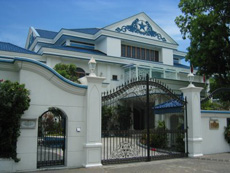
The Maldives faces a constitutional meltdown following a difference of opinion between opposition parties and the government regarding the legitimacy of institutions such as the Supreme Court, after the transition period expired last night.
According to the government’s interpretation, institutions such as the civil service commission, Human Rights Commission of the Maldives (HRCM) and the courts ceased to have legitimacy on conclusion of the interim period at midnight, after parliament failed to legislate for their continuity.
The Attorney General resigned this morning, claiming that while he had some responsibility for the ‘constitutional void’, a great deal more lay with the opposition-majority parliament and Speaker Abdulla Shahid, an MP of the main opposition DRP.
President Mohamed Nasheed had nominated a Chief Justice of the Supreme Court and was reportedly waiting for parliament to pass a bill on judges to determine how many more justices should be elected to the bench, however the Speaker cancelled the session prior to the deadline despite expressing earlier confidence that the interim matters would be resolved before the deadline.
“The Majlis failed to get its work done on time. This left the President with two options: allow the country to have no Supreme Court at all; or issue a decree so at least the administrative functions of the Supreme Court can continue. The President chose the latter option,” said Press Secretary Mohamed Zuhair.
Nasheed issued a decree at midnight that the trial courts – the Criminal and High Courts – would continue to function, while the interim appellate court consisting of four members “of high repute” would oversee the administrative aspects of the Supreme Court, such as receiving appeals.
“We hope Majlis members will hurry up and pass the required legislation so the court can function as envisaged under the Constitution,” Zuhair said.
However the four members of the government’s short-lived appellate court resigned this afternoon, Zuhair later confirmed, citing commitment to other duties but most likely seeking to avoid the political cross hairs aimed at the positions.
Moreover, the Civil Court today ruled that the Supreme Court bench remains valid, and that the Maldives National Defence Force (MNDF) was obliged to return the keys to the building to the sitting judges.
The government will appeal in the High Court – despite the resignation of the Attorney General – using the MNDF, which has its own lawyers, Zuhair stated.
Similarly, the opposition argues that under Article 284 of the Constitution, the Supreme Court is not beholden to the interim deadline and is obliged to function as normal, until the new court is appointed by parliament.
Article 284 under the chapter on transitional matters reads: “The Supreme Court appointed pursuant to this Chapter shall continue until the establishment of the Supreme Court”.
“There’s no argument about it; it’s very clear,” said former Attorney General Azima Shukoor, legal representation to opposition People’s Alliance (PA) MP Abdulla Yameen, whom the government detained for more than a week on accusations of treason and bribery.
“There are no issues with dates – [the Constitution] very clearly states that there has to be a Supreme Court of five members. The government is trying to take control of the judiciary.”
The government contends that the entire chapter on transitional matters – including Article 284 and others governing the interim Supreme Court – were annulled at the conclusion of the transitional period last night, plunging the country into a “constitutional void” following parliament’s failure to legislate the continuation of several institutions.
President’s member on the Judicial Services Commission (JSC), Aishath Velezinee, said the clause relating to the Supreme Court was “not indefinite”, and referred to appointment of judges “at any time within the two year transitional time period.”
“[Husnu Suood] was arguing last night that parliament needed to meet before midnight and approve an extension of the interim period, which seemed like a very sensible thing to do,” Velezinee said. “If [parliament] were working in good faith, they would have done that.”
Writing on his personal blog, independent MP for Kulhudhufushi South, Mohamed Nasheed, who was the legal reform minister when the constitution was ratified, concurred that the country had “officially fallen into a constitutional void” following parliament’s failure to complete transitional matters in the two year period set by the constitution.
Nasheed, who first warned of the repercussions of missing the constitutional deadline for last year’s parliamentary elections, argues that institutions or posts created after a constitutionally stipulated deadline would not be legitimate.
As a consequence, he writes, the legal status of parliament, the Elections Commission and the Anti-Corruption Commission were in doubt, as all three were formed after the deadlines elapsed.
Moreover, he added, the deadline for local council elections passed in July 2009, the new Supreme Court has not been formed, the reappointment of judges was questionable, lower courts had not been instituted and an Auditor General as well as members to the Civil Service Commission and Human Rights Commission are yet to be appointed.
That both the executive and legislature had failed to deliver the lawful state envisioned in the Constitution, Nasheed writes, was a source of “shame and sadness”.
With the two main parties at loggerheads, Nasheed writes that the distance between the parties has only grown and there was no longer an environment conducive to political negotiation and compromise.
Instead of assigning blame, he urged, both sides should be looking for a solution to the crisis.
As a solution, Nasheed suggested the parliament complete transitional matters as soon as possible, and then call a public referendum to determine whether citizens approved of the post-interim process.
The referendum could be held concurrently with local council elections, he suggested, whereby citizens could be asked to endorse new provisions inserted to the constitution to legitimise the “belated” institutions.
“If a solution cannot be found within the constitution, shouldn’t we get the direct say of citizens?” he asked.
Meanwhile, in an possible bid to encourage the opposition to return to the chamber, the Foreign Ministry has suspended the ambassadors to Sri Lanka, China, and Saudi Arabia, all three of whom were appointed by the former administration and were not endorsed by parliament prior to the interim deadline.
The government has also been negotiating with the International Commission of Jurists (ICJ) to send a mission to the Maldives to help establish an independent judiciary.
Commonwealth Secretariat Spokesperson Eduardo del Buey confirmed the Commonwealth Secretariat had received a request from the government of Maldives “for assistance in constituting an interim appellate court drawn from Commonwealth judges.”
“We are considering this request as a priority, and will respond to the Government shortly. In responding, we will be discussing with the Government how best to ensure adherence to the Latimer House Principles, which define the separation of the three branches of Government and to which all Commonwealth governments have committed themselves,” del Buey said.
Velezinee has also called for the mediation of the UN Special Rapporteur on Independent Judiciary, claiming that she did not believe anyone in the country would be trusted enough by both sides to establish the core institution.
Despite the burgeoning political crisis of the the last few days, and aside from minor scuffles between protesters outside parliament last night, Male’ has been relatively calm and turmoil largely restricted to the political echelons.
The holy month of Ramadan begins on August 11, when the pace in the normally frenetic capital typically slows considerably.
The cabinet has approved a new set of procedures governing its interactions with parliament.
“After discussing the draft Cabinet rules of procedure, the Cabinet passed relevant clauses for communications with the People’s Majlis,’’ said the president’s office in a statement last week.”
Foreign Minister Dr Ahmed Shaheed said the regulations “are quite important in terms of how the government will interact with parliament from now on. It draws a clear boundary.”
Referencing article 115 (f) of the Constitution, the new regulations state that a cabinet member can only be summoned to the parliament on mention of a the appropriate article in the constitution, and shall answer questions only during a parliament meeting.
Furthermore, cabinet ministers shall only answer to the parliament “if the cabinet minister is given the notice 14 days prior”, and “shall only answer questions that the minister must according to the law on questioning ministers.”
Dhivehi Rayyithunge Party (DRP) Deputy Leader and MP Ali Waheed said the approved procedures were “against the spirit of the constitution” and would be void.
‘’Actually, parliament has yet to approve a cabinet. When a cabinet is established we will summon them to committee meetings as well – ministers must appear before committees in the interest of the people – the constitution is very clear. Without doubt these new procedures are void – nobody can narrow the summoning of cabinet ministers to parliament.’’
However, Maldivian Democratic Party (MDP) MP Ahmed Shifaz said that according to the constitution, the reality for cabinet ministers was very different.
“It does not say that the ministers have to be present at committees hearings – the constitution says that ministers should be answerable to the parliament inside the parliament chamber, not in the committees,’’ said Shifaz.
He said that the opposition still had to approve the cabinet, and that otherwise summoning them for questioning was an act against parliamentary system.
‘’It is not the people who the opposition wish that should be in the president’s cabinet, it should be people appointed by the president,’’ he added.
Leader of the Dhivehi Qaumee Party (DQP) Dr Hassan Saeed has called on the UK-based Law Society to lead a mission to the Maldives to assess the erosion of the rule of law, in an interview with the organisation’s publication The Law Society Gazette.
Dr Saeed told the Society that President Mohamed Nasheed, “a former political prisoner dubbed the Maldives ‘Nelson Mandela’”, was dismantling the 2008 Constitution and trying to “crush citizens’ rights under foot”.
President Nasheed was establishing his own “public courts” to replace independent courts, the Society reported Dr Saeed as claiming, while “courts are suspended” and “judges assaulted.”
In the article, the Society’s president Linda Lee urged the Maldives authorities “to uphold and protect key constitutional principles.”
Minivan News contacted the DQP seeking clarification of the claims.
Regarding the assaults on judges, the party’s Secretary General Abdulla Ameen noted that following a ruling in a case concerning Juhmoree Party MP Gasim Ibrahim by Chief Judge of the Criminal Court Abdulla Mohamed, “a lot of people went outside [the judge’s] house and physically threatened him, and set his motorcycle on fire.”
Concerning the suspension of courts, “the government has created a culture of fear among the judiciary, and they have had to cancel sessions and hold emergency meetings because of the increase in tension.”
The government had breached the rights of individuals “by arresting people without warrants,” Ameen said, referring to the recent detention of People’s Alliance MP Abdulla Yameen on the Presidential Retreat of Aarah following accusations of bribery and treason.
He also criticised the government for leaking audio tapes appearing to implicate MPs for corruption, “despite the Constitution clearly protecting private conversations between individuals.”
Ameen said Dr Saeed had requested the Law Society send an independent delegation to investigate the issues, “but if any other [institution] is interested we would also welcome it.”
The President’s member on the Judicial Services Commission Aishath Velezinee has also appealed for the UN Special Rapporteur on Independent Judiciary and the International Committee of Jurists (ICJ) to send mediators to the Maldives.
Foreign Minister Dr Ahmed Shaheed said Dr Saeed’s claims in the Law Society article were “totally out of orbit.”
“One has to wonder what he is talking about – look at his own track record serving under former President Maumoon Abdul Gayoom [as Attorney General]. We are clearly making steady progress,” Dr Shaheed said.
“Claiming that judges are being assaulted is very irresponsible. I’m not aware of any case where a judge has been assaulted, and in such an event there are domestic remedies available,” Dr Shaheed said.
Regarding Dr Saeed’s claim that courts were being suspended, “that’s outrageous. I’m not aware of a single time this has happened.”
“When a lawyer becomes a politician, they must continue to respect certain professional ethics as well,” he said.
“They are out to tarnish [President] Nasheed’s image, and they have taken issue with his awards and his description as South Asia’s ‘Nelson Mandela’,” Dr Shaheed said. “I think this is a case of the green-eyed monster.”
The request by the Law Society that the government respect the rule of law was “a standard expectation and we respect it.”
“The government is not disregarding the law,” he said. “Look at the behaviour of the other [arms of state]. Parliament is trying to usurp the powers of the executive, and the judiciary is behaving very questionably.”
Working in such an environment, Dr Shaheed said, the President had been called upon to make “some very difficult judgments, such as [the detention and release] of MP Abdulla Yameen.”
Dr Saeed recently led a DQP delegation to the UK to present the opposition coalition’s case to UK politicians and international institutions, employing a PR company to arrange interviews with several organisations, including The Law Society. The trip was jointly funded by the opposition parties, Minivan News was told at the time.
The international community has urged the Maldives executive to respect the rule of law in negotiating a solution to its current political deadlock with the Majlis (parliament), and in handling its accusations of corruption and treason against several prominent MPs and high-profile businessmen.
In a democracy the judiciary is the crucial arbitrator of any such disputes between the other two arms of government. But Aishath Velezinee, the President’s Member of the Judicial Services Commission (JSC), the independent institution tasked with reforming the judiciary and ensuring both its independence and accountability to the public, believes the current state of the judiciary renders it unfit to do so.
Article 285 of the Constitution outlines an interim period for the reappointment of the judiciary by the JSC, according to minimum standards, with a deadline of August 7, 2010. After this, a judge may only be removed for gross incompetency or misconduct in a resolution passed by a two-thirds majority in parliament – the same number required for impeaching the President or Vice President.
Last week the JSC reappointed 160 of the judges appointed by the former government, despite a quarter of the bench possessing criminal records and many others with only primary school level education. The Supreme Court meanwhile sent the President a letter claiming it had ruled itself tenure for life.
Velezinee blows the whistle, speaking to Minivan News about the JSC’s failure to ensure the accountability of the judiciary, the compromise of its own independence at the hands of the Majlis – and the ramifications for the country in the lead up to the August deadline.
JJ Robinson: What is the function of the Judicial Services Commission?
Aishath Velezinee: The main function of the JSC – as I see it – is to maintain judicial integrity, and to build public confidence in the judiciary and individual judges.
The way we would do it under a democratic governance structure would be to hear the complaints of the people, and to look into these matters objectively and independently, and take action if necessary, to assure the public there is no hanky-panky [going on].
But instead of that, we are putting out press releases saying things like: “You can’t criticise judges”, “You can’t criticise the judiciary”, and ‘‘the president is exercising influence over judges”.
JJ: So the JSC is working as shield organisation for judges rather than as a watchdog?
AV: Very much. It is a shield for judges, and the evidence for that is very obvious. We have all this evidence in the media now from what is happening in the criminal court – a fact is a fact.
Why did [Criminal Court] Judge Abdulla Mohamed open the Criminal Court at midnight when two high-profile [opposition MPs Abdulla Yameen and Gasim Ibrahim] were arrested?
From August 2008 to today there have been many instances when the public might have wanted the court to open outside hours. But no – before that day, they have never opened the court out of hours for anybody else.
This was the first time they have done it – and then put out press releases saying it happened at 9pm? This is not the truth. We have evidence it is wrong.
But the Commission takes for granted that whatever the judge says is right. We can’t protect judges and oversee them.
JJ: This was the case taken to the Criminal Court by Yameen’s defence lawyer [former attorney general Azima Shukoor]?
AV: That’s not standard procedure. According to regulations the Criminal Court can only accept submissions from the State.
It would not have been an issue – the defence lawyer would have been given the opportunity to argue the case when the State went to the court. But Yameen’s lawyer initiated it – and got into the Criminal Court in the wee hours of the night – that is strange.
I’m not saying it is right or wrong – I don’t know. But what I do know is that this is out of the ordinary. The JSC has an obligation to the people to ensure the Criminal Court has done nothing wrong.
JJ: How did the JSC react?
AV: They did nothing. Article 22(b) of the Judicial Services Act gives us the power to look into matters arising in public on our own initiative. But what did the JSC do? They said nobody had complained: “We haven’t received an official complaint.” They were waiting for an individual to come and complain.
My experience, from being part of the complaints committee in the JSC, is that whenever a complaint is received, we have two judges on the complaints committee who will defend the [accused] judge, trashing the complainant, and talk about “taking action” against these people “who are picking on judges”.
Then they will put out a press release: “Nobody should interfere with work of judges.” Their interpretation is that “nobody should criticise us. We are above and beyond the law.”
Since January – when the JSC censored its own annual report, despite the law clearly saying what we should include – they decided to hide the names of all judges who had complaints made against them.
Instead, they released the details – including quite private information – about the complainants.
Civil Court judge Mohamed Naeem has "a box-file" of complaints pending, says Velezinee
JJ: What is the current state of the judiciary?
AV: The current judiciary has 198 judges that were appointed prior to this Constitution being adopted. Those judges were appointed by the then-executive: the Ministry of Justice. The appointment procedure, the criteria – none of these were transparent.
They were only given ‘on-the-job’ training. This ‘Certificate in Justice Studies’ they say they have is on-the-job training given after the 1998 Constitution was adopted, to teach them how to run the country according to that Constitution.
How do we expect these people – without exposure to democratic principles and cultures, without exposure to the world, with only basic education, and with only tailor-made on-the-job training for a different Constitution – how do we expect them to respect and uphold this Constitution?
A majority have not even completed primary school. A quarter have criminal convictions: sexual misconduct, embezzlement, violence, disruption of public harmony, all sorts of things – convictions, not accusations.
We are not even looking at the 100 plus complaints we have in the JSC that are unattended to. They have not been tabled. Civil Court Judge Mohamed Naeem has a box-file of complaints against him. And Criminal Court Judge Abdulla Mohamed has way too many against him.
JJ: Given the condition of the judiciary, and if the government is in a state of political deadlock with parliament, how is the government able to legitimise accusations against the MPs it has accused of corruption and treason?
AV: That is where we have the problem. The international community seem to have forgotten that this is a new-found democracy. We have in all our institutions people who have been in the previous government. We haven’t changed everybody – and they are still following their own culture, not the law.
How can [the international community] ask for the rule of law to be followed when there are no courts of law? Where are the courts? Where are the judges? A majority never even finished primary school.
Supreme Court Justice and President of the JSC, Mujthaz Fahmy
JJ: What possible reason was there for appointing judges with only primary grade education?
AV: It’s very obvious – just look at the records. As a member of the JSC I have been privy to records kept from before [the current government]. In their files, there are reprimands against judges for not sentencing as they were directed. That was a crime when the Minister of Justice ran the courts. The Ministry of Justice directed judges as to how sentences should be passed, and that was perfectly legitimate under that Constitution.
JJ: Has anything changed since 2008 and when the judges were appointed under the former government?
AV: Yes – what has changed is that [the judges] were freed from the executive. So they are very happy with the freedom they have received. But unfortunately they haven’t understood what that freedom and independence means.
They are looking for a father-figure, and they have found him in the current President of the JSC, Supreme Court Justice Mujthaz Fahmy. He has taken on this role, and he is now the king and father of the judges.
So they are all looking up to him to protect their interests. If you look at all the press releases from the Judges’ Association – which is run from Mujthaz Fahmy’s home address – he makes arbitrary decisions in the JSC and then puts out press statements from this organisation run from his home, to defend his own position.
We are in a very big game. Mujthaz Fahmy has been under the thumb of the former executive for way too long – the man is going on 50, he has been on the bench for 25 years, he has never had anybody come and argue with him – he can’t stand anybody who challenges him. So he’s got a problem with me sitting on the Commission because I do not take his word as the law. The man thinks that anything that comes out of his mouth is the law, and the majority of the JSC members take it as a fact.
But if you look into the documentation, if you look into the recordings – nothing that comes out of that man’s mouth will hold. Those interviews he is giving, all he is using is this image he has built up of himself as ‘the esteemed justice’. That is what he is using to convince the public that he is right. And they are trashing me in public and in biased media, just so people do not listen to me.
I do not ask anybody to take my word. I am saying: hear the recordings in the commission. Listen to what they say.
They have this belief that whatever happens in the Commission must be kept a secret amongst ourselves. This was run like a secret society – we have a pact of secrecy amongst us. I broke it, because I do not believe in tyranny of the majority. What we are seeing here is a repeat of what happened in the High Court in January, what we are currently seeing happen in the Majlis, and the same things are now happening in the JSC.
Elements of the parliament are collaborating with the JSC, says Velezinee
JJ: What are the links between the Majlis and the judiciary?
AV: That is a very serious issue. I am currently sitting on this seat as the President’s appointed member of the JSC, but prior to this, I was was the member of the general public appointed by the Majlis. They have forgotten that part.
I have brought this to Majlis attention. When the Commission voted on what I call the minimum ‘sub-standards’ for the judiciary, I sent a complaint to the Majlis. The same letter I sent to the President and the President of the Law Society. I sent it to the Speaker of the Majlis, as well as the chair of the Independent Commissions Committee, Mohamed Mujthaz.
When the JSC finalised the ‘substandards’, the Majlis into recess. So I went to the Anti-Corruption Commission (ACC), because it was the only constitutional structure where I could go to hold the JSC accountable. It is rather odd for one Commission member to go to another commission and ask them to investigate her own commission.
I met the ACC on May 12. The JSC say they adopted the substandards on May 11. Later I collected all the documentation, and wrote a report – because this is not going to be something easy to investigate. This is a whole conspiracy cooked up from the time the JSC was initially constituted. It has been planned, and it is very clear this is a plot.
When the Majlis reopened in June, I sent an official complaint to the Independent Commissions Committee which they accepted. On June 16, the Majlis wrote two letters to the JSC, one letter requesting all documentation and recordings relating to Article 285 – my complaint.
The JSC is not respecting Constitution and is doing as it pleases. Their disregard of Article 285, and their decision to adopt substandards for judges, comes from their belief in a promise made by the former government.
They do not refer to the Constitution in adopting the standards. They refer to conversations they had with the majority party at that time, a delegation led by our dear JSC President, Mujthaz Fahmy. He and a team of judges met with the politicians to negotiate a guarantee that no judge would be removed under the new Constitution.
Although we have Article 285 in the Constitution – to give the people a judiciary they can trust and respect – we have the President of the Commission responsible for the implementation of this article working on this political understanding with the former government.
This is very clear from the recordings.
All I’m asking is for third party to look into this – and that third party is the Majlis. After the Majlis took all the documentation and recordings, they had requested the JSC meet with the Majlis Independent Commissions Committee at 2:30pm on June 23.
If you go back to your news files, that was the day when the Majlis floor heated up. Since then the Speaker [DRP MP Abdulla Shahid] has suspended the Majlis.
The committee accepted the complaint – if they had not, they would not have asked us to come and discuss this with them.
I believe the speaker is taking undue advantage of this political crisis. The Speaker of the Majlis is now coming and sitting in the JSC [office] day and night, during Friday, holidays and Independence Day. The Speaker is sitting in the JSC trying to expedite this process of reappointing judges before the Majlis starts on August 1. What is going on here?
The Supreme Court, formerly the Presidential Palace
JJ: What is going on?
AV: I believe that when the Majlis was suspended, they should have directed the JSC to at least halt what was going on until they have looked into the matter. It is a very serious complaint I have made – it is a very serious allegation. And if that allegation and complaint is unfounded, I am willing to stand before the people, in Republic Square, and be shot.
I believe we have all the evidence we need to look into this matter – but under this Constitution, we have to go to the Majlis. But where is the Majlis? And what is the Speaker doing in the JSC?
What about all those other complaints? The Commission’s president is not letting us work on them. We have in our rules that any member can ask for a matter to be tabled. I asked him to look into the matter – and do you know what he did? He sent me a letter to my home address – as though I was not a member of the Commission – and asked me to write it in a proper form and bring it to the attention [of reception].
The JSC has decided Article 285 is symbolic, that article 22(b) does not exist, while the esteemed people of the law in the commission, include the Commission President, Supreme Court Justice Mujthaz Fahmy, explain to me that article 22(b) gives me the power to write a letter, fill in a form and submit a complaint. I asking – why did the drafters of this law put in a clause to give me a right I already have as any ordinary citizen?
Where we are right now – with the lack of confidence in the judiciary – it all lies with Mujthaz Fahmy.
JJ: What do you mean when you talk about “a plot”? How interconnected is this?
AV: They are trying to expedite the reappointment of judges without looking into my complaint. If you look into my complaint, you will find this has been done in an unconstitutional way.
What they are doing right now is going to kill the Constitution.
We are not going to consolidate democracy if they succeed in getting away with what they are doing right now. The Speaker has suspended the Majlis whilst a very serious complaint is with the Majlis committee, and now he is sitting in the JSC doing this.
If there is a matter pending in a court of law, usually they ask for a court order until the matter is settled. You don’t just carry on as if nothing is happening.
We have a petition signed by 1562 people – the JUST campaign – calling for an honest and impartial judiciary. This was not even put on the Commission’s agenda – it said it did not find it necessary to take it into account, and on that day I was not given opportunity to participate because on the agenda was the matter of approving judges under the substandards.
We are asked to put before any other matter the people, and the Constitution. Instead, the Commission is working in the interests of these individual few judges who have hijacked the judiciary. Mujthaz Fahmy must go.
JJ: So these Commission members met with politicians from the former government, to obtain a guarantee that sitting judges would remain on the bench, and not be subject to reappointment under Article 285? What do the politicians get back from the judges?
AV: We are talking about corruption. The change in government came in 2008 because people were fed up with a corrupt administration and autocratic governance.
But all those people who were in power entered parliament. The Speaker, who is right now sitting in the JSC working night and day expediting the reappointment of the judges, was also part of that administration. It is within their interest to keep this judiciary here, and not work in the interests of this Constitution, or the People.
Their personal interests take precedence over everything else. I’m afraid that is what we are seeing.
JJ: Do you feel the media has been taking this case seriously enough?
AV: I’ve been writing to all the concerned authorities since Januruary. I’ve been going on and on about the JSC and the dictatorship within it for a long, long time. I knew where we were heading, I have been warning the Majlis and talking to people from various parties. I have been talking about Article 285 for so long that I have become ‘the old article 285 madwoman.’
JJ: Do you think the current political crisis can be resolved without a functioning judiciary?
AV: Absolutely not. But then a functioning judiciary cannot be introduced without this crisis being resolved. How can the international community ask for the rule of law to be followed when there are no courts of law?
We need an impartial investigation of what is going on. And I believe the Maldives does not have anyone able to conduct an impartial investigation. We need assistance – the International Commission of Jurists (ICJ) should be here. The UN Special Rapporteur on Independence of the Judiciary should be here, right now.
This is not the fault of the judiciary. We have a large bench, and most of the judges have absolutely no idea about what is going on. They have not even been given orientation on the new Constitution.
I had the opportunity to meet magistrates from four Atolls. They know the law. But what they need is a basic understanding of the principles of this Constitution, of the foundations of democracy. Because it is through those lenses that they should be interpreting the Constitution.
I am not in favour of the removal of all judges. But I demand that all judges with criminal records be removed – they should not be sitting there even now, and there’s 40-50 of them – a quarter of the bench.
Why is the JSC remaining silent? Why is the Speaker of the Majlis in the JSC [office]? By his silence, and through the act of suspending the Majlis, the Speaker has given the JSC the opportunity to complete this act of treason they are currently committing.
The deadline for the judicial reform period under the new constitution in August 7. The Speaker and the President of the JSC are working overtime to get all these judges reappointed before the Majlis restarts on August 1. That is treason.
Supreme Court Judge Uz Ahmed Faiz Hussain, the President's nomination for Chief Justice
JJ: What benefit would outside arbitration bring?
AV: It is difficult because all our documentation is in Dhivehi. But we need an independent and impartial body to look into this properly. Forget listening to me or Mujthaz. Forget listening to politicians, and investigate. We need an impartial mediator.
It is very easy for the international community to turn around and blame the executive for taking a dictatorial attitude. We are demanding the executive uphold the rule of law. But what about the Majlis? Where is the rule of law when the Speaker suspends the Majlis and hides in the JSC expediting the reappointment of judges? Where are the courts to go to?
We need the public to understand the Constitution, and we need all duty-bearers to uphold the Constitution. I’m afraid half the members of the JSC do not understand the principles of democracy or the role of the JSC, or the mandate we have. Then there are a few who understand it very well but remain silent while all this goes on
JJ: The President recently nominated Supreme Court Judge Uz Ahmed Faiz Hussain as the new Chief Justice, and is awaiting Majlis approval. How likely is this to resolve the current situation, given the Majlis is currently suspended?
AV: Uz Ahmed Faiz Hussain is a well-respected man amongst the judges. I have never heard anybody question his independence or impartiality. He is a learned man and amongst all the politicking and hanky-panky going on, he has maintained his integrity.
But the Majlis has to appoint him and the Majlis may not even get that far – the Supreme Court has already declared itself permanent.
I’m telling you: this is big. What we are seeing is all interconnected – it is one big plot to try – in any way possible – to return power to the corrupt.
President Mohamed Nasheed has hinted that he is prepared to hold mid-term elections – a promise he made prior to being elected – if the opposition agreed to amend the constitution and re-elect the parliament.
”Elections have been very friendly to me in my life,” Nasheed said, speaking at an MDP rally last night. ”I am ready to face any elections should they be needed.”
However, Nasheed demanded that the opposition agree to amend the constitution and re-elect parliament.
”Although the tax bill to increase the government’s revenue has not been passed, [we] will fulfill the pledges,” said Nasheed, noting that six projects were scheduled to commence in Male’.
Nasheed has recently claimed that laws passed by the parliament were making it difficult for a presidential system to function effectively.
“In my view, the essence of this is connected to the form of the constitution,” he said, adding that the “teething issues” related to implementing the constitution must be resolved.
“One way is for all political parties to agree to amend the constitution to change to a parliamentary system,” he suggested, adding that he was ready to face any election in this event.
As the existing constitution allows parliament to block executive functions, said Nasheed, the government could neither ensure economic development nor provide basic services effectively.
“If opposition political parties do not believe [changing to a parliamentary system] is best, the second way is for us to perfect the presidential system,” he said.
“Either perfecting the presidential system, or changing to a parliamentary system [is the choice],” he said.
Opposition Dhivehi Rayyithunge Party (DRP) MP Abdulla Mausoom said that the president had promised the people he would hold mid-term elections, “and he has no other choice.”
”That was an unconditional statement he made before the last [presidential] elections,” said Mausoom. ”He has to do it without applying any conditions.”
Mausoom claimed that today, people of the Maldives did not have trust in the president.
”I will say we should wait and see. He is repeating an earlier statement he made, it means there is a possibility that he might do it,” Mausoom added.
The government and the opposition parties are currently holding closed-door discussions, ostentatiously to try and resolve the current political deadlock.
A group of opposition Dhivehi Rayyithunge Party (DRP) MPs have declared they will forward a no-confidence motion against President Mohamed Nasheed to parliament.
“There is no need to go out and protest on the streets, there is only one individual who is the issue for the Maldives,” said DRP MP Ahmed Nihan. “It is the president who is the issue, and as MPs it is our lawful duty to file this motion and send the president home.”
Nasheed had violated the constitution which justified invoking article 100 of the constitution, concerning impeachment, claimed Nihan.
“Multiple times he has gone beyond the chart and violated the constitution – we have no other choice,” Nihan said, adding that if the president was “allowed to to do whatever he wished, there will be no use for an institution named parliament.”
Nihan said that DRP MP Ahmed Mahlouf, DRP MP and deputy leader of the party Ahmed Ilham and DRP MP Ali Arif were working together to secure the no-confidence vote.
A vote to impeach the President or Vice-President requires a two-thirds majority in the 77-member parliament, and counting the voting history of the Independent MPs, would still require 8-10 of the ruling MDP MPs to cross the floor and vote with the opposition.
Nonetheless, several weeks ago the government revealed that six MDP MPs had written to the President alleging opposition MPs had attempted to bribe them to vote against the government, prompting the resignation of cabinet in protest and precipitating the current political deadlock.
Nihan said he would propose the motion be supported by the rest of the DRP, “although we do not know what would our party’s stand would be,” he said.
“Any MP who works according to the oath and is sincere to their people, will definitely support the motion,” he claimed.
“This is a very serious declaration, this is not a joke. The whole nation is calling in one voice simultaneously for the resignation of the president,” he added.
MDP MP Ahmed Shifaz said that opposition MP were only in parliament with the sole intention of trying to topple the government.
“I can give you 100 percent assurance that they will not be able to topple the government in parliament,” said Shifaz. “Even if they try [with this motion] it would not be successful.”
Shifaz claimed that opposition MPs made such claims to try and boost their status among opposition supporters.
People’s Alliance (PA) MP Abdulla Yameen was released Friday afternoon from his controversial detention on the presidential retreat island of Aarah, more than a week after he was taken into ‘protective custody’.
Maldives National Defense Force (MNDF) spokesman Major Abdul Raheem confirmed that Yameen – former President Maumoon Abdul Gayoom’s half-brother – had been released from custody under orders from President Nasheed.
“He was released at his house and we are no longer providing him with security,” Raheem said, adding that Yameen was never “under arrest”.
The leader of the minor opposition party, who was last week released from house arrest by the Supreme Court, had been accused by the government of corruption, bribery and treason alongside Jumhoree Party (JP) MP Gasim Ibrahim, a high-profile businessman thought to be one of the wealthiest men in the Maldives.
Deputy Speaker of the Majlis and PA Deputy leader Ahmed Nazim is also facing allegations of corruption concerning the judiciary, along with ruling party MP Mohamed Musthafa. Both were released by the criminal court last week due to the court ruling that current evidence was insufficient to warrant their detention.
The week prior to Yameen’s detention, recordings of phone conversations between the MPs implicating them in apparent corruption and vote-buying were leaked to the media, prompting both a rise in public anger against MPs and debate over the ethics of tapping personal phone calls.
After taking him into custody following violence outside his house last week, MNDF refused to present Yameen in court despite an order from the Criminal Court on July 15. Parliament’s speaker Abdulla Shahid on Wednesday suspended parliament indefinitely until the release of the MP.
Meanwhile, a coalition of opposition-aligned parties including the Jumhoree Party (JP), People’s Alliance (PA) Dhivehi Qaumee Party (DQP) and Dhivehi Rayyithunge Party (DRP) appealed to the international community to put pressure on the government to release Yameen.
The government contended that even though Yameen was being held on Aarah against his will, his detention was constitutional because of public anger towards Yameen and the risk to his safety.
Assistant Secretary to the United States Robert Blake, who visited briefly last week, suggested the President “either charge or release Mr Yameen.”
Speaking to Minivan News this morning, Yameen confirmed he had been “fully released”.
“I think [President Nasheed] finally realised concept of protective custody was ridiculous,” Yameen said, adding that he felt safe walking the streets.
“I have personal security in my house, but I can’t afford more than that,” he said, adding that he expected the police and MNDF to protect his home from further mob violence.
“[Otherwise] I’m perfectly capable of defending myself,” he said, explaining that he had “followers” who would protect him at the price of continued street violence.
Yameen said he was unsure why the government had sought to gain by detaining him, as the opposition parties were “already engaged in dialogue with the government two days before my arrest.”
“Perhaps the President thought it was the only way I would cave into his demands. Otherwise his actions are incomprehensible – he certainly hasn’t gained anything from this,” Yameen suggested. “International reception has been bad and locally very hostile.”
Yameen further added that the President’s comparison of him during a press conference last week to former President Amin Didi, who was assassinated by a mob in Male’, was “grotesque”, and that Male’ was not suffering from such a degree of public disorder.
Of his custody, Yameen described the physical conditions as “OK”, however “nobody except my wife, children and my lawyer had access to me.”
Ahmed Thasmeen Ali, Leader of the major opposition party, the DRP, said last week that Yameen’s custody was the “essence” of the present deadlock as the government had “not followed due process”.
A rare press conference to be held at the President’s Residence Muleaage this morning at 10:45am was cancelled at the last minute.
The President’s Press Secretary Mohamed Zuhair was not responding to calls at time of press.
Parliamentary Speaker Abdulla Shahid this morning cancelled parliamentary sittings until the government releases MP Abdulla Yameen from MNDF “protection” on ‘Aarah’, the presidential retreat.
The Human Rights Commission of the Maldives (HRCM) has meanwhile issued a statement calling on the government to release Yameen from his ‘protection’ at Aarah.
“On July 15 the Maldives National Defense Force (MNDF) arrested Abdulla Yameen Abdul Gayoom, and since then it has been five days and he has not been presented to court,” HRCM said in a statement.
“He is held in custody against article number 49 of the constitution,” the commission claimed.
“Although he was isolated for his own protection, violating article 49 is unconstitutional, and therefore the HRCM calls on the government to follow the constitution and release Yameen immediately.”
The statement cited article number 48(D), which states that any person arrested should be brought before a judge to determine the validity of the detention period, and claimed that defence forces did not follow the article.
“We note that the defence forces have not attended the criminal court and have ignored the court’s order to summon Yameen to court,” the statement added.
The MNDF told parliament in a letter read out in yesterday Yameen was not being held pending criminal investigation, but for his own “protection” based on “secret” information received on July 15.
In its statement, HRCM claimed that “as the Maldives is a country which has a infant democracy, the people of the Maldives and the government should uphold the constitution and democratic principles.”
The commission said that to ensure people’s confidence in a democratic system of government, it was important to establish a culture that respected human rights, justice, and equality in Maldivian society.
The MNDF maintains Yameen was taken to the Presidential retreat for his own protection and on his request.
However in a phone call with Minivan News, Yameen, who is accused by the government of corruption and treason, claimed the MNDF took him to the retreat forcibly in an attempt to cool the situation in Male’.
My name is Ben Abdul-Rahman Plewright. I am a graduate of political sciences from the University of Western Australia.
Though I am not a Maldivian, I feel compelled to refute the claim that the MDP are the ones who have suspended the newly founded Maldivian constitution. The truth of the matter, I here assert, is that it is the other way around.
Oh, and, what is my business interfering in your internal affairs, you may ask? Well, first of all, I am a Muslim, and I take seriously the Hadith that the Ummah is as one body, and the pain of one Muslim should be felt and alleviated by all other Muslims.
Second of all, I believe in what Martin Luther King said,:”Injustice anywhere is a threat to Justice everywhere…”
We are all profoundly interconnected. This is especially demonstrated in my situation since I am married to a beautiful Maldivian woman and I have two half Maldivian children and perhaps a third one on the way.
It was the since arrested parliamentarians and the corrupt judges who suspended the constitution initially by ignoring the separation of powers which must exist between the parliament and the judiciary.
The opposition broke the constitution down, Anni (President Mohammed Nasheed), the MNDF and the MDP Cabinet are struggling to mend the constitution within whatever means they can. He cannot do so strictly within the constitutional framwork as the opposition broke the constitutional framework down.
This move by the MDP and MNDF to eradicate those who disregard the constitution is necessary for the salvation of the long term effectiveness and sovereignty of the constitution. It is the salvation of liberal democracy in the Maldives.
One of the main aspects of the constitution is the independance of the judiciary. When a parliamentarian (Yamin or Nazim or any power-brokers within the parliament) control the judiciary, it is absolutely necessary that the judiciary and that any controlling parliamentarian be removed from power to preserve and restore the separation of power between the parliament and the judiciary (the legislature and the judiciary).
MDP are fighting for the integrity of the constitution, they are not suspending or violating the constitution, the constitution was already destroyed by the parliamentarians and judges who violated it, Anni is fixing it!
This move by MDP and MNDF is necessary for the salvation of the constitution and for the long term realization of democracy in the Maldives.
Please, Dr Shaheed, and anyone else who can, please deliver this truth to the international community so that they will support your struggle to save liberal democracy in the Maldives.
Long live the constitution, thank you MDP for fighting to save the constitution!
 (1)Dislikes
 (0)
(0)