MP pushes no-confidence motion against Education Minister

MP for Fares-Maathodaa Ibrahim Muttalib has announced that he will file a no-confidence motion against Education Minister Dr Musthafa Luthfy over the ministry’s steering committee’s recommendation to make Islam and Dhivehi optional subjects for grades 11 and 12.

Appearing on Television Maldives’ ‘Q&A with Miqdad’ programme last night, the independent MP argued that the decision would undermine respect for religion and language among youth.

Muttalib claimed that Luthfy told him that students of Arabbiya School, which was shut down after a wall collapsed, would be transferred to other schools.

“We now believe that national education matters will not go well because of the attitude and thinking of the Education Ministry, especially Mustafa Luthfy,” he said. “So [Luthfy] should either make amends or resign.”

Muttalib, former treasurer of the religious conservative Adhaalath party, said he had drafted the motion and hoped to secure 10 signatures from MPs needed to submit a motion of no-confidence.

The decision

“Now the education minister is saying it was not his decision to change the two subjects to optional,” Muthalib said today. ”I want the minister to tell us whose idea was it then.”

Muthalib claimed that Luthfy told him last week that there was “no way” the decision could be reversed.

”If the education system implements a curriculum like this, students would be moved away from religion and mother tongue,” he said. ”I would not support such a curriculum that discourages the use of our own culture and language.”

While he could not predict how MPs would vote on the motion, Muttalib said “there are many MPs who respect religion.”

Curriculum
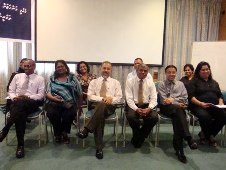
Education Ministry team

Luthfy told Minivan News today that while he had watched the TVM programme, he did not think Muttalib “was serious.”

He added that he did not want to comment on the no-confidence motion.

“It’s not true that I said in a meeting last week that there was no way the decision could be changed,” he said.”It’s not my decision. It’s only a suggestion by the ministry’s steering committee.”

Luthfy has stressed that the decision of making Dhivehi and Islam subjects elective has not been finalised.

A Curriculum Team at the Education Development Centre is currently at work on revising the national curriculum for the first time since 1984.

“Political coffin”

The Adhaalath party yesterday condemned the Education Ministry’s decision, characterising it as Luthfy putting “the final nails in his political coffin.

An angry crowd protested outside the minister’s house on Tuesday night following the Adhaalath press release.

Sheikh Hussein Rasheed Ahmed, president of Adhaalath party, said today that did not wish to comment on the no-confidence motion.

”It is not our concern,” he said. “Our problem is that Education Minister is misbehaving.”

The State Minister for Home Affairs said the party had discussed the issue with Luthfy on several occasions.

“This is a national issue.” he said. “He cannot solve a national issue on his own. He has to discuss with the cabinet, parliamentarians and senior government officials.”

Senior officials at the Education Ministry has stressed that the steering committee’s recommendation would only be implemented following cabinet deliberations.

Main parties

Opposition Dhivehi Rayyithunge Party (DRP) MP Abdulla Mausoom told Minivan News today that it was imperative that Maldivians “try to save their identity.”

“The school curriculum should also be designed in a way that would help save the country’s identity, which is religion and language,” Mausoom said. ”Dhivehi and Islam are both very important subjects.”

He added that the state had a responsibility to preserve and protect national identity and culture.

“The main reason why I do not like this government is that they never prefer to discuss any issue -and even if they did [want to] they rarely they do it- but they never would accept the recommendations and suggestions,” he said.

The MP for Kelaa said that the DRP parliamentary group will discuss the issue and decide its stance.

Meanwhile, ruling Maldivian Democratic Party (MDP) MP Alhan Fahmy said the time had not yet come to take up the issue at parliament.

”It would be a very big issue if they were removing the two subjects from the school curriculum,” Alhan said. “But if it is optional that means any student who wishes to study it can study it. Students have the opportunity. I don’t see what all the fuss is about.”

Alhan said the issue was being blown out of proportion to serve political purposes, adding that the MDP parliamentary group had not officially discussed the matter yet.

Statistics of the Education Ministry show that of the 7,137 students who sat for the GCE O’Level examinations last year, only 32 per cent passed in five subjects, while 2,284 students qualified for higher secondary education.

Likes(1)Dislikes(0)

National Security Committee meeting on Gitmo detainees postponed

Today’s National Security Committee meeting regarding the transfer of Guantánamo Bay inmates to the Maldives has been rescheduled, after Speaker of Parliament Abdulla Shahid requested to cancel it.

The meeting has been postponed for next week, after a call from Shahid to the Chairman of the committee and leader of the People’s Alliance (PA), Abdulla Yameen.

He wanted to postpone the meeting until Parliament reconvenes in June and all committee members are back from leave.

Yameen said the meeting “was cancelled by the speaker,” and has been rescheduled for next Sunday. He said although he was not sure if all members of the committee would be present at the meeting, “we will have quorum.”

He did not want to comment on the issue of the detainees “as of yet.”

Independent MP for Kulhudhuffushi-South, Mohamed Nasheed, said “when the chair wants to hold a meeting, the speaker has no right to postpone it.”

He said the decision to hold a committee meeting, whether during recess or session, was completely up to the chair of the committee, “and there’s nothing the administration or the speaker’s office can do.”

Nasheed said the Majlis committees were all “very democratic institutions,” and all the powers vested in the chair were provided for in the codes.

“The only people who can object is a majority from the committee itself,” he added.

Nasheed said “the meeting will not be cancelled” and there will be “lots of hearings” with the Foreign Ministry, Police, and the Attorney General, among others.

He said the situation will be verified, details asked for and documents submitted on the matter.

“The committee will then make an assessment and then report to the Majlis.”

Dhivehi Rayyithunge Party (DRP) MP Ahmed Nihan said Yameen had decided “all the party should be present,” and added “the Parliament should be involved” in deciding upon the issue of the detainees.

He said it was important the meeting was held with “the inclusiveness of all [11] members,” and should be postponed until all members returned from leave.

“If anything happens to Maldives, we should all be concerned about this.”

Price per head

MP Nasheed said he was “not in favour of the meeting going in a particular way,” but he believes it is “a serious issue” where law and policy must be looked at carefully.

He said the government was trying to paint the detainees as “innocent and helpless Muslims,” but, he asked, “if they don’t want them in the jurisdiction of the US, why keep them in a third country?”

Nasheed argued that the detainees’ fundamental freedoms were still being encroached on. “Their movements are still controlled. Why do all these things?”

He said although the “government’s spin” was that they were innocent, he noted that Bermuda’s government was paid US$9 million per head for each Guantánamo detainee they settled in their country.

“They ought not get into this deal just for the money,” Nasheed said, adding that there were children in Vilingili orphanage who needed families, money and staff to look after them. “Why take in Chinese or Palestinians?”

“If they’re innocent, free them,” he said. “But the government is saying they are not even capable of committing a crime. This is absurd.”

He noted the government had initially tried to transfer two Chinese nationals who had been detained at Guantánamo, until a Chinese delegation came to the Maldives protesting that the two men were terrorists.

He said the government withdrew its intention to resettle the two men “only after China issued a press release.”

Precedent

The small South Pacific island nation of Palau, a former US territory until 1994, agreed to take in 17 Muslims from China last June, according to The Times (UK).

The men, from the Xinjiang area in China’s north-west, belong to the Uighur ethnicity.

They claim to have been persecuted for decades under Beijing’s rule, and fled to neighbouring Pakistan.

They were taken to Guantánamo on the basis that they had received a small-arms training, which they claim was to defend themselves from China.

China has repeatedly asked the US government to send the men back to China, claiming they are terrorists, but their plea has met with harsh opposition. The US fears they will be killed or tortured if sent home.

China has also asked many other countries not to take the men in, leaving Palau as the sole country on the list of volunteers to resettle the Uighurs.

They were found innocent in 2004, but remained in Guantánamo until Palau’s government agreed to take them in. Palau is one of the few countries that does not recognise China, but maintains diplomatic relations with Tibet.

Additionally, the US gave Palau US$200 million in “development and budget” aid, but the White House has denied the money is tied to the transfer of the detainees. The Pentagon, on the other hand, has called it a “pay-off.”

Correction: When stating that US$9 million was paid per detainee, MP Nasheed was referring to the case in Palau, although the government of Bermuda also accepted four Uighurs from Guantánamo Bay. Whether Bermuda’s government accepted money from the US was not made public.

Likes(2)Dislikes(0)

JSC decision must be investigated by Parliament, urges member

The Judicial Service Commission (JSC) decided last week to reappoint all current judges, regardless of whether they hold a previous conviction for a crime or a criminal breach of trust or bribery.

After the decision was made, member of the commission Aishath Velazinee spoke out against it, writing in her blog, “it is indeed a sad state of affairs, and an insult to all those honest judges whose integrity and good name is compromised by today’s decision.”

Today, Velazinee told Minivan News it might seem like “one mad woman screaming,” but insisted “the Majlis has to attend to this and demand a public inquiry. I can only bring it to public attention.”

She said “Parliament has failed to hold the JSC accountable,” and said she still “firmly believes” the composition of the commission presents a conflict of interest, leading to a vote that ultimately contradicting the purpose of the commission.

The JSC was created to reform the judiciary and investigate all judges, “and was asked to evaluate every single sitting judge appointed prior to the 2008 Constitution,” Velazinee said.

According to the Constitution, the nine-member commission must comprise of the speaker of parliament; an MP and a member of the public both appointed by Parliament; three judges, one from the Supreme Court, High Court and the trial courts; a private lawyer elected among licensed lawyers; the Chair of the Civil Service Commission (CSC); a person appointed by the President; and the Attorney General.

“The JSC was not functioning under the law of the Constitution, and not acting in the interest of the public,” said Velazinee, who is the President’s member on the Commission.

She suggested it be made up of a “cross-section of people in this country, who are educated and have an understanding of democracy.”

Last week’s decision was won by majority, with five votes in favour.

“They have decided Article 285 is symbolic,” Velazinee said, “it is a very simplistic view of democracy.”

Article 285 stipulates that the JSC shall determine before August 7, 2010 whether or not judges on the bench posses the qualifications specified by the Constitution.

Currently, there are seven judges found guilty of a criminal breach of trust; five with allegations of a criminal breach of trust; two are being prosecuted for an alleged breach of trust; one is on trial for sexual misconduct; two have been found guilty of sexual misconduct; one was found guilty for an offence which had a prescribed punishment in Islam; and another judge who has been accused of a criminal breach of trust, and found guilty of sexual misconduct.

That is a total of nineteen judges with a criminal history, most of which have not been tried in a court of law.

Velazinee said she was not given an opportunity to discuss or issue alternative proposals, even though she had been trying to bring attention to her argument for months. “Even the Superior Court Justice decided it was not worthy,” she added.

Parliament’s power

Parliament has the power to reverse or alter the JSC’s decision, “but now they’re in recess, too,” Velazinee said, noting probably nothing much can be done until the Majlis reconvenes in mid-June.

Adding to Velazinee’s concern, the JSC has only until 7 August of this year to submit any reforms and all cases on the judges. “And probably not even until the deadline,” she added.

She said although the president “would normally have a say” in this decision, “in the current political context, the president getting involved could do more harm.”

Press Secretary for the President’s Office, Mohamed Zuhair, said “there are legalities to be considered” because “the law does stipulate a clause on limitations,” which says that a judge, or an MP or a citizen, “can be absolved of a crime after five years” of being convicted.

He added “judges should be examples” and new regulations and legislation should be considered.

Zuhair said President Mohamed Nasheed “will adhere to the Constitution,” and there is “nothing to do until Parliament comes back.”

But, he added, a parliamentary committee could look into the issue extraordinarily, just like the National Security Committee is having a sitting this Wednesday.

Judges Abdulla Mohamed and Abdulla Didi did not respond to Minivan News at time of press.

Attorney General Husnu Suood did not respond, either.

Likes(2)Dislikes(0)

Veto could impede local council elections, says EC

The Elections Commission (EC) would be in “a difficult situation” if the president ratifies the decentralisation bill but vetoes the complementary local council elections bill, EC President Fuad Thaufeeq has said.

If the president leaves more than a 28-day period between the ratification of the two bills, said Fuad, the EC would not have enough time to prepare for the elections.

President Mohamed Nasheed has said he will veto the local council elections bill as article four of the legislation woul disenfranchise “half the electorate” as it requires citizens to be present in their registered constituency to be able to vote.

“If he ratifies the decentralisation bill first, it states that elections should take within 150 days,” Fuad said. “But the other bill, the local council elections bill, gives a period of 122 days. So even if the Majlis passes amendments as soon as possible, say in June, we won’t have enough time to prepare.”

He added that the EC believes the two bills should be ratified together in order to avoid the clashes.

Moreover, if an amendment is passed to allow remote voting, the EC would need “double the funds to allow people to vote anywhere”.

The EC would need “a lot of manpower” as there would be 279 constituencies and some islands would require 100 different kinds of ballot paper.

The EC did not raise concerns with article four as it would be fairer for those living in their registered constituency or island of birth to elect local government representatives.

“It would be better for those who actually live in the island to be able to vote than those who are registered,” he said.

In his weekly radio address on Friday, President Nasheed said article four would disenfranchise “at least 60,000 people” from the atolls currently residing in Male’.

Nasheed said he would ratify the bill only as “a last resort”.

“In my view, it is not the right thing to do. It is not a good bill,” he said.

Mohamed Zuhair, president’s office press secretary, said parliament had to bear responsibility for the problems as “they passed the bill knowing all these periods were in there”.

In addition to problems regarding process, he added, the president had to consider economic, social and legal ramifications.

“We can’t sacrifice content or substance because it could compromise the process,” he said. “But the president hasn’t made a final decision and he will serious consideration to these issues.”

Although article four did not allow for remote voting in the original draft legislation submitted by the government, MPs of the ruling Maldivian Democratic Party (MDP) proposed an amendment to allow people to vote anywhere in the country.

However, the amendment did not garner bipartisan support as MPs of the opposition Dhivehi Rayyithunge Party (DRP) voted against it.

Vili-Maafanu MP Ahmed Nihan said the DRP said he participated in a “heated debate” at a meeting with the EC over article four.

Nihan said the DRP agreed to keep the article unchanged based on the EC’s recommendations and the government’s assurances.

“We passed the bill the way it was sent to us by the Attorney General,” he said. “Now [MDP] are trying to blame us. We have said we will submit an amendment to allow everyone to vote even if takes three times more money.”

Nihan said the DRP parliamentary group was ready for an emergency sitting of parliament to vote on amendments, but added that the president should ratify the bill first as further delays would put the government and the Majlis “on the back foot”.

Likes(1)Dislikes(0)

President to veto local council elections bill

President Mohamed Nasheed has announced that he will veto the bill on local council elections voted through by parliament earlier this week.

Speaking at a ruling Maldivian Democratic Party (MDP) rally last night, President Nasheed said ratifying the bill on decentralisation would be “the intelligent thing to do” but article four of the local council elections bill would deprive many citizens of their right to vote.

Article four requires that voters would have to be present in their island of birth or registered constituency in order to cast their ballots.

The bill was voted through by the opposition Dhivehi Rayyithunge Party (DRP)-People’s Alliance coalition without any votes from MDP MPs.

The president said a large number of people from the atolls living in Male’ or “40 per cent of the population”, would be deprived of the right to vote if he ratified the bill.

Moreover, he said, young men and women who work outside their islands would not have a say in local government.

He added that the bill was “definitely unconstitutional”.

In the 2008 presidential elections, said Nasheed, MDP received the majority of its backing from islanders living in Male’.

President Nasheed accused opposition MPs of employing “trickery and deceit” during the last session of parliament.

“50,000 people will vote for MDP. This is a cunning plan to deprive them of their vote,” he said.

Shifting blame

The two main political parties have  blamed each other for the controversial article four.

Two amendments proposed by the MDP to allow remote voting were defeated in parliament on Sunday.

”We proposed to amend the bill in a manner everyone can vote for,” said MDP MP Eva Abdulla. “But DRP MPs did not vote for it.”‘

Eva said then MDP then proposed another amendment to allow people of other islands living in Male’ to vote in the council elections “but they refused for that also”.

”There are more than 20 percent of each islands population who are from other islands,” she said.

DRP MP Ahmed Nihan said that DRP MPs did not vote for the amendments because it did not provide the right to vote for everyone equally.

“‘One amendment allowed voting for people living in Male’ who had left their birth place, which is not fair,” Nihan said. “The other reason why we did not vote for the amendments is during the meeting held with political parties and the Elections Commission (EC), DRP objected to article four, but everyone else supported so we also agreed.”

Apart from DRP, said Nihan, MDP and MPs of the Dhivehi Qaumee Party participated in the meeting with the EC.

”The EC said that it would be difficult for them to keep ballot boxes everywhere and said they had financial difficulties too,” he said. “But we said it should be like any other elections, and the EC said that it was different from presidential elections and parliamentary elections and also said that it was the way they do it in other countries as well.”

He said that the ruling party was trying to “mislead people”.

”DRP had confirmed that we will present amendments to that bill and try to keep ballot boxes in other countries where Maldivians live,” he said.

But, MDP MP Mohamed Hamza dismissed Nihan’s claims as “all lies”.

”We presented two amendments, first one to at least allow people from islands living Male’ to vote,” Hamza said, ”the second one to hold the elections as widely as the elections commission could,”

He said that DRP MPs rejected both even though they understood it would deprive people of the right to vote.

DRP MP Ahmed Mahloof said the DRP raised the problem at the meeting with the EC and warned that article four would “become an issue”.

”[But] the EC wanted to make it different from other elections,” he said.

Mahlouf said President Nasheed was unhappy that the bill states all appointed island and atoll councilors should be dismissed.

“We want as many people to take part in the vote,” he said.

Likes(1)Dislikes(0)

CSC and political appointees: Pay cuts (Part II)

In part two of our comparisons between salaries of political appointees and civil servants, Minivan News examines the pay cuts initiated last year, parliament and the government’s promotion of state-owned companies.

The figures reported by Minivan News yesterday represented the fixed salaries of both political appointees and civil servants. The pay cuts made to salaries last October meant a 20 percent reduction for political appointees and a 15 percent reduction to civil servants’ salaries.

Press Secretary for the President’s Office, Mohamed Zuahir, said starting on 13 May 2010, civil servants and political appointees will get a 7 percent reimbursement from the government, which will go into a pension fund.

“Meaning those who had a 15 percent reduction will now only have an 8 percent reduction,” Zuhair noted.

Most members of the civil service are in the middle management services, who earn anywhere from Rf 7,680 to Rf 10,106 after the pay cuts. This rank includes directors, senior technical officers and deputy and assistant directors.

The wages of Permanent Secretaries have also been queried, as they are civil servants working for political appointees. They are not in the regular structure but are linked to deputy ministers.

Their fixed salaries were originally of Rf 20,500 plus Rf 15,000 for allowances. After the 20 percent pay cut which started in October 2009, they now earn a total of Rf 28,400 a month. This makes permanent secretaries the highest paid members of the civil service, followed by professors who now earn Rf 20,280 after the pay cuts.

Civil servants and political appointees

The figures obtained by Minivan News show the highest number of political appointees are island councillors, with 168 across the country. After the pay cuts, they are making Rf 9,600. In total, the government is spending Rf 1,612,800 per month on island councillor’s salaries alone.

The figures also show that 35 state ministers and 55 deputy ministers are currently working for the government. State ministers are currently being paid Rf 37,600 a month, while deputy ministers get  Rf 28,400 per month, after the 20 percent salary reductions.

Together, the wages for state and deputy ministers add up to Rf 2,878,000 per month.

Despite Parliament’s decision to pass the decentralisation bill without the provinces act, and the government’s promise to reduce political appointees, former Utility Development Director at the President’s Office, Ahmed Nasheed, was appointed Deputy Minister of State for the South-Central Province yesterday.

His wages bring the figure up to Rf 2,906,400 each month.

Government-owned companies

Another point of contention has been the creation of government-owned companies which have been transferred from the civil service, such as the Malé Health Services Corporation.

Those who are critical of the salary cuts for civil servants have argued the government is still technically paying the wages of those working in these companies, which means government expenditure on wages has not reduced.

Zuhair said the creation of these companies was not only to reduce the civil service, but “it is also a more practical model.”

He said these companies are “self-sufficient and depend on earnings as a commercially viable business,” and are now relying more on Private Public Partnerships (PPPs) than on government subsidies.

Zuhair noted although many state-owned companies such as STELCO were receiving government subsidies in the past, new policies mean they will not be subsidised any more. “MNBC salaries were given out based on revenue,” he added.

Parliament

MPs are currently earning Rf 62,500 a month, and are among the few sectors paid by the state who did not take a pay cut last year.

Parliamentary sittings take place three days a week, and there are three Parliament sessions a year. The sessions are held for three months and are followed by a one-month break.

Maldivian Democratic Party (MDP) MP for Hoarafushi, Ahmed Rasheed, said he would not support a reduction to MPs’ salary cuts because he is always helping his constituents by giving them money of his salary. “I am not using a single rufiyah from my salary,” he said. “Last month, I spent Rf 134,600 for my island’s people. When you look at it like that, 62,500 is not much.”

Rasheed said this money was used mostly for medical purposes, including bills from IGMH and even air fares to Sri Lanka for medical treatment.

He said people from his island “are very poor, and right now they don’t know what to do.”

Dhivehi Rayyithunge Party (DRP) MP for Galolhu South, Ahmed Mahlouf, said if the economic situation was really that bad, “then yes, of course we would agree with lowering our salaries.” But, he said, “DRP and other opposition MPs don’t believe that the salary of any servant should be reduced.”

He said “Maldives is not going through such a bad economic stage,” adding that “even during the tsunami salaries weren’t reduced.”

Mahlouf said no one’s salaries should have been reduced, and “if we agreed to reduce it, it would mean we agree with the economic situation being that bad. That is why we are fighting for their rights.”

Likes(2)Dislikes(0)

MP sends first proposal to amend Constitution

MP for Dhaal, Kudahuvadhoo, Ahmer Amir, sent the first proposal to Parliament to amend the Constitution, reports Miadhu.

Amir proposed to amend Article 231 (c) which stipulates local council’s term shall be of three years. He proposed to change it to a five year term, arguing that having elections every three years would be very costly.

This is the first proposal for amending the Constitution of the Maldives since it was adopted in August 2008.

Likes(1)Dislikes(0)

MPs with ‘decreed’ debt face disqualification from parliament

An article of the constitution stating that members of parliament with unpaid debts face immediate disqualification from the Majlis stands to be tested in the Supreme Court, after a spate of cross-party accusations on the subject.

Article 73 [c]of the constitution states, “A person shall be disqualified from election as, a member of the People’s Majlis, or a a member of the People’s Majlis immediately becomes disqualified, if he has a decreed debt which is not being paid as provided in the judgment.”

Deputy Leader of the Dhivehi Rayyithunge Party (DRP) Umar Naseer has filed a case at the Supreme Court claiming that the Maldivian Democratic Party (MDP) MP for Thimarafushi Mohamed Mustafa has an unpaid debt dating back to 1997 and should therefore be unseated.

However the MP has said there was “no doubt” of his eligibility for remaining an MP, dismissing the case filed against him. The Supreme Court has concluded its hearings on the case but has yet to deliver a verdict.

Umar argued that MP Mustafa should not have been eligible to be a candidate in last year’s parliamentary elections ”because he had a proven debt which was not paid.”’

“He has to pay US$31,231.66 (Rf401,326.83) to Bank of Credit and Commerce International (BCCI), which is now bankrupted and its loans and debts have been taken over by the Maldives Monitary Authority (MMA),” Umar said.

Umar said that on 28 August 1997, the civil court ruled that the debt should be payed by MP Mustafa and his company Seafood International Private Limited.

”We raised the issue at the Elections Commission (EC) during the parliamentary elections and the former president of EC said that there was no debt which should be paid by Mustafa,” he said.”That’s why I took it to the Supreme Court.”

But, Mustafa claimed he inquired with the MMA about the outstanding debts.

‘The MMA said that there was no debt that I should pay,” Mustafa said, ”That’s why I ran in the parliamentary elections.”

Mustafa added that the Elections Commission (EC) also investigated the case and ruled that he was eligible.

‘They are trying to defame my character,” he said. ”Umar Naseer is a politically insane person.”

Last month, the Male’ municipality asked the attorney general to file a suit against Mustafa to recover unpaid rent for a plot he leased for a restaurant in artificial beach.

MP Mustafa is one of several MPs who have been variously accused of having outstanding unpaid debts.

Namira Engineering was sentenced last week to pay Rf116,497 to the State Trading Organisation (STO). People’s Alliance MP and Deputy Speaker of Parliament Ahmed Nazim, who was former managing director of Namira Engineering before he resigned from the company, said he had left it three years ago and has no connection with the debt.

On 8 January, a criminal case involving Nazim, Eydhafushi MP Ahmed “Redwave” Saleem and former Atolls Minister Abdullah Hameed, was sent to Prosecutor General’s Office.

On 31st of January, Peoples Alliance party leader Yameen Abdul Gayoom sued the DRP leader-elect Ahmed Thasmeen Ali to recover an unpaid debt.

On 8 December 2009, Sultans of the Sea, a company affiliated with DRP Leader Ahmed Thasmeen Ali, was ordered to pay Rf654 million to Bank of Maldives.

The BML audit report released last year revealed that US$633 million worth of loans was issued on 2008. Of the US$633 million, US$45 million was granted to Sultans of the Seas and US$36 million to Fonnadhoo Tuna Products.

MP Thasmeen did not respond to Minivan News at time of press.

Likes(1)Dislikes(0)

Copyright laws presented to parliament

Parliament today voted to proceed with a bill on copy right laws submitted by the ruling Maldivian Democratic Party (MDP).

MPs voted unanimously to send the bill to the economic affairs committee for review.

Introducing the draft legislation, MDP MP Mohamed Thoriq said the proposed copyright laws would create a legal framework to protect intellectual property in the Maldives and thereby “encourage creativity”.

Opposition Dhivehi Rayyithunge Party (DRP) MP Abdulla Mausoom said while the party supported to the bill, it needed some amendments: ”Software protection was not fully provided in the bill,” he said.

A significant proportion of software used in the Maldives, including by government agencies, are pirated copies. Historically this has been due to the both the ready accessibility of unlicensed software and the comparatively high cost of legitimate licenses in the developed world. For example, a copy of a popular accountancy software package that costs Rf25 (US$2) at a shop in Male’ can run to several thousand US dollars if bought legitimately.

As the bill was connected to the productivity of the country, Mausoom added, it was very important to make it as comprehensive as possible.

Maldivian Democratic Party MDP MP Mohamed Mustafa concurred that the bill was important to the Maldives as ”copyright should be protected in the country.”

DRP MP Ahmed Nihan said that the bill was necessary but noted that ”there are amendments that should be brought to the bill.”

Nihan said that there were people who had become mid-level businessmen by selling the pirate copies of softwares and other products.

‘There are fake iPhones, blackberries and other types of mobile phone sold in the market,” he said. ”This business of fake models and products should be prevented.”

Likes(0)Dislikes(0)