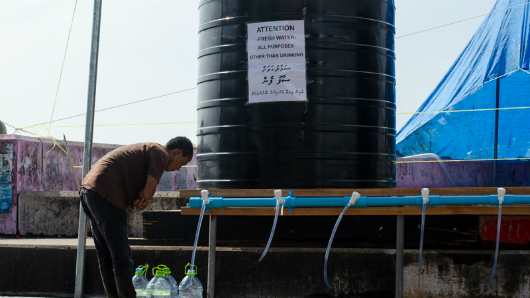
Water distribution to stop as Malé water crisis nears end

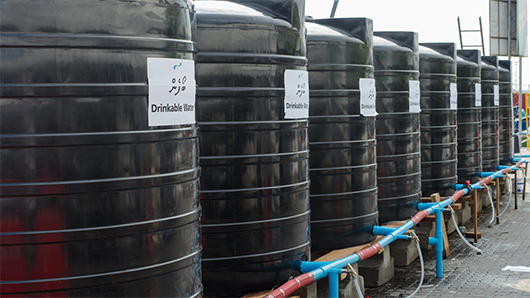
Distribution of free water will stop today in the capital Malé, says the Maldives National Defence Force (MNDF), as the water crisis nears an end.

After a fire in the Malé Water and Sewerage Company (MWSC) on December 4 left the capital’s 130,000 inhabitants without running water, 24 hour service was resumed to homes yesterday.

An MNDF spokesman confirmed to Minivan News today that the mobile units had ceased operation, and that distribution of bottled water from 10 designated points in the city would stop today.

The Maldives Red Crescent – which has played a key role in relief efforts – has also confirmed that its operations have shut down.

“We have closed down our operations centre as things are more or less back to normal,” explained Senior Programme Officer Fathimath Himya.

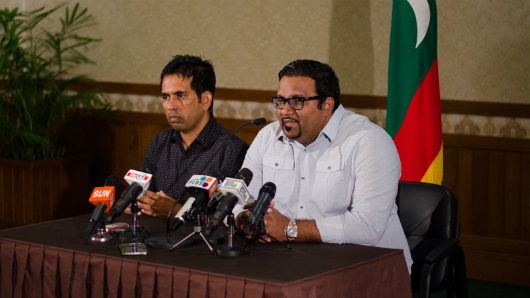
Minister of Defence Colonel (retired) Mohamed Nazim – who leads the president’s water crisis task force – told the media on Thursday night that full services would be resumed for three days in order to test the repairs.

“The water treatment plant is functioning on a temporary setup,” Haveeru reported Nazim as saying. “But we must ask you to not stress the water supply and manage by making some adjustments”.

Custom built panel boards arrive in the Maldives from Singapore on Wednesday via a Sri Lankan Air Force flight.

Sri Lanka has been among a number of international donors who have provided bottled water and desalination facilities over the past 8 days – most notably India which was first to respond, sending military aircraft with fresh supplies within 24 hours of the fire.

The Bangladeshi naval ship Samudra Joy became the third vessel to arrive in Malé on Thursday (December 11), joining the Indian and Chinese ships already docked near Malé’s main port.

BNS Samudra Joy

While Nazim had announced on Wednesday (December 10) that free water would no longer be distribute as stocks returned to local shops, long lines continued to be seen around the capital on Friday evening.

The crisis has raised questions regarding the city’s preparedness for such an instance, although President Abdulla Yameen has described the situation as unforeseeable.

During the crisis, Yameen’s task force revealed it was to seeking US$20million in donations to the ‘Malé water crisis management fund’.

After the opposition and civil society groups expressed concerns over the lack of detail regarding the fund, Nazim explained on Wednesday that it would cover the uninsured costs of relief efforts as well as the construction of the 20,000 ton water reserve.

The President’s Office explained earlier this week that MWSC plants produce 20,000 tonnes of water per day at full capacity, while the population of Malé consumed around 14,000 tonnes per day.

The government has revealed that private donors have contributed US$5.5million to the fund so far, pledging to disclose full details of fund. China is reported to have donated to the fund, as well as private donors from Saudi Arabia and from within the Maldives.

Both the UN in Maldives and the Human Rights Commission of Maldives have commended the government’s response to the situation, though the opposition has called for a full inquiry into the causes of the crisis.


Related to this story


Government scales down water relief effort

UN Maldives commends government’s response in water crisis, opposition condemns

No fall back for disaster of this magnitude: President Yameen

Likes(3)Dislikes(0)

“We do not want to be in Paris to get perished,” Maldives ambassador tells climate change convention

The Maldives has urged the world to take reach a strong and legally binding climate change agreement at the 2015 United Nations Climate Change Conference.

Speaking at the plenary meeting of the 20th Conference of the Parties to United Nations Framework Convention on Climate Change (UNFCCC) in Lima Ambassador Ahmed Sareer emphasised on the need for a negotiated text in order to arrive at a strong agreement in Paris in 2015.

“We do not want to be in Paris to get perished,” said Sareer.

The Maldives mission to the United Nations reports that Sareer told the meeting that the Maldives, as a small, low-lying island state, is among the most vulnerable and least defensible countries to the projected impacts of climate change.

Touching on the ongoing water crisis in Malé, Sareer said that the situation “is a stark example of the vulnerability of small island developing states like the Maldives that has no natural fresh water sources”.

A fire in the capital’s only desalination plant left 130,000 people without running water last week, requiring international relief efforts to deal with the crisis.

Unusual in the crowded capital, water shortages have become commonplace in the country’s outer atolls – a combination of periods of drought and groundwater contaminated by the 2004 tsunami.

Noting the recent pledges to the Green Climate Fund – intended to raise $100 billion a year by 2020 – Sareer said: “as a small island developing state that is constantly facing an existential threat, the current pledges are simply not enough”.

The Maldives has recently become chair of the Alliance of Small Island States (AOSIS), while former President Maumoon Abdul Gayoom calling on larger nations to allow vulnerable states to take a lead in climate change policy.

Ambassador Sareer said that the Maldives’ share of global emission is negligible, and that the government of Maldives was striving to make the country resilient.

Former President Nasheed – who gained international acclaim for his efforts at the 2009 climate change conference – recently told the International Bar Association (IBA) that he feared Maldivians could become the world’s first climate change refugees.

“When I was elected president, I caused some controversy by saying we would someday have to leave our islands. I was hopeful then that we would be able to change the way our story ends. But I fear it is too late now for the Maldives,” he told the IBA’s showcase session on climate change and human rights.

The 2015 United Nations Climate Change Conference – or COP21 – will be held in Paris between November 30 and December 11 next year.

The COP21 organising committee has said that: “By the end of the meeting, for the first time in over 20 years of UN negotiations, all the nations of the world, including the biggest emitters of greenhouse gases, will be bound by a universal agreement on climate.”


Related to this story

Maldivians could be among first climate refugees, warns Nasheed

Maldives world’s most vulnerable country to climate-change related impacts on food security

Maldives’ economy hardest hit by climate change: Asian Development Bank

Likes(4)Dislikes(0)

JSC recommends dismissal of Chief Justice Ahmed Faiz and Justice Muthasim Adnan

The Judicial Services Commission has today recommended Chief Justice Ahmed Faiz and Justice Musthasim Adnan be dismissed from the Supreme Court bench.

The decision comes within hours of  President Abdulla Yameen ratifying an amendment to reduce the seven-member Supreme Court to five judges.

According to local media, several members of the judicial watchdog body boycotted today’s extraordinary meeting, claiming the amendment was unconstitutional.

JSC Secretary General Abu Bakr refused to provide details of today’s meeting stating the commission had decided to keep proceedings confidential until the Majlis reaches a decision.

According to the revised Judicature Act, the JSC must deem two of the seven judges unsuitable for the position within three days and the parliament must vote out the judges with a two-thirds majority of members present and voting within seven days. Dismissed judges will be provided a generous compensation package.

Article 154 of the Constitution says a judge can only be removed if the JSC finds a judge guilty of gross incompetence or misconduct.

Dismissal of the judges appear likely as the ruling Progressive Party of the Maldives (PPM) and coalition partner Maldives Development Alliance (MDA) control 48 seats of the 85-member house.

The opposition Maldivian Democratic Party (MDP) and Jumhooree Party (JP), who opposed the amendment, only control 23 and 12 seats respectively.

The amendment was proposed by MDP MP Ibrahim ‘Mavota’ Shareef, but the MDP issued a three line whip against the proposal with opposition leader and former President Mohamed Nasheed saying it would allow President Yameen to stack the Supreme Court bench in his favor.

JP Leader Gasim Ibrahim on December 2 called the amendment unconstitutional and an “atrocity.” He said the amendment will allow the executive and Majlis to change the Supreme Court bench at their whim.

Faiz and Adnan have formed the dissenting opinions in several controversial cases, including the decision to annul the first round of presidential elections held in September 2013.

Since then, the Supreme Court has been involved in numerous controversies both in and out of the court room.

Earlier this year, the Supreme Court used a ‘suo moto’ proceeding – allowing the Court to act as both the plaintiff and the judge – against the Elections Comission (EC).

EC president Fuwad Thowfeek and Vice President Ahmed Fayaz were subsequently charged with contempt of court and disobedience to order, being sentenced to six months in jail after the court used testimony given in the People’s Majlis independent commission’s oversight committee.

More recently, the court employed a similar ‘suo moto’ proceeding against the Human Rights Commission of the Maldives (HRCM) after it criticised the judiciary in its Universal Periodic Review (UPR) for the UN Human Rights Council.

The court charged the HRCM with undermining the constitution and sovereignty of the Maldives by spreading lies about the judiciary.  It said that the UPR submission– based on a 2013 report by the UN Special Rapporteur for Independence of Judges and Lawyers Gabriela Knaul – was “poorly researched”, “irresponsible” and “dangerous”.

June this year also saw Judge Ali Hameed – a sitting judge at the Supreme Court – cleared of a sex tape scandal after three recordings surfaced allegedly showing Ali Hameed engaging in sexual acts with three different woman.

The revised Judicature Act also propose the establishment of two additional branches of the High Court in the northern and southern regions of the Maldives.

The two new branches can only adjudicate the rulings of the magistrate courts. The nine-member High Court is to be divided among the three branches with three judges in each branch.

Likes(0)Dislikes(0)

Government scales down water relief effort

President Abdulla Yameen’s administration has scaled down water relief efforts today by ending the distribution of bottled water to residents of capital Malé.

“We decided to stop the bottled water distribution because there is no shortage of drinking water at the moment. There is also enough water at corner shops for purchase,” Minister of Defense Colonel (retired) Mohamed Nazim said at a press conference last night.

The government had set up water distribution centers after a fire at Malé Water and Sewerage Company (MWSC) on December 4 gutted the sole desalination plant in Malé, leaving 130,000 people without drinking and running water.

The opposition Maldivian Democratic Party (MDP) condemned the government’s decision with party Chairperson Ali Waheed saying that the decision will lead to further hardship and claimed the Maldives is currently seeing its worst days since the 1970s.

A Bangladeshi navy ship, the BNS Samudra Joy, arrived in Malé today with 100 tonnes of bottled water and five reverse osmosis plants, the Foreign Ministry has said.

Meanwhile, custom built panels to replace the damaged panel boards connecting electricity generators and desalination plants at MWSC arrived in Malé from Singapore today.

MWSC has now started releasing water once in the morning and once at night. Water was available for four hours this morning and will be available from 7:30 pm – 12:00 am tonight.

The government has also decided to establish a 20,000 ton ‘strategic reserve’ of water to prevent another crisis, using funds gathered through the US$ 20 million ‘Malé water crisis management fund.’

Nazim, who also heads the water crisis task force, said that funds would mainly be used to recover costs which are not covered by insurance, the construction of the 20,000 ton water reserve and to cover the cost of relief operations. Individuals and corporations who contributed to the relief effort will all be reimbursed, he said.

The fund’s establishment has garnered criticism from the opposition and civil society groups, who have demanded transparency in the fund’s utilization.

In response, Nazim said the fund was set up with “very good intentions.”

“Information about the fund would be released in a very transparent manner. I urge the public to refrain from politicizing the fund.” he added.

Anti-corruption NGO Transparency Maldives has demanded a break down of the US$20 million and said “the decision to seek donations from the public raises questions given that MWSC is a private, profit-making corporation with 80 per cent government shares.”

Private donors have contributed US$5.5million to the fund so far.

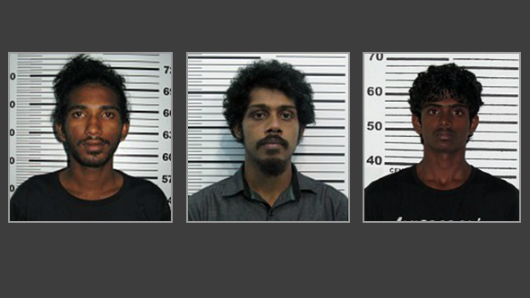
Protests demanding free water continued in Malé last night, but were disrupted for the third time by a group of seven young men.

Minivan news observed six to seven young men who were hiding within the protesters jump on a truck and start vandalizing the generator powering the sound system. One attacker lifted up the generator and threw it on the ground.

Police immediately moved in and arrested the attackers. Minivan news saw little to no resistance from the attackers during the arrest.

Several eyewitnesses later told Minivan news that the attackers were praising President Yameen as they waited for a police vehicle to take them to the police head quarters.

“President Yameen is the best thing to have happened to the nation,” one of the attackers was reported as saying.

Another eyewitness told Minivan News that he heard one Special Operations (SO) police officer insulting Former President Mohamed Nasheed while stating those arrested would be released the next day.

A police media official confirmed to minivan news that seven men were arrested last night in relation to the attacks at the protest.

A similar incident occurred on the previous night when three young men attacked the protest armed with box cutters.

On Wednesday, Mirihi Island resort has donated a temporary desalination plant capable of producing 100 tonnes of water to the Indhira Gandhi Memorial Hospital.

The MNDF has also started distributing disposable cups, plates and cutlery to cafés in Malé.

Likes(2)Dislikes(0)

Failure to prosecute serious crimes tantamount to “state-sponsored terrorism,” says Nasheed

The government’s failure to investigate and prosecute serious crimes is tantamount to “deliberate state-sponsored terrorism,” contends former President Mohamed Nasheed.

In a statement issued yesterday on the occasion of International Human Rights Day (December 10), the opposition leader accused senior government officials and elements of the police of complicity in abductions, murder, arson attacks, and gang violence.

“I note that the government has not investigated such incidents that have occurred throughout the year and serious criminals are on the loose. The state has not pressed charges against them,” the statement read.

Nasheed argued that the government’s inaction has caused harm and undermined fundamental rights, calling on the public to “find courage from each other for justice and stand up against inhumane torture.”

The opposition Maldivian Democratic Party (MDP) was formed to change the old system of governance and bring an end to ill-treatment and torture inflicted on citizens by the state, the statement observed.

“Custodial abuse was stopped under the MDP’s first government. Maldivians began to find hope and courage,” it continued.

“[But] the flame of hope is again flickering out.”

At a rally held last month to celebrate the current administration’s first year in office, President Abdulla Yameen pledged to crack down on violent crime and implement the death penalty.

“We have peace and order in Malé and all regions of Maldives. We have peace. However, this is not to say that isolated and significant dangerous crimes do not occur,” he said.

Unresolved cases

Nasheed’s statement went on to list serious crimes that have occurred in 2014, stressing that the perpetrators have not been brought to justice in the majority of the cases, including the stabbing of former MDP MP Alhan Fahmy on February 2.

An expatriate lorry driver was stabbed and robbed of cash and a mobile phone on January 25, the statement continued, while two days later, three men were stabbed in separate incidents in the capital Malé.

On February 3, a minor was assaulted with a wooden plank near the Adi Park in the Henveiru ward of the capital and sustained head injuries.

While suspects were taken into custody in some of the cases, Nasheed noted that none of the arrests led to criminal prosecution.

On April 12, former Gender Minister Dr Amaal Ali was robbed at knifepoint at her residence.

“On April 4, 2014, a 79-year-old was stabbed in Gaaf Dhaalu Thinadhoo,” the statement continued. “On May 18, 2014, Mohamed Naeem, of Baa Hithaadhoo Thiraa, was stabbed and injured in an assault inside a guesthouse in Malé.”

On July 31, a 35-year-old man was stabbed to death on the island of Thulusdhoo in Kaafu atoll and the suspect voluntarily submitted to police.

Two days later, two young men were stabbed in Malé, resulting in the death of 18-year-old Mohamed Mazin while undergoing treatment for stab wounds.

In the previous week, four men and a woman were assaulted in separate incidents. While one man was mugged in the Maafanu ward, two men were stabbed in Hulhumalé, a woman was stabbed in the back in the Galolhu ward, and a fourth victim was stabbed in the Henveiru ward.

On August 23, two men and a minor were assaulted and stabbed by masked men on motorcycles in the Dhidhi Goalhi in front of Iskandhar School in Malé.

One of the victims, Ahmed Aseel, 19, later died as a result of injuries sustained in the assault.

Police intelligence suggests that the spate of violent assaults in Malé since the beginning of Eid Holidays were gang reprisals “caused by a disturbance between two groups,” Chief Inspector Abdulla Satheeh told the press at the time.

More recently, a man was injured in a violent assault on October 3, a group of girls were attacked with a chain in Raa Madduvari on October 9, and a young man was stabbed near the police tow yard in Malé on October 26.

During the past month, two men were stabbed in a café in Malé on November 2 and a young man was assaulted with an iron rod in the Galolhu ward of Malé on November 16.

Earlier in the day, an 18-year-old man was arrested after entering the Bilabong International High School with a machete during a gang fight.

On December 7, a 28-year-old man was stabbed to death in Malé near the People’s Majlis building.

Nasheed also referred to the suspected abduction of Minivan News journalist Ahmed Rilwan 125 days ago, accusing the government of both negligence in investigating the disappearance and covering up the abduction.

Moreover, in June, a vigilante mob abducted several young men in a push to identify online activists advocating secularism or professing atheism.

Nasheed noted that police did not investigate the incidents despite media reports.

“During the past year, press freedom and freedom of expression have declined. Intimidation of journalists and youth active on social media have become commonplace. The government has obstructed peaceful political activity,” the statement read.

In October, Amnesty International called on the government to “intensify efforts” to find those responsible for death threats, abductions, and violent attacks against journalists, politicians, and civil society activists.


Related to this story

Yameen pledges to end violent crime at ‘Successful 365 Days’ rally

MDP condemns insecurity as PPM celebrates peace and order

Likes(1)Dislikes(0)

HRCM commends government response to water crisis

The Human Rights Commission of Maldives (HRCM) commended the government’s response and relief efforts during the ongoing Malé water crisis in a statement issued yesterday on the occasion of International Human Rights Day.

The efforts of various government institutions – under the supervision of President Abdulla Yameen – to provide water to residents of the capital were “praiseworthy,” HRCM Chair Mariyam Azra said.

The HRCM noted that arrangements were made to prioritise persons with special needs, pregnant women, the elderly, and children.

The commission advised taking the human rights of disadvantaged persons into account when formulating government policies, structures, and plans.

Parliament should also ensure the protection of fundamental rights in approving legislation, the statement added, noting that rights could only be restricted or narrowed “only if demonstrably justified in a free and democratic society.”

Meanwhile, among the commission’s achievements during the past year were conducting a national inquiry into the rights of persons with disabilities and finalising plans to open a regional office in the south.

Likes(0)Dislikes(0)

Parliament reduces Supreme Court bench to five judges

The People’s Majlis has today amended the Judicature Act to reduce the seven-member Supreme Court bench to five judges.

The amendment proposed by opposition Maldivian Democratic Party (MDP) MP Ibrahim ‘Mavota’ Shareef passed with backing from the ruling Progressive Party of the Maldives (PPM) and its ally Maldives Development Alliance (MDA).

46 MPs voted in favor and 19 MPs voted against the amendment.

The MDP had issued a three-line whip against the proposal with opposition leader and former President Mohamed Nasheed claiming the amendment would allow President Abdulla Yameen to stack the bench in his favor.

Shareef himself voted against the amendment.

MDP MP ‘Reeko’ Moosa Manik – who has announced intentions to contest in the MDP’s 2018 presidential primary – voted for the amendment.

He previously described the formation of the current Supreme Court bench as a “shameful” political bargain between the MDP and then–opposition parties in 2010.

According to the amended Judicature Act, a Supreme Court judge can only be dismissed if the judicial watchdog body, the Judicial Services Commission (JSC), decides they are unsuitable for the position.

The JSC must then submit names of the judges to be dismissed within three days of the amendment’s enforcement.

Judges can only be dismissed by a two-third-majority vote of the Majlis. The amendment gives the Majlis a period of seven days to dismiss the judges. Judges who fail the vote will remain on the bench.

The PPM and MDA control a combined 48 seats in the 85-member house.

Three judges sit on the ten-member JSC. They are Supreme Court Judge Adam Mohamed, High Court Judge Abdulla Hameed and Superior Court Judge Mohamed Easa Fulhu.

The amendments also propose the establishment of two additional branches of the High Court in the northern and southern regions of the Maldives.

The two new branches can only adjudicate the rulings of the magistrate courts. The nine-member High Court is to be divided among the three branches with three judges in each branch.

The Supreme Court has recently been involved in numerous controversies both in and out of the court room.

Earlier this year, the Supreme Court used a ‘suo moto’ proceeding – allowing the Court to act as both the plaintiff and the judge – against the Elections Comission (EC).

EC president Fuwad Thowfeek and Vice President Ahmed Fayaz were subsequently charged with contempt of court and disobedience to order, being sentenced to six months in jail after the court used testimony given in the People’s Majlis independent commission’s oversight committee.

More recently, the court employed a similar ‘suo moto’ proceeding against the Human Rights Commission of the Maldives (HRCM) after it criticised the judiciary in its Universal Periodic Review (UPR) for the UN Human Rights Council.

The court charged the HRCM with undermining the constitution and sovereignty of the Maldives by spreading lies about the judiciary.  It said that the UPR submission– based on a 2013 report by the UN Special Rapporteur for Independence of Judges and Lawyers Gabriela Knaul – was “poorly researched”, “irresponsible” and “dangerous”.

Knaul’s report had detailed the pressing need for judicial reform, noting that the five-member transitional Supreme Court had been replaced by a seven-member permanent bench in 2010 with “no legal or constitutional basis”.

June this year also saw Judge Ali Hameed – a sitting judge at the Supreme Court – cleared of a sex tape scandal after three recordings surfaced allegedly showing Ali Hameed engaging in sexual acts with three different woman.

Likes(1)Dislikes(0)

Custom built MWSC panels to arrive in the Maldives

A Sri Lankan Air Force flight is currently on its way to the Maldives from Singapore with custom built panels to replace the damaged panel boards connecting electricity generators and desalination plants at the Malé Water and Sewerage Company (MWSC).

The capital Malé was  plunged into crisis on Thursday (December 4) as a fire at MWSC gutted the desalination plant, leaving 130,000 people without running water, leading to the dwindling of bottled drinking water supplies.

Defense Minister Mohamed Nazim said the two boards will arrive in Malé tonight. Of the nine panel boards, five were functional on Monday and MWSC had started releasing water to households in two three-hour periods in the morning and at night.

However, residents living above the second floor of buildings have said they only receive water for a very short period of time. The MWSC has asked individuals to report issues with water leakages and booster pumps to send an SMS to 1050 with the client’s name and water meter number.

Previously, the government rejected an offer by the Indian government to provide technical assistance in fixing the panels, saying it is seeking assistance from countries that are more technologically advanced.

The government has today announced it has received US$ 5.5 (MVR 84 million) for the ‘Malé water crisis management fund.’

The crisis management fund – which has seen donations from several local corporations and foreigners – was set up by the government with an aim of collecting US$ 20 million (MVR 308 million) to repair the damages at the desalination plant and to fund relief efforts.

Notable local businesses such as Champa Group and Universal enterprises donated US$ 100,000 to the fund, while an unnamed Saudi Arabian donor provided US$ 1 million.

Telecomms company Ooredoo donated US$ 75,000 to the fund. Trans Maldivian Airways (TMA) and State Trading Organization (STO) have also donated funds.

Anti-corruption NGO Transparency Maldives called on the government to display more transparency in order to avoid “economic and political repercussions stemming from the water crisis”.

In a press statement, the NGO urged the government to provide a breakdown of the estimated US$ 20 million needed to overcome the crisis and how the government intends to spend it.

“Furthermore, the decision to seek donations from the public raises questions given that MWSC ins a private profit-making corporation with 80 percent government shares,” said Transparency Maldives.

An Indian flight is also due to arrive today with 50 tons of water while the INS Deepak supplied 400 tons of water straight to MWSC tanks on top of the 1250 supplied two days ago.

Indian High Commission said today that the water relief operations resumed on the request of the Maldivian government.

Opposition Maldivian Democratic Party (MDP) also criticized the fund stating that the government should only demand US$ 20 million after they have decided how it is going to be spent.

“Where is the money going to go to? Why have we not seen a breakdown on how the money is going to be spent? Will this be a new ring in the chain of corruption by the government?” questioned party Vice Chairperson Ali Niyaz.

Former President and opposition leader Mohamed Nasheed has also called for an inquiry into the fire, suggesting that the Danish government previously recommended keeping 21 days of water reserves in the capital.

Transparency  Maldives noted that the crisis had demonstrated “the interminable relationship between good governance and citizens’ right to essential human needs,”  and called for greater regulation of state-owned enterprises.

With 130,000 citizens of the capital left without water, the government has said it could take up to two weeks to fully repair the damage. President Abdulla Yameen has said that there could have been no back up plan for a “disaster of this magnitude”.

Likes(3)Dislikes(0)

Parliament approves state budget for 2015 with 60 votes in favour

The People’s Majlis today approved the record MVR24.3 billion (US$1.5 billion) state budget for 2015 submitted by the government without significant changes to either spending plans or revenue forecasts.

None of the 19 amendments submitted by opposition Maldivian Democratic Party (MDP) MPs and Jumhooree Party (JP) MPs to revise the budget passed as pro-government MPs voted against all the proposals.

The ruling Progressive Party of Maldives (PPM) along with coalition partner Maldives Development Alliance (MDA) controls a combined 48 seats in the 85-member house.

The budget passed with 60 votes in favour and 19 against.

The MDP parliamentary group had issued a three-line whip for its MPs to vote against the budget if none of the proposed revisions are passed. All JP MPs, however, voted to approve the budget.

While the budget review committee completed its review process without significant revisions, pro-government MPs recommended several constitutional amendments to reduce recurrent expenditure.

During the budget debate last month, opposition MPs criticised higher taxes, deficit spending and alleged discrimination in the allocation of funds, whilst pro-government MPs praised planned capital investments and contended that the budget was balanced.

In his budget speech, Finance Minister Abdulla Jihad noted that recurrent expenditure in 2015 is expected to be MVR15.8 billion (US$1 billion) or 65 percent of the budget while the forecast for government income or revenue is MVR21.5 billion (US$1.3 billion).

Capital expenditure meanwhile accounts for 30 percent of the budget, Jihad said, which includes MVR6.3 billion (US$408 million) for the Public Sector Investment Programme (PSIP).

Jihad noted that MVR3.4 billion (US$220 million) was anticipated from new revenue raising measures, which includes revisions of import duty rates from July onward, the introduction of a ‘green tax’, acquisition fees from investments to special economic zones, income from the home ownership programme, and leasing 10 islands for resort development.

The government has since decided to reduce the green tax from the initially proposed US$10 per day to US$6 per day and exempt guest houses from the tax.

Additionally, the cabinet’s economic council yesterday decided not to impose a planned 10 percent import duty on staple foodstuff.

However, in its professional opinion on the budget, the Maldives Monetary Authority (MMA) advised against making ad hoc changes to policies that could affect projected revenue and expenditure.

“If policies are changed the budget deficit would increase and become difficult to finance,” the central bank cautioned.

The MMA also advised against launching infrastructure projects without securing financing.

Following its annual Article IV consultation, the International Monetary Fund (IMF) advised that “large capital investments should only be embarked upon when full financing is secured at affordable costs and the growth benefits clearly outweigh the costs.”

The IMF also recommended addressing the fiscal deficit by reducing public expenditure and reigning in public debt.

During the final debate at today’s sitting of parliament on the report compiled by the budget committee following its review, MPs suggested allocating funds in the 2015 state budget to ensure a permanent solution to the ongoing water crisis in the capital.

While opposition MDP MP Ibrahim Mohamed Solih recommended returning the budget to the committee for revisions, several MPs stressed the importance of establishing a backup mechanism to supply water.

MDP MP Ibrahim Mohamed Didi contended that the crisis could have been averted if the fire and rescue service of the Maldives National Defence Force (MNDF) properly carried out its responsibilities.

The MNDF could have conducted a ‘fire audit’ of the Malé Water and Sewerage Company (MWSC) at least once a month in the interest of national security, the retired brigadier general said.


Related to this story

Finance minister presents record MVR24.3 billion state budget to parliament

MDP, JP MPs propose 19 amendments to 2015 budget

MDP parliamentary group issues three-line whip against proposed 2015 budget

Likes(4)Dislikes(0)