Sniffer dogs locate drugs at Maafushi jail

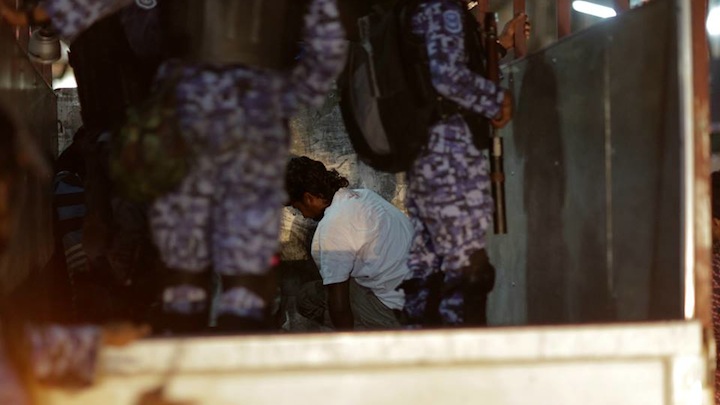
The police drug enforcement department and the Maldives correctional services conducted a joint operation in Maafushi jail yesterday using sniffer dogs to locate drugs.

Tuesday’s 14-hour operation was the first time dogs were used to search a Maldivian prison.

Superintendent Ahmed Shifan, head of the drug enforcement department, told the press today that the dogs located 25 rubber packets containing hash oil and five packets containing heroin.

A large number of mobile phones, SIM cards and chargers was also confiscated from the cells, Shifan said.

He added that police are working with the correctional service to prevent the entry of drugs and phones to the high security prison. Prison guards have previously been caught smuggling drugs for inmates.

The correctional services had also confiscated 200 packets of illicit narcotics during a search operation in November last year.

Home minister Umar Naseer brought in 16 puppies from the Netherlands in March to tackle the Maldives’ entrenched drug abuse and trafficking problem.

The dog squad or ‘K9 unit’ reportedly cost the government US$40,000. Custom-made kennels have been established at the airport, and the government has brought in British and Dutch trainers to train police officers on working with the dogs.

Likes(2)Dislikes(0)

Environment ministry launches waste management campaign

The ministry of environment and energy has launched a waste management campaign today to raise awareness among the public.

The ‘Saafu Raajje’ campaign aims to “promote public education and awareness on proper waste management and reduction of waste being thrown out on to the streets, parks and other public places and on to the sea,” the environment ministry said.

The ministry is organising a clean up event at the Usfasgandu area in Malé on Saturday at 7am.

Environment minister Thoriq Ibrahim launched the campaign at a ceremony held at the Hotel Jen in Malé.

In his remarks at the function, Thoriq said individuals have a responsibility to keep the Maldives’ fabled natural environment clean. The lack of a proper waste management system was one of the biggest challenges facing the country’s environment, he said.

Work is underway on establishing island waste management centres in 44 islands across the country, Thoriq said.

The environment ministry meanwhile sent out mass text messages today with an appeal to keep public spaces clean and free of garbage.


Likes(2)Dislikes(0)

Over MVR6m needed to provide water to 97 islands

The disaster management centre estimates that about MVR6.5 million (US$421,530) will be spent this year to provide clean water to 97 islands due to persisting shortages.

Deputy minister of defence Fathmath Thasneem told the press today that 97 islands have reported water shortages so far this year and the centre has delivered supplies to 76 islands.

The centre is able to provide water within two weeks upon request, she said.

The centre is presently filling community water tanks in eight islands and trying to provide supplies to five other islands, she added.

Thasneem appealed for islands to report shortages before supplies run out and advised communities to boil the supplied water before drinking as health problems have arisen.

The centre provided supplies to 77 islands last year.

Since its inception in 2004 after the Indian Ocean tsunami, which contaminated groundwater in several islands, the centre has been providing water to about 80 of the Maldives’ 188 inhabited islands each dry season for the last ten years.

While islands communities relied on groundwater in the past, consumption in most islands has increased above the rate at which groundwater is naturally replenished, according to the environment ministry, forcing communities to rely on rainwater.

In 2005, the government provided islands with large numbers of storage tanks to store rainwater.

However, with low average rainfall during the dry season, numerous islands are left in a drought every year, forced to rely on the disaster centre for drinking water.

Likes(2)Dislikes(0)

Commonwealth human rights NGO calls for police brutality investigation

The Commonwealth Human Rights Initiative (CHRI) has called on the government to investigation allegations of police brutality and arbitrary arrest of protesters from Friday’s anti-government demonstration.

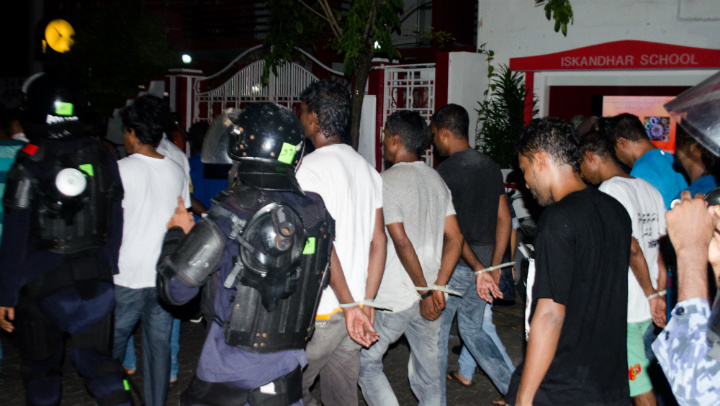
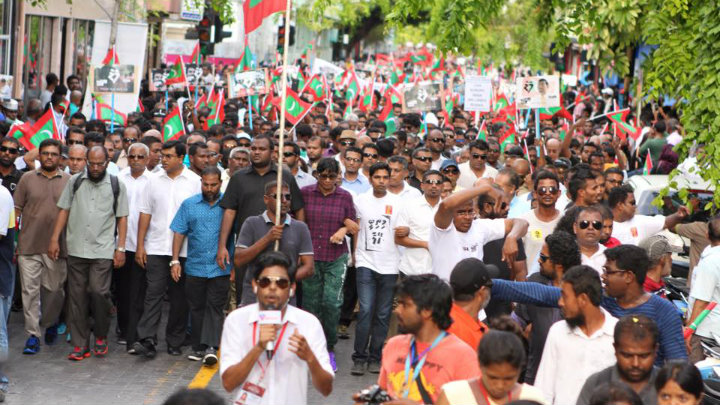
The international human rights NGO expressed concern with reports of police using disproportionate force against protesters during a crackdown on the 20,000-strong opposition protest. Nearly 200 protesters were arrested and 175 remain in police custody.

The main opposition Maldivian Democratic Party has also alleged the police severely beat three men arrested on suspicion of assaulting a police officer at the protest and threatened to kill them.

“The reports once again point to serious concerns regarding police excesses. Freedom of assembly is a fundamental tenet of participatory democracy and it is the duty of the government as well as the police to take measures to ensure people are able to exercise their right in a peaceful and meaningful manner,” said CHRI Director Maja Daruwala.

“Any action of the police in dealing with public gatherings must be strictly according to procedure established by law and must be held accountable. Allegations of excessive use of force must be investigated independently. Only then will Maldives move towards policing that is fair, non- discriminatory, lawful and efficient.”

The CHRI is an NGO with a Special Consultative Status with the Economic and Social Council of the United Nations.

Police have denied the allegations of torture. A police media official told Minivan News yesterday that lawyers for the detainees have not submitted complaints to the police. The human rights watchdog said it is investigating three cases of apparent brutality.

The CHRI also said high number of arrests raises questions over the legality of police action, as freedom of assembly is a fundamental right guaranteed by the constitution while the 2013 peaceful of assembly law assures protestors will not be detained or prosecuted for taking part in a demonstration.

The law also includes procedural safeguards on the dispersal of unruly or violent public gatherings with the use of force, the CHRI noted, including a requirement for police to issue at least three warnings.

The law states that the use of force must be legitimate, reasonable and proportional to the situation.

The NGO called for independent investigations by the police and human rights watchdog bodies to determine the legality of police action on May 1, including “a review of the grounds on which such large numbers have been arrested and detained”.

If investigations determine that excessive force was used, the CHRI said junior officers in charge of dispersing protesters as well as senior officers with supervisory responsibilities must face civil or criminal charges.

“CHRI calls for an end to police impunity that once again lies at the heart of deepening public distrust and urges the Government to provide accountable and just policing befitting a constitutional democracy,” reads the NGOs statement.

Likes(2)Dislikes(0)

“You will never walk out of here alive”: MDP reveals details of alleged torture of May Day detainees

The main opposition Maldivian Democratic Party (MDP) has accused police of torturing and threatening to kill suspects arrested for assaulting a police officer during Friday’s anti-government protest.

Nine suspects have been taken into custody over the assault. Video footage shows protesters tripping and kicking a Specialist Operations (SO) officer and one man hitting the policeman over the head with his baton.

The MDP said Moosa Sharmeel, 35, was arrested from his home in Malé by policemen in plainclothes and severely beaten in front of his wife and children.

“He was taken to police headquarters where he was beaten again. The detainee reports that the policemen inside the building, including those at the reception counter, cheered on while he was being beaten,” the MDP said in a statement yesterday.

Policemen kept saying “we will kill you” as they beat him, Sharmeel told his lawyer.

“He was shoved on the floor and beaten until he lost consciousness. His head smashed open when he was shoved to the floor.”

Police have denied the allegations of torture. A police media official told Minivan News yesterday that lawyers for the detainees have not submitted complaints to the police.

Lawyers and families could also file cases with independent oversight bodies such as the Police Integrity Commission (PIC) and the Human Rights Commission of Maldives (HRCM), the official suggested.

The human rights watchdog is investigating cases of alleged police brutality and custodial abuse.

Nearly 200 protesters were arrested from the 20,000-strong anti-government demonstration, which was the highest number of arrests made from a single protest in over a decade. Some 175 protesters are being held in remand detention for 15 days.

Sharmeel’s lawyer, Abdulla Haseen, told the press yesterday that a police officer intervened and stopped the beating. He was then taken to the Indira Gandhi Memorial Hospital and admitted at the intensive care unit for treatment of injuries.

Police denied his requests for a CT scan after he complained of a “foul smelling discharge from his head,” the MDP said.

Haseen said Sharmeel was suffering from chest pains, had difficulty digesting food, and suspects he has internal injuries due to the beating.

Eyewitnesses told Minivan News they saw policemen in plainclothes beating a man around 3:15am on Saturday near the Henveiru stadium, close to Sharmeel’s residence. Seven men, some wearing jerseys and shorts, repeatedly punched and kicked the man and drove off with him in a police van.

The MDP said Sharmeel was not taken to court within 24 hours “as his injuries from the beatings would have been too visible.”

“Instead, he was released near the Malé detention Centre (Atoll Vehi) and immediately shown another arrest warrant and taken into custody again,” the party said.

Police allegedly told Sharmeel he was “arrested for his own safety” and are now claiming “he was beaten inside his home by members of the public who also allegedly transported him to the Police HQ.”

The MDP also said two other suspects, Abdulla Ibad, 32, and Mohamed Rasheed, 52, were also beaten at the police headquarters.

Both detainees reported police threatening to kill them. Rasheed said police “kept saying ‘you will never walk out of here alive again. We will charge you with terrorism, you do not have that much longer to live anyway.'”

The party said other detainees reported beatings on the police vehicle after their arrest.

Former MDP MP Ahmed Easa was allegedly kicked and beaten on the head with batons after he was hauled on to the police vehicle. Minivan News journalists at the scene heard Easa scream from the vehicle packed with SO officers.

Easa was limping when he was brought to the remand hearing on Saturday.

The MDP noted that video footage shows Easa along with other protesters shove off the violent protesters, help the fallen SO officer to his feet, and take him back behind police lines.

Easa and MDP chairperson Ali Waheed were brought to a clinic in Malé last night. The MDP has said police doctors at Dhoonidhoo recommended the pair consult specialist doctors.

Lawyer Fareesha Abdulla said yesterday that three of her clients among the May Day detainees have alleged beatings by police.

The Dhoonidhoo doctor recommended medication for head injuries for one detainee, who says he has not received medicine so far, she said.

Police officers kicked and beat a second detainee with batons on a police vehicle, she said, while an SO officer kicked him on the groin with his knee at the police headquarters.

He has not been provided medicine prescribed by police doctors, she said.

Another detainee with a chronic illness said police were not providing medication at prescribed times, Fareesha said.

The detainee was having seizures due to the lack of medication, she said.

Likes(3)Dislikes(0)

Maldives defends death penalty and flogging

The Maldives has defended the death penalty for murder and flogging for fornication at a UN human rights review on Wednesday, stating the punishments are mandatory in Islamic law.

Several countries including France, the United Kingdom, Ukraine, Namibia, Spain, Australia and Montenegro expressed concern over Maldives’ decision to end a six-decade moratorium on the death penalty last year.

However, speaking to the UN human rights council in Geneva, legal affairs secretary Aishath Bisham said: “We would like to stress that Islamic principles dictate that its legal measures are to be enforced and regulated by law and process after necessarily subjecting it to rigorous judicial framework.”

The Maldives constitutional assembly had declared Islam to be the state religion and the basis of all laws enacted in the country, and requires judges to refer to Islamic law, she noted.

However, the enforcement of the death penalty and flogging are “never intended to be arbitrary or capricious,” she said.

The former UN high commissioner for human rights Navi Pillay and Amnesty International have called on the Maldives to abolish flogging, describing it as an inhumane and degrading treatment.

In 2012, the juvenile court’s decision to flog a 15-year-old rape victim sparked international outrage and led the high court to overturn the ruling.

Information previously made available by the Department of Judicial Administration showed that, while applicable to both men and women, flogging is largely discriminatory against women in practice.

But Bisham said the enforcement of flogging is never served “as a retributive penalty” and primarily serves as a deterrent.

“It is strictly regulated and enforced only when the appeal or its opportunity is exhausted and is executed with civility. The respective regulations disallow flogging on any woman found to be mentally incompetent, or if there is a potential risk to the person’s life, limb or even the function of his her senses.

“Flogging is never enforced on children and pregnant women. The practice itself is with minimal force, with absolutely no instances of nudity or exposure, in full recognition of the person’s right to dignity constitutionally prescribed in the Maldives,” she added.

The standard of proof required in proving an offence prescribed in Islamic law is “far stricter than the conventional threshold of beyond reasonable doubt.”

Flogging is enforced in the Maldives in only five out of a potential 425 offences, she said.

Meanwhile, the death penalty will be enforced in cases of wilful murder alone, and only if the accused confesses in a court of law and when all three tiers of the judiciary deem the accused guilty, she said.

If the accused denies the charges at any stage of prosecution, it will be legally impossible to issue the death sentence, she said.

The government will “urgently strengthen” the legislative and judicial framework in cases of flogging and death penalty and will continuously subject the process to periodic independent assessments, she added.

The Maldives also maintained reservations on the call for lesbian, gay, bisexual and transgender rights and freedom of religion.

“Provisions on the country’s Islamic identity are evident in every single draft of constitution ever adopted all throughout our constitutional history. The government emphasises proudly that Islam has been and will remain as the defining part of the nation, its culture, and its people,” she stressed.

Likes(3)Dislikes(0)

Defence ministry sacks eight officers

The defence ministry has dismissed eight officers at the aviation security command claiming the military no longer trusted them.

But the dismissed officers, who are all members of the main opposition Maldivian Democratic Party (MDP), told Minivan News they were fired because of their political views.

The dismissals come at a time of heightened political tension in Malé following the imprisonment of former president Mohamed Nasheed and ex defence minister Mohamed Nazim.

The fired officers had served between 13 and 26 years at the aviation security command.

They include the head of security for Koodoo Domestic Airport, head of administration, head of cargo unit, head of human resources, supervisor of the Malé international airport’s international terminal, two outpost duty officers and a driver.

“We are all members of MDP and we will always remain so. But never in my 26 years of service have I ever betrayed the state. Now they see my political beliefs as a threat to them,” former head of Koodoo Airport Mohamed Nadeem told Minivan News today.

Hussain Nazeef, who was the head of cargo unit, said members of the ruling Progressive Party of the Maldives (PPM) had wanted them dismissed from their jobs.

“We were at a very senior level and the people working for us, who were also members of PPM, lacked proper qualification and the leadership to advance. So the only way for them to go ahead was to get us fired,” Nazeef said.

The ministry, citing budgetary constraints, had given the eight officers notice in early March, but the decision was not enforced until Wednesday. Two more officers who were given notice in March still remain at their jobs.

The dismissal notes said: “Based on the intelligence information gathered by the Ministry of Defence and National Security, you are no longer trusted to continue working in an environment related to the national security.”

At a press briefing today deputy defence minister Thorig Ali Lutfee dismissed the officer’s claims, but failed to reveal the reasons for dismissal.

“It is difficult to state the exact reason why we let go of any of our staff. We don’t want to reveal our reasons to the media,” he said.

Meanwhile, other employees of the Aviation Command say they “fear for their jobs” and have described their working environment as “tense.”

“There are many people who are depressed because they do not know what will happen to them eventually. People are scared of losing their jobs. It’s not easy to work in a place not knowing what accusations they are going to throw at you the next minute,” an employee who asked to remain anonymous said.

The defence ministry has previously brought changes to its ranks during Maldives’ frequent political crises.  In February, following the arrest of ex defence minister on weapons smuggling charges, the military dismissed the head of the armory and the head of the special protection group.

Several employees of state owned companies have also reported being dismissed for their participation in the opposition’s mass protests.

The defence ministry also dismissed several senior ranking officers from the military during the contested presidential elections of November 2013.

Nine soldiers including former head of military intelligence Brigadier General Ahmed Nilam, Brigadier General Abdulla Shamal, Captain Abdulla Muizz Musthafa and Sergeant Major Naushad Ali were dismissed in December 2013 after President Yameen assumed power.

Nilam and Muizz subsequently sued the state for unfair dismissal.

The Civil Court last Thursday threw out Nilam’s lawsuit, stating they were unable to summon Nilam to court as he had provided the wrong address on case documents.

Muizz’s case is ongoing.

Likes(4)Dislikes(0)

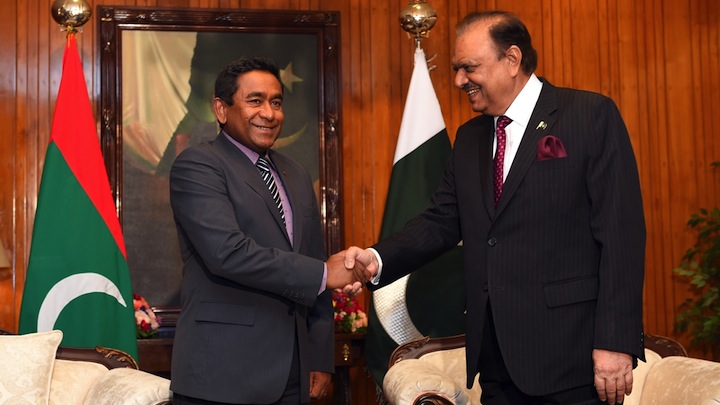
Four bilateral agreements signed with Pakistan

The Maldives has signed four Memorandums of Understanding with Pakistan today during president Abdulla Yameen’s ongoing two-day state visit.

The MoUs were for mutual cooperation in healthcare, education, sports, and combating drug abuse.

President Yameen was accompanied by first lady Fathmath Ibrahim, speaker of parliament Abdulla Maseeh Mohamed, and cabinet ministers. The delegation is due to return tonight.

President Mamnoon Hussain hosted a banquet in honour of president Yameen last night. The pair held talks on strengthening bilateral ties earlier in the day.

“President Yameen thanked his Pakistani counterpart for the excellent hospitality extended to himself and his delegation,” said the president’s office.

“President Yameen also extended an invitation to President Mamnoon Hussain to visit the Maldives at his earliest convenience. At the meeting, both the leaders deliberated on enhancing trade and cultural exchanges, as well as expanding the scope of investment opportunities. Discussions were also held on supporting each other in the global arena.”

Yameen has also reportedly invited prime minister Mohamed Nawaz Shareef to attend an official function due to be held on July 26 to mark the golden jubilee of the Maldives’ independence.

Likes(1)Dislikes(0)

Maldives judiciary hammered in UN human rights review

Countries across the world have blasted the Maldives for it’s politicized judiciary and expressed alarm over threats to journalists and human rights defenders at a UN periodic review of human rights in Geneva today.

The imprisonment of former president Mohamed Nasheed on terrorism charges was also noted with concern by Norway, Germany, the United Kingdom, Denmark, the United States, Canada and Australia.

But many countries welcomed new anti-torture laws and laws protecting migrant worker and women’s rights in the Maldives, and applauded progress in healthcare and education.

The UN’s Universal Periodic Review (UPR) comes amidst heightened international scrutiny of the Maldives over political turbulence triggered by Nasheed’s arrest in February. Hundreds were arrested this weekend in a 20,000 strong anti-government protest.

Foreign Minister Dunya Maumoon said the Maldives is training and building capacity of judges, and said criticism of Nasheed’s trial had “mainly focused on the process and not the merits.”

Many countries also slammed the Maldives for the Supreme Court’s decision to try members of the Human Rights Commission of the Maldives (HRCM) for treason over a submission to the UPR.

Despite the strong criticism, the foreign ministry in a statement tonight said the human rights council had “praised Maldives for the tremendous progress it has achieved in the promotion and protection of human rights.”

Judicial reform

Expressing concern over a “lack of respect for the most basic principals of fair trial and due process” during Nasheed’s trial, Norway called on the Maldives to release the opposition leader immediately.

Germany noted a climate of growing fear in the Maldives due to increasing gang related violence, religious intolerance, and attacks and death threats faced by journalists, politicians and civil society groups.

The UK meanwhile called on the Maldives to ensure administration of justice is “fully consistent with international human rights standards” and take urgent action to protect journalists, NGOs and to investigate and prosecute individuals behind the threats.

The UK also expressed concern over arrests of opposition leaders during the mass antigovernment protest on May 1, and called for dialogue between the government and opposition parties.

Denmark noted irregularities and rushed processes in Nasheed’s trial, and recommended the “Maldives restore confidence in its legal system by ensuring the clear and unambiguous division of powers, including the indisputable independence of its judicial processes and judges.”

The United States urged the Maldives to end politically motivated prosecutions, including the Supreme Court’s prosecution of members of the human rights watchdog.

The US said it was concerned about fair trial guarantees and said Maldives must strengthen the independence of the judiciary by reforming the process by which the judicial watchdog – the Judicial Services Commission – selects and appoints judges.

Adding its voice to calls for Nasheed’s release, Canada said Maldives must reaffirm its commitment to democracy and rule of law, and institute an independent bar association.

Meanwhile, India said the judiciary must adhere to due process to maintain public trust and said the space for legitimate political dissent must be safeguarded.

Botswana, Brazil, Argentina, Slovenia, New Zealand, Ghana, Switzerland, Italy, Ireland, South Korea, Bangladesh, Liechtenstein, Netherlands, Trinidad and Tobago, Kenya and France also spoke on the need for judicial reform.

International spotlight

Responding to criticism of Nasheed’s trial, foreign minister Dunya said the case “has highlighted the profound need to work together and strengthen oversight institutions, including the judiciary and the need to bring urgent reforms to the judiciary.”

She censured Nasheed for his decision not to seek an appeal, stating appellate courts were set in place to address shortcomings by the lower courts.

Nasheed’s lawyers had decided not to appeal after the criminal court failed to provide the necessary documentation within a shortened ten-day appeal period. The opposition leader has instead appealed to president Abdulla Yameen to reduce his sentence and release him through special procedures in the Clemency Act.

On the Supreme Court’s prosecution of the human rights commission, the Maldives representative in Geneva, Geela Ali, declined to comment, stating: “as the matter is yet to be decided, we deem it inappropriate to comment on the matter just yet.”

The charges were brought in September last year under new suo moto regulations that allow the Supreme Court to prosecute and pass judgment. The case is still pending.

Dunya said the Maldives had formulated a judicial sector strategic action plan with new benchmarks for increasing efficiency, effectiveness and public confidence in the judiciary.

“Almost everyone seems to have something to say, about what they think is good for the Maldives. As a result, every baby step that the Maldives takes is fiercely debated all over the world, including in the corridors of power in key capitals,” she said.

“It is easy to criticize, but we urge you to not only do that: invest in us, bring about meaningful change.”

She insisted Maldives’ institutions must have the space to grow organically, and said meaningful democratic change cannot be imposed. Change “can only be sustained if the change is locally owned, locally driven and locally shaped,” she said.

Likes(2)Dislikes(0)