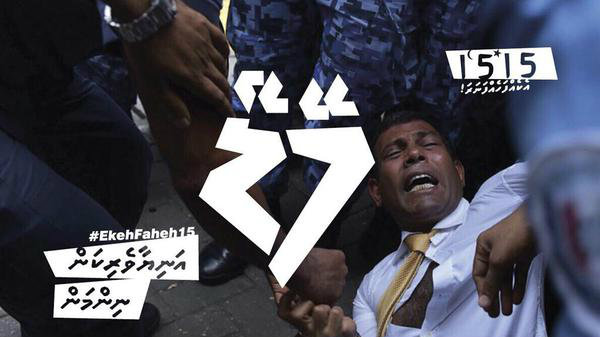
Comment: May Day! May Day! May Day! Maldives

“When dictatorship is a fact, revolution becomes a right.” – Victor Hugo.

By many accounts, the atmosphere in Male’ is both festive and fearful right now. And so it would be. Today, supporters of democracy in the Maldives and those who want to prolong the increasingly autocratic regime of Abdulla Yameen Abdul Gayoom are going head to head. Both sides are ready to give it their all, whatever happens, whatever it takes.

For democracy

There is little doubt that the country is heavily divided. On the side of democracy supporters are at least 48% of the electorate who voted for Mohamed Nasheed in the 2013 election stolen by Yameen Abdul Gayoom through the Supreme Court. Added to this are a majority of the 23% who in 2013 voted for Qasim Ibrahim, the tourism tycoon who helped fund Yameen’s win and is now being persecuted by him. Also among the democracy supporters are those aligned with the religious Adhaalath Party who voted either for Qasim Ibrahim or Yameen. One of their leading figures, Sheikh Imran Abdullah, so zealously effective against Nasheed in the 2013 presidential campaign, is also now campaigning against this government. All in all, Yameen–and the autocratic values that he represents–has the support of less than 25% of the electorate, if that. A conservative estimate would, therefore, put the percentage of the Maldivian electorate against the government at around 65%. A higher figure is likely to be more accurate.

A large share of these people will be out on the streets of the capital Male’ today for what is likely to be the biggest demonstration in the history of the country.

People have come on boatloads from across the 1200 island archipelago. ‘We have travelled on different ships, but we are now all on the same boat’, observed one such protester on social media. They will all be congregating in Male’ at 3:45 in the afternoon, under the hot tropical sun. They want to rise up against the government that has refused to listen to any of their multitude of woes and worries: murders that have not been solved; abductions that have not been investigated; corruption that has been encouraged; islands that have been sold to shady businesses; lagoons that have been signed away for centuries; atolls handed to foreign governments for unknown purposes; medical care that has been negligent; basic services that have been inadequate; streets that have become too dangerous to walk; children who have not been protected; living that has become too expensive to afford; freedoms that have been severely curtailed; promises that have been unfulfilled; and lives that have become too joyless and filled with fear to enjoy. They want a government that would listen; a government of the people, for the people. And they are ready, in their tens of thousands, to come out on the street and demand all this, all theirs by right.

Against democracy

‘I do not want to rule with force,’ President Abdulla Yameen Abdul Gayoom has said. But short of using his own fists, he has done nothing but. All three powers of the State are entirely in his hand, though he continues to insist they are not. Some of the claims are laughable, such as his insistence that the judiciary is independent from his influence. The entire world has seen and said otherwise after the courts prosecuted and jailed opposition leader Mohamed Nasheed in the manner it did. With Yameen’s Progressive Party of Maldives (PPM) holding an absolute majority, the parliament is his toy, too. As is the Prosecutor Generals’ Office, almost all independent commissions, and also the country’s armed forces.

With clear evidence of the partiality of these institutions laid bare on a daily basis, Yameen’s claims of not exercising undue influence makes him frequently look like Iraq’s Comical Ali: Maldives’ own Comical Abdulla.

The government has been preparing for the protest by banning civil servants from attending the rally, by firing pro-democracy staff in government-run institutions, and by producing and repeating the narrative that to protest is to destroy the country’s peace–as if there can be peace when a majority of the people are refusing to be ruled against their will. None of it is working. Desperate, it has wheeled out religious clerics to say it is against Islam to rise up against an elected leader. Sadly for the government, a majority of Maldivian clerics–having helped instigate the February 2012 coup which brought down the country’s first democratically elected–government, has little credibility left in this department.

In the meantime, Yameen’s right hand man, the financially rich but morally bankrupt Tourism Minister Ahmed Adeeb, has tried to heat things up further, challenging the protesters to ‘bring it on!’ He has said the government is ready to take on anyone that disagrees with it. There is fear, as well as compelling room for conviction, among democracy supporters that Adeeb–’bro’ to hundreds of gangsters–would not hesitate to bring the ‘boys’ out on the streets today. The plan would be, as has been executed many times before, to get his thugs to pretend they are part of the protest, and commit acts of violence in response to which the SO can unleash their own violence against the peaceful thousands marching for their rights.

The security forces

Police

The Maldives Police Service has become one of the country’s least respected institutions. With a Police Commissioner of little education and even less knowledge of policing at the helm–appointed solely for his loyalty to Yameen–the force has become even more disliked than it was after the 7 February which a group of them facilitated. Since Hussein Waheed became Commissioner, the police have been deployed to do a lot of Yameen’s dirty work–framing political opponents, freeing criminal allies, and brutalising democracy activists. Members of theSpecial Operations police (SO)–supposedly an ‘elite’ group–have become such lackeys of the president that they are even attending to the president’s superstitions, carrying out ‘top secret’ midnight operations to cut down trees that were supposedly cursed against the government.

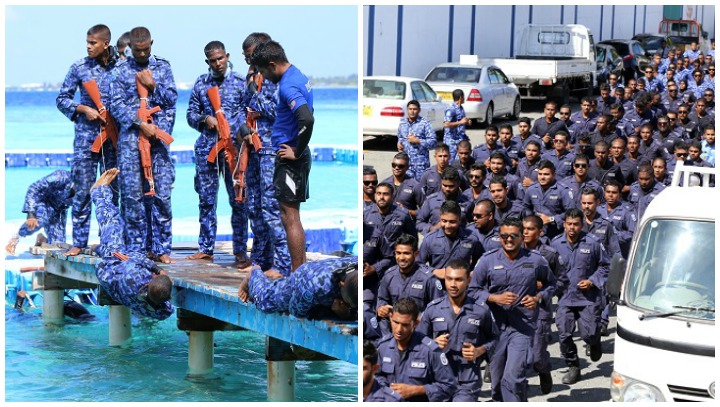
The only people looking forward to the protests as much as, or even more, than the protesters themselves today are the police. From everything they have said and done since today’s protests were announced, they have been preparing for this day. In the last week there have been almost daily press briefings all of which have included threats, intimidation and announcements of new measures to curb the right to freedom of assembly. They have all but imposed visa requirements on people travelling to Male’ from other islands for the protests, demanding they have accommodation, food and other arrangements pre-booked before travelling. They have instigated stop and search operations targeted at boats en route to Male’; paraded troops with imitation guns, banned batons, and gas canisters to perform ‘training exercises’; and they have used ‘intelligence reports’ to arbitrarily arrest leading opposition activists. They have arbitrarily banned the media from certain areas; and banned protests ‘between two prayer times’ — as if there is any time that’s not between one of the five daily prayers. They have warned that caution must be exercised near mosques and schools – as if there is any area on the two square kilometres of Male’ that is not near a mosque or a school. They have said no sound systems can be used after 11:00p.m and that it must all end at sharp midnight. They have declared the protest, yet to begin, ‘not peaceful’. They have announced a strategy of zero tolerance. Any infringement of the growing list of illegally actions, at anytime during the protest, by anyone, and ‘we will crackdown’, they have said.

Strength in unity

Not everyone who supports democracy, wants to protest the unjust incarceration of Nasheed, and rise up against the current government, can join the march today. There are many valid reasons to hold people back–mothers who cannot leave their children; the unwell; people who believe they simply cannot risk their livelihoods; people who cannot be in Male’ for various reasons; and more. But, no matter how hard the government and the police would like to believe otherwise, fear is the last reason holding any democracy supporter back from the streets of Male’ today. Together, the people are stronger than any government, no matter how brutal.

This article was originally published on Dhivehisitee.com

All comment pieces are the sole view of the author and do not reflect the editorial policy of Minivan News. If you would like to write an opinion piece, please send proposals to [email protected]

Likes(6)Dislikes(1)

Nasheed ‘an innocent man and the Maldives’ great hope’: Amal Clooney

“It may be famous for the pristine holiday beaches of its Indian Ocean coastline but the Maldives has taken a dark authoritarian turn. In 2008, the island nation became a democracy after Mohamed Nasheed was sworn in as president after the country’s first-ever free and fair elections,” writes Amal Clooney in the Guardian.

“A charismatic leader, Nasheed introduced liberalising reforms at home, while calling for global action against climate change in an attempt to combat the rising sea levels that threaten to inundate the low-lying nation. His remarkable story is chronicled in the acclaimed documentary The Island President.

“Seven years later, however, Nasheed is in prison, having been sentenced to 13 years imprisonment for the crime of “terrorism” following a politically motivated show trial.

“As a young man, Nasheed made a name for himself as a dissident journalist who challenged the repressive regime of Maumoon Gayoom, the Maldives’ long-serving dictator. Over a 15-year period, Nasheed was arrested more than 20 times. He was twice named by Amnesty International a prisoner of conscience.”

Read more

Likes(5)Dislikes(0)

Fear and festivity in Malé on the eve of May Day protest

With additional reporting by Ismail Humaam Hamid and Zaheena Rasheed.

The Maldives’ capital city Malé is gearing up for a mass anti-government rally tomorrow. The day will kick off with prayers at dawn and at noon. Protesters have been told to wear comfortable shoes and clothes for the official demonstration, which will start from the Artificial Beach at 3:30pm.

Supporters from Maldives’ remote atolls are continuing to arrive by the thousands, and the opposition has set hashtags #EkehFaheh15 (OneFive15) and #AniyaaverikanNinmman (To end tyranny) for the day, and started circulating leaflets on how to reduce the effects of pepper spray and tear gas.

Supporters say they are determined to “end the government’s tyranny” and free imprisoned ex president Mohamed Nasheed and former defence minister Mohamed Nazim.

Meanwhile, tourism minister Ahmed Adeeb has accused the opposition of plotting to overthrow President Abdulla Yameen’s government as the police continued riot control exercises on Malé’s streets.

“We expect the security forces to confront us, but we have no fear,” a smiling Khadeeja Ibrahim, 49, told Minivan News outside the main opposition Maldivian Democratic Party (MDP) offices at noon today.

She was among a group of MDP members who were about to deliver tens of thousands of petitions calling for Nasheed’s freedom to the president’s office. The police turned them back.

Across town, Ibrahim Nadheem, 26, who works in a grocery shop and is studying to become a Quran teacher said Nasheed “brought me hope, he had a vision for the youth, that we should grow up to be skilled and educated citizens.”

Nadheem’s face is disfigured by a broken nose after a police officer punched him during a protest in 2012.

At the airport, Mohamed Zubair, who suffered serious head injuries in a brutal police crackdown in February 2012, says he is ready to sacrifice again for Nasheed’s freedom. “Today I am hopeful.”

Nasheed and Nazim’s imprisonment has united former bitter rivals, the Adhaalath Party, the Jumhooree Party and the MDP, who now say President Yameen is out to silence all dissent.

The opposition called for the demonstration when Yameen turned down repeated calls for dialogue despite months of nationwide protests. The president made a record number of public appearances this week and has appealed to the armed forces to defend his administration.

Among government employees, paranoia and fear is high. Employees at the state-owned electricity company, STELCO, the Maldives Ports Limited (MPL) and the immigration department say their superiors have threatened them with dismissal if they are seen at the protests.

“We are all afraid, I can’t go. I don’t want to lose my job, I have to pay rent and take care of my family,” one 43-year-old man, who works in STELCO, told Minivan News.

The MPL has meanwhile arranged a BBQ at 1:30pm and a dinner for all of its employees tomorrow, in a move opposition supporting workers say is aimed at keeping them away from the protest.

“We’ve also been told if anyone of us is seen at the protests, we will be dismissed immediately,” an employee who wished to remain anonymous said.

The home ministry this week said it has received reports that dozens of island council members are traveling to Malé on state expenses to take part in the protests, and has asked the anti-corruption watchdog to take action.

The department of judicial administration has also demanded island offices to provide information on magistrates and judicial sector employees who have traveled to the capital this week.

Meanwhile, a website set up for the Mayday protest was hacked and a photo of president Yameen and the PPM logo was put up with the words: “Go back to your homes if you want peaceful Maldives.”

On social media, opposition supporters called for revolution.

Elsewhere, supporters shared advice on how to mitigate the effects of pepper spray and tear gas and how to act in the event of a charge by the police.

Some proposed home made plastic masks for for pepper spray.

The police have also raised concerns over violence, saying they have received reports protesters will harm police officers and attack the residences of cabinet ministers. Tonight, they issued a statement telling protesters to suspend activities for the hour between the dusk and evening prayers and said the demonstration must end by midnight.

Adhaalath Party (AP) president Sheikh Imran Abdulla said last night that protesters will perform the evening prayers on the street after a special prayer at sunset, advising protesters to bring prayer mats.

The police have released several photos and videos of protest control trainings this week.

The AP, which has claimed responsibility for organising the protest, must bear legal costs for any unlawful activities that may take place before or after protests, the police said.

Some opposition supporters fears of attacks by gangs, who are allegedly controlled by tourism minister Adeeb. Gangsters have attacked protesters in recent months with knives and vandalised their equipment.

Individuals who said they will not attend the protests cited concern over a possible confrontation between police and protesters.

“I am not happy with the idea of protesting, it creates too much conflict. The end result will not be good,” said 49-year-old Maryam Waheedha.

A fisherman who wished to remain anonymous “for the safety of his family” told Minivan News that he was unhappy with the government, but did not like to protest.

“I used to make 3,000 rufiyaa a week from two baskets of fish before Yameen came to power. But now I am not able to make that in a month even with a ton of fish,” he claimed.

Pro-government supporters denounced the opposition as power-hungry, but said they expect tomorrow’s turnout to be high.

Mohamed Waheed, 36, said; “We will not go to the protest, we will be sleeping on May 1. I do think there will be a good turn out at the protest, big enough to pressure the government.”

Likes(3)Dislikes(0)

Former first lady submits Nasheed’s case to UN

Former first lady Laila Ali has lodged a petition with the UN requesting a judgement declaring former president Mohamed Nasheed’s detention illegal and arbitrary.

Laila and Nasheed’s international legal team is seeking an opinion from the UN working group on arbitrary detention declaring that his imprisonment for 13 years on a terrorism charge violates the Maldives’ obligations under the international covenant on civil and political rights and the universal declaration on human rights.

The charge relates to the military detention of a criminal court judge during his tenure.

The UN judgment should also “call for his immediate release; request the government investigate and hold to account all those responsible for his unlawful arrest, detention, trial, and imprisonment; and request the government award Nasheed compensation for the harm caused by being deprived of his liberty,” the petition stated.

Briefing the US press in Washington DC with lawyers Amal Clooney and Jared Genser, Laila said Nasheed’s absence was difficult for her and the couple’s two children.

“[But] I also have hope, I have hope because my international legal team has just filed a petition to the United Nations looking in upon arbitrary detention documenting the evidence that my husband’s detention is illegal and in violation of international law,” she said.

She also expressed concern about the health and safety of her husband.

“I am here today as a wife and a mother of two young daughters. I have always tried to maintain a private life for myself and for my daughters. I’m speaking out now because my husband has been silenced and not in a position to speak for himself,” said Laila.

Amal meanwhile said the conviction was “clearly designed to punish him for criticising the government and to remove him from the political scene.”

She noted that Nasheed had been arrested over 20 times during the 30-year reign of former president Maumoon Abdul Gayoom and “subjected to blatantly political trials”.

Nasheed’s treatment under Gayoom’s half-brother, current president Abdulla Yameen “is no different, perhaps a tiny bit less transparent,” she said.

The terrorism charges followed the exit of Jumhooree Party (JP) leader Gasim Ibrahim from the ruling coalition, she continued, which bolstered Nasheed’s chances of winning the next presidential election.

After placing third with 24 percent of the vote in the 2013 polls, Gasim’s endorsement of Yameen in the second round run-off was crucial for the latter’s victory. Nasheed had emerged the front-runner in the first round of polls with 46 percent of the vote.

Gasim’s alliance with Nasheed “clearly became too much” for president Yameen, she contended.

The criminal court’s 19-day trial violated due process and compromised the basic guarantee of presumption of innocence, Amal argued.

She noted that Nasheed was not allowed to present defence witnesses while key witnesses had said they simply assumed Nasheed ordered the arrest of criminal court chief judge Abdulla Mohamed in January 2012.

“This was considered more than sufficient for the judges to convict him” said Amal.

She contended Nasheed never ordered Judge Abdulla Mohamed’s arrest and said: “Nor could these events even if they true, on any rational analysis constitute the crime of terrorism with the severe penalties that this carries,” she added.

Amal said that the court had said that there is no need to call for defense witnesses because such witnesses “would not be able to refute the evidence submitted by the prosecution”.

“This tells you everything you need to know about the process. Because why call a defense witness, if you already know that the verdict is going to be guilty,” she said.

Testimony from two of the three presiding judges were also included in the prosecution’s submission to the trial. “It’s difficult to imagine a clearer case of judicial partiality,” Amal said.

Nasheed was also denied legal representation during the first hearing of the trial, while the judges later refused to grant him the opportunity to appoint legal counsel when the opposition leader’s legal team resigned in protest against the court’s refusal to grant sufficient time to mount a defence.

She also referred to police “manhandling and physically dragging Nasheed to the court room” after he attempted to talk to reporters outside the court building.

Amal also noted president Nasheed’s global advocacy for climate change and his decades-long struggle for human rights in the Maldives.

“He paid the price for his courage and popularity,” she said.

Likes(2)Dislikes(0)

EU resolution based on ‘fabrications, misconceptions, and misrepresentations’

The ruling Progressive Party of the Maldives (PPM) and the foreign ministry have slammed a European Union parliamentary resolution urging the government to release ex-president Mohamed Nasheed.

The resolution is based on “fabrications, misconceptions and misrepresentations”, the PPM contended while foreign minister Dunya Maumoon declared that “the human rights achievements of the Maldives is better than some European countries.”

The non-binding resolution adopted today urged member states to issue warnings on the Maldives’ human rights record on their travel advice websites over an increased tendencies towards authoritarian rule, including Nasheed’s imprisonment for 13 years on terror charges.

The EU parliament noted a crackdown on political opponents including the imprisonment of two former defence ministers and a ruling party MP, the intimidation of media and civil society and the politicisation of the judiciary.

But Dunya said the Maldives’ “achievements since 2004 is exemplary for a small state.”

“We have a vibrant political system where people have space to express their political opinions without any hindrance. We do not shoot protesters. There is no looting in the name of political rallies.  Our custodial facilities do not torture those under state custody,” she said.

The PPM meanwhile said the EU had issued “equally grossly-misinformed releases” in the past, but “chose to turn a blind eye and stay silent on matters regarding the Maldives during the three year three month regime of former President Mohamed Nasheed, which was the single most brutal, dictatorial and violent period of rule in contemporary Maldivian history.”

The PPM suggested that the European parliament “risks tarnishing its own standing in global society, and it’s reputation among European citizens themselves by refusing, for shrouded political gains, to call a spade a spade.”

“The European Parliament must by now know that its failure to report the truth in matters regarding the Maldives has left its own reputation among the Maldivian public at serious risk of irreversible damage,” reads the PPM statement released today.

The ruling party went on to claim Nasheed’s government arbitrarily arrested political activists and MPs, sent out “knife-wielding thugs” against opposition protesters, unlawfully politicised state media, undermined independent institutions, and carried out corruption amounting to “hundreds of millions of dollars.”

The rise of extremism worsened under Nasheed’s administration, it continued, as its “schizophrenic policies on religious affairs in the country had contributed to the ideological confusion among young people, which has led to some Maldivians fleeing the country to join the ranks of foreign fighters in ISIS-led terrorist conflict zones.”

As Nasheed was found guilty of ordering the “enforced disappearance” of criminal court chief judge Abdulla Mohamed in January 2012 – “a gross Nazi-esque violation” of constitutional rights and international norms – the PPM asked whether the EU condoned the “kidnapping of judges”.

Neither the government nor the public will entertain calls for Nasheed’s release “through the very unlawful and unethical avenues that Nasheed himself employed”.

“This is not a banana republic nor is this a pawn of any regional bloc or external power,” the PPM said.

Hours before the resolution passed, president’s office minister Mohamed Hussain Shareef ‘Mundhu’ told the press he expected a “watered down” resolution, and said the government is “happy” with the resolution as it shows that the current administration is upholding the Maldivian constitution and sovereignty.

“Actionable” clauses such as imposing a travel ban and freezing assets of Maldivian government officials were removed before the resolution was put to a vote, he said.

According to Mundhu, the resolution  “praises” Nasheed and EU MEPs are demanding his release as the former president was “a proxy ruler” of Europeans. He alleged that the EU is condemning the Maldivian government for refusing to allow freedom of religion and same sex marriage.

The resolution was pushed through by the UK’s Conservative Party, which Mundhu said was a longstanding ally of Nasheed’s Maldivian Democratic Party (MDP), and the Christian Democratic Party.

Other parties in the European parliament “forced” the Conservative Party to remove the actionable clauses, he claimed.

Mundhu also said the EU refused to extend the duty-free status of fish imported from Maldives due to the country’s stance on freedom of religion and legalising gay marriage.

An EU delegation that visited the Maldives this week had told government officials yesterday that a non-binding resolution by the European parliament was inconsequential and akin to “a resolution adopted by the Baa atoll Thulhadhoo council,” Mundhu said.

President Abdulla Yameen has previously accused the EU of imposing restrictions on Maldivian imports for refusing to abandon Islamic principles.

The country has since sought other markets for fish exports and the EU was no longer  “that important economically, outside of tourism”.

Likes(2)Dislikes(0)

Addu City councillor signs for PPM

Addu City councillor for the Hulhumeedhoo district, Ali Mohamed, has defected from the opposition Maldivian Democratic Party (MDP) to the ruling Progressive Party of Maldives (PPM).

Ali Mohamed signed his membership form at a ceremony held on Tuesday night to inaugurate a resort development project on the uninhabited island of Ismehela in the southernmost atoll.

He said at the ceremony that he wanted to work with the government to ensure the development of Addu City.

“We were elected by the people to serve them. I don’t believe that I was elected to topple governments and to protest against the government on the street,” he was quoted as saying by local media.

He said development can be ensured by working with the government and called on other MDP MPs councillors to sign for the ruling party.

A futsal stadium recently built in Hulhumeedhoo and the 600-bed integrated resort development project on Ismelehera was proof that results can be achieved through cooperation, he added.

The MDP had won all six seats of the Addu City council in both the 2011 and 2013 local council elections. Ali Mohamed becomes the first PPM councillor for Addu City.

Meanwhile, Addu City mayor Abdulla Sodiq said in a Facebook post on Tuesday that the council has never obstructed the government’s development projects.

Progress or development cannot be achieved by “selling political convictions for a small sum of money,” he wrote.

Likes(1)Dislikes(0)

Parliament passes Islamic university bill

Parliament yesterday passed a bill to establish an Islamic university in the Maldives.

The legislation was passed unanimously with 55 votes in favour and outlines powers and responsibilities of the envisioned higher education institution.

Once ratified, the current Islamic college or ‘Kulliya’ will be upgraded to a university. The speaker of parliament will serve as an interim chancellor until one is appointed.

MPs of the ruling Progressive Party of Maldives hailed the passage of the bill as “historic” and praised president Abdulla Yameen’s administration for submitting the bill as pledged during the 2013 presidential campaign.

Likes(2)Dislikes(0)

Suspect acquitted in murder of 75-year-old woman

The criminal court on Wednesday acquitted a suspect charged in connection with the murder of a 75-year-old woman on the island of Neykurendhoo in Haa Dhaal atoll.

Ali Shaheem from Kaafu Guraidhoo was accused of suffocating Fathmath Zakariyya to death with a towel on April 15, 2012.

The court said the prosecution was unable to prove its case beyond reasonable doubt.

However, Shaheem had confessed to the murder during the police interrogation. While state prosecutors submitted a video of the confession, the court said a forensic reports relating to the videos were not submitted.

The judge also said the prosecution did not submit a doctor’s report that ruled out natural causes.

However, Shameem was found guilty of stealing the deceased’s phone. He was also accused of stealing her jewellery.

While an expatriate state witness had testified that Shaheem sold him the jewellery, the court said the sate was unable to prove that the jewellery was stolen from Fathmath.

The phone was meanwhile in Shaheem’s possession when he was taken to the Kulhudhufushi police station and its serial number matched the phone used by the deceased.

The court said Shaheem was unable to prove his assertion that he had bought the phone.

The trial on the charges of murder and theft were conducted without a lawyer as Shaheem had declined legal representation.

Likes(1)Dislikes(0)