Nasheed conviction “grossly unfair,” highlights “judicial politicisation,” says ICJ

The conviction of former President Mohamed Nasheed on terrorism charges was “grossly unfair” and highlighted “judicial politicisation,” the International Commission of Jurists (ICJ) have said in a press release today.

The opposition leader was sentenced to 13 years in prison on March 13 over the “kidnapping or abduction” by the military of Criminal Court Chief Judge Abdulla Mohamed in January 2012.

“The Maldivian judiciary’s independence has been compromised for years by serious pressure from the government, and this grossly unfair conviction highlights the numerous problems with the politicization of the judiciary in the country,” said Sam Zarifi, the ICJ’s Regional Director for Asia and the Pacific.

“It is crucial for Maldivian authorities to allow Mr. Nasheed to appeal his case effectively, with transparency and monitoring by Maldivian and international observers.”

ICJ contended that trial was marred by “gross violations of international standards of fair trial, including Article 14 of the International Covenant on Civil and Political Rights, to which the Maldives acceded in 2006.”

Among the violations listed by the ICJ included two of the three judges presiding over the trial having testified in the 2012 investigation, denial of legal representation for Nasheed during the first hearing on February 23, and the denial to the defence team of both full access to evidence and state witnesses and the opportunity to consult with Nasheed.

Moreover, ICJ noted that the court denied Nasheed the opportunity to seek new representation after his lawyers quit in protest of the court’s refusal to grant sufficient time to mount a defence.

“The defence was also denied the opportunity to call its own witnesses,” the press release added.

Following Nasheed’s conviction, President’s Office Spokesperson Ibrahim Muaz Ali told Minivan News that the president could not “interfere in judicial proceedings and is not to blame for court proceedings,”

“If you study this case, from the beginning to the end, it is clear the charges are not politically motivated,” Muaz insisted.

President Abdulla Yameen meanwhile called on all parties to respect the verdict and noted that the opposition leader has “a constitutionally guaranteed right of appeal.”

“The government calls on its international partners to engage constructively, based on mutual respect and dialogue in consolidating and strengthening democratic values and institutions in the country,” read a statement issued by the President’s Office.

Appeal

ICJ contended that Nasheed’s “right to appeal has been infringed by the unprecedented amendment of the statutory period for appeal from 90 days to 10 days, via Supreme Court circular six weeks prior to the trial.”

“In addition, the court has still not released to Mr. Nasheed’s defense team the full court record required to prepare and present an effective appeal within this accelerated timeframe,” the press release added.

It noted that the organisation has previously documented both the “politicisation of the judiciary” and the “polarised political climate in the Maldives, calling attention to a justice system characterised by vested interests and political allegiances rooted in the country’s authoritarian past.”

“Recent events reflect a justice system that still remains deeply politicised along the same lines of entrenched political loyalties that pre-date the transition period,” said Zarifi.

“The Maldivian judiciary must allow a proper appeal in this case if it is to establish itself as a separate and equal branch of the government dedicated to supporting the rule of law.”

The ICJ called on the government to ensure full acess and adequate opportunity for Nasheed’s lawyers to prepare an appeal, “and to ensure that the appeal proceeding is conducted fairly and transparently, with full access to media and domestic and international observers, in compliance with fair trial and due process standards under both Maldivian and international law.”

“The Maldives must also take effective measures to ensure that such violations do not reoccur in this or future cases,” the ICJ said.


Related to this story:

Nasheed to wait on appeal until Criminal Court provides full case report

Nasheed’s terrorism trial “a mockery” of Constitution, verdict “may have been pre-determined,” says Knaul

UN human rights chief expresses strong concern over “hasty and apparently unfair” Nasheed trial

US, EU, and UK concerned over lack of due process in Nasheed trial

Respect Criminal Court verdict, says President Yameen

Former President Nasheed found guilty of terrorism, sentenced to 13 years in prison

ICJ says Majlis has “decapitated the country’s judiciary”

Runaway judiciary leaves the Maldives “at a dangerous junction,” says Velezinee


Likes(6)Dislikes(2)

MP Mahloof, Raajje TV journalists among nine arrested at opposition protest

MP Ahmed Mahloof and opposition-aligned private broadcaster Raajje TV journalist Mohamed Wisam and cameraman Adam Zareer are among nine arrested from last night’s opposition protest march.

A police media official told Minivan News today that the former ruling party MP, two journalists and six others were arrested for “obstructing police duties and disobeying police orders.”

The Criminal Court this morning extended the remand detention of the Galolhu South MP and the two journalists to five days.

While one protester was released from police custody, the court extended the remand detention of two protesters to seven days and three protesters to five days.

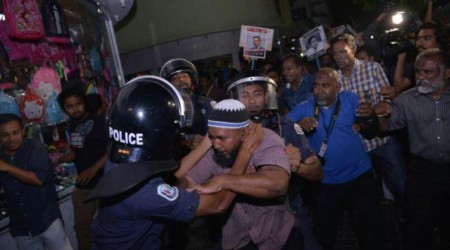
Photos of Specialist Operations (SO) police officers manhandling the Mahloof have been widely circulated on social media. Journalists at the scene reported that the MP’s shirt was ripped open during the arrest near the fish market.

Photo from Ranreendhoo Maldives

The opposition Maldivian Democratic Party (MDP) has meanwhile condemned Mahloof’s arrest, claiming he was “targeted” by the police and due to his outspoken criticism of the government following his expulsion from the Progressive Party of Maldives (PPM).

The ruling party’s disciplinary committee expelled Mahloof on February 25 for allegedly defaming President Yameen and bringing the government into disrepute with false statements in the media.

In a statement released today, the MDP claimed Mahloof was arrested “brutally” and condemned police for “obstructing the protest in violation of the Constitution”.

Police used obscene language while arresting the MP, the statement alleged.

The opposition party said riot police officers pepper MDP MP Ali Nizar as well as other protesters in the eye and confiscated the protest’s “sound pickup” and loudspeakers.

Raajje TV has meanwhile condemned the arrests of the two journalists, describing the arrests as an “obstruction of rights guaranteed under the constitution, including the rights to freedom of information and freedom of press.”

A Channel One journalist was also arrested the previous night for allegedly obstructing police duties. The Criminal Court extended his remand detention to 10 days.

Calling for the immediate and unconditional release of its staff, Raajje TV noted that it was “yet to receive any justice with regards to previous attacks targeted to our station and journalists.”

Raajje TV journalist Wisam interviewing MP Mahloof

The Maldives Police Service also released a statement alleging that protesters assaulted several police officers last night after breaking through barricades near the Republic Square.

Protests are banned in the ‘green zone’ area encompassing the Republic Square as well as police and military headquarters.

Protesters also smashed the windows of a police vehicle last night, the statement added. Police officers on the vehicle were attempting to stop protesters from using loudspeakers after 11:00pm.

Invoking powers granted by Article 41 of the Freedom of Assembly Act, police issued a statement earlier this week ordering protest organisers not to use loudspeakers or megaphones after 11:00pm and to end the protest at 12:00am.

Moreover, police warned protesters against repeatedly gathering in one location or street.


Likes(3)Dislikes(0)

Fourth expatriate stabbed in Malé

An expatriate worker was stabbed in the Galolhu ward of Malé around 7:10pm on Wednesday, reports local media.

Police said the expatriate is undergoing treatment at the Indira Gandhi Memorial Hospital after his arm was slashed in a scuffle near the Auto Garage. His condition is not serious, police said.

Today’s assault is the latest incident in a recent spike in violence against expatriates.

A 25-year old Bangladeshi, Shaheen Mia, was stabbed to death in a Malé café in the early hours of the morning on Sunday (March 22), while a Bangladeshi national identified as Bilal was found dead in Alif Alif Atoll Thoddoo Island on Monday night.

The following day, three expatriate workers were stabbed between 7:20pm and 7:40pm in three different locations in Malé.

Police have yet to make any arrests in connection with either the murders or the stabbings.

Likes(1)Dislikes(0)

Gayoom denies rifts within government

Former President Maumoon Abdul Gayoom has denied any rifts between himself as leader of the Progressive Party of Maldives (PPM) and President Abdulla Yameen’s administration.

Speaking to reporters on Tuesday prior to departing for Singapore to attend the funeral of ex-Prime Minister Lee Kuan Yew as President Yameen’s representative, Gayoom denied claims by Adhaalath Party President Sheikh Imran Abdulla that he was a victim of the government’s “brutality.”

“Things are going very well with the party working together with the government. There is no discontent at all,” he was quoted as saying by newspaper Haveeru.

Gayoom suggested that the opposition was using his name for their political purposes.

Asked about international concern over the conviction of former President Mohamed Nasheed, Gayoom said criticism from foreign nations and organisations was not a cause for concern.

Gayoom reportedly said Maldivians connected to foreign actors wanted to help them achieve their ends in the country, but the PPM did want to follow instructions issued by another nation.

He added that the criticism was baseless and uninformed, suggesting that certain foreign parties harboured longstanding prejudices against the Maldives.

Likes(1)Dislikes(0)

British High Commissioner pays farewell call on President Yameen

British High Commissioner to the Maldives John ‎Rankin paid a farewell call on President Abdulla Yameen today.

According to the President’s Office, ‎President Yameen ‎expressed his gratitude to High Commissioner Rankin for the ‎cooperation ‎and close friendship with ‎the Maldives during his tenure and conveyed his hopes to further ‎strengthen the close mutual ‎relations the two ‎countries.

Discussions were also focused on the current political situation ‎of the country and President Yameen assured the Government’s ‎commitment to uphold the rule of law and consolidate democracy in the ‎Maldives.

High Commissioner Rankin expressed his pleasure to serve as his nation’s High Commissioner to the Maldives and reassured the British Government’s commitment to work with the Maldives on “issues of mutual interest.”

Likes(1)Dislikes(0)

Amendments prohibit civil servants from holding political party posts

Amendments voted through to the Civil Service Act today prohibits civil servants from either holding posts in political parties or seeking the registration of a political party.

The amendments also prohibit civil servants from using powers to directly or indirectly influence political activities as well as participating in political activity either during official working hours or in a way that casts doubt on impartiality in the performance of duties.

The amendment bill (Dhivehi) submitted on behalf of the government by Progressive Party of Maldives (PPM) MP Mohamed Ameeth was passed unanimously with 40 votes in favour and one abstention.

Continuing protests on the People’s Majlis floor with sirens and megaphones into the 12th consecutive sitting, opposition Maldivian Democratic Party MPs did not participate in the vote.

Presenting the legislation (Dhivehi) in August last year, the PPM MP for Raa Madduvari explained that the amendments to the 2007 law were part of a raft of bills proposed by the government to bring outdated laws in line with the new constitution adopted in August 2008.

Ameeth said the restrictions were necessary to ensure that the civil service was free of political bias and undue influence.

In September 2011, the Supreme Court backed a ruling against the prevention of civil servants’ participation in political activities.

The apex court referred to Article 30(a) of the Constitution, which states, “Every citizen has the right to establish and to participate in the activities of political parties.

Likes(1)Dislikes(0)

Former MDP President Dr Didi arrested

Former Maldivian Democratic Party (MDP) President Dr Ibrahim Didi was arrested on Wednesday for attending opposition protests in violation of a Criminal Court order, reports online news outlet CNM.

Didi was arrested during a protest on February 27 and accused of obstructing police duty. After being held in remand detention for 10 days, the former fisheries minister was released on March 10 on the condition that he not attend protests for 30 days.

Police said Didi was arrested today in connection to an ongoing investigation.

Most people arrested during the ongoing opposition protests are released on the condition that they do not participate in protests for a period determined by the court. Human Rights NGO Maldivian Democracy Network (MDN) has described the move as unconstitutional, arguing the condition violated the right to freedom of assembly and expression.

Likes(1)Dislikes(0)

Ex-defence minister’s final hearing on illegal weapons pushed back to Thursday evening

The Criminal Court has pushed back the last hearing in former Defence Minister Mohamed Nazim’s illegal weapons charge to Thursday evening.

Defence lawyers today requested additional time to listen to recordings of witness testimony from previous hearings before they issued concluding statements.

The three-judge panel gave lawyers until 4:00pm on Thursday to prepare. Judges could deliver a verdict at their discretion afterwards.

Defence lawyers once again requested the three-judge panel to allow Nazim to leave the country, claiming doctors had said the retired colonel faced a potentially life-threatening condition, and had recommended he be flown abroad as soon as possible for medical tests that are not available in the Maldives.

But presiding Judge Abdul Bari Yoosuf contended the phrase ‘as soon as possible’ could be interpreted in various ways, and said the Criminal Court was working to expedite a verdict in the case.

Nazim was charged with illegal weapons possession after police discovered a pistol and three bullets at his home during a controversial midnight raid on January 18. He was subsequently dismissed from the cabinet, and arrested on February 10 on additional charges of terrorism and treason.

Nazim, in his defense, claims rogue police officers planted the weapons at his home on Tourism Minister Ahmed Adeeb’s orders after the pair fell out over Adeeb’s alleged use of SWAT officers for criminal activities, including the chopping down of all of Malé City’s areca palms in October last year.

Both Adeeb and the Maldives Police Services have dismissed the allegations.

In the last hearing on Monday, judges summoned only two of Nazim’s 37 defence witnesses.

Fabricated evidence?

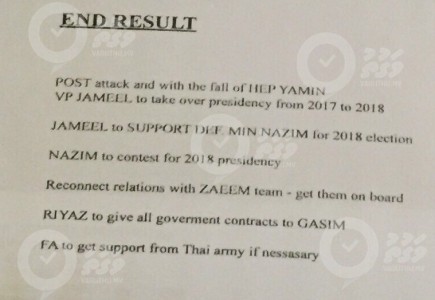
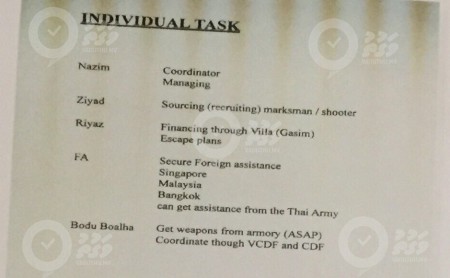
State prosecutors also claim documents in a pen drive confiscated along with the weapons suggested Nazim was plotting a coup d’état and planning to harm President Abdulla Yameen, Commissioner of Police Hussein Waheed and the Tourism Minister.

Defence lawyer Maumoon Hameed once again claimed police officers had tampered with and fabricated evidence against Nazim, suggesting coup plans were in fact not even contained in the allegedly planted pen drive.

Hameed, who is also President Yameen’s nephew, said a forensic digital expert, Ameen Abdul Gayoom, in a closed hearing on March 19 said the pen drive had last been accessed in February 2014.

But the alleged plans to harm President Yameen – which were only revealed to judges and lawyers in the closed hearing – were supposedly to be carried out in November or December 2014, he said.

He went on to claim that the then-Assistant Commissioner of Police Hassan Habeeb had printed out the documents in the pen drive and questioned Nazim soon after the raid. He questioned how Habeeb had accessed the pen drive without resulting in the change of date of last access and noted Habeeb’s name was not listed on the pen drive’s chain of custody.

Habeeb was recently promoted to Deputy Commissioner of Police, and according to witness testimony in previous hearings, had commanded the raid on Nazim’s apartment.

State prosecutor Adam Arif denied that the forensic digital expert had made any comments on the date of last access, and said the chain of custody recorded the officers who had handled the physical pen drive, and not the electronic documents contained in it.

Hameed also noted several empty slots on the chain of custody record, saying the broken record suggested possible tampering.

Chain of custody is the record of all individuals who maintained unbroken control over the items of evidence, to establish proof that the items of evidence collected at the crime scene is the same evidence presented in a court of law.

Hameed also said there were gaps of between six and nine hours between when investigating officers had received the evidence and when they had handed evidence over to the forensic departments, arguing the delay amounted to officers flouting police regulations.

Further, while a Maldives National Defense Force (MNDF) officer had testified in a previous hearing to having fired the pistol to test if it was functioning, Hameed said the chain of custody record indicated the MNDF only had the weapons for just 15 minutes.

In response, Arif said the empty slots on chain of custody do not mean an unauthorised individual had handled the evidence, and said it did not affect the credibility of evidence presented at court.

Arif claimed the MNDF had possessed the evidence for over an hour, ample time to test the authenticity of the pistol and three bullets.

He also said the long delay in investigating officers handing over evidence to the forensics department did not necessarily mean officers had tampered with the evidence.

If convicted, Nazim faces a jail term between ten and 15 years.

The three judge panel overseeing Nazim’s case are the same judges who convicted former President Mohamed Nasheed on terrorism and sentenced him to 13 years in jail in a trial many observers have called a “travesty of justice.”

Likes(2)Dislikes(0)

Maldives bans migrant worker protests, threatens to cancel visas

The Department of Immigration and Emigration today warned migrant workers against participating in protests and threatened to cancel work visas for protesting expatriates.

The warning came after local media today announced migrant workers had called for a mass protest on Friday against entrenched discrimination and a recent spike in violence which saw two Bangladeshi nationals murdered and three stabbed in Malé.

A 25-year old Bangladeshi, Shaheen Mia, was stabbed to death in a Malé café in the early hours of the morning on Sunday (March 22), while a Bangladeshi national identified as Bilal was found dead in Alif Alif Atoll Thoddoo Island on Monday night.

Meanwhile, three expatriate workers were stabbed on Tuesday between 7:20pm and 7:40pm in three different locations in Malé.

But the Controller of Immigration and Emigration Mohamed Anwar in a statement today said expatriates protesting for their rights was against the terms of their work permits, and threatened to cancel visas without a second warning.

If action was taken against an expatriate worker for protesting, Anwar said the Immigration Department would also suspend services to their employers.

He called on employers to remind migrant workers to respect Maldivian laws and stay away from protests.

“The immigration department will not hesitate in penalising those who participate in protests,” he added.

The Human Rights Commission of the Maldives’ (HRCM) Vice President Ahmed Tholal said the ban on migrant worker protests was unconstitutional.

“The constitution guarantees every person on Maldivian soil the right to protest. A clause in a migrant worker’s contract cannot override the constitution,” he told Minivan News.

Expressing grave concern, Tholal said the recent fatal attacks amount to hate crimes as the violence appears to be targeted against migrant workers.

He noted discrimination and inhumane treatment of migrant workers were entrenched issues in the Maldives, and said this week’s violence further marginalised an already vulnerable group.

Tholal called on the Maldives to immediately initiate discussions with diplomatic missions and take urgent action to ensure the safety of migrant workers.

According to the 2014 national census, there are 58,683 migrant workers in the Maldives. However, the department of national planning said the figure was much lower than the official figure recorded by the Immigration Department.

The US State Department in its 2014 Trafficking in Persons report described the Maldives as a “destination country for men, women, and children subjected to forced labor and sex trafficking.”

Migrant workers – primarily Bangladeshi and Indian men in the construction and service sectors – experienced forced labor, including fraudulent recruitment, confiscation of identity and travel documents, withholding and nonpayment of wages, and debt bondage, the report said.

The State Department welcomed the Maldives passing its first anti-trafficking law in 2013, but decried “serious problems in anti-trafficking law enforcement and victim protection.”

“The government did not adequately train police and other officials on trafficking, nor did it provide authorities with procedures to identify victims among vulnerable populations and refer those victims to protective services. Consequently, the government penalised some victims for offences committed as a result of being trafficked and also deported thousands of migrants without adequately screening for indications of forced labor,” the report said.

Following the enactment of the Anti-Human Trafficking Act in 2013, the Maldives avoided relegation to Tier 3 and possible international sanctions.

Human rights group Transparency Maldives (TM) has also described the Immigration Department’s protest ban as unconstitutional and called on the government to listen to worker’s concerns.

TM also urged law enforcement agencies to expedite investigations into migrant worker murders and called on the government to sign the International Covenant on Migrant Workers immediately.

Likes(3)Dislikes(0)