US encourages all parties to accept first round results

The US has hailed the results of the first round of the presidential election in the Maldives as a “victory for the democratic process”.

In a statement, Deputy Spokesperson for the US State Department Marie Harf noted that the results had been “widely hailed as a success” by the Commonwealth, United Nations, and local Maldivian observers.

The comment comes as Jumhooree Party candidate Gasim Ibrahim, who placed third with 24.07 percent and narrowly missed a place in the run-off, contests a case in the Supreme Court seeking annulment of the results, alleging electoral irregularities.

The JP was supported in the ongoing court case by the Progressive Party of the Maldives (PPM), while Attorney General Azima Shukoor also intervened and criticised the conduct of the Elections Commission.

“As the country prepares for the second round on September 28, the United States and the international community again stand ready to assist Maldivians as they exercise their fundamental right to choose their own government,” declared the US State Department.

“For this final round to be as successful as the previous round, all political parties must respect the democratic process and continue to allow for a free, fair and peaceful vote to take place. We encourage all parties and all presidential candidates to respect the results and work together for a peaceful transition for the benefit of the Maldivian people,” the statement concluded.

Likes(0)Dislikes(0)

India expresses hope that second round will go ahead as planned

“India believes that it is of utmost importance that the electoral process is allowed to proceed unhindered so that the second round is conducted according to schedule and the will of the people of Maldives is fully recognised,” the Indian Ministry of External Affairs has said.

“It is important that all sides respect the verdict and aspirations of the people of Maldives. We hope that the second round of Presidential elections will be held as scheduled on September 28, 2013 in a similar transparent, organised and peaceful manner.”

The statement, released in response to media enquiries, again praised the conduct of a first round it describes as “unblemished by any notable incident”.

The statement also reiterated the observations of Indian election observers, who had praised the Maldives Elections Commission as being “logistically well-prepared for this election”, as well as describing the much-criticised voter registry as “accurate and robust”.

Likes(0)Dislikes(0)

MDP condemns Attorney General’s intervention in JP’s Supreme Court effort to annul election results

The Maldivian Democratic Party (MDP) has condemned the intervention of Attorney General (AG) Azima Shukoor in the Jumhooree Party’s (JP’s) case at the Supreme Court seeking annulment of the September 7 presidential election, expressing concern over the AG’s support of the JP’s stance at Tuesday’s hearing.

In a press release on Tuesday night (September 17), the MDP accused Azima Shukoor of advocating against “the interests of a state institution or the state and in favour of the Jumhooree Party’s self-interest.”

As the Attorney General represents the state, the MDP contended, Azima Shukoor should advocate on behalf of the state and protection of the public interest.

“Therefore the party calls upon the Attorney General – appointed by Dr Mohamed Waheed Hassan Manik, who got only five percent of the vote – to cease advocating on behalf of the state to nullify the votes cast by the people in the first round of the presidential election, and annul the election to dis-empower the people and the constitution,” the statement concluded.

Azima meanwhile told newspaper Haveeru today that article 133(d) of the constitution allows the Attorney General to intervene in such cases. The article states, “The Attorney General shall have authority, with the leave of the court, to appear as a friend of the court in any civil proceedings to which the Government is not a party, where in the opinion of the Attorney General the interests of the State or the public interest dictate.”

“The government decided that we have to say something for the sake of public interest since we can see all this information,” Azima was quoted as saying.

Azima also denied seeking annulment of the election at yesterday’s Supreme Court hearing. She had however asked the apex court to order the Prosecutor General and the police to investigate alleged electoral fraud as “serious issues” had been noted.

The AG told the court that her office had uncovered discrepancies in the voter registry, including underage people listed as eligible for voting, and the mixing up of voter information – including gender, address, and date of birth.

High Court ruling

Meanwhile, in its judgment (Dhivehi) yesterday in the JP’s case against the Elections Commission (EC), the High Court ordered the commission to allow the JP supervised access to the voter lists in lieu of ordering the EC to release hard copies of the list to the party.

The JP had claimed that the registry included hundreds of ineligible voters (underage citizens), names of voters doubled or repeated, and thousands of people registered to houses without the home owner’s knowledge.

The High Court ruling however stated that the JP was unable to offer any evidence to substantiate the claims of electoral fraud.

The ruling stated that election complaints “should not be submitted based on suspicion,” noting that the EC’s lawyer, former Attorney General Husnu Suood, had addressed each of the JP’s arguments.

Of the seven people the JP claimed were deceased but had voted, the EC proved to the court that four were alive.

On the JP’s complaint regarding people registered to houses in Male’ allegedly without the home owner’s knowledge, the EC explained that people who were originally on the Male’ Municipality’s Special Register – a special registry of people residing in the capital without owning homes – were registered to vote in ballot boxes closest to their current residence. They were registered upon written request, the EC lawyer noted.

Moreover, Suood said that the EC depended heavily on data provided by the Department of National Registration (DNR) in compiling the voters registry. The 170 names that the JP claimed were doubled on the list would have different identity card (ID) numbers and dates of birth, he noted.

DNR Director General Fareeda Yoosuf insisted yesterday that there was no chance forged IDs could be used to vote.

Each individual identity card is unique and does not change even when renewed and, even in cases where lost IDs are replaced, the same identity number is used, Yoosuf noted.

“The card number will remain the same for each individual no matter how many times the card is renewed,” she explained. “We haven’t issued identity cards with two different numbers to the same person, so I’m certain that can’t be done.”

“When each person has a unique number and is allowed to vote based on that number, there is no chance a person can vote more than once by using different ID numbers,” she continued.

No complaints of forged identity cards have been received by the DNR so far, she noted.

“Vote Rigged!”

According to the official results of the first round of voting, MDP candidate Mohamed Nasheed finished top with 45.45 percent (95,224 votes) of the vote, followed by Progressive Party of Maldives (PPM) candidate MP Abdulla Yameen in second place with 25.35 percent (53,099).

JP candidate Gasim Ibrahim narrowly missed out on a place in the second round run-off on September 28 with 24.07 percent (50,422 votes). The JP coalition however disputed the results at both the High Court and Supreme Court and launched a “Vote Rigged!” campaign of rallies – complemented by special programmes on Gasim’s Villa TV – alleging that the EC rigged the polls.

“God willing, it will be Gasim Ibrahim who will be the President of the Maldives on 11 November. Allah willing, do not doubt this. I tell you, do not doubt this,” the business tycoon declared at a recent rally.

Early on Monday morning , police acting on a tip-off from the JP, barricaded streets around the EC and took its garbage into custody. The JP accused the commission of disposing of evidence, though police later reported that the rubbish contained nothing affecting the outcome of the election.

EC Chair Fuwad Thowfeek has emphatically denied allegations of vote rigging, pointing to the commission’s transparency, ongoing complaints investigations, and praise from a broad spectrum of election observers.

The UN Resident Coordinator in the Maldives, Tony Lisle, issued a statement yesterday encouraging “all presidential candidates to respect the results” of first round of presidential elections – in line with those of all other observers on the September 7 polls including delegations from the Commonwealth, UK, India, Australia, Malaysia, US, EU, Japan and Thailand.

Likes(0)Dislikes(0)

Body of Madifushi’s former island chief discovered in island’s lagoon

Islanders on Madifushi in Thaa Atoll discovered the body of the former island chief Mohamed Rahaa in the island’s lagoon.

A member of the island council told local newspapers the body was discovered at 1:00pm this afternoon.

The council member told the paper that Rahaa was more than 65 years old, and that his body was found naked.

He said Rahaa’s family has advised the council that it was the deceased’s practice to go to the sea every afternoon to take a bath before attending prayers.

Likes(0)Dislikes(0)

French film screening in Male’ tonight

The Alliance Française (AF) de Male’ will tonight host the first of its monthly screenings of French films (subtitled in English), at the Centre for Higher Secondary Education (CHSE) by Sultan Park in Male’.

After a short introduction in English, ‘Tout ce qui brille’ (‘All that glitters’) will be shown at 8pm, and comments on the film will be welcomed afterwards.
Entry is free for AF members and MVR50 for non-members.
Likes(0)Dislikes(0)

Maldives heading towards stability, democratic governance: former President Nasheed

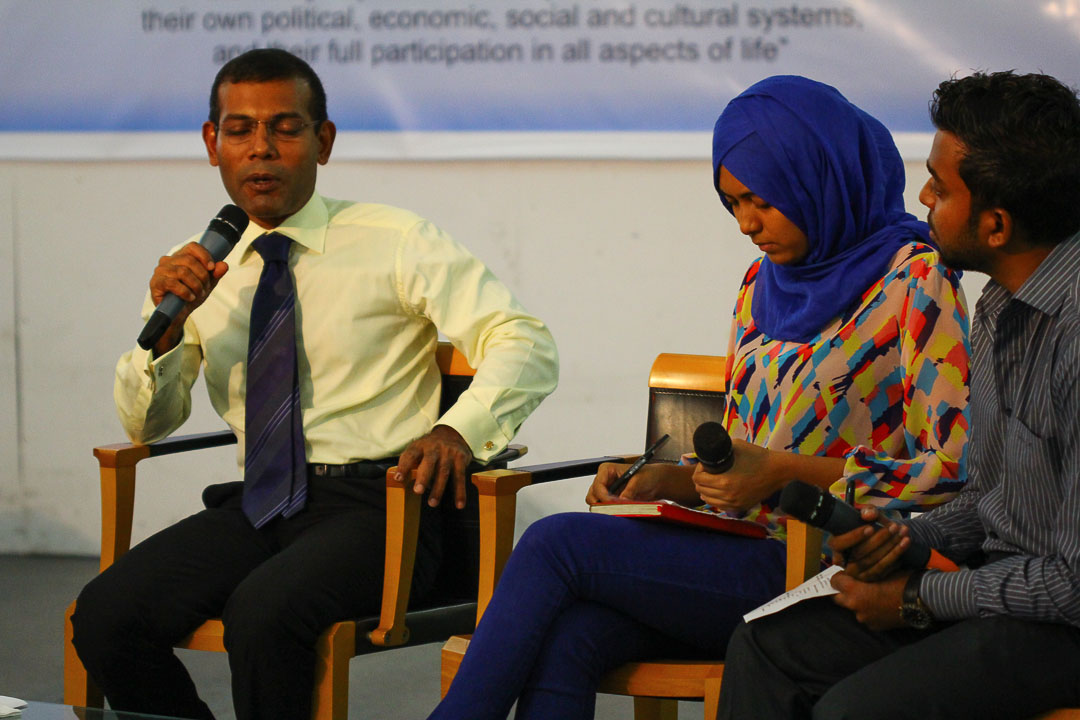
The Maldives is heading towards peace, stability and consolidation of democracy after ten tumultuous years, former President Mohamed Nasheed said at a youth forum organised by the Junior Chambers International (JSI) chapter of Maldives and Dhiyouth at City Hall on Monday night (September 16).

“I don’t really see much room for going wayward now. People might try to rig two or three elections. [They] might try to arrest some people. And there might even be three or four coup d’etats. But, overall, I don’t see this curve slumping too much,” the Maldivian Democratic Party (MDP) presidential candidate said in his keynote speech at the event, which was held to mark the International Day of Democracy.

“The Maldives will become stable and democratic principles will continue to be instilled. Neither the youth of this country nor everyone else are willing to let go of the rights we have now. In my view, tonight we are celebrating the victory of the youth. Through your efforts, the elderly have received social security, and through your efforts, a prosperous future has been secured for your children.”

The impact of the momentous events of the past ten years would be far greater and more significant than any other ten years in the history of the country, Nasheed observed, advising youth to “build a better Maldives in light of that experience.”

Nasheed was elected president in the Maldives’ first multi-party democratic election in 2008 following the adoption of a democratic constitution. The 2008 election and liberal constitution was preceded by a pro-democracy movement led by the MDP in the wake of unprecedented civil unrest in September 2003, which was precipitated by a brutal custodial death exposed to the public and subsequent fatal shootings in prison.

Free expression and dissent

In his speech, Nasheed argued that the most important prerequisite for youth development was an atmosphere conducive to exercising the rights of free expression, assembly and participation in peaceful political activities.

As 60 percent of the Maldives’ population is youth, Nasheed said political parties have to explain their policies to the youth demographic.

It is also the duty or responsibility of youth to have their say in the formation of a government that would pursue the best policies for young people, their families, and their communities, he said.

Freedom of speech and expression of dissent are “essential bases for nation-building,” he added.

Democratic practices were introduced in the Maldives between 2005 to 2008, Nasheed continued, noting the role and “sacrifices” of youth in pro-democracy activism.

“It was quite recently that people were arrested for a gesture or an expression,” he said. “Even in 2004, 2005, a lot of people were arrested and given serious punishments because of what they said. As long as that practice persisted, most Maldivian citizens were unable to participate in the affairs of the country. When that practice or principle changed, the participation of youth broadly increased.”

In formulating the MDP’s manifesto for the 2013 presidential election, Nasheed said the party believed that the bulk of the policies should target youth.

In contrast, he said, the 2008 manifesto was focused on establishing a social security system.

The 2013 manifesto reflects “the extent to which youth have raised their voices concerning their needs during the past five years,” Nasheed said.

The MDP manifesto – the “result of conducting a democratic exercise of consultation” – includes creating 51,000 job opportunities, conducting a skills training programme, setting a minimum wage, providing higher education opportunities, offering grants and scholarships, growing the entertainment sector, and establishing sports facilities, Nasheed noted.

Nasheed also stressed the importance of rehabilitating youth incarcerated for drug abuse through a “Second Chance” programme and implementing policies for reintegrating drug addicts into society as gainfully employed youth.

Q&A

Following his remarks, Nasheed participated in an hour-long question and answer session on topics ranging from civic education, family planning, minimum wage, job creation, policies for persons with special needs and feasibility of infrastructure projects.

On the issue of negative campaigning, Nasheed predicted that political parties would learn ahead of future elections that defaming rivals was ineffective and focus instead of presenting comprehensive policies.

“I predict that political parties will present policies much more in the next election rather than do what they’re doing now, which includes attempting to buy votes – people are learning each election that [vote buying] is unsuccessful,” he said.

As a “crude survey” has estimated that seven percent of the Maldivian population are persons with special needs, Nasheed said the MDP will pursue policies to amend building codes to ease access and establish at least one school in each atoll to provide specialised education for students with special needs.

A minimum wage of MVR4,500 (US$292) a month would meanwhile incentivise local businesses to hire Maldivians in lieu of foreign workers who were often paid only US$150 a month, Nasheed explained, adding that small businesses would be exempt from the legally mandated wage.

Asked by “a youth leader currently representing the Maldivian youth to the Commonwealth” whether an MDP government would consider “a democratically-elected youth council and youth parliament” as a forum for youth leaders, Nasheed invited youth interested in politics to forgo “ceremonial” and “superficial” activities in favour of direct participation.

“The real thing is better than superficial activities. Step up to a podium no matter how young you are and participate in real activities – 17, 18 or 19 years is not really that young. At the time I turned 20, I had been in the pillory for 30 days,” he said.

Likes(0)Dislikes(0)

Indian naval ship visits the Maldives

Indian Naval Ship Khanjar berthed in Male’ harbour on 16 September 2013, on deployment for joint exclusive economic zone (EEZ) and anti-piracy patrols with the Maldives National Defence Force (MNDF).

INS Khanjar will undertake a Joint EEZ patrol in the Maldivian EEZ from September 18-21. Officers from the MNDF Coast Guard will embark the ship for this mission.

According to a statement from the Indian High Commission in Male’, several professional activities were conducted between the ship and MNDF Coast Guard personnel. These included refresher training capsules on Force protection, Search and Rescue, High risk boarding and other naval exercises for MNDF personnel.

“INS Khanjar is the fourth of the famed ‘Khukri’ class Missile Corvettes of the Indian Navy. The ship is christened after the traditional weapon ‘Khanjar’- a curved double edged dagger, epitomising the fighting spirit of the ship. Designed for surface-to-surface warfare, teh ship packs a considerable punch compared to her size. The weapon outfit includes surface to surface missiles, close range anti-air missiles, medium calibre gun and close-in weapon systems. She also has the capability to carry an Alouette helicopter for air operations. INS Khanjar is part of the elite Eastern Fleet of the Indian Navy and is commanded by Commander BS Bains,” stated the High Commission.

“The ship’s deployment to Male underscores the strong bilateral ties between India and Maldives and is expected to go a long way in strengthening maritime security cooperation between the two countries,” the statement added.

Likes(0)Dislikes(0)

“India is the regional superpower and we must be mindful of that”, Nasheed tells Economic Times

The Maldives, and its strategic location in the Indian Ocean eyed by world powers, is once again at the cross-roads, writes Dipanjan Roy Chaudhury for India’s Economic Times.

Nearly one and-a-half years after then President Mohamed Nasheed was ousted in what his supporters describe as a coup, the archipelago is all set to elect a new president to replace Mohammed Waheed Hassan. The first round of presidential polls was held on September 7 and there was no clear winner. Nasheed has emerged as the frontrunner, but missed necessary majority of 50 percent, as the votes were split among the other three contenders. His main rival, Abdulla Yameen, a half-brother of former President Maumoon Abdul Gayoom, came second.

Nasheed and Yameen will face each other in a run-off election on September 28. Runoff is not new for Nasheed. In 2008, he became president after a run-off against Gayoom. Challenges before the next president include rising fundamentalism and lack of investor confidence after Waheed’s government canceled the country’s biggest foreign investment project with India’s GMR.

The outgoing president, who secured a paltry 5.13 percent in the first round, is expected to back Yameen in the run-off elections. Taking time out from his hectic campaign for the run-off, Nasheed spoke to ET from Male on his prospects in polls, Maldives foreign policy, relations with India and democratic values.

Read more

Likes(0)Dislikes(0)

Nasheed government sought to make Maldives an “economic slave”: Economic development minister

Economic Development Minister Ahmed Mohamed yesterday (September 16) accused former President Mohamed Nasheed of working to make the Maldives “an economic slave” to an unspecified foreign company.

Ahmed, a senior member of the Dhivehi Rayyithunge Party (DRP), which this week announced it would be backing Nasheed’s in a second round of voting for this year’s presidential election, was quoted in local media as being highly critical of the former head of state.

Although Economic Development Minister Ahmed did not reportedly name the foreign company accused of trying to enslave the nation.  However, the present government last year controversially scrapped a US$511 million contract signed under by Nasheed’s administration with India-based infrastructure group GMR to develop and manage an entirely new airport terminal.

The Maldives is presently facing a US$1.4 billion compensation claim from GMR for its decision to terminate the contract over allegations that the International Finance Corporation (IFC)-approved tender was open to corruption. The allegations were ultimately rejected by the country’s Anti-Corruption Commission (ACC).

However, Ahmed was reported in Sun Online as slamming Nasheed for alleged efforts to make the Maldives what he called an “economic slave” to a foreign business by taking loans with high interest rates and short repayment periods. The comments were made during a rally held by the Progressive Party of Maldives (PPM) and its election coalition partner the Maldives Development Alliance (MDA).

Despite the claims, the government earlier this month said it hoped to secure longer-term financing to plug a shortfall in annual revenue that has seen the number of 28-day Treasury Bills (T-bills) sold by the state almost double in July 2013, compared to the same period last year.

Finance Minister Abdulla Jihad told Minivan News at the time that the state’s increased reliance on short-term T-bills between July 2012 and July 2013 reflected the current difficulties faced by the government in trying to raise budgeted revenue during the period. He cited minimal interest from the private sector in providing finance as adding to these difficulties.

Jihad added that the current administration was also reliant on 28 day T-bills, which were being sold as a means to “roll over” debt one month at a time.

“We are trying to have banks get longer-term finance such as T-bills at present,” he said.

Economic Development Minister Ahmed also claimed yesterday the number of doctors had fallen by the time of his controversial resignation last year following a mutiny by sections of the police and military, while also criticising the former president’s record towards education.

“By the time Nasheed resigned, the value of Maldivian Rufiyaa had been decreased by 32 percent, which means that a commodity which earlier cost MVR 100 (US$6.5), cost MVR 132 (US$8.5) by the time he resigned,” he was quoted as saying.

According to Sun Online, the economic development minister also said that the aim of unspecified peoples was to “remove” Nasheed from office.

Ahmed Mohamed was not responding to calls from Minivan News or requests to clarify his comments at time of press.

The comments were made as PPM vice presidential candidate Dr Mohamed Jameel Ahmed last week declared that former President Nasheed “will not be allowed to assume power”, even should he emerge as the clear winner in the run-off.

Clarifying his remarks to Minivan News at the time, Dr Jameel stated that his comments during the rally reflected the “criminal charge filed against Nasheed” concerning his role in the detention of Criminal Court Chief Judge Abdulla Mohamed, who stands accused of corruption and halting investigations into his conduct through the courts.

Likes(0)Dislikes(0)