“Government cannot be hijacked by taking over army headquarters”: MDP protest enters day five

The government of the Maldives can no longer be “hijacked” by taking over the army headquarters and arresting or assassinating the incumbent ruler as in centuries past, deposed President Mohamed Nasheed said on Sunday night.

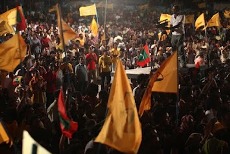
Addressing supporters on the third night of the ongoing Maldivian Democratic Party (MDP) ‘Journey to Justice’ protest, Nasheed explained that “the days when this country was ruled by the might of the forearm has been relegated to the past.”

“What we are seeing today is that the Maldivian people will not idly sit by and watch the flame of freedom flicker out,” he said.

He added that taking control of the army headquarters to assume executive power was “an outdated and antiquated way of thinking” in the 21st century.

“The secret or essence behind this is that the government of this country is not the property of the ruler,” he continued. “The government of this country belongs to its people. It can only be stolen from the people after arresting all of them or when there are no longer any people left in this country.”

A Maldivian government could no longer rule over the populace without their consent and respect, he added.

“The days when the Maldivian people could be beaten into submission with electric batons, pepper spray or sticks are long past,” he asserted, adding that “most Maldivians value freedom and despise brutality.”

Nasheed expressed concern with the continued arrest and detention of elected councillors and MDP supporters across the country.

In contrast to fiery speeches by MDP MPs threatening to march the crowd to “reclaim what was stolen,” Nasheed insisted that violent confrontations or the use of force would not be necessary.

He went on to congratulate the protesters for “showing an example to the world” of a peaceful demonstration.

“Shedding a single drop of blood from any Maldivian” would be unacceptable, he added, advising protesters to act “with wisdom and patience.”

Nasheed also urged speakers who take the stage to not abuse the right to free expression by using indecent or “obscene language” or resorting to personal attacks.

Day four
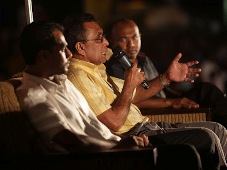
On the following night, former TV presenter Miqdad Adam hosted a panel discussion with former ministers Hassan Latheef and Hassan Afeef along with lawyer Ahmed Abdulla Afeef focusing on the legal issues surrounding the transfer of power.

Hassan Afeef,  former home minister, explained that the coup started with “rebelling or mutinying officers” refusing to obey orders from the former Commissioner of Police and his deputies on the night of February 6.

Shortly before beginning their protest at the Republic Square in the early hours of February 7, a rogue group of riot police attacked the MDP Haruge (headquarters), assaulted former State Minister for Home Affairs, Mohamed ‘Monaza’ Naeem and ransacked the place.

According to eyewitnesses, a police officer hit an elderly man on the head with a chair. Haruge was attacked for a second time after a group of soldiers and police assisted by gang members took over the state broadcaster.

Afeef added that a number of army officers also refused to obey orders from either the Commander-in-Chief or Chief of Defence Forces Brigadier General Moosa Ali Jaleel.

If police officers believed they were given an unlawful order, Afeef continued, they should complain through the proper channels.

Afeef noted that current Police Commissioner Abdulla Riyaz, Defence Minister Mohamed Nazim and State Minister for Home Affairs Mohamed Fayaz ‘FA’ had “no legal status” to enter army barracks, negotiate on behalf of the mutinying police or relay demands to President Nasheed.

Local media reported on the morning of February 7, between 10am and 11am, ex-Colonel Nazim addressing the crowd and informing them that President Nasheed had been told to “immediately and unconditionally resign” before 1.30pm.

Afeef claimed that Nazim told President Nasheed that “his life could be in danger” if he refused to comply with demands from mutinying police and army officers.

Former Youth Minister Hassan Latheef referred to opposition politicians meeting then-Vice President Dr Mohamed Waheed at 1:00am at his official residence following a night of roving protests.  He added that Dr Waheed evaded questions from cabinet members the next day.

Lawyer Ahmed Abdulla Afeef meanwhile criticised Chief Justice Ahmed Faiz for administering the oath of office on February 7 without looking into whether President Nasheed resigned under duress or not.

Ahmed also noted that the resignation letter was snatched by “the three men with no legal status” who entered the President’s Office with a number of army officers and took the letter to parliament.

Calling for an independent inquiry, Ahmed argued that compromising President Nasheed’s volition or discretion at any point of the process would render the resignation unlawful.

The former ministers also contended that opposition parties resorted to a violent takeover because they were convinced MDP would have won the 2013 presidential election based on delivery of campaign pledges, such as free universal healthcare, housing programmes and a nationwide transport network.

Likes(0)Dislikes(0)

India should give free kick to a friend: former Indian High Commissioner

The sudden resignation of President Nasheed in Maldives on February 7 took many by surprise, writes A. K. Banerjee, former Indian High Commissioner in the Maldives, for the Institute for Defence Studies and Analyses (IDSA).

The media in India reported it as a coup, a military takeover, the President was forced out, etc. Nasheed’s description of the change as a coup gave it a particular flavour. India is allergic to coups in its neighbourhood. It has had to get used to them in Pakistan and is wary of them in Bangladesh. This reflex is rooted in its deep seated commitment to democracy with a supreme civilian authority.

Coups also imply surprises and India does not particularly care for them. In the instant case the association of the word coup with Maldives set off a reflex and a chain reaction set in thereafter. India remembered the coup attempted in Maldives in 1988 when it had to rush its forces there to restore the government’s authority. An implied threat to its own security from an unstable situation in Maldives caused the Government to take the line of least resistance ie, accept the newly sworn in President, Dr. Waheed and assure him support and treat the matter as an internal issue of Maldives, to be sorted out by them.

Overall, the message that went out of New Delhi was that while it cannot be unconcerned about happenings in that country, it is prepared to work with whoever is legitimately in power there. However, the issue of legitimacy has now come to the fore and many feel that this needs to be looked at closely. Also, by being the first country to accept the developments there as an internal matter, India set an example for others to follow [witness the US position].

Democracies are however notoriously unstable to begin with and need patience and commitment all round. Maldives is no different and its institutions have not worked properly so far. The President was getting increasingly frustrated and the opposition confronted him at every step. Nasheed, long used to agitating for change and clamouring for power, did not, it seems, grow in office and his style was quite un-presidential. One could say that he was being democratic and had the zeal of a reformer. But holding office and leading street demonstrations require different hats.

Nasheed and his supporters faced opposition from a rich business class which controlled the mainstay of the Maldivian economy, i.e., the tourism industry. The downturn in the European economies, which sends the bulk of tourists to Maldives, has negatively affected this sector, which, in turn, impacted on the domestic political dynamics.

In describing his ouster as a coup, perhaps Nasheed wanted to indirectly involve India which he felt he was justified in doing given his attempts to bring the two countries closer, apart from his genuine democratic credentials. Yet at the same time he did not want armed conflict in his country or a civil war like situation. Since his ouster he has been loudly proclaiming his democratic credentials and wants India to hear him. He has repeated that he handed over power under duress and as a democrat he hopes India will see his position and, literally, rescue him. Not only that, he wants to bring forward elections to challenge the opposition and test their legitimacy at the hustings.

What should India do? Having made the point that Maldives is a major security issue for us and bearing in mind the overall international scenario prevailing now, we should bat for a friend. Knowing how slippery the democratic playfield can be and having a sense of who actually has fouled, as a sort of friendly referee, we should award a free kick to the player who has been knocked down.

How can we do that? We should work for a unitary government and persuade all to agree to early elections. But since there are no free lunches, we should recommend that Maldivians agree to long term strengthening of democratic institutions and resolve their differences peacefully; different factions must talk to each other and work towards a modus vivendi. Above all, authorities in Maldives must be encouraged to respect human rights and avoid use of force to deal with political dissent.

Read more

Likes(1)Dislikes(0)

Paradise lost – has democracy gone to hell in the Maldives: Economy Watch

Democracy, as Samuel P. Huntington once famously put it, often comes in waves, writes Raymond Tham for Economy Watch.

According to Huntington’s analysis, countries can be over-swept by democratic ideals during one such wave; and a political transition might occur – transforming the government from an authoritarian to a democratic one.

Yet, as Huntington would later note, the waves of democracy are often followed by “reverse waves” as well. In a reverse wave, a newly democratic country could potentially revert back to its authoritarian ways, especially if the remnants of the old regime attempt to rear up their ugly heads once again.

Former Maldivian President Mohamed Nasheed learnt this lesson the hard way. Less than four years after becoming the first democratically elected president of the Maldives, Nasheed was swept out of power on February 7th 2012 by a coup – led by his predecessor Maumon Abdul Gayoom.

Gayoom, and his associates, had apparently forced Nasheed to resign at gunpoint, with Nasheed’s vice president Mohamed Waheed Hassan – who Nasheed has now accused of being complicit with Gayoom’s scheme – installed as president on that day itself.

These violent scenes were a stark contrast to a year ago, when a young and upbeat Nasheed arrived in Delhi for a conference on promoting liberal governance in South Asia. During the conference, Nasheed expressed optimism on his country’s democratic process.

“We are in the process of consolidating our democracy,” said a cheerful Nasheed, as quoted by the Economist. Commenting on the Arab Spring, Nasheed also expressed confidence that his country could soon become a model for other Islamic states in adopting democracy.

“We are a 100 percent Muslim country. We feel if democracy can survive in the Maldives, it can survive in other Islamic countries.”

Read more

Likes(0)Dislikes(0)

India has let the Maldives down: Headlines Today

Ousted president Mohamed Nasheed, 44, was talking to his core group of advisers at his ancestral home ‘Keenerege’ in Male when the news of Indian Prime Minister Manmohan Singh’s letter of support to new President Waheed Hassan Manik, 59, came in, writes Gaurav C Sawant, for Headlines Today.

A shocked Nasheed, or Anni as he is known to friends, could not speak for several minutes. Those in the room say there were tears in his eyes. “He felt he had been let down by a friend,” said Ameen Faisal, Nasheed’s close friend and the country’s national security adviser before the alleged coup.

Nasheed had stepped out of his home on February 8 to address his Maldivian Democratic Party (MDP) workers when the ‘notorious’ Star Force crackdown began. The former president took refuge in a hardware store but they were found and taken into custody. Nasheed, who was the first democratically elected president of Maldives, says he was ousted in a military-backed coup and that Waheed, the vice-president, was involved.

Faisal, who was high commissioner to India-designate till the alleged coup on February 7, says India has made a strategic blunder in the Indian Ocean Region. “I was the defence minister of Maldives. I know how both China and Pakistan are desperately trying to make inroads here. We are India’s natural allies. Yet instead of supporting the first democratically elected president, India put its weight behind forces that want to make Maldives the Pakistan of the Indian Ocean,” Faisal insists.

Nasheed, too, expressed his disappointment with India’s response. “India’s stand is misguided and ill-informed. I hope they will consider a course correction,” he told India Today. Nasheed feels New Delhi is taking him for granted and India may lose its influence to China, Faisal added.

China is desperately pushing its economic diplomacy. “The Maldivian National Defence Force was keen to renew its defence agreement with Beijing. Twice they came to me when I was president. I refused,” Nasheed said.

Read more

Likes(0)Dislikes(0)

MDP agrees conditional participation in “interim government”

The Maldivian Democratic Party (MDP) has agreed to join an interim government that would pave the way for an early presidential election on the condition that five senior officials of Dr Mohamed Waheed Hassan Manik’s government are removed from their posts.

At a press conference yesterday, Male’ City Councillor ‘Sarangu’ Adam Manik read out a statement from an advisory sub-committee of MDP’s national council outlining the party’s position, which holds that “a government installed in a coup d’etat does not have the constitutional authority to form a national unity government.”

The former ruling party’s national council had passed a resolution on February 8 declaring that it would not recognise the “illegal government” of Dr Waheed.

“As President Mohamed Nasheed always places public interest first, his advice was, given that this problem can only be resolved with the participation of the people, to call for an early election,” Manik explained.

In response to Dr Waheed’s invitation to join a national unity government, Manik said the party considered the formation of such a government unlawful.

“However as the party also believes that the national interest would not be upheld without the participation of the largest political party, the Maldivian Democratic Party, and because this party has also worked in the interests of and for the benefit of the people, the party has informed Mohamed Waheed Hassan Manik that we are ready to participate with conditions in an interim mechanism to be formed to prepare for an early election,” he stated.

The MDP’s condition is for Dr Waheed to dismiss Defence Minister Mohamed Nazim, Home Minister Dr Mohamed Jameel Ahmed, Commissioner of Police Abdulla Riyaz, State Minister for Home Affairs Mohamed Fayaz and Chief of Defence Forces Ahmed Shiyam.

The party contends that the individuals in question were actively involved in the coup d’etat. On the morning of February 7, following the police mutiny, Nazim, Riyaz and Fayaz entered the MNDF headquarters to negotiate with President Nasheed and announced to the protesters that they had demanded Nasheed’s “unconditional resignation” by 1.30pm.

Meanwhile, MDP’s national council convened for an emergency meeting this afternoon and decided to hold a primary to choose its presidential candidate as required under party regulations.

Likes(0)Dislikes(0)

Dr Musthafa Luthfy resigns as chancellor of National University

Dr Musthafa Luthfy has resigned from his post as chancellor of the Maldives National University (MNU) in protest of the change of government on February 7 after a police mutiny forced President Mohamed Nasheed to resign under what he later claimed was duress.

According to local media, Dr Luthfy in his resignation letter expressed displeasure with the transition and contested the legality of Dr Mohamed Waheed Hassan Manik’s ascension to the presidency.

Luthfy, a founder member of Dr Waheed’s Gaumee Ihthihaad Party (GIP), spoke at the first night of the ongoing Maldivian Democratic Party (MDP) protest condemning “the coup d’etat” and calling on Dr Waheed to resign to make way for an early presidential election.

Likes(0)Dislikes(0)

Villa International High School threatens disciplinary action against student

Villa International High School – owned by business tycoon and leader of the Jumhooree Party (JP) Gasim Ibrahim – has threatened disciplinary action against a student who spoke at the ongoing Maldivian Democratic Party (MDP) protest.

According to Haveeru, the high school has decided to take action against Mikael Ahmed Naseem, a grade 12 student and school captain, for speaking at a rally organised by a political party.

Mikael had strongly criticised MP Gasim and claimed that students of Villa International High School were “against the coup.”

A school official told Haveeru that a committee would decide the form of disciplinary action, explaining that participation in partisan political activities were forbidden to students under general regulations for school children.

Likes(0)Dislikes(0)

Two MNDF, two police officers resign to join MDP protest

Two officers each from the Maldives National Defence Force (MNDF) and Maldives Police Service joined the ongoing Maldivian Democratic Party (MDP) demonstration last night after resigning in protest of the security forces’ role in the change of government on February 7.

The four ex-officers – Staff Sergeant Shafraz Naeem and Fire and Rescue Lance Corporal Mohamed Imram from MNDF, along with Staff Sergeants Imran Abdulla and Mohamed Niyaz from the police – were introduced to the cheering crowd shortly after midnight by former Housing Minister Mohamed Aslam as “honourable and patriotic sons of the Maldives.”

The four officers were “not alone” in their decision, said Aslam, insisting that a number of officers in the police and army were “of independent thought.”

Speaking after Aslam, former Defence Minister Ameen Faisal urged protesters to stop harassing and taunting security personnel with chants of’ “Money, money, yes sir!” as “only a few officers” participated in the police mutiny demanding President Mohamed Nasheed’s resignation in the early hours of February 7.

Former Youth Minister Hassan Latheef meanwhile suggested changing the slogan to “Money, money, no sir!” in recognition of the officers who resigned.

President Nasheed and members of his cabinet took to the stage to shake the ex-officers’ hands while the crowd saluted them.

The army has since issued a statement contending the two officers had not resigned and were absent without leave (AWOL). According to MNDF, the pair also had a history of disciplinary problems and administrative action had been taken against them.

Day three

Meanwhile the MDP’s mass protest demanding a date for an early presidential election entered its third consecutive day today, with more boatloads of supporters continuing to arrive in Male’.

Protesters from Thaa Madifushi swam ashore after 4:00pm today claiming they were not allowed to dock at the harbour while a large vessel from Haa Dhaal Kulhudufushi arrived this morning.

Addressing the gathering after midnight on the first day, President Nasheed urged supporters to “not do anything apart from expressing merriment.”

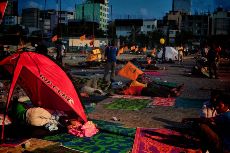
A number of protesters spent the night at the tsunami memorial area while the protest resumed the next day with a carnival atmosphere. Volunteers cooked rice with sausages while a children’s evening was arranged in the late afternoon.

On the second night, bodu beru (traditional Maldivian music) groups and local musicians entertained the crowd with improvised songs taunting the police. Among the performers were Sameeu, Fasy, Shiuz and musicians associated with the Dinba family.

Police have meanwhile told local media that the institution would not attempt to obstruct the gathering as long as it remained peaceful.

Speaking for a few minutes after 5pm today, President Nasheed said what was at stake was the freedom of future generations.

“One of the main reasons we can’t stay home indifferent is because we are very much assured in our hearts that there would be nothing more important for us to do than this after giving up our future,” he said.

Likes(0)Dislikes(0)

Story of the 1988 coup attempt: Economic Times

Operation Cactus, India’s military intervention at the request of then President Gayoom of the Maldives in 1988, was a spontaneous response, swiftly executed, writes Sushil Kumar, for the Economic Times.

But who would have ever imagined that a mission to thwart a coup in the island capital of Male, would finally be accomplished more than a thousand kilometers away and turn out to be a historic mid-ocean rescue operation.

After the rapid induction of an Indian Army para brigade at the airport on Hulule island, adjacent to Male, the rebel group who were Sri Lankan mercenaries of the PLOTE cadre, ran for cover and grabbing hostages from ashore, hijacked a merchant vessel , Progress Light, which was anchored in Male harbour.

With its motley group of seven hostages that included a Maldivian cabinet minister and his Swiss mother-in-law , the hijacked ship raced out of Male harbour under the cover of darkness. But unknown to rebel leader Abdullah Luthufi on board Progress Light, an Indian Navy Task Force led by INS Godavari with Captain Gopalachari in command, was fast closing in.

As the drama unfolded at sea, the Indian Navy operations room in Delhi was palpably tense yet privileged by the distinguished presence of then Prime Minister Rajiv Gandhi, who was keenly following the action. The Maldivian president had personally requested that the rebels be captured and brought back to Male to face trial, so ensuring the safety of the hostages and also rounding up the rebels was certainly going to be a daunting task. This was evident from the incalculable difficulty of the mission flashed to Captain Gopalachari, the task force commander – “rescue the hostages and capture the rebels .”

When dawn broke on the following day, the rebels on Progress Light were startled by the presence of menacing-looking warships of the Indian Navy task force that had stealthily encircled the hijacked ship during the night. Agitated and confused, the rebels initially refused to talk and pressed on doggedly in a north-easterly direction. Their intentions were clearly to seek refuge in Sri Lanka; radio transmissions monitored by the IN warships had confirmed this.

After hours of inaction at sea, a terse message from the Sri Lankan Navy came like a bombshell to the Indian Navy operations room: “The SLN had been directed by its government to destroy the rebel ship, if it approached within 100 miles of the Sri Lankan coast.” Our sources also confirmed that Sri Lankan Navy gunboats were manoeuvring out of Colombo harbour.

The Sri Lankan ultimatum posed an operational dilemma for the Indian Navy, since the rebels were hell-bent on taking the ship to Sri Lanka. Moreover, the mandate given to the Sri Lankan Navy also had the possibility of a naval confrontation which would have ruined everything. Fortunately, camaraderie at sea remains a praiseworthy concept and with the hotline as a handy device, a tense situation was promptly defused.

Read more

Likes(0)Dislikes(0)