Police submit cases to PG alleging damage to Alifushi police station on Feb 8

Police on Monday submitted cases to the Prosecutor General (PG) against 24 individuals charged with damaging the police station on Alifushi in Raa Atoll, and obstructing police work during the February 8 protests.

Police stated that the 24 individuals were charged for forcefully entering the police station around 7.45pm on the night of February 8, threatening officers on duty, forcing them to evacuate the premises, damaging the station building and for obstructing the police service.

The 24 people charged includes 20 men from the island of Alifushi itself. They are: Hassan Ahmed, 30, Velaanaage; Hassan Nashid, 30, Fasaanaa; Nail Abdulla, 25, RoashaneeAage; Muaviyath Abdul Latheef, 30, Scenery; Ahmed Mohamed, 22, Seny; Ismail Saif, 26, HabibiHap, Moosa Niyaz, 27 and Abdulla Niyaz, 24, Snow; Ali Fayaz, 31, Malaaz; Fazal Ibrahim, 19, NightHouse; Abdul Majid Moosa, 33, Hudhuasurumaage; Adam Shareef, 41 and Ibrahim Shareef, 29, VareyVilla; Abdul Hameed, 55, SameeVilla; Yameen Ibrahim, 26, Panama; Ishaq Adam, 28, Moonlight; Faruhadh Mohamed, 33, and Abdul Hafeez Mohamed, 27, HusnooVilla; Ahmed Riyaz, 21, Redfish, Shiyan Ibrahim, 28, Niuma.

The other four men are Mohamed Ramzy, 24, Shifana Villa, Lhaviyani Atoll Lhaimagu; Ahmed Giyas, 26, Berebedhimaage, Lhaviyani Atoll Naifaru; Hassan Simah, 30, Giyarest, Haa Dhaalu Atoll Neykurendhoo and Mohamed Ziyau, 26, of Samantha, Raa Atoll Rasgetheemu.

Police Spokesperson Sub-Inspector Hassan Haneef told Minivan News that police were looking into damage caused to police stations across all areas of the Maldives on February 8. He confirmed that police were not investigating damage caused to the police and MNDF headquarters by police and civilians on February 6-7, stating that “it makes no sense for police to look into this matter ourselves.”

Haneef said instead that the damage would be investigated under procedures determined by the government.

Local news sites have previously reported that in addition to damages to police offices, the state has submitted 409 cases concerning charges of arson on February 8 to the PG.

Meanwhile the Police Integrity Commission in its report into the events of February 6-7 stated that they had found in their investigations that ‘some among the police officers gathered in the Republican Square” had caused damage to the police headquarters, further stating that these would be treated as separate offences.

Minivan News tried contacting President’s Office Media Secretary Masood Imad and the Vice Chair of the Police Integrity Commission, Abdulla Waheed, but neither was responding to calls at the time of press.

Likes(1)Dislikes(0)

Government threatens legal action against parliament

President’s Office Spokesperson Abbas Adil Riza has threatened legal action “using all the powers of the government” against the People’s Majlis to “bring parliament back to the right path” in an appearance on government-aligned private broadcaster DhiTV on October 25.

Referring to parliament’s General Affairs Committee approving an amendment to the rules of procedure to conduct no-confidence motions through secret ballot, Riza said that the government could not “turn a blind eye” to what he contended was a move that violated the constitution.

“The constitution and parliamentary rules of procedure clearly state which votes are to be conducted through secret ballot. The rest of the votes should be open,” he claimed.

Riza went on to heavily criticise the committee decision, insisting that it violated the parliamentary rules on conducting committees meetings and votes.

The formerly ruling Maldivian Democratic Party (MDP) has submitted no-confidence motions against both Home Minister Dr Mohamed Jameel Ahmed and President Dr Mohamed Waheed Hassan Manik.

While the motion against Home Minister Jameel has been tabled in the agenda for November 14, the impeachment motion has yet to be tabled.

The MDP-dominated General Affairs Committee approved the amendment for a secret ballot last week with four votes in favour and none against, committee chair and Dhivehi Rayyithunge Party (DRP) MP for mid-Henveiru Ali Azim told local media. Only five MPs reportedly attended the committee meeting last week.

The amendment to parliament’s standing orders or rules of procedure would have to be approved in a vote at the Majlis floor to become official.

While a minister can be removed from his post through a simple majority of the 77 MPs in parliament, a two-thirds majority or 52 votes would be needed to impeach a sitting president.

Meanwhile, responding to Riza today, MDP Spokesperson and Henveiru South MP Hamid Abdul Gafoor told Minivan News that the party believed the remarks constituted a threat to violate separation of powers.

“It is simply second nature for the 7/2 police and military-backed coup-invoked dictatorship to use force to stay afloat,” the MP said.

Hamid had earlier tweeted that Abbas’s remarks were “open threats of use of force to stop secret ballot.”

Likes(0)Dislikes(0)

Comment: Election-phobic politicians cowering behind judiciary

“So you are proposing to incarcerate Mr Nasheed, are you?” a reporter recently asked a leader in the so-called Maldives Unity Coalition.

“Yes, we are. We will keep him in prison for a long time,” he replied.

The reporter winces.

“I see,” he says, just managing to look respectful. “So, you won’t have him to compete with your candidate to win elections?”

Ingenious, these people must think themselves.

“It’s one way to force you to the top, of course. But I shouldn’t call it civilised, or democratic,” he blurts out. “Justice has to be enforced, so, we don’t look at it like that,” the politician says. “Posterity will.”

The defeat of 2008 common amongst them, political losers of that election have tripped up and toppled the elected government in just three years.

Getting the peculiar lexicon right – the so called “harmonious diplomatic narrative” about the police mutiny amidst-coup and the actions of politicians leading up to the regime-change – took the Commission of National Inquiry (CoNI) a while, and eventually they had to ‘selvam’ the whole thing.

The so-called Unity Coalition that toppled the elected government comprises leaders of parties that have ostensibly not conducted organisational or internal elections in a transparent or an all-inclusive manner since inception. Despite having to resort to stark and obvious giveaways of election-phobia, they are looking to hunker down and stay on in power, obviously for as long as possible.

Getting on about it through the judiciary

Almost all senior MDP members are political victims of the previous regime, many having undergone torture and time in their prisons. However the new democratic regime, seeming to steer clear of paving the way and facilitating transitional justice, probably led opponents to cut up rough and go on talking openly about putting Mr Nasheed away in prison again.

Maldivians know that sitting presently in the Judicial Service Commission (JSC), the oversight body for the judiciary, are political opponents of President Nasheed – opponents in whose personal and political interest it is to incarcerate and disqualify their main challenger prior to elections. They have been publicly talking about it for months.

While members of the DRP, PPM and others in that bandwagon actively work to regularise discrepancies in the house, political leaders involved in regime-change such as MP Gasim Ibrahim and Majlis Speaker Abdulla Shahid continue to be influential members of the Judicial Service Commission.

Meanwhile, breaches of the Constitution by the Judicial Service Commission, such as the nullification of Article 285 – which stipulates qualification criteria for judges – by declaring it as a “symbolic article”; the subsequent reappointment of the pre-2008 Constitution judges without required checks; the prevention of meaningful changes and the establishment up of an independent judiciary are all pending in parliament without further inquiry.

The legitimacy of Chief Judge of the Criminal Court Abdulla Mohamed’s re-appointment as a judge can only be determined by an inquiry into the Judicial Service Commission and its actions over Article 285. All attempts to address issues of the Judicial Service Commission – especially with regard to its contravening Article 285 and pending complaints against Abdullah Mohamed – have been blocked by the opposition MPs of the DRP, PPM, and the DQP, by systematically disrupting every sitting in which these matters are raised. These MPs have gone so far as to publicly state that they will stonewall and prevaricate all pending issues concerning Article 285.

Ethical misconduct

While Article 285 embodies qualifications for judges, the case ofAbdulla Mohamed, glorified by the opposition as ‘Abdulla Gazi’, the hero of regime-change and victim of Nasheed’s government, have been widely published.  In 2005, then Attorney General Dr Hassan Saeed first forwarded to the President’s Office concerns about the conduct of Abdulla Mohamed after he allegedly requested an underage victim of sexual abuse to reenact her abuse in open Court.

In 2009, the new democratic government forwarded those documents to the Judicial Service Commission (JSC), which was requested to launch an investigation into the outstanding complaints as well as the alleged obstruction of “high-profile corruption investigations”.

The JSC decided not to proceed with the investigation on July 30, 2009. However in November that year, the JSC completed an investigation into a complaint of ethical misconduct against the judge.

The case was presented to the JSC in January 2010 by former President’s member of the JSC, Aishath Velezinee, after Abdulla Mohamed appeared on private network DhiTV and expressed “biased political views”.

Velezinee observed at the time that it was the first time the JSC had ever completed an investigation into a judge’s misconduct.

“There are many allegations against Abdulla Mohamed, but one is enough,” she said at the time. “If the JSC decides, all investigation reports, documents and oral statements will be submitted to parliament, which can then decide to remove him with a simple two-thirds majority”, she said.

Weeks later, Ibrahim Shahum Adam of Galolhu Cozy, listed by police as one of the nine most dangerous criminals in Maldives, and in prison for his alleged involvement in a stabbing near Maafannu “Maziya Grounds” during July, 2010 that killed 17-year-old Mohamed Hussein of Maafannu Beauty Flower,  was abruptly released by ‘Abdulla Gazi’ saying he wanted to hold the Health Minister accountable, as police had claimed a difficulty in obtaining a health certificate.

Shahum had also earlier attacked a fellow student attending an Imam course inside a teashop, and the victim, Ahmed Naeem of Carnationmaage, Alif Alif atoll Thoddu, had testified in court .

Days after Shahum was released by Abdullah “Gazi”, he was arrested again by police for the alleged  stabbing murder of 21-year-old Ahusan Basheer of Varudheege, Hithadhoo, Addu City, while the young man was walking along a street in Male’.

In October 2011, the ruling Maldivian Democratic Party (MDP) appealed for assistance from the international community over the “increasingly blatant collusion between politicians loyal to the former autocratic President, Maumoon Abdul Gayoom, and senior members of the judiciary – most of whom were appointed by Gayoom during his 30 years of power.”

On October 26, Judge Abdulla ruled that the arrest of Gassan Maumoon – son of former President Maumoon Abdul Gayoom – on suspicion of hurling a wooden block at protesters leading to a participant being disabled for life, was unlawful. This established a precedent that police could not arrest suspects without an arrest warrant “unless the arresting officer observes the offence being committed”.

The contentious ruling led police to release 11 suspects while the Prosecutor General’s Office (PGO) sought legal clarification on criminal justice procedures.

JSC a stakeholder in trial

It is laughable that the Judicial Service Commission is itself a stakeholder in the ongoing case against President Nasheed, as it is the very failure of that Commission to uphold the rule of law and fulfill its Constitutional mandate that underlies the creation of “Judge” Abdulla Mohamed, the subject of the trial.

Thus it is difficult to ‘selvam’ the fact that it is contradictory to the principle of natural justice for the Judicial Service Commission to decide the bench or in any way interfere and/or influence the trial.

The Judicial Service Commission intervened in Nasheed’s trial with blatant impunity, by abusing its powers to appoint judges to courts and deciding the bench for the trial itself. The Judicial Service Commission temporarily transferred three magistrates from other magistrate courts specifically to create the three member panel that is presiding over President Nasheed’s trial.

Some months earlier, the Anti Corruption Commission was widely quoted in the press on the appointment of the wife of a JSC member, Magistrate Shiyama, to the so-called Hulhumale’ Court, and the allegations continue that the Hulhumale’ Court is kept by the Judicial Service Commission in violation of the Judicature Act as a reward to Shiyama who, with a diploma in legal studies, does not qualify for appointment as a magistrate to a superior court.

Meanwhile, many people who attended the enforced first hearing of this so called trial believe that the Prosecutor General filed the case against President Nasheed invoking Article 81 of the Penal Code in open contravention of Article 17 of the Maldives Constitution under which every citizen is entitled to rights and freedoms without any discrimination, regardless of their political beliefs.

There has been no previous instance of a magistrates’ panel being convened to prosecute any case or individual charged under Article 81 of the Penal Code. Thus, it is common belief that appointing a magistrates’ panel to prosecute this case, by appointing magistrates from different jurisdictions including one who is currently under investigation by the Judicial Services Commission, is a direct violation of Article 17 of the Maldives Constitution.

Calls for Judicial reform get louder

Calls for judicial reform in Maldives are getting broader acceptance with talk rife these days in tea shops, coffee houses and Usfasgandu, of widespread corruption and corruptibility among judges.

Meanwhile some lawyers are publicly detailing tactics used by various judges to deny litigants due process.  Alleged such tactics include intimidation, muzzling, ignoring court rules, creating new rules, fabrication of facts, testifying for a party, issuance of absurd legal opinions, torturing the law as well as other creative means that have boggled the minds of numerous laypeople, lawyers and even judges.

These discussions are removing the halo of honorability that surrounds many “respected” judges and demonstrating how, for many judges, the canons of judicial conduct and Article 285 were enacted only for public consumption. It also demonstrates how certain judges, when challenged to explain their decision or stance, act no different than the same common criminals they were appointed to judge.

Judges accused of being corrupt are acting with the knowledge that their decisions will most likely be affirmed by fellow judges on appeal, pursuant to a tacit “fraternity” code. In other words, trial court judges openly utter absurdities in their opinions with the knowledge that fellow judges at the appellate court are not too keen on reversals.

They are also accused of acting with the knowledge that any commission charged with investigating judicial misconduct at the state level can at present ‘selvam’ such reports and dismiss any complaints against fellow judges.

Can they ‘selvam’ the vote?

Out in Singapore and Bangalore, schemes are going on at full blast to ‘selvam’ a submission in procuring Dr Duhbuhlyoo a good international job, after his much lauded and ruthless puppet role here. After all, the deputy, Duhbuhlyoo D, other friends among glorified foreign touts, and merchants of blood-oranges, all parodying here in the guise of diplomats and others flaunting professional respectability, are thinking of questionable money transactions in the PR, hospitality, border control and other deals pegged to Maldives.

Here in the Maldives, those who have faith in human ingenuity and meaningful change for the good, those who consider it necessary every once in a while for the right-thinking element of the community to slip it across certain of the baser sort – are at it regular like these days. They exude the confidence that all this will begin to come right again soon, through ballots proving the best weapon, against both a shady judiciary and those cowering behind it.

Mohamed Zuhair was former President Mohamed Nasheed’s Press Secretary from November 2008 to February 2012.

All comment pieces are the sole view of the author and do not reflect the editorial policy of Minivan News. If you would like to write an opinion piece, please send proposals to [email protected]

Likes(0)Dislikes(0)

“Legal order” last option to compel judges to attend committee: MDP

A “legal order” from parliament is the last available option to compel three judges of the Hulhumale’ Magistrate Court to attend parliament’s Government Oversight Committee, following their refusal to answer two previous summons, the Maldivian Democratic Party (MDP) said in a statement on Saturday.

The press release stated that “the excuses” offered by the three magistrates on administrative grounds – contending that as judges of the lower courts they doubted whether they could answer questions regarding the Commission of National Inquiry’s report and that they needed to await a decision by the Judicial Service Commission (JSC) – were “reasons that lacked any principle.”

“Therefore, the party notes that the measure left to be taken to bring the summoned judges to the Majlis committee is to issue a legal order to that effect,” the statement read.

Asked for clarification on the “legal order”, MDP Spokesperson MP Hamid Abdul Gafoor said that the statement did not refer to a court order contrary to the “assumption” by Sun Online and Haveeru.

“No mention was made of a court order in the news brief. Sun appear to have assumed so. The Majlis can bring out an ‘amuru‘ [order] according to house rules,” Hamid explained.

‘Hulhumale’ Magistrate Court’

The MDP also contests the legitimacy of the Hulhumale’ Magistrate Court, which was created by the JSC before the enactment of the Judicature Act in October 2010.

A constitutional case concerning the magistrate court is currently pending at the Supreme Court.

Writing in his personal blog on October 9, Independent MP for Kulhudhufushi South, Mohamed ‘Kutti’ Nasheed, explained that a magistrate court could not be established at Hulhumale’ as the Judicature Act states that magistrate courts should be set up in inhabited islands aside from Male’ without a division of the trial courts (Criminal Court, Civil Court, Family Court and Juvenile Court).

According to appendix two of the constitution, Hulhumale’ is a district or ward of Male’ and not a separate inhabited island. The former magistrate court at Hulhumale’ should therefore have been dissolved when the Judicature Act was ratified, Nasheed argued.

The three magistrates of the contested Hulhumale’ Magistrate Court are Shujau Usman, Abdul Nasir Abdul Raheem and Hussain Mazeed.

“Summon any person”

The MDP statement meanwhile observed that article 99(a) of the constitution states that the People’s Majlis or any of its committee has the power to “summon any person to appear before it to give evidence under oath, or to produce documents. Any person who is questioned by the People’s Majlis as provided for  in this article shall answer to the best of his knowledge and ability.”

However, following the first attempt to summon the magistrates, the JSC and the Supreme Court made public statements insisting that the JSC was the only authority empowered by the constitution to hold judges accountable.

A statement by the JSC on October 9 citing the constitution, the Judicature Act and the Judicial Service Commission Act contended that no other state institution could interfere with the work of judges or make any attempt to hold judges accountable.

Under article 159(b) of the constitution, the JSC is empowered with the power and responsibility “to investigate complaints about the judiciary, and to take disciplinary action against them, including recommendations for dismissal.”

Parties in the ruling coalition have meanwhile condemned the decision to summon the magistrates as an attempt to influence the trial of former President Mohamed Nasheed at the Hulhumale’ Magistrate Court on charges of illegally detaining Criminal Court Chief Judge Abdulla Mohamed.

The formerly ruling MDP has a voting majority on the Government Oversight Committee.

While Speaker Abdulla Shahid sent the summons issued by the committee on October 9, local media reported that parliament’s Counsel General Fathmath Filza had advised that summoning judges was not within the mandate of the committee.

Meanwhile, following the judges’ snub of the second summons, MDP MP Ali Waheed told reporters outside parliament on Wednesday that the actions of the magistrates and the JSC as well as the Supreme Court’s encouragement of their behaviour was a “cat and mouse game” played by the judiciary.

“What we are witnessing is a ‘cat and mouse’ or a ‘hide and seek’ game being played between parliament and judiciary. If that is the case, we are going to play the cat and mouse chase, because we are not going to step back from our responsibilities,” he said.

Likes(0)Dislikes(0)

Malidves slips to 95th in ‘Ease of Doing Business’ index

The Maldives has slipped 16 places in the World Bank’s Ease of Doing Business report for 2013, ranking 95th out of 185 economies measured.

Much of the drop is due to the introduction of a new taxation system, which previously saw the Maldives at the top of the index. Taking into account the business profit taxes, pension payments and others, the report calculates the Maldives’ total tax on gross commercial profits for a business in its second year of operation profit as 30.7 percent, well below the South Asia average of 40.2 percent.

The Maldives is rated 167th – worse than Afghanistan – for ‘getting credit’, a measure of the availability of credit information and the effectiveness of collateral and bankruptcy laws in facilitating lending.

While the rating is particularly hurt by the lack of a credit ratings registry, the Maldives scores several points lower than the regional average for protecting the rights of creditors.

The Maldives ranks higher than the regional average for resolving insolvencies, with an asset recovery rate of 50 percent (compared to the regional average of 33 percent) in half the time (1.5 years).

Likes(0)Dislikes(0)

DRP MP Rozaina posts more Theemuge invoices on Twitter

Dhivehi Rayyithunge Party (DRP) MP Rozaina Adam on Thursday posted more invoices and receipts from the former presidential palace Theemuge on her Twitter account, following her exposure earlier this month of extravagant spending by former President Maumoon Abdul Gayoom’s family.

The lavish expenses were allegedly made out of the Theemuge Welfare Budget – funds that were earmarked for helping the poor upon written request to the former palace, such as requests for assistance to seek medical treatment overseas.

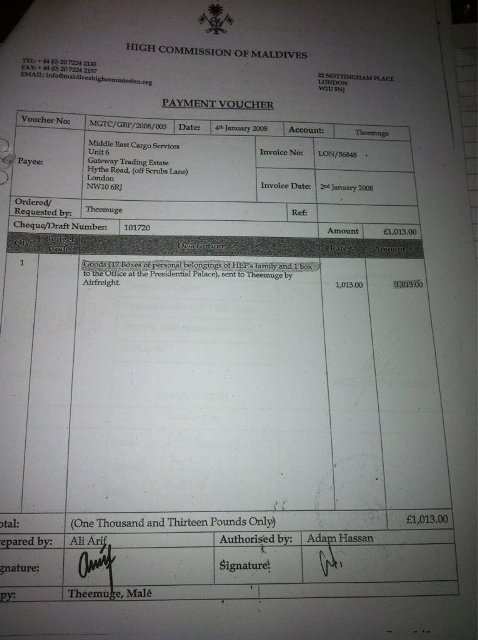
The latest invoices to be made public by the DRP MP included a payment voucher of £1,013 (MVR 25,122) from the Maldives High Commission in the UK for “17 boxes of personal belongings of HEP’s [His Excellency the President’s] family and 1 box to the Office at the Presidential Palace, sent to Theemuge by airfreight.”

The boxes contained items purchased by the former President’s family during shopping sprees in London, the MP explained.Theemuge invoice

Among the other documents uploaded by the MP for Kaafu Thulusdhoo was “a receipt verified by the Audit Office for US$50,000 taken by [former First Lady] Nasreena [Ibrahim] on her Dubai trip,” MP Rozaina tweeted.

Rozaina also posted a credit card statement “for the meal by MAG [Maumoon Abdul Gayoom] family at Thanying Restaurant which cost MVR 21,803.88.”

She posted a second receipt of US$1,414 for a meal at the same restaurant in Singapore “on the same trip by MAG family.”

“Here’s the actual meal receipt for 1 meal by MAG family from ‘Song of India’ restaurant [at a] cost [of] MVR 22,097.7,” Rozaina tweeted with a picture of another receipt.

After MP Rozaina first made the allegations of extravagant spending from Theemuge in parliament, former President Gayoom’s lawyer, Ibrahim Waheed, released a statement insisting that all expenditure out of Theemuge was “in accordance with the rules and regulations” and in line with the former presidential palace’s budget approved by parliament.

Waheed added that all records and documentation of expenditure were left at the palace files when the former president left office in November 2008.

Rozaina however issued a counter statement last week noting that the former president’s lawyer had neither contested the authenticity of the bills and invoices nor denied that the expenses were made out of the Theemuge budget.

In her statement, the DRP MP said that the invoices and bills she made public were “just a few among thousands” at parliament’s Finance Committee.

Pressed by Twitter users when she first uploaded the documents on October 19 as to why she had not spoken about the Theemuge expenses before, Rozaina tweeted, “I thought auditor general was politicising. He sent all the bills this year.”

“Previously it was just a report,” she added. “Documentary evidence was sent to the Majlis only this year.”

Rozaina revealed that parliament’s Finance Committee was currently reviewing the Theemuge audit report.

MP Rozaina’s husband and DRP MP for Raa Atoll Alifushi, Mohamed Nashiz, is the deputy chair of the committee.

The damning audit report (English) of the former presidential palace for 2007 and 2008 – released in April 2009 – stated that 49 percent of the palace’s welfare budget, equivalent to MVR 48.2 million (US$3,750,000 at the time), was diverted from the budget for the poor in 2007 and 52 percent, MVR 44.9 million (US$3,500,000), in 2008.

“We believe this is corruption and misappropriation of public funds,” the former Auditor General had stated.

Likes(0)Dislikes(0)

Comment: Legislature versus judiciary in the Maldives?

After three years of continuous confrontation between the executive and the judiciary, Maldivian democracy is now getting exposed to the inevitability of an issue-based confrontation between the legislature and the judiciary.

The clash may have flowed from the on-going criminal case against former President Mohammed Nasheed, but central to the emerging row could be the question of comparable supremacy of the judiciary and the legislature, an issue that has been basic to other democracies too.

In an infant multi-party democracy such as the Maldives, it will be interesting to note how the constitutional institutions take forward the cumulative concerns of nation-building in areas where other emerging democracies had handled near-similar situations with abundant caution and accompanying maturity.

The current controversy flows from President Nasheed purportedly ordering the arrest of Criminal Court Chief Judge Abdulla Mohammed on January 16, and holding him ‘captive’ in an island away from the national capital of Male, the latter’s place of ordinary residence. With the change ofgGovernment on February 7 now has come the criminal case against President Nasheed and a host of others serving his government at the time. However, the involvement of a judge in this case should not distract from the issue on hand.

What is material to the present situation is the summoning of the three judges of the suburban Hulhumale Court by the Parliament Subcommittee on Government Accountability, dominated by members of President Nasheed’s Maldivian Democratic Party (MDP). The judges, first asked to appear before the committee, almost around the same time as President Nasheed was summoned to appear before the three-judge bench, stayed away once.

They have stayed away a second time, since. Media reports quoting committee sources claimed that on neither occasion did the judges assign any reason for not appearing before the committee.

In ordinary circumstances, this has the potential to trigger an all-out confrontation between parliament and the judiciary. In this case, however, circumstances may have conspired already to make it even more complex. The fact that these are possibly the only judges to have been summoned by the said parliamentary committee under the new constitutional scheme of 2008 has not gone unnoticed. Nor has the fact that they were trying President Nasheed when they were summoned by the committee. A government party member on the committee also went to town soon after it decided on the summoning of the judges that many of the non-MDP members were held up in a Parliament voting when the decision was taken. The implication was still that the government party members may not subscribe to the decision taken by their MDP counterparts, who have a majority representation on the committee.

Not much is known about the immediate causes surrounding the summoning of the judges. Prima facie, it is said that they were required to depose before the committee on matters flowing from the Report of the Commission of National Inquiry (CoNI), submitted to President Waheed Hassan Manik in August-end.

While upholding the constitutional validity of the power-transfer after President Nahseed resigned on February 7, the multi-member body with international representation had recommended the further strengthening of the ‘independent institutions’ under the constitutions. However, it is argued that any furtherance of the goal could not be achieved by parliament or any of its committee, by summoning members of the subordinate judiciary. It has to be at higher-levels, be it in terms of policy-review, execution or supervision.

Ruling Progressive Party of Maldives’ (PPM) member of the Committee, Ahmed Nihan Hassan Manik, said, without much loss of the time when the judges were first summoned, that the panel had exceeded its mandate. Pointedly, he referred to the pending criminal case against President Nasheed, and said that neither any parliamentary committee nor the full House could discuss any case pending before any court in the country. “The MDP says that they do not accept Hulhumale court’s jurisdiction. Parliament committees do not have the mandate to summon judges in relation to this accusation. I think MDP members did this because they are emotionally charged,” Nihan said on that occasion.

Cat-and-mouse or hide-and-seek game?

The Supreme Court, whose directions the three judges were believed to have sought, reportedly advised them against appearing before the parliamentary committee. The Judicial Services Commission (JSC), another ‘independent institution’ under the 2008 Constitution, was even more forceful in its defence of the judges’ decision not to appear before the committee. Citing specific provisions, the JSC said that the Majlis should stop interfering in the judiciary and should respect the separation of powers as guaranteed under the constitution.

The JSC cited Article 141 (c) of the constitution, which reads thus: “No officials performing public functions, or any other persons, shall interfere with and influence the functions of the courts.” It further referred to Article 21 (b) of the Law on the Judicial Services Commission and said that it was the sole authority for holding judges accountable to their actions. Further, the JSC has also Article 9 of the Bill on Judges as legal foundation for its arguments against judicial interference by the Majlis. The JSC may have a point, considering that ‘Institution Commissions’ such as this one were given constitutional protection only to free subordinate organs of the government from perceived interference and influence by the Executive and the rest.

MDP members on the parliamentary committee have denied any linkage between the case against President Nasheed and the summoning of the trial judges. MDP’s Parliamentary Group Deputy Leader Ali Waheed, chairing the committee, has also described the actions of the judges and the JSC as well as the Supreme Court’s encouragement of their behaviour as a “cat-and-mouse” game played by the Judiciary. “What we are witnessing is a ‘cat-and-mouse’ or a ‘hide-and-seek’ game being played between Parliament and the judiciary. If that is the case, we are going to play the cat-and-mouse chase, because we are not going to step back from our responsibilities,” Minivan News quoted him as telling a news conference after the judges failed to appear before the committee.

Ali Waheed denied that they were summoning the three judges “to settle scores or for a personal vendetta or to destroy their reputations”, but within the course of executing their legal duties.

“As the chair of Parliament’s Government Oversight Committee, I shall continue to execute my duties and we believe the constitution allows us to summon anyone with regard to our concerns and we will do so. So I sincerely urge them not to hide behind a constitutional clause dictating the responsibilities of the judges,” Waheed said, maintaining that the committee’s intentions were sincere and that it was being very “respectful” and “patient”.

According to Minivan News, Ali Waheed went on to add: “These people are those who must lead by example (in upholding the law) but what we see is that neither the Anti-Corruption Commission, nor the Auditor-General, not even Parliament is being allowed to hold these people accountable. They can’t be above the law and should not even think they are,” he continued. “What we are repeatedly reassuring them is that we will not allow committee members to question them on matters not in their mandate.”

Waheed’s fellow MDP parliamentarian Ahmed Hamza argued that the judges’ decision was in contrast to principles of rule of law, which were fundamental to a democratic State. “In every democracy it is the people from whom the powers of the State are derived. Parliament represents the people, and their actions reflect the wish of the people, so all authorities must respect the decisions,” he said. Hamza, according to Minivan News, reiterated that the current system of separation of powers holds the three arms of the State accountable to one another through a system of checks-and-balances.

Hamza dismissed the claims made by pro-government parties that the committee was attempting to influence the on-going trial of President Nasheed. “We are not trying to defend Nasheed, all we are trying to do is to carry out our duties and responsibilities vested in the constitution. We will not question them about any ongoing trial, nor will we comment on their verdicts and decisions,” Minivan News quoted Hamza as saying further.

Democratic precedents

The committee’s summons for the three Judges was formally routed through Parliament Speaker Abdulla Shahid, thus conferring the authority of the Majlis. For an infant democracy, the current controversy has the potential to create a constitutional deadlock of a new kind, after President Nasheed in mid-2010 ordered the closure of the Supreme Court by the nation’s armed forces for a day. The period also witnessed a deadlock of sorts between the Executive and the Legislature, where the present-day ruling parties were in the Opposition and held a collective majority. However, the current deadlock has greater potential for inflicting deeper constitutional wounds than the rest. At the centre of the issue however would be the Executive, which prima facie has no role to play but may be called upon to resolve the issue, nonetheless, particularly if the situation were to go out of hand in the coming days and weeks.

It is not as if other democracies have not faced similar or near-similar problems. What is, however, unique to the Maldivian situation is that in the absence of political, legal and constitutional precedents of its own, the temptation for each arm of the State to assert its relative supremacy and consequent paramountcy against one another could be too tempting to test and also resist.

Elsewhere there have been many instances of the kind, though even there does not seem to be any parallel of the Maldivian kind where judges have been summoned before a parliamentary committee to comment on issues after they had assumed judicial offices.

In the US and many other western democracies, parliament and parliamentary committees have both the right and responsibility to vet prospective judges to superior courts nominated by the executive, and also vote on such nominations, where required. It is so in those countries when it comes to other senior governmental appointments, including envoys to foreign countries. The Maldives follows such a scheme, yet in the case of judges, as the 2010 controversy showed, the differences were over nominations to the JSC, not of individual judges, particularly at the subordinate levels. Incidentally, in none of the western democracy is there a known precedent of a serving member of the subordinate judiciary being summoned by a parliamentary committee. They are often left to the administrative control of the higher judiciary, which only is subject to the option of impeachment of its individual members by the legislature.

In neighbouring India, which is the world’s largest and possibly a more complex democracy at work than its western counterparts, issues involving the judiciary and the legislature are confined to two broad-spectrum spheres, other than in matters of ‘impeachment’ (which was effectively used twice since Independence, with 50 per cent success rate). In India, the judiciary and the legislature have often come into conflict over the former staying the operation of any legislative ruling in terms of actions initiated against individuals called to bar. Where a final verdict is available, the legislature concerned has often abided by the judicial verdict even in such matters.

Judicial intervention in legislative action in India otherwise has been confined mostly to the Speaker’s rulings or initiatives in matters pending before him under the anti-defection law. The law came into force in the mid-eighties, close to 40 years after independence, and opened up a new chapter on legislative jurisprudence of the kind. While holding the law, empowering the Speaker of the legislature concerned, as the final arbiter of what constituted ‘defection’ by an individual member or a group in a parent party, the higher judiciary applied a kind of checks-and-balances in the application of the rule to individual cases, based on facts and circumstances. The Supreme Court’s judgment in the ‘Manipur Assembly Speaker case’ defined and restricted the role of the Speaker under the anti-defection law. This was however followed by the Apex Court’s verdict in the ‘S R Bommai case’ (1994) which in fact sought to expand the scope and role of the legislature in deciding a government’s floor majority.

As coincidence would have it, almost every Third World, South Asian democracy seems to have witnessed issues involving the judiciary and the legislature, with the executive coming to be willy-nilly involved, by extension. In Pakistan, the supremacy of the Judiciary ultimately dictated that the Legislature’s pro-confidence resolution did not have the required legal and constitutional binding, with the result, Prime Minister Yousaf RazaGilani quit on court orders. His successor, Raja Pervez Ashraf, after indicating to go Gilani’s way has obliged the Supreme Court’s directive in writing to the Swiss Government on the bank accounts of the nation’s President, Asif Ali Zardari.

In ‘revolutionary’ Nepal, the incumbent government promptly followed the Supreme Court directive on holding fresh elections to the Constituent Assembly without seeking to extend its term further. In Pakistan and Bangladesh, over the past couple of years, the respective Supreme Court have held preceding constitutional amendments passed under the military regime unconstitutional, and no section of the incumbent Legislature has contested the same. More recently in Sri Lanka, the legislature was said to be in a seeming conflict with the judiciary, but on record, senior Ministers were deployed to annul all such apprehensions.

It is in the larger context that Maldives has to view the emerging controversy involving the legislature and judiciary, which if left unaddressed, has the potential to rock the constitutional boat further.

Considering however the telescoping of the democratic process that Maldives has adopted unintentionally, as the events and consequent constitutional issues have shown, the possibility of further clarity on the overall spectrum appearing at the end of the tunnel on this core issue too cannot be ruled out. Either way, the stake-holders need to handle the issues and the attendant controversies with the knowledge, accommodation and sensitivity that they demand.

The writer is a Senior Fellow at Observer Research Foundation

All comment pieces are the sole view of the author and do not reflect the editorial policy of Minivan News. If you would like to write an opinion piece, please send proposals to [email protected]

Likes(0)Dislikes(0)

IPU to send human rights fact-finding mission to Maldives

The Inter-Parliamentary Union (IPU) has decided to send a human rights mission to the Maldives “to gather first-hand information” on cases involving human rights abuses and political intimidation of MPs.

The decision was adopted by the IPU during its 127th Assembly in Quebec City, Canada, upon the recommendation of its Committee on the Human Rights of Parliamentarians.

In a press release on Wednesday following the decision to send the fact-finding mission, the IPU expressed concern with the “on-going climate of violence and confrontation in the Maldives, expressing shock at the recent killing of MP Afrasheem Ali.”

“In a resolution on the case of 19 MPs from the Maldivian Democratic Party (MDP), alleged victims of excessive violence, arbitrary arrests and criminal charges believed to be politically motivated, the Organisation is similarly perturbed by reports of renewed ill-treatment, detention and harassment by law enforcement officers,” the statement read.

“Maldives has been in political crisis since February when incumbent President Mohamed Nasheed was replaced by his Vice-President Mohamed Waheed. There has been growing international concern at the political intimidation and serious outbreaks of violence in the country.”

Aside from the concerned MPs in the human rights abuse cases, the press release added that the IPU mission will meet officials from the government, parliament and judiciary “at the invitation of the Maldives government.”

MDP MP for Galolhu North, Eva Abdulla, participated in the meeting of the IPU Committee on the Human Rights of Parliamentarians on October 21.

In March, the MDP parliamentary group submitted cases alleging police brutality against the former ruling party’s MPs to the IPU’s human rights committee at the 126th Assembly held at Kampala, Uganda.

During the same meeting, Eva was unanimously elected as a member of the IPU’s Committee of Women Parliamentarians.

MDP Chairperson 'Reeko' Moosa Manik in intensive care.

The cases concerned targeted police brutality against MDP MPs on February 7 and 8, in particular on the latter date during a heavy-handed police crackdown on an MDP protest march that left scores injured and hospitalised, including former MDP parliamentary group leader and Hulhu-Henveiru MP ‘Reeko’ Moosa Manik and Maafanu South MP Ibrahim Rasheed ‘Bonda’.

Three classified reports by the IPU concerning police brutality against MDP MPs have been shared with parliament and the executive since the transfer of presidential power on February 7, the party revealed this week.

No charges have been pressed to date against police officers of the Special Operations (SO) unit caught on camera beating civilians and MDP MPs.

The IPU is a global organisation of parliaments, established in 1889. It works to foster coordination and exchange between representative institutions across the globe. The IPU also offers technical support to affiliated nations. The Maldives has been a member of the organisation since 2005.

Likes(1)Dislikes(0)

Comment: Arab spring, authoritarian winter

The democratic aspirations of many countries around the world rising against authoritarian regimes early last year was, at the time, an uprising many thought would bring progressive change to the political systems in those countries.

It came to fruition through the voice of youth; educated young individuals affronted by meager job opportunities and other socio-economic inequalities perpetrated by the oligarchic superstructures entrenched in these countries.

This was the true spirit of what came to be known as the Arab Spring. The scattered archipelago of the Maldives, in South Asia with its coastlines in the Arabian Sea had the first ever peaceful transition into democracy by a Muslim-majority country in August 2008, a precursor to the events in the Middle East last year. However, a year later the stories from Egypt, Syria, Libya and Tunisia do not resonate with the ambitions of the resistance movements seen throughout the Middle East last spring.

In Egypt, former autocratic ruler Hosni Mubarak first came to power three years after Maumoon Abdul Gayoom did in the Maldives.

Mubarak was deposed in a popular uprising backed by the military – a conclusion unfathomable to many, even in the most well-informed US diplomatic circles. Although defiant developments, these ‘Black Swan’ moments of history (as coined by Lebanese-American scholar Nassim Nicholas Taleb) have proven to be more beneficial towards Islamists and the elite, rather than the young liberal movement with political and economic grievances who initiated, organised and executed the revolts.

When Cairo was bustling with news of elections in June this year, military and powerful businessmen still held on to power and the latter continued to monopolise the economy. In the weeks leading up to the elections, confrontations between civilians and the military regime in power turned violent. An onslaught of police brutality and violation of fundamental rights directed systematically towards pro-democracy protesters took place in all of the Arab Spring countries. Rampant instances of human rights abuse in the Maldives following the dubious transfer of power in February have been repeatedly condemned by Amnesty International, the International Federation of Human Rights (FIDH), Reporters Without Borders and many other international organizations. A group of Maldivian women who were arrested earlier this year alleged that police sexually harassed them whilst they were under police custody. International bodies have called for investigation into all these accesses by the police but to no avail.

If there is a pattern to be realised, it is that the ruling elite and their grip on the leading elements of the military – formed through years of power -seem to plunder the determination of the people in these countries to have a genuine democracy.

Similarly to the Egypt, in the Maldives the power vacuum left over after the removal of former dictator Maumoon Abdul Gayoom was filled by Islamists and Gayoom loyalists.

The Muslim Brotherhood’s engagement with Egyptians has been a long and significant since its establishment in 1928. The Adhaalath Party, an Islamist party in the Maldives, has little akin to the Muslim Brotherhood in that regard. The party joined the December 23rd coalition made up of the then opposition parties. The coalition was made up of Dhivehi Rayyithunge Party (DRP); the former dictator’s neophyte attempt at multi-party politics which he later defected.

He then created the Progressive Party of Maldives (PPM), while his family friend, businessman-come-politician Gasim Ibrahim, created the Jumhoree Party (JP), while the Dhivehi Qaumy Party (DQP) was created by Dr Hassan Saeed and Mohamed Jameel Ahmed who held cabinet portfolios under both Gayoom and Nasheed’s administration. It was this coalition of dictator loyalists who created a religiose Maldivian ‘rally round the flag’ effect that aided the military and police backed coup.

In the case of the Middle East, the transition seemed sudden and spontaneous. The Maldives deposed the three-decade dictator through the first ever multi-party democratic elections in the country in October 2008 as prescribed in a new Constitution which came to effect in August that same year. Mohamed Nasheed came into power with a citizen-centric manifesto with development and social welfare pledges.

It could be seen as the inexorable result of slow, erratic outbursts of civil unrest that began with the death of Evan Naseem under police custody in 2003. His death caused the highly restricted yet obsequious Malé and nearby islands to be worked into a fervor unheard of under Gayoom’s autocratic rule, apart from sporadic uproars in the 1980s.

Again in 2004 Nasheed’s arrest sparked another nationwide resistance. Gayoom was forced to embark on a reform agenda due to local and international pressure, which intensified due to economic upheaval following the 2004 tsunami. Mubarak’s stronghold on the judiciary weakened and pressure for judicial reform came a year before Gayoom came under pressure to initiate judicial and constitutional reform in 2004.

Eventually in four years a democratic Constitution with separation of powers, independent institutions and a bill of rights was enacted.

The reversal of the hard-earned democratic transition however came quite precipitously when police and military mutinied. The result was a dubious power transfer believed by majority of Maldivians to be a ‘televised coup d’état’ against democratically elected government. In Egypt, Mubarak’s loyal military did the opposite by siding with majority of Egyptians last year.

In Egypt, Tunisia, Libya, Syria and the Maldives the similarity is the patrimonial style of governance, however historically and culturally these countries differ greatly. Former French colony Tunisia is culturally and aesthetically more westernised than its counterparts. Libya and Syria have more potential for continued sectarian conflict. Nonetheless, the political discourses of Egypt and the Maldives are more similar compared to the dynamics of the other Arab Spring countries.

The propensity for Islamism however differs at present. The Adhaalath Party does not have any seats in the People’s Majlis, whereas Muslim Brotherhood, Al Nour and Salafists have secured a majority of Egypt’s parliament. It is difficult to tell if Islamists will benefit to a similar extent in the Maldives during next year’s parliamentary elections, but given the social and cultural rise in fundamentalism it is probable in the near future.

The military’s role in transitions and socio-economic disparities further exacerbated through patrimonial form of government are also shared themes between the two countries. Gayoom and his predecessors ruled the Maldives in a highly centralised form of government which translated into systemic inequalities between the capital Malé and the outer islands. These were the disparities the Maldivian Democratic Party (MDP)’s manifesto sought to alleviate, however many development projects and the free health care system initiated by the MDP have now been discontinued.

The first democratically elected President Nasheed of the Maldives has been on trial since August this year with civil and criminal allegations against him. His party and supporters maintain that the charges are politically motivated to stop him from contesting in next year’s elections.

Meanwhile citizens who protested the legitimacy of Mohamed Waheed’s post-‘coup’ government in February are also being prosecuted nationwide. In all countries authoritarianism is prevalent following the hopeful spring last year. The crackdown on dissent this year has been exceptionally brutal in the Middle East. It is clear that post-colonial nations have been unable to reform their police and military to serve their citizens.

In Egypt the military might have done what was popular amongst its citizens but in no way does it discount their self-interest. Security forces continue to make political decisions as they were trained to do during the colonial era. The Arab Spring that started at the end of 2010 and bloomed to full glory in 2011 may have brought with it much hope, but since the ousting of their respective symbolic autocrats, neither the system of government nor the politicised police and military have democratised. This failure is making possible the resurgence of authoritarianism and an increasingly Islamist future for the region just as it has done in the Maldives.

All comment pieces are the sole view of the author and do not reflect the editorial policy of Minivan News. If you would like to write an opinion piece, please send proposals to [email protected]

Likes(1)Dislikes(0)