High Court orders immediate release of former warden arrested over inmate torture investigation

The High Court has today ordered the immediate release of former head prison warden ‘Isthafa’ Ibrahim Mohamed Manik, citing that his arrest was unlawful and he was currently not in a position to eliminate evidence as claimed by police.

Isthafa was arrested in Male’ in connection with the investigation of photographs allegedly obtained from the Department of Penitentiary and Rehabilitation Services (DPRS) and leaked to the media, appearing  to show inmates being tortured in custody. Police obtained permission to extend his detention to 15 days from Maafushi Court on Friday.

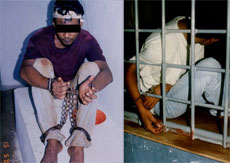
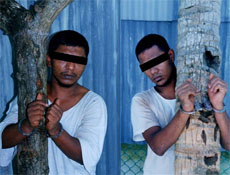
The photos released so far include images of men tied to coconut palms, caged, and bloodied. One of the photos, of a prisoner lying on a blood-soaked mattress, has a 2001 date stamp.

The High Court ruled that Isthafa was required to be summoned to the Criminal Court because he was arrested in Male’.

The decision of the Maafushi Court was inconsistent with systems applied in such situations, and the Supreme Court’s procedures, said the High Court.

The High Court also said that the Maafushi Court warrant to extend the detention of Isthafa noted that the extension warrant was issued to prevent Ishtafa from influencing witnesses and evidence.

Inspector of Police Abdulla Nawaz confirmed in a statement to the state broadcaster MNBC that the matter involved severe cases of torture and suspected fatalities, and had been passed to police.

Isthafa was summoned for questioning by police in March in mid-March 2011, regarding an undisclosed investigation.

Local media reports citing unnamed sources at the time claimed Isthafa had been summoned to clarify information surround the possible death in custody of a prison inmate named Abdulla Anees.

Abdulla Anees of Vaavu Keyodhoo Bashigasdhosuge, was an inmate at the former Gaamaadhoo complex and was officially declared missing in the 1980s. President Mohamed Nasheed has claimed that human bones discovered on the site of the former Gaamaadhoo prison were thought to match the age and estimated period of death of Anees, after sending the samples to Thailand for DNA analysis and carbon dating, and asked police to investigate.

In April the government claimed crucial files relating to the investigation into the Gaamaadhoo bones had gone missing – including the originals kept with the DPRS, and copies stored with police.

State Home Minister Ahmed Adhil told Minvan News at the time that the government had ordered a police investigation into the missing files.

“Police  informed the Home Ministry that they have located copies of the files, but the original was held by the DPRS and is still missing. We don’t count copies of papers so we don’t know whether any important documents are missing unless we find that original,” he said.

Adhil said at the time that the Ministry could not yet say whether the files had been misplaced or deliberately removed, although the theft of the documents “is a very close possibility.”

Earlier this month, former deputy leader of the opposition Dhivehi Rayyithunge Party (DRP) Umar Naseer, a key leader in Gayoom’s faction of the DRP, claimed to have obtained information that results of the examinations showed the bones were “over 800 years old.”

”Those bones were first taken to Thailand for investigation and [investigators] said they were over 800 years old,” said Naseer. ”Later the government sent the bones to America, where they also said the same.”

Umar said the investigation into the identity of the bones was now closed, ”but the government will never say that because they want to use it for political purposes.”

Following Isthafa’s arrest, former President Maumoon Abdul Gayoom’s spokesperson Mohamed Hussein ‘Mundhu’ Shareef told Haveeru that the detention of the former head of prisons was the “the third part of the drama” in a long-plotted lead up to the arrest of the former president.

“The attempt to arrest President Maumoon will only boost his profile. We see this simply as the government’s attempt to divert the people’s attention from the dollar crisis and rising commodity prices,” Shareef told Haveeru.

Press Secretary for the President’s Office, Mohamed Zuhair, did not respond to Minivan News at time of press.

Likes(0)Dislikes(0)

Comment: Islam is for tolerance of the Other

It is disturbing and saddening to see that we dare to curtail basic human interests and entitlements of others that some of us take for granted.

What Islam stands for: According to Article 16 of the Madinah Charter (al-mithaq al-madinah) of 622 CE, social, legal and economic equality was promised to all loyal citizens of the state, including non-Muslims.

Similarly, ‘Umar ibn al-Khattab’s Covenant following the Arab conquest of Jerusalem reads:

“[‘Umar ibn al-Khattab] has given [people of Jerusalem] assurance of safety for their lives and property, for their churches and their crosses, for their sick and their healthy, and for all the rituals of their religion.

Their churches shall not be used as dwellings, nor shall they be demolished and nothing shall be diminished…”

Now all this has basis in the Qur’anic injunction that “there is no compulsion in religion”. Have we then lost our humanity and humaneness?

It is hypocritical of us to ban and curtail such basic freedoms by saying that the Maldives is a ‘sattain satta muslim qaum’.

How we became ‘sattain satta muslim qaum’

It is true that we have a strong Islamo-nationalist identity. But we must know that identities are artificial and they are constructed through symbols and discourses.

Our national identity is a construction of a discourse largely engineered by President Gayoom.

President Amin may have been behind the initial promotion of nationalism. But his nationalism was not based on an exclusionist Islam. None of his national day statements that I have read promoted such an oppressive conception of of Islamo-nationalism.

The discourse of an exclusionist Islamo-nationalism is found in Gayoom’s speeches, writings and policies. In fact, according to Gayoom’s official biography, A Man for All Islands, Gayoom, from the beginning, ensured that an Islamo-nationalism was a priority of his regime.

Gayoom-controlled radio, TV, and the education system promoted and socialised us into this discourse of exclusionist Islamo-nationalism.

We may not readily realize that we are influenced by and socialized into this mythical discourse of Islamo-nationalism based on ‘sattain satta muslim qaum’. The power of this discourse is so perverse that even the most natural word association for ‘sattain satta’ probably is ‘muslim/Islami qaum’.

And all major oppressive measures in the country have been justified based on the discourse of ‘sattain satta muslim qaum’.

Thanks to the 30-year efforts of Gayoom, today our ‘imagined community’ is thoroughly based on an exclusionist and oppressive conception of Islam.

Islamo-nationalism’s oppressions

According to Daniel Brumberg, total autocracies such as Saudi Arabia spread the idea that the state’s mission is to defend the supposedly unified nature of the nation or the Islamic community.

Gayoom’s regime may not have been a total autocracy. But his stated political justification of the state was his mission of defending a unified community.

We must know that, just like his Arab counterparts, this was just a ploy for political control. Hence, any differences of views to that of his vision are taken as ‘anomalies’ or ‘deviations’ or ‘falsities’ threatening national unity.

Such people must be ‘rectified’, exiled, imprisoned, deported, tortured, or if need be exterminated. Exclusion or extermination can also find more poignant forms such as civil death or suicide.

Gayoom’s discourse of ‘sattain satta muslim qaum’ often oppressed two kinds of opponents: Islamiyyun such as Sheikh Hussain Rasheed Ahmed and non-religious challengers like current president Nasheed.

Islamiyyun were brandished as ‘Islam din rangalah nudanna meehun’. And non-religious political opponents were brandished as either ‘fundamentalists’ or ‘Christian missionaries’.

The outcomes of this oppressive Islamo-nationalist discourse are naturally not limited to Maldivians.

Hence the migrant workers in the Maldives also cannot practice their religions as respectable and equal human beings.

Undoing Islamo-nationalism

Identities cannot easily been undone. But it is not impossible to undo them. As an immediate step, the government must stop spreading Gayoom’s discourse of ‘sattain satta muslim qaum’.

Even the current government spreads the discourse that ‘Maldives is the only 100% Muslim liberal democracy’. While this discourse is presented often to the donors, this is just the same Gayoomist myth. We are neither 100% Muslim nor a liberal democracy.

We are still a borderline democracy according to comparative democratization research. The Freedom House still designates the Maldives as an ‘electoral democracy’, and our donors know this. Instead of promoting Gayoom’s discourse, we must acknowledge our oppressive laws, practices and attitudes, and try to change them.

Secondly, we need to create a Divehi equivalent for ‘tolerance’. Divehi word ‘tahammal’ or ‘kekkurun’ does not fully convey the meaning of the concept of tolerance. Tolerance means accepting people and permitting their differences and practices even when we personally strongly disapprove of them.

We may not want to become Buddhists or Hindus, nor may we approve of Buddhism or Hinduism. But we must accept the Buddhist and Hindu Sri Lankans or Indians in the Maldives and we must permit their religious practices.

Third, our education system must promote tolerance, mutual respect, and a critical-history of the country and Islam in general.

Textbooks must problematize the mythical narrations like Rannamari, which as Maloney said, served to render other historical events peripheral. Instead, the real age and images of Divehis must be re-taught.

The age of the Divehi is not 900 years, but more than 1500 years. The real Divehi is indeed indicative of a far richer adventurism, innovation, cultural practices, linguistic uniqueness, adaptability, and the sheer incredible strength of spirit and survivability in these lands against numerous odds, not least foreign interventions.

The real Divehi is indicative of an incredible story of inclusiveness, of co-existence of political exiles and immigrants from India or Sri Lanka. This Divehi story must be our discourse for re-doing our historical identity.

Gayoom’s mythical unity as found in the oppressive Religious Unity Act is not even our historical reality in the Muslim period. Maliki madhab was dominant until 1573, when Muhammad Jamal Din advocated Shafi’I madhab.

Thus, whether we approve of it or not, we have both intra-religious and inter-religious differences. There is no way to stop this diversity except through despotic oppression.

We cannot remain ignoring this reality and deluding ourselves into a utopian umma. We must embrace the ‘fact of pluralism’ and tolerance as basis of our new national identity.

That, after all, is also what Islam stands for.

All comment pieces are the sole view of the author and do not reflect the editorial policy of Minivan News. If you would like to write an opinion piece, please send proposals to [email protected]

Likes(0)Dislikes(0)

Former prisons chief interrogated after release of DPRS torture photos

Former Prisons Division Head with the Department of Penitentiary and Rehabilitation Serivces (DPRS) Isthafa Ibrahim Manik has been detained and questioned by police, after disturbing photographs of tortured victims in custody were obtained by the Presidential Commission and leaked to the media.

Manik remains in custody at Maafushi after the courts granted police a 15-day extension of detention.

The photos released so far include images of men tied to coconut palms, caged, and bloodied. One of the photos, of a prisoner lying on a blood-soaked mattress, has a 2001 date stamp.

A senior government official told Minivan News that the photos were obtained by the Commission from the DPRS itself on Monday, and that those released “are just the tip of the iceberg.”

Inspector of Police Abdulla Nawaz confirmed in a statement to the state broadcaster MNBC that the matter involved severe cases of torture and suspected fatalities, and had been passed to police.

“Former heads of the Prisons Division will be interrogated,” he said. “We will also question former ministers if it is believed that they were involved,” he added, claiming that police would withhold the identities of some of those summoned for questioning.

One of the pictures, reportedly obtained from the DPRS

National Security Advisor and former Defence Minister Ameen Faisal, a member of the Presidential Commission, told MNBC that prison records had revealed that inmates were punished without court order “and subjected to inhumane torture and ill-treatment.”

“This commission has received information that some inmates who were tortured ended up dead,” Faisal said.

Many members of the current government, including President Mohamed Nasheed and Foreign Minister Ahmed Naseem, claim to have been tortured under the former administration.

“They were limited only by their imagination,” Naseem said, describing the describing the former government’s treatment of prisoners as “medieval”.

Gayoom’s spokesperson Mohamed Hussein ‘Mundhu’ Shareef told Haveeru that the government’s arrest of the former head of prisons was the “the third part of the drama” in a long-plotted lead up to the arrest of the former president.

“The attempt to arrest President Maumoon will only boost his profile. We see this simply as the government’s attempt to divert the people’s attention from the dollar crisis and rising commodity prices,” Shareef told Haveeru.

The Presidential Commission has previously summoned Gayoom, who refused to appear.

In October 2010, President Nasheed’s high profile support of elderly historian Ahmed Shafeeq, who has alleged that 111 people died in custody under the former administration and that he himself had been arrested and his diaries destroyed, prompted Gayoom to write to the British Prime Minister David Cameron.

In the letter, Gayoom appealed for pressure to be placed on President Mohamed Nasheed following “the escalation of attempts to harass and intimidate me and my family.”

The matter, he told the British PM, involved “unsubstantiated allegations by an elderly man by the name of Ahmed Shafeeq that I had, during my tenure as President, ordered the murder of 111 dissidents.”

“In a book authored by this Shafeeq, which was ceremoniously released [on October 10] by Mohamed Nasheed himself, it is accused that I also ordered the man’s arrest and supposed torture in prison. In a country of just over 300,000, it is safe to assume that even one ‘missing person’ would not go unnoticed, let alone 111.”

Men chained to coconut palms

Nasheed’s government had “escalated its attempts to harass me” in the run up to the local council elections, Gayoom wrote, despite his retirement from politics.

“After the government’s defeat in last year’s parliamentary elections, the popularity ratings of the ruling MDP have fallen further in recent months as a result of the government’s failure to deliver on its campaign promises, and its lack of respect for the law.”

“On the other hand,” Gayoom told the British PM, “I continue to enjoy the strong support, love and affection of the people, and have been voted by the public as ‘Personality of the Year’ in both years since stepping down from the presidency.”

Likes(0)Dislikes(0)

“I tried to clean the muddy aspects of a long rule”: former DRP MP Ali Waheed

The following is an English translation of a speech by former opposition Dhivehi Rayyithunge Party (DRP) member Ali Waheed given after signing with the ruling Maldivian Democratic Party (MDP).

I first met you from behind a podium like this during the 2008 presidential campaign. The 2008 presidential election was a competitive contest that took place due to the hard work of the beloved members of MDP and the efforts of members from other parties as well. We were able to have that election due to a lot of hard work by some members of the Special Majlis [constitutional assembly convened to revise the constitution].

What I am trying to say is, with the life of our constitution changed and those changes accepted by the people, but without forming an interim government – that is a transitional government that included the opposition – we Maldivians had to face a competitive election. That election was won by his Excellency President of the Maldives Mohamed Nasheed from the Maldivian Democratic Party-led coalition.

Following that election then came the parliamentary election. In that election the Maldivian people gave to those opposed to the government a majority to hold it accountable. In truth, a government of change was formed among us and, to hold that government to account, parliamentary majority was given to opposition parties.

Two and a half years we swam in that sea. However, what we, or I definitely, tried to do [in opposition] was clean the muddy aspects of a long rule. To do that, at the DRP Congress I came out in first [place] as deputy leader in spite of the direct disapproval of DRP Zaeem al-Usthaz Maumoon Abdul Gayoom.

However, when boys who came from Thoddoo, Addu and the street achieved high posts in democracy, beyfulhun (aristocrats or members of the upper class) could not accept it!

We did not bring change to the country for a person to advance because he belongs to a certain family or clan, but for a person to move up through merit. Today we can see that those who could not digest this have created different factions and we can see the state of the party we formed with our hard work. Therefore, because [the party] has become an inheritance, I have let go and walked out empty-handed.

I’ve come to this podium tonight empty-handed. I have signed this form as a common member of MDP. I joined DRP as a common member. I know how to climb one rung after another and advance in the party.

We have seen that in parliament we have had very competitive and heated debates. However democracy is for those who can come to the [discussion] table even with differences of opinion.

There are people in the DRP who believe that talking to Caranyge Mohamed Nasheed is haram [sinful or forbidden]. However, I say this with daring, I am the one who criticised Mohamed Nasheed the most but here I am at this podium!

Democracy is about criticising when it’s needed and shaking hands if we have to. We are all Maldivians here! This country belongs to all of us. This President is the President of all of us so we can criticise and praise him, too.

What we see in parliament, with two and a half years gone, what we see from opposition activities is that, despite prolonged efforts within the opposition coalition, everything becomes about saving a person whose tail is caught and stuck in the 30-year reign! Everything! So what solution can [they] bring?

We dare to load our magazine with bullets, sling our rifles and come out to the front. That’s why it is from our tongues that the ‘boom, boom’ comes most loudly. However, a flight cannot be operated without passengers, without fuel. That’s why I’ve come to collect the passengers.

We truly have to think today, our country is at a very critical juncture economically and socially. My manner of speaking is not going to change even if I’ve left the blue podium for the yellow. The fact that prices of goods are rising is a reality that we all know. That dollars are out of reach for us is a reality.

The government has a plan but what the opposition has is only calling [the plan] bad. When we asked for an alternative, we never got an answer for that.

When the party’s name failed and the name of youth was attached, even then we came out to protest, because it was on behalf of the rights of the Maldivian people. However when it came to negotiating, or when it came to offering a better change than the one made by the President, what they are now saying is ‘if we protest any further we might be arrested, so we’re going to stop protesting’!

It can’t be done this way. There must be a solution. Therefore, when there is no purpose or destination, what I want to say is that it’s going to become an exercise in futility. Ordinary DRP members use your brains and think!

We come out under different colours not only to serve the party, but to serve the nation. If so, if one party offers a better ideology or philosophy, ideology must be met with ideology. We cannot change the country if we bring only resistance to that ideology [without offering an opposing or alternate ideology].

So it’s been two and a half years of resisting and opposing for argument’s sake. But two and a half years later, DRP has not given birth to an ideology – that is why I had to leave.

Ali Waheed and Reeko MoosaI do want to say this though: because the government did not have a majority in parliament, I do accept that things had to be done in the margins. Any government would have had to do so, as the President says, acting inside and outside and in margins of the chart – that was necessary to maintain this government!

Now however, when parliament returns from recess, we will redraw the chart and its boundaries will be clear. We will move forward with this government even if it means setting aside those who would obstruct benefits to the Maldivian people.

If we do not, what we have before us are very dire consequences. For example, we are very young. Our young generation is bound in chains. There is not a single family in this country without a youth caught up in drug abuse. With things as it is, we cannot solve this if we squander the future of this country with political quarrels between opposition and government in parliament.

Tomorrow we might have a new leader and a yet a new one the day after that. A new colour might come. I have not come to the MDP podium assuming at all that MDP will win in 2013. Even if [MDP] loses, we have come accepting a principle and we shall remain so.

You would have heard at the last sitting of the Majlis session about a sunset law, as it’s popularly known in the media. If powerful laws are written as the prescription for what’s ailing our youth, we cannot find a solution. And if we resist the changes that need to be made to our economy, we cannot win tomorrow. Therefore, we have to bring our expenditure in line with revenue. Without doing so, how can we bring down the price of a dollar? The only thing that will come down will be our shorts.

I don’t want to say much today. I don’t want to launch attacks. I saw yesterday the leader of my former party saying that ‘leaders are those who do not leave whenever they are worried.’ I have been worried and concerned for two and half years now. I have not come [to MDP] all of a sudden.

I did go to the Supreme Court and remove ministers, thinking that it was a philosophy that was beneficial to the Maldivian people. However when the matter of approving this Finance Minister [Ahmed Inaz] came before us, we started receiving orders to eliminate him because he was young. But I’m a youth too. I told them, why not keep [the no-confidence motion] until after the recess, as politically by then the people will be unhappy with rising prices. But they went and ahead and did it anyway. After that, the finance minister said at a news conference that Majlis giving him consent meant MPs have said yes to the increase in the value of dollars – for that they wanted to submit a no-confidence motion and the first name on it was Ali Waheed. I told them you sign it, it cannot be done!

This is why I’m saying that the efforts of politicians in parliament and inside and outside government to shape and instill democratic principles in this country are going to waste. Independent institutions are being filled with people who belong to those whose tails are caught. The whole system is collapsing! We cannot stand aside and watch this happen.

It is not the President or MDP who will be harmed because of this. It is the beloved Maldivian people and our children who will suffer. […] We must not be stuck in quotation marks after two and a half years. We have to hike it up to maximum and bring wellbeing and prosperity for our people. Vassalaamalaikum.

Ali Waheed as a DRP MP:

“I would say our Zaeem, former President Maumoon Abdul Gayoom, is with us here tonight. The reason is that there’s a full moon tonight and Maumoon is this party’s full moon.”
April 2010, celebrating the DRP’s victory on the decentralisation bill.

“Given the state of the country today, the biggest betrayal to the nation and the Dhivehi Rayyithunge Party would be to split up this party,”
November 2010, on holding concurrent opposition protests

”They take me to police custody like a medicine they take twice daily. It’s all President Mohamed Nasheed’s doing. He is afraid of me.””
– March 2010, after a police case against him was filed with the Prosecutor General for last years ‘gate-climbing’ protest outside Muleaage.

“Without doubt these new procedures are void – nobody can narrow the summoning of cabinet ministers to parliament.’’
October 2010, after the government ordered Ministers not to respond to parliament questioning.

“People who should be behind bars are sitting around on the beaches, sucking on butts and all sorts of things – this is the result.”
October 2010, on how the lack of prisons is responsible for rising crime.

“When I received government documents that I believed had the potential to harm the national security of the country I presented it to the national security committee to investigate. I do not believe that it is known as thieving. It was not leaked by my mistake.”
May 2010, after releasing confidential documents on the government’s intention to accept several Guantanamo Bay inmates.


Likes(0)Dislikes(0)

President claims MDP parliamentary majority as DRP MP Ali Waheed signs with MDP

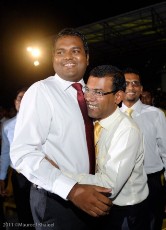
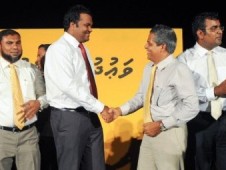
Just a day after resigning from the opposition Dhivehi Rayyithunge Party (DRP), MP Ali Waheed was last night welcomed to the Maldivian Democratic Party (MDP) by President Mohamed Nasheed, who claimed Waheed’s decision had handed the party a parliamentary majority and the capability to push ahead with proposed reforms.

Waheed, a former DRP deputy leader, yesterday signed up the party alongside Ahmed Assad ‘Adubarey’ and DRP Sports Wing Head, Hassan Shujau.

A senior MDP source told Minivan News that additional members of the party were talking with the MDP about signing, but were reluctant to abandon the troubled party in such a large group.

The opposition figures followed in the wake of former opposition MP Alhan Fahmy in an exodus to the other side of the country’s political divide.

DRP MPs including Ahmed Nihan, currently working closely alongside the Z-DRP faction of the opposition critical of party leader Ahmed Thasmeen Ali, claimed that the MPs were switching sides solely for financial payoffs, though an MDP official insisted no such transactions had taken place.

However, dismissed DRP Deputy Leader Umar Naseer has submitted a case to the country’s Anti-Corruption Commission (ACC) accusing the MDP of bribing opposition MPs to join the party.

Speaking during the rally held at Male’s artificial beach last night, Waheed reportedly accepted that he had criticised the president and the MDP in the past, but said that he now stood with them nonetheless.

“I was one of the strongest critics of President Nasheed,” he was reported as saying in newspaper Haveeru. “But I am right here at this podium; being able to criticise everyone is one of the fundamental aspects of democracy.”

Addressing the crowds afterwards, President Nasheed reportedly said that Ali Waheed would be welcomed to the party and could potentially take a senior position within the party following his switch.

Nasheed talked of the significance of having a political majority for the MDP and claimed that the party’s influence on parliament would need to be used responsibly and with respect to others in the Majlis.

Waheed along with DRP spokesperson Ibrahim ‘Mavota’ Shareef and opposition leader Ahmed Thasmeen Ali were unavailable for comment when contacted by Minivan News this morning.

Shareef has previously acknowledged that Waheed had served as a rising star in the DRP, and his loss would be a “great blow”.

Changing political landscape

The recent election of another former opposition MP – Alhan Fahmy – to the deputy leadership of the ruling party may be a key factor in luring ambitious MPs from the troubled opposition. However if rumours of money changing hands proved true, several MDP members have privately expressed concern that this risked unsettling grassroots members loyal to the ruling party from the beginning.

Further discontent is likely on the islands among those constituents who voted for a party, rather than the MP.

The MDP also risks importing potential skeletons into the party along with the MP, such as the case with former Dhivehi Qaumee Party (DQP) MP Hassan Adhil who is currently under house arrest and facing charges of child molestation.

Furthermore, the departure of MPs loyal to Thasmeen’s faction will place further pressure on the more prosaic side of the opposition, limiting its ability to resist the leadership ambitions of Gayoom’s far less compromising ‘Z-Faction’ and risks greater destabilisation of the opposition.

The MDP has however struggled to pass legislation in the opposition-majority parliament, and is fervently seeking to tip the balance in its favour and gain control of the legislature to push through difficult bills such as the revised penal code, evidence bill, and income tax for people earning over Rf30,000.

Taking control of parliament is a major victory for both the MDP and the government, and potentially marks the end of the ‘scorched earth’ politics in the Majlis that led to the en-masse resignation of cabinet ministers in July last year.

While the Maldives has a presidential system of government on paper, the constitution hands significant powers to parliament – particularly oversight of independent institutions. Control of the voting floor gives the MDP levers with which to address the challenges facing the judiciary and independent institutions in the country.

Likes(1)Dislikes(0)

Q&A: Finance Minister Ahmed Inaz

Finance Minister Ahmed Inaz was approved by parliament in late April 2011, replacing Ali Hashim who was among President Mohamed Nasheed’s cabinet ministers to be ousted by the opposition-majority parliament. He was approved just as the government implemented a managed float of the rufiya, and spoke to Minivan News about the recent and rapid changes to the country’s economy, the challenges it is facing and the future outlook.

JJ Robinson: An International Monetary Fund (IMF) mission is in town following the conclusion of the Article IV consultation last year. What is the current status of the government’s involvement with the IMF?

Ahmed Inaz: The IMF is discussing a new three program [with the government]. We are talking about structural adjustments that need to be brought in, and on the revenue side we are agreeing measures we foresee need to take in the next two years. We are trying to agree on the policy side.

They have their suggestions and recommendations and we have the policies the President is proposing, and we are trying to come a common agreement hopefully by the start of next week. I’m hopeful we will re-enter the program.

JJR: The IMF delayed the third tranche of funding in November last year citing “significant policy slippages” on behalf of the government. Did the third tranche get delivered?

AI: The question is not about that, the question is what can be practically done in this country. The new government came in with a new democratic setup, but not the budget to support that. The budget didn’t carry the cost of the new reforms.

It is not a matter of whether we can cut down expenditure – yes there are fat layers in the country, not only in the civil service, also in the judiciary and independent institutions. But the fundamental issue is that because of the democratic transition we have a state with recurrent expenditure higher than its revenue.

To make matters worse, the salaries of the state payroll are higher than our income. You can see where the problem lies.

What we foresee is that there are two ways in which we have to work to rectify this issue.

One is to trim the fat layer, by matching outputs with staff and increasing productivity.

The other thing is by increasing our revenue. We need to move from the current inefficient way of raising revenue – which bases revenue on import duties – to a more direct taxation policy.

We currently have the import duty which is a burden for businessmen, because they are taxed before they sell. We will abolish most duties, apart from those on items that are environmentally damaging, those that affect health, and other discouraged items.

The rest will be abolished and we will move into a direct taxation policy when the business profit tax starts in July. We have also started collecting revenue from a Tourism Goods and Services Tax (TGST), and we propose that we increase this as well as introducing a general GST for the public, and an income tax.

This would not be a payroll tax. It would be an income tax on people earning above Rf 30,000 (US$2300) per month. We think this is more justifiable.

Some may feel that this will collect only a very small amount of revenue – but this not just revenue from employment, but income from business dividends, house sales and so forth.

JJR: The former auditor general reported difficultly getting people to declare assets. Is this difficult with high net-worth individuals in the Maldives?

AI: One thing you have to understand is that this is a path other countries have walked. I remember when I was doing my graduate studies, even then we were talking about this. It was something the educated intellects were advocating. It never happened because there was no political willingness – willingness we now have.

I believe that once we start we will sort the rest of the issues. The TSGT is already being taken from big resorts as well as small guest houses on remote islands – very small businesses. They declare – amazingly, they declare.

I think this is something the country can take, and then we can move to rectify problems and perfect the system.

JJR: The general popularity of the idea seems quite sour with members of the opposition. How do you propose getting this tax through the opposition-majority parliament?

AI: All the businessmen I have met – all the reasonable businessmen I have met – believe that the country has to move to a much more structured, predictable and more coherent system of governance. And to do that we need an economic system that supports social change, and supports the change we have brought politically.

To sustain their businesses it is important that they have social and political stability. It would be a grave mistake if one stands up and says they don’t support [income tax], because that will bring instability to the country and harm businesses.

The other thing is that once you have a system of redistributing wealth through direct tax, such as we are proposing, this is spent on infrastructure, welfare, education, transport – all of these things that directly benefit wealthy businessmen, because they don’t have to pay for it on an individual basis. So the cost of doing business will be lowered.

I believe MPs, businessmen and business-MPs will support this. Those I have met have given their full support – they just want to be consulted first.

JJR: Don’t you think that as a potentially populist issue this may become a victim of the country’s adversarial politics?

AI: I think the opposition is very mature. When we were in the opposition, then the opposition was very mature. I think they will choose the best for the country. We are doing the tough job here – by 2013 the game will be easier. We are laying the foundation for the country, not only by changing the political scenario but bringing huge economic changes. I think they will support it.

JJR: Back to the IMF. A theme in their reports last year – and also those of the World Bank – was that while the Maldives’ income might be increased gradually, the country’s immediate problem was the inflated state budget, leading to a high deficit, while the country was at the same time insisting on a pegged currency. The government’s attempt to introduce cuts last year were scuttled – in your mind what were the reasons for this?

AI: One thing was that the business profit tax was delayed in parliament – for reasons I don’t think I have to elaborate. The TGST we proposed was higher than what are getting now, and that has also had an impact on us.

Also we have to remember that the redundancy of the civil service is not an easy thing – the country’s employment has been totally dependent on the government. It is a very big change, and we have said we want the government to be a policy maker, a regulator, but not doing business, so jobs are created in the private sector.

I’m happy to say our redundancy program – with assistance from the Asia Development Bank (ADB) – has to this date enrolled 800 people and already some of them have already been paid and moved out of the civil service. We hope over the next few weeks we will achieve our target of 1300 – the idea is that they will retrained and not return to the government for at least three years.

JJR: A key criticism of the government’s economic policy from the opposition is its spending on political appointees.

AI: Out of total government expenditure, 75 percent is paying the payroll. The political appointees are three percent of that payroll.

I believe that any appointee, whether political, civil service or judicial – any unproductive appointee – is a burden on our system and we should make them redundant.

JJR: Enmity between the Finance Ministry and the Civil Service Commission (CSC) last year led to the ministry filing charges with police against the CSC, just as the cuts issue entered the court system. What is the relationship like now between the Ministry and the CSC?

AI: We are working very closely with them and they have been very cooperative on the redundancy issue.

JJR: A number of private sector businesses have expressed concern that while the Maldives Monetary Authority (MMA)’s decision to enforce the use of the rufiya for all transactions is fine when you have a freely-convertable currency, it presents a serious problem when the banks refuse to sell dollars to them.

AI: The government doesn’t print dollars, and the government doesn’t earn dollars, except for fees and taxes, which is a very small percentage of the total demand for dollars in the country. The dollars are earned primarily by the resorts and fish exporters.

What we want is a system where the foreign exchange system operates as a market. We have introduced a banded float [within 20 percent of the pegged Rf12.85 to the dollar]. What we want is that the dollar earners will sell this to the market, and within the next three months an equilibrium will be achieved.

I don’t mean a low rate – I mean an equilibrium. Once that is set and the speculation and market adjustment has competed, we will have addressed the fundamental reason as to why the black-market existed.

Firstly, because the existing laws and regulations were not enforced, and existing legislation relating to money changers legislation was not being enforced – we cannot have 220 money changers in the country. I have not seen this in other countries. They have to be proper money changers who have invested a certain amount of capital, just like the banks.

I emphasise this but I still don’t get the commitment I need from stakeholders to address it.

Secondly, the monetary regulation states that rufiya is the legal tender for all transactions, with the exception of the government’s collection of taxes and fees. I think we should enforce this irrespective of the sector. We should have rufiya prices – what other country has prices in another country’s currency?

You can still pay in dollars – but this is the exchange rate. For [the customer] it may still seem as though you are paying in dollars, but the transactions are actually happening in rufiya. In Colombo you pay in local currency, even if you use your credit card. We need to have that enforcement irrespective of the sector.

In the medium term we need to address the budget deficit, especially recurrent spending, which has to be matched with income. A state cannot be operated without matching recurrent expenditure to its income – that is madness. A state has to have a prudent economic system – capital expenditure can still be borrowed, because future returns are there.

We working with the ministries to streamline and reduce the deficit in the budget. Next year we are hoping to have a balanced budget.

JJR: The opposition-majority parliament has substantially added to the last two budgets submitted by the government, and the President has been compelled to ratify these. How do you deal with this?

AI: We are trying to work on the legal side as well as the practical, and make sure this is enforced – at least that recurrent expenditure and income is matched, and that any additional bill passed during that particular year is supported with a revenue measure.

They can’t just simply tell us to pass a budget, and then pass bills giving us additional expenditure – every bill comes at a cost. What we propose is that they think about this and rectify it – this is very important.

The third long term goal is increasing productivity and exports, to make sure that whichever government is in power, our manifesto continues and the country can move forward. We need exports to be increased, and earn dollars. Long term, that is the only solution to counter this [economic situation]. In the long run there should be a regulatory framework that supports this.

JJR: Speaking of the regulator, where does the Maldives Monetary Authority (MMA) fit into this? It was only recently that the government was calling for the resignation of MMA Governor Fazeel Najeeb for failing to help address the situation.

AI: I don’t want to dwell on that. For me the governor – whoever is there – I should work with them. What I want is the regulations to be there. For example, the devaluation of the currency within this 20 percent band – that has to be supported.

Once we make a decision, such as the devaluation, we cannot go back. The fundamental health of the economy told us that we had to do this. The President met with the MMA Board, which advised, and a decision was made. It is not time for us to affect the confidence of the economy – an economy cannot survive without confidence. That is the crucial factor an economy needs – and state institutions need to ensure that confidence is there.

JJR: If the government was convinced that the value of the rufiya was going to fall somewhere within that band, why not float the currency altogether?

AI: The reason what that if we float the currency it would have short-term consequences and immediate jumps. A band means the government will defend that band – that is what we are doing with the weekly auction of dollars to the banks.

Secondly we have numbers from the TGST income that suggest we have been underestimating our economy. By having our policies in place – productivity increasing policies and growing additional exports – we are confident we can pull the value of the rufiya down to 10 in the long term – that is our aim. It is not a joke.

JJR: There is a lot of concern, particularly in resort circles, that the new policy restricting expatriate remittances will reduce the willingness of people to work in the Maldives. What was the logic behind that decision?

AI: We understand that expatriate employees are very important. We will never hurt them and we will ensure that their interests are protected. The regulation that the Ministry and MMA are working on will only limit repatriation of what they earn legally under their contract. If they remit more, obviously they will have been earning illegally.

They are living and spending in the Maldives as well – but they can still repatriate up to what they earn. What we are trying to do is limit illegal workers [remitting dollars out of the country].

JJR: If at the same time you are enforcing use of the rufiya when there is some doubt as to whether you can walk into a bank and exchange that into dollars to remit it overseas – does that not impact confidence in the economy?

AI: We believe the market is currently unstable because of the changes we have brought, and that these changes will take three months for the various variables to work. In that period the government will work with the MMA to ensure that stability exists.

There will be a lot of low confidence and instability, and that will not only be felt by the expatriates. All our imports and consumables, medicine, education – is imported. But we are confident we can get through this.

JJR: Potential foreign investors looking at the economy and observing the recent changes may be unsettled by this instability. How do you address this concern?

AI: The current government is a centre-right government, and we are opening our doors to an unimaginable level for foreign investment.

We will not be treating foreign investors different from local businesses. We will not put in unreasonable controls on the economy, and we will make sure foreign investors are consulted, as with the locals.

We have not done this in the past.because we have been very tightly focused on politics as well as the economy, and haven’t been able to communicate as much in English perhaps as we should have.

I believe [foreign investors] have confidence in our economy, and we will ensure their investments are protected in this country, and that wel continue to have policies to encourage further investment. This country does not have a solid financial sector so we need foreign investors very much. That is understood by the current government, and the policy is to attract foreign investors.

JJR: So economy before politics from here on in?

AI: Yes. Until the next election!

Likes(0)Dislikes(0)

Ali Waheed resigns from DRP, while MDP plans signing ceremony

Deputy Leader and MP of the opposition Dhivehi Rayyithunge Party (DRP) Ali Waheed has submitted his resignation letter to the DRP Office this morning, amid rumors that he is about to join ruling Maldivian Democratic Party (MDP).

Relevant sources have confirmed to Minivan News that Waheed submitted his resignation to the DRP Office this morning, and that the MDP will hold a special ceremony tomorrow night where Waheed will sign with the MDP.

Ali Waheed has not been responding to calls from any media since rumours of his decision began to circulate last weekend. He has so far only said that if he makes a political decision, he will make it publicly to the media and the people.

A senior MDP official speaking on condition of anonymity told Minivan News that Waheed will join MDP tomorrow night, “along with two other DRP MPs.”

He also claimed that the MPs were not joining the MDP for money, as claimed by the opposition’s Gayoom faction MP Ahmed Nihan earlier this week.

”They decided to join the MDP because of the internal conflict in their party,” the source said. “The MPs feel worried and insecure, so they are moving towards a direction where they have a future,” he said. ”Due to this internal conflict in the party the MPs on the side of DRP Leader Ahmed Thasmeen Ali in particular are very concerned. Those MPs did not shift sides for cash, they are very loyal to Thasmeen.”

He said that Thasmeen and former President Maumoon Abdul Gayoom will try and hold the remaining MPs in the party, but said that the MPs were “very concerned and worried about their future.”

”If Gayoom wants to run for the presidency during the next elections, he will have to do it right, according to the party’s charter,” the source said.

DRP Deputy Leader and Spokesperson Ibrahim ‘Mavota’ Shareef recently told Minivan News that rumours of Waheed’s impending departure were “propaganda to try to discredit some of us in the party.”

“Ali Waheed is a rising star with widespread support, and it would be a great blow to the party if he were to leave,” Shareef acknowledged.

Thasmeen meanwhile told Minivan News that he would not believe Waheed had joined MDP until he saw it actually happen.

Changing political landscape

The recent election of another former opposition MP – Alhan Fahmy – to the deputy leadership of the ruling party may be a key factor in luring ambitious MPs from the troubled opposition. However if rumours of money changing hands proved true, several MDP members have privately expressed concern that this risked unsettling grassroots members loyal to the ruling party from the beginning. Further discontent is likely on the islands among those constituents who voted for a party, rather than the MP.

The MDP also risks importing potential skeletons into the party along with the MP, such as the case with former Dhivehi Qaumee Party (DQP) MP Hassan Adhil who is currently under house arrest and facing charges of child molestation.

Furthermore, the departure of MPs loyal to Thasmeen’s faction will place further pressure on the more prosaic side of the opposition, limiting its ability to resist the leadership ambitions of Gayoom’s far less compromising ‘Z-Faction’ and risks greater destabilisation of the opposition.

The MDP has however struggled to pass legislation in the opposition-majority parliament, and is fervently seeking to tip the balance in its favour and gain control of the legislature to push through difficult bills such as the revised penal code, evidence bill, and income tax for people earning over Rf30,000.

Control of parliament would also give the MDP levers with which to address the challenges facing the judiciary and independent institutions in the country.

Likes(0)Dislikes(0)

Z-DRP faction files case against MDP with Anti-Corruption Commission

The main opposition Dhivehi Rayyithunge Party (DRP) has filed a case in the Anti-Corruption Commission (ACC) against the ruling Maldivian Democratic Party (MDP), accusing the party of bribing opposition MPs to join the party.

A senior member of Gayoom’s faction of the opposition and former Deputy Leader of the DRP, Umar Naseer, sent a letter to the Anti-Corruption Commission stating that ‘’offering money to an MP to shift parties is nothing less than an act of corruption.’’

The letter alleges that former DRP Deputy Leader and MP Ali Waheed, who resigned from the MP today, was bribed with “millions of rufiya”.

Naseer called on the ACC to monitor the bank accounts of Ali Waheed, his friends and family to assure that there was no corruption involved in Waheed’s decision to join MDP.

Umar Naseer did not respond to Minivan News at time of press while MP Ahmed Nihan and MP Ahmed Mahlouf were unavailable.

Meanwhile, tomorrow night MDP has said it will hold a special ceremony during which Ali Waheed publicly sign with the party.

Ali Waheed has not officially confirmed his decision to the media, however, senior MDP officials have confirmed that it will happen.

Aside from Ali Waheed, two other DRP MPs will sign with MDP tomorrow night during the special ceremony.

A Z-DRP faction senior official also told Minivan News that Ali Waheed and Hassan Shujau, a DRP council member, decided to join MDP after they were offered millions of rufiya “and other assets”.

Hassan Shujau has been now appointed as the State Transport Minister, days after he decided to join MDP.

MDP Secretary General Ahmed Shah and Spokesperson of MDP Ahmed Haleem did not respond to Minivan News at time of press.

Likes(0)Dislikes(0)

MDP recruiting spree includes DRP officials and supporters

President Mohamed Nasheed has appointed former council member of the opposition Dhivehi Rayyithunge Party (DRP), Hassan Shujau, as state transport minister, amid a recruitment spree that has netted the ruling party a number of senior opposition members.

Reports that Shujau and DRP MP Ali Waheed were planning to join the ruling Maldivian Democratic Party (MDP) began circulating last weekend. The party confirmed Shujau had joined, although Waheed has remained silent on his decision, telling media that any political decisions would “be made publicly”.

This week Minivan News was told by a senior official of Z-DRP faction that both Ali Waheed and Shujau were to join MDP for an amount of money which is “so high that they won’t need to work ever again if they accepted.’’

Yesterday a special ceremony was held at the President’s Office to appoint Shujau to his new post, during which President Nasheed said that he was confident that Shujau had the capability to fulfill his responsibility as the state transport minister.

Nasheed also said he was pleased that Shuaju has made his decision to join the government and implement its manifesto after being affiliated with another political party.

Nasheed has also appointed Sheikh Gubaadh Abubakur, a former senior member of the DRP member and one time close ally of former President Maumoon Abdul Gayoom as undersecretary in the President’s Office.

After the government confirmed Shujau’s decision to join MDP, speculation has risen that Waheed would join as well.

Local media reports that a special ceremony is pending to mark the signing of MP Waheed, a move DRP Spokesperson Ibrahim ‘Mavota’ Shareef has acknowledged would be “a great blow” to the party.

“Ali Waheed is a rising star with widespread support, and it would be a great blow to the party if he were to leave,” Shareef said recently.

Meanwhile several opposition figures have begun criticising Ali Waheed for his supposed decision.

Local media reported that Z-DRP faction MP Ahmed Nihan had condemned Waheed and said that if he signed with MDP, “he is betraying those people who elected him as their MP.”

Leader of DRP Ahmed Thasmeen Ali told Minivan News that he did not believe Waheed would join the ruling party after running for parliament on a DRP ticket.

Furthermore, MDP confirmed that former Human Rights Commissioner of the Maldives (HRCM) Ahmed Saleem has joined the party.

“When I ran for the membership of HRCM, they issued a three-line whip to vote for me. They backed me when I ran for the membership of MBC’s board as well,” said Saleem, who was voted out of the position by the opposition majority parliament.

“I served the government for 42 years yet they rendered me unneeded. But MDP supported me even then.”

The DRP is currently riven by an internal political split as a faction loyal to former President Maumoon Abdul Gayoom have sought to oust party leader Ahmed Thasmeen Ali, who has fallen out of favour with the party’s founder and ‘honorary leader’.

Likes(0)Dislikes(0)