Shops vandalised, police station damaged in third night of violent protests

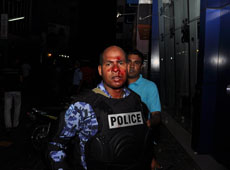
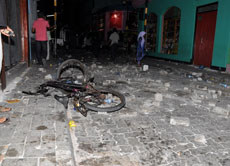
A third night of violent protests in Male’ ended around 4:00am this morning after the windowpanes of a police station were smashed, shops vandalised and fires started across the city.

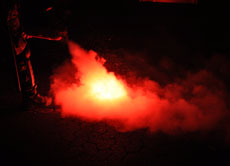
Police used tear gas to disperse a crowd gathered at the intersection of Male’s main street Majeedee Magu and the tourist strip Chaandhanee Magu, the focal point of the protests so far, after a group of MDP activists arrived and clashed with opposition protesters and young people around 11:30pm.

The two sides were separated by police but continued attacking each other with bricks and bottles. Police appealed for people to leave the area and eventually dispersed the crowd at 12am using tear gas.

“Police dispersed the two crowds using tear gas to minimise the amount of force that would need to be applied,” Sub-Inspector Ahmed Shiyam told Minivan News.

Police, he said, had noticed that “once the criminal activity starts most people leave the protest.”

A group of Maldivian Democratic Party (MDP) activists then gathered outside the house of the former President’s half brother, Abdulla Yameen, before being moved on by police and the Maldives National Defence Force (MNDF).

Meanwhile, anti-government protesters gathered outside the Maldives Monetary Authority (MMA) building.

“The opposition [demonstrators] gathered in the area for 1-2 hours and started several fires in the road before they were dispersed with teargas,” Shiyam said. “ Later they attacked a police building in Maafaanu and a police vehicle, vandalised the Maldivian Democratic Party (MDP) headquarters and set several more fires. They also smashed the window of the STO Home Improvement store. The opposition MPs who had gathered at the MMA building left when vandalism began.”

The remaining crowd kept moving, Shiyam said. “Most of those involved were people known by police to be involved in criminal activities.”

More than 30 people were eventually arrested. Some police officers were injured and police property was also damaged.

“We saw some protesters [hurt] but we received no reports of serious injuries,” Shiyam said.

Of the 52 people arrested for violence the previous evening, whom police claimed were connected to various gangs in Male’, most were subsequently released by the Criminal Court while “12-15” remain in police custody.

The opposition has maintained that the demonstrations against the government’s decision to implement a managed float of the rufiya are led by youth unhappy with rising commodity prices, despite the active involvement of dismissed opposition Deputy Leader Umar Naseer, and MPs Ilham Ahmed, Ahmed Mahlouf, Ali Waheed, and Ahmed Nihan.

The government has meanwhile accused former President Maumoon Abdul Gayoom’s faction of the opposition of instigating and organising the protests.

“The government understands that many people are concerned about the economy and recent price rises and we are doing everything possible to ease the situation,” the President’s Press Secretary Mohamed Zuhair said in a statement.

“Peaceful protest is legal and welcome in the Maldives’ new democracy. But former President Gayoom is taking advantage of economic situation to cause violence in the streets. These protests are more to do with Gayoom trying to shore up his position in the opposition, than the state of the economy,” he claimed.

“In the Middle East, you have democrats on the streets bringing down dictatorships. Ironically, in the Maldives, the remnants of the former dictatorship are trying to bring down democracy.”

The Human Rights Commission of the Maldives (HRCM) meanwhile issued a press release urging people not to misuse the right to protest “and obstruct the media.”

The commission said that protesting late at night in densely populated areas “violates the right of many others.”

”We call on the police not to disperse the protests by using methods that harm the protesters and civilians,” HRCM said.

At a press conference today, Deputy Commissioner of Police Mohamed Rishwan said protests would be restricted to the artificial beach and the tsunami monument areas in Male’, unless prior permission was given by police or Male’ City Council.

The government meanwhile defended its decision to float the currency within 20 percent of the pegged rate of Rf12.85 “as part of a package of measures introduced on the advice of the central bank, International Monetary Fund and other multi lateral organisations, in order to reduce the country’s budget deficit and stabilise the economy.

“According to the World Bank, in late 2008 the Maldives was in the worst economic situation of any country undergoing democratic reforms since 1950s. The budget deficit stood at 31 percent of GDP, inflation stood at 12 percent and the economy was reeling from a massive fiscal expansion which saw the government wage bill increase by almost 400 percent between 2004 and 2009.

“Since coming into office, the Nasheed administration has reduced the budget deficit from 31 percent to 16 percent of GDP, helped ease the chronic dollar shortage through a managed float of the Ruffiya and brought the economy from recession to 4 percent growth this year,” the President’s Office said in a statement.

The IMF has pressured the government to cut back on its disproportionate public sector wage bill, however austerity measures attempted last year ended up in a political stalemate and the government instead embarked on a program of corporatisation, allowing it to hire and fire while circumventing what it claimed was the opposition-driven machinations of the Civil Service Commission (CSC).

Opposition spokesman Ibrahim Shareef has accused the MDP of financial mismanagement and recklessly increasing spending, without investing “in productive resources that ensure future revenue for the country, and reducing expenditure in areas that do not affect the people – such as foreign missions.”

“They need not reduce the civil service, because these are the lowest paid government employees and reducing their numbers would have not tangible effect. But the top players in government – the political positions – and positions in the paper companies created by the government are many areas [that can be reduced],” Shareef claimed.

The government recently announced an incentive programme to encourage public sector employees as young as 18 to leave the civil service, offering lump sum payments of between Rf 150,000 – Rf 200,000, which was positively received by the CSC.

Likes(0)Dislikes(0)

Parliament sends controversial Crime Prevention Bill back to committee, goes to recess

The controversial National Crime Prevention Bill was returned to committee during a special session of the Majlis last night, after more than 100 amendments were proposed.

Parliament voted 37 to 33 in favour of a proposal by Dhivehi Rayyithunge Party (DRP) MP Ali Waheed, seconded by the opposition allied People’s Alliance (PA), and backed by some Independents, to send the bill back to committee.

The majority of MPs was of the opinion was that the addition of over 100 amendments to a bill restricting constitutional rights could not be properly considered and voted on before the end of the sitting at 12am.

Voting went along partisan lines with ruling Maldivian Democratic Party (MDP) MPs and Independent MP Mohamed Nasheed in the minority against the DRP-PA coalition, the Jumhoree Party (JP) and the Dhivehi Quamee Party (DQP).

DRP MP Ahmed Mahlouf was conspicuously the only MP who abstained while leader of the People’s Alliance (PA), Abdulla Yameen, did not participate in the vote.

Waheed put forward the proposal after Speaker Abdulla Shahid informed MPs of the number of amendments to the bill, and opened the floor to a debate to decide how to proceed with the special sitting.

Shahid announced the parliamentary recess at the end of the sitting as no proposal had been made to either extend the special sitting or hold another.

MDP MPs claimed that the amendments were a filibuster tactic to avoid confronting the issue, with MP Ibrahim Rasheed suggesting as much when he said the amendments were made by those who “lacked sincerity” while MP Abdul Gafoor Moosa said that none of the amendments were submitted by MDP MPs.

As Chair of the National Security Committee, Yameen presented the committee report to the floor, explaining that a consensus was reached among committee members to restrict the rights for a limited period to empower the authorities to curb dangerous crimes.

The draft legislation contained a number of provisions that could violate or restrict constitutional rights, including the right to remain silent and a mandatory 15 day detention period.

If passed into law, police would be empowered to enter private property without a court order to arrest a person suspected of any of the crimes listed in the legislation or in case evidence is being or hidden.

Moreover, a person accused of any of the crimes in clause four of the bill could meet a lawyer in private only after 96 hours after the arrest, prior to which any such meeting would have to take place in the presence of police officers.

If a suspect is arrested at the scene of a crime with related evidence either on his person or at the place, the court could interpret the silence of the accused as an admission of guilt or association with the crime.

On extension of custody or remand detention, courts must consider the criminal record of the accused along with police intelligence and grant a minimum mandatory period of 15 days of remand detention.

In addition, refusal by the accused to disclose information on finances or assets considered as evidence shall be deemed an offence punishable by up to five years in prison.

The bill includes a ‘sunset clause’, making it applicable for 18 months, but it has raised concerns in the international community regarding the compromise of constitutionally-guaranteed human rights.

Notably, the draft bill provides exemption for MPs and those working in independent commissions from searches of their homes without a court warrant.

Independent MP Nasheed, who is parliament’s focal point for the Crime Prevention Committee, reprimanded MPs for passing on their responsibility to the committee and going to recess, stating that the sunset law was not prepared in haste and that as senior officials of the state had spent the past three days working in the Majlis, MPs who were interested could have attended the committee sessions.

The President’s Member on the Judicial Services Commission (JSC), Aishath Velezinee, said parliament’s focus on police powers as a means to resolve crime in the Maldives avoided them having to debating the real issue – the lack of an independent judiciary.

“My concern is that they have avoided a discussion of the issues this debate has raised regarding the establishment of an independent judiciary. They are still giving it a blind eye, and trying to fix crime without considering it,” she said. “There is no point passing laws and legislation if there is no independent judiciary to uphold it.”

She noted that members of parliament’s opposition majority had been colluding “with self-appointed leaders of the judiciary” in an effort to maintain the administration of justice that existed under the former government.

“They have simply renamed the former Ministry of Justice as ‘independent judiciary’,” she said.

Velezinee claimed that the police powers were only required “because there is no confidence in the judiciary.”

“I support absolute police power with a sunset clause in certain cases, such as when the criminal court has connections with organised crime,” she said.

The violation of constitutionally-mandated rights that this would entail has led to mutterings of concern among the international community – concern shared by many young Maldivians, one of whom told Minivan News that he was so confident that police would abuse their new powers, such as entering houses without a warrant, that he would “pack my bags and leave the Maldives for 18 months” if the bill was passed.

Likes(0)Dislikes(0)

“Prices of goods have been a lie”, says President Nasheed

Extract from a speech given by President Mohamed Nasheed at Sunday night’s Maldivian Democratic Party (MDP) rally, concerning the state of the economy.

Our nation remains a nation, as I often say, because our ancestors went fishing, collected cowries, climbed palm trees, constructed boats, built resorts and operated them. Our nation remains a nation not just because rulers ruled and judges judged. Our nation remains a nation because workers have laboured.

The rights of Maldivian workers and various benefits are not being spoken about in this country today for the first time. In the 1700s, Judge Hassan Thajudheen forbids Maldivians from working without remuneration. From that day onward, Maldivian workers from day to day have been noting their rights, and their responsibilities as well, to the present day.

In our country, if we want to bring the labour market to the right path, we have to look at or consider not just the worker. I always say, to do something, you have to do something else. After continually doing that, when what we envisioned has been reached, then what we want will have been sustainably achieved.

Prices of goods are not lowered with an army officer in front of the shop. To bring down prices, we have to build a good, strong economy. We have to change our economy into the shape of a strong economy of a middle-income country.

This was not the case yesterday. Most of the goods we sell in this country are imported. We pay for it in dollars. When we don’t know the value of the dollar – that is the goods in the market were bought with dollars and we don’t know its value – there is not a single way for us to know the value of the goods we have bought. Therefore, there’s no way we can know anything.

To build an economy on that basis and to consider it a sound economy is a mockery. It is not something I can do. I too know, [MDP MP] Alhan has said very clearly, we can keep building and building and building debt. The law very clearly gives me the discretion to print money. For the first three months after I assumed office, at the end of every month I was brought a piece of paper, on it was written that I had printed Rf200 million (US$16 million).

With every Rf 200 million, the value of the rufiyaa kept falling. When we took over the government, inflation was at 12 percent. [Prices] were rising at a rate of Rf12 each passing month. Today [inflation] is 0.65.

When prices soared to the highest, the price of a can of powdered milk rose by Rf 4 – two children will drink from one can of milk for a month. How much of an increase in rufiyaa per day has that become for us? I too know the prices of goods in the country. I do go into shops. I know that the price of a small coconut is Rf5 in Filledhoo, but Rf10 in Male’.

We do not lack information. Nor do we lack a course of action. And I am not unaware of what we’re doing and what we are about to do. Leaders of nations are anxious and cowardly when it comes to making changes to the country’s monetary and economic system. They remain hesitant about making changes to salaries, hesitant about making changes to taxation. They remain anxious and fearful of inflation.

However, in truth it is not us who have to suffer from that cowardice today, but our children tomorrow. The question before us today is who should we treat better? The woman we are married to now or our young children? I know it is a difficult question.

Everything we have done in our lives has been for our children. We build harbours for our children; we build homes and sewerage systems for our children. We give pensions as well, for our children.

Today prices of goods have gone up, too, for our children.

The straight value of the dollar to the rufiyaa is not a number I saw in a dream one day and took to heart. The price of a dollar set in 2001 was not based on a transaction between rufiyaa and US dollars. The price of a dollar has been set today based on market transactions. Today you are seeing straight the true price of the goods at market. It is not that prices have not gone up, you have found out the price! What was written before was a lie. It was not a price. It is a picture that rulers have showed you as a price. Our children and children’s children are being destroyed by the seduction of that picture.

Do we want the present or the future? This party was formed because we said ‘we want the future, today is done, the sun has set, what we can win is tomorrow.’ There is no way we can get today. We have to reach, too, for tomorrow.

Most workers in this country are fishermen. 44 percent of the workforce are fishermen. When the value of the dollar is low, its unfairness is felt most by fishermen. The fish they catch is sold out of the country. When the export price improves, the [purchasing] price improves for them. Because the value of dollars has gone up, the income of most workers in the country has gone up exponentially. It has gone up!

I have just come back from Thinadhoo. I went to Kolamafushi too. I know what’s happening in Ihavandhoo and Hoarafushi as well. Maldivian fishermen are today selling a kilo of raw fish for Rf16.50. That is not a price that they would have ever imagined before. A kilo of raw fish for Rf16.50. How much is a cupful of rice? How many cupfuls of rice can you get today for one handharu fish?

I would say the Maldives has not seen any more prosperous times than this.

The second [main source of employment] for workers in the country is in the tourism industry. The service charge in that business is paid in dollars, you know. On April 11, the income of workers in that sector has gone up 20 percent.

About 20 to 25 percent of the workforce in the Maldives is employed by the government. For them, it has become a little bit difficult. Like I said, a Rf4 [increase] from a can of powdered milk, for two children to drink for a month. Total monthly household expenses have gone up by Rf300 or Rf400 for a secretary, for a lawyer, for a labourer. To plug that gap, we must do what we have to do.

The government’s monetary and economic policy is now being implemented. We are now making the changes necessary to instil the characteristics of a middle-income country in our economy. An administrative framework for taxation has been established. A 3.5 percent GST is being levied on tourism services.

The government aim is to completely eliminate import duties beginning on January 1, 2012, for all children’s food, all foodstuff, pens, pencils and paper. We are working towards that end. It will be done on January 1, 2012.

In order to do it, the state needs an additional Rf1.3 billion. Today our budget forecast is Rf2.3 billion as duties. The government is giving up that duty, but while doing so, we have decided to ask the honourable members of the People’s Majlis to increase the tourism GST from 3.5 percent to 5 percent and introduce a 3.5 GST for other businesses.

If we wish to change our economy, we have to make these courageous changes. There is one additional tax. That is, the income tax. It will hurt the most there. We plan to take an income tax from those who earn above Rf30,000 a month. About Rf30 a month. When that amount is paid to the government as income tax, then the whole cycle of the economy will, God willing, become stable – this is where we see ‘The Other Maldives.’

That is where the value of the dollar will be brought down to the level we want and the price of goods and services will fall.

Our task is very clear to me. I know that, God willing, our efforts will bear fruit. This morning, among the changes to be made to the economy, I noted a special point. A lot of workers in the country are foreigners. Most of the time, businesses employ them because they work for cheaper rates. For work done in this country, [a person] should be able to live an ordinary life in this country, whether it is a foreigner or a Maldivian.

The government plans to determine what the minimum wage paid to a worker should be. Here or abroad, when that is paid to workers, we believe job opportunities will not be lacking for Maldivians.

We can bring our country to the right path. I know that there are many people who find what I have to say difficult to hear. But I say repeatedly, I am not someone who will squander our children’s future. We took over government to realise the hopes of the Maldivian people – to establish a system of good governance for the people.

We do not arrest people. We do not torture people. This government will not pillory, handcuff, torture or chain anyone. We talk to the people through verbal interactions, not through fear and intimidation. The Maldives is maturing into a full democracy. The biggest secret of our success is the many citizens of this country fighting for freedom and hoping for better days.

Before concluding, I would tell everyone here not to worry at all. Some nights, they might be squatting at the Chandanee Magu intersection. Other nights, leaning against a door somewhere. We must not be concerned and worried about it. What happened last night was very unfortunate. I didn’t know that protest was going on last night even when I slept.

What I have to say [to the demonstrators] is that our resolve will not be shaken. Neither this party nor I will be shaken. Our policies won’t budge either. God willing, in Alhan’s words, we are going to ‘The Other Maldives’ at maximum.

Likes(0)Dislikes(0)

Comment: Osama’s ideology thrives despite his death

It is hard to overstate the impact Osama bin Laden has had on the world. Almost all major actions in international relations and warfare in the last decade were implemented either to further or to counter his ideology.

Al Qaeda’s attack on the United Stated on 11 September 2001 was driven by Osama’s belief that imperialist American foreign policies had created a world of injustice and equality for Muslims. He believed it was the duty of every Muslim to wage a holy war to correct those wrongs. His aim was to establish an Islamic Caliphate where Shari’a was the only system of law and Wahhabism or other purist forms of Islam the only forms of belief practised. In such a war, waged across the world to protect Islam and its believers, and to further its cause, Osama believed there were no innocents.

This thinking of Osama’s was what came to inform most Western definitions, policies and actions in the last decade about terrorism, Islam, and what it means to be a Muslim in the twenty first century.

Analysts have in recent years found Al Qaeda to have been virtually destroyed by the War on Terror, its network of secret cells across the world dismantled in ten years of aggressive counter-terrorism policies. It may also be the case that Osama’s death will reduce further the number of violent acts committed in the name of the Islam. It does not, however, mean that the large numbers of his followers across the world have stopped subscribing to his ideology or that they will stop doing so. Osama’s ultimate goal, the establishment of an Islamic Caliphate comprising of Islamic states that practise Shari’a and practise the form of Islam that he followed, remains alive and well. The Maldives is a case in point.

Osama in the Maldives

The Maldivian society has changed beyond all recognition in the last ten years. Some of the changes, like democracy, would have happened in due course – with or without the War on Terror. But it is difficult to accept that the other most fundamental change – manifest in the faith of the people – would not have been possible without the War on Terror and its validation of Osama as the most powerful representation of Islam.

Followers of Wahhabism, and other types of Islam, had existed in the Maldives years before the War on Terror. They had, however, been severely – sometimes violently – oppressed by former President Gayoom. They stayed on the fringes of society, widely seen as ‘odd’, often mocked. In the early 1990s when four women opted to wear the full buruqa, it was rare enough an occurrence to be newsworthy. Ten years later, it is the woman without some sort of a buruga that has become the oddity. The War on Terror, and its focus on Osama’s ideologies as representing Islam, made it possible for such groups to come out of the shadows. Whether the state recognised their beliefs as legitimate or not mattered no longer; their identities were not limited to the national anymore – there was the Ummah.

Emboldened by the mainstream position in Islam bestowed upon Wahhabism in the War on Terror, Maldivians who followed Osama’s ideologies and other strands of thought in Islam such as Salafism and Neo-Salafism began to come out in the open and loudly espouse their views. There were more tangible benefits such as increased funding and other forms of support from Islamic religious networks abroad – even as the War on Terror attacked the financial networks of Al-Qaeda more and more funds became available for Maldivian ‘fringe’ religious groups to increase their presence in society.

Educating minds

One of the most significant forms of such assistance came as educational scholarships. During the last ten years a large number of Maldivians were sent to various places of Islamic learning abroad from Madhrasaas in Pakistan to old bastions of Islamic knowledge such as the Azhar University in Egypt. A large number of them returned in the first half of the War on Terror to found religious organisations and parties. During the chaotic period of Maldivian transition to democracy in 2008, when the ruling government entered into politically opportune alliances with parties formed by such returning graduates, they gained a foothold within the structures of government that had previously been denied them.

This is not to say that every Maldivian who studied in an Islamic institute of learning is a follower of Osama’s ideologies – that would be as incorrect a generalisation as the assumption that every western educated Maldivian is a secularist, a liberal or even a democrat for that matter. What it does mean, however, is that it has put into positions of power a large number of graduates who believe in the superiority of Shari’a above all other systems of law, and are sympathetic to – if not actively engaged in – efforts to establish an Islamic state in the Maldives.

Despite outright denials by Islamic Minister Abdul Bari, evidence suggests that fringe religious movements in the Maldives did receive support from groups abroad – even if they were more organisational than financial. Many of the methods and means by which such movements flourished in the Maldives follow the same rulebook used by Al-Qaeda recruiters across the globe: targeting the most vulnerable, disaffected, and most curious in society. They gathered at mosques, recruiting young people seeking answers to questions of life, existence, and God; opened bookshops filled to the brim with their teachings in strategic locations near large schools; and actively sought out vulnerable young people feeling the most alienated and disaffected.

Winning hearts

In the Maldives, some of the richest such pickings were available in prisons where the shambles that is the criminal justice system locks up young drug addicts, homosexuals and apostates along with murderers and rapists. Maldivian religious movements that began and flourished during this period engaged in a policy that was often more organised and more humane than what the state had to offer such prisoners. Unlike government authorities, religious groups did not abandon their recruits once they left prison.

Reliable reports from ‘defectors’ reveal that recovering addicts recruited into the movement and given jobs within the business interests of the various religious groups were allowed to keep their jobs even if they relapsed and were caught with their hand in the till. In contrast to state policies, which force drug addicts to languish in prison without help, and are released into society without any efforts of re-integration or rehabilitation, the religious movements offered a lifeline that the alienated grabbed with both hands.

One of the most unique ‘opportunities’ available only to Maldivian recruiters is the geographic composition of the Maldives. Recruitment into the cause, research has shown, is less successful when the targeted segment of the population is exposed to other forms of thinking, and when individuals within the targeted community have an existing sense of identity, belonging and nationhood. Lack of education, religious or otherwise, and isolation from much of the rest of world and its many strains of thought and ideologies made it easy for recruiters to persuade whole populations that theirs was the only and the ‘right’ belief system.

From the fringes to the centre of society

The success of Osama’s ideologies in the Maldives and its impact cannot, however, be measured by the number of Maldivians who committed acts of violence in the name of a Holy War. With a population of 300,000, Maldivians are statistically incapable of making a significant contribution to the furthering of Osama’s violent ideals. The success of his ideologies are much clearer when we count the number of Maldivians who have become convinced that minority forms of Islam, like the Wahhabism followed by Osama, are the ‘right’ forms of Islam.

It is also  evident from the number of Maldivian Muslims who follow the same thoughts that now occupy positions of power within the newly democratic government. The Adhaalath Party, which distances itself publicly from the violence advocated by Osama, nonetheless, is pursuing many of the same goals – the establishment of a purist Islamic state in the Maldives that believes in gender inequality, practises Sharia, and contributes to Osama’s world vision of an Islamic Caliphate.

On Friday it galvanised thousands of Maldivians to march for the adoption of Shari’a as its only system of law, propagating death for death as the solution to the country’s burgeoning problem of gang violence. It has also advocated the view that any member of parliament that votes against a decision to implement Shari’a and the death penalty would be deemed apostates. Various prominent members of Adhaalath, and other Islamic parties and groups in the Maldives following the agenda, have displayed the same Anti-Semitism that drove Osama, equating Israel and Zionism with Judaism and placing the blame for the Palestinian situation solely and squarely on the shoulders of every follower of the religion.

‘Winning the hearts and minds of Muslims’ was a strategy employed by both sides of the War on Terror. Globally, despite the death of Osama, there is no clear winner. In the Maldives, the struggle appears more or less over: followers of Osama’s goal of an Islamic Caliphate are winning hands down; and are leading Maldivians, like Pied Piper, towards an Islamic state that would have made Osama proud.

<em>All comment pieces are the sole view of the author and do not reflect the editorial policy of Minivan News. If you would like to write an opinion piece, please send proposals to [email protected]</em>

Likes(1)Dislikes(0)

Business head cautious over president’s cost-cutting plans

President Mohamed Nasheed has outlined tax reforms he claims will help to eventually alleviate concerns over the higher costs of goods and services at the heart of protests that have raged in Male’ over the last two days.

Beyond announcing that May 1 would now serve as a public holiday every year in celebration of International Labour Day, the president aso attempted to outline government plans for economic reform.

Speaking yesterday during a function to mark Labour Day, Nasheed unveiled plans to try and reduce costs for “everyday items” by between 10 to 15 percent by removing import duties, which the government estimates account for Rf2.3bn of budgeted state income during 2011.

The president said he believed these costs can be covered by tax reforms; both on the earnings of members of the public with a monthly wage of over Rf30,000 a month and increasing taxable income from the tourism industry.

“The reforms to our financial system involve creating a tax mechanism, like in other civilised societies, instead of depending solely on import duties,” he stated, while also pledging to introduce a minimum wage rate during the year.

Some prominent investment groups in the country, while supporting initiatives to reduce costs that have led to ongoing public protests in the country, say that the addition of a minimum wage and a Goods and Services Tax (GST) on all businesses operating in the country, needed to be gradually implemented to ensure the nation’s fledging economy can cope with any potential changes.

As part of his reforms, the president claimed that the government planned by next month to propose amendments that would remove import duties on basic items as of 2012.

According to Nasheed, these proposals would be backed by other amendments expected to be forwarded to parliament. This includes an increase in the Tourism GST, introduced on January 1 this year, to five percent from the 3.5 percent introductory rate, as well as implementing an entirely new GST of three percent on general trade outside of travel industry services.

“I have no doubt that these reforms will shift the government from its current sources of income to more sustainable income sources,” he claimed.

To try and counter the more pressing concerns of high costs that have allegedly led thousands of, mostly young, people taking to the streets in protest, the president claimed that it was purseuing a number of financial [instruments] to try and cut down on the impacts of higher living costs such as in establishing a minimum wage during 2011.

“This government came to power with hopes, to give a decent and an honourable life for Maldivians,” he said. The president said that the initiative was part of plans to promote employees rights as well as those of employers within the country through the establishment of “stronger labour relations frameworks.”

“Most political leaders are disinclined to restructure monetary systems, change wage limits, and reform tax regimes because they are pressured to consider the needs of few powerful people,” Nasheed claimed. “But I assure you that the leader you [Maldivian people] have elected is not like that.”

In addressing Nasheed’s plans, the Treasurer of The Maldives National Chamber of Commerce and Industry (MNCCI), Ahmed Adheeb Abdul Gafoor, said that he believed further development such as investment was needed to strengthen the Maldivian economy before taking on major reforms – at least in the short-term.

“Introducing these tax reforms and schemes like the minimum wage will be difficult over the next two years. The Maldives is at a disadvantage when it comes to economies of scale as it is,” he said. “What I would like to see is a transitional period rather than introducing these measures straight away.”

Adheeb claimed that with the planned introduction of the additional GST on general trade and corporate tax, the prospect of setting a minimum wage would need to be studied in terms of possible impact, particularly in the private sector.

“We [the private sector] could end up losing some of our competitive edge over other countries. What we need is some breathing space and for these reforms to be bought in gradually,” he said. “We have to build confidence in the economy especially with small and medium businesses. If the minimum wage is going to be introduced it should be set on an economic basis and not for short-term political benefit.”

Adheeb therefore urged the government to consult employers – especially in smaller and medium enterprises – before putting any initiatives like a minimum wage in place, adding that private enterprises had been a key component in the more successful developments of the Maldivian economy.

“The tourism industry here has been developed mainly by the private and not the public sector,” he said.

Likes(0)Dislikes(0)

Petrol bombs found in mosque during second night of anti-government protests

A second night of violent protests in the capital city ended with the arrest of several demonstrators after petrol bombs were thrown at police in the early hours of this morning.

Protesters gathered last night near the Tsunami Monument in Boduthakurufaanu Magu and marched towards the intersection of Male’s main road of Majeedhee Magu and the tourist street of Chandhanee Magu; the same location as Sunday morning’s sit-down protest.

Protesters demanded the government lower the cost of living and called on President Mohamed Nasheed to resign, claiming people were increasingly unable to afford basic commodities following the government’s effective devaluation of the rufiya.

Police blockaded the area to vehicles and maintained a presence, but unlike Sunday used no tear gas or force on the crowd.

Riot police at the scene were bombared with petrol bombs, stones, water bottles, chilli sauce, “and a hammer”, according to police Sub-Inspector Ahmed Shiyam.

“The protesters were trying to incite police. Some police were injured but not seriously,” he said.

Police yesterday issued a statement claiming that the the first round of violent protests was premeditated after discovering a ready supply of rocks stashed near the intersection.

Several police were injured when the protest turned violent

During last night’s protests, “police received information that petrol bombs were being made in the toilet area of a nearby mosque. Police attended the mosque and found petrol bombs and equipment used to make them.”

Police water cannon and tear gas were deployed in the area, but were not used. A number of violent protesters into custody who were later identified as known gang members. No MPs were arrested.

“We saw two journalists injured by a stone, although not seriously,” Shiyam said.

Senior political figures at the protest included dismissed DRP Deputy Leader Umar Naseer, and DRP MPs Ahmed Mahlouf, Ahmed Nihan. Jumhoory Party (JP) leader MP ‘Burma’ Gasim Ibrahim, and DRP leader MP Ahmed Thasmeen Ali visited the scene at around 1:00am.

Gasim addressed the crowd but did not stay long, while Thasmeen joined the protesters.

Spokesperson for the DRP, Irahim ‘Mavota’ Shareef, confirmed to Minivan News that the protest was authorised by the DRP Council – significant, as Umar Naseer was dismissed from the party last year for leading similar protests on behalf of the opposition without approval.

Meanwhile, Maldivian Democratic Party (MDP) parliamentary group leader and MP ‘Reeko’ Moosa Manik led a group of around 100 MDP activists in an apparent attempt to clash with the DRP supporters, but were quickly cut off from the demonstration by riot police.

Both crowds threw objects at each other, with Moosa’s crowd yelling that they did not believe that living costs had risen.

After warning protesters several times to leave the area, police dispersed the crowd by slowly moving into the intersection. The protest was finally dispersed around 3am early this morning.

Thrown rocks left on the street in the aftermath of the protest

Speaking to Minivan News, DRP MP and leader of the party’s youth wing Ahmed Mahlouf claimed that last night’s crowds were larger than the previous protest – particularly the number of young people present.

“The crowds are much greater than last night and I am confident that the turnout will be even bigger tomorrow night,” he said.

The protests would be begin at the artificial beach area every night at 8:45pm ahead of a “huge” protest scheduled for Friday, Mahlouf said.

He acknowledged that the protests had descended into levels of violence that “could not be accepted” with some groups of people throwing stones and cans of petrol at police that at one point also threating to set a shop on fire.

“There is some suspicion that the MDP may have paid these individuals to do this.  There were so many stones and petrol bottles thrown at police as well as hitting stores,” he said.

“We cannot accept these levels of violence and as protestors we just want to raise our voices and get our point across about high prices.  Even last night we were asking police to arrest these people, though this difficult to do in large groups of people.”

The protests have been claimed by some opposition politicians to have been organised by, and represent, youth groups in the country rather than a single partisan interest.

Amidst plans by organisers for further protests throughout the week, Mahlouf said his party would nonetheless be having a meeting today to decide whether to talk with police about possible means to reduce potentially violent confrontations.

“A lot of these techniques were used by the MDP before they came into power,” he claimed.  “I do not want to see a repeat of that.”

However, the MP claimed that a number of senior MDP activists had also joined the protests and spoke out concerning government economic policy, including some friends of President Mohamed Nasheed.

“We know people aren’t with them any more and that they don’t believe what he [President Nasheed] says,” he said.  “Even in the MDP leadership elections where he supported the appointment of both Ibrahim Zaki and Mohamed Aslam, the party has voted against him.”

MDP spokesperson Ahmed Haleem Zaki claimed that the intervention of opposition groups like the DRP in the protests formed part of wider plans to create “drama” that distracted from a failure to pass so-called anti-gang legislation in the Majlis this week.

“Today parliament is supposed to be considering passing a bill that would give more power to police to arrest gang members,” he said. “This is a political problem where we have an important bill needing to be passed and the opposition parties do not want it to go through.

Haleem did confirm that fellow MDP MP ‘Reeko’ Moosa Manik had turned up with some supporters during the protest, but said he was not himself responsible for instigating violence.

“Moosa was hit by stones and was then taken to hospital, but I can’t confirm if he was seriously injured or not,” he said.

Haleem claimed that Moosa intended to try to call for an end to violent confrontations and denied that his presence may have exacerbated confrontations at the protest site.

“We do not want violence as we are the [country’s] ruling party. Moosa was there to support police and ask protests to go home peacefully,” he claimed.

When questioned over whether MDP supporters were amongst the young people protesting, Haleem said that the party accepted that the cost of living was a major issue and that the last two years had thrown up a number of difficulties for the government in balancing the nation’s finances.

“However, we had the previous government who treated Maldivian money as if it was their own family fortune for many years,” he said. “They left the economy in such a situation that the government has been forced to take drastic measures. People know that the cost of living is high all over the world from China, to the US and the UK.”

According to Haleem, opposition parties had sought to use the protests to court drama and political instability in order to try and garner negative press coverage of President Nasheed through major news networks like CNN and Al Jazeera.

“I think [Nasheed] is very popular right now and that is why the opposition want drama,” he said. “[The opposition] thought they could compare the protests to mass movements in Egypt’s Tahrir Square – a site linked to the fall of former Egyptian leader Hosni Mubarak – but people are not stupid and know very well that this isn’t the case. After four or five months we expect the economic situation to have improved.”

Meanwhile, MDP coalition partner the Adhaalath Party, led by State Islamic Minister Sheikh Hussein Rasheed, has issued a press statement in support of the anti-government protests.

The Adhaalath Party said it believed that the youth protest was “a peaceful gathering.”

”Lowerer living expenses is one of the main pledges of this government,” said the party. ”We call on the government to find a wise solution for this issue.”

The Adhaalath Party said that the protest was conducted lawfully and that ”it is not acceptable to use tear gas and batons to disperse a lawful protest.”

The party also expressed concern that police officers and protesters were injured during Sunday night’s protest.

Currency in crisis

The government has struggled to cope with an exacerbating dollar shortage brought on by a high budget deficit – triggered by a spiralling public sector expenditure – in comparison with the foreign currency flowing into the country. Civil service expenditure has increased in real terms by 400 percent since 2002.

Banks subsequently demonstrated reluctance to sell dollars at the pegged rate of Rf 12.85, and high demand for travel, commodities and overseas medical treatment forced most institutions to ration their supply or turn to the flourishing blackmarket.

After a short-lived attempt to crack down on the illegal exchange of dollars, the government floated the rufiya within a 20 percent band, effectively allowing it to be sold at up to Rf 15.42 to the dollar.

The International Monetary Fund (IMF), which has been critical of the government’s growing expenditure despite a large budget deficit, praised the decision as a step towards a mature and sustainable economy.

Police extinguish a thrown petrol bomb

“Today’s bold step by the authorities represents an important move toward restoring external sustainability,” the IMF said in a statement. “IMF staff support this decision made by the authorities. We remain in close contact and are ready to offer any technical assistance that they may request.”

However, many companies dealing in dollar commodities immediately raised their exchange rates to Rf 15.42, along with the Bank of Maldives.

The government’s move, while broadly unpopular, acknowledges the devaluation of the rufiya in the wake of increased expenditure and its own inability to overcome the political obstacles inherent in reducing spending on the country’s bloated civil service.

Yet as Maldives relies almost entirely on imported goods and fuel, and many ordinary citizens have found themselves harshly affected by short-term spike in prices of up to 20 percent as the rufiya settles.

“We do not really know, based on the breadth of the domestic economy, what the value of the Maldivian rufiyaa is right now,” Economic Development Minister Mahmoud Razee admitted at a recent press conference.

The government has said it hopes the rufiya will stabilise within three months.

Likes(0)Dislikes(0)

Economy’s pigeons come home to roost

The stated cause of the opposition-led protests in Male’ – the party claims the rallies are “youth led”, however opposition politicians are a leading fixture at the demonstrations – is the increase in the cost of living due to the government’s recent decision to implement a managed float of the rufiya, within a 20 percent band of the pegged rate of Rf 12.85.

An ongoing dollar shortage, reluctance of banks to exchange local currency, and a flourishing blackmarket that reached Rf 14.2-14.8 to the dollar, culminated in mid-April with the government finally acknowledging that the rufiya was overvalued – after a short-lived attempt to crack down on ‘illegal’ exchanges.

High demand immediately led to most banks and companies dealing in dollar commodities – such as airline ticketing agents – to immediately raise their rate of exchange to the maximum permitted rate Rf15.42.

With the Maldives almost totally reliant on outside imports, including fuel and basic staples such as rice, the government’s decision has effectively led to a 20 percent increase in the cost of living for most ordinary Maldivians.

Moreover the Maldivian economy is dependent on oil to such an extent that is spends a quarter of its GDP on it – US$245 million – the vast majority on marine diesel, making imported energy one of the single largest drains on the country’s economy.

Customs documents obtained by Minivan News in January showed that Maldives was spending almost US$100,000 more per day more on fossil fuels than it was in the summer of 2010. At that time, oil was US$86 a barrel. By the same calculations but with today’s oil price, the Maldives is paying an additional US$450,000 per day for oil compared to summer prices last year.

Amidst rising commodity costs and external pressures, the country’s insistence on maintaining a fixed rate while increasing government spending had late last year begun to affect shop shelves and raise the ire of the International Monetary Fund (IMF), which delayed the third tranche of its funding due to “significant policy slippages” concerning the government’s failure to curtail spending. That amount in itself was not substantial, but the IMF is used as a financial bell-weather by most major donors.

The government’s unwillingness to face the political difficulties inherent in its budget deficit of 21 percent – the legacy of a 400 percent increase in civil service expenditure since 2002 and a hot printing press – was compounded by the addition of an extra layer of local government added to the state payroll, and the country’s graduation from the UN’s ‘Least Developed Country’ status to ‘Middle Income’, and the loss of concessional credit and certain trade concessions.

In an article for Minivan News, Director of Structured Finance at the Royal Bank of Scotland Ali Imraan observed that ‘growth’ in the domestic economy had been driven by the public sector and “paid for by printing Maldivian rufiya and clever manoeuvres with T-Bills, which the government has used since 2009 to be able conveniently sidestep the charge of printing money. In simple terms: successive governments printed/created money to drive domestic economic growth.”

Imraan pressed for the Maldives to invest in private sector revenue growth “rather than building airports on every island”, and implement a progressive taxation system targeting high earners in the interest of income equality. He also urged the Majlis to uphold the constitutional stipulation whereby MPs – such as those with business interest in the tourism sector – removed themselves from voting on issue in which they had a vested interest, and further suggested that the government resolve the matter of stalled tourism developments “awarded to parties with no money or track record.”

“Moratoriums on lease payments or debt repayments may look innocuous enough, but they rob the country of vital growth opportunities and hence ultimately rob the people. We should not stand for it,” he said.

Imraan’s latter suggestion proved somewhat prescient when the Tourism Ministry renewed the lease for Hudhufushi in Lhaviyani Atoll, despite the resort island’s owner owing more than US$85 million in unpaid rent – most of it fines for non-payment.

The government’s decision to implement a managed float of the currency came as a least one local sales agent for international airlines operating in and out of the Maldives closed its doors to customers, blaming an inability to pay the airlines because of a lack of US dollars circulating within the economy.

Parallel economy

The Maldives’ profitable tourism industry is considered to be indirectly responsible for 70 percent of the country’s GDP, and certainly the vast majority of its foreign currency earnings.

However historically little of the industry’s financial success has reflected on the Maldives’ domestic economy, with the inflow of money limited to the flat rate bed tax, import duties and worker salaries – most of that in rufiya.

With the introduction this year of a 3.5 percent tourism goods and services tax, a business profit tax and a revision of the rents paid for resort islands, the government now has a number of economic levers it can pull to increase revenue in the future.

However it has struggled to explain that to people now paying 20 percent extra for basic commodities – an affront to the MDP’s pledge to reduce the cost of living – and seems have been caught unawares by this week’s populist protests.

Both factions of the opposition have meanwhile seized the political opportunity to take the focus off the party’s internal troubles, but have offered few alternatives beyond demanding the government “reduce commodity prices”.

“I believe a lot of people are very unhappy with rising prices. People are asking the government to bring down the prices,” opposition Dhivehi Rayyithunge Party spokesman Ibrahim ‘Mavota’ Shareef told Minivan News.

“It has been a sudden and tremendous jump and people were not prepared for it. This feeling is shared across party lines.”

Shareef accused the MDP of financial mismanagement and recklessly increasing spending, without investing “in productive resources that ensure future revenue for the country, and reducing expenditure in areas that do not affect the people – such as foreign missions.”

“They need not reduce the civil service, because these are the lowest paid government employees and reducing their numbers would have not tangible effect. But the top players in government – the political positions – and positions in the paper companies created by the government are many areas [that can be reduced],” Shareef claimed.

“Before the tsunami the country’s finances were very well managed, and even after the tsunami, given the circumstances, they were well managed. Tourism infrastructure was damaged, islands needed reconstruction and in some cases resettlement. We had to spend a lot of money, and increased the budget from Rf4 billion to Rf5.5-6 billion. It was still a manageable level, and although it was not the best option we had no choice at the time,” he claimed.

The opposition – and the Civil Service Commission (CSC) – for much of last year opposed the reductions in the 21,000-strong civil service demanded by the IMF, with the issue becoming mired in the court system.

The opposition contested that it is unfair to reduce the number of civil servants while increasing the number of political appointees. While the government now has only 170 political appointees on its books, Shareef claimed “they do not show up on paper because of the paper companies the government created in the name of corporatisation to try and fool the International Monetary Fund and the World Bank. I don’t think a country of this size – 350,000 people – needs to have so many political appointees.”

The government has since changed tactics, offering incentives to civil servants as young as 18 to leave the state payroll.

Under the scheme, the application deadline for which was May 31, civil servants and government employees are eligible for one of four retirement incentive packages: no assistance, a one time payment of Rf 150,000 (US$11,700), a payment of Rf 150,000 and priority in the small and medium enterprises loan scheme (for those 18-50 years of age), or a lump sum of Rf 200,000 (US$15,600) and priority in government training and scholarship programmes (for those 18-40 years of age).

The move to incentivise the departure of civil servants is likely to draw further support from the IMF, which has finished its Article IV consultation and may be weighing up the provision of further support.

Meanwhile, the government is unable to respond to demands from the constituency to reduce commodity prices without explaining the complexities of the situation it finds itself in. Yet neither is it realistic “to pin our hopes on some sort of tourism growth bonanza in the short term,” wrote Imraan. “We might as well play the Euro lottery every week if this is the only plan.

Likes(0)Dislikes(0)

Osama bin Laden killed in Pakistan by US forces, says Obama

US President Barack Obama has declared the death of Osama bin Laden at the hands of US forces.

In a live broadcast to the US on Sunday night, Obama claimed that an intelligence lead in August 2010 had culminated in the tracking of bin Laden to Abbottabad, a town north of Islamabad in Pakistan far from the tribal belt where the US has been searching for the fugitive.

“It was far from certain, and it took many months to run this thread to ground. I met repeatedly with my national security team as we developed more information about the possibility that we had located bin Laden hiding within a compound deep inside of Pakistan. And finally, last week, I determined that we had enough intelligence to take action, and authorised an operation to get Osama bin Laden and bring him to justice,” Obama said.

“A small team of Americans” engaged bin Laden in a firefight, killing him. No US or civilian casualties were reported, and bin Laden’s body was recovered.

A US official told Associated Press that “We are assuring [his body] is handled in accordance with Islamic practice and tradition.”

Counter-terrorism cooperation with Pakistan “help lead us to bin Laden and the compound where he was hiding,” Obama said.

“We must also reaffirm that the United States is not – and never will be – at war with Islam,” he added. “Bin Laden was not a Muslim leader; he was a mass murderer of Muslims.  Indeed, al Qaeda has slaughtered scores of Muslims in many countries, including our own.  His demise should be welcomed by all who believe in peace and human dignity.”

Reaction

Crowds immediately gathered outside the gates of the White House singing the country’s national anthem, while news networks reported a “party atmosphere” spreading throughout the country.

British Prime Minister David Cameron said that confirmation of bin Laden’s death should  “bring great relief to people across the world”.

“Osama Bin Laden was responsible for the worst terrorist atrocities the world has seen – for 9/11 and for so many attacks, which have cost thousands of lives, many of them British,” the PM said.

A Western diplomat based in Islamabad told the UK’s Guardian newspaper that bin Laden’s death was a “game changer” for US foreign policy in Afghanistan and Pakistan.

“I’m overjoyed, but what this exactly means is really not clear,” the diplomat said.

A number of analysts speculated that while bin Laden’s death was a significant symbolic victory for the US, it was unlikely to hamper al Qaeda’s operations as bin Laden was no longer involved in the day-to-day functioning of the terrorist organisation.

The US State Department meanwhile issued a travel alert to all US citizens warning of an outbreak of anti-American violence in the wake of bin Laden’s death.

“Given the uncertainty and volatility of the current situation, US citizens in areas where recent events could cause anti-American violence are strongly urged to limit their travel outside of their homes and hotels and avoid mass gatherings and demonstrations,” the State Department said.

US Assistant Secretary of State for South Asia, Robert Blake, is currently in Male’ for meetings with political leaders and civil society.

Likes(0)Dislikes(0)

MDP elections bring down “Male’ supremacy”

Provisional results from Saturday’s ruling Maldivian Democratic Party elections point to two Adduans, Dr Ibrahim Didi and Alhan Fahmy, on the way to the two top posts of the party.

The latest “preliminary” results dated May 1 and posted on the MDP’s website show that former fisheries minister Dr Didi was leading with 9,048 votes for the post of party President, with 53 percent of votes. Special Envoy to the President, Ibrahim Hussein Zaki was showing as having obtained 7,546.

The post of Vice President seems more or less confirmed for MDP MP Alhan Fahmy who is leading with 10,171 votes. Transport Minister Mohamed Aslam who contested Fahmy got 5,985 votes and Hussain Adam 128 votes. The website says that “so far” 145 boxes have been counted, while 73 remain to be counted.

Though the MDP said it would try to announce the final results yesterday, some members have expressed discontent at the length of time being taken to announce the final results. Both Zaki and Aslam have conceded the results, according the MDP’s site.

Didi told a meeting of the MDP held last night at the Artificial Beach that he will immediately start the “homework” needed for President Nasheed to win in 2013. He praised Zaki for the graceful way he accepted defeat and Zaki in turn told the meeting that he will stay true to the party’s aspirations and that internal dissent “doesn’t mean internal rebellion”. The MDP will always stay united “in its lines”, Zaki said.

Alhan told the meeting that the party will now “speed ahead with full throttle” in getting to the destination envisioned by President Nasheed and that he will “win over 100,000 members” to the MDP. He praised Aslam for the graceful way he had also accepted defeat, and expressed his confidence in Aslam’s capabilities.

The election of two candidates from Addu, the only other region of Maldives with “city” status, will bring down the traditional Male’ supremacist attitudes which hinder a sense of social equality and have ultimately resulted in economic disparity.

“The Maldives’ ruling party being led by two Adduans should give out a strong message that this party is reform-minded and therefore will not tolerate intolerance and will strive towards national achievements based on merit, not on social status which does not necessarily come from merit,” an MDP official told Minivan News on condition of anonymity.

“Furthermore, this also demonstrates to the Maldivian people that this party’s ordinary members are still reform-minded Maldivians and we have a self-cleansing democratic mechanism within the party that will ensure that the party is never hijacked by scrupulous opportunists.”

There was discontent among ordinary members of the MDP, which accuse its senior members of being “badly out of touch once they got into the government.”

“Today’s results should herald as a wake-up call to senior MDP leaders that ordinary members will not tolerate corruption,” an MDP activist, who was arrested more than once along with President Mohamed Nasheed during the party’s protests as the opposition before 2008, told Minivan News on condition of anonymity. The activist was referring to alleged corruption cases involving Zaki, a former tourism minister and SAARC Secretary General.

“The government now seems more concerned with running big-budget projects attracted by the business community through opportunists like Zaki, rather than implementing socio-economic programs that address the root causes of youth violence which occur today. Two years later, we have yet to see a ‘halfway house’ and inmates in Maafushi Prison continue to suffer torture and subhuman conditions.

“That could have gone a long way to solving many of the pressing current issues like abuse and gangsterism,” she said, adding that, “I was surprised when the President openly endorsed Zaki. But then I realised that ironically the MDP leaders in the government had more pressing concerns than party issues in order to find short-term ‘fixes’ from international sources so that the government could survive each popular vote, and continue its national reform program.”

Prior to the elections President Mohamed Nasheed said that the elections would demonstrate to the Maldivian people “how political parties should perform in a democracy.”

Alhough some people have left the MDP, the President said that the “real members” of the party would not leave just to follow a “personality cult.”

The presidential jab was apparently at the current main opposition, the Dhivehi Rayyithunge Party (DRP), which has gone into disarray due to the return to active politics of former President Maumoon Abdul Gayoom. The move has resulted in the party splitting into two factions, one loyal to Gayoom and the other loyal to DRP leader Thasmeen Ali, who remains heavily in debt to the state and the target of corruption allegations. Gayoom’s “worst days” continue as he recently lost a landmark defamation suit launched against a Maldivian journalist.

DRP MP Ahmed Mahlouf has meanwhile criticised the MDP’s elections, stating there was a “poor” voter turn-out according to the results of the ballot boxes which have been announced so far, but an MDP official retorted that the “45,000 people who voted in favor of the MDP in the February Local Council Elections speaks for itself.”

Likes(0)Dislikes(0)