Day of protests ends with pepper spraying of Umar Naseer

An opposition protest held last night near the artificial beach was dispersed by police after the group tried to make its way towards the intersection of Majeedhee Magu and Chandanee Magu, the focal point of last week’s violent demonstrations.

Earlier this week police had announced they were restricting protests to the artificial beach and tsunami monument areas, and have since quickly dispersed those conducted elsewhere.

Demonstrators at the artificial beach last night carried placards written in English reading “Remove sex offenders/drug addicts from government”, and “Resign now”.

As the demonstration took place, five rows of police and Maldives National Defence Force (MNDF) personnel armed with heavy wooden batons stood between the 300-400 demonstrators and the route down Majeedhee Magu.

At around 11:30pm demonstrators, attempted to reach the intersection and were forced to split up by groups of police with interlocked arms.

Police eventually used pepper spray to subdue several protesters who attempted to force their way into the intersection, including dismissed Deputy Leader of the Dhivehi Rayyithunge Party (DRP) Umar Naseer.
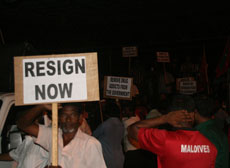
Placards at the artificial beach

“Five or six people who tried to force their way through our shield line were arrested and taken to police headquarters, and then released,” Sub-Inspector Ahmed Shiyam said.

Minivan News observed a light police presence all over the city, with larger squads of riot police stationed near key locations such as the President’s Office and the Chandanee Magu intersection. Several MNDF troop trucks stood ready outside the MNDF headquarters, but the military presence appeared minimal.

Besides the opposition protest and groups of young men hanging around the intersection heckling police, Male’ was unusually quiet for late evening. Entire city blocks in the north-east of the city were closed off and Republican Square was deserted.

An opposition protest in the square that morning involving several hundred people was quickly dispersed by riot police, and covered by foreign media including Associated Press and Al-Jazeera. The protest was subsequently rescheduled for the evening.

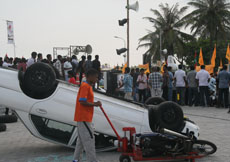
Later in the afternoon, a somewhat carnival atmosphere descended over the city as the Maldivian Democratic Party (MDP) staged a flag-waving counter-protest of several thousand people near the tsunami monument, alongside a concert stage and a police road safety campaign consisting of upturned cars and burned motorcycles.
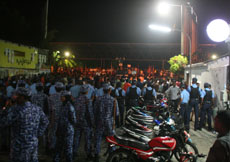
Five lines of police blocked off Majeedee Magu.

“Anti-government protesters claim the uprising is inspired by the Arab revolution, that people power is rising up,” reported Al-Jazeera. “But here on the other side of town are thousands of voicing pointing out that the revolution has already happened.”

In an interview with the news network, President Nasheed accused the opposition of trying to reinstate authoritarian rule.

“I don’t think these are spontaneous demonstrations. If you look at the events and incidents [this week] it is very easy to understand this is very well stage-managed and fairly well played,” he said.

Al-Jazeera observed that “while leading opposition figures are clearly at the forefront of these demonstrations, they deny this,” and interviewed DRP Leader Ahmed Thasmeen Ali.

“It is not attempt overthrow or change the government, it’s just raising voices,” Thasmeen told Al-Jazeera.

Note: Maldives coverage begins at 0:50

Likes(0)Dislikes(0)

UN’s Sri Lankan war crimes report “singularly counterproductive”: Foreign Minister

Maldives Foreign Minister Ahmed Naseem has told journalists in Colombo that the UN report into human rights abuses in the closing days of the country’s civil war is “singularly counterproductive.”

The report was leaked to the Sri Lankan media several weeks ago and contains allegations that the army shelled hospitals, UN facilities and aid workers with the International Committee of the Red Cross (ICRC) in the final days of the civil war between the army and the Liberation Tigers of Tamil Eelam (LTTE).

The report also accuses the Sri Lankan government of intimidating and in some cases abducting journalists “in white vans”. The LTTE was criticised for allegedly using civilians as human shields.

A former UN spokesperson based in Sri Lanka told media after the report was leaked that it “damns the government of Sri Lanka’s so-called war on terror, which incidentally killed many thousands of civilians. The Tamil Tigers were equally rotten in their disdain for life.”

“The focus should now be on how the country can move forward,” Naseem said, during a press conference at the Galle Face Hotel.

“As a responsible member of the Human Rights Council, the Maldives believes it is imperative that the international community closely examine all aspects of the report before taking any further action.”

The UK’s television network Channel 4 has meanwhile said it will air what it claims is “probably the most horrific” footage the station has ever shown, after obtaining “trophy” videos of what it claims are Sri Lankan war crimes.

According to the network, footage obtained by the station includes “extrajudicial executions filmed by Sri Lankan soldiers as war trophies on their phones; the aftermath of shelling in civilian camps and hospitals alleged to have been deliberately targeted by Sri Lankan government forces; dead female Tamil fighters who appear to have been systematically raped; and pictures which document Tamil fighters alive in the custody of Sri Lankan government forces and then later dead, apparently having been executed.”

The Sri Lankan media has overwhelming supported the government against the UN report, contrasting war crime accusations from the West with the triumphalism displayed following the death of Osama Bin Laden.

“We suffered 30 years of ruthless terror, our innocent villagers were massacred, our security officers, innocent men, women and children were killed by suicide bomb blasts and snipers, our ministers, parliamentarians and presidents were killed or disabled for life, our children were massacred in trains, innocent travelers in buses were bombed, a bus load of our Buddhist priests were butchered,, our airports were bombed and terrorism restricted our daily existence,” wrote one commentator on the Lankaweb social media website.

Under the UN’s own regulations a formal war crimes investigation can only be launched on the invitation of the host country, or through a mandate voted by a body such as the UN Human Rights Council.

The Maldives has been a vocal member of the latter, and was quick to sever diplomatic ties with the Libyan government following “clear evidence that the Gaddafi regime is guilty of crimes against humanity and war crimes.”

“I’m concerned the UN report is a bit belated. Why say it now? Why not when the war was going on?” asked President Mohamed Nasheed’s Press Secretary, Mohamed Zuhair, speaking to Minivan News recently.

“My point is that this report only appeared after the war was over. We support the Sri Lankan government’s desire for peace and harmony, and any government that brought about that peace should be held in high honour,” Zuhair said.

If an investigation was to take place, Zuhair suggested, “it should happen in an independent manner, with reconciliation on both sides.”

Read the full UN report (English)

Likes(0)Dislikes(0)

Parties launch protests as foreign media descends on Male’

Police this morning dispersed a rally of several hundred anti-government demonstrators who gathered at Republican Square near the headquarters of the Maldives National Defence Force (MNDF), amid a somewhat carnival atmosphere that settled over other parts of the city on Friday.

Dismissed Deputy Leader of the opposition Dhivehi Rayyithunge Party (DRP), Umar Naseer, and MPs Ali Arif and Ahmed Mahlouf were detained for an hour after allegedly shoving police.

After a run of demonstrations across Male’ this week in protest against the government’s decision to implement a managed float of the rufiya, effectively devaluing the currency, police on Wednesday announced that any protests not held in the open artificial beach or tsunami monument areas would be immediately dispersed.

The DRP, which insists the protests are ‘youth-led’ despite the apparent leadership of its MPs, has tried to replicate the ‘Arab Spring’ protests across the Middle East, painting President Nasheed as a despot to the international media and dubbing a busy Male’ intersection ‘Youth Square’.

The DRP announced that the protest would continue this evening at the artificial beach from 8:45pm.

Meanwhile, the ruling Maldivian Democratic Party (MDP) held a counter-protest this afternoon, with several thousand people gathering near the tsunami monument carrying banners and waving yellow flags.

Speaking at the rally, President Mohamed Nasheed stated that the government’s currency decision was backed by the International Monetary Fund (IMF), and challenged the opposition to defeat him in an election rather than attempting to topple the government illegitimately.

Nasheed claimed that the budget deficit had improved since the government took power, and that it had also introduced state pensions, health insurance and benefits for single parents and the disabled.

A concert stage and a number of upturned and smashed vehicles in the area, part of a police ‘Speed Kills’ campaign, provided a surreal backdrop to the pro-government demonstration.

An upturned car near the MDP rally, part of a police road accident campaign.

A number of foreign media outlets, including Al-Jazeera, have arrived in Male’ to cover the demonstrations after violent protests last week were widely publicised internationally.

Passing the DRP headquarters this afternoon and assumed to be foreign media, Minivan News was approached by an opposition supporter who compared the pro-government demonstrators to “pro-Mubarak supporters” who “beat us at night.”

Former Egyptian President of 30 years Hosni Mubarak was deposed by a democratic uprising in Egypt, leading to a tide of similar pro-democracy rallies across the Middle East.

Maldivian tourism representatives attending the Arabian Travel Market in Dubai, the region’s largest such expo, claimed this week to be receiving cancellations because of safety fears amid the ongoing demonstrations.

“Travel operators in Taiwan have said they are postponing and cancelling group bookings because of negative perceptions [of safety] in the Maldives,” a tourism source attending the expo told Minivan News.

“We just had another two confirmed bookings cancelled today because of reports of riots and instability. We worked hard to get these bookings and the potential domino effect is really worrying – people panic.”

Economic problems

An ongoing dollar shortage, reluctance of banks to exchange local currency, and a flourishing blackmarket that reached Rf 14.2-14.8 to the dollar, culminated in mid-April with the government finally acknowledging that the rufiya was overvalued – after a short-lived attempt to crack down on ‘illegal’ exchanges.

High demand immediately led to most banks and companies dealing in dollar commodities – such as airline ticketing agents – to immediately raise their rate of exchange to the maximum permitted rate Rf15.42.

With the Maldives almost totally reliant on outside imports, including fuel and basic staples such as rice, the government’s decision has effectively led to a 20 percent increase in the cost of living for most ordinary Maldivians.

In an article for Minivan News, Director of Structured Finance at the Royal Bank of Scotland Ali Imraan observed that ‘growth’ in the domestic economy had been driven by the public sector and “paid for by printing Maldivian rufiya and clever manoeuvres with T-Bills, which the government has used since 2009 to be able conveniently sidestep the charge of printing money. In simple terms: successive governments printed/created money to drive domestic economic growth.”

With the introduction this year of a 3.5 percent tourism goods and services tax, a business profit tax and a revision of the rents paid for resort islands, the government now has a number of economic levers it can pull to increase revenue in the future.

However, it has struggled to explain that to people now paying up to 20 percent extra for basic commodities – an affront to the MDP’s pledge to reduce the cost of living – and was caught unawares by this week’s populist protests.

Both factions of the opposition have seized the political opportunity to take the focus off the party’s internal troubles, but have offered few alternatives beyond demanding the government “reduce commodity prices”.

Read more on the Maldivian economy

Likes(0)Dislikes(0)

Foreign Ministry criticises opposition media “manipulation”

The Maldives Foreign Ministry has accused some opposition parties of acting irresponsibly by “misleading” international media over details of protests held this week in Male’, which it alleges have begun to impact interest in the country’s lucrative tourism industry.

Facing members of the local media today, Foreign Minister Ahmed Naseem rejected Minivan News’ use of the term “unrest” to describe demonstrations that have taken place over five nights this week in Male’ concerning the cost of living in the country, claiming that the government was “open to negotiation” on the issue and welcomed alternative political solutions from opposition.

Naseem’s claims were rejected by Ahmed Thasmeen Ali, head of the country’s largest political opposition party, who claimed to have not been consulted by the government on resolving the issues of living costs, as well as adding that it would be difficult to control the output of international news media.

The protesters, who are expected to take part in a sixth consecutive demonstration tonight, have demanded the government lower the cost of living and called on President Mohamed Nasheed to resign, claiming people were increasingly unable to afford basic commodities following the government’s effective devaluation of the rufiya.

Parliamentarians including some members of the Dhivehi Rayyithunge Party (DRP) and the Zaeem-DRP (Z-DRP), an off-shoot of the main opposition party and its coalition partner the People’s Alliance (PA) party activists have been involved in the protests, yet have insisted that the street portests were instigated as part of a non-partisan “youth movement”.

As the protests have been covered by international news media, leading to concerns about the potential impact on the country’s tourism industry, Naseem said he did not believe terms such as “unrest” were appropriate to describe events he believed had been orchestrated by opposition politicians in the DRP and Z-DRP to offset their own internal struggles.

“With regards to what is happening in Male’ I think these are orchestrated events. I have a strong feeling the DRP is trying to find out who their leader is and that is the reason for the actions seen in Male’. We do these things [appointing leaders] through elections and by-elections. They [the DRP] do it through street walks and demonstrations and whatever else you can call it. You said unrest? I don’t think there is unrest,” he said.

The foreign minister added that he believed that there was a small number of people organising the protests looking to create deep unrest in the country and that they should be held responsible for their actions.

“People who organise such events [the protests] should take full responsibility for the images and disruption and damage to property caused,” he said. “I think everyone whose property has been damaged should file cases against the people who are organising these events.”

Reacting to the comments, DRP leader Ahmed Thasmeen Ali said he was “utterly surprised” that a member of the current government, which has vocally supported freedom of speech and democratic reforms, would find protests “unreasonable” on the basis of protecting tourism.

“We have seen them try to stifle protest through using excessive police force,” he claimed. “We are peaceful protestors and are not impacting tourism in Male’.”

Thasmeen added that he believed the government had not made attempts to initiate a dialogue on the issue of living costs, although the opposition said they were willing to negotiate on the matter even though they did not agree to the current devaluation strategy being pursued.

“Obviously there are a lot of protesters here, but the government does not want to listen,” he said. “Lots of people are suffering.”

Thasmeen said that accusations that the country’s political opposition had been “misleading” international media was an “oversimplification” of the issues behind the protests.

“The international media are professionals, many of who will already know the facts of the protests, I don’t see it will be possible to manipulate them,” he said.

Thasmeen claimed that reports of excessive force against protesters had been accurate, adding that MDP supporters led by their parliamentary leadership had been “violently charging” protest crowds while police were attempting to disperse peaceful protesters.

In light of the factional divides occurring within the DRP between Thasmeen and the Z-DRP faction linked to former President Maumoon Abdul Gayoom, the current party head said that apparent collaboration between the two groups was not related to the internal situation of the party.

“It is the duty of responsible politicians to try and find solutions to this problem [living costs],” he said. “There are a number of opposition I believe who have become involved with these protests.”

Thasmeen added that it was inevitable that although the protests has been initiated by a “youth movement” they had become politicised with involvement of figures such as former DRP Deputy Leader Umar Naseer and MP Ahmed Mahlouf.

Likes(0)Dislikes(0)

Local sports star reported injured in police standoff during fifth night of Male’ protests

A well-known local football star has been sent to Sri Lanka for medical treatment after suffering serious injuries during a fifth night of protests in the Maldivian capital.

Media reported that Ahmed Assad ‘Adubarey’ was injured when he was caught and crushed between police riot shields.

Police had restricted protesters to the open area around the tsunami monument and the artificial beach area in the capital Male’ after complaints from business owners and residents around the Majeedhee Magu and Chandanee Magu intersection, a two-lane road the demonstrators have dubbed the Maldives’ “Tahrir Square.”

Protesters split up to try and reach the area, with 10 people including Dhivehi Rayyithunge Party (DRP) MP Ahmed Mahlouf arrested by police and released later in the evening.

Those that reached the intersection were immediately dispersed by police, with several injuries reported.

It is thought that 14 demonstrators arrested during the week’s protests currently remain in custody after the Criminal Court issued warrants extending their detention.

A pickup truck with loudspeakers used by the opposition was damaged and looted by a group of seven young men near the Heniveru police station, in front of 600 demonstrators.

‘’We are residents of this area and you have caused much disturbance to us,” one of the men said, facing down the protesters. “You cannot move even a step forward. If you have the guts, take one step forward and you will see what happens,’’ he said, as 600 people stood silent.

Police are trying to locate the driver of the pickup.

‘’We had a report that a pick-up used by the protesters was destroyed by a group of people and we are now investigating the case,’’ said Sub-Inspector Ahmed Shiyam.”So far no one has been arrested in connection to the incident.’’

The opposition has maintained that the protests are ‘youth-led’ over concerns at the rising cost of living, despite the active leadership of MPs loyal to the former President Maumoon Abdul Gayoom’s faction of the opposition.

Certain activists said to belong to the Maldivian Democratic Party (MDP) are also said to have been involved in the protests, along with other political parties.

Meanwhile, US Assistant Secretary of State Robert Blake has told a press conference in Colombo that the budget deficit was the Maldives’ most pressing issue, and the at the opposition was obliged to assist in resolving the matter.

“The government has laid out a series of steps with the advice of the International Monetary Fund,” Reuters reported Blake as saying. “If the opposition opposes those steps, then it’s incumbent on them to divulge what their own plan would be and then to engage in good-faith negotiations with the government.”

President Nasheed’s Press Secretary, Mohamed Zuhair, said in a statement that the country “should unite for the common good.”

“If the opposition Z-DRP faction does not like the government’s economic policies, we call on it to set out an alternative, credible economic plan to reduce the budget deficit.”

Tourism insiders also alleged yesterday that growing international coverage of the protests has negatively impacted tourist interest from certain travel markets at the Arabian Travel Market in Dubai.

“Travel operators in Taiwan have said they are postponing and cancelling group bookings because of negative perceptions [of safety] in the Maldives,” a tourism source attending the expo told Minivan News yesterday.

“We just had another two confirmed bookings cancelled today because of reports of riots and instability. We worked hard to get these bookings and the potential domino effect is really worrying – people panic.”

In addition to these claims, the National Council of the ruling Maldivian Democratic Party (MDP) yesterday announced that it had approved a resolution to conduct “direct action to defend the government, the constitution of the Republic of the Maldives, the President of the Maldives and senior government officials” against an opposition-led protest planned for Friday afternoon.

The group claimed at the time that it was responding to threats by opposition figures to “torture and kill” the president and other ministers at Republic Square.

Likes(0)Dislikes(0)

Tour operators cancelling bookings after protest coverage

The impact of four nights of violent protests in Male’ has been felt by Maldivian tourism representatives attending the Arabian Travel Market in Dubai, the region’s largest such expo.

“Travel operators in Taiwan have said they are postponing and cancelling group bookins because of negative perceptions [of safety] in the Maldives,” a tourism source attending the expo told Minivan News.

“We just had another two confirmed bookings cancelled today because of reports of riots and instability. We worked hard to get these bookings and the potential domino effect is really worrying – people panic.”

The source noted that the average spend of couple holidaying to the Maldives was US$7000.

Reports in major newswires Associated Press (AP) and AFP on the Maldives’ protests were widely syndicated in world media, drawing largely from comments made by spokesperson Gayoom’s spokesperson Mohamed Hussain ‘Mundhu’ Shareef.

“Police are chasing protesters. Some of those injured have been rushed to hospital,” Shareef told AFP by telephone after last night’s protests, adding that scores of people had been arrested, “including parliamentarians Ali Arif and Ahmed Mahloof.”

“Arif and Mahloof were later released, but we have no news of Naseer’s whereabouts. Our legal team is trying to trace him,” Mundhu said.

Police said that Naseer was released at 1:30am, an hour after he was arrested. Minivan News spoke to Naseer today.

The previous evening, Shareef informed AP that 5000 people were demonstrating in the capital and dozens had been “crushed brutally”, including women.

“The opposition also blames Nasheed for failing to manage the economy – worth over a billion dollars – by recently devaluing the currency, while food prices have risen by as much as 30 percent,” AFP reported.

“Shareef said the protests aimed to emulate those across the Middle East and North Africa, pushing for political reforms in dictatorial regimes.”

Hong Kong yesterday became the first country to put out a travel warning on the Maldives, raising the country’s threat level to ‘amber’ alongside Israel, Iran, Indonesia, Russia and Pakistan.

China’s Xinhua news agency reported a government spokesperson as saying that “Those who plan to visit the Maldives or are already there should monitor the situation and exercise caution.”

Chinese visitors to the Maldives now constitute the greatest number of tourism arrivals, and are a major emerging market. A sharp increase in recent years offset a decline in European arrivals caused by the global recession in 2008.

The Maldives Association of Travel Industry (MATI) has meanwhile issued a statement claiming that reports on the situation were “exaggerated and ill-informed.”

“The series of demonstrations and public unrest by political groups opposed to the government of the Maldives have, over the last few days, led to some reports in the international press of civil unrest in the country.

“The Maldives is safe for visitors and remains peaceful and stable. The police and other authorities have the political situation well under control,” MATI stated.

Further protests – which the opposition maintains are ‘youth-led’ despite the active organisation of opposition MPs – are planned for the weekend, with reports of islanders travelling to Male’ to participate.

Likes(0)Dislikes(0)

MDP council approves “direct action to defend government” on Friday

The National Council of the ruling Maldivian Democratic Party (MDP) has approved a resolution to conduct “direct action to defend the government, the constitution of the Republic of the Maldives, the President of the Maldives and senior government officials” against an opposition-led protest planned for Friday afternoon.

“Following disturbances over the past three nights, the [opposition allied] parties said [Monday night] that as they do not recognise the President and consider the government inept, their real purpose is to gather people to the capital Male’ from all across the country on Friday, May 6, 2011, to take the President out to the Republic Square, remove him from office in the presence of the police and army, and then torture and kill the President along with ministers and MDP leaders,” the resolution states.

The MDP resolution adds that as the opposition parties’ “decision to carry out this brutal deed was announced openly and publicly on VTV and DhiTV at 2.30pm last night [Monday night]” a council sub-committee shall be formed to determine the measures to be taken “in defence of the state.”

The committee consists of newly-elected MDP President Dr Ibrahim Didi, Vice-President Alhan Fahmy and MP “Reeko” Moosa Manik, leader of the party’s parliamentary group.

While the protests have adversely affected the public, school children and shops in the busy intersection of Chandanee Magu and Majeedhee Magu, the MDP resolution claims that corrupt ministers of the former government, wealthy businessmen and resort owners capable of controlling the dollar supply were leading and orchestrating the demonstration “in the name of youth”.

The resolution further accuses the protestors of “misleading the international community and the public” by spreading false information using opposition-aligned media.

Bad blood

Moosa meanwhile claimed today that a large group of opposition protesters broke into the house where his three children use to live, Henveiru Zeeniya, and made death threats against them and their grandmother before causing damage inside the residence.

“Fortunately, my children don’t live there anymore,” Moosa told the MDP website.

Moosa alleged that the group was acting on orders from Umar Naseer of Gayoom’s faction of the Dhivehi Rayyithunge Party (DRP), whose dismissal as Deputy Leader precipitated the rancorous split in the party.

On the second night of the protests, VTV showed footage of Moosa getting hit on the head with a rock while he was attempting to confront the protesters with a group of MDP activists.

Umar Naseer told Minivan News that “Moosa Manik must have been drunk and he probably meant to say Mohamed Nasheed and mistakenly said ‘Umar Naseer’.”

He called on Moosa to clear his car’s trunk, referring to the incident where some alcohol bottles were discovered inside a car belonging to Moosa, an incident over which Moosa sacked his driver claiming it was a set up.

Naseer added that protests would continue this evening, starting from the artificial beach.

”The youth are organising these protests, and we are taking part in it,” he insisted.

The National Council of the ruling Maldivian Democratic Party (MDP) approved a resolution Tuesday to determine direct action to “defend the government, the constitution of the Republic of the Maldives, the President of the Maldives and senior government officials” against an opposition-led protest planned for Friday afternoon.

“Following disturbances over the past three nights, the allied parties said [Monday night] that as they do not recognise the President and consider the government inept, their real purpose is to gather people to the capital Male’ from all across the country on Friday, May 6, 2011, to take the President out to the Republic Square, remove him from office in the presence of the police and army, and then torture and kill the President along with ministers and MDP leaders,” the resolution states.

The MDP resolution adds that as the opposition parties’ decision “to carry out this brutal deed was announced openly and publicly on VTV and DhiTV at 2.30pm last night (Monday night)” a council sub-committee shall be formed to determine the measures to be taken “in defence of the state.”

The committee consists of newly-elected MDP President Dr Ibrahim Didi, Vice-President Alhan Fahmy and MP “Reeko” Moosa Manik, leader of the party’s parliamentary group.

While the protests has adversely affected the public, school children and shops in the busy intersection of Chandanee Magu and Majeedhee Magu, the MDP resolution claims that corrupt ministers of the former government, wealthy businessmen and resort owners capable of controlling the dollar supply were leading and orchestrating the demonstration “in the name of youth”.

The resolution further accuses the protestors of “misleading the international community and the public” by spreading false information using opposition-aligned media.

Likes(0)Dislikes(0)

Commodity prices vary “significantly” between retailers, reports Economic Development Ministry

The Department of National Planning and the State Trading Organisation (STO) have conducted a price comparison exercise across Male’ in a bid to show that while some retailers are charging inflated prices for basic commodities, most prices have risen little.

Speaking yesterday evening from the President’s Office, Economic Development Minister Mahmood Razee said the statistics, which were compiled by the Department of National Planning in collaboration with his ministry, indicated that although certain prices had been found to have risen in the last few months, there was no pattern to link these costs solely to a controversial managed float of the local currency.

The opposition has maintained that demonstrations raging across Male’ this week were against the government’s decision to implement a managed float of the rufiya and are led by youth unhappy with rising commodity prices.  These claims were made despite the active involvement of dismissed opposition Deputy Leader Umar Naseer, and MPs Ilham Ahmed, Ahmed Mahlouf, Ali Waheed, and Ahmed Nihan.

However, Razee added that discussions were ongoing with the STO – a main buyer of goods to the country – to try and maintain import supplies of 27 key food items in attempts to try and keep prices stable as well as enacting a cabinet pledge to cut import duty on diesel fuel by 50 percent.

Speaking ahead of a fourth night of protests by young people, parliamentarians and political activists on the streets of Male’, Dhivehi Rayyithunge Party (DRP) MP Ahmed Mahlouf said that although he had not been made aware of the content of the statistics at the time, he believed that protestors would not believe or be satisfied by the government’s claims and reaction.

“At this time, I think it would be difficult to accept that this is a genuine or positive message. At this point I don’t think [this] one press conference will help people,” he said.

Mahlouf added that he believed comments made by President Nasheed earlier this week, where he allegedly denied knowledge of the street protests concerning increased living costs that have garnered news coverage all over the world, had been extremely offensive to people gathering on the streets .

“It would be better to have a statement from President Nasheed apologising for the stupid comments he has made,” he added. “These comments have only made protestors more angry.”

Government findings, which were compiled on April 2 by officers visiting ten different stores across Male’, were said to highlight prices found to vary, sometimes significantly, between the retailers.

Speaking at press conference last night alongside Finance Minister Ahmed Inaz and representatives from the Maldives Monetary Authority (MMA), Razee said that when talking about changes in prices, it was important to try and determine how extensive they were.

“Yes, there are changes in prices, however, we should also see that in terms of essential commodities, what are the different brands that are there [in stores] and the price variations between them?” he said.

Following price comparisons conducted on May 2 at 10 different stores in Male’, Razee took the example of the prices of five powdered milk products, where prices between the stores were said to vary between Rf150 and Rf345. In addition he also pointed to the price differences in diapers, which he claimed varied between Rf118 and Rf150 for the same product.

The figures presently supplied by the government to Minivan News did not appear to verify these price fluctuations.

Razee added that he was unable to speculate on how long some of these potential differences in prices may have been present in stores across the capital or when and for what purpose they may have been implemented.

“What we are saying it, if you look at the price fluctuations that were there in 2006, 2007 and 2008, and if you look at the price fluctuations of the last few years, you will see there is no clear cut format or reason to believe this is directly related to the float of the currency,” he said. “Yes, it would have a bearing, but what needs to [be understood] is that there may changes to the prices. However, these are varied.”

Razee claimed that the government was not using this explanation as an excuse to avoid acting on public price concerns and said that measures were being taken to try and offer stable prices for certain “essential products”.

“We are in consultation with the STO and we have identified together 27 elementary items, out of which six are currently imported directly. [STO] is going to import the other items [on this list] as well to try and maintain price stability and ensure the availability is there,” he said. “In addition to this, the cabinet today advised the president to remove 50 percent of the duty on diesel. So this will give some relief to power generation, electricity bills and transportation costs.”

Finance Minister Inaz added that the government had decided to release some of its statistics to try and highlight current prices being paid by goods in relation to the last few years.

“It is very easy in a small economy to play with and manipulate the confidence of the economy,” he said. “Confidence is the most important factor to build an economy and it can be easily twisted. We agree the prices have gone up, but we want to maintain these price levels at a competitive level compared to other international rises.”

Cost statistics

The government, in figures compiled by Department of National Planning, outlined a number of changes in the average prices paid for goods between March 2010 and March 2011.

These price changes include:

• One kilogram of loose rice – up 1.07 percent from last year

• One kilogram of ordinary flour – down 1.89 percent from last year

• One kilogram of frozen chicken – up by 8.73 percent from last year

• One medium sized coconut – up 69.71 percent over last year

• One hundred grams of garlic – up 22.34 percent last year

• One kilogram of potatoes – up 8.74 percent last year

• One kilogram of imported onions – down 12.64 percent from last year

• One kilogram of yellow coloured dhal – up 17.63 percent from last year

• One 500 millilitre bottle of Kinley mineral water – down 30.30 percent from last year

• One 185 gram can of Felivaru brand fish chunks in oil – up 22.24 percent from last year

• One unit of state-supplied electricity – unchanged from last year

• Thirteen kilogram of cooking gas – up 12.12 percent from last year

• One litre of petrol – up 32.65 percent over last year

• One packet of Fitti brand small baby diapers – up 4.35 percent from last year

Likes(0)Dislikes(0)

US Assistant Secretary of State urges opposition and government to cooperate on solving economic challenges

The US Assistant Secretary of State covering South Asia, Robert Blake, visited the Maldives yesterday during a tour of the region, and urged the government and the opposition to cooperate in finding a solution to the country’s economic challenges.

“As in many young democracies, the transition to a functioning system of checks and balances between different branches of government is very challenging,” Blake said.

Blake said that he had discussed with President Mohamed Nasheed the steps the Maldives was taking to try and stabilise the economy and reduce the budget deficit, and urged the opposition to involve itself in finding a solution.

“It is very important for them to come together and for [the opposition] to come up with an alternative – if they have an alternative – and negotiate an agreed plan. It is most important to continue momentum, reduce the deficit and put the economy on a firmer financial footing, while at the same time continuing the process of strengthening democracy.

“I encourage the government and opposition to work to together to try and tackle the prblems the Maldives is facing. Even in an older and more established democracy such as our own, politicians can find it difficult to work together across party lines in a spirit of fairness and bipartisanship, for the sake of governing well. But when they do, everybody benefits.”

Blake said he was encouraged during his meeting with the President that Nasheed had “reaffirmed his commitment to freedom of assembly”, and noted that despite the country’s political “growing pains”, “the Maldives’ international influence far exceeds its size, particularly in multilateral organisations such as the UN and its human rights council.”

He thanked Nasheed for the Maldives’ votes concerning Syria, Libya and Iran, and noted that he had “become one of he world’s leading climate change advocates, with a flair for drawing attention to the critical impact climate change is having on island nations.”

US-Maldives cooperation extended to visits by figures from the US legislature, student exchange programs, visiting American Muslim speakers, and military collaboration on security and training, he noted. Blake suggested further cooperation with the new Maldives National University, with faculty visiting from US universities.

Blake also spoke briefly on the successful US assassination of Osama Bin Laden in Pakistan, explaining the State Department’s decision to issue a worldwide caution for American citizens.

“I think difficult to predict [the reaction],” he said. “It is reasonable to assume that Al-Qaeda will try to retaliate for the loss of its leader, and we wanted to make sure people were aware of this development, especially in areas where there is already anti-American sentiment.”

Blake left for Sri Lanka last night, visiting USAID-supported programs and meeting with local leaders in Kilinochchi and Mullaitivu.

Likes(0)Dislikes(0)