Rf900,000 stolen from Damas Company

Police are investigating the theft of two safes holding over Rf 900,000 (US$58,365) from Damas Company’s head office, located on the fifth floor of the company’s building.

General Manager of Damas Ahmed Shakeeb said on Sunday that the two safes were noticed missing when the office was opened on Saturday.

He claimed the “theft was well planned” as the safes were stolen from the office without any damage to the office or locks.

“Thieves must have used the keys to open the doors. They had only entered the room where the safes were locked in,” Shakeeb said.

However he noted that it is too soon to say whether any employee was involved, adding that the theft has now been reported to the police.

Police Sub-Inspector Ahmed Shiyam confirmed that police are investigating the theft.

No arrests have yet been made.

Meanwhile police are also investigating the theft of Rf 400,000 (US$26,000) from a safe in the office of the Maldives Transport and Contracting Company (MTCC) earlier this month.

According to police, a group of people entered the MTCC office in the Hulhumale Ferry terminal in Male’ by forcing open the door and cutting a hole through the ceiling to the first floor where the safe was located.

The thieves then forced open the safe and took the money.

Police observed the thieves “most probably” had information as to where the safe was located and that there was a significant sum of money inside.

Likes(0)Dislikes(0)

Comment: Open Letter to the President

Open letter for his Excellency Mohamed Nasheed, The President of The Republic of Maldives.

Excellency, Honourable Mr. President: May I start this open letter by wishing you and your family to be blessed by God alike your Government and all Honourable Maldivians, people that I have in great esteem and very close to my heart.

The first time I was in your lovely country was long ago and naturally like most, I have
repeatedly come back. I did it as a tourist and as well as a business man with interests as I am (or… was until GMR destroyed my business) a small business man with economical activities in your country. At a certain moment I even created projects like the Sea University, that should develop studies and produce medicines using the elements exiting in the sea, as the sea is one of the greatest Maldivian assets. IT is not to be forgotten Excellency, that the day tourists will be gone, the sea will still be there.

The duty free island, a place where tourists could by all sorts of goods duty free, different from the airport, was another project that never saw the light but was design by me with all the love I have for Maldives.

The first time I landed in the Maldives, I was coming from Sri Lanka, and the contrast was so high that I really felt I was on paradise. The country was clean, peaceful, the water blue, the people nice. It was sunny and very organised. I was thrilled.

True that at that time, freedom of expression did not exist, and talking too much or too loud could mean something terrible. I understand that today under your presidency, the situation changed and Maldives is now part of a big international club where freedom and respect for life is a core subject. Being myself an European, I admire you Sir and I admire your government as the path to development and growth always goes via the respect and creativity of people, that naturally cannot exist without freedom.

Sir, I am not an important person. I’m a humble European, that dedicates his life to coach Presidents of corporations in management, as well other institutions like the Catalan High management of the police or the High management of the European Patent or Brand office. I am not a guru, certainly do not pretend to be, but I’m proud of being a humble person, hard worker and a thorough professional that enjoys working in life. I am not into politics and would never pretend to talk about something I don’t know.

I am writing you this open letter Excellency, because I really love your country and feel sad when I see that people taking advantage of it.

A country, Your Excellency, needs above all her people and needs to invest in developing her citizens. If there is not a critical mass of national brain power being the driving force of the economy and culture, the country will fall very easily into the hands of abusers, the same ones that in the international scene move the economy with the only goal of making money without values or respect for the people regardless where their operations take place. For them, the geography is not important. Once the cows are milked, they are ready to move to another pasture with no guilty feelings of what is left behind.

You and your government are making huge efforts to develop the economy and growth. That is perceived from the outside. You work hard under a climate of respect and social peace, thus increasing the well being of Maldivian citizens, and sometimes that takes time to be seen. Results don’t come quick, we know. In this sense it is clear that Maldives needed a bigger up-to-date airport, a modern gate to the country and to get it you had to do work with international corporations with expertise in the field. It is therefore normal that in return those corporations request to have for them the business cake represented by the flow of currency expressed in millions coming from the tourists, a cake that is very attractive. So far, so good, but what about Maldivians?

At this point I apologise as I don’t want to step into the internal affairs of your country, but Excellency I live in a country that has 17 autonomous regions, with 17 governments and with 17 Presidents with their cabinets and a central government, so I think I know something about nationalism and protecting the citizens when it comes to putting the economy into international hands. These days the world is as as small as a handkerchief, so international cooperation is inevitable, but what about the protection
and development of the local business people? Shouldn’t the airport structure consider this? Shouldn’t Maldivian citizens’ business be allowed to profit from their country’s development? Shouldn’t the airport have a place for all, Dhivehi people and international business people? Airports for a country like Maldives are a strategic subject.

Once more I apologise as I am no one to give lessons on the subject but being involved with the Maldives for so long, my love for the country cannot keep me silent. A country is made by it’s people and its people make the country. If that is not to be considered why should people vote for any government? The airport could and can have a place for everybody. The airport belongs to the Maldives, is it so difficult for international corporations to understand it?

With my greatest respect and admiration for you and your government, that is getting more and more respect in the international scene, I remain yours faithfully.

God bless the Dhivehi people.

All comment pieces are the sole view of the author and do not reflect the editorial policy of Minivan News. If you would like to write an opinion piece, please send proposals to [email protected]

Likes(0)Dislikes(0)

The burden of ‘budhu’-a new age for Dhivehi

“Does language follow a democratic movement, or does a movement follow the language?” queried a source educated in rhetoric and journalism.

Many changes have come to the Maldives in the last twenty years, but some wonder whether Dhivehi is opening the door for political maneuvering.

“In the past, everything in the king’s palace had a word,” said Immigration Controller Abdulla Shahid. Listing wooden nails and coil ropes named for their specific purposes, he explains “it was a king-centered, palace-centered community. The people lived for King. But it has changed very little over hundreds of years.”

Today, Dhivehi leaves gaps of understanding which politicians have been using as public pressure points, Shahid claimed. Those gaps are sometimes filled with superstition, running deep in time.

A Superstitious Past

According to folklore and historical research, the Maldives is the only island group in the Central Indian Ocean to have supported indigenous culture since ancient times. As such, its people have a fairly isolated and protective heritage.

Certain sayings and practices exemplify the fear that isolation engendered.

“Traditionally Maldivians didn’t think that it was good for a person to look too much at the sea, because one’s ‘heart would turn to stone’”, wrote Xavier Romero-Frias in The Maldivian Islanders. He advises that the Dhivehi meaning conveys a loss of memory and focus, rather than a loss of mercy.

Romero-Frias also explains that the winding streets on islands were not only attractive– they also prevented kaddovi, malevolent spirits of dead ancestors, from walking about. Replacing them with straight paths at the king’s order in the 1900s was unpleasant, to say the least.

The advent of Islam in 1100 AD tried to dispel indigenous superstition. The Sunni tradition in particular strongly discourages aniconism, or the depiction of religious and living beings. Signs of the Buddhist culture as well as “all type of Dhivehi cultural expressions deemed un-Islamic”, were destroyed, including budhu, or any carven image of a living being.

Some say the new regulations had a positive effect on Maldivian culture. “Wahhabism removed suspicions and freed the psyche,” said one source familiar with the issue. With numerous demons and windowless architecture, he said, Buddhist culture leaned heavily on superstition and deterred progress. “There were ill-omen days, and on those days people might not go fishing, for example,” he said.

While physical evidence of a Buddhist past has more or less vanished, words and their superstitious connotations linger.

Budhu is one example. Lacking words for ‘doll’ or ‘monument’, Dhivehi speakers generally refer to such objects as budhu–a habit that can lead to confusion.

In one story from Gan Laam Atoll, a statue is remembered as a human being.

Naseema Mohamed, a history consultant at Dhivehi Academy, told the tale of a big man who always stood near the island’s stuppa, no matter the weather. He never sat down. Mohamed said the story was about a standing man, but infers that the “man” was a Buddha statue.

“To some, even a photograph is considered a budhu,” Shahid said. Shahid was in prison for the first 16 years of his daughter’s life, and saw her only 12 days a year. To remind their daughter of him, his wife kept a picture at eye-level in the house. The gesture was reportedly disdained by Shahid’s sister, a pious woman who only took photographs for her passport.

The burden of budhu

Given the many meanings and uses of the word budhu, it seems reasonable that statues and monuments would be considered a public, cultural threat in the Maldives. However, as the recent vandalism and theft of monuments in Addu illustrates, gaps in language could be “one of the most serious problems, especially at this time,” as Shahid claims.

Officials have suggested that the attacks on the SAARC monuments have a political base. Shahid believes they were engineered because the public was pre-disposed to accept the destruction of images. Without separate, secular terminology for ‘monument’, people fell back on the religious argument.

“This is just one of the factors of how the religious and political groups were able to blow things out of proportion,” said Shahid. “Nobody wants to argue about budhu, they don’t want to be labelled a non-Muslim, so it’s better to stay quiet.”

The SAARC monuments were first criticised by the Islamic Ministry on religious grounds. Soon after, opposition Progressive Party of the Maldives (PPM) hailed the vandals as “national heroes” and filed a case against Customs for allowing the statues into the country. When Nepal’s statue was stolen on December 7, Addu City Mayor Abdullah Sodig asserted that the theft had a political base.

Recalling acquaintances who asked whether people would start worshiping new idols in Addu, Shahid concluded, “my opinion is this whole thing has gone out of proportion because of the language problem.”

When asked about Shahid’s assessment, Mohamed pointed out that Pakistan’s monument was a historical illustration. “There was nothing for anyone to be angry or annoyed about, although I could understand how some people would have that reaction,” she said.

Editor of MaldivesCulture.com Michael O’Shea said most Maldivians harbor suspicions, but many make distinctions. “Because budhu has a wide range of meanings, getting upset about some forms of it and not others is a personal choice,” he observed.

However, politics prevail. “You can’t have a cultural discussion without it turning into a political swinging match,” said O’Shea.

Recent events support his claim.

On the day before the nation-wide protest to “Defend Islam”, a religious rally at which key speakers pledged to defeat President Mohamed Nasheed in the 2013 presidential election, Afghanistan’s monument was broken from its mount and sunk in the sea. Addu Councilor Hussein Hilmee said the monument was an image of Afghanistan’s Jam minaret, which features Qur’anic phrases and is listed as a UNESCO World Heritage site.

As printed slogans at the “Defend Islam” protest reminded the public, statues–even of the Jam Minaret–offend the national religion.

The destruction of the Addu-based monuments was one of several demands made by the protestors, who came close to clashing to with MDP protestors late Friday night.

De-politicising Dhivehi in a democratic era

Politics govern most conversations in both manner and practice, said one source familiar with linguistics and media. He said the evolution of journalism illustrates the pressures of a democratic revolution on Dhivehi language.

“The language of journalism is now less formal than it was before. But, as it becomes less formal it also becomes less neutral,” he observed.

The democratic revolution of the previous decade pushed Dhivehi to its limits. “Under Gayoom, we didn’t have a word for ‘protest’. Instead, we said ‘express displeasure’. Previously, there was no word for ‘detainee,’ only ‘convict’. You were either a political offender or a convict,” he said.

Dhivehi evolved quickly “because the movement was happening very quickly,” but the source said it could learn from Arabic media, notably Al Jazeera, which developed new words instead of adopting English terms.

Pointing out that ‘freeze’ in Dhivehi only refers to objects, the source queried, “When the western press talks about unfreezing assets, we haven’t even got a word for freeze. How do we keep up with that?”

However, the source claimed, journalists are falling short of their duty.

“Journalists are passing the buck. They are saying it is not their job to change Dhivehi, but this is a responsibility of journalism. You can’t just copy the politicians” because it narrows the discussion and alienates the people, he said. “There should be some strong face of journalism. At the moment it seems like the entire discussion is in the language of politicians.”

What are the consequences?

“It is not just a constitution that will bring democracy and human rights and civil society. In Maldives, it’s everything. From language, to religion, to the population size. The language issue is a problem here. It has to be overcome.”

Likes(0)Dislikes(0)

Protests proceed peacefully as a majority defends Islam

Two much-anticipated protests, one to defend Islam in the Maldives and another to exhibit support for a “moderate Islam” drew crowds of thousands along Male’s eastern coast this afternoon, and thousands more on islands across the country.

Contrary to  speculation, no violent outbreaks or confrontations took place on a grand scale. However, three individuals were injured during a protest against the government’s religious policies in Haa Dhaal atoll Vaikaradhoo. They have been taken to the island’s health clinic, Haveeru reports.

Meanwhile, police and national defence forces (MNDF) are maintaining close operations on Male’.

“There is no violence, so the police are continuing to survey the situation but they will not interrupt the ongoing demonstrations unless there is a confrontation,” said Sub-Inspector Ahmed Shiyam.

A coalition of NGOs and six political parties began organising a protest “to defend Islam” several weeks ago. Ruling Maldivian Democratic Party (MDP) coordinated a counter-protest after threatening messages were posted on the coalition’s promotional website. Over the past week government, religious and security officials attempted to negotiate the situation, with rumors of members of the Taliban joining the protest raising concerns over public order.

Both protests began at 4 pm today. MDP’s protest concluded at 5:30, however the “Defend Islam” protest leaders have announced they will remain in action so long as the public demands it.

Defend Islam

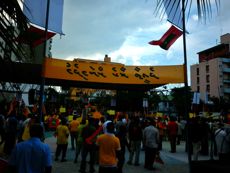
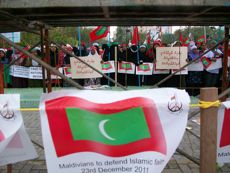
Banners bearing slogans including “We stand united for Islam and the nation”, “No idols in this holy land”, “No to the Zionist Murderers”, “No to El Al Airlines” and “We stand for peace” lead participants to gender segregated areas across from the Tsunami Memorial area, where approximately 20 protest leaders spoke from a mounted podium.

Speakers from various religious and political opposition parties addressed an estimated 5,000 men, women and children of varying ages and attire. Protestors were handed t-shirts and banners reading “Maldivians in defense of Islam” along with Maldivian flags.

“We don’t know there is a moderate, higher or lower Islam. We only know Islam, which is above all the religion. The only road we must follow is based of Allah’s callings,” said Jumhoree Party Leader  and tourism tycoon Gasim Ibrahim.

Gasim urged the people gathered to continue the rally peacefully, assuring his party will “stand with the people to protect Islam”.

Former State Islamic Minister and current spokesperson for Adhaalath party Sheikh Mohamed Shaheem Ali Saeed said the party does not support terrorism, adding that the security forces would know the actual people provoking terrorism.

He also vowed to defeat President Nasheed in 2013 elections.
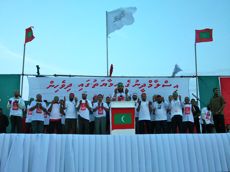
The crowd raised cries of “Allahakbar” between speeches, and Shaheem led an oath to defend Islam in the Maldives.

Dhivehi Rayyithunge Party (DRP) Leader and MP Ahmed Thasmeen Ali said that he was there on behalf of DRP to assure Maldivian citizens that the party will stand with the religion of Islam.

”We are gathered here to uphold Islam for the future of the next generations,” Thasmeen said, accusing the current government of trying to establish anti-Islamic policies.

Increased diplomatic relations with Israel, including possible service of El Al airlines, and recent debates over Shariah law were among examples given.

”We are here to show that will not support those policies yet we are not extremist,” he said. ”We will stay forever as an Islamic nation.”

El Al Airlines was expected to begin service to the Maldives on December 13, but has been postponed indefinitely. The National Security Committee is currently reviewing the situation.

Half-brother of former President Maumoon Abdul Gayoom and Progressive Party of Maldives (PPM) MP Abdulla Yamin argued that President Nasheed would have stood in the front line of this gathering if he wanted to uphold Islam.

”Today they are asking whether churches could be built and idols could be kept,” Yamin said. ”And, the police do not have to defend the idols.”

Yamin accused the government of trying to abolish Arabic and Islamic studies from the country.

”The current government does not care about Arabic and Islamic Studies and has in fact disrespected Arabic and Islamic studies,” he said, reiterating that this nation will forever be an Islamic nation.

Several speakers called on the government to condemn United Nations Human Rights Chief Navi Pillay for her suggestion that flogging be abolished as a punishment for extra-marital sex. Pillay’s comments fueled gathering tensions over the SAARC monuments erected in Addu and the agreement with El Al Airlines, which culminated in today’s protest.
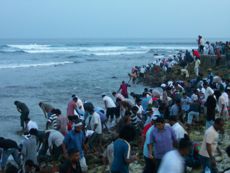
At 6 pm protestors flocked to the sea and were given water bottles for ablutions before a group prayer on site.

MDP for Moderate Islam

Meanwhile at the MDP rally held at Artificial Beach, President Mohamed Nasheed said the government will continue to practice a tolerant form of Islam, reminding listeners that Islam in the Maldives has traditionally been tolerant.

“We can’t achieve development by going backwards to the Stone Age or being ignorant,” he said.

The President also called on leaders of political parties to explain their stance on religious issues to the public ahead of the 2013 presidential election.

“Should we ban music? Should we circumcise girls? Should we allow 9 year-olds to be married; is art and drawing forbidden? Should we be allowed to have concubines? We have to ask is this nation building? Because we won’t allow these things, we are being accused of moving away from religion,” he said.

Nasheed also urged MPs to discuss the inclusion of Sharia punishments in a revised penal code “without calling each other unbelievers.”

“At this moment we may not realise how important this gathering is, but years down the line we will look back and realise this was a crucial moment,” he said.

“I asked you to come here in support of the middle, tolerant path. And I believe that most citizens want to continue our traditional form of Islam,” the President said.

President’s Press Secretary Mohamed Zuhair told Minivan News today that “the opposition said 100,000 would attend their rally, but less than 5,000 showed up.”
“This is because their rallying call was based on a lie – that Islam is under threat in the Maldives,” he said. “It also proves most Maldivians want toleration and not the introduction of extreme punishments such as stoning, amputation and genital mutilation of girls.”

Public Responses

“The government today is breaching the Islamic values everyday. It is already too late to protest. But we need to stop President Nasheed from speaking against Islam. That’s why I am here,” said one 35 year old woman protesting at the Tsunami Memorial.

“I am not at the MDP rally because they are calling for moderate Islam. We don’t want that. We want 100 percent, full Islam in Maldives,” said another participant.

“Islam calls for flogging, stoning and hand amputation. But President Nasheed speaks against these Islamic penalties openly. That means he’s not following Islam. He wants music, he wants adultery and alcoholism to takeover us,” a woman alleged.

Minivan News asked why the people are not protesting outside the parliament or the judiciary, to change laws which currently exempt those Islamic penalties.
The women argued that these bodies are not the ones allowing Israeli flights to land in Maldives, or which approved the monuments in Addu, which they claim are religious idols.

“It is the government that is responsible for these things. Besides we are not allowed to protest outside the parliament and courts. So we are raising our concerns here.”

One observer of the MDP rally clarified that, “This protest is not related to Islam in any way, they are just doing it because they like to protest.”

Other onlookers were more circumspect.

A man who attended the MDP rally said he was happy that there was no violence. “This is how the protests should be. People have now expressed what they want. Let the public decide.”

“I am here to defend Islam. Not to take any sides. The government is doing things that are conflicting with the Islamic values we have been following,” claimed a man wearing a t-shirt reading “one religion”.

According to him, allowing Israeli flights to land in Maldives, closing down Arabiya (Islamic) School and keeping monuments in Addu is all part of the government’s conspiracy to eradicate Islam from the Maldives.

“I am just here to watch what is happening because it is my country,” a man said.

Ahmed Naish, Ahmed Nazeer, Hawwa Lubna and Eleanor Johnstone contributed to this article.

Likes(0)Dislikes(0)

Extremist rhetoric will hurt Maldives’ international image: Foreign Minister

An increase in extremist rhetoric in the Maldives may affect the country’s international image and the ability of its citizens to freely travel abroad, Foreign Minister Ahmed Naseem warned on Thursday.

The Maldives had “a lot to lose” should such intolerance continue, Naseem said: “A large number of Maldivians travel outside the country and such rhetoric will have implications for the average Maldivian travelling abroad, and on those Maldivians already living abroad.”

The Maldives was a liberal democracy “with a Constitution based upon respect for the human rights of all,” Naseem claimed.

“As a democratic nation, each of us should be willing to listen to the views of others. It is our collective responsibility to promote equality and tolerance and to strengthen our democracy. A reversal of our democratic values could alienate the Maldives and tarnish its world renowned reputation for hospitality,” he said.

Islam was a religion of “dignity, peace and tolerance,” Naseem added. “Anyone who tries to use religion to incite hatred or violence is acting contrary to our national values and our Constitution.

“I call on all Maldivians to choose the path of peace and reconciliation, and to stay to the path of the traditional moderate Islam that has earned Maldives its place as a model Islamic country among the international community,” he said.

Asked about the ongoing detention of controversial blogger Ismail ‘Khilath’ Rasheed, who was today declared a prisoner of conscience by Amnesty International after his participation in a ‘silent protest’ calling for religious freedom, Naseem acknowledged that the matter “was of concern to the international community.”

“We must protect our Constitution, but whatever needs to be investigated can surely be investigated without arresting anybody,” he said.

Police Commissioner Ahmed Faseeh was meanwhile today reported in newspaper Haveeru as expressing concern that the Maldives was heading towards becoming “Afghanistan” – except that unlike Afghanistan, it was not able to produce its own food.

Organisers of both the ‘Defend Islam’ and ‘Moderate Islam’ protests assured parliament’s national security committee that there would be no violence tomorrow. However Faseeh expressed concern over police intelligence suggesting the involvement of gangs.

“They are very versatile and we advise everyone to refrain from encouraging them. Even if they’re used for a good cause, it just encourages them,” Haveeru reported Faseeh as saying.

Likes(1)Dislikes(0)

Universal health insurance a first for Maldives

Parliament yesterday passed a bill to bring universal health coverage to Maldivian citizens for the first time in the nation’s history. The bill was submitted by Nolhivaram MP Mohamed ‘Colonel’ Nasheed and unanimously approved by with 72 votes.

“Previously, the public paid for health care and the need applied for subsidies under the welfare system, or sought assistance from well-connected friends and family,” the President Press Secretary Mohamed Zuhair explained. “This bill means a lot.”

According to the bill citizens receive government-sponsored coverage up to Rf100,000 (US$6,500) per year. Zuhair said the bill includes provisions for citizens who require further financial assistance.

Expatriate workers are also eligible for coverage providing their employers pay a upfront fee of Rf1,000 (US$65).

The Aasandha (well-being) program was officially signed at Artificial Beach today with hundreds of Maldivian citizens in attendance. The mood was positive.

“This will make it much easier for everybody in the Maldives,” said onlooker Mariyam Hafseena. “Before we had to pay for treatment and medication, which is expensive. Now it will be free. We never expected this would happen, it’s a surprise and we are very happy!”

A statement from the Mexican government recalled that universal health insurance was approved in Mexico eight years ago. “Mexico and the Republic of Maldives are developing countries, but with our universal health insurance programs our people’s health care can be better than that of developed countries such as the United States.”

Health Minister Aminath Jameel said the program brought “excellent and comprehensive health care for all from the public and private health sectors.”

Aasandha is a public-private partnership with Allied Insurance. Under the agreement, Allied will split the scheme’s shared 60-40 with the government. The actual insurance premium will be paid by the government, while claims, billing and public awareness will be handled by the private partner.

Provision of the service was said to have been made available through a collaboration with London-based international banking organisation Lloyd’s and the US-based Global Assurance Group.

The service will cover emergency treatment, including overseas if the treatment is not available locally, inpatient and outpatient services, domestic emergency evacuation, medicine under prescription, and diagnostic and therapeutic services.

Maldivians regularly travel to Sri Lanka, India and Singapore for medical treatment, including giving birth. Allied has also claimed that its premium package now allows for coverage everywhere in the world including the US and Canada.

Zuhair confirmed that the government has agreements with medical centers in these countries and can provide coverage for treatment at designated centers as well as travel stipends.

Coverage for treatment abroad is limited to high-income individuals, however Zuhair understood that the some government funds would be available to needy families.

The universal deal also comes with universal responsibility.

Zuhair said the public is expected “to appropriately follow a healthy lifestyle”, reiterating that the new system does not equate with a free-for-all dispensary. At the same time, the government “is challenged to raise the standards of medical service and continuously improve the care available in the Maldives.”

Plans for such improvements are in place. One recently proposed plan would shift the pharmaceutical industry to generic drugs, which the World Health Organisation considers more affordable and reliable than brand-name products.

The same plan would also streamline the prescription process, cutting back on paperwork and reducing patient stress.

The new health insurance plan will become active on January 1, 2012. Zuhair said citizens can expect minimal paperwork responsibilities.

“The new system should be very easy,” he said. “We are working to cut down paperwork and keep all the information in a central database. More will be handled by the government.”

Zuhair advised the public to attentively update their identification cards, as these will be necessary to receive treatment under the Aasandha plan.

Parliament yesterday also passed a pre-school bill, submitted by Meedhoo MP Ahmed Siyam Mohamed and approved with 71 votes, and an archive bill submitted by Manadhoo MP Mohamed Thoriq, approved with 66 votes.

Likes(0)Dislikes(0)

Laamu Gan Asseyri project to proceed: Tourism Minister

The government has apologised for miscommunications which led to the “unfortunate” media coverage of a contract between the Ministry of Tourism and J Hotels and Resorts for a mid-market tourism center at Laamu Gan Asseyri Project, Tourism Minister Mariyam Zulfa has said.

“The Cabinet did not decide to cancel the contract, if you read the government gazette closely it just put the project on hold for some time. The intention was never to withdraw the agreement,” she explained.

Minivan News recently reported along with local media that the Cabinet had terminated its contract with J Hotels and Resorts and would solicit further bids for the project. Company chairman and former MP Abdulla Jabir issued emphatic warnings that he would sue the government.

Jabir today said he has been informed by the Minister that the Cabinet would approve the project.

“So far I’ve been advised that it will go forward, so we’ll see how things go. I don’t know what the Cabinet will do, one day they make a decision the other day they change it, but in time we will see how it proceeds,” he said.

Jabir reiterated that the Minister had assured him that the project would go forward, and that he had no bad relations with any ministry.

Speaking with Minivan News yesterday Zulfa said, “J Hotel and the Tourism Ministry were and are keen to get the project going, especially since the President has said that the mid-market project is a priority to the government and that it will make sure that project gets done.”

Given the project’s value, Zulfa said the Cabinet wanted to ensure that everything was in line with the government’s vision before proceeding with the agreement. She believed the Cabinet had not been provided with sufficient information to make an informed decision on the matter.

Zulfa said she has now presented all the relevant information to the Cabinet, and the project will move forward.

“The government enjoys a good relation with the development party, and we regret the unfortunate turn of events that led to this misunderstanding,” she said.

The Asseyri project, launched in March, aims to bring two 300-bed hotels and 69 guest houses to the 25 hectare area along with recreation activities, water sports and restaurants.

“Right now we can’t cater to the mid-market tourists who want to have options when they make a trip to or within the Maldives. This will give them that opportunity. And the basis of the project will be the natural beauty–the beach, lagoon and reef are absolutely fantastic,” said Zulfa.

She added that the mid-market project is designed in and around the airport development project, and will offer job opportunities and economic growth.

Moving away from the existing one island, one hotel tourism product, the Asseyri (beachside) project intends to rent out commercial components of an area to different parties, allowing larger numbers of local entrepreneurs to participate in the Maldives’ lucrative tourism sector.

In July, Addu City Council announced its intention to incorporate the project’s core values and aspects into Addu City’s development plan.

The two areas ear-marked for the project are the Maafishi Area of Hulhumeedhoo Island and the start of the Hankede area, Hithadhoo.

Likes(0)Dislikes(0)

Amnesty declares imprisoned blogger a prisoner of conscience

Amnesty International has declared imprisoned blogger Ismail ‘Khilath’ Rasheed a prisoner of conscience, and called for his “immediate and unconditional” release.

The controversial blogger was arrested on December 14 following his participation in a ‘silent protest’ on Human Rights Day, calling for religious tolerance in the Maldives.

A group of men attacked the protesters with stones, and Rasheed was taken to Indira Gandhi Memorial Hospital (IGMH) with a fractured skull. He was subsequently arrested for questioning over his involvement in the silent gathering, and the Criminal Court granted police a 10 day extension of detention for the investigation.

“The continued detention of Ismail ‘Khilath’ Rasheed is in breach of international treaties on freedom of expression and peaceful assembly, including the International Covenant on Civil and Political Rights, to which the Maldives is a state party,” Amnesty said in a statement.

“Amnesty International is dismayed that instead of defending Ismail ‘Khilath’ Rasheed, who has peacefully exercised his right to freedom of the expression, the government of Maldives has detained him. Moreover, the government has taken no action to bring to justice those who attacked the ‘silent’ demonstrators, even though there is credible photographic evidence of the attack.”

The attack on Rasheed and his subsequent detention was a “clear example of the erosion of freedom of expression in the Maldives,” Amnesty stated.

“This basic human right is not just under attack from some religious groups; it is also violated by the government of the Maldives. All people in the Maldives should be able to enjoy their right to freedom of expression without being attacked or detained by the police.”

President Mohamed Nasheed was himself declared an Amnesty prisoner of conscience in 1991, following his repeated and prolonged incarceration by the former government.

A photo of Rasheed's alleged attacker taken by the protesters

Journalist detained

Reporters Without Borders (RSF) has also called for Rasheed’s immediate release.

“All he did was start a debate about the issues of religious freedom and tolerance in Maldives,” RSF stated.

“The authorities must explain the reasons for his arbitrary detention and release him at once. It is disturbing to see the government yet again yielding to pressure from the most conservative fringes of Maldivian society.”

Rasheed was one of the country’s leading free speech advocates and one of the few Maldivians bloggers to write under his own name, RSF observed.

“The Maldivian constitution bans the promotion of any religion other than Islam but guarantees freedom of assembly and expression as long as it does not contravene Islam. Rasheed professes to be an adherent of Sufism, which emphasises the inner, spiritual dimension of Islam.”

Reaction

President Mohamed Nasheed’s Press Secretary, Mohamed Zuhair, told Minivan News that Hilath had been arrested under an existing regulation passed by parliament that had no bearing on the [executive] government.

“The government’s policy is to allow freedom of expression to the greatest extent possible under the Constitution,” he said.

Under new regulations published by the government in September, interpreting the 1995 Religious Unity Act passed by parliament, media is “banned from producing or publicising programs, talking about or disseminating audio that humiliates Allah or his prophets or the holy Quran or the Sunnah of the Prophet (Mohamed) or the Islamic faith.”

Violation of the Act carries a prison sentence of between 2-5 years, and the Communications Authority of Maldives (CAM) in November blocked access to Rasheed’s blog on orders from the Ministry of Islamic Affairs, on the grounds that it contained anti-Islamic material.

Rasheed was arrested amid growing religious and political tensions in the Maldives in the lead up to a ‘Defend Islam’ protest to be held on Friday, December 23.

The protest follows several incidents of religious intolerance in the past few months, including as vandalism of the ‘idolatrous’ SAARC monuments in Addu Atoll and hostility towards calls by the UN Human Rights Commissioner Navi Pillay for a moratorium and debate on the flogging of women for extramarital sex.

The December 23 protest is being organised by a coalition of religious NGOs and opposition political parties, who have attacked the government for decisions such as its diplomatic relationship with Israel.

“The government is saying that the Maldives has had an unbroken Islamic tradition for 800 years, and 90 consecutive Chief Justices who have applied Sharia Law,” Zuhair said.

“The President is asking everyone to take a stand tomorrow on the 23rd for the continuation of the Maldives’ moderate Islamic tradition,” he said.

It was “not accurate” to suggest that the government was yielding to fundamentalist fringe elements, he insisted.

“This is political. [Former President] Maumoon Abdul Gayoom and his cronies are testing their support base. The people who are funding this so-called Islamic gathering are the same people selling pork and alcohol.”

Likes(0)Dislikes(0)

Housing success a three-part puzzle

The development of housing, industry, and transportation infrastructure is expected to greatly improve the “extreme” situation on Male’, said Infrastructure Development Ambassador Sarangu Adam Manik.

“There are more people in Male who do not have housing than people who do,” he said.

The capital Male’ has a land area of less than two square kilometers but is home to one-third of the country’s population or approximately 125,000 people residing in an estimated 16,000 households; the total number of households in the Maldives is estimated to be 46,000.

With 50,000 people per square kilometer Male’ is the most densely populated city in the world, outdoing Mumbai’s 33,000 people per square kilometre.

President Mohamed Nasheed previously said the “household is the main engine of development.” Making good on this claim, he yesterday conferred land tenure agreements to 20 parties who had applied for housing and housing grants to 27 applicants, saying the government intends to provide housing for all 21,000 applicants to the Veshi Fahi Male’ housing program.

Earlier this year, ten flats were awarded under the same program.

The government originally pledged 10,000 flats.

A statement on the President’s Office website said the program aims “to satisfy the lives of all Maldivian citizens, and augmenting the nation’s economically active population by economically mobilizing nearly 150,000 people.”

Under phase one of the project launched in January, a total of 1,000 parties were invited to apply for the housing scheme. Over 8,000 application forms were submitted on the first day.

The Cabinet also approved related projects including the development of a container park in Thilafushi to incentivise relocating warehouses in Male’ and construction of a multi-purpose local market with modern facilities for residents of Male’.

The programme was launched on November 10, 2010 with the aim of combining the development of Malé, Vilingili, Guli Falhu, Thilafushi, Hulhumalé and Malé International Airport.

Manik said the network of projects  will jointly reduce the stress on Male’.

“Gulhifalhu will help tremendously the housing and economic situation. Thilafushi will  centralise the industrial sector, and the bridge will improve mobility–all components will help the situation on Male’,” he surmised.

The Cabinet yesterday decided to proceed with the plan to construct a bridge between Male and Hulhule, a reclaimed island attached to Hulhumale.

Since Hulhumale’s population is expected to double in the next year as people take advantage of new housing opportunities, mobility will become an issue, Manik said.

“Think about it, you will have two to three thousand flats, each with a family of four or more people on average. That’s eight to twelve thousand people,” he pointed out.

He also noted that the current boat-based system is vulnerable to changes in weather.

Manik said building a bridge was not a new idea. “The previous government proposed it but didn’t find a way to do it. President Nasheed’s ability to think ahead and think strategically means that the new government has found a way to do it. Gayoom’s government talked about it but we never saw a plan.”

Reflecting on public complaints of some infrastructure development programs, Manik surmised that “everybody wants to be the khafir except the khafir.

“Each power is trying to draw new borders, and there are always demarcation problems. People will settle down and things will become more progressive. It takes time to accept a new democracy.”

Likes(0)Dislikes(0)