Who is not worried about the recent spike in violence of all forms? Who is not anguished by the madness of senseless killings? And inflation? What explains these issues?
And what explains Adhalaath’s reaction or action? Maybe ‘functionalisation’ of Shari’ah in an effort to enlist more members before the upcoming Adhalaath party elections?
Maaddi was a word that was prominently censured in Sheikh Ilyas’s darus on April 22. Now according to maadi social science, attempts toward ‘shariatisation’ of the state happen under such general socio-political conditions as we now see in the Maldives, and as we witnessed under not very dissimilar conditions but in a different context of post-Suharto Indonesia.
That is, however, another story for another comment.
So is lack of Islam to be blamed for social ills?
History of Islam in the Maldives: a mixed story
Maldivian history is littered with examples of ‘bad’ religious beliefs and practices: from Maloney’s ‘parallel religious system’ of fandita, sihuru-haahooru, astrology, and so on to visiting the dead, maulood, and beliefs in demons of all sorts; from unveiled women to women who would not cover their chests; from a woman ruler (which was noted with ‘strangeness’ by Ibn Battuta) to ex-wives sharing homes with ex-husbands and to people fainting when Ibn Battuta passed hudud punishments, we see a very mixed story in our history. The popular Islam in the Maldives especially prior to late 1970s was a far cry from the ‘puritan’ Islam we now see.
Hence, I argue, it is simply bad maaddi social science to blame the recent social ills on alleged lack of proper Islamic education.
Gayoom’s ‘renewed commitment’ to Islam
Writing in the late 1970s, Clarence Maloney, a maaddi anthropologist who did maaddi ethnography in the Maldives, has this to say: President Gayoom’s government ‘engineered a renewed Islamic commitment’. In fact, since the 1980s we have seen a hitherto unseen effort to Islamise the society.
From Mau’had to Arabiyya to the introduction of Islamic studies at all levels in the education system; from annual Ramadan Ihya darus started by Gayoom at Mulee-aage to darus throughout the year by Gayoom’s government in the islands; from the ‘lot of attention given to Islam, as part of nationalism’ (as the then Minister of State for Presidential Affairs Mohamed Hussein was quoted in Gayoom’s biography) to re-marking of the mythical Maldives’ conversion-to-Islam day in 2000, the Maldivian society we see today is far more conscious of ‘true’ Islam than it had ever been in the past.
Democratic openings and Islamic nahda
If what President Gayoom did was not enough, come 2004’s democratic openings, we saw an unprecedented Islamic nahda in the country. The young public sphere or al-mujtama’ al-madani saw itself largely controlled by Salafi organisations.
From Jamiyyathul Salaf (the first-ever salafist NGO in the country) to quasi-political Adhalaath party to the Islamic Foundation, this rise in the salafi phenomenon has not been matched by all other jamiyyas combined. In terms of organisational capacity, outreach, activeness, and financial capabilities salafis surpass all others.
From rallies addressed by world-class televangelists and da’ees like Zakir Naik, Abdurraheem Green, and Bilal Philips to darus CDs to Facebook groups, blogs, websites like Noorul-slam.com, Dheen.info, Dhiislam.com, MvislamQA.com, and Dharuslive.com to almost daily darus at rallies, in taxis, on television and radio like Radio Atoll; from children’s specialized darus to religious camps like Hijra; from Rihla to I’lmi khazana; from English-language madhaha and nursery rhymes to other innovative outreach programmes such as road-side darus on mega-screens, the country has seen an unprecedented effort to re-Islamise the society.
This is truly an Islamic nahda.
Correlation between Islamic nahda and social ills
Now there is a clear positive correlation between Gayoom’s Islamisation and recent re-Islamisation phenomena and the apparent rise in social ills in the country.
But, no, I will not blame these Islamisation phenomena for the social ills.
Blaming Islamisation phenomena for social ills seems to me as bad an explanation as Sheik Ilyas’s explanation that Islamic studies get a meager three hours weekly in the curriculum, or that Islam teachers are not qualified, or people are not Islamic enough, or there is a harb al-afkar against Muslim Maldivians by adaavaaiythereen (enemies).
If there is one single thing prominently wrong with our education system, it is the utter lack of maaddi social sciences and humanities subjects such as sociology, political sciences, anthropology, philosophy, theology, linguistics, and literature.
Finally, I am not a maaddi sociologist, so I do not know where the explanation for our social ills lies. Disappointingly, we do not have sheiks doing such research in the country, and hence the government’s increasing ‘militarisation’ of the issues.
All comment pieces are the sole view of the author and do not reflect the editorial policy of Minivan News. If you would like to write an opinion piece, please send proposals to [email protected]
A third night of violent protests in Male’ ended around 4:00am this morning after the windowpanes of a police station were smashed, shops vandalised and fires started across the city.
Police used tear gas to disperse a crowd gathered at the intersection of Male’s main street Majeedee Magu and the tourist strip Chaandhanee Magu, the focal point of the protests so far, after a group of MDP activists arrived and clashed with opposition protesters and young people around 11:30pm.
The two sides were separated by police but continued attacking each other with bricks and bottles. Police appealed for people to leave the area and eventually dispersed the crowd at 12am using tear gas.
“Police dispersed the two crowds using tear gas to minimise the amount of force that would need to be applied,” Sub-Inspector Ahmed Shiyam told Minivan News.
Police, he said, had noticed that “once the criminal activity starts most people leave the protest.”
A group of Maldivian Democratic Party (MDP) activists then gathered outside the house of the former President’s half brother, Abdulla Yameen, before being moved on by police and the Maldives National Defence Force (MNDF).
“The opposition [demonstrators] gathered in the area for 1-2 hours and started several fires in the road before they were dispersed with teargas,” Shiyam said. “ Later they attacked a police building in Maafaanu and a police vehicle, vandalised the Maldivian Democratic Party (MDP) headquarters and set several more fires. They also smashed the window of the STO Home Improvement store. The opposition MPs who had gathered at the MMA building left when vandalism began.”
The remaining crowd kept moving, Shiyam said. “Most of those involved were people known by police to be involved in criminal activities.”
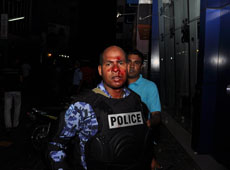
More than 30 people were eventually arrested. Some police officers were injured and police property was also damaged.
“We saw some protesters [hurt] but we received no reports of serious injuries,” Shiyam said.
Of the 52 people arrested for violence the previous evening, whom police claimed were connected to various gangs in Male’, most were subsequently released by the Criminal Court while “12-15” remain in police custody.
The opposition has maintained that the demonstrations against the government’s decision to implement a managed float of the rufiya are led by youth unhappy with rising commodity prices, despite the active involvement of dismissed opposition Deputy Leader Umar Naseer, and MPs Ilham Ahmed, Ahmed Mahlouf, Ali Waheed, and Ahmed Nihan.
The government has meanwhile accused former President Maumoon Abdul Gayoom’s faction of the opposition of instigating and organising the protests.
“The government understands that many people are concerned about the economy and recent price rises and we are doing everything possible to ease the situation,” the President’s Press Secretary Mohamed Zuhair said in a statement.
“Peaceful protest is legal and welcome in the Maldives’ new democracy. But former President Gayoom is taking advantage of economic situation to cause violence in the streets. These protests are more to do with Gayoom trying to shore up his position in the opposition, than the state of the economy,” he claimed.
“In the Middle East, you have democrats on the streets bringing down dictatorships. Ironically, in the Maldives, the remnants of the former dictatorship are trying to bring down democracy.”
The Human Rights Commission of the Maldives (HRCM) meanwhile issued a press release urging people not to misuse the right to protest “and obstruct the media.”
The commission said that protesting late at night in densely populated areas “violates the right of many others.”
”We call on the police not to disperse the protests by using methods that harm the protesters and civilians,” HRCM said.
At a press conference today, Deputy Commissioner of Police Mohamed Rishwan said protests would be restricted to the artificial beach and the tsunami monument areas in Male’, unless prior permission was given by police or Male’ City Council.
The government meanwhile defended its decision to float the currency within 20 percent of the pegged rate of Rf12.85 “as part of a package of measures introduced on the advice of the central bank, International Monetary Fund and other multi lateral organisations, in order to reduce the country’s budget deficit and stabilise the economy.
“According to the World Bank, in late 2008 the Maldives was in the worst economic situation of any country undergoing democratic reforms since 1950s. The budget deficit stood at 31 percent of GDP, inflation stood at 12 percent and the economy was reeling from a massive fiscal expansion which saw the government wage bill increase by almost 400 percent between 2004 and 2009.
“Since coming into office, the Nasheed administration has reduced the budget deficit from 31 percent to 16 percent of GDP, helped ease the chronic dollar shortage through a managed float of the Ruffiya and brought the economy from recession to 4 percent growth this year,” the President’s Office said in a statement.
The IMF has pressured the government to cut back on its disproportionate public sector wage bill, however austerity measures attempted last year ended up in a political stalemate and the government instead embarked on a program of corporatisation, allowing it to hire and fire while circumventing what it claimed was the opposition-driven machinations of the Civil Service Commission (CSC).
Opposition spokesman Ibrahim Shareef has accused the MDP of financial mismanagement and recklessly increasing spending, without investing “in productive resources that ensure future revenue for the country, and reducing expenditure in areas that do not affect the people – such as foreign missions.”
“They need not reduce the civil service, because these are the lowest paid government employees and reducing their numbers would have not tangible effect. But the top players in government – the political positions – and positions in the paper companies created by the government are many areas [that can be reduced],” Shareef claimed.
The government recently announced an incentive programme to encourage public sector employees as young as 18 to leave the civil service, offering lump sum payments of between Rf 150,000 – Rf 200,000, which was positively received by the CSC.
Extract from a speech given by President Mohamed Nasheed at Sunday night’s Maldivian Democratic Party (MDP) rally, concerning the state of the economy.
Our nation remains a nation, as I often say, because our ancestors went fishing, collected cowries, climbed palm trees, constructed boats, built resorts and operated them. Our nation remains a nation not just because rulers ruled and judges judged. Our nation remains a nation because workers have laboured.
The rights of Maldivian workers and various benefits are not being spoken about in this country today for the first time. In the 1700s, Judge Hassan Thajudheen forbids Maldivians from working without remuneration. From that day onward, Maldivian workers from day to day have been noting their rights, and their responsibilities as well, to the present day.
In our country, if we want to bring the labour market to the right path, we have to look at or consider not just the worker. I always say, to do something, you have to do something else. After continually doing that, when what we envisioned has been reached, then what we want will have been sustainably achieved.
Prices of goods are not lowered with an army officer in front of the shop. To bring down prices, we have to build a good, strong economy. We have to change our economy into the shape of a strong economy of a middle-income country.
This was not the case yesterday. Most of the goods we sell in this country are imported. We pay for it in dollars. When we don’t know the value of the dollar – that is the goods in the market were bought with dollars and we don’t know its value – there is not a single way for us to know the value of the goods we have bought. Therefore, there’s no way we can know anything.
To build an economy on that basis and to consider it a sound economy is a mockery. It is not something I can do. I too know, [MDP MP] Alhan has said very clearly, we can keep building and building and building debt. The law very clearly gives me the discretion to print money. For the first three months after I assumed office, at the end of every month I was brought a piece of paper, on it was written that I had printed Rf200 million (US$16 million).
With every Rf 200 million, the value of the rufiyaa kept falling. When we took over the government, inflation was at 12 percent. [Prices] were rising at a rate of Rf12 each passing month. Today [inflation] is 0.65.
When prices soared to the highest, the price of a can of powdered milk rose by Rf 4 – two children will drink from one can of milk for a month. How much of an increase in rufiyaa per day has that become for us? I too know the prices of goods in the country. I do go into shops. I know that the price of a small coconut is Rf5 in Filledhoo, but Rf10 in Male’.
We do not lack information. Nor do we lack a course of action. And I am not unaware of what we’re doing and what we are about to do. Leaders of nations are anxious and cowardly when it comes to making changes to the country’s monetary and economic system. They remain hesitant about making changes to salaries, hesitant about making changes to taxation. They remain anxious and fearful of inflation.
However, in truth it is not us who have to suffer from that cowardice today, but our children tomorrow. The question before us today is who should we treat better? The woman we are married to now or our young children? I know it is a difficult question.
Everything we have done in our lives has been for our children. We build harbours for our children; we build homes and sewerage systems for our children. We give pensions as well, for our children.
Today prices of goods have gone up, too, for our children.
The straight value of the dollar to the rufiyaa is not a number I saw in a dream one day and took to heart. The price of a dollar set in 2001 was not based on a transaction between rufiyaa and US dollars. The price of a dollar has been set today based on market transactions. Today you are seeing straight the true price of the goods at market. It is not that prices have not gone up, you have found out the price! What was written before was a lie. It was not a price. It is a picture that rulers have showed you as a price. Our children and children’s children are being destroyed by the seduction of that picture.
Do we want the present or the future? This party was formed because we said ‘we want the future, today is done, the sun has set, what we can win is tomorrow.’ There is no way we can get today. We have to reach, too, for tomorrow.
Most workers in this country are fishermen. 44 percent of the workforce are fishermen. When the value of the dollar is low, its unfairness is felt most by fishermen. The fish they catch is sold out of the country. When the export price improves, the [purchasing] price improves for them. Because the value of dollars has gone up, the income of most workers in the country has gone up exponentially. It has gone up!
I have just come back from Thinadhoo. I went to Kolamafushi too. I know what’s happening in Ihavandhoo and Hoarafushi as well. Maldivian fishermen are today selling a kilo of raw fish for Rf16.50. That is not a price that they would have ever imagined before. A kilo of raw fish for Rf16.50. How much is a cupful of rice? How many cupfuls of rice can you get today for one handharu fish?
I would say the Maldives has not seen any more prosperous times than this.
The second [main source of employment] for workers in the country is in the tourism industry. The service charge in that business is paid in dollars, you know. On April 11, the income of workers in that sector has gone up 20 percent.
About 20 to 25 percent of the workforce in the Maldives is employed by the government. For them, it has become a little bit difficult. Like I said, a Rf4 [increase] from a can of powdered milk, for two children to drink for a month. Total monthly household expenses have gone up by Rf300 or Rf400 for a secretary, for a lawyer, for a labourer. To plug that gap, we must do what we have to do.
The government’s monetary and economic policy is now being implemented. We are now making the changes necessary to instil the characteristics of a middle-income country in our economy. An administrative framework for taxation has been established. A 3.5 percent GST is being levied on tourism services.
The government aim is to completely eliminate import duties beginning on January 1, 2012, for all children’s food, all foodstuff, pens, pencils and paper. We are working towards that end. It will be done on January 1, 2012.
In order to do it, the state needs an additional Rf1.3 billion. Today our budget forecast is Rf2.3 billion as duties. The government is giving up that duty, but while doing so, we have decided to ask the honourable members of the People’s Majlis to increase the tourism GST from 3.5 percent to 5 percent and introduce a 3.5 GST for other businesses.
If we wish to change our economy, we have to make these courageous changes. There is one additional tax. That is, the income tax. It will hurt the most there. We plan to take an income tax from those who earn above Rf30,000 a month. About Rf30 a month. When that amount is paid to the government as income tax, then the whole cycle of the economy will, God willing, become stable – this is where we see ‘The Other Maldives.’
That is where the value of the dollar will be brought down to the level we want and the price of goods and services will fall.
Our task is very clear to me. I know that, God willing, our efforts will bear fruit. This morning, among the changes to be made to the economy, I noted a special point. A lot of workers in the country are foreigners. Most of the time, businesses employ them because they work for cheaper rates. For work done in this country, [a person] should be able to live an ordinary life in this country, whether it is a foreigner or a Maldivian.
The government plans to determine what the minimum wage paid to a worker should be. Here or abroad, when that is paid to workers, we believe job opportunities will not be lacking for Maldivians.
We can bring our country to the right path. I know that there are many people who find what I have to say difficult to hear. But I say repeatedly, I am not someone who will squander our children’s future. We took over government to realise the hopes of the Maldivian people – to establish a system of good governance for the people.
We do not arrest people. We do not torture people. This government will not pillory, handcuff, torture or chain anyone. We talk to the people through verbal interactions, not through fear and intimidation. The Maldives is maturing into a full democracy. The biggest secret of our success is the many citizens of this country fighting for freedom and hoping for better days.
Before concluding, I would tell everyone here not to worry at all. Some nights, they might be squatting at the Chandanee Magu intersection. Other nights, leaning against a door somewhere. We must not be concerned and worried about it. What happened last night was very unfortunate. I didn’t know that protest was going on last night even when I slept.
What I have to say [to the demonstrators] is that our resolve will not be shaken. Neither this party nor I will be shaken. Our policies won’t budge either. God willing, in Alhan’s words, we are going to ‘The Other Maldives’ at maximum.
The Maldives Journalist Association (MJA) has accused Maldivian Democratic Party (MDP) activists of obstructing a Villa TV (VTV) journalist from reporting a rally being held at the MDP headquarters, and forcing him out of the venue.
VTV is owned by local businessman Gasim Ibrahim, also leader of the opposition-allied Jumhoree Party (JP).
The MJA alleged that journalists covering the riot last night in Majeedhee Magu were also “attacked with stones”.
”We condemn these actions in the strongest possible terms and urge it to be repeated,” said the MJA in a press release issued today regarding the incidents. ”We believe that these attacks targeted at journalists are attacks intended to physically and mentally weaken journalists.”
MJA said the attacks were a violation of freedom of gathering and freedom of expression.
”Journalists are fulfilling a national duty, therefore we request everyone not to obstruct their work,” added the MJA.
Meanwhile, the MDP has issued a statement condemning the ” inhuman activities conducted by the opposition in using youth to conduct unlawful actions”.
MDP alleged that opposition protesters had attacked Parliamentary Group leader and MP ‘Reeko’ Moosa Manik, and described the protests as ”unlawful activities conducted to topple the lawful administration established in this country.”
MDP said that protesting lawfully was supported by the party and urged the opposition to be more responsible, and not confront and obstruct the duty of police.
Police arrested 52 persons during last night’s protest who they claim are connected to various gangs in Male’.
A group of youths, led by opposition MPs, have commenced series of protest demanding the resignation of President Mohamed Nasheed after the government decided to shift the fixed Rf12.85 dollar exchange rate within a 20 percent band.
Police said those arrested were known to be involved in crimes such as robberies, assault and battery and theft.
”We would like to note that gang members active on the front line of such protests at a time when the police are trying to curb the rise in gang related crimes could potentially obstruct the work of police,” said police in a statement. ”We advise people to conduct any activities that obstruct work by police to try make the society peaceful.”
”Some of the protesters who were covering their faces were reported to have sharp knives and such weapons with them,” police said, adding that some of the handmade explosives used in the demonstration could have potentially caused casualties.
Police also said that owners of shops near the intersection the protesters have called ”Tahrir Square” have repeatedly complained that the protest was causing damage to their businesses.
”Therefore, we would also like to remind protest organisers that the protest disturbs the residents of the area and causes damage to the business of shops located in the area,” said police.
Police appealed to politicians to cooperate with the work of the police to curb the rising crime rate in the Maldives.
The Police request for political cooperation comes after opposition MPs have said they would not pass the Crime Prevention Bill presented to the parliament which gives police the authority to search houses without a court warrant, suspend the right to remain silent all persons accused of crimes mentioned in the bill, and grants them the authority to hold persons in detention for 90 hours without a court warrant.
The bill has a ‘sunset clause’ making it active for 18 months, however the international community has expressed concern that the bill contradicts rights guaranteed in the constitution.
Dhivehi Qaumee Party (DQP) MP Riyaz Rasheed told the press that he did not trust the police to provide them so much power, alleging that that police were violent and brutal in dispersing Saturday night’s protest, and that police would misuse those powers to arrest politicians.
No force was used during last night’s protest, police said, however a number of officers were injured by rocks, paving stones and other thrown objects.
A second night of violent protests in the capital city ended with the arrest of several demonstrators after petrol bombs were thrown at police in the early hours of this morning.
Protesters gathered last night near the Tsunami Monument in Boduthakurufaanu Magu and marched towards the intersection of Male’s main road of Majeedhee Magu and the tourist street of Chandhanee Magu; the same location as Sunday morning’s sit-down protest.
Protesters demanded the government lower the cost of living and called on President Mohamed Nasheed to resign, claiming people were increasingly unable to afford basic commodities following the government’s effective devaluation of the rufiya.
Police blockaded the area to vehicles and maintained a presence, but unlike Sunday used no tear gas or force on the crowd.
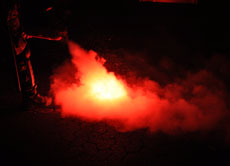
Riot police at the scene were bombared with petrol bombs, stones, water bottles, chilli sauce, “and a hammer”, according to police Sub-Inspector Ahmed Shiyam.
“The protesters were trying to incite police. Some police were injured but not seriously,” he said.
Police yesterday issued a statement claiming that the the first round of violent protests was premeditated after discovering a ready supply of rocks stashed near the intersection.
Several police were injured when the protest turned violent
During last night’s protests, “police received information that petrol bombs were being made in the toilet area of a nearby mosque. Police attended the mosque and found petrol bombs and equipment used to make them.”
Police water cannon and tear gas were deployed in the area, but were not used. A number of violent protesters into custody who were later identified as known gang members. No MPs were arrested.
“We saw two journalists injured by a stone, although not seriously,” Shiyam said.
Senior political figures at the protest included dismissed DRP Deputy Leader Umar Naseer, and DRP MPs Ahmed Mahlouf, Ahmed Nihan. Jumhoory Party (JP) leader MP ‘Burma’ Gasim Ibrahim, and DRP leader MP Ahmed Thasmeen Ali visited the scene at around 1:00am.
Gasim addressed the crowd but did not stay long, while Thasmeen joined the protesters.
Spokesperson for the DRP, Irahim ‘Mavota’ Shareef, confirmed to Minivan News that the protest was authorised by the DRP Council – significant, as Umar Naseer was dismissed from the party last year for leading similar protests on behalf of the opposition without approval.
Meanwhile, Maldivian Democratic Party (MDP) parliamentary group leader and MP ‘Reeko’ Moosa Manik led a group of around 100 MDP activists in an apparent attempt to clash with the DRP supporters, but were quickly cut off from the demonstration by riot police.
Both crowds threw objects at each other, with Moosa’s crowd yelling that they did not believe that living costs had risen.
After warning protesters several times to leave the area, police dispersed the crowd by slowly moving into the intersection. The protest was finally dispersed around 3am early this morning.
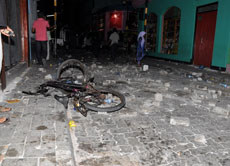
Thrown rocks left on the street in the aftermath of the protest
Speaking to Minivan News, DRP MP and leader of the party’s youth wing Ahmed Mahlouf claimed that last night’s crowds were larger than the previous protest – particularly the number of young people present.
“The crowds are much greater than last night and I am confident that the turnout will be even bigger tomorrow night,” he said.
The protests would be begin at the artificial beach area every night at 8:45pm ahead of a “huge” protest scheduled for Friday, Mahlouf said.
He acknowledged that the protests had descended into levels of violence that “could not be accepted” with some groups of people throwing stones and cans of petrol at police that at one point also threating to set a shop on fire.
“There is some suspicion that the MDP may have paid these individuals to do this. There were so many stones and petrol bottles thrown at police as well as hitting stores,” he said.
“We cannot accept these levels of violence and as protestors we just want to raise our voices and get our point across about high prices. Even last night we were asking police to arrest these people, though this difficult to do in large groups of people.”
The protests have been claimed by some opposition politicians to have been organised by, and represent, youth groups in the country rather than a single partisan interest.
Amidst plans by organisers for further protests throughout the week, Mahlouf said his party would nonetheless be having a meeting today to decide whether to talk with police about possible means to reduce potentially violent confrontations.
“A lot of these techniques were used by the MDP before they came into power,” he claimed. “I do not want to see a repeat of that.”
However, the MP claimed that a number of senior MDP activists had also joined the protests and spoke out concerning government economic policy, including some friends of President Mohamed Nasheed.
“We know people aren’t with them any more and that they don’t believe what he [President Nasheed] says,” he said. “Even in the MDP leadership elections where he supported the appointment of both Ibrahim Zaki and Mohamed Aslam, the party has voted against him.”
MDP spokesperson Ahmed Haleem Zaki claimed that the intervention of opposition groups like the DRP in the protests formed part of wider plans to create “drama” that distracted from a failure to pass so-called anti-gang legislation in the Majlis this week.
“Today parliament is supposed to be considering passing a bill that would give more power to police to arrest gang members,” he said. “This is a political problem where we have an important bill needing to be passed and the opposition parties do not want it to go through.
Haleem did confirm that fellow MDP MP ‘Reeko’ Moosa Manik had turned up with some supporters during the protest, but said he was not himself responsible for instigating violence.
“Moosa was hit by stones and was then taken to hospital, but I can’t confirm if he was seriously injured or not,” he said.
Haleem claimed that Moosa intended to try to call for an end to violent confrontations and denied that his presence may have exacerbated confrontations at the protest site.
“We do not want violence as we are the [country’s] ruling party. Moosa was there to support police and ask protests to go home peacefully,” he claimed.
When questioned over whether MDP supporters were amongst the young people protesting, Haleem said that the party accepted that the cost of living was a major issue and that the last two years had thrown up a number of difficulties for the government in balancing the nation’s finances.
“However, we had the previous government who treated Maldivian money as if it was their own family fortune for many years,” he said. “They left the economy in such a situation that the government has been forced to take drastic measures. People know that the cost of living is high all over the world from China, to the US and the UK.”
According to Haleem, opposition parties had sought to use the protests to court drama and political instability in order to try and garner negative press coverage of President Nasheed through major news networks like CNN and Al Jazeera.
“I think [Nasheed] is very popular right now and that is why the opposition want drama,” he said. “[The opposition] thought they could compare the protests to mass movements in Egypt’s Tahrir Square – a site linked to the fall of former Egyptian leader Hosni Mubarak – but people are not stupid and know very well that this isn’t the case. After four or five months we expect the economic situation to have improved.”
Meanwhile, MDP coalition partner the Adhaalath Party, led by State Islamic Minister Sheikh Hussein Rasheed, has issued a press statement in support of the anti-government protests.
The Adhaalath Party said it believed that the youth protest was “a peaceful gathering.”
”Lowerer living expenses is one of the main pledges of this government,” said the party. ”We call on the government to find a wise solution for this issue.”
The Adhaalath Party said that the protest was conducted lawfully and that ”it is not acceptable to use tear gas and batons to disperse a lawful protest.”
The party also expressed concern that police officers and protesters were injured during Sunday night’s protest.
Currency in crisis
The government has struggled to cope with an exacerbating dollar shortage brought on by a high budget deficit – triggered by a spiralling public sector expenditure – in comparison with the foreign currency flowing into the country. Civil service expenditure has increased in real terms by 400 percent since 2002.
Banks subsequently demonstrated reluctance to sell dollars at the pegged rate of Rf 12.85, and high demand for travel, commodities and overseas medical treatment forced most institutions to ration their supply or turn to the flourishing blackmarket.
After a short-lived attempt to crack down on the illegal exchange of dollars, the government floated the rufiya within a 20 percent band, effectively allowing it to be sold at up to Rf 15.42 to the dollar.
The International Monetary Fund (IMF), which has been critical of the government’s growing expenditure despite a large budget deficit, praised the decision as a step towards a mature and sustainable economy.
Police extinguish a thrown petrol bomb
“Today’s bold step by the authorities represents an important move toward restoring external sustainability,” the IMF said in a statement. “IMF staff support this decision made by the authorities. We remain in close contact and are ready to offer any technical assistance that they may request.”
However, many companies dealing in dollar commodities immediately raised their exchange rates to Rf 15.42, along with the Bank of Maldives.
The government’s move, while broadly unpopular, acknowledges the devaluation of the rufiya in the wake of increased expenditure and its own inability to overcome the political obstacles inherent in reducing spending on the country’s bloated civil service.
Yet as Maldives relies almost entirely on imported goods and fuel, and many ordinary citizens have found themselves harshly affected by short-term spike in prices of up to 20 percent as the rufiya settles.
“We do not really know, based on the breadth of the domestic economy, what the value of the Maldivian rufiyaa is right now,” Economic Development Minister Mahmoud Razee admitted at a recent press conference.
The government has said it hopes the rufiya will stabilise within three months.
US President Barack Obama has declared the death of Osama bin Laden at the hands of US forces.
In a live broadcast to the US on Sunday night, Obama claimed that an intelligence lead in August 2010 had culminated in the tracking of bin Laden to Abbottabad, a town north of Islamabad in Pakistan far from the tribal belt where the US has been searching for the fugitive.
“It was far from certain, and it took many months to run this thread to ground. I met repeatedly with my national security team as we developed more information about the possibility that we had located bin Laden hiding within a compound deep inside of Pakistan. And finally, last week, I determined that we had enough intelligence to take action, and authorised an operation to get Osama bin Laden and bring him to justice,” Obama said.
“A small team of Americans” engaged bin Laden in a firefight, killing him. No US or civilian casualties were reported, and bin Laden’s body was recovered.
A US official told Associated Press that “We are assuring [his body] is handled in accordance with Islamic practice and tradition.”
Counter-terrorism cooperation with Pakistan “help lead us to bin Laden and the compound where he was hiding,” Obama said.
“We must also reaffirm that the United States is not – and never will be – at war with Islam,” he added. “Bin Laden was not a Muslim leader; he was a mass murderer of Muslims. Indeed, al Qaeda has slaughtered scores of Muslims in many countries, including our own. His demise should be welcomed by all who believe in peace and human dignity.”
Reaction
Crowds immediately gathered outside the gates of the White House singing the country’s national anthem, while news networks reported a “party atmosphere” spreading throughout the country.
British Prime Minister David Cameron said that confirmation of bin Laden’s death should “bring great relief to people across the world”.
“Osama Bin Laden was responsible for the worst terrorist atrocities the world has seen – for 9/11 and for so many attacks, which have cost thousands of lives, many of them British,” the PM said.
A Western diplomat based in Islamabad told the UK’s Guardian newspaper that bin Laden’s death was a “game changer” for US foreign policy in Afghanistan and Pakistan.
“I’m overjoyed, but what this exactly means is really not clear,” the diplomat said.
A number of analysts speculated that while bin Laden’s death was a significant symbolic victory for the US, it was unlikely to hamper al Qaeda’s operations as bin Laden was no longer involved in the day-to-day functioning of the terrorist organisation.
The US State Department meanwhile issued a travel alert to all US citizens warning of an outbreak of anti-American violence in the wake of bin Laden’s death.
“Given the uncertainty and volatility of the current situation, US citizens in areas where recent events could cause anti-American violence are strongly urged to limit their travel outside of their homes and hotels and avoid mass gatherings and demonstrations,” the State Department said.
US Assistant Secretary of State for South Asia, Robert Blake, is currently in Male’ for meetings with political leaders and civil society.
A large crowd of mostly young people last night held a protest in Male’ against the rising cost of living, following a spike in import costs brought on by the government’s managed float of the rufiya – a decision which has led to a cost increase for dollar commodities of up to 20 percent.
Although the protest was led by opposition leaders, Minivan News observed many unfamiliar faces not identified as members of either major party.
The protest’s leadership consisted mostly of those from the ‘Z-DRP’ faction of the opposition loyal to former President Maumoon Abdul Gayoom, including MPs Ahmed Mahlouf, Ilham Ahmed and dismissed Deputy Leader Umar Naseer, Dhivehi Qaumee Party (DQP) MP Riyaz Rasheed, Jumhoory Party (JP) MP Ibrahim Muthalib and other opposition allies were also present at the protest.
The group gathered near the artificial beach last night around 9:00pm and marched towards the tourist street of Chandhanee Magu, occupying the intersection with the main road of Majeedhee Magu. Minivan News observed many protesters sitting or lying down in the intersection, some having coffee.
Riot police initially blocked off vehicle access to the area, and waited without taking any action.
However at around 3:30am early on Sunday morning, police advised protesters to leave the area or otherwise they would use force to disperse the crowd.
The protesters declined to leave the area and continued protesting, whereupon police issued several warnings before throwing tear gas canisters into the crowd camped in the narrow and congested intersection, and moving in with shields and batons.
Male and female protesters were injured in the incident after being attacked with batons, while police claimed officers were injured in the effort after bricks were thrown. Protesters also pelted police with empty water bottles, empty cans and other such materials.
“One female officer was hit in the chest with a pavement stone, she is still hospitalised,’’ said Police Sub-Inspector Ahmed Shiyam.
While police were attempting to disperse the crowd, a motorbike in the area was destroyed by fire and the glass window of a nearby shop was broken.
After the violent attacks, police failed to completely disperse the crowd as the protesters continued to return to the area and gathering.
Local media SunFM and Haveeru News also reported that police used excessive force on their journalists taking coverage of the area.
Haveeru, which described the incident as a “deadly clash”, reported that its journalists were arrested after they refused to leave the area were told by a police spokesperson that even journalists wearing press identification could not stay in the area.
The protest lasted until 9:00am this morning, lasting a total of 12 hours.
Residents living in the densely-populated urban area surrounding the intersection have complained of women and children being affected by tear gas used by police used to control the riot.
News agency Associated Press reported Gayoom’s spokesperson, Mohamed Hussain ‘Mundhu’ Shareef, as saying that dozens were hospitalised in the demonstration consisting of 5000 people rallying against “economic hardship, alleged government mismanagement and wasteful spending”, but was unable to raise a response from the Maldivian government. News of the incident quickly went international, appearing on the Washington Post and other major newspapers.
This afternoon the President’s Office released a statement condemning the violent protest as orchestrated by supporters of the former President.
“Scores of people were injured and shops and private property were damaged when protesters hurled bricks and other projectiles at the police. The police responded to the unprovoked assault with tear gas and made several arrests,” the statement said.
“The protest was orchestrated by the Z-DRP, a faction of the main opposition Dhivehi Rayyithunge Party, which is under the control of former President Gayoom.”
President Mohamed Nasheed’s spokesperson, Mohamed Zuhair, added that “peaceful political activity, such as the right to protest, is legal – and indeed welcome – in the Maldives’ new democracy. But there can be no excuse for needlessly causing violence in the streets. We have numerous peaceful political rallies, protests, petitions and other forms of legitimate democratic activity throughout the year, which is a healthy part of our democracy. However, whenever Mr Gayoom’s supporters take to the streets, it always seems to end in violence and bloodshed,” Zuhair added.
Dhivehi Rayyithunge Party (DRP) MP Dr Abdulla Mausoom told Minivan News that he believed the protests, which he described as a “youth movement” rather than an opposition political gathering, had been building for some time amidst concerns regarding the government’s commitment to democracy and increased living costs.
“We feel the protests are overdue, the Maldivian Democratic Party (MDP) is not championing democracy like it promised,” he said.
Mausoom claimed that the prime areas where he believed the government had failed to bring about democratic reforms – a key policy area for the governing MDP party – were in freedom of expression and allowing protesters to demonstrate peacefully.
Although opposition parties like the DRP and the recently formed spin-off faction the Z-DRP were present at the protest, Mausoom said that they had been invited by local young people to support their concerns.
“This has been organised by young people [of the Maldives]. Opposition parties joined in support only after being invited. This was not a political movement, but a youth movement,” he claimed. “The protests were in themselves largely peaceful and we feel the police response was inappropriate.”
Mausoom added that he believed that the protesters should have been given the right to air their concerns and called on the government to address areas such as spending on political advertising and cutting living costs.
The opposition DRP has recently been split by infighting and violence between supporters of Gayoom and those of the party’s leader, Ahmed Thasmeen Ali, triggered by the expulsion last year of Deputy Leader Umar Naseer from the party for organising protests without sanction from the DRP Council.
Both sides claimed the animosity within the party was cause it to “disintegrate“, and there was speculation that Gayoom’s supporters would form a spin-off opposition party. However last Thursday, two days before the protest, Gayoom’s faction officially announced that it was “commencing work” as the Zaeem-DRP (Z-DRP), a separate branch of the main opposition Dhivehi Rayyithunge Party (DRP).
The Zaeem-DRP (Z-DRP) faction today announced that it has officially commenced its work as a separate branch of the main opposition Dhivehi Rayyithunge Party (DRP).
An earlier protest on April 12 against the government’s currency decision ended peacefully, with both factions conducting separate rallies around Male’.
A currency in crisis
The government has struggled to cope with an exacerbating dollar shortage brought on by a high budget deficit – triggered by a spiralling public sector expenditure – in comparison with the foreign currency flowing into the country. Civil service expenditure has increased in real terms by 400 percent since 2002.
Banks subsequently demonstrated reluctance to sell dollars at the pegged rate of Rf 12.85, and high demand for travel, commodities and overseas medical treatment forced most institutions to ration their supply or turn to the flourishing blackmarket.
After a short-lived attempt to crack down on the illegal exchange of dollars, the government floated the rufiya within a 20 percent band, effectively allowing it to be sold at up to Rf 15.42 to the dollar.
The International Monetary Fund (IMF), which has been critical of the government’s growing expenditure despite a large budget deficit, praised the decision as a step towards a mature and sustainable economy.
“Today’s bold step by the authorities represents an important move toward restoring external sustainability,” the IMF said in a statement. “IMF staff support this decision made by the authorities. We remain in close contact and are ready to offer any technical assistance that they may request.”
However many companies dealing in dollar commodities immediately raised their exchange rates to Rf 15.42, along with the Bank of Maldives.
The government’s move, while broadly unpopular, acknowledges the devaluation of the rufiya in the wake of increased expenditure and its own inability to overcome the political obstacles inherent in reducing spending on the country’s bloated civil service.
Yet as Maldives relies almost entirely on imported goods and fuel, and many ordinary citizens have found themselves harshly affected by short-term spike in prices of up to 20 percent as the rufiya settles.
“We do not really know, based on the breadth of the domestic economy, what the value of the Maldivian rufiyaa is right now,” Economic Development Minister Mahmoud Razee admitted at a recent press conference.
The government has said it hopes the rufiya will stabilise within three months.
The Maldives Journalists Association (MJA) has called on police and defense forces to provide opportunity for the press to cover protests freely, referring to an incident last night where journalists wearing press identification were ordered to leave the area, effectively bringing the protest coverage to a halt, while those who refused to leave were arrested.
‘’Police last night arrested two journalists and a web developer for the Sun Media group,’’ said the MJA in a press release. ‘’Some of them were arrested while were even wearing the press identification.’’
MJA claimed that journalists covering last night’s protest were physically attacked and one had pepper sprayed directly in the face.
‘’We remind journalists to work responsibly while covering protests or any other activity,’’ the MJA added.
Meanwhile the police issued another statement on the incident saying that they had been informed that the protesters would be violent.
Police alleged that protesters caused damage to public property and committed arson.
‘’As the police were informed about the plans [beforehand], police met with Dhivehi Rayyithunge Party (DRP) MPs Ahmed Mahlouf and Ahmed Nihan and requested them not to conduct any such activities,’’ said police in the statement.
Police said that protesters disturbed the residents of the area, blocked traffic and that people living in the area were unable to reach their houses.
“Police discovered that lot of loose stones were hidden in the area for the protesters to attack police officers and public property,’’ police claimed. ‘’We also noticed that persons connected with gangs took part in this protest from the beginning.’’
Police also said that where necessary strict action would be taken against those who became violent.
 (0)Dislikes
 (0)
(0)