Are efforts to keep Malé City clean going to waste?

“As we increase our efforts to clean Malé, the amount of garbage dumped on to the street is also increasing,” said Mayor Mohamed Shihab.

The purpose of cleaning Malé’s streets and providing public dustbins – for which 260 people are now employed – is not to collect household waste, but to clean up litter, the Mayor tells Minivan News.

It is important to cultivate a habit of keeping the streets clean and using trash bins in the community, he said, suggesting that the implementation of laws was also required to address the issue.

However, keeping the streets free from litter is just the tip of the rubbish pile explains Shihab, revealing the difficulties the council continues to face in finding a sustainable way to manage the capital’s waste.

Regulation

The waste management regulation which came into partial force on February 5 imposes an MVR100 (US$6.5) fine for littering and a fine between MVR10,000 (US$ 648.5) and MVR100,000 (US$6,485) if any authority in charge of public spaces fails to provide dustbins.

The regulations also require boat owners to place dustbins on sea vessels, imposing a maximum fine of MVR100 million (US$6.5 million) on boats that dump waste into the ocean.

Speaking to Minivan News today, Ahmed Murthaza – assistant director at the Environmental Protection Agency (EPA) – said that no one had yet been fined under the regulation.

The main focus of the EPA up to now has been to create awareness and to advise offenders to correct their actions, although he warned that the agency would start imposing the fines beginning on World Environment Day (5 June 2014).

The EPA will be working with councils and the Environmental Police Unit in implementing the regulation – all of whom are authorised to issues fines.

Waste management

Mayor Shihab has suggested a long term solution for the issue would be the door to door collection of household waste.

“This is is how it is done everywhere around the world. And in all countries, they charge a fee for the service.”

“So in the future the council will be collecting and disposing the garbage. This will be discussed. Even now each house is spending money, 100 or 200 rufiyaa, monthly for this purpose.”

Most households in Malé currently employ garbage collectors – usually migrant workers – who carry the garbage on their bicycles or private pick-up trucks. This garbage is then carried dumped on a barge in the island’s south-west harbor, which then transports it to the landfill ‘garbage island’ of Thilafushi.

This arrangement, however, was intended to be a temporary one initiated in 2013 after garbage piled up in Malé’s two primary waste yards following damage to the collection vehicles.

While the industrial junk yard is once again in use today, the household waste yard remains abandoned as its foundation structure is damaged to a point that it would be harmful for the environment to utilise the place without funding from a reluctant Finance Ministry, explained Shihab

According to the council, the current arrangement will remain in place during the Islamic month of Ramadan – beginning on June 30 – when the household waste produced can be expected to double.

According to shipping industry sources, an estimated 15- 20 percent increase in imported goods is expected during Ramadan.

Environment Ministry data from 2007 put daily food waste produced in Malé at approximately 25 tonnes, while 2012 statistics indicated that 89,797 tonnes of domestic waste was dumped on Thilafushi annually.

“Dumping waste on to the barge was a temporary measure, but this operation will continue in Ramadan with more barges. Instead of keeping a huge pile of waste in Malé, we will work to transport it as soon as possible,”  explained councillor Shamau Shareef.

Tatva solution

For the council, the immediate hope for a solution to Malé waste management is in India-based Tatva Global Renewable Energy.

The Tatva agreement has faced delays after the government of President Dr Mohamed Waheed renegotiated the agreement signed by his predecessor Mohamed Nasheed in 2011.

The new agreement, which will not include collection of garbage from household in its first phase, now requires the final approval of the Finance Ministry to begin operations.

Under the Tatva agreement, the council’s equipment – including trucks and excavators – has to be to handed over to Tatva in working condition. However, as the council’s equipment has been damaged for over a year, funds are needed for repairs before the handover.

“Our concern is that the government is spending MVR7 million [monthly] to rent this equipment, such as excavators, landing craft, and the barge. This money belongs to the people,” said Shihab.

Suggesting that the council could get the same results for just MVR2-3million, he said that the ministry had repeatedly ignored requests for repair funds.

The existing arrangement must be replaced with permanent and sustainable solution, said the mayor, noting that the smell alone from the garbage barge was becoming unpleasant for people living in the vicinity.

Minivan News was unable to obtain a comment from Ministry of Finance at the time of press.

Likes(4)Dislikes(0)

High Court upholds jail sentence of man found guilty of forcing women into prostitution

The High Court has upheld a four-year jail sentence passed by the Criminal Court against a Maldivian man found guilty of forcing three Thai women into prostitution.

In August last year, Abdul Latheef Ali, 64, of Henveiru Philadelphi, was found guilty of running a brothel in the capital Malé and of forcing three female expatriates into prostitution after bringing them to the Maldives ostensibly to work as massage therapists.

Police raided the Sondobon Beauty Care Salon in Latheef’s residence and discovered a naked Maldivian man with a topless Thai woman.

Police found that Latheef had brought the three Thai women through the sponsorship of a company called Asparagus Private Limited, which was also owned by him.

The three women – aged 21, 24, and 36 – testified at the Criminal Court trial that they were hired as massage therapists but were told by Latheef upon arrival in the Maldives that their job description included providing sexual services to customers.

The women told the court that Latheef threatened to fire them and send back to Thailand if they refused to comply.

According to the women’s testimony, customers paid at the reception counter, which was handled by Latheef and a Bangladeshi man, and also paid the women when they were alone.

The women said they were required to give a certain amount of cash to Latheef every day, after which he paid them US$300 (MVR 4,600) a month.

The police officers involved in the raid also testified against Latheef and corroborated the testimony of the three women.

The police officers said Latheef was at the counter when they raided the salon and that he was watching footage from CCTV cameras set up outside, which showed the stairway leading to the salon.

The officers said they found a large stash of condoms, cash, and birth control pills when they searched the premises and noted the absence of cosmetic or beauty care items.

The three-judge High Court panel presiding over Latheef’s appeal ruled (Dhivehi) unanimously yesterday that there were no grounds to overturn the Criminal Court verdict as the evidence presented at the trial was sufficient to establish guilt.

The Maldives ratified its first Anti-Trafficking Act in December 2013, although local NGO Transparency Maldives noted that implementation, monitoring, and enforcement of laws and regulations are still crucial to prevent human trafficking.

Likes(1)Dislikes(0)

Taxi drivers brand calls to introduce Dhivehi taxi boards “ridiculous”

The Dhivehi Language Academy has called on taxis to change their boards to read ‘Taxi’ in the Dhivehi Thaana script instead of English – a move branded “ridiculous” by drivers.

“The problem is not that ‘taxi’ is an English word,” President of the Dhivehi Language Academy Ashraf Ali explained.

“It can be a word of any language, but the law says if a word does not have a Dhivehi equivalent it should simply be written in the Thaana script. The lettering, at least, should be in Dhivehi even if the word is not,” he said.

Taxi drivers have responded with exasperation to the academy’s suggestion.

“It is a waste of money,” said Malé taxi driver Ahmed Afra. “And in any case, what difference does it make? Should we also have someone sit atop the cabs to say whether we are vacant or occupied in sign language for those who can’t read?”

“All this is reaching the ridiculous now. Like the Transport Authority says, the board suffices as a symbol of occupancy and is an added convenience to the passenger. I don’t see why the academy feels the need to complicate things further,” continued Afra.

The new signs became mandatory from May 15, after repeated delays following resistance from drivers who claimed the new regulations – which included mandatory insurance, medical checks, and regulated fares – were too strict.

The Dhivehi Academy was created under the 2011 National Language (Priority) Act and is charged with continuing the preservation and development of the language.

Ashraf has said that precedence must be given to the local language according to the law, and that therefore any English words must be printed in smaller print beneath a larger Dhivehi word.

However, Transport Minister Ameen Ibrahim has told local media that the word ‘Taxi’ written on boards placed atop vehicles should not be seen as a phrase, but rather as a symbol identifying whether vehicle is vacant.

“We can use ‘Taxi’ in either manner. But in this case, we are not using ‘Taxi’ as a phrase, but rather as sign language – as a symbol. Technical persons say that it is a symbol. It is the same in almost all other countries of the world,” he is quoted as saying to local media.

Taxi drivers have said the discussion between the Transport Ministry and the Dhivehi Academy shows the state had implemented the new regulations before it was properly reviewed.

Hassan Shameel argued that the government should have to bear the cost of further changes to the signs, arguing that the transport authority should have resolved such issues before implementing the new regulations.

“Where has the Dhivehi Language Academy been all this time? It’s been an year since this was gazetted, and they snap awake after it was implemented on the 15th of this month and suddenly are concerned about the language. Why didn’t they act before?”

“In any case, if they love the language so much, why do they not notice that the schools, streets, hospitals have their names in English? Why be concerned about taxis alone?” he continued.

Academy president Ashraf stated that the intention was not to increase costs for the drivers, but to come to a reasonable solution through discussions with the Transport Authority.

“There can’t be an immediate solution, and we are aware of that. We are trying to do a sincere task here. All we want is for everyone to embrace and take pride in our individuality and national identity,” he said.

Likes(1)Dislikes(0)

Ihavandhoo islanders to pray for rain after twelve month drought

Haa Alif atoll Ihavandhoo Island Council has called for a communal prayer on Friday morning to pray for relief from drought.

Council President Mohamed Asif told Minivan News that islanders have run out of drinking water and are now relying on store bought desalinated water.

“It hasn’t rained on Ihavandhoo for about a year. Even during the recent rains, Ihavandhoo did not receive the blessing of rain,” he said.

The ‘Isthisqa’ prayer is to be held at the island’s football field.

According to Asif, the island’s groundwater is no longer potable due to the intrusion of saltwater and runoff from sewage.

Ihavandhoo, an island of 3000 people in the country’s northernmost atoll, has reported water shortages every dry season in recent years. Each household has a 2,500 liter tank for rainwater harvesting, but the tanks have run dry due to the prolonged dry season.

Fathimath Zahira, 46, said her three-person household ran out of water last week. She spends approximately MVR60 (US$ 4) on buying water from the store every day.

“God willing, I will go to the prayers,” she said.

Assistant Director at the Ministry of Environment and Energy, Afsal Hussein, said water shortages are linked to climate change.

“Changes to global climate are causing shorter wet seasons and prolonging dry seasons,” he said.

The National Disaster Management Center has already transported 100 tonnes of water to the island in recent months. A new shipment is expected to arrive this week.

Water shortages are a recurring problem on several islands and the ministry is now working on a sustainable solution to the problem, Afsal said.

“Right to safe water is guaranteed by the constitution. The main concept we are using is called integrated water management which means managing all available sources of water – ground water, rain water and desalinated water – to solve water shortages,” he said.

Integrated water management includes recharging groundwater aquifers, increasing rainwater harvests and establishing desalination plants.

Ihavandhoo is one of the three islands were an integrated water management project is ongoing. Councillor Asif said the project will be completed at the end of the year and will provide relief from.

A pioneering project to desalinate water using excess heat from electricity generation was launched in Gulhi, Kaafu atoll, in February. The project, with the potential to produce 8000 litres of clean water per day, will be used in other islands should it prove successful in Gulhi.

Meanwhile, several islands in the Maldives have reported “black rain” showers in the Maldives.

The Public Health Unit (PHU) in early May warned Baa atoll Eydhafushi Island residents against drinking or cooking with black rain.

Similar incidents of black colored rain were reported in 2013 Haa Dhaal Atoll Nolhivaram Island and Haa Dhaal Atoll Kurimbi Island, and in Dhaalu atoll Meedhoo Island.

However, little seems to be known about the health implications of this occurrence. Islanders have speculated that the phenomenon maybe acid rain.

Likes(1)Dislikes(0)

“Remarkable” tournament taking Maldivian football to the next level, says FA

“I think one small country in football taking on something like the Challenge Cup is something very remarkable.”

Speaking ahead of the Maldives opening Group A with tournament outsiders Myanmar this evening, Assistant Secretary General of the Football Association of Maldives Mohamed Nasir pointed out the logistical novelty of an international football tournament in Asia’s smallest country.

“I’m not sure there’s another tournament where land, sea, and air transport is involved in day to day player movements.”

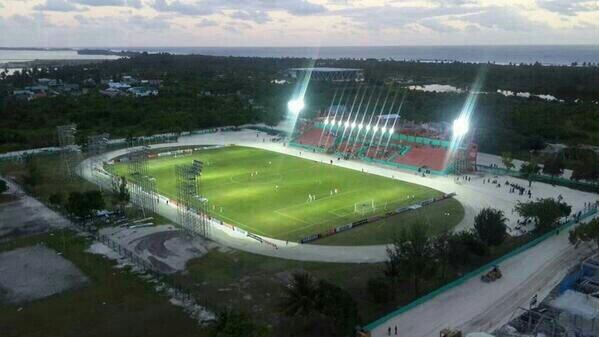
Games will take place in both the capital Malé and the country’s second city Addu, with players from the eight competing teams staying in Bandos and Herathera resorts.

The biggest football tournament to have previously taken place in the country was the 2008 South Asian Football Federation championship – held jointly with Sri Lanka – which the Maldives won, beating regional heavyweights India in the final.

The National Stadium in Malé will host Group A’s games, featuring tonight’s teams as well as Palestine, and Kyrgyzstan – who played this afternoon, Palestine taking a one-nil victory.

Photo by: Ali Arif

The renovated – and renamed – Addu Football Stadium in Hithadhoo will host Turkmenistan, Laos, the Philippines, and Afghanistan in Group B, with the first game tomorrow at 4pm.

As AFC Cup fever grips the country, President Abdulla Yameen has already pledged MVR1 million to the national team should they reach the semi-finals.

Nasir, however, argued that a far more precious reward was on offer should the Maldives win the biennial tournament, with automatic qualification for the 2015 Asian Cup for team left holding the trophy on May 30.

“I think this is one the best things the FA has done to take us to the next level, as we are one step closer to the biggest tournament in Asia and we are pretty optimistic that we have a good chance to qualify,” said Nasir.

Part of the Asian Football Confederation’s ‘Vision Asia’ programme, the AFC Challenge Cup was introduced in 2006 with the aim of providing competition experience to the continent’s smaller footballing nations.

The four previous tournaments were won by Tajikstan, then India, before North Korea won both the 2010 and 2012 editions. The Maldives appeared in the latter tournament, going out at the group stage after defeats to both Turkmenistan and Palestine.

While Afghanistan go into the tournament as the highest ranked team, local media has this afternoon reported that many locals will be throwing their support behind Palestine.

The Maldives Palestine Brotherhood Association told Sun Online today that, while wanting the Maldives to win,  it would be supporting Group A rivals today in a show of support for the Palestinian people.

With high demand leading to the black market trading of tickets, police have today warned action will be taken against touts operating in the vicinity of the stadiums during the tournament.

The police also advised everyone to refrain from racist or defamatory remarks towards players or officials during the cup.

“If such a matter is brought to the attention of the police, we will take necessary action against it. Spectators attending to watch the match are also advised to conduct acts of support within the spirits of the sport,” read a police statement today.

Minister of Tourism Mohamed Maleeh Jamal echoed the police’s comments while unveiling the competition’s offici

al mascots – twodolphins whose tour of the city this afternoon was accompanied by the AFC Cup song,

President Yameen has previously expressed his hope that the tournament will unite those in the country divided by politics, asking all citizens to proudly wear the national team jersey.

“I hope all Maldives is in red colours this evening,” said Nasir. Tonight’s game kicks off at 9pm.

Likes(3)Dislikes(0)

Police dismantle Villimalé hangout, take in six for disobedience

The police have dismantled a youth hangout hut in Villingili and taken six people into custody for “disobeying orders” and “obstructing the police duties”.

Maldives Police Services (MPS) has confirmed the incident in the suburb of the capital yesterday, saying that all six were released after bring given advise on future conduct.

According to police, the hangout was dismantled due to the prevalence of crimes at the spot and because it has been setup unlawfully.

“Police have received reports and observed prevalence of criminal activity at that spot, including drug abuse and fights,” a police official told Minivan News, adding that no unlawful substance or tools were discovered during the operation.

One person involved in the incident has alleged that police refused to show a council order before dismantling the area, while a local resident suggests that similar community leisure areas can be found across the island.

While police claim the operation was carried out “after discussion with the city council”, Malé City Council – under whose jurisdiction the land currently is – has denied authorising the move, or being officially informed of it.

“They discussed the issue of [dismantling] the place in Villimalé, but we told them to take all such hangouts around Malé instead of just that one place in Villimalé,” council member Shamau Shareef explained.

Police refused to comment on the alleged discussions to remove other hangouts around Malé.

The council has previously expressed concern over lack of police cooperation in providing security services, including requests to dismantle all such hangouts and to provide security for the recently held street market in Malé.

Councillor Shamau said that, in a similar incident, police had refused to remove an illegal ‘gaadiyaa’ street vendor’s booth recently.

“They [the vendor] are not paying any lease fees, and there is a court verdict against them. But the police said a court warrant would be required to remove it,” said Shamau.

Local media CNM has reported that some young people at the hangout confronted police demanding a city council order to dismantle the hut, which was not delivered to them.

“We were hanging out there at the joali when they started dismantling [the place] using hammers and other things. We asked them to show the city council’s request to dismantle the place. They said they don’t have to show it and then they handcuffed us in a very brutal manner and beat us up,” CNM quoted one of the youth as saying.

A Villimalé resident told Minivan News that there are many similar hangouts setup in public spaces by the community.

“They are well made and decorated even. Some of the places even have television sets,” he said.

Likes(4)Dislikes(0)

India and Maldives cultural ties go from “strength to strength” as cultural center expands activities

The relationship between India and Maldives has been going from “strength to strength” over the past year, stated officials from the Indian Cultural Centre (ICC)

According to the ICC, the centre will increase its outreach with the new services on offer in order to reinforce the positive relationship.

Speaking at the inauguration of a new Library at the ICC yesterday (May 17), the High Commissioner of India H.E Rajeev Shahare stated that the recently completed elections would aid the good relations.

“The people of India have spoken,” remarked Shahare, “it has happened in the entire South Asian region. We’ve had elections, including in the Maldives. I think the trend, what we see is, very well entrenched in democratic practices,” reported Haveeru.

The collection at the new library will be of use to all ages, from the young to the old, an ICC spokesperson explained. The Facebook page and social media will also be used as a platform to engage the local community, they added.

As well as the library, the ICC already offers a range of classes free to the public, including tabla, Kathak dance and yoga.

The centre was inaugurated in Malé in July 2011, with the primary objective of fostering the cultural ties between India and Maldives.

In the same year, India and the Maldives have agreed to begin implementation of an agreement on co-operation in development projects signed in 2011 titled the “Framework Agreement on Cooperation for Development”.

The agreement, signed during the administration of former President Mohamed Nasheed, mandates the establishment of a joint commission to oversee projects implemented under the programme, and a minimum of one annual meeting of the said commission.

In addition, President Abdulla Yameen recently stated that while the Maldives has “close ties” with China, “nothing will precede ties with India, which are far more precious”.

Yameen told Indian media during his recent official trip to the country, that he had assured its leaders that the bond between the two neighbouring countries is “heartfelt” and “based on sentiments”.

More recently, India’s Army Chief General Bikram Singh visited the Maldives – the visit was the first by a serving Indian Defense Chief since General Deepak Kapoor’s visit in February 2010.

Likes(1)Dislikes(0)

Union leaders’ dismissal leads to staff arrests on Full Moon Sheraton

Four members of staff at Sheraton’s Full Moon resort in Kaafu Atoll were taken into police custody yesterday, following the refusal of three dismissed employees to leave the premises.

While the Tourism Employees Association of Maldives (TEAM) has said the individuals were dismissed due to their participation in Labour Day celebrations earlier this month, representatives of the resort have said the dismissals were preceded by “a number of incidents”.

“There is no freedom of association or freedom of speech in the Maldives, especially not in the tourism industry,” said TEAM Secretary General Mauroof Zakir.

Police have informed Minivan News that the staff members were arrested for obstructing police duty following a call from resort management yesterday afternoon.

Shumaes Rasheed, Marketing Communicating Manager at Full Moon, provided further details:

“As the associates refused to leave the island, Maldives Police Service were notified to assist them in escorting them off the island.”

“Another four associates were arrested by the police for obstruction in carrying out their duties, and these associates have also been dismissed,” added Shumaes, noting that the welfare of the guests had not been affected by the incident.

Zakir told Minivan News that those initially dismissed were “key trade union leaders” on the resort, who had been preparing to  enter collective bargaining with resort management.

Zakir said that the letter of termination issued to those dismissed referred to a gathering on May 1 during which the TEAM members decorated their association hut with banners calling for a minimum wage to US$600, improved freedom to speech, and other internationally recognised union rights.

“We cannot accept that, a wilful and peaceful gathering organised by the union is allowed in the ILO convention,” said Mauroof – noting that this was a convention to which the Maldives is a signatory.

The arrests followed a gathering by employees calling for their colleagues’ reinstatement,  into which police “immediately intervened”, said Mauroof. He suggested police had been on the island for a number of days as part of a pre-planned operation.

Yesterday’s unrest was the latest in a number of incidents of staff unrest among the workers in the country’s largest industry which contributes an estimated 80 percent to the country’s GDP.

Figures from the Tourism Ministry have today revealed arrival figures to have increased by 11.2 percent this year compared with the same point in 2013 – a year which saw a record 1.3 million tourists arrive in the country.

Rising number of incidents

“It is unlikely anything will come out of parliament that will give protection to the workers,” noted Mauroof, suggesting that concerted industrial action by the country’s 26,000 tourism workers may be the only way to improve workers rights. 25 percent of the 17th Majlis are themselves resort owners, he added.

Despite the political turmoil of recent years, the country’s primary industry has remained sacrosanct, with the Majlis even passing legislation prohibiting such acts.

The tourism boycott bill passed the house in October last year, making it illegal to call for a boycott, to support or endorse of a boycott, to participate in a tourism boycott, or any act that would incite fear amongst tourists.

Mauroof suggested that the rising frequency of unrest on resorts in recent months could be attributed to a combination of a rising cost of living in the country and greater awareness of workers’ rights.

Increasing “overuse” of the Freedom of Assembly Actmuch criticised since its introduction in 2012 – by authorities was also cited by the TEAM leader as cause for the dismissal of over 150 tourism employees.

“If the government has positive intentions to protect workers – things might change. Otherwise we will need some international leverage.”

Despite the general desire to separate the country’s primary source of income from its fractious politics, a number of resort workers have alleged in recent months that their dismissals were directly linked to the political leanings of their employers.

Both Gasim Ibrahim – owner of the Villa Group – and Ahmed Shiyam – owner of Sun Siyam Resorts –  have been accused of purging staff rosters of staff members aligned with opposition political groups. Gasim and Siyam are the leaders of the ruling coalition Jumhooree Party and Maldives Development Alliance (MDA), respectively.

Earlier this week, a small but vocal protest could be heard circling the capital Malé, with a lone demonstrator pleading with the MDA leader:

“Sun Travel, I’m begging you on my knees, don’t threaten your employees. Don’t force people into your party. Don’t do this.”

Last month it was revealed that police were investigating a threatening phone call allegedly made by Siyam to a former employee of Vilu Reef resort.

“Let me tell you, you don’t have any rights,” the Dhaal Meedhoo MP was heard to say. “If you try to harm my business I will destroy you.”

Likes(2)Dislikes(0)

Government offers MVR1 million reward if national team reaches AFC Cup semi-finals

President Abdulla Yameen has offered a MVR1 million (US$64,850) reward to the national football team if they make it to the semi-finals of the Asian Football Confederation (AFC) Challenge Cup – scheduled to begin in the Maldives next week.

Speaking at a special function held last night for senior government officials to meet the team, Yameen expressed his desire “to make sports into something which transcends politics.”

“And for Maldivians the king or queen of sports is football,” he said.

The President’s Office has confirmed this amount will be paid by the government but did not comment on how it would be acquired or whether it be taken from the national budget.

“This cannot be valued in material terms, the joy it would bring to our hearts cannot be measured,” he said, noting that the team would receive even more rewards from the people of the Maldives.

Yameen’s generosity followed Jumhooree Party (JP) Gasim Ibrahim’s offer on Monday of  MVR500,000 reward for the team “even if they don’t win the tournament”.

“Please don’t disappoint us, take us forward. God willing, we will win these matches. With the grace of God, and his will, the Maldivian national team will persevere all the upcoming challenges without any change in their ambitions.”

The AFC Challenge Cup matches will be played at the National Stadium in Malé City and Hithadhoo Zone Stadium in Addu City.

President Yameen notes that hosting the AFC challenge cup in the Maldives was a difficult task, but his government decided to do everything it could for youth and to unite the nation.

Shedding light on the benefits of hosting the tournament, he said it would put the Maldives on the tourism charts and playing matches outside of Malé at the Addu City stadium would bring economic development to the region.

Having upgraded the stadium to AFC standards would provide more opportunities for Maldivian teams to play more regional and international matches, with the resulting of improving Maldivian football.

Sports manifesto

Noting that his government gave a special importance to football and sports in general Yameen said that progress was being made in implementing the youth and sports-related programs in his manifesto

“We are going through very tough times [financially], even so we included those funds by the grace of god and we will deliver it. We included MVR300 million [in the budget] for youth and sports activities.”

The work of establishing sporting complexes on all islands with over 2000 people had already begun with futsal and turf stadiums being given particular focus.

Assuring the youth that all football resources required for the next ten years will be established within his five year term, the president also announced development of the ‘Kulhivaru Ekuveni’ sports complex in Malé as a “Sporting City”.

He said the National Stadium in Malé would be upgraded,  while a brand new sporting complex was planned to be established in Hulhumalé with a modern football stadium and integrated services.

In an effort to display the youth’s “individual unique talent” to the world, the president said a football match would be organised with the national football team of Japan, and a cricket match with the Sri Lankan national team, remarking that President Maumoon Abdul Gayoom had done the same before him.

“It is not a simple task to include MVR300 million in the budget every year. We are experiencing [financial] difficulties in many areas right now. However, even with that, we wanted to make sports into something which is beyond politics – for the Maldivian youth, to forget the past, for friendly relations and unity among us.

He appealed to the people of Maldives to support the national team disregarding any differences in political ideologies,  requesting all citizens to “make the national team jersey popular at stadiums and streets”.

Likes(6)Dislikes(0)