Comment: Need to involve the public in Police Planning Process

Devyani Srivastava is a programme officer, focusing on police reforms and access to justice within the Commonwealth Human Rights Initiative (CHRI) – an international, non-government organisation working towards greater transparency and accountability in the criminal justice sector.

Active in the Maldives since 2008, the CHRI seeks to realise increased demand for democratic policing through technical assistance in drafting police-related laws and policies, regularly publishing reports, intervening in court when necessary, and conducting trainings of police personnel across ranks.

The Maldives Police Service (MPS) recently launched its five-year Strategic Plan for 2014-2018. The document, available on the police website, lays down the police service’s key goals and priorities in how it seeks to police crime and the country over the next five years.

The MPS is a pioneer in South Asia in strategic planning, a process that enables police organisations to shape a vision for policing, identify precise goals and targets against the vision, and put in place a system to evaluate implementation and performance against the set goals. Most strategic planning frameworks centre on the drafting of a Strategic Plan which serves as a roadmap outlining policing goals and targets within a given time period, usually three to five years. This is the approach adopted by the MPS.

MPS’s current plan is its third in a short span of ten years since its separation from the military in 2004. This shows the leadership recognises the importance of strategic planning in bolstering police service delivery, organisational efficiency and police accountability. The process itself has improved since the first plan came out in 2007. From reading like a vision document with a wish-list of projects, the plans have become more targeted and contextual.

The process has also become more consultative. The current plan was formulated following a 3-day workshop involving 85 staff including department heads, managerial staff, and executive staff officers deliberating over crime trends and strategic priorities. In a further improvement, the department recently put out an evaluation of its performance in 2012 against targets laid down in the previous Strategic Plan 2011-2013 (also available on their website), and promises to prepare annual business plans and performance reviews for the current plan.

While these are steps in the right direction, much more needs to be done to make the planning process more inclusive, open and transparent. The most significant missing link in the planning process is consultation of the public.  This must be integrated into future planning as a matter of priority.

Decentralise further

First, the planning process should be decentralised further within the organisation. So far, the exercise involves seeking inputs from department heads, managerial staff, and divisional commanders. Junior ranks and staff at the police stations are not involved in any meaningful way, when they are the ones who have a daily interface with local communities, are the first point of contact in case of any trouble, and are directly answerable to the people when something goes wrong.

Their input regarding levels of crimes, difficulties on the ground, and allocation of resources needs to be taken into account if police response to crime is to improve, especially given that police stations in Maldives oversee a number of islands, each scattered from the other. Planning must start at the police station level and feed into action plans at the divisional level, which then filter into the national-level plan.

Just as the MPS assess itself as an organisation on the basis of its strategic plan, the performance of divisional units should be evaluated based on their action plans. This way, both planning and performance evaluation are decentralized and ultimately closer to ground realities.

Bring in public consultation

Second, the process needs to become more open and transparent. Unlike in other jurisdictions where public input and suggestions are actively sought in police planning, the Maldives Police is yet to involve the public in formulating its goals and targets. Information is made available in the public domain only after the Plans are finalised and launched in the media and uploaded on the police website.

A study by my organisation, the Commonwealth Human Rights Initiative, on the implementation of the first Strategic Plan 2007-2011, showed how even other relevant stakeholders including the Police Integrity Commission and civil society organisations were involved only at a later stage when the plan had already been drafted. The public at large was not involved at all. A clear disconnect was visible during our research between the police and other stakeholders over how projects had been prioritised and how crime had been categorised.

The absence of public consultation is a serious limitation of the process. Ultimately, it is the public which is affected by crime and relies on the police for more safety – they must have a say in the police’s planning for better policing and safety. Reaching out to people, especially those living in far flung islands and atolls with varying crime patterns, will improve overall quality of policy-making by identifying practical problems and unintended effects.

Relying solely on police officers’ feedback serving in the islands excludes public feedback, especially of vulnerable communities, which is critical to improving policing. Communities will also become more informed of the kinds of arrangements and measures being put in place to address their issues and understand better how they themselves can contribute to the success of these measures.

A range of methods such as discussion forums held regularly at the local level; public perception surveys to gauge public confidence in the police; user satisfaction surveys to understand problems in service delivery and identify solutions; focused group discussions for example with the youth, elderly citizens, and women to understand needs and expectations of different segments of society; and social media may be employed to understand community expectations and problems.

It is not easy to carry out inclusive and extensive public consultation. It takes time, organisation, manpower, and intellectual resources. It requires regular and constant flow of information between the police and the public, another reason why local units such as police stations need to be involved more closely. Police must provide accessible feedback on the results of consultation, decisions that have been made and suggestions that were rejected so people consider it a meaningful exercise. But making the investments in this kind of planning process is the best way to build public trust and also get to better policing.

Finally, implementing these steps in a systematic manner, and not leaving it to the discretion of individual officers, is crucial to their success. In fact, many countries (UK, Northern Ireland, Canada) have codified strategic planning into their police laws, thereby making it a statutory requirement, and have developed elaborate rules to guide the process including methods of engagement with the community. Maldives Police must move in this direction in order to enable accountable and responsive policing take roots in the island country and give meaning to the promise of rule of law enshrined in its constitution.

Likes(1)Dislikes(0)

High Court upholds decision to return baby to German mother

The High Court has today (March 20) ruled in support of the Family Court decision to return the five month old baby of Ahmed Sharuan and Tanja Sharuan to the mother.

Details of the case revealed in an online petition launched by the mother claim that she was being accused by Sharuan of attempting to raise the child as a non-Muslim, despite having converted to Islam.

The High Court previously released a temporary injunction halting the Family Court order until the appeal case submitted to the superior court by Sharuan reached completion.

Police – having previously launched a search for Sharuan – ceased the investigation following the High Court order.

Speaking to Minivan News on Thursday afternoon, Tanja expressed joy at having received custody of her child.

“I am very happy about the High Court’s decision. I have always had faith in the Maldivian law. As a Muslim mother, I am more than happy to have my baby back in my arms,” Tanja said.

She further expressed gratitude for the “wonderful support given from [her] Maldivian friends”.

Three days ahead of Thursday’s court hearing, Tanja launched an Aavaaz petition seeking support in her case to gain custody of her child.

“My daughter is only five months old and she was abducted by her father from our then home in Zurich and he ran away with her to the Maldives. I am German but now in the Maldives and have submitted a case to the Family Court,” read the petition.

“The Family Court on Monday issued an injunction to my husband Ahmed Sharuan to hand over the baby to me within 24 hours, by 3pm Tuesday 11th February 2014.”

“However, he refused to obey this court order and went into hiding for several days. Whilst in hiding, he arranged a lawyer and submitted an appeal to the High Court to cancel the Family Court injunction. The High Court on Sunday 16th March, suspended the injunction of the Family Court without even hearing my side of the story and without a hearing,” it continued.

“I need all your support to achieve justice in this case. I am hoping that the Maldives justice system will deliver a fair judgement and give me the custody of my child according to the law,” concluded the petition, which has received over 600 signatures at the time of press.

Likes(2)Dislikes(0)

Government seeks to “revert back to centralisation”, says MDP

Threats to disband Addu City Council are “impossible” and show lack of “political understanding” the Maldivian Democratic Party (MDP) has said.

The statement follows warnings from President of Local Government Authority (LGA) and Defence Minister Mohamed Nazim that the council could be disbanded if it did not cooperate with the government.

The six member council was one of two administrative divisions – along with Malé City – designated as cities in the 2010 Decentralisation Act.

Both are dominated by the opposition MDP, with all six of Addu’s council seats being won by the party in recent local elections.

Speaking at a government coalition campaign rally held in Addu’s Hithadhoo island earlier this week, Nazim said that residents did not cooperate with the government and that this can create problems, local media reported.

“Action may have to be taken against them, and could lead to dissolving the council”, he was quoted as saying.

Speaking at the same rally, President Abdulla Yameen remarked, “while the MDP may say that they would hold the government accountable if they win a majority in parliament, they would in reality create problems for the government.”

In response to these comments, the MDP have released a statement characterising Nazim’s “unlawful threat” as a “warning to stop the empowerment and development of Addu City citizens.”

The opposition party accused the government of attempting to dissolve the Addu City Council in order to revert the country to autocratic rule.

“However, the people of Addu City have always shown that they will not bow to such dictatorial actions,” the statement read.

Spokesperson Hamid told Minivan News that the threats made by Nazim were impossible, and a sign of the government’s “desperation” and lack of political understanding.

“Decentralisation is very much welcome and they have tried to revert back to centralisation” he added.

As part of its Majlis election campaign, the MDP has pledged to amend the Decentralisation Act in order to empower local councils. Former President Nasheed has said the party’s aim was to secure financial independence for local government.

“We want each council to conduct business transactions using the island [to generate income] for establishing sewerage and water systems, build roads or even construct a harbour or do work needed for the school – we want to find a way for you to undertake these efforts on your own,” said Nasheed last month.

Budget for Addu

Prior to Nazim’s remarks, President Yameen told residents in Hithadhoo that the 2014 state budget comprised of developmental projects that would solve the problems in Addu City.

Speaking at a parliamentary campaign event held on Tuesday (March 18), the president said that apart from the projects that will be run via the state budget, he had also planned other developmental projects for Addu by obtaining funds from other sources, reported Haveeru.

“According to my information, 50 percent of the finance needed to deal with the land erosion problem has been arranged by the Saudi government. We have written a proposal to Kuwait Fund to attain the remaining 50 percent funds as loan aid,” Yameen was quoted as saying.

In addition, Yameen said that work on building the Islamic Centre in Hithadhoo will commence in June this year.

If the public wanted to see these plans completed, the governmental coalition would need to acquire the parliament’s majority, Yameen said, calling upon the people to vote for candidates representing the government’s Progressive Coalition.

Shortly after this year’s budget was proposed, Addu City Mayor Abdulla Sodig suggested the financial difficulties facing his council were a result of the failure to implement the Decentralisation Act properly.

“Right now decentralisation in this country is just for show,” Sodig told Minivan News in December. “The government and Majlis need to resolve these issues if the citizens are to benefit from decentralisation in a meaningful way.”

Under the landmark legislation, the LGA is tasked with monitoring councils, ensuring standards, improving technical capacity, and coordinating with the central government.

The LGA board consists of a cabinet minister appointed by the president, a member appointed from the MCC, four atoll councillors elected from among members of atoll councils, a representative from civil society appointed by parliament, a member of the general public appointed by parliament, and a member elected from the Addu and Malé city councils.

Likes(1)Dislikes(0)

MH370 sightings in Maldives are not true, reports Malaysian Defence Minister

Malaysian Minister of Defence Hishamuddin Hussein has been informed by Maldivian authorities that rumoured sightings of Malaysian flight MH370 over Kudahuvadhoo are false.

“Regarding reports that the plane was sighted in the Maldives, I can confirm that the Malaysian Chief of the Defence Force has contacted his counterpart in the Maldives, who has confirmed that these reports are not true,” Hishamuddin told the press today.

The defence minister’s comments come after eyewitness reports emerged yesterday of a low-flying aircraft in Dhaal atoll just hours after the Malaysian jet’s disappearance on March 8.

“I saw a flight flying very low and it had a red straight line in the middle of it. The flight was traveling north-west to south-east,” Adam Saeed, a teacher at Kudahuvadhoo school, told Minivan News.

Maldivian authorities have acknowledged the reports, with police taking the lead in investigating the sightings – though both the Maldives Airports Company (MACL) and the Maldives National Defence Force (MNDF) have maintained that no irregular radar activity has been noted.

“The Maldives National Defence Force has been monitoring Maldivian territory with special attention since the disappearance of Malaysian Airlines’ MH370 airplane,” read an MNDF press release last night.

“In the search so far, no military radar has seen the flight. And the MH370 airplane has not been seen from the photos and information of radars established in Maldivian airports.”

“The Maldives National Defence Force has been providing all necessary cooperation to the efforts of the Maldives Police Service as well as international agencies concerning [the disappearance of the flight],” concluded the statement.

Police have announced the start of their investigations, with Kudahuvadhoo officer Mohamed Imad confirming that a team of investigators was being dispatched from the capital Malé to assist with the ongoing local investigations.

A spokesman for the MACL yesterday said that there had been no “credible” sightings or radar evidence of the missing flight, while some witnesses interviews by Minivan News expressed skepticism over the veracity of their neighbours claims.

Local news outlet Haveeru – which broke the story yesterday – said that similar reports had been received as early as March 9, but had been dismissed as lacking credibility.

Regarding communications with Malaysian authorities, Minivan News was unable to obtain a response from either the MNDF or the Ministry of Defence at the time of press.

Yesterday’s reports all described a low-flying plane, heading in a south-easterly direction between 6:15am and 8am (Maldives time).

Malaysian Defence Minister Hishamuddin has today confirmed, however, that the search will continue to focus on the two previously identified corridors.

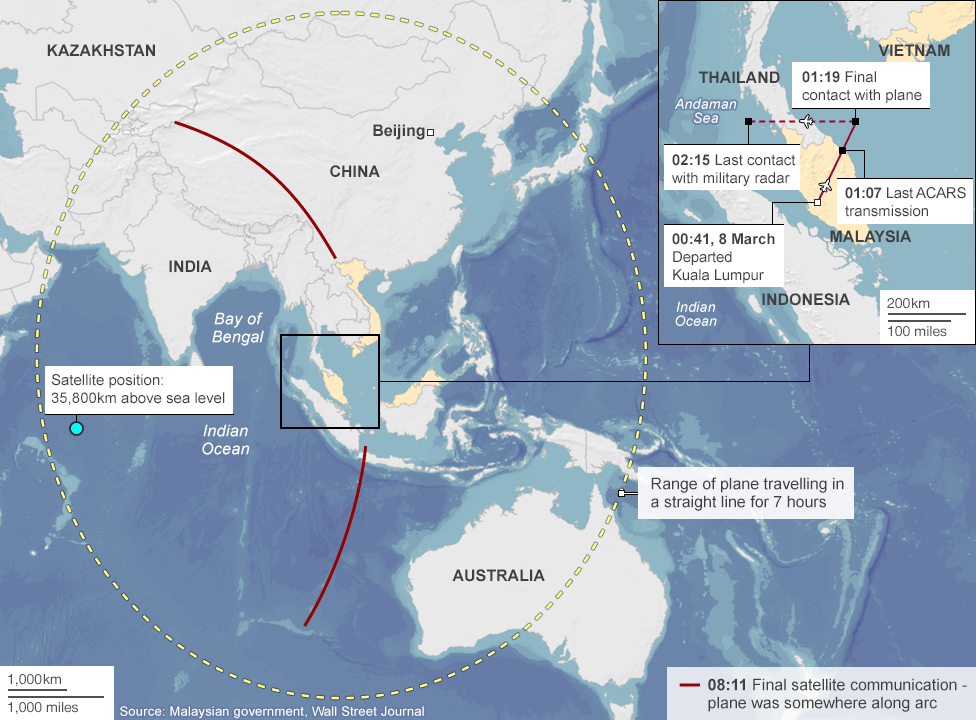
The two arcs – one stretching between Thailand and Kazakhstan, the other south between Indonesia and the southern Indian Ocean – have been determined by locational ‘pings’ detected by a satellite revealing the flight’s last known location at 8:11am Malaysian time (5:11am Maldives time).

Likes(0)Dislikes(0)

Malé City Council to bring back 24 hour shops and cafes

Malé City Council has decided to bring back the 24 hour service at cafes and shops, seventeen months after it was banned by Dr Mohamed Waheed’s government.

The proposition was passed unanimously by nine members present at yesterday’s council meeting (March 18), though the government has suggested that it does not have the authority to make such decisions.

Councilman Shamau Shareef said that the council decision came in response to a number of request from Malé City residents.

“This is what the people want. The former government discontinued the permissions to operate such places citing criminal activity and instability in the city. But now we have an elected government, and we think it should be reconsidered now,” said Shamau.

He noted that council have now been tasked with issuing trade permits for the city and it is in the council’s mandate under the Decentralisation Act to address this issue.

But the Ministry of Economic Development has today said that the issuing of trade permits was delegated to the council under a memorandum of understand with the ministry, which does not allow issuing 24 hour license.

“The government decided to end the running of 24 hour businesses. From that point the procedure for issuing trade permits were changed. City council have been tasked with issuing permits under those procedures,” the ministry’s Director General Usman Shakir was quoted as saying in Haveeru.

Shakir said that the government has not yet changed it’s position on allowing 24 hour businesses, and warned that the ministry will take action if any such permission is issued.

Responding to the ministry’s statement Councilman Shamau said that there are “some barriers” in implementing the decision, but the council is willing to overcome these issues by discussing it with the ministry.

“We will do whatever it takes. This is the capital city, and there are 24 hours ferries operating, people coming from other islands, people are working round the clock. There should be some way for them to eat or buy things they need. We are talking about basic necessities of the people,” he said.

President Mohamed Nasheed’s government decided to issue permits for 24 hour businesses in December 2010. After the change in government, Dr Mohamed Waheed’s administration in October 2012 decided to put an end to these opening hours.

The ministry’s official reason for decision was national security concerns. There was a high level of concern about increasing rates at the time, particularly with political instability and the murder of MP Dr Afrasheem Ali within the same month.

While it is not known whether the decision had any positive impact in reducing crime rates, the parliamentary national security committee at the time suggested impact it had was negative.

Opposition Maldivian Democratic Party at the time described the decision as an attack against small and medium businesses which ‘left thousands of people unemployed’. Resuming the permits was an election pledge of the party’s presidential candidate Mohamed Nasheed in 2013.

Ruling Progressive Party of Maldives was at the time a coalition member of the government, and President Abdulla Yameen was elected as president, the party has maintained support for the ban on 24 hours businesses.

When the permits were revoked in 2012 there were forty four businesses with permit in Malé city, now all shops have to be closed at 11pm and all cafes at 1am.

Likes(0)Dislikes(0)

Kudahuvadhoo islanders spotted low-flying mystery aircraft in hours after MH370 disappearance

With additional reporting by Ahmed Nazeer and Ahmed Rilwan

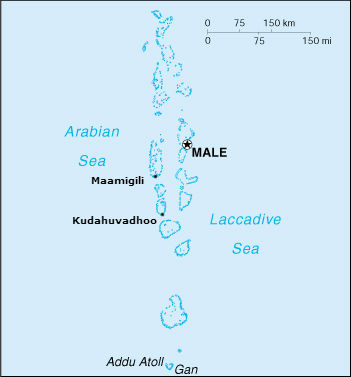
Residents of Kudahuvadhoo in Dhaal atoll have reported seeing a low flying aircraft heading in a south-easterly direction in the morning of March 8, prompting speculation that it could have been the missing Malaysian Airlines flight MH370.

“It was about 6:30am in the morning, I heard a loud noise and went out to see what it was,” Adam Saeed, a teacher at Kudahuvadhoo school, told Minivan News.

“I saw a flight flying very low and it had a red straight line in the middle of it. The flight was traveling north-west to south-east.”

While Saeed’s sighting has been corroborated by a number of witnesses, others remain skeptical that the aircraft could have been the missing jet, whilst aviation authorities maintain that they have no “credible” evidence to support the claims.

Police have confirmed they are looking into the reports without providing further comment.

Co-author of the original story Ahmed Naif explained that Haveeru had been receiving similar reports since March 9, but had been concerned about the credibility of the sightings.

“Later we were getting so many comments that we contacted the island and they said it was true,” explained Naif.

One islander, who identified himself as Hamzath, told Minivan News that had also seen a low-flying plane heading from north-west to south-east, though he remained wary of jumping to conclusions.

“People started talking about it when they realised that the flight that we saw had the same characteristics as of the missing plane,” he said. ”We are still not saying it is the same plane, we just wanted to report it just in case.”

Another witness – who wished to remain anonymous – confirmed a similar height and direction but did not see the plane’s colours, while another suggested that the reports had been exaggerated.

“A plane did fly near the island,” said the anonymous witness. “It wasn’t that big, as big as people say.”

“These days people will be out fishing every morning. Around thirty people would always be there in the morning – but no one talked about it then. If it was that noticeable, loud and big, people would talk.”

Caution urged

Investigators are currently searching an area spanning 2.24 million nautical miles, with two corridor arcs – one stretching between Thailand and Kazakhstan, the other south between Indonesia and the southern Indian Ocean.

The arcs were determined locational ‘pings’ detected by a satellite revealing the flight’s last known location at 8:11am Malaysian time (5:11am Maldives time). Witness reports received by Minivan News and Haveeru put the time of the sighting between 6:15am and 8am.

While the Maldives appears to have been ruled out of the ever-widening search for the missing Boeing 777 and the 239 people on board, reports this morning brought further mention of the Indian Ocean archipelago.

A simulator featuring five airports in the Indian Ocean region was discovered in the home of flight Captain Zaharie Ahmad Shah today, as investigators remain convinced the plane’s disappearance was deliberate. A senior Malaysian police officer told Reuters, however, that such simulators are likely to feature hundreds of runways.

Ibrahim Nasir International Airport was featured on the simulator, as were three runways in Indian and Sri Lanka, as well as the US military base in Diego Garcia.

Although the Maldives receives over one million tourists every year, visitors to isolated islands are normally transported by seaplane from Malé’s airport.

When asked about the possibility of a plane of this size landing on an isolated airstrip in the atolls, Maldives National Defence Force spokesman Major Hussain Ali said this was not possible.

“If you are asking are there any landing strips outside of the main commercial airports, the answer is no,” said Hussain.

Contacted following the emergence of the Kudahuvadhoo sightings, neither Hussain not the President’s Office were responding to calls at the time of press.

Spokesman for the Maldives Airports Company Limited (MACL) Hassan Areef has urged caution regarding the reported sightings in Kudahuvadhoo.

“We have no credible information about the plane in terms of radar or sightings,” said Areef.

“There are so many conspiracy theories – we have no credible information that the plane has come to us.”

One such conspiracy theory has the base at Diego Garcia – which lies around 700 miles south of Kudahuvadhoo – as a potential landing site for the plane, though Malaysian authorities are said to have dismissed this rumour.

Haveeru today quoted a local aviation expert, who considered it unlikely that a commercial carrier would have been flying over the island at that time.

While some witnesses at first assumed that the flight must have come from Maamagili airport, 55 miles to the north, MACL’s published schedule shows no flights from the airport until 7:20am on Saturdays, with all subsequent flights headed to the capital Malé – north-east of Maamigilli.

Maamigili airport is the hub for the domestic carrier Flyme which operates a fleet of 75ft, 50 seater ATR 42-500 aircraft. The Boeing 777 model of the missing Malaysian jet is around 200 feet long with a carrying capacity in excess of three hundred.

Likes(1)Dislikes(0)

Innamaadhoo island council asks Islamic Ministry to take action against Sheikh Shameem

Innamaadhoo island council, in Raa Atoll, has filed a complaint with the Islamic Ministry against Sheikh Ibrahim Shameem Adam after he allegedly preached inside the island’s Friday Mosque without first obtaining permission.

Speaking to Minivan News today Council President Ibrahim Fayaz said that Sheikh Shameem went to the island last Saturday and requested the council’s permission.

Before receiving a response from authorities, however, Shameem held a sermon on the island, said Fayaz.

“They announced that there will be a sermon that night on the topic of sports and entertainment and held the sermon without our permission and we did not do anything about it because then they say Innamaadhoo council had obstructed religious activities and that we are anti-Islamic,’’ he said.

He said that the first 50 minutes of the speech was very good before beginning to resemble a political campaign meeting.

“He started talking about politics and the upcoming parliament elections and people inside the mosque came out, only a few were waiting inside,’’ Fayaz said.

“More than 200 people gathered outside the mosque in protest to the speech he was giving because it was supposed to be a religious sermon and not a political rally.’’

Fayaz said that islanders came and complained to the council, warning that if the council was not able to stop him the islanders might have to do it.

“So I then went inside and turned the loudspeaker and microphone off, but he did not stop,’’ he said.

“I asked him who gave him the permission to conduct a sermon inside the mosque and he replied by saying that the ‘Higher Authorities’ gave him permission. I do not know who higher authorities were.’’

Political sermons

Fayaz said that Shameem indirectly criticised both Maldivian Democratic Party (MDP) and the Progressive Party of Maldives’ parliamentary candidates.

“He criticised them in a way that everyone knew who he was talking about, but did not mention the names,’’ he said. “We even called the police that night because there might have been unrest on the island – and five councilors will not be able to stop the islanders.’’

He said that police asked the council to take a statement from Sheikh Shameem, but that Shameem refused to come to answer questions.

Furthermore, Fayaz alleged that the Islamic Ministry would not take any action against him because he was sent by the Adhaalath Party.

Islamic Minister Sheikh Mohamed Shaheem Ali Saeed today told Minivan News that he had not received any information of the incident.

In December last year Omadhoo island council stopped Sheikh Shameem from delivering a religious lecture at the local mosque, fearing it might “disrupt the stability and social harmony of the island”.

At the time, Haveeru reported that when the council asked for a formal request for permission, the organisers sent a text message to the council president saying the lecture would go on with or without the council’s permission.

In May 2013 Sheikh Imran Abdulla and Sheikh Ilyas Hussein were obstructed from preaching in Vaikaradhoo, in Haa Dhaalu atoll, whilst Kamadhoo island council in Baa atoll prevented Sheikh Nasrulla Ali from preaching.

In Vaikaradhoo the sheikhs continued with police protection in the presence of local opposition activists.

In September 2013, Maldives Broadcasting Corporation (MBC) Chairman Ibrahim Umar Manik told a parliamentary sub-committee that the commission had stopped religious sermon ‘Andhalus’ conducted by Sheikh Shameem for violating the state broadcaster’s guidelines.

The MBC chairman,along with members of the commission, were summoned before the independent institutions committee following complaints by MDP MPs that the sermon by Sheikh Shameem infringed the rights of the party’s presidential candidate.

“We definitely do not consider [televising the sermon] as anti-campaigning against a particular candidate using religion. [But] around 11:35pm, because his talk was changing a little, we stopped the live [broadcasting],” Manik told the parliament committee at the time.

Current laws and regulations require religious preachers to obtain permission from local councils in order to preach at mosques in their administrative areas.

Likes(1)Dislikes(0)

High Court issues injunction against Family Court order to return child to mother

The High Court has released a temporary injunction halting the implementation of a Family Court order asking a man to hand over his five month old baby to its Swiss mother.

The man has been identified by the police as Ahmed Sharuvan,  age 32, from Kanmatheege in Maradhoo in Seenu atoll. The information had been released when police launched a nationwide search for the man after he failed to comply with a Family Court order last week.

The superior court released the injunction after Sharuvan submitted an appeal in the court against the Family Court’s verdict.

The High Court injunction – signed by three judges – stated that the court believes it important to halt the Family Court order until after Sharuvan’s appeal has been completed.

Although the case’s first hearing was scheduled by the High Court for Sunday, it was later cancelled.

Sharuvan’s wife – identified in local media with only a first name, Tanya – also attended Sunday’s court hearing.

Sharuvan attended Sunday’s hearing at the scheduled time and was accompanied by a lawyer. Police began questioning him outside the court premises, with Sharuvan responding by showing the police the High Court’s temporary injunction.

In spite of this, police took Sharuvan to the police headquarters for further “discussions”.

“We did not have the jurisdiction to arrest him then due to the High Court injunction although we were previously looking for him,” a police media official told Minivan News today.

“So we requested him to come along with us to headquarters for further discussions and he obliged. We did not have the jurisdiction to directly question him, so we just held a discussion. He left the police premises directly after the discussion.”

Owing to the High Court injunction, police revealed that the baby remains in the custody of the father. They stated that the police cannot take any action on the matter until Sharuvan’s appeal case at the High Court reaches completion.

Likes(1)Dislikes(0)

Torture in detention increasing, says Human Rights Commission

The Human Rights Commission of Maldives (HRCM) 2013 annual report has revealed that incidents of torture in detention are increasing in the Maldives.

Among the issues noted during the commission’s visits to places of detention – in particular, prisons and police detention centers – and from the cases submitted to the commission were:

  • Detainees being held in cuffs for 24 hours – sometimes for 15 – 30 day – with removal only for using the toilet and for eating
  • Detainees not being provided with necessary items for cleaning themselves, or with pillows and blankets for sleeping
  • Overcrowding of cells
  • Police officers cursing and hurting detainees inside vehicles during transfer
  • Serving of rotten food
  • Not keeping proper records of detainees including medical, search, and solitary confinement records.
  • Not providing family meetings and phone calls
  • Police not providing details of arrested people to HRCM
  • Police entering homes without a court order
  • Addressing underage detainees inappropriately

According to the report, out of the a total 596 recommendations regarding state detention facilities made by the HRCM – including prisons, detention centers and homes for people with special need – only twenty percent have been fully implemented.

The report also noted that the commission faced “huge obstacles” in conducting investigations, resulting in delays the completion of research.

These obstacles included the failure of relevant institutions to provide documents, delays of state institutions in implementing commission recommendations, and the refusal of some government ministries to meet with the commission.

Statistics

With forty cases initiated by the commission, a total of 719 cases were received in the year 2013 – of which 218 were completed. With pending cases from 2000 -2012, the commission completed investigations for total 352 cases within the year.

The rising incidence of torture was reflected in the number of cases submitted,and a total of 72 cases of degrading treatment and torture were submitted within the year.

Among them were cases submitted by victims and their families stating that they were tortured during the police custodial department detention during investigations. Detainees also submitted cases of being denied parole, the detention of persons released under the ‘second chance’ program, and the implementation of sentences which contravened court verdicts.

The highest number of cases – 134 – were submitted regarding the right to a good standard of health care; 77 case related to the right to fair administrative action; 86 cases concerned children, the elderly, and persons with special needs; and 90 cases submitted regarding labour rights violations.

Judiciary

“Citizens had many concerns about the condition of the judiciary in 2013 as well,” read the report, which reported the slow speed at which cases are attended to by the courts and the failure to take action against judges accused of misconduct.

In the report, the HRCM called on the Judicial Services Commission to increase and strengthen it’s role in reforming the judiciary, and for the People’s Majlis to pass important laws such as the penal code, and the criminal procedure and evidence bill.

The HRCM is currently working on an assessment of the Maldives human rights obligations in the judicial sector – with the financial assistance from UNDP – to ensure the judicial system in the Maldives is independent, just, and accessible.

The report mentioned, however, that courts had refused cooperate with the commission’s monitoring programme as the commission “did not get the cooperation of the Supreme Court”.

Freedom of assembly and MP’s behaviour

Notable achievements listed in the report were the passing of a number of bills such as the prisons and parole bill, the anti human trafficking bill, anti-torture bill, access to information bill, the sexual offences bill, the political parties bill, and the freedom of assembly bill.

Regarding the controversial Freedom of Assembly Act, the commission stated that “citizens were relieved” when it was passed and enforced, and that the legislation aimed to minimise restriction of the rights guaranteed by the constitution.

The bill had been criticised prior to its ratification, with local NGOs stating that it impinged upon a number of fundamental constitutional rights and “significantly challenges the entire democratic system of governance”.

The bill was also criticised by the the Maldives Journalists’ AssociationForum Asia – a regional human rights organisation -and the Tourism Employees Association of Maldives. The opposition Maldivian Democratic Party (MDP) argued that it was a reactive measure against the MDP-led anti-government protests calling for an early presidential election.

The “irresponsible acts” of parliament members throughout the year – including violence within the Majlis premises and demonstrations during 2013 presidential address, were mentioned as an issue of concern. Another issue raised regarding MPs was the proposal of amendments to laws in order to “protect personal interests”.

Other prominent issues concerned the large number of child abuse cases,  including sexual abuse and use of children in crimes, along with an increased incidence of rape and other crimes against women.

Violation of the rights of migrant worker, including non-payment of wages, the withholding of their personal documents, and reports of inhumane abuse by their employers and the public was also noted.

The HRCM Annual Report 2013 can be downloaded here.

Likes(0)Dislikes(0)