Tata reaffirms commitment to stalled Maldives housing projects

Indian-based corporate giant Tata has said it has no intention of offloading its stake in a Maldivian joint venture overseeing several housing projects in Male’, despite local media speculation that land set aside for the company had  been sold off.

Tata this week confirmed to Minivan News that it remained invested in Apex Realty PVT Ltd, a Maldives joint venture established under the previous government between itself and developers SG18.

Tata Housing Development Spokesperson Vikram Kharvi added that the company was not considering selling its stake in the project, despite construction work having stalled on several commercial residential projects it was developing through the joint venture.

Kharvi confirmed that negotiations were ongoing with the government at present to resolve certain issues concerning the stalled developments on land provided to the company under its joint venture agreement.

He declined to clarify the exact nature of issues that had stalled the projects at time of press, forwarding specific questions on the matter to Sandeep Ahuja, Tata Housing Development’s Senior Vice President .

Minivan News was awaiting response from Ahuja at time of press.

Deputy Minister of Housing Abdulla Mutthalib confirmed to local media this week that the projects being overseen by Apex Realty had stalled due to what he said were a shortage of funds and construction materials.

Mutthalib expressed hope that the stalled projects could still be completed by year end.

“There are some constraints as they are also using subcontractors. The earlier deadlines given by the government have passed. Shortage of funds and construction material have brought both the projects to a complete standstill,” he was quoted as saying by Haveeru.

Local media also noted speculation that plots of land originally promised to Tata for its residential projects had since been purchased by local developers.

Contacted by Minivan News, Mutthalib declined to comment, adding that only Housing Minister Dr Mohamed Muiz was able to provide information to the press.

Dr Muiz was not responding to calls at time of press.

“Political interference”

In November last year, Tata was among a number of Indian companies reported to have expressed concerns over  political interference threatening their investments.

Officials involved in the Apex Realty housing development project told Indian media in November 2012 that the government was attempting to take over a site in Male’ given to the company, with the intention of building a new Supreme Court.

The current Supreme Court building was formerly the palace of former president Maumoon Abdul Gayoom, but became the court under his successor Mohamed Nasheed, who opted for the less ostentatious official residence of Muleaage.

A source involved in the Tata deal confirmed to Minivan News that the government had offered land on the island of Hulhumale’ to Tata as an alternative to the agreed site in Male’. However, the same source said the developers felt the change would affect the financing of the project.

The claims were made just weeks before the present government declared a concession agreement signed with infrastructure group GMR to manage and develop Ibrahim Nasir International Airport (INIA) “void” – terminating outright the country’s single largest foreign investment project. GMR were then given seven days to leave the country.

Tata, one of India’s most powerful corporate entities, announced its entry into the Maldives housing sector in 2011 as part of a multi-million dollar cooperation agreement with the administration of former President Mohamed Nasheed to build residential and resort properties.

The Wall Street Journal newspaper reported at the time that the Maldives government-commissioned programme, valued at an estimated US$190 million, required Tata to develop around 350 residential flats and a number of island villa properties that would be sold both to the state and on the open market.

Likes(0)Dislikes(0)

Maldives resorts, local communities participating in whale shark festival

This story was first published on the Maldives resort review site, Dhonisaurus.com.

South Ari Atoll is hosting a whale shark festival aiming to bring together local resorts and communities with a view to expanding cooperation on conservation – as well as providing tourists with insight into one of the country’s most elusive creatures.

Based on the island of Dhigurah, the festival is focused not only on trying to better understand the movement and behaviours of whale sharks in their natural habitat, but also to give visitors a chance to better understand South Ari Atoll’s ecology and culture.

Organisers have expressed hope that the festival will establish itself as an annual event in the country, having already secured sponsorship from a number of resorts including LUX* Maldives, Mirihi Island, Vilamendhoo, Holiday Island and the Conrad Maldives Rangali Island.

The event also represents a collaboration between local NGOs such as the Maldives Whale Shark Research Programme (MWSRP), the South Ari Marine Protected Area, the International Union for Conservation of Nature, as well as the Environmental Protection Agency (EPA).

Beyond the country’s traditional appeal as a destination for sun, sand and sea, sightings of creatures like the whale shark have increasingly proven a major draw for visitors in recent years.

In attempts to balance the potential environmental impacts of increased numbers of visitors wishing to experience the country’s delicate ecosystems, several island resort properties have announced collaborations with conservation groups and marine reserves across the country.

The Conrad Maldives Rangali Island resort told Dhonisaurus that beyond playing a role in today’s festival, the property over the last six years has been involved with efforts to promote better conservation and understanding of whale sharks in the country.

Resort spokesperson Katherine Anthony said the resort had been a main sponsor of the MWSRP NGO since 2007, as part of a strategy she said reflected the seriousness with which the property treated the conservation and study of the local environment.

Conrad has said that the nature of the resort’s sponsorship of the MWSRP is partly financial, but  also provided accommodation, fuel and food to the group’s researchers for nine months of the year.

Besides research, the MWSRP also allows guests at the property to participate in three weekly excursions to go out and see the creatures.

“They can talk about whale sharks in depth and give a much more detailed and focused excursion than you’d find elsewhere due to the MWSRP’s in depth knowledge of whale sharks,” she said.

“What we have found is that already one guest has joined the MWSRP as a research volunteer, so it’s definitely a program that’s of interest to our guests.”

Anthony added that resort guests accepting an invite to the festival would be given a unique and rarely seen insight into the local environment.

“It’s also an excellent opportunity to see life on an inhabited Maldivian island, eat Maldivian food, meet Maldivians and talk to them about their lives,” she said.

Biosphere ambitions

On a national level, the Maldives government is moving ahead with plans to transform the Maldives into what it claims will be the world’s largest  biosphere reserve by designating zones across the country that would earmark land use for specific purposes such as tourism development or conservation.

In approving the plan to transform the country into a “world renowned” marine reserve, members of the cabinet claim there has been a growing number of visitors to areas such as Baa Atoll after it became a protected area.

While some tourism industry figures have welcomed existing efforts to transformation areas such as Baa Atoll into bio-reserves, concerns have been raised about the efforts taken to manage such zones in balancing tourism interests with preserving local habitats.

Likes(1)Dislikes(0)

Motor racing event first to offer prize money

The Maldives National Motor Racing President’s Challenge will award event winners with prize money for the first time, although for some racers the trophy and their “pride” are more important.

The National Motor Racing President’s Challenge was launched on June 27 in Male’, a week ahead of the competition to be held on Hulhumale’.

The Maldives Motor Racing Association (MMRA) is receiving support to hold the racing event from the President’s Office and Maldives National Defence Force (MNDF), MMRA Chairman Yoosuf ‘Maaji’ Mazin told Minivan News yesterday.

“This is the first event in the Maldives that the president is giving and it will be continued yearly,” said Mazin. “This is the first time winners will receive prize money, presidential shields, and trophies.”

“MMRA has been doing events on our own, but now we have to do something big because every year there is a football event also, something like a president’s cup, so that means we must also have something like that,” he continued.

International racers from Sri Lanka will be coming for this event, “so we want to make it huge”, added Mazin.

There will be over 100 race car drivers and motorcycle riders competing in the two day event, which will take place on Hulhumale’ July 5-6. Seventeen separate race events are scheduled for the final.

Most of the competitors are “youth and youngsters”, so having sanctioned racing events is important for road safety, according to Mazin.

“This [event] is important because in Male’ the youth have been using the road for illegal racing and there will be a lot of accidents. After we started this there have been very few accidents in Male’,” said Mazin.

“It will be good to control all the guys like that by giving them a safe racing outlet,” he added.

Mazin explained that he approached Defence Minister Mohamed Nazim and “asked him for a budget to help with the event this time”.

“He has given us a committee from MNDF to make this event successful,” said Mazin. “They will be with us during all the events.”

“Nazim actually likes bikes and cars, so because of his interest he’s doing this for us, for the youth,” he added.

Nazim spoke at the National Motor Racing President’s Challenge launch ceremony yesterday evening, which was followed by riders displaying the motorcycles and cars that will be driven in the race and a music show.

Following the July 5 qualifying events on Hulhumale’, a music show and fireworks are scheduled to take place at 8:00pm.

Competition pride

“This is the most popular event for youth – after football – everyone likes to do racing and stunts,” said a local racer nicknamed Xaim.

“It’s every young guy’s fantasy to become a racer because they want to compete internationally.”

He explained that previously races were only about “fun and entertainment”, but have now become more competitive because sponsors are providing financial support.

Each team will make “big investments” spending approximately 100,000 MVR (US$6548.79) total, with upgrades for one motorcycle costing approximately 30,000 MVR (US$1964.64), according to Xaim.

Despite the costly investments, racers are still only interested in winning the trophy, not the prize money, because it’s about “pride”, he added.

Earlier this year, amateur and professional racers took to the streets of Hulhumale’ to compete in the Piston Cup 2013 racing challenge, the Maldives’ first official motorsport competition.

Likes(1)Dislikes(0)

Bank of Maldives reportedly resolves US$58 million debt chase out of court

The Supreme Court has dismissed an appeal filed by two companies linked to Dhivehi Rayyithunge Party (DRP) Leader and President Mohamed Waheed’s vice presidential candidate Ahmed Thasmeen Ali concerning unpaid debts to the Bank of Maldives (BML), after an out-of-court settlement was reportedly reached by both parties.

Lawyers representing Mahandhoo Investments and Kabalifaru Investments – companies with ties to Thasmeen – told presiding Supreme Justice Ali Hameed that they had negotiated a settlement with BML over US$58 million owed to the bank, according to local media.

Mahandhoo and Kabalifaru had appealed a High Court verdict upholding a Civil Court ruling – issued three years and eight months ago – ordering the companies to settle the debt.

BML lawyers confirmed to the court that such an agreement had been reached and that they had no objection to the Supreme Court dismissing the case, private broadcaster VTV reported.

Thasmeen and the Department of Judicial Administration were not responding to calls at time of press.

Minivan News is also awaiting a response from BML, with the bank’s public relations manager Hussain Rasheed claiming he had not received official confirmation that a settlement had been reached in the case at time of press.

Today’s case was heard a day after Ahmed Faiz, a council member of President Waheed’s Gaumee Ihthihaad Party (GIP), was arrested after reportedly trying to sell a sex tape of a Supreme Court Justice.

Media reports have not identified the judge involved in the case. However, potentially compromising photos alleged to depict Supreme Justice Ali Hameed, who oversaw today’s trial of the BML case, began circulating on social media in March this year. The images appear to show the judge in a hotel room with a woman.

Debt claims

In October 2011, the High Court upheld Civil Court verdicts issued in late 2009 ordering Mahandhoo Investments and Kabalifaru Investments to repay millions of dollars worth of loans to BML.

In the first case involving Mahandhoo Investments, BML issued a US$23.5 million demand loan, a US$103,200 bank guarantee and US$30,090 letter of credit on July 10, 2008.

The second case involved a US$3.3 million loan issued to Kabaalifaru Investment. A Civil Court verdict on September 30, 2009 ordered the company to settle the debt within 12 months.

Meanwhile, a third case involving a Civil Court verdict in December 2009 ordered luxury yachting company Sultans of the Seas – with close ties to the DRP leader – to pay over US$50 million in unpaid loans, including incurred interest and fines, was also appealed at the High Court.

In September 2009, Maldives Customs filed a case at Civil Court to recover US$8.5 million from Sultans of the Seas in unpaid duties and fines for allegedly defrauding customs to import two luxury yachts, and in February 2010 the court ordered the company to pay MVR 110 million (US$7 million) as fines and unpaid import duties.

MP Thasmeen, this month appointed as the running mate of President Dr Mohamed Waheed ahead of September’s election, is himself expected to face a Supreme Court case over whether his parliamentary seat should be vacated over the issue of unpaid debts.

Former opposition Maldivian Democratic Party (MDP) MP Mohamed Musthafa announced his intention this week to file a case at the country’s apex court requesting a decision on whether Thasmeen should lose his seat for not paying back loans taken from Deputy Speaker of Parliament Ahmed Nazim.

Musthafa also raised issues concerning funding taken from the Bank of Maldives by companies including Mahandhoo Investments and Kabalifaru Investments, in which the DRP Leader is said to be a shareholder.

Musthafa was disqualified from the parliament in 2012 over an unpaid decreed debt, which the court concluded had rendered him constitutionally ineligible to remain in the seat.

As a consequence, he argued there was precedent for the court to declare MP Thasmeen’s Kendhoo Constituency seat vacant.

On June 17, the Civil Court ordered all Thasmeen’s bank accounts of frozen, and ordered immigration to withhold his passport following a case filed by Deputy Speaker Nazim to recover a debt of MVR 1.92 million (US$124,513).

Nazim filed the case requesting enforcement of a Civil Court verdict in April 2011 – upheld by the High Court in April 2013 – ordering the vice presidential candidate to pay back the money.

Nazim, an MP with the Progressive Party of the Maldives (PPM), initially sued Thasmeen in March 2011 to recover the remainder of a loan worth MVR 2.55 million (US$200,000).

Likes(0)Dislikes(0)

Customs seize MVR 10 million worth of drugs hidden in mattresses

Customs officials last night seized 11.6 kilograms of illegal narcotics which they claim has an estimated street value of more than MVR 10 million (US$650,000).

The shipment of drugs was hidden inside foam mattresses imported from India.

Customs Superintendent Abdulla Shareef said in a press conference today that customs intelligence had received information about the shipment two months ago, and had been preparing for the operation for a long time.

The drugs were smuggled into the country on a cargo boat that set out from India on June 19, according to Shareef.

Shareef told the press that customs officials searched the boat at 10:00pm while it was docked in the Male’ commercial harbour, and discovered 14 packets hidden inside seven mattresses.

Two Maldivians have been arrested in connection with the case.

According to Shareef, the packets included one kilogram of heroin and 10.6 kilograms of hash oil.

He said the drugs seized were handed to police early this morning.

Police spokesperson Ismail Ali told Minivan News police could not give any details on the case and said they would only confirm the shipment had been handed over.

Likes(0)Dislikes(0)

Thousands rally in Male’ for MDP’s eighth anniversary and carnival parade

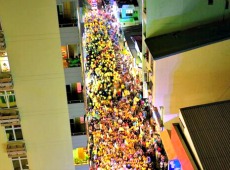
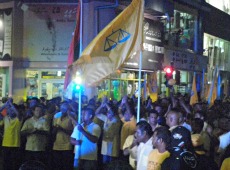
The Maldivian Democratic Party (MDP) celebrated their eighth anniversary with thousands of people participating in last night’s march and spectators lining the streets of the capital.

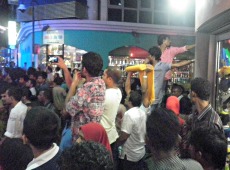
The excitement was palpable as thousands came out of their neighborhoods, crammed the sidewalks and climbed on top of any available structures to watch the parade spectacle and take photos. Countless people were seen waving and shouting from their windows and balconies as the anniversary parade circled around Male’.

MDP has claimed upwards of 15,000 parade participants – some social media estimates were upwards of 20,000 – took part in the event. Minivan News observed the protest parade stretching the entire length and width of the nearly two kilometre long thoroughfare of Majeedhee Magu.

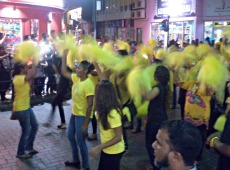
Protesters represented a variety of demographics including children, youth, the elderly, disabled, women and men, organised into groups, some carrying giant MDP flags, while others waved yellow ribbons, fans or pom poms.

Groups of women were twirling yellow umbrellas adorned with frangipani flowers (the party’s symbol) or carrying signs with the slogan ‘ehburun’ (meaning a one round victory). Some young men played volleyball while others in the parade drummed a festive beat.

Women and men alike were shaking yellow pom-poms and dancing in the streets to music remixing dance beats with phrases from former President Mohamed Nasheed’s speeches.

The Dhivehi lyrics translated to “MDP is a ship for all seas, This party is not going to sink, We will not fade away, You can arrest us, jail us and kill us but MDP’s ‘fikuru’ (ideology) can no longer be eradicated/wiped out from the Maldives”.

Countless parade participants, including port workers, were also adorned with yellow construction hats, while two young men wore milk and banana costumes in recognition of a previous Nasheed speech in which he discussed the importance of child nutrition, and pledged to ensure every school child had a suitable breakfast.

There were constant chants of ‘ehburun’ by the parade participants and crowds lining the main thoroughfares of Male’ that comprised the parade route. The parade ended at ‘Usfasgandu’, MDP’s protest area located near the Tsunami Monument, where applause and shouts from thousands of supporters could be heard echoing through the streets as members cut the party’s birthday cake.

Introducing multi-party democracy

“The MDP was the first political party to be registered eight years ago – we are the largest and oldest party – and we are built on people’s hopes,” MDP’s Youth Wing President Aminath Shauna told Minivan News.

“We wanted to celebrate that and show the people’s strength, which we definitely saw last night. The parade was a way to show that while we are a political party committed to political reform and social change, we can still have fun,” said Shauna.

“We wanted to make it very colorful and an opportunity for all kinds of people to participate, and they did, children, youths, mothers and fathers, as well as elderly MDP supporters, the parade had activities for everyone,” she continued.

“There hasn’t been an event like this – not at night with all the lights and music – since MDP’s February 17, 2012 rally, and that was more of a spontaneous protest,” she explained.

“The MDP has consistently had large numbers of people’s support and participation, but this event was by far the most comprehensive.”

“There was not a single spot empty on the sidewalks and people were cheering and waving from their windows and balconies. At least 15,000 people were out in support of the parade in Male’ alone,” she claimed.

“I have not seen that many people come out and even watch Maldives National Defence Force (MNDF) parades on Majeedhee Magu. There is a huge strong base of support in the islands as well, even in the UK Maldivians living abroad celebrated, social media is showing the quite broad spectrum of MDP supporters,” said Shauna.

“This event was significant because MDP is so young. I don’t think any country would see a ‘people’s party’ come out of nowhere – based on sheer public support – and be able to maintain a peaceful stance after so much brutality and injustice,” MDP MP and Spokesperson Hamid Abdul Ghafoor told Minivan News.

“It’s also significant that MDP’s eighth birthday coincides with the [upcoming] elections.”

“On MDP’s eighth birthday what we are seeing is unprecedented. After eight years we are still completely the ‘people’s party’, which we’ve seen from the amount of public support,” Ghafoor continued.

“People came out all over the country to celebrate, even on small islands in the most unlikely places they had [MDP birthday] cakes and meetings, it’s incredible,” he said.

Former President Nasheed meanwhile tweeted on the occasion,

Likes(1)Dislikes(0)

Two-thirds of Maldivians back moratorium on flogging: survey

Nearly two-thirds of Maldivians support a moratorium on flogging, according to the results of a survey conducted by Asia Research Partners and social activism website Avaaz.org.

The survey, the first of its kind to be conducted in the Maldives, found an “overwhelming” 92 percent of Maldivians believe that laws and systems to protect women from sexual assault should be reformed.

Of those polled, 62 percent supported an outright moratorium on the practice of flogging, while 73 percent declared existing punishments for sexual crimes were unfair to women.

Moreover, only one in five of those surveyed said current systems and laws were “adequate or fair”, according to a statement issued by Avaaz.

“While honeymooners relax in paradise, a war against women is being waged in the Maldives which the government is refusing to stop. Over two million people from around the world want them to act and now 92 percent of Maldivians want laws against rape and sexual abuse. President Waheed can easily pass a law banning flogging but refuses to act to end this medieval practice,” said Avaaz Campaign Director, Alice Jay.

“The poll flies in the face of the country’s parliamentarians who have claimed it would be “political suicide” to outlaw flogging and have done nothing to stop the practice, but instead given in to hard-line Islamist calls for harsher Sharia punishments.”

The survey was conducted across Male’ and Hithadhoo in Seenu Atoll in May 2013 by Asia Research Partners, both over the phone and through face-to-face interviews. All respondents were aged over 18 years.

‘Horror in paradise’ petition

The survey comes months after a case in which a 15 year-old rape victim was sentenced to 100 lashes and eight months’ house arrest for a separate offence of fornication garnered substantial international attention and condemnation.

The 15 year-old’s case attracted worldwide media attention and was widely condemned by international organisations and other nation states. Media condemnation was particularly strong in the UK and Germany, two of the Maldives’ most significant tourism markets.

In March, an Avaaz petition calling for the repeal of the sentence and a moratorium on flogging in the Maldives collected more than two million signatures – a figure more than double the number of tourists who visit the country annually.

“Since the campaign launched four months ago, Avaaz has been in discussions with the Maldivian government officials who have so far refused to take action on this issue,” the organisation said in a statement.

“Despite promises from the Gender Ministry, the President’s Office, the Attorney General’s office and the Foreign Ministry, this 15-year old child still faces the flogging sentence and far from ending this practice, some Maldivian political parties are calling for even harsher punishments.

“As a result of their failure to act, Avaaz is now planning to run hard hitting targeted adverts urging President Waheed and several parliamentarians who own some of the major Maldivian resorts, to act,” the organisation declared.

Stalling

After the sentencing initially made international headlines, President Mohamed Waheed issued a statement expressing “deep concern” over the verdict and pledging an appeal.

At the same time his coalition partner, the Adhaalath Party, warned that “Allah has decreed that expressing disapproval of issues such as this contradicts with faith in Islam”, and cautioned that “If such sinful activities are to become this common, the society will break down and we may become deserving of divine wrath.”

Then-Attorney General Azima Shukoor – now Minister for Human Rights, Gender and Family – subsequently lodged an appeal of the decision in the High Court arguing that the girl’s confession to the fornication offence had been taken in violation of established procedure.

The first hearing was held on April 29 behind closed doors, with no apparent movement in the case since.

Avaaz meanwhile moved to pressure the government into entertaining a moratorium on the practice of flogging.

The most recent Avaaz statement cited UK-based religious scholar Sheikh Dr Usama Hasan, who said “Sharia is not a fixed set of laws that can never be changed. Modern penal codes are thus fully Islamic if they share the values of justice and compassion, even if they do not include amputations, floggings or stonings to death. The latter punishments should be seen as ancient cultural practices, not essentially Islamic.”

The government’s position has meanwhile wavered between broad support for a moratorium and legal reforms to suspicion over the motivations of the Avaaz campaign and allegations of politicisation.

President’s Office Spokesperson Masood Imad was not responding to calls at time of press, but has previously noted that the Maldives had for over 50 years turned away from practicing Sharia punishments such as stoning, amputation and the death penalty, and suggested similar space for a debate on flogging.

However he cautioned that all authorities involved in proposed legal reforms would have to tread “a very fine line” in order to tackle long standing “traditions” and beliefs in the country.

At the same time, recently dismissed Deputy Tourism Minister Dr Maleeh Jamal has called for “negative news to be minimised”, emphasising that “People should not be doing anything to damage the industry. In Switzerland, you would not see a campaign designed to damage Swiss chocolate.”

A parliament committee currently reviewing the new penal code has meanwhile come under pressure from conservative religious elements, including the Adhaalath Party, to ensure Hadd punishments were included in the code – including flogging and amputation.

Speaking recently to Minivan News, one member of the committee said he feared not including such punishments would lead to backlash from conservative groups and amount to “political suicide”.

“We want to remove it as well. But, our hands are tied. Only public pressure can stop it,” he said.

Flogging stats

Almost 90 percent of the people found guilty of “Zina” – fornication – and sentenced to flogging in 2011 were female, according to statistics from the Department of Judicial Administration.

A total of 129 fornication cases were filed in 2011 and 104 people sentenced, out of which 93 were female.

These included 10 underage girls (below 18), 79 women aged 18-40, and four women aged above 40 years.

Gender Ministry statistics meanwhile show 1 in 3 Maldivian women between the ages of 15 and 49 have suffered either physical or sexual abuse over the past five years. At the same time, there has not been a single conviction for rape in the last three years.

Read about the practice of flogging in the Maldives

Likes(0)Dislikes(0)

Former President Nasheed calls on MDP to vacate ‘Usfasgandu’ in favour of meeting halls

Former President Mohamed Nasheed has called on Maldivian Democratic Party (MDP) supporters to vacate the ‘Usfasgandu’ protest area in favour of the various ‘jagaha’ (meeting halls) established across the capital ahead of September’s election.

Nasheed was quoted in local media as requesting that the opposition party’s supporters make use of the official meeting areas being set up by the MDP across Male’, rather than the protest site that has been the basis for many of the party’s activities since the controversial transfer of power last year.

“I will ask members of the MDP’s executive committee very sincerely to clear Usfasgandu. We are a party that wisely takes whatever steps are needed at the time,” he was quoted as saying by Haveeru.

Usfasgandu, which is presently being leased to the party, has been at the centre of an ongoing legal dispute over the last 12 months between the MDP-dominated Male City Council (MCC) and the government’s Housing Ministry, which is seeking to claim ownership of the site.

Minister of Housing and Infrastructure Dr Mohamed Muiz told Sun Online last week that a notice had been sent to the MCC requesting they clear and vacate the area by June 27 – or else police would be requested to assist in clearing the site.

Dr Muiz was not responding to calls from Minivan News at time of press, while Deputy Housing Ministers Abdulla Muththalib and Mohamed Faiz today declined to comment on the matter.

A police media official, who declined to be named, said it had also received no communications from the ministry requesting assistance to clear Usfasgandu by tomorrow’s supposed deadline.

Despite reports of the Housing Ministry’s intent to reclaim the Usfasgandu area, Mayor Ali Manik said no order had been received by the MCC requesting the land be returned. He added that any decision on whether to clear the are could only be made by the MDP.

The MDP told Minivan News today that while it has also not received any notice of attempts by the state to clear the site, the importance of the area to the party had “waned” as its campaigning spread across the capital and country ahead September’s election.

The opposition party said it intended to focus on local campaigning through the establishment of various jagaha across the Maldives.

Nasheed today opened the latest MDP jagaha adjacent to the country’s justice building – despite authorities contesting the legality of its location. The MDP contends that the jagaha was further than a distance of 50 feet from the building as demanded by law, and was therefore legally situated.

Relevance

Addressing the future of Usfasgandu, MDP MP and Spokesperson Hamid Abdul Ghafoor said there was a “general feeling” within the party that Usfasgandu was believed to have served its purpose.

He added that the party had been considering vacating the area over the last week in order to limit the possibility of confrontations with authorities.

Ghafoor added that an official parade to commemorate eight years since the founding of the MDP would begin at Usfasgandu this evening, but its relevance as an area for campaigning was already waning with the establishment of jagaha areas.

“The general view of the party is that the area is not really useful anymore and is slightly irrelevant to our campaigning, though I understand there is nostalgia among many people for the area,” he said. “In time, I think we would have seen the site slowly die out.”

Intimidation allegations

Ghafoor alleged that reports of the Housing Ministry seeking to reclaim Usfasgandu reflected an attempt by the state to intimidate political rivals such as the MDP and its supporters ahead of an election.

He claimed that this intimidation was part of attempts by the state to destabilise the country ahead of September’s presidential election in order to cast doubt on whether the country was capable of holding a national vote.

Ghafoor said as a result the MDP was wary of any potential clashes with authorities, such as those seen during attempts to evict the party from Usfadsgandu in May last year. He said that many in the party believed that keeping the area was “not worth” the potential for unrest should police intervene.

Land dispute

Although Usfasgandu was later returned to the MDP after the clashes in May 2012, police once again moved to cordon off the area by January 2013 at the request of the High Court.

The court at the time ordered that Usfasgandu not be occupied by any party until it delivered a verdict over a dispute between the Housing Ministry and the MCC over ownership of the site.

In early February, the Civil Court ordered the MCC to clear the land plot and hand it over to the Housing Ministry, though the order was later overturned by the High Court. The High Court ruled that the Civil Court order had failed to follow legal procedures in its hearing of the case and was therefore unlawful.

Usfasgandu was handed back to the MDP by the MCC in March of this year, with the council claiming at the time that no other party had requested use of the land at the time.

A spokesperson for the High Court today said that no further rulings had been made concerning the legal ownership at present, with its previous order overturning the Civil Court still said to stand.

Despite now opting to vacate the site, Ghafoor claimed that the lack of notification from the Housing Ministry over its attempt to reclaim the Usfasgandu reflected a further breakdown in communication between state departments.

“The Housing Ministry had been completely isolated on this matter and no one seems to be taking it seriously,” he said.

President’s Office Media Secretary Masood Imad was not responding to calls at time of press from Minivan News.

‘Paint war’

The MDP’s political rivals have continued to criticise the MCC for providing a plot of land to the opposition party, expressing concern that their supporters had not been given similar opportunities in the capital.

Government-aligned Progressive Party of Maldives (PPM) MP Ahmed Nihan alleged last week that it was this sense of disparity among political rivals that had led to a so-called ‘paint war’ across the capital resulting in private property and even plant-life painted in political colours.

Supporters of the PPM were accused of covering state property and government buildings, such as walls outside the new Supreme Court compound in Male’, in the party’s official colour of pink.

PPM MP Nihan meanwhile accused MDP supporters of instigating the painting throughout Male’ by covering entire areas of the capital such as Usfasdgandu in yellow, leading to reprisals from rival supporters.

Likes(0)Dislikes(0)

Police to hire 75 civil assistants as non-uniformed personnel

The Maldives Police Service (MPS) has made an announcement in the government gazette on Sunday (June 23) seeking to hire 75 “civil assistants” as non-uniformed personnel for administrative work.

A police media official explained to Minivan News today that the MPS planned to assign all administrative work to civil staff and free up “uniformed police officers for operations.”

While there were civil staff working for police at present, the media official added, uniformed personnel with police training were also carrying out administrative tasks, such as “answering the phone at police stations and writing reports.”

Shifting all administrative work to civil staff would allow uniformed personnel to attend to police work and election security matters ahead of the presidential election in September, the media official said.

According to the criteria listed in the job announcement, interested candidates must have at least two O’ Level C passes, must have passed Dhivehi and Islam, and must not have been convicted of a crime with a punishment prescribed in the Quran or theft, fraud, embezzlement, drug abuse or drug trafficking in the past five years.

In addition, applicants must not have sought treatment or rehabilitation for drug abuse during the past five years and must not be a registered member of a political party.

The deadline for submitting application forms, available on the police website and at the police headquarters, is 4:00pm on July 4.

The civil assistants will be paid monthly wages of MVR 3,470 (US$225) in addition to MVR 1,000 (US$65) a month as a service allowance and 35 percent of the salary as a non-practice allowance.

The new police staff will cost the state MVR 426,300 (US$27,645) a month and MVR 5.1 million (US$330,739) a year.

The announcement seeking 75 civil assistants followed the recruitment of new officers for a “special constabulary” reserve force in May this year.

Reserve force officers were to be paid 85 percent of the salary of a regular police officer of the same rank.

Budget crisis

Following the controversial transfer of presidential power on February 7, 2012 in the wake of a violent mutiny instigated by officers of the Special Operations (SO) command, more than 1000 police officers were promoted110 new police officers were hired, a housing scheme was introduced for police officers with 300 flats to be constructed in Hulhumale’, arrangements were made for cheap accommodation in Sri Lanka for police officers and their families and a loan scheme was set up for police officers.

The additional recurrent expenditure on wages for new police staff comes at a time when the country is facing a budget crisis, with island schools and hospitals understaffed, local councils unable to settle outstanding utility bills, and development projects stalled over lack of funds.

In April, Finance Minister Abdulla Jihad sought authorisation from parliament to divert MVR 650 million (US$42 million) allocated for infrastructure projects in the budget to cover recurrent expenditure.

Jihad warned that government offices and independent institutions might be unable to pay salaries or electricity and phone bills if funds were not transferred from the MVR 1.8 billion (US$117 million) Public Sector Investment Programme (PSIP).

Earlier in April, the cabinet decided to delay implementation of new development projects financed out of the state budget due to shortfalls in revenue.

Moreover, in a report on the Maldivian justice system released in May, UN Special Rapporteur for the Independence of Judges and Lawyers, Gabriela Knaul, expressed concern of an impending budget crisis for the judiciary.

“The immediate implications of the budget cuts on the judiciary are appalling. For instance, the Department of Judicial Administration only has funds to pay staff salaries until November 2013 and it had to cancel training this year,” Knaul noted.

“The Civil Court reported that it would not have sufficient funds to pay its staff salaries after October 2013; furthermore, existing budgetary resources would not be sufficient to pay for utilities and facilities after June 2013,” she added.

During the parliamentary debate last year on the state budget proposed for 2013, opposition Maldivian Democratic Party (MDP) MPs criticised budgeted salary increases for military and police officers as well as plans to hire 800 new personnel for the security services.

The state’s annual wage bill was projected to skyrocket by 37 percent in 2013 as a result of hiring more employees.

MDP MP Eva Abdulla claimed during the budget debate that the police and army hired 250 and 350 new staff respectively in 2012.

Consequently, the institutions spent more than MVR 75 million (US$4.8 million) in addition to the approved budgets for 2012, she claimed.

Meanwhile, in its professional opinion on the budget submitted to parliament, the Auditor General’s Office observed that compared to 2012, the number of state employees was set to rise from 32,868 to 40,333 – resulting in MVR 1.3 billion (US$84.3 million) of additional expenditure in 2013.

This anticipated increase included 864 new staff to be hired by the security services, the Auditor General’s Office noted.

Likes(0)Dislikes(0)