Elections Commission confident of resolving all voter registry issues

The Maldives Elections Commission (EC) has said it remains confident it will have resolved all 2,279 complaints raised by the public over the recently published list of eligible voters, in line with today’s deadline (June 14).

EC President Fuad Thaufeeq told Minivan News that the commission’s work amending the voter registry had so far gone “better than expected”, with all submissions received from the public amended. However, he conceded that challenges still remained in notifying all the complainants about the changes made to the list, as required by regulations.

“The challenge we have experienced so far is delivering the message to all the people who made these complaints that the requested changes have been made,” he said. “It is proving a bit difficult, though our staff are working very hard, in some cases up until 10:00pm at night to get hold of them.”

Transparency Maldives has meanwhile said that it has received only one significant complaint at present regarding outdated voter registry information, adding that all other complaints raised were small and sporadic in scale. However, the NGO said it continued to advocate a simplification of the present law on making further changes to the voter registry.

Thaufeeq said the corrected voter registry will then be published on either June 15 or June 16 in the government gazette and on the EC’s own website.

“What happens next?”

According to Transparency Maldives, anyone who has registered complaints with the EC regarding data on the voter registry will have five days to file a complaint with the High Court should they wish to appeal any decision made by the commission.

Under law, the High Court is then required to rule on any such appeal within 15 days.

Upon publication by the EC of the amended voter registry, any Maldives national over 18 will then be given a further 10 days to lodge any complaints concerning changes made to the list, the NGO added.

Transparency Maldives said the final process would be voter re-registration, where members of the public will be required to confirm or change their present permanent residence either in the country or abroad to confirm where they wish to vote.

The NGO emphasised that this stage will be critically important, as a person from an outer atoll presently living in Male’ will be required to return to their home island unless they re-register their new location with the EC.

A date for voter re-registration to begin has yet to be decided by the EC.

Simplification

Transparency Maldives Project Director Aiman Rasheed said the NGO had so far received only one significant compliant about the registry, which was made by members of Fuvahmulah council concerning the amount of outdated details of islanders on the list.

“The last time we spoke to the EC we raised this issue and they had a rational explanation for what had occurred. It seemed that people who moved house on the island or left for Male’ had not been updated,” he said.

Aiman said the EC had dealt with the issues where possible, with other corrections expected to be made during the re-registration process that will be announced at a later date.

“Apart from this, there have been no major complaints beyond some small, sporadic issues,” he added.

Aiman said that with an estimated 25 percent of the population living away from their registered address in the Maldives, re-registraton was expected to be a much larger issue towards ensuring the vote to everyone in the country eligible to do so.

He argued that the NGO still believed the voter registration could be simplified by requesting the public to check their permanent address at the same time as other details on the registry.

“The argument against this has been from the section of the population employed as fishermen, as they do not know where they will be later on in the year. It was therefore easier for them to wait nearer to the election,” Aiman said. “There is a challenge there, but we still feel [voter registration] should be simplified. This is of course not the EC’s fault though, this relates to the law.”

Likes(0)Dislikes(0)

Indian coastguard rescues crew of Maldivian cargo vessel

The Maldivian cargo ship MV Asian Express sank on Wednesday evening 300 kilometres west of Kochi, after its hull reportedly cracked below the waterline.

The ship, which was travelling to the Maldives from Pakistan carrying a cargo of sand and cement, suffered an engine failure on Tuesday evening and began drifting, reported IBN Live.

According to marine tracking reports, the Indian Coast Guard ship Varuna arrived to assist but was forced to abandon attempts to fix the engines because of rapidly deteriorating weather conditions.

The Indian coast guard subsequently evacuated all 22 crew members, including 18 Maldivians and four Indian nationals.

The Maldives National Defence Force (MNDF) confirmed it had received the first distress reports, and said the Maldivian crew were being transferred to Kochi following total loss of the vessel.

The MV Asian Express was carrying aggregate imported from Pakistan, after a shortage began impacting the Maldives’ construction industry.

Aggregate was previously imported to the Maldives from India under a special quota, however this was temporarily revoked on February 15 amid a breakdown in the country’s relationship over the government’s eviction of Indian infrastructure giant GMR and ongoing mistreatment of Indian nationals working in the country.

Likes(0)Dislikes(0)

Police forward Disaster Management Centre case to PG

Police have forwarded a MVR 24 million (US$1.55 million) corruption case involving the National Disaster Management Centre to the Prosecutor General, calling for charges against nine people including former head of the centre, Abdulla Shahid.

In a statement issued today police confirmed the case was forwarded to the PG and called for the prosecution of Abdulla Shahid, 50, Mohamed Shahid, 53 (the brother of parliament speaker Abdulla Shahid), Ahmed Najah, 24, of Maradhoo in Addu City, Ahmed Arif, 49, of Henveiru Everglow, Mohamed Waheed, 53, of Eydhafushi in Baa Atoll, Abdulla Saeed, 49, of Hoadedhoo in Gaafu Dhaalu Atoll, Abdulla Hassan, 56, of Henveiru Sosunmead, Moosa Ali Kaleyfaanu, 49, of Kandholhudhoo in Raa Atoll, Ahmed Shammoon Zahir, 23, of Mahchangolhi Blackpool.

The case was first forwarded to police by the Auditor General on April 19, 2012, while the Anti-Corruption Commission forward the matter on January 18, 2013.

Police thanked the Anti-Corruption Commission and Auditor General’s Office for assistance in investigating the case.

The case involving the Disaster Management Centre concerns an audit report produced by the Auditor General. In the report, the Auditor General alleged that MVR 24 million (US$1.5 million) was fraudulently obtained from the budget allocated for the centre for the year 2009 and 2010.

The Auditor General’s special report into the case alleged that the Disaster Management Centre had photocopied, edited and reused ‘Credit Purchase Order Forms’ in 2005, to withdraw the MVR 24 million from the centre’s budget at the Finance Ministry.

The ‘Credit Purchase Order Forms’ were originally given to the Disaster Management Centre in 2005 to withdraw cash from the Tsunami Recovery Fund.

The Auditor General’s report also suggested that the Finance Ministry was complicit in the alleged fraud.

In March 2012, the Anti-Corruption Commission (ACC) sent a corruption case to the Prosecutor General’s Office concerning the Disaster Management Centre and a housing project carried out on Gan in Laamu Atoll, following damage suffered in the 2004 tsunami.

Likes(0)Dislikes(0)

Sheikh Fareed files defamation case against President of Islamic Foundation over fraud allegations

Well-known religious scholar Sheikh Ibrahim Fareed, and Vice President of the Islamic Foundation of the Maldives (IFM) Mohamed Fauzee, have filed a defamation case against the religious NGO’s President Ibrahim Fauzee.

The case was submitted after Ibrahim Fauzee alleged to local media that Sheikh Fareed and IFM Vice President Mohamed Fauzee had defrauded the NGO.

A lawyer for the two accused told media today that the case filed sought payment of more than MVR 3 million (US$195,000) and a public apology from Ibrahim Fauzee on local media for three consecutive days.

The lawyer said Mohamed Fauzee ran a Quran class in Male’ and a construction company, and that the remarks by Ibrahim Fauzee had affected his work.

President of IFM Ibrahim Fauzee told Minivan News he has evidence to support allegations including CCTV footage.

‘’They are worried because we can prove criminal charges against them,’’ he said, adding that he would release the footage to the press. “The story in the media is inaccurate.”

Fauzee said Sheikh Fareed had been dismissed from his position as Vice President of the Religious Council of IFM, and Mohamed Fauzee from the position of the NGO’s Vice Presidency following the matter. Fareed was one of the organisation’s founding members.

Sheikh Fareed’s mobile phone was switched off and he was unavailable for a comment at time of press.

Likes(0)Dislikes(0)

‘Surfers against sewage’ shame city council over night market littering

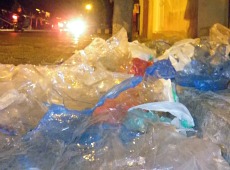
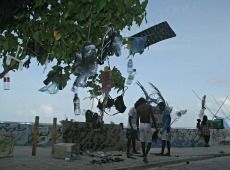
Appalled by excessive amounts of garbage littering streets, nearby parks, and sea due to the Male’ night market, local surfers have staged a creative protest using the rubbish to pressure the city council into action.

The night market is held annually before Ramazan to provide people a plethora of affordable goods. Locally referred to as the ‘Ungulhey Bazaar’ – literally meaning the ‘rub up against someone market’ – the 10 day event draws dense crowds, and this year has a record-breaking 765 stalls representing 450 groups, according to local media.

Thousands of people shopping and eating amidst the hundreds of densely packed stalls generates enormous amounts of waste, which is pitched onto the streets or into the adjacent sea since there are no trash cans.

For the past three years the market has been located near ‘raalhugandu’, Male’s surf point, adjacent to the Tsunami Monument in Henviru ward.

Fed up with the pollution the “surfers against sewage” decided to take action.

“There are no dustbins so the rubbish ends up in the ocean and we don’t want that,” local surfer and Maldives Surfing Association (MSA) Spokesperson Ibrahim Riffath told Minivan News yesterday (June 11).

“It’s very bad, like a real slum,” said Riffath. “The Maldives is one of the most beautiful countries, but the sh*ttiest place.”

The wind carries the waste into the water and spreads it through the streets, so the bad storm that wreaked havoc on Male’ and the night market earlier this week exacerbated the problem, Riffath explained.

The surfers were in good spirits walking through the empty market stalls to collect trash – which was strewn over the ground – to reuse for their protest.

An impromptu improvisation about the waste management problem, sung by local surfer Ibrahim Aman to the tune of Pink Floyd’s the Wall, with accompanying lyrics “we don’t need no trash around us”, made the rubbish hunt a lively affair.

As did Aman’s poetry about inserting trash into a bin: “My name is dustbin and I’m always empty. My girlfriend’s name is garbage…”

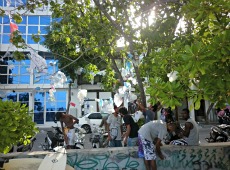
The random rubbish pieces were arranged along the sea wall, hung from trees in the small park near ‘raalhugandu’, and piled next to protest boards in an artistic fashion.

Witty signs, banners, and graffiti expressed their frustration with the waste management problem: “Is this a pretty picture? Is this heaven on earth? Is this the garbage area? For an independent Dhivehi Raajje (Maldives) we need a clean Dhivehi Raajje.”

The lone trash can located near the park at the night market’s entrance was adorned with graffiti saying “What is this?”, while other ironic messages saying “thank you city council”, “welcome to paradise”, “sunny side” and “carbon neutral 2013”.

While most of the “surfers against sewage” are MSA members, their protest was not conducted as an official MSA initiative, but was rather spontaneous collective effort.

“MSA’s president wrote to the city council this year, but we have not yet received a reply,” said Riffath.

“The city council is saying they will have dustbins, but they have not yet done it and no one is coming to collect the trash,” he continued.

“They told us that this place, [the raalhugandu park], is not the road so it’s not part of their mandate to clean,” claimed Riffath.

“We are doing this for ourselves, the public and the environment,” he added. “People aren’t educated about why littering is so harmful.”

Be green and clean

“It’s not nice or hygienic,” local surfer Hamd Abdul Hadhi told Minivan News yesterday.

“Each stall should be responsible for keeping their area clean, daily,” he suggested. “If we were rich we would have bought the dustbins ourselves.”

“Most of the pollution from the market ends up in the sea,” he explained. “The trash hurts the fishes and corals, plus when we’re surfing and get a plastic bag stuck to our faces then we’re in trouble.”

Raising awareness about the link between human and environmental health is necessary to stop people from haphazardly throwing their garbage everywhere, which is why the surfers are leading by example, Hadhi noted.

“People are damaging mother nature so much with rubbish,” he said. “As surfers, we understand more than others and want to show people that it is good to be clean.”

“We clean the park and surrounding area two or three times a week, but no one else bothers,” Hadhi lamented. “And every night market we put up notices saying ‘do not litter here’.”

“It’s not just for our benefit, waste management is important for the whole country,” he said. “We are one of the smallest countries, so it’s crazy we can’t manage waste properly.”

“No one listens to us, so this [protest] is all we can do,” he declared.

Male’ City Council

“Of course this is a problem at the night market,” Male’ City Council (MCC) Mayor Ali ‘Maizan’ Manik told Minivan News today (June 12).

“I move around every day early morning and my goodness I know how bad it is,” said Manik.

“My secretary general will be arranging a meeting for this afternoon with the [protest] organisers and we will discuss waste management how we can reach a solution and solve this issue,” he added.

Manik explained that the Environment Ministry has been handling the waste management problem, but has not kept the MCC informed of what they are doing.

“Given the Anti Corruption Commission (ACC) investigation into the [Tatva] contract we were asked to stop [waste management activities] until the inquiry was completed,” said Manik.

“I spoke with the Environment Minister and they are already approved to sign the [new] Tatva agreement, but before the council signs we have to know the changes they have made to the contract,” he noted.

“The Tatva discussion was already held and the original agreement was signed in November 2010,” he continued.

“Changes were already made to the agreement by the International Finance Corporation (IFC) and World Bank, so there shouldn’t be [additional] changes, but the Environment has Ministry altered the contract,” Manik said.

“This is the kind of government we have, doing this to disturb us,” he added. “The waste management agreement should be made to benefit the public.”

Likes(4)Dislikes(0)

Police deport man arrested in connection with Artur brothers case

The Immigration Department has deported Godzine Sargyasan, the French national who was identified as one of the Artur brothers, in compliance with a police request.

In a statement issued today, police said Godzine Sargyasan had registered a company in the Maldives to invest in the tourism industry, but had obtained an import/export license for products not related to the tourism industry.

According to police he also registered a local investment and became affiliated with gangs in Male’, to the point he was assisting them and became involved in assault.

Police said allowing such persons to do business in the Maldives posed a threat to the national security and put the economy of the country in danger.

In April, police issued statement asking for public assistance in locating Godzine Sargsyan and a Maldivian involved with him. The pair surrendered to police in May.

Local newspapers reported they had been living in the Marble Guest House before surrendering themselves to police. Police later searched the guest house after arresting the two men.

The Criminal Court recently confirmed that Godzine Sargyasan had been charged with assault and battery, cases related to fraud, and providing invalid documents to government institutions.

Photos of the Arturs in the company of two Maldivian cabinet ministers initially emerged on social media, apparently taken during the Piston Motor Racing Challenge held on Hulhumale’ between January 25 and 26.

A company named ‘Artur Brothers World Connections’ was registered in the Maldives in October 2012, with the Artur brothers holding an 80 percent share in a 61-19 percent split.

Likes(0)Dislikes(0)

Maldives forms environment police as civil society criticises lack of enforcement, legislation

The Maldives Police Service (MPS) and the Ministry of Environment and Energy have announced the formation of a new unit that will assign 22 trained officers to deal with ecological violations across the country.

The Environmental Police Unit, formed through a Memorandum of Understanding (MOU) signed on June 6, will aim to investigate and punish violations of laws relating to biodiversity and littering, the Environment Ministry claimed in an email to Minivan News.

Formation of the new unit comes as NGOs and not for profit groups have raised individual concerns over a perceived lack of enforcement or a clear legal framework to uphold environmental protection efforts across the country.

These ongoing concerns over enforcement are said to already directly impact both the country’s fledgling national parks and marine reserves, as well as on individual inhabited islands.

Enforcement

According to the Environment Ministry, officers from the new police unit will be required to assist the state in enforcing national regulations such as in providing sports fines related to vehicular emissions or cases of illegal sand-mining, or dealing with poaching of protected species in the country.

Police will also be required to share details of environmental crimes to the ministry, which did not share any further information on the specific offences that police will asked to focus on at time of press.

Under the MOU, the Environment Ministry will be required to give technical advice on the formation of the environment unit, including training for 22 officers in dealing with environmental crime.

The ministry is also called on to host workshops and awareness events for various agencies within the police force, as well as for customs officials, port authorities and the coast guard.

Environment authorities are also required through the MOU to provide all necessary information on laws and regulations, as well as other treaties and agreements signed by the Maldives as part of the country’s wider sustainability aims.

Stakeholder concerns

Numerous stakeholders in Maldives’ environment sector have meanwhile this week told Minivan News that a perceived lack enforcement as well as concise national legislation has in recent years held back ecological protection efforts.

For Ali Rilwan, Executive Director for local NGO BluePeace, a lack of enforcement of the country’s environmental regulations was believed to be the most pertinent long-standing issue setting back conservation and protection efforts at present.

Rilwan claimed that a lack of national mechanisms to report and enforce environmental crimes continued to hamper state initiatives to curb practices such as harvesting of turtles eggs and the export of shark.

In the case of national parks and biospheres, Rilwan alleged that a lack of enforcement was a particular problem for any conservation attempts.

He claimed that without such regulation, marine reserves and other conservation zones currently established in the country were operating more as “paper parks” than designated protected areas.

According to Rilwan, the lack of a nationwide enforcement mechanism to protect environmental laws was presently most apparent in smaller islands where police presence was often limited, making it difficult to report suspected offences.

“The police are supposed to have already been enforcing laws and regulations for environmental protection. But enforcement is something that we have not seen attempted,” he said.

Rilwan added that with the Environment Ministry not having representation within island councils, monitoring potential abuses of environmental law on more than 1,000 islands across the country would limit the effectiveness.

“There are local councils who can focus on the issue, but in the case of any criminal acts, councillors themselves would not be able to investigate or penalise any perpetrators contravening environmental law,” he said.

Rilwan added that with the training of environmental police in the country, he believed there could be an opportunity for effective enforcement going forward.

However, Mohamed Hameed, Promoter of the Edu Faru Marine National Park project in Noonu Atoll, has said he believes the Maldives main challenge regarding ecological protection was the continued lack of a holistic legal framework to protect the environment.

“The Maldives at present is an example of a very sensitive environment. You can get police to check on it, but you need a legal framework to protect these places,” he said. “At present, this legislative framework is lacking.”

Despite successive government in the Maldives playing up sustainability as a key part of their national development plans, Hameed said that current legislation on the environment was presently “all over the place” with various laws overlapping ad contradicting each other in some cases.

Taking successful international examples of marine reserves such as Australia’s Great Barrier Reef or the Kosterhavet National Park in Sweden, he claimed that both parks were protected within the respective legal frameworks of both nations.

Without similar amendments being considered in the Maldives, Hameed said that it would be very difficult to ensure projects like the Edu Faru MNP were properly protected.

He claimed from his own experience of trying to establish the country’s first MNP, a process said to have taken over two decades, efforts to set up an environmental not for profit organisation had been complicated by the fragmented legislative framework presently used in the country.

Hameed claimed that despite both President Dr Mohamed Waheed and former President Mohamed Nasheed supporting the MNP’s formation, he was still waiting for official paperwork and all the agreed lands to be handed over to him so work could fully begin on the site.

The MNP, which was established through a Memorandum of Understanding (MOU) with the Environment Ministry back in 2011, is designed to protect nine islets by keeping them in a “pristine” state and undeveloped for future research.

Reserve focus

National parks and reserves are expected to become an increasingly important part of the Maldives conservation efforts on the back of a pledge by the current government to make the country the world’s largest marine reserve by 2017.

The government has is committed to move ahead with plans to transform the Maldives into a biosphere reserve through the designation of zones across the country that would earmark land use for specific purposes such as tourism development or conservation.

Likes(0)Dislikes(0)

Cancelled agreement to develop IGMH cost US$150,000, reveals audit

The termination of an agreement between the Ministry of Health and Family with Indian company Apollo Hospitals Enterprises to manage and develop the Indira Gandhi Memorial Hospital (IGMH) cost the government US$150,000, the Ministry of Finance and Treasury’s audit report for 2010 has revealed.

The audit report (Dhivehi) made public on Thursday (June 6) flagged an advance payment of US$ 150,000 from the finance ministry’s special budget to Apollo Hospitals as 20 percent of a transition management fee under the “management and development agreement” (MDA) signed on January 23, 2010.

Auditor General Niyaz Ibrahim contended that the payment was made by the finance ministry in violation of budgetary rules and accounting principles, adding that expenses of another office or institution should not be included in the finance ministry’s financial statement.

Moreover, the privatisation of the government hospital was not overseen by the privatisation committee as stipulated in public finance regulations amended in late 2009, the audit report noted.

The secretariat of the privatisation committee, which functioned under the Ministry of Economic Development, informed auditors that interested parties were invited to submit detailed proposals for developing IGMH in a public-private partnership deal in January 2009.

However, none of the detailed bids met the criteria set by the health ministry and the privatisation project was scrapped.

Following a visit by then-President Mohamed Nasheed to India, Health Minister Dr Aminath Jameel told the press on January 25, 2010 that Apollo was awarded the project because none of the bidders fit the criteria.

Apollo was chosen following consultation with the Indian government and based on legal advice, she added.

However, in August 2010, the Male’ Health Services Corporation – which operated IGMH – advised the health ministry against proceeding with the privatisation deal as Apollo’s proposal was not financially feasible for the government-owned health corporation.

On September 30, 2010, the health ministry informed Apollo that the government has decided to scrap the project since the necessary financial capital had not been arranged.

The audit report also noted that a transition management agreement and an operation management agreement that was required under the MDA was not signed in the stipulated 180-day period.

“Therefore, the US$ 150,000 paid to Apollo Hospitals under the MoU [Memorandum of Understanding] signed with IGMH in 2010 was a waste of funds with no benefit to the state,” the audit report stated.

It added that the loss was incurred as a result of “inadequate planning” before hastily signing the MoU without obtaining legal advice, considering the financial burden on the state and determining a source of capital.

The Auditor General recommended asking the Anti-Corruption Commission (ACC) to determine whether any state official abused their authority in awarding the project to Apollo Hospitals without a bidding process.

Other cases

Among eight other cases highlighted in the report where expenses were made ostensibly in violation of public finance law, the audit revealed that in 2007 the government incurred a loss of MVR 30.8 million (US$1.9 million) after paying for 150,000 copies of the Quran Dhivehi translation with numerous errors.

The audit report noted that the project was awarded to Novelty Printers without a bidding process through the tender evaluation board.

Moreover, an advance payment of 85 percent of the contracted amount was made to Novelty Printers in violation of existing regulations, the audit discovered.

In June 2010, the Fiqh Academy decided to destroy the copies printed in 2007 as the errors could not be easily corrected. The decision was made following a year-long review by scholars of the academy.

The audit discovered that the errors in the final version were not present in the proofed copy approved by the President’s Office in 2007 – during the final years of former President Maumoon Abdul Gayoom’s reign – suggesting that Novelty was responsible for the errors.

Novelty Printers wrote to the President’s Office in November 2008 apologising for the printing errors, which they explained occurred due to a problem in the computer file used to make the printing plates.

The audit also discovered that Novelty was paid the remaining 15 percent of the contracted amount in May 2010 after a state minister at the finance ministry approved the payment.

The state minister sent a memo to the budget section falsely claiming that the government had received all 150,000 copies, the audit report noted.

The Auditor General recommended that the ACC should investigate the culpable official for alleged corruption and that the state should either recover the MVR 30 million paid to Novelty or demand 150,000 copies without errors.

The audit report also noted that the government was ordered by the Civil Court in January 2010 to pay US$119,616 as compensation for a former deputy general manager of the Maldives National Shipping Line (MNSL) for unlawful termination in 2002.

The Auditor General recommended legal action against the government officials responsible for incurring the financial loss by unlawfully sacking the MNSL deputy manager in 2002.

The audit further revealed that in 2009 and 2010 the finance ministry paid US$ 4 million to two American companies under a “settlement agreement” while arbitration proceedings were ongoing in Singapore.

In 2006, a consortium formed by the International Medical Group and Sirius International Insurance Corporation was awarded a contract to provide health insurance for government employees.

The companies sought arbitration in Singapore following a contract dispute with the now-defunct Ministry of Higher Education, Employment and Social Security. However, the US$4 million settlement was reached out of arbitration in May 2009 by the new government that took office in November 2008.

The settlement was paid out of the finance ministry’s special budget in 2009 and 2010.

The Auditor General recommended “a thorough investigation” to recover the financial loss incurred by the government as a result of the contract.

The audit report also contended that the finance ministry had not undertaken “adequate efforts” to recover MVR 51.4 million (US$3.3 million) owed to the government as loan repayments as of December 2010.

The loans worth a total of MVR 69.4 million (US$4.5 million) were provided to select individuals by the President’s Office from 1992 to 2006 under special privileges afforded to then-President Gayoom.

The loans were given with a six percent interest rate to be paid back within two to five years, the report found, noting that the repayment period would have lapsed in 2011 for the most recent loans.

However, in a letter sent to the finance ministry on November 6, 2008 – five days before Gayoom left office – the repayment period was extended to five years.

As the loans were given to senior officials of the outgoing government, the audit report contended that the decision to extend the repayment period amounted to corruption.

The Auditor General therefore asked for an investigation by the ACC into the extension and recommended that the finance ministry file court cases to recover the unpaid amounts.

Likes(0)Dislikes(0)

Health Trust Fund fundraising events raise over MVR 5.5 million (US$357,142)

Following a week of fundraising events the Health Ministry has raised over 5.5 million MVR (US$357,142) for the Health Trust Fund established in late April, falling short of the MVR 270 million (US$ 17,532,450) needed for health sector services.

The Health Trust Fund was established 20 November 2012 under Ministry of Finance and Treasury regulations and inaugurated on April 29, 2013.

The only way the Health Trust Fund can be maintained is through donations of sufficient assets and in this regard government and private sector contributions are very important, Minister of Health Dr Ahmed Jamsheed recently told local media.

He explained that the health sector requires an additional MVR 270 million (US$ 17,532,450), which requires public contributions and cooperation.

Previously health sector services were “covered by the people”, however following the start of the Aasandha universal health insurance scheme on 1 January 2012 the government of Maldives needed a “huge amount of finance” to cover expenses, said Jamsheed.

Therefore, the Health Ministry organised a series of fundraising events to “commence activities to raise funds, not to gather all the funds need to cover all health sector services,” he added.

“We want health services to be sustainable by putting an end to service disruptions due to machinery breakdowns as well as provide a systematic way for people to give in-kind donations,” Health Ministry Director and fundraising media team member Thasleema Usman told Minivan News yesterday (June 8).

“There has always been a budget shortfall at the Health Ministry, there has never been enough money,” Usman said.

“We wanted to try and do something for the Maldivian people, additionally there are also people who want to contribute [to the fund] for the benefit of the public,” she added.

Usman explained that the various fundraising events were organised as a start for the trust fund and to raise awareness among the public.

“We didn’t want this to be a ‘once off’ thing,” she said.

“Although the total amount of funds raised are still being tallied, as of this afternoon (June 9), the total reported was MVR 5.5 million (US$357,142), with over MVR 2 million (USD$129,870) in cash donations and more than MVR 3 million (US$194,805) from in kind contributions,” Maldives Food and Drug Authority (MFDA) Senior Scientific Officer and fundraising media team member Mariyam Shabeena told Minivan News today (June 9).

Budgetary needs

The health sector budgeted MVR 2.2 billion (US$142,857,000) for 2013, however around MVR 1.1 billion  US$71,428,500) or 50 percent of the total budget is allocated for the National Social Protection Agency (NSPA), according to Usman.

She said that over MVR 5 million is needed for social safety net subsidy programs, such as single parent’s allowance, foster parent’s allowance, disability registration and benefit and electricity subsidies, which fall under NSPA.

NSPA is also responsible for managing the national social health insurance scheme, a public-private partnership with Allied Insurance.

“Aasandha requires 1.13 billion MVR (US$73,376,550) to provide actual health care,” Usman said.

“An additional MVR 500 million (US$32,467,500) is required for Indira Gandhi Memorial Hospital (IGMH) operations and the Health Ministry budget also includes institutions, such as the Maldives Food and Drug Authority (MFDA), National Drug Agency (NDA), etc,” she continued.

Usman explained that the health trust fund will be transparent, with legal mechanisms to manage the money.

“The Health Ministry can only have a sustainable trust fund if funds are raised legally, by abiding with Finance Ministry regulations,” she said.

“The fund has a very well written policy that explains how the money will be used and what has been used,” Usman continued.

“A nine member committee chaired by the Health Minister will oversee the fund, which has a grading system to determine where funds are need most.”

Members of the public making contributions can earmark their donations for a particular island or association, but the trust fund committee needs to know what is being earmarked so contributions are not wasted, Usman added.

Events

“We have received a lot of support from the media, they have been a very, very big help,” said Usman.

A one hour telethon pre-show was broadcast nationwide from June 1 – 7 on four TV stations – MBC, VTV, DhiTV, Raajje TV – and three radio stations – MBC, VTV, DhiFM to raise awareness about the fundraising events.

“The broadcast reports showed where we are, the assistance required, and the grand realities of how the Health Ministry spends their budget,” Usman explained.

The actual telethon was held Saturday ( June 8 ) from 6:00am to midnight. It was kicked off with a sponsored walk along one of Male’s main thoroughfares.

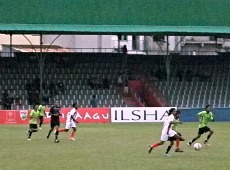
Additionally, two charity football matches were held in Male’s National Stadium Friday (June 7), with Maldivian media presenters facing off against film stars.

The film star women’s team was victorious, winning 4 – 0 , while the men’s media team won 3-0 after dominating overtime penalty kicks.

Proceeds from ticket sales and t-shirt purchases also contributed to the Health Ministry fund.

Furthermore, a Children’s Evening fundraising event was also held at Male’s Children’s Park (Kudakudinge Bageecha).

Donation boxes were also placed at ferry terminals in Male’, as well as IGMH, regional and atoll hospitals.

“Ultimately these events were very successful because we were able to raise so much money,” said Usman.

Likes(1)Dislikes(0)