The Civil Court has rejected a lawsuit filed today by the opposition coalition against the planned US$25 airport development fee to be charged by Indian infrastructure giant GMR, which recently won the bid to redevelop Male’ International Airport.
The coalition argue that any new tax must be approved by parliament, as per the constitution. However the Civil court dismissed the lawsuit noting that the plan had not yet been implemented.
Former Qari Hussein Thaufeeq, arrested last month on multiple charges of child sex abuse, has been transferred to house arrest, reports Haveeru.
Renowned Qari Thaufeeq, Maafannu Dreamy Light, was arrested on 17 August this year and faces up to 18 years imprisonment if found guilty.
He was transferred to house arrest on Friday, as confirmed by the Criminal Court and the police.
The penalty for child sex abuse, according to the Child Sex Abuse (Special Provisions) Act, is 10-14 years but can be extended to 15-18 years if the accused was in a position of trust with the childrenhe allegedly abused.
Thaufeeq was a resource person at the Centre for Holy Quran in Male’ when the allegations were made against him.
Fifty couples, more than three times the daily average, are planning to get married on Sunday the 10 October 2010, reports Haveeru.
The binary number 10-10-10 prompted many to lodge applications at the Family Court to have their marriage ceremony performed on the day. The Family Court approved 50 applications, and told Haveeru that it will try and accommodate all requests.
On average 15-20 marriages are performed daily. On dates that are easy to remember – and leave little chance of forgetting the anniversary – the average always increases manifold. 87 couples got married on 08-08-08, 56 on 07-07-07 and 63 on 06-06-06, says Haveeru.
Adopting proven sources of renewable energy such as wind and solar will reduce both the price of electricity in the Maldives and cut down on price fluctuations caused by the expensive importation of fossil fuels, claims Danny Kennedy.
He would know. The former Greenpeace campaigner turned solar power entrepreneur is riding a surge of interest in the renewable technology, spurred by economic rather than environmental imperatives.
“The solar industry grew 40 percent during the recession,” he tells Minivan News.
“The average price in the US is now US$0.24 a kilowatt, which makes solar power already a third cheaper than grid electricity in the Maldives.”
The Australian environmental campaigner ran Greenpeace campaigns across the Pacific in places such as Papa New Guinea, the Solomon Islands and Fiji, prior to moving to the United States and founding Sungevity, the residential solar company that is now the third largest such provider in the country after just a few years in operation.
Kennedy is in town to oversee the pro-bono installation of 48 photovoltaic (PV) modules on the roof of Maldivian President Mohamed Nasheed’s house, ‘Muleaage’, which convert solar radiation into direct current electricity using photovoltaic semiconductors.
Nasheed has already agreed to personally help install the units, which Kennedy expects will save the country US$300,000 in electricity over the 25-year warrantied lifespan of the units.
Sungevity calculated the solar production potential of Nasheed’s roof from its office in Oakland California, using aerial images from Microsoft’s mapping software.
The method uses a fiendishly clever piece of trigonometry developed by a young student from Sydney Grammar School in Australia, that takes the altitude of the photographing plane from the image’s metadata then uses trigonometry to calculate the angle and direction of the potential customer’s roof, and then plugs in known quantities such as the area’s solar potential and price of electricity.
The result is that customers can determine the amount of electricity the unit will generate and potential savings, over the internet, “with plus or minus one percent margin of error. That’s better than sending a kid onto the roof with a tape measure, which introduces human error.”
The schoolboy’s innovation stunned the Redmond heavyweight sent over to Sungevity from Microsoft to see how the software worked, who told Kennedy that the company couldn’t have done such a thing “with 300 of our own engineers.”
Installing the units on Nasheed’s roof is now the last phase of the operation.
“We installed the rails today, and we’ll install the PV modules over the next few days. There are still some conduits to install to the generating room, and some carpentry to do,” Kennedy explains.
As the President’s house is connected to the grid in Male’, the solar cells will feed electricity back into the grid and help power the city when Nasheed is not running the air conditioning or using the microwave.
“My sense is that he’s trying to do something symbolic and make a statement about solutions to climate change,” Kennedy said. “He seems to be trying to lead by example.”
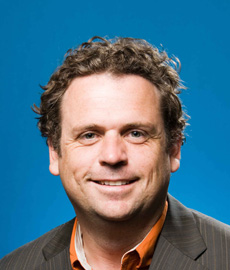
Founder of Sungevity Danny Kennedy suggests the Maldives can develop and export its expertise in renewable energy
The light stuff
The driving force behind solar power is now economic, says Kennedy.
While the capital expenditure for a small unit runs to US$30,000, installations in countries like the US are heavily incentivised and banks are increasingly offering ‘solar financing’ so customers can avoid the upfront hit.
“Solar is now about saving money,” Kennedy says. “The US and Australia give cashback on solar installations, while in the EU the model is a feed-in tariff. In Germany the model pays 40 euro cents per kilowatt hour, so if you install a solar system with a 20 year lifespan, you can sit back and let the thing turn a profit.”
As a result, “Germany‘s projected installation this year is 7000 megawatts – by comparison, Male’s powerplant generates 38.76 megawatts.”
The UK is not far behind Germany, with a proposed 31 pence feed-in tariff: “The UK solar market is going to go gangbusters in the next few years,” Kennedy says.
Feed-in tariffs are the fastest way to promote quick adoption of the technology, Kennedy explains, but incentive models – cashback and feed-in tariffs – “take on the vested interests involved in fossil fuels.”
“The Maldives can move to clean fuel, hedging against fuel price rises while taking on the vested interests of incumbent technology,” Kennedy suggests.
The flat and predictable cost of solar power contrasts with that of fossil fuels, he says, which are expensive for a country like the Maldives to import, subject to price flucutations, and vulnerable to Middle Eastern instability.
“While a small system may cost up to $30,000, it will pay itself back tenfold over its lifespan. It’s a safe and predictable return on investment,” he says.
In the US at least, the price of grid electricity is rising by seven percent per annum, Kennedy explains. The cost of solar units is meanwhile plummeting as production of the devices, led by China, skyrockets.
“Every doubling in production of PV modules represents an 18 percent reduction in price,” Kennedy explains.
“The Chinese have noticed this are increasing production massively, and have doubled production twice in the last three years. There has been a 50 percent drop in price in the last 18 months.”
A country like the Maldives with comparatively low energy requirements has the potential to meet much of its energy demands through a combination of solar, wind and wet (tidal) renewable energy generation, Kennedy suggests, as well as create a great many jobs in the sector.
And if the German experience is anything to go by, that expertise is soon going to be in high demand across the world.
“German companies like Bosch said early on that they are going to become better at this that anyone else, and manage the IP (intellectual property). Now, it’s German engineering staff who are running the Chinese production lines.”
The Maldives could develop its own expertise, Kennedy suggests: “the challenges of powering an isolated island in the Maldives are similar to those of a town in the Australian outback,” he notes.
Kennedy sees the future of power generation as working rather like the internet, running as a grid with many small generators feeding into the system rather than the centralised production and distribution of power.
“I’m not a great advocate of large-scale power plant development, solar or otherwise,” Kennedy says. “It risks replicating the mistakes of the past – it’s a Faustian bargain you make, as with Edison: ‘Give us lights in the streets and we’ll give you a regulated monopoly.’”
Because of the pollution profile, plants are also located further from population centres and up to 30 percent of electricity generated is lost in transmission.
“There are new high-voltage DC lines becoming available but uptake is not substantial,” Kennedy says, predicting a future where power generation is controlled by the consumer and with less wasteful transmission.
“Who pays for that bit in lost in the middle?” he asks: “The public purse.”
With 50 percent of the world’s solar installations in Germany, weather is no longer as great a limiting factor of solar technology either, Kennedy says.
The principle obstacle has rather been one of “political will” – which Nasheed will demonstrate when he clambers onto his roof over the next few days to poses for photos with his new PV cells. Clearly a publicity stunt – but nonetheless a bright idea.
Imposing the death penalty, following Shari’a, and harsher prison conditions are the best way forward for solving the increasing violence in Maldivian society, several MPs have stated.
Fares-Maathodaa MP Ibrahim Muththalib said the major problem faced by society today is the decision of the criminal justice system to ignore Shari’a. “We cast aside the Shari’a and adopted man-made sentencing laws”, he said, making today’s violent society possible.
“Instead of being put to death, murderers are allowed to languish in prisons, given the opportunity to get married and to procreate. We cannot stop the violence without stopping such practices. We cannot stop such problems without a death for death policy”, Muththalib told the Majlis.
“I believe that if you impose the death sentence on just two people in this country, there will no longer be anyone left who will kill. If you amputate the hands of two people in this country, there will be no more thieves left. We have to think about how we can establish these principles of Islam”, Muththalib said.
The debate began after an emergency motion tabled by Hoarafushi MP Ahmed Rasheed on Monday to discuss the violent murder of 81-year-old business man, Hussein Manik, on September 27 in Hoarafushi.
“Those who kill should be killed”, Rasheed said, introducing the motion. “We should amend our penal system to ensure that those who endanger the lives of others would be held in solitary confinement for life, and are never eligible for parole”, Rasheed told the Majlis.
If the murderers of Mohamed, or “any criminals of the sort” should ever return to Hoarafushi, he said, he would personally lead a campaign to provide justice to the people of the island. “I will not hesitate, even if it means that I personally get entangled in the law.”
Madaveli MP Mohamed Nazim agreed that the death penalty, as in the Shari’a, was the answer. “Islam is unequivocal that the penalty for death should be death”. The current violence in the country is a consequence of ignoring or violating the teachings of Islam, he said.
“Otherwise, had we maintained the principle of death for death the murderer would not be there to kill again, or to encourage others to kill. The problems we are confronting today is a consequence of ignoring this principle, which would have set an example for the Ummah and the nation’, he said.
Nazim also said there is no need to amend the country’s murder laws, as the death penalty already exists. “I do not see anything in the penal code that says the penalty for murder should be changed to 25 years imprisonment”.
Nazim said that unless and until the death penalty is imposed, as it is stated in the current penal code, the escalating violence in the Maldives could not be stopped.
Thoddoo MP Ali Waheed attributed the increase in violent crime to the lack of proper prisons. “People who should be behind bars are sitting around on the beaches, sucking on butts and all sorts of things – this is the result”, he said.
Drugs, agreed several MPs, were the main cause for the increase in violence in the Maldives. “We know that sometimes people can get intoxicated to such an extent that they become unaware of their own actions. Sometimes murder can be committed,” said Vilifushi area MP Riyaz Rasheed.
MPs themselves should set a good example, and allegations of intoxicating substances being found in their places of residence or their vehicles are not helping matters, Riyaz Rasheed said.
“Pictures of official delegations abroad show them drinking some sort of a yellow liquid”, he said. Unless such ways are amended, there would be no solution to the social problems of the Maldives today, Riyaz Rasheed said.
Maavashu member Abdul Azeez Jamal Abubakr suggested that religious scholars can make the most important contribution to the problems in society. Perjury, he said, is a major problem in Maldivian courts.
The gravity of such an act, as stated in Islam, should be made clear. “It is incumbent upon religious scholars to relay the ominous penalties that await such actions in Islam”, he said.
Religious NGO Jamiyyathulsalaf has called for the resignation of Education Minister Dr Musthafa Luthfy, and claimed that Arabiyya is the only Maldivian school “with an adequate education policy.”
“The whole education policy of the Maldives has been designed in a way that moves the students further from the religion,” President of Salaf Sheikh Abdulla Bin Mohamed Ibrahim said today.
“As a consequence, students have become poorly educated. If you refer to the results of the students who pass, anyone will understand that.”
Sheikh Abdulla said there was only one school in the Maldives that has an adequate educational policy.
“That school would be Arabiyya School. The School teaches Arab, Hadith, Sunnah of the prophet and the Quran,” Sheikh Abdulla said.
Sheikh Abdulla said the idea of introducing co-educational policy was completely unacceptable.
“There will be social and disciplinary issues that students would have to face if the policy was introduced,” he said. “There will also be consequences for teachers.”
He also warned that “a coalition of NGOs” was preparing to be on standby to come out and demonstrate against the change, if necessary.
Minister of Education Dr Musthafa Luthfy told Minivan News that co-education has been a part of the Maldivian education system for a long time.
“When we studied at ‘Edhuruge’ [traditional places of learning, where classes were held at a teacher’s house] there were girls and boys mixed,” said Dr Musthafa. “There are currently only four schools in the Maldives that is not Co-educational.”
Dr Musthafa said his idea was to develop an integrated educational system that comprised of science, commerce, arts and aesthetics.
“That is an educational system that will contain drawing, music, exercise and sports, plus praying, reciting of the Quran and other religious events,” he said. “This type of policy is known to increase students’ intellectual ability and skills. If anyone is in doubt, they can ask parents and school managements whether students have moved further away from religion or closer to it after I assumed office,” he said.
Luthfy has previously come under criticism after the Ministry’s steering committee suggested making Islam and Dhivehi optional for A-Level students. The controversial proposal led to late-night protests outside Luthfy’s house and an eventual no-confidence motion in parliament, which was annulled when President’s Nasheed’s entire cabinet resigned in protest at parliamentary obstruction.
Blackmarket rates have risen and banks have imposed stricter trade limits on dollars as the country’s currency shortage resurfaces, reports Haveeru.
The rufiya is pegged to the dollar at Rf12.85, however banks regularly refuse to exchange and limit trade transactions in dollars to US$500 at a time. This has now fallen to US$200, Haveeru reports.
Companies that need to buy US dollars with local currency are compelled to use the blackmarket, which is currently at around Rf13.50-13.35 to the dollar. It reached Rf14.50 at the height of the shortage last year.
Parliament returned for its final session of the year today after a month-long recess and passed the Judicature Bill in a bipartisan vote, a crucial piece of legislation for judicial reform.
The last sitting of parliament on August 30 was called off after MPs clashed over amendments proposed to the bill by the opposition Dhivehi Rayyithunge Party (DRP) to both prevent the courts from conducting trials related to the activities of the former government and block retrials of controversial cases.
Parliamentary Group Leader of the ruling Maldivian Democratic Party (MDP) “Reeko” Moosa Manik told Minivan News at the time that MDP MPs protested because the DRP was attempting to “take the judiciary in their fist”.
However, in contrast to the acrimonious sitting of the last session, voting on amendments passed smoothly.
The Judicature Act was passed today with 50 votes in favour, four against and six abstentions.
As stipulated by chapter six of the constitution, the Act specifies the hierarchy and jurisdiction of the courts as well as standardized procedures for administration.
Once ratified, the Act will also create a Judicial Council to formulate regulations and procedures for trials.
The bill was proposed by the government in March this year.
Free whip
Baarah MP Mohamed Shifaz, spokesperson for the MDP parliamentary group, told Minivan News today that he voted against the bill because he was “not satisfied” with some provisions.
Following extensive discussions, the two parties came to an agreement on the bill during the last session, Shifaz explained, but the DRP proposed “a lot of amendments at the last minute.”
Speaking to Minivan News at the time, DRP MP Dr Abdulla Mausoom, accused the MDP of scuttling the last sitting on August 30 when “it was not going the way MDP MPs wanted.”
“We have the right to propose amendments; all the things they are saying are excuses,’’ said Mausoom. “MDP MPs just do not like following the due procedure of the parliament.’’
Mausoom defended the amendments as intended to “broaden the bill and to frame it in such a way that the courts can perform their work best.”
The bill was voted through with all the amendments proposed by the main opposition and only one amendment proposed by an MDP MP.
On the final vote, Shifaz said that the MDP MPs were given a free whip “to vote with their conscience” as the matter was of national interest.
Among several issues with the final bill, Shifaz said that he objected to “a big gap” between courts in the capital Male’ and the atolls as islanders would have to come to Male’ for civil cases involving an amount in excess of Rf100,000 (US$7,782).
Moreover, he added, the Act would give excessive powers to the Judicial Services Commission, such as control of the Department of Judicial Administration, which would be renamed if the bill is ratified.
Point of order
Today’s sitting became heated during the preliminary debate on a bill on jails and parole proposed by the government when DRP MPs raised consecutive points of order to object to President Mohamed Nasheed’s refusal to ratify the amendments to the Public Finance Act more than a month after parliament voted to override a presidential veto.
According to article 91(b): “Any bill returned to the People’s Majlis for reconsideration shall be assented to by the president and published in the government gazette if the bill, after reconsideration, is passed without any amendments, by a majority of the total membership of the People’s Majlis.”
The objections of the DRP MPs were echoed by Dhivehi Qaumee Party (DQP) MP Riyaz Rasheed and independents Ibrahim Muttalib and Ahmed Amir.
The MPs argued that passing any further legislation was “pointless” until the president ratified the amendments to the Public Finance Act, claiming that continuing sittings in the meantime was a serious procedural issue.
As the sitting grew heated, Deputy Speaker Ahmed Nazim threatened to invoke his authority under the rules of procedure to call out the name of DRP Deputy Leader Ali Waheed and force him out of the chamber.
Addressing the points of order, Deputy Speaker Nazim said that the matter was “a constitutional issue” as article 91(b) did not specify the period in which the president had to ratify bills passed by parliament for a second time.
The minority opposition People’s Alliance MP suggested that a dispute between the executive and the legislature could only be resolved through the courts.
“I don’t believe that with the issue you are raising we could make any progress without passing through the stages of the legal process,” he said.
Former DhiFM journalist Qufthag Ajeer has reported the private radio station to police, alleging senior management deliberately leaked the source of his story concerning mistreated employees at the Hulhule’ Island Hotel (HIH).
Ajeel, who recently resigned over the issue, has sent a letter to Commissioner of Police Ahmed Faseeh requesting a “fair investigation” of the case.
“The Hulhule Island Hotel threatened to take legal action against DhiFM if the source of the report was not revealed,” said Ajeer. “DhiFM then revealed the hidden source to the Hulhule Island Hotel without my knowledge.”
Ajeer alleged that DhiFM management searched through his personal folder at work to obtain the source’s identity before revealing it to HIH without his consent, or that of the source.
Article 28 of the constitution guarantees absolute protection of journalists from being forced to reveal sources: “No person shall be compelled to disclose the source of any information that is espoused, disseminated or published by that person.”
Such so-called ‘shield laws’ are intended to increase the accountability of businesses, organisations and governments by promoting ‘whistle-blowing’, ensuring protection of sources if a media organisation is taken to court and preventing journalists from being held in contempt of court for refusing to reveal them. They do not protect against the pursuit of defamation cases.
As a consequence of DhiFM’s action, Ajeer said that the Hulhule Island Hotel has now warned the source that he will be dismissed for disclosing the information.
Editor of DhiFM Masoodh Hilmy told Minivan News that Ajeer was “misled”.
“I can confidentially say that no person at DhiFM revealed the source of the article,” said Hilmy. “But the Hulhule Island Hotel did request us to reveal the source and said they take would legal action against us.”
Hilmy said DhiFM replied to the Hulhule Island Hotel saying that the source would only be revealed if the court ordered the news organisation to do so.
“The Hulhule Island Hotel did not threaten us, but demanded an apology claiming the article contained false allegations,” he added.
President of the Maldives Journalist Association (MJA) Ahmed Hiriga Zahir, compared the matter to Watergate and told Minivan News that journalists had a responsibility to confide sources with their editors.
However if the institution then revealed the identity of a source to a third party, “I don’t think this is ethical.”
“They should respect sources. Even the constitution guarantees the protection of sources for a journalist.”
Hiriga suggested that some senior journalists and editorial leadership in the country did not have this background in the principles of journalism- “it may be they don’t know what they are doing,” he said.
Ajeer was among six DhiFM journalists who launched a protest outside the media company’s offices yesterday, alleging unfair dismissal and claiming editorial pressure to produce negative coverage of the government.
The Media Council of the Maldives meanwhile issued a statement claiming that the protesting DhiFM journalists were a “serious obstacle” to the press freedom in the country, and that disagreements among reporters about newsroom policy should be resolved internally.
Ajeer pointed out that the Media Council consisted of “two senior DhiFM officials trying to defend DhiFM.”
 (0)Dislikes
 (0)Dislikes
 (0)
(0)