DQP MP Riyaz Rasheed attacked, party alleges

The Dhivehi Qaumee Party (DQP) has alleged that DQP MP Riyaz Rasheed was attacked last night while he was on his way home after attending a meeting.

A crowd gathered around Riyaz’s car demanding he get out of it, and assaulted him when he did so, Haveeru reported.

DQP today issued a press release saying it “was possible” that Maldivian Democratic Party (MDP) Chairperson and MP ‘Reeko’ Moosa Manik “was behind the attack”.

“The fact that the attack came a few days after former MDP Parliamentary group leader Moosa gave a warning to Riyaz, it is possible that the attack has some connection with the warning,” the DQP claimed.

DQP said that Riyaz Rasheed was the MP who had submitted “the most number of bills to the parliament,” an MP that had been “criticising the government publicly” and that there had been “many attempts made to silence his voice.”

“The government has repeatedly attempted to stop Riyaz from his work against corruption in this government, by trying to bribe him, threatening him and by torturing him,” the DQP alleged.

Meanwhile, MDP Chairperson and MP Moosa Manik said he believed that DQP Dr Hassan Saeed was behind the attack “if they are blaming it on me.”

“Dr Hassan Saeed and Riyaz have been disturbing me and my family for a long time,” Moosa said. “And because that does not satisfy them, they are now blaming me for this.”

Moosa said he had “never attacked anyone physically or mentally.”

“I call on the police to investigate and find out on what grounds they are making this accusations on me,” he said.

Police Sub-Inspector Ahmed Shiyam said the matter had been reported to police, who were investigating.

Likes(0)Dislikes(0)

Key taxation bill put before parliament for vote

Parliament will vote on Monday whether to introduce one of the government’s four key pieces of tax legislation that it has promised the International Monetary Fund (IMF) will help the country claw its way out of a crippling budget deficit.

The combined goods and services tax (GST) bill contains a general GST of 5 percent, and an increase to the existing tourism GST (TGST) from 3.5 percent to 6 percent.

Parliament voted on July 18 to send to committee four bills of the government’s economic reform package: the GST bill, an income tax, a corporate profit tax and a bill governing excise and reduction of import duties.

At the time all four bills received more than 50 votes apiece from the 72 MPs present and voting, hinting at broad cross-party acceptance of the need for taxation. Of the 72 MPs acting as a committee, 51 voted approval of the bill with the proposed amendments.

To expedite the process, an 11-member sub-committee was chosen to review the bills with five MPs of the ruling Maldivian Democratic Party (MDP), three MPs of the opposition Dhivehi Rayyithunge Party (DRP), Jumhooree Party (JP) Leader Gasim Ibrahim, one MP of the minority opposition People’s Alliance (PA) and Dhuvafaru MP Mohamed Zubair as an Independent MP.

On Monday, parliament will vote whether to finally pass the GST bill when it is presented to the chamber.

Most of the many amendments proposed to the bill by the committee are administrative, but several concern additional commodities to be exempted from GST, including petrol, diesel, cooking gas, telecoms and adult diapers.

The amendments also replace the government’s proposed start date of October 1 to within a month of whenever the legislation is published in the government’s gazette (following presidential ratification).

Following consultations with the opposition and the apparent support of 51 members for the bill, the Dhivehi Rayithunge Party (DRP) issued a pamphlet declaring it no longer supported the bill.

“They already essentially voted to support it, but now the DRP are bringing out statements and newspapers interviews saying don’t support it, and they have issued a whip line for the party not to support it [in the vote tomorrow],” said a source in the President’s Office.

The source said the government was also hoping the amendments to the Export-Import Act of 1979 would also be passed, as the GST was intended to replace it and crossover would see the same commodities being taxed twice.

At its press conference today, the DRP handed out a booklet titled “DRP’s response to the government’s fiscal and economic nuisance” with seven main points against the economic reform package.

The DRP objected to a projected growth of Rf1 billion in the budget for 2013 and expressed concern with expenditure out of the budget reaching 66 percent of GDP in 2009 – compared to 32 percent in Seychelles and 21.6 percent in Mauritius – claiming that the purpose of the new taxes was to “find money to influence the public for the 2013 [presidential] election.”

On the second point, the DRP notes that the 27 unemployment rate “proudly announced by the President” meant that 1 out of 4 people were unemployed, advocating diversification of industries to increase productivity. The DRP observed that the government’s policy for controlling inflation and spurring job growth was vague and unclear.

Thirdly, the DRP would oppose the introduction of a personal income tax on the grounds that the country’s unique geography, limited natural and human resources, and high cost for investments in the country did not make a direct tax advisable in the current economic climate.

While the government proposed that only those who earn above Rf30,000 would have to pay the tax, the DRP noted that all citizens would have to file tax returns.

“The charts of the government’s fiscal and economic nuisance package show Rf300 million will be received in 2012 from income taxes and 475 million in 2013,” it reads. “Instead of making all citizens file tax returns in order to earn 475 million two years after taxes are introduced, it would be far better to reduce the government’s useless expenditure by that amount.”

It adds that administrative costs for collecting income taxes from Maldivians living abroad would be disproportionate to the returns.

As its fourth point, the DRP noted that the General GST would affect small businesses such as cornershops, cafes and teashops, which would “need a lot of preparation” to maintain accounts and provide customer’s statements showing the GST percentage.

Morever, taxing “total value of business transactions” would not be possible with GST at zero percent for some items.

Considering the potential “administrative confusion” and the country’s heavy reliance on imports, the DRP argues that levying a customs duty at the entry point to the country was more effective.

The DRP is also against abolishing the Foreign Investment Act as it would remove protectionist restrictions, urging instead “amendments to the law to pave the way for foreign parties to invest in the Maldives and conduct businesses”.

The DRP “could not agree to sell the country’s remaining assets to the MDP’s friends” after “[losing control of] the country’s main gate, the international airport, the national telecom service, and Maldivian seas and shallows.”

Proposed amendments to the Immigration Act was meanwhile intended to “provide an opportunity for MDP’s friends to settle in the country and establish a foothold.”

Offering residential visas, it continues, would worsen unemployment and crop up “more challenges” for Maldivian professional workers.

On its final point, the DRP claims that the fiscal responsibility bill was “a scheme” to negate parliament’s amendments to the Public Finance Act and “reclaim the fiscal discretion offered to councils in the Decentralisation Act”.

In prior meetings with the government, the President’s Office source told Minivan News that “we agreed that state expenditure needed to be lowered, something the IMF was also asking for, but they mentioned none of these [other] things. We’re keeping our side of the bargain, but it’s hard to reach an agreement with them when they keep changing their minds.”

Unless the bills are passed before parliament goes for a month’s recess on Tuesday, the government may miss its commitments made to the International Monetary Fund (IMF) on announcing the economic reforms package. These included:

  • Raise import duties on pork, tobacco, alcohol and plastic products by August 2011 (requires Majlis approval);
  • Introduce a general goods and services tax (GST) of 5 percent applicable to all sectors other than tourism, electricity, health and water (requires Majlis approval);
  • Raise the Tourism Goods and Services Tax (TGST) from 3.5 percent to 6 percent from January 2012, and to 8 percent in January 2013 (requires Majlis approval);
  • Pass an income tax bill in the Majlis by no later than January 2012;
  • Ensure existing bed tax of US$8 dollars a night remains until end of 2013;
  • Reduce import duties on certain products from January 2011;
  • Freeze public sector wages and allowances until end of 2012;
  • Lower capital spending by 5 percent

At the announcement of the economic reform package, Governor of the Maldives Monetary Authority (MMA) Fazeel Najeeb acknowledged that “there will be some eyebrows raised and some reservations on the measures – this is inevitable in any country changing its taxation regime.”

“There are instabilities and I hope these will be short term. But I think what we are doing is in the interest of the economy and will bring it out of the mess it is in. I think it is necessary that we act together now,” Najeeb said.

The IMF package, he noted, represented “a joint commitment by the Ministry of Finance and the central bank: a state affair in the interests of the economy and the country. Everybody in the country realises and recognises that there needs to be a change in the status quo. The status quo is a fiscal stance that is unmanageable.”

Asked whether he felt the new taxes were likely to be passed by parliament, “I think when it comes down to the details of what and how the legislation takes shape, that should be left to Majlis. What I can say is that status quo needs to change, and I don’t think this can be only reduction [in expenditure]. There needs to be a considerable amount of income increase. A combination of revenue as well as expenditure.”

Last week, at a launching ceremony for the “Fiscal and Economic Reform Programme,” Mohamed Umar Manik, chairman of the Maldives Association of the Tourism Industry (MATI), observed that a sustainable source of government revenue was necessary for providing public goods and services.

“Today we have democracy in our country, but democracy can only be strengthened if we are able to deliver,” said the Chairman of Universal Enterprises. “To do this, our government must have sources of income. A detailed reform agenda has been proposed for this. In my view, it is an ideal reform programme.”

Sunland Travels Director Hussain Hilmy stated that the Maldives’ “economic policy and legal framework needs to undergo modernisation and reform.”

“We in the business community welcome the bold initiative being undertaken to carry out a programme of comprehensive economic and fiscal reform,” Hilmy said.

He added that businesses were “delighted” with the government’s policy of a “shift away from import duties as a major source of government revenue.”

Meanwhile, speaking to Raajje TV last night, Finance Minister Ahmed Inaz said that the proposed tax system should have been in place 10 years ago, and that any further delay was unnecessary.

Inaz said the additional revenue was needed to pay civil servant salaries, and provide services such as water, power, independent institutions, sewerage, hospitals, schools “and the salaries of Majlis members and their committee allowances.”

Likes(0)Dislikes(0)

MDP declares support for mandatory presidential primaries

The ruling Maldivian Democratic Party (MDP) will back a proposal to make presidential primaries mandatory in the political parties bill, currently at committee stage.

MP Ibrahim ‘Ibu’ Mohamed Solih, MDP parliamentary group leader, announced the decision at a press conference yesterday, two days after the main opposition Dhivehi Rayyithunge Party (DRP) declared it would not support the General Goods and Service Tax (G-GST) bill up for a final vote tomorrow.

“We believe that as many members as possible should have a say when a presidential candidate of a political party is determined,” Ibu Solih said. “In our party, we have a general vote among members to select the presidential candidate. When a bill on political parties gets passed, we believe that principle should be included in the law.”

Speaking to Minivan News today, MP Ahmed Mahlouf of the DRP’s Z-faction and spokesperson of the ‘joint opposition parliamentary group’ said that the opposition MPs would “welcome” the MDP’s move.

“But the bill should have been passed a long time ago,” Mahlouf said, reiterating a claim the Z-DRP has made in the media over past months that the bill had been parked at committee as part of “a deal between [DRP Leader Ahmed] Thasmeen [Ali] and MDP.”

The political parties bill has been stalled at committee stage since May 19, 2010.

Mahlouf said that Thasmeen was the one who stood to lose from stipulating mandatory presidential primaries.

“Thasmeen has no backbone,” Mahlouf continued. “At first he said he would support the tax bills and now he’s saying he doesn’t support it anymore.”

The opposition parliamentary group would support any amendment to the political parties bill stipulating mandatory primaries, Mahlouf said.

In June, the breakaway Z-faction called for an “emergency congress” to determine the party’s presidential candidate after ‘Honorary Leader’ and former President Maumoon Abdul Gayoom withdrew his endorsement of Thasmeen.

Thasmeen was selected as the party’s presidential candidate in the DRP national congress in March 2010 after he ran uncontested for the post.

At a press conference today, DRP Deputy Leader Ahmed Mohamed said that he did not believe the MDP’s announcement had any relation to the DRP’s stance on the tax bills.

“Perhaps it might be an effort to shake us up a bit,” he speculated. “We are really not against a primary. We at the Dhivehi Rayyithunge Party are not opposed to a primary. What we’re saying is that the DRP charter does not say anything about a primary.”

Ahmed Mohamed noted that proposal to hold a presidential primary did not pass at the party’s last congress. The DRP charter states that the party’s presidential candidate shall be its leader, he said.

“So we can’t go against the DRP charter,” he stressed, adding however that the DRP would not oppose a presidential primary if it was stipulated in a law. “But we can’t do it now no matter how much some people might want it.”

Likes(0)Dislikes(0)

MDP, PA in favour of disclosing financial statements

The ruling Maldivian Democratic Party (MDP) and minority opposition People’s Alliance (PA) have come out in favour of making MPs financial statements public.

Deputy Speaker Ahmed Nazim, PA parliamentary group leader, told local media yesterday that the party will send a letter to the parliament secretariat requesting that financial statements of its MPs should be made available to state institutions upon request.

The decision comes after the Anti-Corruption Commission (ACC) entered parliament on Thursday under a court order to seek MPs’ financial statements. The commission has since told local media that it sought the statement of one MP, whom it did not reveal.

Meanwhile MDP parliamentary group leader, MP Ibrahim Mohamed Solih, said at a press conference yesterday that the party believed financial statements should be made available to anyone who sought it.

“Since we are representatives of the people, we believe that the public should know about MPs’ incomes, standard of living, and what they do with their incomes,” he said, adding that the party would “establish a proper system” to make the information available.

A decision would be made following discussions at the MDP’s national council or parliamentary group, the MP for Hinnavaru said.

In April this year, parliament reached an impasse on public declaration of assets by MPs after voting against a proposal by the Ethics Committee to not make the information available unless ordered by a court of law.

When MPs voted against the proposal 34 to 24, Deputy Speaker Ahmed Nazim declared the matter “void.”

“However, the Secretary General’s request for counsel on this matter has not been decided one way or the other,” he said at the time. “So the Secretary General will go ahead with it according to the rules of procedure.”

The Secretary-General had asked the Ethics Committee to determine whether MPs’ financial statements should be released to other state institutions upon request.

Secretary General Ahmed Mohamed confirmed to Minivan News that the requested financial statements and documents were provided to the ACC team before the court order expired at 3:00pm.

According to Article 76 of the constitution, “Every member shall annually submit to the Secretary General of the People’s Majlis a statement of all property and monies owned by him, business interests and liabilities. Such declarations shall include the details of any other employment and obligations of such employment.”

Likes(0)Dislikes(0)

Media Council condemns Criminal Court for excluding journalists from Deputy Speaker’s corruption trial

The Maldives Media Council (MMC) has condemned the Criminal Court for barring journalist from a corruption hearing involving Parliament’s Deputy Speaker and People Alliance Party (PA) MP Ahmed Nazim.

The council issued the statement following the Criminal Court judge’s decision, stating that the court’s claim that journalists were blocked because they gave a negative perspective on the court was not probable grounds to disallow journalists from hearing the trial.

The Council said that the Criminal Court’s decision would prevent the court from gaining public confidence.

The MMC’s press statement said the decision to bar journalists from the trial was “a huge challenge” for people’s right to a free press, as outlined in the Constitution.

Last Thursday, the Criminal Court refused to allow journalists to observe the hearing of Nazim’s ongoing corruption trial. Nazim is facing charges of multiple counts of conspiracy to defraud the former Atolls Ministry.

Local dailies Haveeru and Sun Online reported that the hearing was scheduled to start at 12:00pm, but was actually conducted one hour earlier at 11:00pm. The court had not informed any of the reporters who registered at the court that morning of the time change.

According to Haveeru, court reporters who learned of the time change and requested entry were told that “the judge has decided to hold a closed hearing.”

When asked by reporters to offer a reason for the closed hearing, the court official asked the reporters to wait, went inside and did not appear until the hearing was over.

Almost two hours after the hearing concluded, Criminal Court Media Officer Ahmed Mohamed Manik told the court reporters that had not been allowed to enter because “negative perceptions of the court were being created [among the public] because of some journalists.”

Queried by the court reporters, the Criminal Court official insisted that the judge was authorised to exclude the public from trials under article 42 of the constitution. Members of the public were allowed to attend today’s hearing.

Under normal court procedure, only trials involving child sexual abuse are closed to the public.

Likes(1)Dislikes(0)

Third of government’s Dhiraagu shares to be made public

The government has decided to release a third of its shares in local telcoms giant Dhiraagu to the public.

Dhiraagu a major player in the telecommunications, mobile and broadband internet markets of the Maldives, and is one of the country’s most profitable companies.

The government will make a third of its shares available to the public from October, to both local and foreign parties, reports Sun Online. Share prices have not yet been published.

The Maldivian government previously held 55 percent of Dhiraagu’s shares, while the British company Cable and Wireless held the remaining 45 percent. Upon winning the 2008 presidential election, President Nasheed’s government sold 7 percent of the shares to Cable and Wireless, reducing government shares to 48 percent and giving Cable and Wireless a controlling interest.

Minister of Economic Development and Foreign Trade, Mahmoud Razee, told Sun that studies would determine the prices and ratios of shares to be offered in local and international markets, and that the shares would be “affordable” to the average Maldivian.

Minister Razee also stated that as Dhiraagu was a strong company, people could benefit from buying its shares.

Opposition Dhivehi Rayyithunge Party (DRP) Deputy Leader Ibrahim ‘Mavota’ Shareef told Minivan News that the shares were valuable, but said he was not in favor of selling them.

“As far as [the DRP] is concerned, we do not believe this is a wise decision. Dhiraggu is a very profitable and well-managed company, and it makes a lot of money for the government. This is a time when we are undergoing an economic crisis, and we cannot afford to have these shares dispersed.”

Shareef said he thought most Maldivians would be interested in the shares, but said he doubted whether the majority of people would be able to afford them.

“The people who have the capacity to buy these shares are either foreign companies, or very rich Maldivians,” he said.

The government estimates that the sale of the shares will generate Rf 1.46 billion (US$95 million).

Shareef said the outcome would be obvious as soon as the shares hit the market.

“In the Maldives, we know who has the money. We know a majority of people don’t have the money. There must be some political reason for this decision, it’s not just an economic strategy,” he suggested.

Likes(0)Dislikes(0)

NGOs, concerned citizens launch protest against MPs’ committee allowance

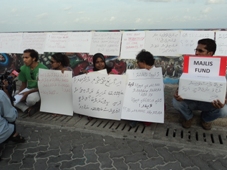
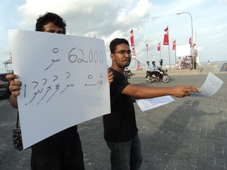
A group of concerned citizens and members of civil society organisations launched a protest today in response to parliament’s Public Accounts Committee (PAC) decision last week to issue a lump sum of Rf140,000 (US$9,000) as committee allowance back pay for January through July this year.

If the PAC decision stands, in addition to a monthly salary of Rf62,500 (US$4,000), at the end of August each MP would receive a lump sum of Rf160,000 (US$10,386) as committee allowance.

At a time when the country faces a crippling budget deficit, the back payment of the allowance will cost the state up to Rf12.32 million (US$800,000), rising to Rf76.23 million (US$4.9 million) in wages for 77 MPs for the whole year.

Gathered near the tsunami memorial after 4:30pm today, the protesting citizens handed out flyers to passersby with a graph showing the steep rise of MPs’ remuneration from Rf4,500 (US$292) a month in 2004 to Rf82,500 (US$5,350) a month in 2011.

“MPs do not need to be paid more money to do committee work!” reads the flyer. “It is the duty of MPs. It is one of the most important responsibilities that has to be carried out by MPs.”

As this was “clearly stated in Majlis’ law,” drawing an additional Rf20,000 from public coffers “is a gross injustice to the Maldivian people.”

Aiman Rasheed from Transparency Maldives told Minivan News that the protestors believed the decision to institute a committee allowance was symptomatic of “inherent problems in the entire system.”

“With such a high budget deficit and high inflation, we do not accept that the hike [in remuneration] is at all responsible,” he explained.

Aiman dismissed the argument that a committee allowance would improve parliament productivity: “The rules of Majlis committees, how they function, the relationship of the parties and procedures on proposing bills should be changed. Basically, they should become better people.”

For productivity to increase, said Aiman, parliament as an institution should function better.

Carrying a placard calling on her MP to not accept the allowance, Salma Fikry, executive board member of NGO Democracy House, said that the “pretext [of improving productivity] the MPs are using is utterly ridiculous.”

“The civil servants are in more close proximity to the public, so what about the productivity of civil servants?” she asked.

Salma argued that as committee meetings were “part of MPs’ duties,” the decision to issue Rf20,000 as committee allowances “is an injustice done to the Maldivian people.”

Aiman meanwhile asserted that the decision to issue a lump sum for seven months cast doubts on MPs “sincerity” as each MP would receive the back pay regardless of attendance.

Moreover, Aiman pointed out that parliamentary committees did not function for two months of the current session over a partisan dispute regarding the revision of committee composition.

“These things need to be talked about,” he said. “What we are trying to do is bring this issue to the spotlight and help the public understand […] With a constitution based on parliamentary supremacy, nothing in the country can go right if the MPs aren’t responsible. We want to create grassroots demand about what is going in Majlis and for the public to be aware of it.”

Salma however said she doubted if MPs would be moved by the protests to scrap the controversial allowances.

“Because in January this year we launched quite a strong campaign against the Parliamentary Privileges Act and we also spoke about the committee allowance during that campaign,” she explained. “But what we see today is that civic action is not bearing what it should in this democracy of ours.”

This was the case because state institutions such as the People’s Majlis were “too strong” and “has a lot of vested interest and a lot corruption,” she said.

Aiman concurred that MPs “do not bow to civic pressure” but the NGOs and concerned citizens hoped to “equip the public with relevant knowledge” to hold parliament accountable and achieve a reduction in “the almost exponential [year-on-year] growth” of salaries in the state budget.

“Thirdly, [we want] the public to understand these issues and demand accountability,” he said. “Fourth, we want to broaden the engagement of citizens with the People’s Majlis. And to let the People’s Majlis know that the people are watching you and that the people do care.”

Likes(0)Dislikes(0)

Comment: Let’s talk about ideology

There is an unbearable emptiness to Maldivian political rhetoric. Everywhere we look are people who say what they do not mean, and mean what they do not say.

Take former President Gayoom’s pre-Ramadan Epiphany: Z-DRP and Adhaalath are ideological twins.

Since when? Does Adhaalath not espouse beliefs that Gayoom once allegedly had people tortured for? Legend has it that the kind of beards that men sport with such pride these days were once shaved with chilli powder by Gayoom’s henchmen. This is a madness in method missing even from the notorious ‘enhanced interrogation techniques’ at Guantanamo Bay.

Now, though, we are to believe that this vast ideological chasm between Gayoom and Them has been magically crossed. That somehow, in the turmoil of transition, the ideological kaleidoscope was shaken so much that Gayoom and Adhaalath are now soulmates.

Do you find it hard to believe that an individual could flip-flop across such vast ideological terrain in one lifetime, let alone in one political career (no matter how long)? Is it difficult to grasp how one man can go from actively banning the buruga to aligning himself with those who take the measure of a woman’s morality by the very same piece of cloth?

Do you find it difficult to get your head around how a man who once courted international diplomatic accolade with such rigour would now align himself with a party that thinks Iranian approval is a foreign policy victory? Even bearing in mind that this is Gayoom we are talking about, it is hard to make sense of such a complete volte face, is it not?

Do not be too hard on yourself, though, for no such vast ideological changes have occurred. The truth of the matter is there was no ideology to begin with. We are an ideologically empty vessel, and the proof is not just in the clamour that such vessels tend to make and we hear constantly on our airwaves. It is there to see in the many crossings made over seemingly irreconcilable ideological lines in recent times.

Remember DRP’s most vitriolic and vociferously anti-MDP figure in the Majlis, MP Ali Waheed, moving to MDP in May this year? The air was filled with such a triumphant yellow that everyone looked jaundiced. What was there to celebrate? That MDP was one man closer to an outright parliamentary majority.

Granted, a majority is clearly necessary if MDP is to surmount the blockades to progress set up by the Maldivian Tea Party-ers. But on how firm an ideological ground is a party willing to welcome – if not buy – a man who until the moment of transfer had been against everything the party stood for?

Fast-forward a few months, and there is Mr Ali Waheed, the proud owner of a MRF 4.6 million home, on the beachfront of Hulhumale’. How did he afford it? It is a question that one must not ask for fear of ‘politicising’ the issue, says the man himself. Indeed. These journalists must be insane to find anything political about an MP, even on the outrageous monthly income of Rf 60,000, buying a plot of land for almost Rf 5 million.

Then we have Adhaalath, the party of purists and the gatekeepers of heaven for Maldivians. One day they describe the West as the Great Satan, the Puppet Masters of the religiously weak Dhivehin, the corrupters of our children and the seducers of our youth. The next day they fly in individuals who represent the worst the West has to offer to lecture us on how we should conduct and govern ourselves.

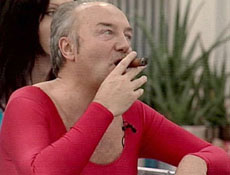
British MP George Galloway

First there was Philip Green, according to whom England is a country full of drunken louts who do nothing but puke and urinate alcohol on the streets of London twenty four hours a day seven days a week.

Then Adhaalath proudly links us via video to George Galloway, former UK MP and Celebrity Big Brother star who once danced on national television in a pink lycra cat-suit. While even sinful liberals found Galloway’s behaviour hard to comprehend, self-righteous Adhaalath seems to have had no such qualms.

If Adhaalath believes what it says, how can it hold Galloway up as a figure of authority to the same people that it wants to cleanse of all alleged Western debauchery? Galloway’s decisions in the Middle East have not been exactly wise, to put it kindly. But that’s all right, because Adhaalath found some perverse use to make of him. And Galloway lapped it all up, like the cat that he was on Big Brother, happily dictating our foreign policy as ‘an entirely Muslim country’.

And this, ladies and gentlemen, in the same week we were celebrating our independence from British protection. It was also the same week in which Gayoom was speaking of the imminent threat we face from a supposed revitalisation of British imperial ambitions.

Ideological complexities? No. Lack of ideology, lack of a purpose except one’s own political or pecuniary power. What matters is knowing which side of your bread your Halal butter is on. What matters is that there is a pot of political gold at the end of the rainbow of beliefs one can feel free to pick and choose from.

This emptiness of rhetoric, of being, is dangerous.

As we saw from the riots in London earlier this month, when the people at the top believe that it is okay to rob from the poor with impunity like the bankers did in the West; and that it is alright to violate the rights of others as Murdoch’s news empire did in Britain – the chances are that the little people below may feel free to do the same.

If we want a society with purpose and belief, we need leaders who say what they mean; not individuals who take a Hypocrite’s Oath when assuming office.

To see the future of things to come if we continue on this path of duplicity, we need only look at the rampant hypocrisy among us from the designation of ‘Top Fashion Accessory’ status to the buruga to the ‘Back to the Prophet’s Day’ men on Harley Davidsons with their orange beards grotesquely flowing in the wind.

If all this is doing your head in, sign up for an Incantation Class at the Islamic Foundation’s Halal Magic Courses. Book early, though. They are proving even more popular than the fishnet stockings and the Botox shots that are to accompany next season’s lamé burugas.

All comment pieces are the sole view of the author and do not reflect the editorial policy of Minivan News. If you would like to write an opinion piece, please send proposals to [email protected]

Likes(1)Dislikes(0)

Parliament approves Rf160,000 lump sum for each MP as committee allowance back pay

Parliament’s Public Accounts Committee (PAC) on Wednesday approved a lump sum of Rf160,000 (US$10,376) for every MP, in committee allowance back pay for January through August.

The decision to approve the Rf20,000 (US$1200) monthly allowances in December 2010 was met with  protests and widespread public indignation. However in June this year, parliament rejected a resolution proposed by opposition Dhivehi Rayyithunge Party (DRP) MP Ahmed Mahlouf to scrap the allowance.

The back payment of the allowance will cost the state up to Rf 12.32 million (US$800,000), following a year in which a quarter of all parliament sessions were disrupted and at a time when the country faces a crippling budget deficit.

A Majlis official, who wished to remain anonymous, confirmed to Minivan News that following its decision, the committee asked the Speaker to issue the lump sum allowance with MPs’ salaries this month.

Deputy Speaker Ahmed Nazim, chairman of the PAC and parliamentary group leader of the minority opposition People’s Alliance (PA), was not responding at time of press.

Article 102 of the constitution states that parliament shall determine the salaries and allowances of the President, Vice President, cabinet ministers, members of parliament, members of the Judiciary, and members of the independent institutions.

The Rf20,000 allowance was initially approved on December 28, 2010 as part of a pay scheme recommended by the PAC.

The opposition-majority PAC decided earlier this month that MPs who attend less than 50 percent of committee meetings would not receive the allowance while those who attended between 50 and 75 percent would receive Rf10,000 (US$648) a month.

While MPs who attend over 75 percent of meetings would receive the full amount, those who did not wish to take the allowance would be allowed to refuse it.

Few MPs that Minivan News contacted today wished to comment on record regarding the controversial allowances.

Independent MP Mohamed Nasheed told Minivan News that he was not informed of the Public Accounts Committee decision.

“There was a decision to institute committee allowance, I know. [But] I am not in support of a committee allowance at all. And if there is any back pay, that would be awfully irresponsible,” he said.

Nasheed added that he had written to the Speaker requesting that he “not be given it and that it may not be deposited with my salary.”

Maldivian Democratic Party (MDP) MP Ahmed Hamza, a member of the PAC, meanwhile said that he too was not aware of the decision.

If a decision had been made, said Hamza, it must have been done while he was either absent or had stepped out of the committee meeting.

“I do not think it is a good idea at all,” he said. “I have expressed my disapproval at the committee when it was first discussed.”

Hamza added that he did not want the allowance. Other MDP MPs on the committee did not respond at time of press.

With the committee allowance, in addition to their existing salaries, Maldivian MPs earn just US$215 a month less than MPs in Sweden.

Breakdown of the vote to scrap the allowance, by MP.

Likes(0)Dislikes(0)