MDP allege police investigations are campaign obstruction

Additional reporting by Ahmed Nazeer

The opposition Maldivian Democratic Party (MDP) has alleged that officials in the government were threatening senior party figures in a bid to obstruct the party’s presidential campaign, ahead of the upcoming presidential elections.

In a press statement released yesterday (August 25) on its website, the MDP alleged that recent police summons and prosecution of its senior figures – including parliamentary group members – were part of the government’s plan to obstruct campaigning.

The statement came shortly after former President Mohamed Nasheed’s former Special Envoy, Ibrahim Hussain Zaki, was summoned to police for questioning. Zaki’s passport has also been withheld by the authorities.

Last week, the prosecutor general filed charges against six people – including MDP MPs Hamid Abdul Ghafoor, Abdulla Jabir, and former Press Secretary Mohamed Zuhair – regarding their apprehension at Hondaidhoo island last November, allegedly in possession of alcohol.

Meanwhile, members of MDP MP Ali Waheed’s family – including his mother, father and wife – were summoned to police as part of an investigation into a corruption case concerning the buying of a house in Male.

“The MDP condemns the politicized police summons and prosecutions against during former Special Envoy Ibrahim Hussain Zaki, parliamentary group members Hamid Abdul Ghafoor and Abdulla Jabir, as the MDP’s campaign gathers pace ahead of the presidential elections,” read the MDP’s statement.

The party also alleged that the arrests on Hondaidhoo were politically motivated and were the government’s attempt to influence the now-shelved no-confidence motions filed against then Home Minister Mohamed Jameel Ahmed and Defense Minister Mohamed Nazim.

Despite the MDP’s claims, Chair of Elections Commission Fuwad Thowfeek told local media that the commission had received few complaints regarding attempts to obstruct campaigning.

Thowfeek said that the commission’s complaints bureau was addressing the complaints filed, and would take action if required.

“Complaints concerning attempts made to influence and obstruct campaigns are very low compared to previous elections. The complaints are very few,” Thowfeek told local newspaper Haveeru. “We expect this year’s election to be smoother compared to last elections. We are only getting very few complaints, even when the election is very close.”

Police investigations

On November 16, 2012, police arrested ten people during a ‘special’ operation on the island of Hondaidhoo in Haa Dhaal Atoll for the alleged possession and consumption of drugs and alcohol. During the raid Ghafoor, Jabir, Zaki, Zuhair, and his wife Mariyam Faiz were all brought under police custody.

Others arrested included Jadhulla Jaleel, Hamdan Zaki, two Sri Lankan nationals named Raj Mohan and Anoor Bandaranayk, as well as a Bangladeshi named Suhail Rana.

Police at the time said that they found large amounts of “suspected” drugs and alcohol after obtaining a court warrant to search the island. The arrests were made “based on information received by police intelligence,” police claimed.

Sub-Inspector Hassan Haneef was reported as saying that the suspects were arrested with alcohol and “hash oil”.

Haneef added that police officers at the time of arrest had requested all suspects taken into custody on Hondaidhoo to provide urine samples for a routine examination. However, only Hamdhaan Zaki and the three foreign suspects complied with the request.

Last June, the police sent cases of seven individuals – including the two opposition MPs –to the Prosecutor General’s Office for prosecution. Meanwhile, the case regarding Zaki has yet to be submitted for prosecution as he left the country shortly after being released, only returning two weeks ago.

On February 20, 2013, police declared they were investigating a corruption case involving Ali Waheed in which his mother purchased land in Male’ for MVR 7.938 million (US$514,000) in October 2011.

At the time, Anti-Corruption Commission (ACC) President Hassan Luthfee confirmed the institution was also investigating a case concerning the Thoddoo MP.

“We have earlier received complaints regarding the MP taking bribes following his defection from the Dhivehi Rayyithunge Party (DRP) to the MDP. There were also claims that he utilised the money he received as bribes to buy a house. We are investigating the matter,” Luthfee said.

Contacted by Minivan News today, Ali Waheed said he had already commented on the matter through Twitter.

My wife was summoned to police tonight while I am on campaign @ GA. Abdulla Riyaz is mistaken. She is much stronger and better than me!

— Ali Waheed (@ali20waheed) August 25, 2013

Likes(1)Dislikes(0)

‘Costed and Budgeted 2013-2018’: MDP manifesto launched

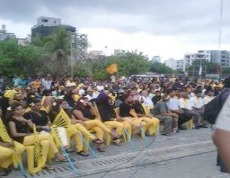
The Maldivian Democratic Party (MDP) held a parade and rally on Saturday (August 24) that it claims was attended by over 8,000 supporters in order to launch their complete manifesto, titled “Costed and Budgeted 2013 – 2018”.

After a parade down Majeedhee Magu – the main street through Male’ – MDP presidential candidate and former President Mohamed Nasheed addressed his supporters and explained the contents of the party’s manifesto.

“These policies in our manifesto are based on what we learned when we walked door to door, conversing with citizens, enquiring what your thoughts and needs are,” Nasheed said at the rally held in the ‘Raalhugandu’ area.

“In the next 5 years, the state will make a revenue of MVR 72 billion [US$4.6 billion] through the tax system, investments and other programmes we run. Within those 5 years, we will implement 137 development projects. We have budgeted to spend a total of MVR 30 billion [US$1.9 billion] on policies directly related to the people’s development,” Nasheed explained. “The rest will be spent on salaries of civil service staff, debt repayment and administrative matters.”

“I am not contesting in the upcoming elections with a handful of empty vows. Our competitors’ pledges are made in a manner where, if coming on to an island the first person they meet asks for a fishing vessel, they promise to deliver fishing vessels for them all. And then say they meet a teacher who asks for an iPad, whereupon they’ll pledge to give iPads to all teachers. The next person in line might say he is not feeling well, whereupon the candidate may vow to deliver a nurse and doctor to each house. This is not how a political party should form its pledges,” said Nasheed, criticising the competing candidates for the upcoming September 7 election.

“Our pledges contain things that will be fulfilled upon implementation of our policies. Take a look, this manifesto will not contain even a single policy which has not been accounted for. Even if we are asked to submit a budget to the parliament by tomorrow, we are ready to do so.”

Highlighting the contents of the manifesto, Nasheed stated that it included plans for introducing 51,000 job opportunities, a MVR120 million (US$7.7 billion) savings scheme for higher education, MVR118 million (US$7.6 billion) student loan scheme, 20,000 accomodation flats, a MVR2000 (US$129) allowance for every single parent and person with special needs, and an allowance of MVR2300 (US$149) for the elderly.

Nasheed further stated that the party found it highly concerning that “the national debt is 82% of national production”, saying that the manifesto has been designed keeping the factor in mind.

“We will continue to implement the tax system we established in our first term. We will carry out development work without increasing GST and taxes from business profits. We will also introduce income tax, as we previously proposed in 2010,” he continued.

The presidential candidate also stated that it was “of utmost importance” to establish a development bank in the country.

“We especially discussed this with the Asian Development Bank and the World Bank, and based on existing studies made with the assistance of the UNDP, our aim is to establish a development bank within the first year of our term,” he stated.

“With 600 million rufiya from our state budget, and 400 million rufiya from international financial bodies, the development bank will be able to release funding for the generation of 1 billion rufiya capital,” he continued.

“Our aim is for the development bank to issue to private entities 20 percent [of total funds] for the construction of houses, 8 percent to implement a transport system, 44 percent for agriculture, travel and fishing, 13 percent for the education field, 13 percent for education.”

“MDP’s basic objective has been to ensure that if there is a service that is available to any citizen of the Maldives, then to make it available to all other citizens equitably.”

According to Nasheed, the manifesto includes plans to spend MVR16 billion (US$1 billion) on social protection.

Concluding his speech, Nasheed stated that the MDP Manifesto included plans to assure that life becomes better in many aspects for the public. The former president finished by stating that all that was now left for the public was to go vote.

“September 7 is the day we vote to regain the development that we lost on February 7, 2012.”

Parade of Pledges

Prior to the rally, MDP held a parade down Majeedhee Magu with over 8,000 supporters.

In addition to Nasheed, Speaker of Parliament Abdulla Shahid, Male’ City Mayor Ali Manik, and several MDP MPs were seen in the frontlines of the parade.

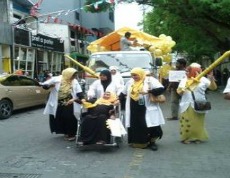
The atmosphere appeared festive, with different groups performing different acts throughout the parade.

Besides pompoms, streamers, and balloons, each ward of Male’ had prepared a small truck to represent one of the pledges included in the party’s manifesto.

While one truck represented the health insurance policy – with actors depicting a scene in a hospital’s maternity ward – another represented the guest house policy – with an actor lounging on a truck designed to look like a beach.

Traffic police officers provided security throughout the parade.

Contrary to some previous demonstrations and rallies, no hostility was observed between police and participants of MDP’s rally.

Minivan News observed one policeman being asked by rally participants if he had received a letter from Nasheed, adding that if he had not then he must be ‘baaghee’. The young participants were referring to a speech delivered by Nasheed last week, in which he stated he had sent letters to all police officers, except those who had directly partaken in what the MDP alleges to be the February 7 coup d’etat.

The policeman responded by taking a folded up piece of paper out of his pocket and showing Nasheed’s signature on it to the supporters who had questioned him.

“I am not a baaghee. We will win ‘eh burun’ [in one round],” he said

Read the full MDP Manifesto here (Dhivehi)

Likes(0)Dislikes(0)

Transparency Maldives voices concerns over Supreme Court integrity

Transparency Maldives has raised questions over the integrity of the Supreme Court after a recent scuffle within the seven-member judges bench over the appointment of parliament’s choice to replace former Chair of Civil Service Commission (CSC) Mohamed Fahmy Hassan.

“Transparency Maldives calls upon the Supreme Court to maintain its actions in such a fashion that the court does not allow further diminishing of its integrity and to be transparent in its functioning and sharing of information to strengthen the public trust towards the institution,” read the statement.

The Supreme Court’s seven-member bench was split following the issuance of an injunction ordering the appointment of Dr Mohamed Latheef at the CSC. Chief Justice of Supreme Court Ahmed Faiz Hussain released a statement to media accusing his own court of issuing the injunction without the knowledge of himself and two other Supreme Court Justices (Ibrahim Areef and Muthasim Adnan).

The local NGO has released a statement claiming that the Supreme Court’s failure to make key documents public, such as the recent injunction, showed how much the apex court of the country disregarded the need for transparency in important matters.

Transparency in the functioning of an institution and respecting the right to information being a fundamental necessity in order to refrain from corruption and corrupt practices, said Transparency, pointing out that disregard for such necessities a negative impact on public confidence.

The Supreme Court, being the final authority to decide on all legal and constitutional matters of the state, was irresponsible to allow the public to question its integrity at a time when political polarization has taken its toll, said Transparency.

The NGO called on the court to release a copy of the injunction, and the statement made by the Chief Justice regarding the injunction, to public as it concerned the interests of the public.

Parliament and courts clash

The parliament and the Supreme Court came to loggerheads following Supreme Court’s decision to overrule the parliamentary deposition of then CSC Chair Fahmy.

In November last year parliament voted 38 – 32 to remove the CSC chair after the Independent Institutions Committee investigated a complaint of sexual harassment lodged by a female employee of the CSC.

Fahmy was alleged to have called the female staff member over to him, taken her hand and asked her to stand in front of him so that others in the office could not see, and caressed her stomach saying ”it won’t do for a beautiful single woman like you to get fat.”

On 14 March 2013, the Supreme Court ruled that parliament’s decision to remove Fahmy from his position was not based on reasonable grounds and invalidated the decision.

Earlier this August, the parliament disregarded a prior Supreme Court’s ruling when appointing Fathimath Reenee Abdul Sattar to replace Fahmy at the commission.

However, just minutes before the former Permanent Secretary to the Ministry of Defence was given the letter of appointment by President Mohamed Waheed Hassan to, the Supreme Court issued an injunction to halt the appointment contending that Fahmy had requested the Supreme Court to look into the matter.

According to local media reports, the court’s injunction stated that appointing a new member to the commission, when the court had already decided the dismissal had been in violation of the constitution, was itself unconstitutional.

Shortly after the Supreme Court Injunction, the chief justice then accused his own court of issuing an injunction without his knowledge.

Meanwhile, the Attorney General Azima Shukoor has reportedly advised President Waheed that he does not have any responsibility for determining members to the CSC.

Last week, Parliament appointed CSC member and former chair Dr Mohamed Latheef as the new chair of the commission. However, Fahmy has refused to step down and is still continuing to appear at the CSC meetings as the chair of the commission leading to further disputes.

Last Thursday, the new CSC Chair Dr Latheef sent a letter to the President asking him to find a solution to ongoing issues with Fahmy. Dr Latheef stated that Fahmy continued to come into work after his dismissal by the parliament, obstructing the running of the institution.

Latheef told the president that this issue affected both the civil servants themselves and the services being provided to the public. President Waheed responded last Friday stating that he would make a decision within the next three days regarding the issue.

“I have to seek the legal advice on the matter. This matter has become very complicated now,” President Waheed told local newspaper Haveeru on Friday.

Likes(1)Dislikes(0)

Presidential candidate Gasim has no plans to boycott TVM

Presidential candidate Ibrahim Gasim has no plans to boycott national broadcaster Television Maldives (TVM), despite media reports last week suggesting his Jumhoree Party (JP) was considering such a move.

“Gasim would never do anything like that. We have no plans to boycott TVM,” said JP Policy Secretary Mohamed Ajmal.

Ajmal also confirmed that the JP’s leader would be participating in the upcoming presidential debate, due to air on TVM on September 1. Competing parties had claimed that talk of a boycott was a pre-planned attempt to “dodge” the debate.

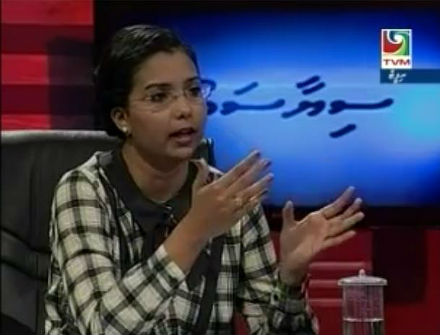
JP deputy leader Ilham Ahmed last week told local media that the JP would be considering a boycott of the station after TVM presenter Liza Laurella asked Gasim a series of personal questions in what he interpreted as an attempt to damage his reputation.

“This was done with the intention of demeaning a person under a systematic plan. We don’t believe that this could have been done under press freedom,” Ilham explained to reporters from Haveeru. “We have seen TVM going after Gasim.”

The Maldives Broadcasting Corporation (MBC) defended its station, telling local media that Gasim’s TVM interview was conducted within its editorial policy.

The interview with Gasim was the first of a series of programs titled ‘Siyaasath’ (‘policy’) featuring all four presidential hopefuls in discussion of their respective parties’ policies.

The program concluded last night with the interview of former president and Maldivian Democratic Party (MDP) candidate Mohamed Nasheed.

Reflecting on all four interviews, Ajmal alleged that all candidates had not received equal treatment from the host.

“We are not happy with the way Liza handled it. Maybe [that approach] is okay in Europe, but not in the Maldives,” he said.

Ajmal noted in particular Liza’s tendency to point her finger at Gasim during the interview: “It was very disrespectful.”

The ‘siyaasath’ episode featuring current President Dr Mohamed Waheed was singled out as an example of unequal treatment, with Ajmal describing his interview as “very mild” in comparison.

“All interviews should have been equally harsh,” he added.

The JP’s criticism of the show were dismissed as “baseless” by the Progressive Party of Maldives’ (PPM) MP Ahmed Nihan, whose candidate Abdulla Yameen appeared on ‘siyaasath’ last Thursday.

“The PPM believe Liza did quite well… we understand there will be those types of questions in a hard talk program like this,” said Nihan.

His sole criticism of the program concerned a lack of focus, with what he felt was an excessive time spent discussing the past at the expense of debating policies for the future.

Nihan did however acknowledge that this problem had been consistent in all four interviews.

Likes(0)Dislikes(0)

Maldivian Foreign Minister dies during treatment in Singapore

Maldivian Foreign Minister Dr Abdul Samad Abdulla has died during treatment after undergoing kidney dialysis at Mount Elizabeth Hospital in Singapore.

The 67 year-old died during treatment at 1:05am Male’ time on Sunday morning, according to the Foreign Ministry.

Dr Samad was first admitted to intensive care on August 20 in a critical condition after suffering a severe heart attack. The 67 year-old had undergone heart bypass surgery 15 years ago.

On Thursday the Foreign Ministry reported that Dr Samad’s condition appeared to have stabilised, although he remained in intensive care in a state of induced unconsciousness after undergoing dialysis.

“On behalf of the Government and people of the Maldives, and on his own behalf, President Waheed extends his heartfelt condolences, at this time of national tragedy, to the family of the late Dr Abdul Samad,” read a statement from the President’s Office.

“The President recognises Dr Abdul Samad Abdulla’s sincere services to the government and the people of Maldives, especially as the Minister of Foreign Affairs of the Maldives, in strengthening diplomatic relations with other countries,” the statement added.

Dr Samad has served in numerous roles for both the Maldives Health Ministry and the World Health Organisation (WHO).

He has also served as the first High Commissioner of the Republic of Maldives to the Peoples Republic of Bangladesh and was appointed Minister of Foreign Affairs in March 2012, by President Dr Mohamed Waheed’s new government.

Dr Samad’s funeral will take place in Singapore after Zuhr (afternoon) prayers. Vice President Mohamed Waheed Deen will attend the funeral, reports local media.

Dr Samad is survived by wife Ameena Ali and three children.

Likes(1)Dislikes(0)

Q&A: Elections Commission Chairperson Fuwad Thowfeek

The 2013 Maldives presidential election is set to occur amid the political polarisation and institutional mistrust that has escalated since the controversial transition of power in February 2012.

Former President Mohamed Nasheed and his Maldivian Democratic Party (MDP) maintain that a coup d’etat had been orchestrated by loyalists to the former 30-year autocratic ruler President Maumoon Abdul Gayoom and led by mutinying police and military officers. This was followed by the security services’ crackdown on demonstrators, months of MDP protests, and demands for early elections, as well as fears the judiciary may prevent Nasheed from contesting.

With the Maldives’ presidential election taking place on September 7, there is considerable national and international pressure on the Elections Commission to deliver. Minivan News discusses some of these key elections issues with Fuwad Thowfeek, Chairperson of the country’s first independent Elections Commission (EC), established on November 24, 2009.

The role of security services…

Leah R Malone: Is the Elections Commission (EC) document outlining the Maldives Police Service (MPS) elections mandate available?

Fuwad Thowfeek: For every election since 2008, a Memorandum of Understanding (MoU) has been signed between the Elections Commission and the police service. The same document – containing more or less the same content – will be prepared and signed between the MPS and EC indicating the election duties of both institutions – when we need their services, how to approach them, what they will do for us, how we will greet them, etc. This type of understanding is there, it will help both institutions to stick to our duties.

Both institutions agreed on the prepared draft more than two weeks ago, it just needs to be finalized and signed. It’s very close to ready now. Because we have so much other work pending, and our deadlines are reaching, priority has been given to other activities, but very soon we will sign this.

LRM: Was the EC notified regarding MPS ‘Operation Blue Waves’? Were the parameters of the operation developed in collaboration with the EC?

FT: Yes, it will be our MoU in their mind. They gave us information that they will be having this operation and expressed the activities that they will be undertaking with our knowledge.

We’ve had a number of meetings with the MPS and even on our advisory committee we have an assistant commissioner of police who was present at all of our meetings. We’ve also had meetings with other branches of the police service – we are very much in contact with each other.

LRM: The MPS website states that the operational priority for ‘Operation Blue Waves’ includes “stopping campaign members from breaking any campaign laws” – is that an appropriate rule for the police to be enforcing, or should this fall within the purview of the EC?

FT: If anybody does anything that constitutes any criminal act the police are entitled to stop that activity, whether it is related to elections or otherwise. But we have not yet requested police to stop any [campaign activities].

If there are any complaints we give the specific details of that place and information to the police, and we request them to take actions according to the legal framework they have. [Stopping campaign activities is] not something specifically requested of the police [by the EC], but because the legal framework allows them to address any kind of law that’s being breached, if they’re choosing to focus on that, it’s still within their jurisdiction.

Almost the whole country is working on campaigning… We don’t request anybody to just focus [on those activities] to see if there’s anything going wrong. If anybody reports [complaints] to us then we request the police to look into it. That is our main target, not to look for any crimes, just to see how the things are going on.

LRM: The MPS has stated that police will remain 100 feet away from voting centres in “normal situations”. What will happen in an ‘abnormal’ situation? If a polling station head does request the MPS enter in the event of a disturbance, what is the protocol, how soon would they need to leave the polling station?

FT: If there is any disturbance on the day of voting, first the elections officials will try to control the situation. If the officials are unable to control it, then we will request the police to come in and take the person away from that ballot box area. In that case, once he or she or the group is taken out of that area, activities will again resume.

LRM: In July, former President Nasheed voiced concerns that police would try to influence the election by having individuals create a disturbances as a pretext for police officers entering the polling station. Additionally, Progressive Party of Maldives (PPM) presidential candidate Abdulla Yameen has recently said that disturbances are likely on election day.

What type of training have the polling station heads received to address these kinds of situations? If the polling station head is a younger individual, are they going to have the authority to actually stand up to a Special Operations (SO) officer – particularly in the more disputed areas where there’s anticipated tension, such as Addu City, Thinadhoo [Gaafu Dhaal Atoll], Kulhudhuffushi [Haa Dhaal Atoll], and/or Male’?

FT: First, we have given a 10 day training to the trainers, which was completed last week. We trained 77 trainers. They will be going out to all the atolls and giving two day trainings to the polling officials. The two day training will be good enough for them to understand all the laws, rules, regulations, and procedures of the polling activities.

In each polling station there will be at least seven to ten officials and about 50 percent will have experience with previous elections. The head of the polling station will be responsible for the whole team and, on behalf of the team, the head of the polling station will make all the decisions, and even if required will call for police assistance. In the polling stations we will have young [EC] officials, but the polling station heads will be experienced officials over 30 years-old. But we are trying to place people over 35 years of age as head of each polling station. In general, we are trying to employ people with previous elections experience, [who are] not very young. We always prefer to take people, if available, above 30 years of age. In cases where we don’t get enough officials, then we go for some younger adults, but mostly you will find the average age is over 30 years.

LRM: What should the Maldives National Defence Force’s (MNDF) elections role be? Have they been in contact with the EC or have you been coordinating more with the MPS?

FT: We are coordinating more with the police services and, even in the previous elections, we have been in touch with the police to see to the security of all the ballot boxes and polling stations. The police will seek assistance of MNDF only if they find it necessary to ask for help, but it’s very unlikely.

The security of the presidential candidates and running mates will be looked after by the MNDF. That is the only role they should be playing.

Election preparations…

LRM: Police Commissioner Riyaz recently noted that a national coordination committee has been established with representatives from different political parties and relevant institutions, so the committee can address any election issues that may arise “using diplomacy rather than out on the streets”.

Is this a committee that the EC participates in? What is the committee’s purpose?

FT: I think he was referring to the National Advisory Committee. We have in this committee a representative from each of the presidential candidates, the Maldives Police Service (MPS), the Human Rights Commission of the Maldives (HRCM), the Maldives Broadcasting Commission (MBC), the Maldives Media Council (MMC), Transparency Maldives – representing all the local civil society organisations – plus five members of the EC.

The purpose of the committee is to facilitate communication between the different institutions. The representative from each candidate or institution will take our decisions or discussions to their organisations and/or the concerned people.

LRM: How many EC staff will be placed on smaller islands during the presidential election?

FT: On every inhabited island we will have a minimum of seven EC officials at each ballot box, even if the number of people [voting] is less than 500, or even 200. In the tourist resorts and industrial islands we are planning to send five officials to each ballot box [location], because there will be an average of 200 people to vote at each ballot box. There are 700 to 1000 people expected to vote per each ballot box on the inhabited islands. In Male’ also we have 103 ballot boxes. For example, there are 48 boxes for residents of Male’ voting in Male’ and 55 for people from other atolls living in Male’.

LRM: How do you plan on coordinating elections observers from so many different institutions, including the EC, HRCM, Transparency Maldives, media, and other individuals from the Maldives and abroad?

FT: Actually, our planning section will be dealing with all the observers, monitors, and all the [election] officials. We will hold a training session  – what they can do, what they should avoid and each individual will be given a photo ID pass, so with that ID they can visit any ballot box, whether it is in Male’, Hulhumale, Villingili, even Addu or Fuvahmulah – any place depending on their need, they can go and see it.

For the coordination [of these various individuals] we will keep some special staff for that, but we don’t have much to communicate with them. Once the training session is completed, the observers and the monitors will be very sure about their roles and work. And we are going to leave them very independent actually, so that it is their duty. That makes it very easy for us as well as easy for them.

After making their observations, they write their reports, we will like to receive all the comments and remarks from all the observers. That’s something that will help to develop our process for the next election.

LRM: Why is the 2013 presidential election being held September 7, when the 2008 election was October 8?

FT: We have to follow the dates and periods given according to the constitution, the presidential elections law and also the general election law. September 7 is the first round and then in three weeks time on September 28 we have to hold the second round if nobody gets over 50 percent of the valid votes. The president will be sworn into office in November.

In 2008, it was a special period given, as noted in the constitution. [This year] if the second round is going to be on the 28 of September, one week from that date on October 4 we will be announcing the final result. There will be over one month for the elected president to prepare to take office. I think that’s good because last time the period was too short. There was not sufficient time previously between when the president was elected and then took office. [This year] it’s only one month and one week [to prepare] or even if we count the date from the preliminary result there will be just six weeks for the president to prepare to take office.

LRM: To what extent have India and the US provided elections assistance as pledged?

FT: The Indian Elections Commission mainly and also the Indian High Commission in Male’, and USAID have been assisting. Last year, two batches of 10 people each [from the EC] were given a one month training in New Delhi in their elections institution. This year also two batches of six each received training, one batch in Bangalore and one in New Delhi. In addition, two commissioners have been given the opportunity to attend an observation tour and training program.

Also, the Indian Elections Commission has provided a team of IT experts, software developers, to produce programs for various activities of the EC, like maintaining a political party register, the dispatch of voting materials, result making of the various elections, and there are many other administrative requirements. The software will make the EC’s work simpler and help to maintain very transparent records.

For example, [regarding] the local council elections and parliamentary elections, in the Maldives people can live on any island, but they will be registered mostly on the island of their birth or their parents’ island. For example, I can live on Kulhudhuffushi for any period and there can be people lets say from 150 islands living on Kulhudhuffushi too, but for the local council election, if they are from 150 different islands then 150 different types of papers should go there. Sorting this out and sending the exact number of ballots manually – according to the law we cannot send more than 1 percent of the [islands] ballot papers, unless there are 100 voters belonging to that island – is kind of a nightmare for determining the results. Last time our staff were working day and night and found it so hard to make the appropriate packets for each island. A very powerful software [program] is needed [for this] process.

It’s very difficult and complex, but the presidential election is nothing compared to this. We are very comfortable with the presidential election – it is the same ballot paper we are sending all over the country.

Political party criticisms and next steps

LRM: The PPM has claimed that the EC has not provided adequate answers to their previous complaints/enquiries, and that the upcoming presidential election is not likely to be free and fair as there is a possibility voters’ information will be altered.

How did the EC respond to their concerns previously? Was it addressed in the Advisory Committee or was it addressed separately when speaking with their party representatives?

FT: A few times they have come and met me – twice a delegation from PPM came and met me and once a delegation met the Vice Chair of the Elections Commission.

Every time we have very clearly explained everything to them, answered all their queries and gave very detailed responses to them. But there are some demands that we cannot meet. For example, one of their demands was to see our IT section. They wanted to see the hardware and software of our network system, which we cannot do and we are not ready to do for the safety and security of our system.

Other than that we have attended to almost all their requests. We have given them very detailed answers. The interesting thing is that it is the same commission, the same five members have been in this commission for the last three and a half years. I was here for the last five years, but I was the only member during the interim period that is still with the commission – I have seen the entire progression.

We conducted local council elections – which were much more complex and complicated [than the presidential election] – without any problems we managed to do it. And we have also held three parliamentary by-elections and over 20 local council by-elections. In each election or by-election there were complaints [filed], but no one has ever complained about the members of the Elections Commission. [Now] suddenly they started questioning our competence and our ability, this is very strange.

LRM: Why do you think the PPM is putting so much pressure on the EC, since the commission addressed their concerns previously? Why do you think this is happening now, with less than 20 days to the election, when there were many months to file complaints?

FT: I don’t know actually, and regarding the questions they have raised, we have given really clear answers to them. We are not hiding anything, we are very transparent. Everything has been really clearly explained, so I don’t understand. President Mohamed Waheed and President Mohamed Nasheed are very confidant in this commission, they have no complaints at all.

We don’t hesitate to answer any questions from any party, whether it’s a political party, or media, or any social club or society. We are ready to meet each and everyone. We are willing to share our knowledge and experience. That is what even we have been hearing, that the public recognises our efforts and they have confidence in us. So it is very strange that suddenly PPM has found these types of problems with us.

LRM: What is the next step the EC will take to address these issues with the PPM, particularly if they pursue legal action? Do they have any legal grounds to stand on? If they do take these issues to court, given the need for judicial reform, do you think that could be problematic for the EC to hold the presidential election?

FT: They don’t have any grounds for legal action. That is why we are very comfortable. Even if they go to court we will have no problems at all. We will clarify everything to the court.

Today (August 22) we are trying to publish our voters list according to the ballot boxes, so this will be the list that will be used on the day of voting. A copy of this list will be given to all the presidential candidates and also to the political parties that are interested in obtaining a copy of the ballot boxes with the voters list. We have so much confidence in our work – we have done really good, professional work – that we are giving it openly [to the public] to see and tell the EC if we have incorrectly listed any person in the voter registry or if any person is missing.

If anybody is missing from the list, we will very clearly tell them why the person is missing. For example, during the last two weeks, we received complaints from 17 people that they were absent from the voter list, out of 239,593 people registered to vote. Only 17 are missing out of 239,593 [only .007 percent of registered voters].

This type of accuracy is kind of a world record. For this we did so much work. We produced a list on the government gazette website, we have been talking to the media, newspapers, radio, and TV, asking people to check their names and inform the EC if anybody’s name is missing. We have made it so easy for everybody that someone can sit at home and check our website, just enter your ID card number and if your name is not there you will get a message. Or call 1414 and one of our operators will answer, or send an SMS to 1414 and you will get an automatic SMS reply, or send somebody to the EC and ask the receptionist to check for the name in the voter list.

So much work has been done, but these are 17 people that for some reason ignored or didn’t hear our calls and they just realised it when it was too late. Another reason why some of them are not recorded [in the voter register] is that a lot of people go to Sri Lanka, India, Singapore, or Malaysia for delivery. Then after the birth of the child they don’t remember to put them in the local register, so this is one reason why some names are missed. But still we said if there is a second round we are going to include these people, because they have informed us we will take the necessary steps, however for this round there is nothing we can do.

We are not the people compiling the initial register, we are getting it from the island council offices and also the Male’ City Council office. So the primary source of the [voter] list is from all the council offices, then we have to communicate with them and also we have to check it with the Department of National Registration. It’s has been very hard work over the last five year to come up with a voter registry of this standard.

LRM: Is there any additional statement you would like to make or message you would like to give Maldivian voters and/or the international community?

FT: My request is kind of an advanced request to all the voters. Today we are uploading all the voters lists for each ballot box – make sure where you are going to vote. Please check it through our website, SMS, by making a telephone call to us at 1414, or sending someone here [to the Elections Commission] to check it.

On the day of voting, we are starting at 7:30am, so go to the ballot box as early as possible so you will not be standing in the queue for long – going early will avoid delays and facilitate all the officials. If you go at the closing hour at 4pm, the queue may be too long and you will have to wait.

Regarding the international community, we want them to observe all the [election] activities including the actions at the ballot box and also in the other areas, and to express their observations very frankly and very truly. That will help us in the future and give confidence to the world as a whole regarding how the election has gone, how good or bad it was. I’m sure we will get a very good result because we have worked very hard.

Likes(2)Dislikes(0)

Commonwealth unveils 17 member observer group for presidential election

Former Prime Minister of Malta Dr Lawrence Gonzi is to head a 17 member Commonwealth group arriving in the Maldives on August 31 to observe the upcoming presidential election.

The group, constituted by Commonwealth Secretary-General Kamalesh Sharma, is mandated to “observe and consider all aspects of the electoral process” on September 7 to ensure it is held in compliance to agreed standards for fair polling.

It was confirmed by the Maldives Election’s Commission late last month that observers from both the Commonwealth and EU would be monitoring the election. Representatives from other local groups and institutions have also pledged to observe the vote.

The Commonwealth Observer Group, scheduled to arrive in the Maldives later this month, is expected to be in the country until September 14.

The group’s work will be overseen by a Commonwealth Secretariat support group, led by Nishana Jayawickrama, head of the intergovernmental organisation’s Asia/Europe Political Affairs Division.

According to the Commonwealth, the seventeen member panel consists of:

  • Group Chair Dr Lawrence Gonzi
  • Hugh Craft, former Australian diplomat
  • Bruce Hatch, Canadian elections expert
  • Elizabeth Ohene, former minister and media expert in Ghana
  • Navin Chawla, India’s former Chief Election Commissioner
  • Prof Lisa Ann Vasciannie, Jamaican governance expert
  • Yusmadi Yusoff, former Malaysian MP
  • Notemba Tjipueja, Namibian Elections Commission Chair
  • Maryan Street, New Zealand MP
  • Prof Attahiru Jega, Nigerian National Electoral Commission Chair
  • Zobaida Jalal, former minister in Pakistan
  • Dr Alphonse Gelu, Registrar of Political Parties in Papua New Guinea
  • Hendrick Gappy, Seychelles Electoral Commission Chair
  • Ms Lindiwe Faith Mokate, South African Human Rights Commission
  • Andi Schubert, Sri Lanka youth representative
  • Prof Sylvia Tamale, Ugandan gender expert
  • John Turner, UK elections expert

In a statement, the Commonwealth said the observer group will work impartially and independently, conducting itself in line with the International Declaration of Principles for Election Observation.

As well as making possible recommendations on how to strengthen the electoral framework in the Maldives for future voting, the observers will also submit a report on the 2013 presidential election to both Commonwealth and Maldives authorities.

Local observers

Earlier this month, both the opposition Maldivian Democratic Party (MDP) and Human Rights Commission of the Maldives (HRCM) announced plans to station election observers in specific areas of the country.

The MDP has pledged to place more than a thousand election observers throughout the country, an average of four observers per ballot box.

Meanwhile, the HRCM will reportedly be stationing its own election observer teams in 10 regions of the Maldives to monitor polls.

Likes(1)Dislikes(0)

Parliament refutes President Waheed’s claim of 100 pending bills

The People’s Majlis has refuted President Dr Mohamed Waheed Hassan’s claim last week that 100 pieces of legislation needed to implement the 2008 constitution have yet to be passed by parliament.

In a press release yesterday (August 23), the parliament secretariat revealed that 43 bills were required to give effect to the constitution adopted in 2008, of which 24 were submitted and 18 were passed by parliament during the past five years.

The legislation was mandated by article 299 (b)(2) of the constitution, which states, “the People’s Majlis shall until the enactment and commencement of laws required to give effect to this Constitution, approve a course of action in relation to these matters. The Executive shall within thirty days of the commencement of this Constitution draw up a list of such laws and submit it to the People’s Majlis. Within ninety days of the commencement of this Constitution, the People’s Majlis shall draw up and approve a schedule for enactment and commencement of such laws.”

The parliament’s press statement noted that current Attorney General Azima Shukoor was in the same post in 2008 when the list of 43 laws was submitted. Azima – former President Maumoon Abdul Gayoom’s last attorney general – was reappointed to the post by President Waheed following the controversial transfer of presidential power on February 7, 2012.

“Therefore, given the situation, we regret the false claims made by the President in a way that could cause loss of public confidence in parliament, and which was made with the intention of achieving a specific purpose,” the press release stated in conclusion.

President Waheed made the claim at a ceremony on Thursday night to confer national awards of honour and recognition. In his speech (Dhivehi), President Waheed contended that the public has not enjoyed the benefits of the reforms envisioned in the 2008 constitution due to “loopholes in a very young and incomplete constitutional framework.”

“We see a person who does not have the approval of the People’s Majlis, in charge of the highest number of state employees. We are in a situation where the people doubt the highest court in the country. Suspects in criminal cases are in state institutions. Murderers and people who have committed arson roam freely in the streets. The rights of women and children are unprotected,” President Waheed said, according to the President’s Office website.

President Waheed further contended that all the provisions in the constitution “cannot be said to have been drafted with the whole country’s framework of governance in mind.”

As the constitution was drafted during the final years of “a long rule,” he argued, some provisions were added “with the intention of changing the condition that existed then.”

“When the drafting of the constitution was completed under these circumstances, a number of problems were noted,” he said. “Some 100 laws needed to implement the constitution have yet to be formulated.”

The Majlis statement meanwhile provided a list of the bills passed, pending and yet to be submitted by the executive. The six pieces of legislation currently under review at the committee stage include the freedom of information bill, the education bill, the penal code, the criminal justice procedures bill, the evidence bill, and the jails and parole bill.

Among the 19 bills that have yet to be submitted include legislation on public referendums, freedom of expression, press freedom, parliamentary ombudsman, state secrets, defamation, women’s rights, public services, trade unions, legal counsel, civil justice procedures and national security.

The executive was also required to submit amendments to existing laws governing the Human Rights Commission, the Civil Service Commission, the auditor general, children’s rights and family matters.

The legislation passed by the parliament in the past five years for implementation of the constitution included bills establishing independent institutions such as the Elections Commission, Judicial Service Commission, Police Integrity Commission, Anti-Corruption Commission and the Prosecutor General’s Office.

Parliament has also passed laws governing the courts, presidential and parliamentary elections, freedom of assembly, decentralisation, parliamentary privileges, political parties, customs, state pensions, state benefits for persons with special needs, and electoral districts.

Likes(0)Dislikes(0)

Comment: Revisiting the Maldives’ transition to democracy

This article was first published on Dhivehi Sitee. Republished with permission.

The first multiparty presidential election of 2008 in Maldives saw an end to the 30-year dictatorship of Maumoon Abdul Gayoom and the adoption of a modern democracy for the first time in the Maldives. Nevertheless, as in many other nascent democracies, there is real doubt whether Maldives can sustain its democracy in its fullest sense, especially after the recent coup that ousted the first democratically elected president in February 2012.

Some scholars argue that the mode of democratic transition a country experiences proves to be a critical factor in determining the country’s democratic future. Hence, an analysis of the mode of democratic transition that occurred in Maldives may help in predicting whether democracy could be sustained in future.

Political scientist Samuel Huntington argues that the process of democratisation could be determined based on ‘the relative importance of governing and the opposition groups as the sources of democratisation’.

He identifies three broader modes of democratisation; (1) ‘transformation’ (from above) occurs when the regime itself takes initiative in bringing democracy; (2) ‘replacement’ (from below) occurs when opposition groups take the initiative and replace the regime by bringing democracy; and (3) ‘transplacement’ (through bargain) occurs when both government and opposition work together to bring about democracy.

My aim here is to analyse the process of democratisation in Maldives in terms of the theories offered by Huntington, and identify the modes of democratic transition that occurred in Maldives.

This in turn may help predict the future sustenance of democracy in Maldives. I will argue that no one particular mode of democratisation occurred in Maldives as none of them materialised fully. However, various efforts from the current opposition Maldivian Democratic Party (MDP), together with the leadership of Mohamed Nasheed, have contributed significantly to the process and facilitated negotiations with the regime leading to democratisation.

To achieve the stated-aim, I will discuss the major events that contributed to the democratisation process in Maldives by relating them to the modes of transition outlined above.

The initial period of democratic struggle – a period of near ‘replacement’

The initial period of the struggle for democracy in Maldives depicts characteristics of ‘replacement’ where citizens started to challenge the regime through various means and made attempts to overthrow the autocratic government. The first serious challenge to dictator Gayoom was in 1988, with a failed coup attempt carried out by Sri Lankan Tamil mercenaries financed by wealthy Maldivians. A year after the attempted coup, the election of western-educated young politicians to the parliament in 1989 resulted in increased pressure for democratic reforms.

However, many of them and their family members faced significant threats from the regime and some of them were imprisoned for various politically motivated charges[3]. The regime continued to suppress major opposition figures through arbitrary arrests. In 2001, Mohamed Nasheed – both a Member of Parliament and a major opposition figure – was arrested and imprisoned for two and half years. The same year, the opposition MDP made their first attempt to formally register themselves as a political party. The Home Ministry, mandated to register civic organisations, sent the petition to parliament where it was overwhelmingly rejected.

On September 20, 2003, civil unrest broke out in the capital Male’ sparked by the death of prison inmate Hassan Evan Naseem. Evan was tortured to death by security forces during an interrogation. News of his death led to riots in the prison and a subsequent shootout by the police that killed three more inmates and injured many others. The news spread throughout Maldives, becoming the major trigger for many to publicly demand democratic reforms.

Since the September unrests, Gayoom came under tremendous pressure from both domestic and international actors that compelled him to announce democratic reforms. On June 2004, during an informal meeting, Gayoom announced his proposed changes to the Constitution including two term limits for the president, direct election of the president, measures to increase separation of powers and removing the gender bar for political participation. Moreover, he urged citizens to publicly debate his proposals. The opposition were still very sceptical about Gayoom’s real intentions and raised doubts about whether he could bring about concrete reforms.

However, the reform announcement itself facilitated the opposition to organise more activities publicly. Matt Mulberry from the International Center on Nonviolent Conflict, argues that the reforms announced by Gayoom ‘technically gave citizens freedom of speech and freedom of assembly’. As a result, some citizens organised a series of “minivan debates” (‘minivan’ means ‘independent’ in Dhivehi) where they discussed the political issues facing the country. Unsurprisingly, the government sent police to disrupt these debates, eventually declaring them illegal.

Despite these repressive actions, the opposition organised a huge protest on August 12-13, 2004 to mark the death of Evan Naseem and demanded reforms, including the release of political prisoners. A record number of citizens took part in the protest which became the largest political gathering ever in the history of Maldives at that time.

The crackdown that followed the protest led to the arrest of hundreds of activists and injured many protesters. As a result, violence erupted in capital Male’ and other parts of the country. Despite the oppressed media, news of the regime’s repressive actions attracted the attention of many international actors. By then, President Gayoom faced immense pressure from the UK, US, India and Sri Lanka to bring about political reforms.

From ‘replacement’ to ‘transplacement’ – a period of joint action

The mounting international pressure and political instability in Maldives led to a new phase in the democratisation process as the regime agreed to have serious negotiations with the opposition. The willingness of joint action from both the regime and the opposition led to a period of ‘transplacement’ in the democratisation process. The regime agreed to sit with the opposition for the first time in the UK.

During the negotiations, the regime agreed to more reforms including formation of independent oversight bodies such as the Police Integrity Commission and the Judicial Services Commission. Moreover, informal talks between reformers within the regime and the opposition were held in Sri Lanka facilitated by the British High Commissioner.

However, the lack of true commitments from the regime led the opposition to realise that international pressure alone would not help bring down the autocratic leadership. Hence, they increased their efforts in organising more protests, speeches and sit-ins. As a result of the mounting support for the opposition’s cause, reformers within the government increased their efforts in pressuring Gayoom to implement urgent reforms.

The pressure from a few reformers within the government and the opposition MDP led to a period of ‘transformation’ where the regime was compelled to take reform actions. In April 2005, the then Attorney General Dr Hassan Saeed overturned his predecessor’s decision by issuing a formal legal opinion to allow the registration of political parties. In June 2005, the parliament unanimously voted in favour of a resolution to allow multi-party democracy for the first time in Maldives. The MDP – the main opposition party – led by Mohamed Nasheed was formally registered, along with several other political parties representing different views. In March 2006, the regime published a roadmap that ‘included 31 proposals for revision of the Constitution, a series of time-bound commitments on human rights, and proposals to build institutions and mobilise civil society’.

However, many still doubted whether the regime was committed to real reforms. Ahmed Shaheed (then Foreign Minister) later argued that, through the reform agenda, Gayoom was seeking to get rehabilitated and thereby stabilise his presidency. He argued that, by 2007, Gayoom had achieved his aim by gaining widespread domestic support and getting rehabilitated.

However, new cracks that significantly weakened the regime emerged as those most closely associated with the reform agenda left the government. On 5th August 2007, both Dr Hassan Saeed and Mohamed Jameel (Justice Minister) resigned from their posts. They claimed that working outside Gayoom’s regime was the only option to advance their reform agenda. Later on the same month, Ahmed Shaheed resigned from the post of Foreign Minister, accusing the government of stalling democratic reforms. These developments saw more public support for the opposition reform movement. After several disagreements with the Special Majlis (Special Parliament), Gayoom ratified the new Constitution in August 2008, allowing key democratic reforms and paving way for the first multi-party presidential election in October that year.

Democracy sustainable?

As evident from the discussion above, three modes of democratisation have contributed to the democratisation process in Maldives, though characteristics of ‘transformation’ are very little. Interestingly, there appears to be a correlation between each mode as the occurrence of one type led to the other. This observation therefore contradicts Huntington’s view that the three modes of democratisation are alternatives to one another.

However, it is important to note the significant role played by the opposition MDP, especially Mohamed Nasheed as the leader who never took a step back in his quest to bring democracy to Maldives. It is clear that MDP played the most critical role in the process of democratisation. I have previously argued that Gayoom is the major obstacle to sustaining democracy and the threat is heightened more than ever with his current political activeness.

Reflecting on the process of democratisation and the strong influence of Gayoom on many institutions till today, I still doubt sustenance of democracy in the Maldives. Similar to the 2008 election, this year’s election is very much a choice between democracy and autocracy.

All comment pieces are the sole view of the author and do not reflect the editorial policy of Minivan News. If you would like to write an opinion piece, please send proposals to [email protected]

Likes(0)Dislikes(0)