All candidates should accept outcome of a credible election: McKinnon

The opposition Maldivian Democratic Party has called for increased international assistance to help ensure a free and fair presidential election in September, alleging that the country’s political system is presently under considerable “stress”.

As the country’s sole political opposition, the MDP has criticised what it calls a “lack of decisive action” from the international community both in implementing findings from the Commonwealth-backed Commission of National Inquiry (CoNI) report, as well as providing election support.

The government-aligned Progressive Party of Maldives (PPM), which is also fielding a candidate in September’s election, meanwhile said it believed “a lot more has to be done” by the Elections Commission (EC) to ensure voting is free and fair.

The claims were made following Commonwealth Secretary-General’s Special Envoy Sir Donald McKinnon’s visit to the Maldives this week, as preparations get underway for the presidential vote scheduled for September 7, 2013.

In a statement released yesterday (June 5), McKinnon called for free, fair, peaceful and inclusive elections, while also highlighting the need for the public to ensure their details were correctly included on the recently gazetted electoral register.

Verification

Upon being published in the Government Gazzette last Thursday (May 30), the public has been given a 10 day window to check and clarify that people included on the list were correctly registered – or risk invalidating their right to vote.

With the conclusion of a four-day visit to the Maldives yesterday, McKinnon called on all Maldives nationals with the right to vote to take the time to verify their details were correct.

“Voter registers are at their best when the regulatory authority and the political parties work together to ensure their accuracy,” he said.

“It is also my hope that the nominated candidates of political parties will be able to contest the election, on a level playing field, so that the election outcome fully reflects the will of the voters. This will be important for the election’s credibility. I would also expect all candidates to accept the outcome of a credible election.”

Mckinnon’s statement also spoke on the importance of moving forward with recommendations raised in the CoNI report on holding “perpetrators of police brutality” during last year’s controversial transfer of power to account.

As part of his visit, McKinnon met with President Dr Mohamed Waheed to pledge the Commonwealth’s support for free and fair elections, while the government said it remained committed to fair polling and the need for unspecified political reform.

President’s Office Media Secretary Masood Imad was not responding to calls at time of press.

Calls for action

Speaking to Minivan News following the publication of McKinnon’s statement, MDP MP Hamid Abdul Ghafoor claimed that the party had continued to hope for stronger action from the Commonwealth during the last year to ensure implementation of the CoNI report’s findings.

The CoNI report rejected the MDP’s allegations that the government of former President Mohamed Nasheed was toppled by a “coup d’etat” on February 7, 2012, following a mutiny by sections of the country’s police and military.

The MDP eventually accepted the report last year “with reservations” concerning the alleged omission of key evidence submitted at the time.  The party claimed the decision was taken to move ahead with recommendations that members of the security forces be found investigated for “illegal acts” during the transfer be punished accordingly.

During a parliamentary inquiry by the Parliament’s Executive Oversight Committee (EOC) earlier this year, the Police Integrity Commission (PIC) claimed that actions by certain officers during the mutiny which led to the change in government were unlawful and amounted to crimes worthy of prosecution by the state.

PIC Vice President Haala Hameed said during the session that the PIC had identified 29 cases of police misconduct, out of which cases concerning six police officers had been sent to the prosecutor general (PG) for prosecution.

The PIC at the time claimed it had urged then-Home Minister Mohamed Jameel to suspend the officers immediately, however the request was not adhered to, and instead at least one of the accused was promoted.

The commission this week announced it had concluded its investigation into police conduct during the controversial transfer of power in February 2012.

Ghafoor alleged that there had since been very limited interest from the Commonwealth in following up on the CoNI recommendations, accusing senior police and military officials of preparing for September’s election in a similar manner to political parties competing in the vote.

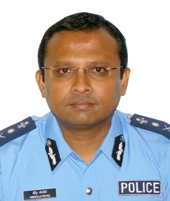
He raised particular concern that Police Commissioner Abdulla Riyaz and Minister of Defence Colonel (Retired) Mohamed Nazim, who assumed their roles directly following the controversial transfer of power, remained in their positions ahead of the election.

Vote concerns

Although welcoming McKinnon’s comments stressing the importance of the public verifying their details were included correctly on the voter registry, Ghafoor claimed that the Commonwealth had identified only one of a number of potential electoral concerns ahead of September’s vote.

He therefore called for greater intentional assistance to ensure free and fair elections ahead of September’s polling.

“The entire political system in being put under stress now and we wait to see what assistance the Commonwealth will provide,” Ghafoor said. “Our Elections Commission is good, but they continue to be put under pressure.”

“There is a lack of decisive action, but the words are certainly there from the international community,” Hamid added.

Alongside the MDP, the government-aligned Progressive Party of Maldives and the Jumhoree Party are also expected to field candidates directly against President Waheed and a coalition of several parties backing him as their candidate during September’s election.

Speaking to Minivan News, PPM MP Ahmed Nihan said that while the party continued to work within the present coalition government under President Waheed, it held concerns about his alleged use of state funds for campaigning.

He said that despite claims made in local media by members of the president’s coalition that recent island visits had been for the benefit of the nation, the PPM viewed the trips as state-funded election campaigning by Dr Waheed’s party.

From the perspective of the EC, Nihan said that the party was also continuing to come across issues within the recently published election registry relating to incorrect information and the inclusion of voters now believed to be deceased.

He said that with an estimated third of the population also having moved from their home islands to the capital in recent years, correct registration would be another vital issue in the lead up to September.

Nihan claimed the EC therefore “has a lot of work to do” in the lead up to September to ensure its database of registered voters was both up-to-date and correct, adding that with the money spent by the state over the last three years, uncertainty remained over how smoothly voting would go.

“The government also has to try and provide the funds for the EC and also participate with international stakeholders to get the assistance to ensure elections are free and fair,” he said.

Minivan News was also awaiting a response to the MDP’s allegations at time of press from Moosa Rameez, a spokesperson for the JP, which is headed by local business magnate and MP Gasim Ibrahim.

The President’s Office has previously rejected accusations that the government was working to exert undue influence on voters through state resources, accusing both the MDP and PPM of making allegations without any evidence.

Likes(0)Dislikes(0)

Father of main suspect in Afrasheem murder case accuses police of coercion

The father of Hussain Humam, the main suspect in the murder of MP and religious scholar Dr Afrasheem Ali, has alleged his son was psychologically traumatised and under coercion by the police when he confessed to the crime.

The suspect has since retracted the confession he gave at a hearing held June 1.

In two separate letters dated May 26 that were sent to Criminal Court Chief Judge Abdulla Mohamed and the Human Rights Commission of the Maldives (HRCM), Humam’s father Ahmed Khaleel asks for assistance from authorities to “ensure [my] son is granted a fair trial devoid of coercion and undue influence.”

Referring to the May 22 hearing of the case, the letter sent to the Criminal Court and obtained by Minivan News reads: “I observed that when my son, Hussain Humam, was brought to the hearing, he was under psychological fear. I observed that he was in a very bad condition, was physically weak and his eyes were reddened. And during the trial, my son, Hussain Humam Ahmed, displayed signs of mental instability, including staring upwards, placing his handcuffs against his mouth, and laughing. Owing to these circumstances, I believe it is of utmost importance to assess Humam’s mental status prior to scheduling another hearing.”

During the previous hearing Judge Abdulla Didi denied a request by Humam’s lawyer that his client be psychologically tested, stating the lawyer had not mentioned any psychological disorder during a prior hearing to extend Humam’s detention.

Alleged police intimidation during trial

Khaleel also alleged in the letter that during the May 22 hearing, police acted “outside of the norms of a court hearing: attempting to psychologically intimidate Humam, and acting in many ways to influence what Humam had to say.”

Khaleel alleges that police  forced Humam into initially rejecting his right to have a defence lawyer, stating, “When the Judge enquired if he wished to have a lawyer, Humam quietly said ‘I do want a lawyer too’, at which point the police officer on his right, and the two officers on his left – Ali Ismail and Shamin – gave angry looks towards Humam and gestured with their eyes in a way that seemed to indicate that Humam was not permitted to say so. I believe that this forced my son to give up and lose this constitutional right.”

“The police also continued to converse with each other while the hearing was ongoing, discussing different aspects of the case itself, and speaking in such a way that it seemed Humam was being threatened. They also exchanged written documents with the state prosecutor outside of court proceedings,” his father alleged.

“Despite the judge unfailingly working to carry out a trial based on fairness and equality where the rights of both concerned parties are protected, with reference to the actions of police in and out of the courtroom, I do not accept that the hearing in question was a fair and just hearing,” Khaleel wrote.

Khaleel called on the court to review video footage of the hearing to confirm his claims, and pleaded for his son to be granted a fair trial and the constitutional rights entitled him.

CP Riyaz and other senior police officials accused of coercion

Khaleel alleged in his letter that in every instance he had visited Humam, his son had repeatedly complained that the police were trying to force him to confess to the MP’s murder.

“I have also observed that the police have phrased their words in such a manner that forces [Humam] to confess. For instance, police brought Humam to Male’ as a hearing had been scheduled for May 16. However, your court cancelled the hearing in the end, and instead of taking Humam back to the Villingili Police Station (where he is being held in detention), he was kept in police headquarters in Male’,” Khaleel wrote.

“I have learnt that while he was being kept in Male’, several police officers of various senior ranks questioned him, outside the processes of investigation, including Commissioner of Police Abdulla Riyaz. They all pushed him to confess, assuring him that he would be spared the death sentence if he did so, and threatening that if he did not, they would ensure that he was sentenced to death. Police further said that if he chose to confess, he would be spared from both the death sentences and charges previously raised against him, and tried to confuse and delude him,” he alleged.

“I have also learned that police, even in other instances, have tried to threaten and coerce Humam into a confession, and have asked him to make use of the opportunity presented.’”

“The confession was an exaggerated mix-up of disjointed statements”

“My wife – Humam’s mother – and I met Humam on May 23 and my wife asked him to tell the truth for her sake and the nine months and ten days she carried him inside her, and Humam cried out, ‘No, mother, I did not kill Afrasheem’. He said the same when I repeatedly questioned him about it,” Khaleel stated.

“Therefore, Humam having stated in front of both of us in the court hearing, in such a way that will be heard by the whole of the country, that he had killed Afrasheem, he then told us that he had, in fact, not committed the murder, and this gives rise to many questions in my mind about how this could have happened,” he continued.

“I am now certain that the police and various political leaders, in a bid to hide the truth behind this, and to conceal the real murderer, have made police question Humam and get details about his life and past. I am also certain that the statement that was submitted to the court as one provided by Humam, is in fact an exaggerated account mixing together responses Humam gave to police about unrelated matters, adding and taking out details, and changing and editing it to align with what the police want it to state,” Khaleel alleged.

“When police are exerting undue influence and interfering with a case under the jurisdiction of your court; forcing Hussain Humam to give up a constitutional right, concealing the actual culprits behind the murder for different political gains, telling Humam various things in a bid to pin this on innocent people, and senior police officers are pushing their long arms into this matter outside the boundaries of the trial, I would like to bring this matter to your attention,” he wrote in conclusion of his letter to the Criminal Court Chief Judge.

Speaking to Minivan News today, Khaleel confirmed that officials of the Criminal Court had met with him and advised him on the best way to proceed.

“They told me that some of the matters I had pointed out can only be raised through a lawyer. They were helpful and listened to my concerns,” Khaleel said.

Criminal Court Media Official Ahmed Mohamed Manik was not responding to calls at the time of press.

Police deny coercion allegations

“It is an outright lie. The hearing proceeded in the presence of the judge. Media was also present in the room. Police did not at all intimidate or threaten Humam in any way, nor did police attempt to influence the courts in any form,” stated a police media official, requesting to remain unnamed.

“We can say with certainty that at no time, during or after the investigation stages, did senior officials talk to Humam to pressure him into a certain action or to influence the trial,” the police spokesperson said.

“Confused how HRCM defines human rights”

Khaleel also wrote to HRCM, expressing concern that his son was being subjected to psychological trauma, threats and intimidation while being held in police custody.

He further alleged that Humam was being coerced into confessing to a crime he did not commit, requesting the commission to look into the matter, and to grant an appointment in which he could provide further details of the allegations.

Khaleel further claimed that police had initially prevented Humam from seeking legal representation, thereby stripping him of the constitutional right stipulated in Article 16 of the Constitution of Maldives.

“I have not had any response from HRCM. I have been endlessly trying to get them to do something about this. I have called them lots of times, and they either say they’ll call back or that there’s no one relevant to talk to. Once, I was told there was no point in meeting the HRCM President just yet, that maybe I should meet someone else they recommend. My point is, how will I be able to meet anyone unless they grant me an appointment, at the least?” Khaleel told Minivan News.

“If they call themselves the Human Rights Commission, shouldn’t they be looking into matters like this where a citizen is being deprived of his rights? I am no longer sure how this commission defines human rights, or just how much they are able to protect such rights,” he said.

HRCM Media Official Sajidha Majdi confirmed that the commission had received the letter, but declined from commenting on the matter, stating it was against the commission’s policy to speak about an ongoing case.

Likes(0)Dislikes(0)

DQP MP Riyaz submits bill proposing hanging as preferred method of execution

Dhivehi Quamee Party (DQP) MP Riyaz Rasheed has submitted a bill to parliament proposing executions be carried out by hanging people sentenced to death in court.

Riyaz told newspaper ‘Haveeru’ that he submitted the bill because the government’s version of the bill, drafted in December 2012, had yet to be submitted to parliament.

According to Riyaz’s bill, the trials of people accused of offences punishable by death under the penal code are to be conducted with a defence lawyer, even should the defendant refused.

The bill requires the lower courts to forward a case report to the High Court 14 days from the date the trial reaches a conclusion. The High Court is required to conduct a trial to determine whether the lower court’s ruling is lawful.

Should this decision be upheld, the matter must then be referred to the Supreme Court, which issue the final ruling on the case.

According to the bill, the defendant is given the opportunity to meet his family and say his last words before he is hanged.

The bill obliges the state to delay implementing death sentences if the person is a minor, pregnant woman, mentally ill or suffering from a disease.

In December last year, Attorney General Azima Shukoor drafted a bill outlining how the death sentence should be practiced in the Maldives, with lethal injection being identified as the state’s preferred method of capital punishment.

The government’s draft, which has yet to be submitted to parliament was criticised by religious groups in the Maldives, who argued that the state’s method of execution should be beheading or firing squad.

Likes(0)Dislikes(0)

Judiciary needs transitional arrangement before elections: former JSC member

The former Presidential Member of the Judicial Service Commission (JSC) Aishath Velezinee has called on international organisations to lead a transitional arrangement for the judiciary prior to September’s presidential elections.

UN Special Rapporteur for the Independence of Judges and Lawyers Gabriela Knaul’s final report to the UN Human Rights Council extensively outlined the political, budgetary and societal challenges facing the judiciary and wider legal community, as well as the politicisation of the Judicial Services Commission (JSC) and its failure to appoint qualified judges under Article 285 of the constitution.

The Special Rapporteur also expressed “deep concern” over the failure of the judicial system to address “serious violations of human rights” during the Maldives’ 30 year dictatorship, warning of “more instability and unrest” should this continue to be neglected.

“The UN special rapporteur’s report has raised very serious concerns that the public should be thinking about, because it has implications that affects every single individual in this country, the report is not for the state alone,” said Velezinee during a press conference held on June 5.

“The report raises questions regarding the impartiality of the supreme court. It highlights a political bias in the supreme court,” Velezinee said. “If we are going to allow the supreme court to be the decider on elections, there is very little reason for the public to have confidence in the election results.”

Velezinee noted that because only three months remain before the September 7 presidential elections, “It is time for the parliament and for the leaders to sit down together and come to a transitional arrangement.”

“That transitional arrangement should include a bench or some system outside of existing courts, outside of the supreme court, that will have a final say on all election related issues,” she stated.

“It can’t be done only locally. We need the expertise, presence and participation of the International Commission of Jurists as well as the UN in a transitional arrangement,” she continued.

“Considering the status of the state today, we need a partnership. Bilateral participation would not be something to promote, the best thing would be to have broader participation with international partners,” Velezinee added.

Resistance to consolidating democracy

“Our country today is at a serious critical junction and the issues are all coming from resistance to consolidating democracy,” said Velezinee.

“One of the most serious issues noted in the [UN special rapporteur’s] report is the misconstruing of democratic concepts in the constitution, and the use of these for personal gain by state officials within the JSC, Supreme Court, as well as parliament.”

“After elections the judiciary must be overhauled,” she declared.

The JSC was required to re-appoint judges under Article 285 of the constitution who possessed “educational qualifications, experience and recognised competence to discharge the duties and responsibilities of a judge, and must be of high moral character.”

“It is only through acknowledgement and acceptance that we have breached the constitution on article 285 that we will have the opportunity and the legitimacy to overhaul the judiciary,” explained Velezinee.

“That is very important, unless we do that we may fall into a cycle of coups… and this will go on unless the judiciary functions correctly.”

Velezinee said that while only the Maldivian Democratic Party (MDP) “has stood by the constitution”, it had failed so far to directly address the controversial re-appointment of unqualified judges to the judiciary.

“I have heard the MDP talk about problems in the judiciary and with individual judges, but I am disappointed I have not yet heard them speak of the constitutional breach of article 285,” she told Minivan News.

“[Parliamentary Speaker Abdulla] Shahid is an expert on democracy and is ready to intervene to return the Maldives to the constitution,” claimed Velezinee. “Having Shahid join the MDP is good because now they can go ahead and return the country [to constitutional rule].”

“I also welcome [former Attorney General Husnu] Suood breaking his silence and taking initiative. It’s a good sign he’s speaking up,” she added.

Eariler this week Suood claimed that the JSC had been taken over “dark powers”, and that it was fully under the control of certain political figures.

Suood further contended that the presidential candidate for the government-aligned Progressive Party of Maldives (PPM) Abdulla Yameen Abdul Gayoom, the Deputy Speaker of Parliament and PPM MP Ahmed Nazim, and retired Supreme Court Judge Mujthaz Fahmy have long been in the business of influencing the judges and the verdicts they had been issuing.

“The entire judiciary is under the influence of [retired Supreme Court Judge] Mujthaaz Fahmy,” he alleged.

Suood further alleged that Deputy Speaker Nazim had close ties with members of the JSC, and said several judges had told him that Yameen Abdul Gayoom – half brother of former President of 30 years, Maumoon Abdul Gayoom – had on several occasions given instructions to the judges over the phone as to how their sentences should be phrased.

Yameen and Nazim have denied the allegations.

Likes(2)Dislikes(0)

Department of National Registration suspends issuing ID cards, citing malfunctioning air conditioning

Staff at the Department of National Registration have refused to continue issuing national identity cards 94 days before elections, complaining of a malfunctioning air conditioning unit and “discomfort in working conditions” for the past four days.

Services were stopped abruptly at approximately 10.30am this morning, after a long queue of customers had already been issued service tokens, according to local media.

Service seekers had expressed anger at the announcement that services will no longer be available, with some reports stating that the people had demanded that services be resumed as “whatever heat the staff feel, we feel too”.

Assistant Director at the Department of National Registration Abdulla Haleem has confirmed to local media that services have been temporarily discontinued due to faulty air conditioning in the department’s service area.

He stated that staff has continued to complain about the difficulties of working “under such warm and uncomfortable circumstances” for the past couple of days.

Haleem said that the department’s failure to repair the air conditioning has led to staff refusing to serve at counters, instead resorting to “sitting in the innermost rooms of the department which has functioning air conditioning”.

Haleem further stated that staff refused to provide services despite more citizens coming to apply for national identity cards during the school holiday period, when people from the islands find it more convenient to visit the capital.

Civil Service Commission Media Official Ali Nizar stated that the commission had not received any official complaints about the matter.

“As a commission, we focus on staff interests. We believe that the department should provide appropriate working conditions for their staff,” Nizar stated.

“Unless we get a direct official complaint, we tend to not get involved in such matters,” he said.

“As far as we know, services will commence again tomorrow once the department solves the issue and provides staff with suitable conditions,” he said.

The Department of National Registration was not responding to calls at the time of press.

“It is a concern, but will one day affect elections?” : Transparency Maldives

Local NGO Transparency Maldives, which will be active in elections monitoring during the September 7 presidential elections, stated that the interruption of services is a concern, if it may affect the upcoming elections.

“If the issuing of ID cards is affected by today’s suspension of services, then it may negatively affect elections. In such an instance, the problem needs to dealt with as soon as possible,” stated Transparency Maldives’ Advocacy and Communications Manager Aiman Rasheed Ibrahim.

“It is a question whether one day of non-service will have an effect on the elections, we hope it doesn’t. We need to be extremely careful these days and if there is a chance that it may have a negative impact, then it must be addressed as soon as possible,” he said.

“Huge concern with elections just 94 days away”: contesting parties

With 94 days to the presidential elections, contesting political parties have expressed concerns that the interruption in issuing identity cards may compromise the constitutional right to vote of a large part of the electorate.

“If we get to have a free and fair election, we intend to win it in a single round. However, with the state the system is in now, it is very complicated,” said member of the Maldives Democratic Party (MDP)’s Membership and Campaign Committee, Ahmed Shahid.

“From the information we have gathered, we understand that approximately 40,000 identity cards will expire before September 7. According to the information we have, the Department of National Registration has the capacity to issue about 350 or so cards a day. This suggests that the 40,000 people from the electorate will not all be able to get the cards renewed before the elections. In a situation like this, now we have the service suspension from that department. This is a huge concern for us,” he said.

“From what we are seeing now, it doesn’t seem as though the state is really trying to solve these issues prior to elections,” Shahid alleged.

“In meetings with the Elections Commission (EC), we were told that about 1500 inmates will also be having their cards expired before election day. The Commission seemed unsure of who has to bear the responsibility for getting these cards renewed. An idea was floated that parents of inmates should take the initiative, but I don’t think that is a practical approach. The state must find a more responsible alternative,” Shahid continued.

“The EC also spoke of concerns that the department is not cooperating at its best so far, and about the reluctance to place absolute trust in them as the department is a government body. They’ve been requesting access to the department’s records in order to run a comparison with the EC’s electorate list, but said they’ve only been granted access a week ago,” he said.

“We are in an extremely sensitive situation now. With things as they are, actions like what the Department of National Registration has done today is a cause for extreme worry,” Shahid stated.

Jumhooree Party Spokesperson Moosa Ramiz also voiced concerns that the denial of a service as vital as the issuance of identity cards will lead to many voters and candidates being stripped of their constitutional rights.

“This leads to a huge loss for the citizens, as well as presidential candidates. The elections are looming close overhead, and the government is halting the issuance of IDs, which are absolutely necessary for anyone to be able to vote. Citizens are being thrust into a very sad situation,” Ramiz stated.

“The institutions which must be responsible need to attend to this immediately, even if they need to give up on all else they are doing now,” he said.

Gaumee Ihthihaadh Party (GIP) Ahmed Thaufeeq, Dhivehi Rayyithunge Party (DRP) leader Ahmed Thasmeen and Progressive Party of Maldives (PPM) Spokesperson Ahmed Mahloof were not responding to calls at the time of press.

Elections Commission President Fuad Thaufeeg and Secretary General Asim Abdul Sattar were also not responding. EC Vice President Ahmed Fayaz’s phone was switched off at the time of press.

Likes(0)Dislikes(0)

JSC meetings with Fahmy in attendance “not valid,” concedes Attorney General

Attorney General Aishath Bisham told parliament’s Government Oversight Committee yesterday (June 4) that official meetings of a state institution would not be valid if a member with disputed legal status was in attendance.

In response to a question by MP Ali Waheed, the committee’s chair, Bisham insisted that Mohamed Fahmy Hassan would not have to be reinstated as chair of the Civil Service Commission (CSC) after the Supreme Court ruled that his removal by parliament was unconstitutional.

“My stand on this has not changed at all,” she said.

While Fahmy returned to work following the Supreme Court judgment, both Bisham and her predecessor Aishath Azima Shukoor had contended that he could not remain in the post.

Despite the previous Attorney General informing Fahmy of her legal opinion, the CSC later revealed that Fahmy resumed work after a letter from the President’s Office authorised him to do so.

Fahmy also began participating in meetings of the Judicial Service Commission (JSC) as an ex-officio member in his capacity as CSC chair.

Bisham told the oversight committee last night that she had shared her concerns with the JSC but refused to answer further questions on the issue.

Fahmy was in attendance at a JSC meeting on May 29 where a petition by Bisham to indefinitely suspend High Court Chief Judge Ahmed Shareef was voted through with three votes in favour and one against. Fahmy reportedly abstained in the vote.

Local media meanwhile reported yesterday that the JSC nominated Fahmy to represent the commission on the 13-member Zakat Committee, which was set up to oversee the Zakat trust fund.

At last night’s committee meeting, MP Ali Waheed asked Bisham whether a meeting of any state institution or independent commission with the participation of a member whose legal status was disputed could be valid.

“It would not [be valid],” she replied.

Following her concession, the Maldivian Democratic Party (MDP) MP for Thohdhoo in Alif Alif atoll thanked the Attorney General and immediately adjourned the committee meeting.

Supreme Court ruling

Fahmy was dismissed from his CSC post in November 2012 in a no-confidence vote in parliament following an inquiry by the Independent Institutions Committee into allegations of sexual harassment against a CSC employee.

Both Fahmy and the victim were summoned to committee after the complaint was lodged in the first week of June.

Fahmy was alleged to have called the female staff member over to him, taken her hand and asked her to stand in front of him so that others in the office could not see, and caressed her stomach saying ”it won’t do for a beautiful single woman like you to get fat.”

MPs voted 38-32 to approve the committee’s recommendation to remove Fahmy from the post.

The Supreme Court however ruled 6-1 in March 2013 that Fahmy would receive two punishments for the same crime if he was convicted at court following his dismissal by parliament (double jeopardy).

The apex court contended that the Independent Institutions Committee violated due process and principles of criminal justice procedure in dealing with the accused.

Delivering the judgment, Supreme Court Justice Abdulla Saeed reportedly said that a person should be considered innocent unless proven guilty in a court of law and was entitled to protect his reputation and dignity.

In his dissenting opinion, Justice Muthasim Adnan – the only Supreme Court justice with a background in common law – however noted that article 187(a) of the constitution authorised parliament to remove members of the CSC “on the ground of misconduct, incapacity or incompetence.”

Article 187(b) meanwhile states, “a finding to that effect by a committee of the People’s Majlis pursuant to article (a), and upon the approval of such finding by the People’s Majlis by a majority of those present and voting, calling for the member’s removal from office, such member shall be deemed removed from office.”

Justice Adnan argued that an inquiry by a parliamentary committee into alleged misconduct would not be a criminal investigation. Therefore, he added, the oversight committee would not be required to prove guilt to the extent required at trial before making a decision.

He further noted that parliament’s dismissal under the authority of article 187 and a possible conviction at a late date could not be considered meting out two punishments for the same offence.

Likes(0)Dislikes(0)

Govt will not sign current draft of SOFA, Defence Minister tells parliament

Defence Minister Mohamed Nazim has informed parliament’s opposition-dominated Executive Oversight Committee that the government will not sign the current draft of a Status of Forces Agreement (SOFA) with the United States.

Nazim alleged that a leaked draft of the agreement had been “doctored”, according to local media, however he refused to share the current draft with the committee.

The government would only share the draft with the National Security Committee, Attorney General Aisthath Bisham told the oversight committee.

“It’s just a draft, and is at a very infant stage,” Nazim was reported to have told the committee. “We discussed it with relevant government authorities. I myself don’t believe that the draft can be finalised without making the necessary amendments.”

Islamic Minister Sheikh Mohamed Shaheem Ali Saeed has also opposed the signing of the SOFA agreement.

“There is no way that the SOFA agreement can be signed, allowing foreign forces to stay on our land. Nor can we allow them to make the Maldives a destination in which to refuel their ships,” Shaheem stated previously on social media.

“The reason is, the US might attempt to use the Maldives as a centre when they are attacking another Muslim state. There is no way we will let that happen,” he said, asserting that he “will not compromise on the matter at all”.

The agreement

The leaked draft of the proposed SOFA with between the Maldives and the US “incorporates the principal provisions and necessary authorisations for the temporary presence and activities of United States forces in the Republic of Maldives and, in the specific situations indicated herein, the presence and activities of United States contractors in the Republic of Maldives.”

Under the proposed 10 year agreement outlined in the draft, the Maldives would “furnish, without charge” to the United States unspecified “Agreed Facilities and Areas”, and “such other facilities and areas in the territory and territorial seas of the Republic of Maldives as may be provided by the Republic of Maldives in the future.”

“The Republic of the Maldives authorizes United States forces to exercise all rights and authorities with Agreed Facilities and Areas that are necessary for their use, operation, defense or control, including the right to undertake new construction works and make alterations and improvements,” the document states.

The US would be authorised to “control entry” to areas provided for its “exclusive use”, and would be permitted to operate its own telecommunications system and use the radio spectrum “free of cost to the United States”.

The US would also be granted access to and use of “aerial ports, sea ports and agreed facilities for transit, support and related activities; bunkering of ships, refueling of aircraft, maintenance of vessels, aircraft, vehicles and equipment, accommodation of personnel, communications, ship visits, training, exercises, humanitarian activities.”

US position

US authorities have reiterated they have no intention to establish a base in the Maldives, and emphasised that the SOFA is a standard agreement used for conducting joint military exercises.

Former US Ambassador to Sri Lanka and the Maldives, now Assistant Secretary of State for South and Central Asia Robert Blake, told the Press Trust of India in May that the agreement referred to joint military exercises and not a future base-building endeavor.

“We do not have any plans to have a military presence in Maldives,” Blake said, echoing an earlier statement from the US Embassy in Colombo.

“As I said, we have exercise programs very frequently and we anticipate that those would continue. But we do not anticipate any permanent military presence. Absolutely no bases of any kind,” Blake said.

“I want to reassure everybody that this SOFA does not imply some new uptick in military co-operation or certainly does not apply any new military presence. It would just be to support our ongoing activities,” he said.

Likes(0)Dislikes(0)

Comment: Decision on US base may have to wait

Notwithstanding the recent media leaks on a ‘US military base’ in Maldives, a decision on whatever that facility be, may have to wait until after the parliamentary polls of May 2014, not stopping with the presidential elections due in September this year.

In effect, this could mean that a national debate, and more importantly a parliamentary vote, will be required before any government in Male – this one or the next – takes a decision, though none is now in the air even a month after a section of the local web media went to town on the ‘leak’ and subsequent reports in the matter.

For starters, it may be too premature, if not outright improper, to dub the emerging relations as ending in a military base for the US in the Indian Ocean Archipelago.

The two governments have stuck to the position that the ‘Status of Forces Agreement’ (SOFA), with the US claiming it to be a general agreement for extending training facilities by the American armed forces. According to the US, similar agreements already exist with over 100 countries.

Maldives Defence Minister, Col Ahmed Nazim (retd), too has said that they were not contemplating any military facility for the US but only for the latter extending training to his nation’s personnel.

He has since gone to town, declaring that the leaked document was ‘not genuine’ and that they had shared the original one with the President’s Office, the Attorney-General’s office and the Maldivian customs – and would do so only with the Security Services Committee, not Parliament’s Government Oversights Committee, where the opposition Maldivian Democratic Party (MDP) incidentally is in a majority.

Bringing parliament into the picture

For now, the lid has been placed on the issue after Attorney-General Aishath Bisham clarified that handing over any region in the Maldives for the setting up of a foreign military facility of whatever kind would require parliamentary clearance with a simple majority.

In doing so, the Attorney-General cited the advice given to the incumbent government of President Mohamed Waheed Hassan Manik, by her predecessor Aishath Azima. According to her, Azima had advised the Defence Ministry as early as March 21 that parliamentary approval would be required for any agreement of the kind with the US. Bisham said she stood by her predecessor’s position in the matter. The media leaks appeared a month later.

As may be recalled, the law providing for prior parliamentary clearance for agreements of the nature came into being when Maldivian Democratic Party (MDP) leader Mohamed Nasheed was President in 2010. That was when the Nasheed government was keen on signing a construction-cum-concession contract for the Male international airport with India-based infrastructure developer, GMR Group.

The deed was done, but not without high drama and controversy both inside and outside parliament.

Between the executive and the legislature in a democracy, both sides blamed each other for ‘colourable exercise’ of respective powers in the ‘GMR deal’ but none questioned the subsequent application of the new law to new agreements of the kind.

The US-SOFA deal cannot be exempted either, unless parliament were to do so. However, given the present political calculus and electoral calculations, no political party or leader may have the will to move forward in the matter, inside parliament or otherwise,.

As may also be recalled, after much drama and bilateral tensions, the succeeding government of President Waheed cancelled the GMR contract. The decision has since been upheld by the mutually agreed-upon arbitration court in Singapore, which is also looking into the compensation claims of GMR. The Maldivian government argues that the contract was ab initio void, and has cited the existence of the law requiring previous clearance for transferring possession of a ‘national asset’ to foreign parties, as among the reasons.

The law came about at a critical juncture at the birth of the GMR contract. A day after the Nasheed government announced the formal decision in the matter the opposition-majority parliament hurriedly passed the law, pending the unanticipated reconstitution of the board of the Male Airport Company Ltd (MACL), after the existing one was unwilling to sign on the dotted line.

President Nasheed returned the bill to parliament promptly, under the existing provision. Left with no option but to assent the bill after parliament had passed it a second time, with equal hurry and vehemence.

As is the wont in many other countries, the Constitution provides for any bill passed by parliament a second time becoming law automatically, if within a stipulated period the President does not give his assent. In the Maldives it is a 15-day window. However, the MDP government got the GMR contract through before the lapse of the 15-day period, and President Nasheed too gave his assent to the said bill within the stipulated time, if only to avoid arguments about the untenable nature of his continuance in office under controversial circumstances of the kind.

From ACSA to SOFA…

Apart from SOFA, the US has signed another 10-year agreement, titled the ‘Acquisition and Cross-Servicing Agreement’ (ACSA), which it claimed had been done similarly with over 100 countries. The ACSA, signed ‘on a bilateral basis with allies or coalition partners that allow US forces to exchange most common types of support, including food, fuel, transportation, ammunition, and equipment.

The agreement does not, in any way, commit a country to any military action. Some would argue that SOFA is an extension of ACSA, but some others also point out that not all countries that have signed ACSA are targeted by the US for signing SOFA.

In the case of Maldives, in 2009, when MDP’s Nasheed was the Maldivian President, his Defence Minister of the day, Ameen Faisal was said to have discussed an ACSA with visiting US Ambassador Patricia A Butenis.

According to Wikileaks, sourced to US Embassy message of October 7, 2009, “He also reiterated the Maldives’ interest in establishing a USN (US Navy) facility in the southernmost atoll. He thanked the Ambassador for US security assistance…”

In the present case, Maldivian media reports, claiming access to unauthenticated draft of SOFA, said that the agreement outlined “conditions for the potential establishment of a US military base in the country”. The draft, obtained by Maldivian current affairs blog DhivehiSitee, “incorporates the principal provisions and necessary authorisations for the temporary presence and activities of the US forces in the Republic of Maldives and, in the specific situations indicated herein, the presence and activities of the US contractors in the Republic of Maldives”, the Minivan News web-journal said in the last week of April.

Under the proposed 10-year agreement outlined in the leaked draft, Maldives would “furnish, without charge” to the US unspecified “Agreed Facilities and Areas”, and “such other facilities and areas in the territory and territorial seas? and authorize the US forces to exercise all rights that are necessary for their use, operation, defence or control, including the right to undertake new construction works and make alterations and improvements”.

The draft also says that the US would be authorised to “control entry” to areas provided for its “exclusive use”, and would be permitted to operate its own telecommunications system and use the radio spectrum “free of cost”.

Furthermore, the US would also be granted access to and use of “aerial ports, sea ports and agreed facilities for transit, support and related activities, bunkering of ships, refuelling of aircraft, maintenance of vessels, aircraft, vehicles and equipment, accommodation of personnel, communications, ship visits, training, exercises, humanitarian activities”.

The contents of the leaked draft has remained uncontested – maybe because it is an American template that has been leaked – and provides for US personnel to wear uniforms while performing official duties “and to carry arms while on duty if authorised to do so by their orders”. US personnel (and civilian staff) would furthermore “be accorded the privileges, exemptions and immunities equivalent to those accorded to the administrative and technical staff of a diplomatic mission under the Vienna Convention”, and be subject to the criminal jurisdiction of the US – and not the Maldivian laws, with a preponderance of Islamic Sharia practices.

The draft exempts US vessels from entry fee in ports and airports, and personnel from payment of duties even for their personnel effects brought into Maldives.

The draft also stipulates that neither party could approach “any national or international court, tribunal or similar body, or to a third party for settlement, unless otherwise mutually agreed” over matters of bilateral dispute flowing from the agreement. This would obviously cover “damage to, loss of, or destruction of its property or injury or death to personnel of either party’s armed forces or their civilian personnel arising out the performance of their official duties in connection with activities under this agreement”.

Sri Lankan precedent on ACSA

In recent years, ACSA became news in neighbouring Sri Lanka at the height of ‘Eelam War IV’, when the government of President Mahinda Rajapaklsa signed one with the US in seeming hurry. President Rajapaksa was away in China when his brother and Defence Secretary Gothabaya Rajapaksa signed the ACSA at Colombo in March 2007, with Robert Blake, who was the US Ambassador to Sri Lanka and Maldives at the time.

It is believed that the US intelligence-sharing, helping Sri Lanka to vanquish the dreaded LTTE terror-group, particularly the ‘Sea Tigers’ wing, followed the ACSA.

At present, questions are being asked within Sri Lanka if the current US ‘over-drive’ over ‘war crimes and accountability issues’ relating to Colombo at UNHRC may have anything to do with Washington’s possible desire to sign up for SOFA or such other agreements.

However, there is nothing whatsoever to suggest that such may have even be the case. It is however to be presumed that the US may not be exactly happy over Sri Lanka getting increasingly involved in China’s sphere of influence, what with President Rajapaksa visiting Beijing almost every other year, and signing bilateral agreements in a wide-range of sectors, as he has done less than a fortnight back.

A section of the Sri Lankan media in the immediate neighbourhood has since claimed that MDP’s Nasheed would take up the issue with Colombo and New Delhi. Otherwise, President Rajapaksa’s ruling front partner, Minister Wimal Weerawansa, head of the National Freedom Front (NFF), a shriller breakaway faction of the one-time Left militant, now ‘Sinhala-Buddhist nationalist’ Janatha Vimukthi Peramana (JVP), is alone in his condemnation of the US move in Maldives. The Sri Lankan Government and polity otherwise have refrained from any reaction – so have their counterparts in India.

Politics of silence?

If partners in the Maldivian government and also the opposition MDP seem to be maintaining relative but calculated indifference to the leaked document, it may not be without reason. The Wikileaks’ indication of the predecessor Nasheed government’s willingness to sign ACSA with the US and then Minister Faisal’s interest in the ‘US setting up a military facility in the southernmost atoll’ may have silenced the party to some extent.

The Progressive Party of Maldives (PPM), which in its earlier, undivided avatar as the Dhivehi Progressive Party (DRP), put Maldivian sovereignty and national security as among the major causes for its opposition to the Male airport contract with the GMR.

Post-leak, media reports have quoted second-line MDP leaders in the matter. The party’s international spokesperson, Hamid Abdul Ghafoor, said that the MDP had heard of the proposal – supposedly concerning Laamu Atoll and the site of the former British airbase on Seenu Gan in the south of the country.

“We are wondering what our other international partners – India, Australia, etc – think of this idea,” Ghafoor said.

Other party leaders too have reacted cautiously, linking their undeclared future decision in the matter to the views of the Indian neighbour and regional power, whose security interests too are involved.

It is not only the opposition in the Maldives that has maintained silence over the proposed agreement with the US.

Ruling front partners who prop up the Waheed government inside the Cabinet and more so in Parliament have also avoided direct reference to the US proposal, at least in public. The president is not known to have commented on the subject, as yet. When the SOFA leak appeared in April, President’s Office Spokesperson Masood Imad said that he had texted President Waheed, who had no knowledge of any agreement.

The Defence Ministry also had no information on the matter, he said. At the time, Imad would not comment on whether the government would be open to such a proposal.

Subsequently, Defence Minister Nazim clarified that no decision had been taken in the matter. There thus seemed to be an attempt to show up the SOFA initiative, if there was any on the Maldivian side, as that of the Defence Ministry.

It is not a new process in the Maldivian context, as in most other nations, specific initiatives of such kinds are often moved only through the departments or ministries concerned, and the rest of the government is involved, at times in stages.

The Nasheed government’s certain initiatives in similar matters too had followed this route, in relations to China, it is said. In this background, Defence Minister Nazim’s delayed clarification that the Government had shared the official document with the relevant authorities and that the “leaked agreement was altered and shared on the social media” should set some of the concerns on this score to rest – at least for the present.

However, as the SOFA leak says, “The proposed agreement would supersede an earlier agreement between the US and Maldives regarding “Military and Department of Defense Civilian Personnel”, effected on December 31, 2004.

PPM’s founder, who had also founded the DRP, was Maldivian President in 2004. Hence possibly the reluctance of the PPM to keep the ‘US issue alive’, over which the Gayoom leadership had taken on the Nasheed government, on the ‘Guantanamo prisoner’ issue, for instance.

The issue involved the transfer of a Chinese prisoner of the US from the infamous Guantanamo Bay facility in Cuba, to Maldives, but domestic opposition flowing from the nation’s Islamic identity (however moderate) stalled the process.

After Diego Garcia…

A SOFA agreement for the US with Maldives acquires greater significance in the current context of the nation having to possibly the vacate the better-known yet even more controversial Diego Garcia military base in the Chagos Archipelago, less than 750 km from southern Maldives’ Addu Atoll with the Gan air-base.

The 50-year lease agreement for Diego Garcia, which the British partner of the US in the NATO purchased from Mauritius in 1965 for three-million pound-sterling a year earlier, ends in 2016.

The controversy over the forcible eviction of the local population to facilitate the lease has not died down in the UK, and there are strong doubts about the likelihood of its extension, owing to a British High Court verdict, which restored residency rights to the original Chagos inhabitants as far back as 2000.

Though a subsequent 2008 House of Lords ruling has over-turned the court verdict, the Chagos have appealed to the European Court of Human Rights, where embarrassment might await both the UK and the US. Whether or not the Chagos can return to their home, a 2010 British decision to declare the Archipelago as the world’s largest marine reserve and protected area could well mean that no military activity could occur thereabouts.

The controversies have not rested there, and continue to rage in court-room battles, and could become a cause for the civil society in the UK and rest of Europe. It is in this context, any SOFA agreement would trigger an interest and/or concerns in neighbouring Sri Lanka and India – not necessarily in that order – as also other international users of the abutting Indian Ocean sea-lines, which Diego Garcia and Maldives, not to leave out Sri Lanka’s southern Hambantota port, built in turn by China.

Neighbourhood concerns

Thus, US Assistant Secretary of State Robert Blake’s assertion after the SOFA draft leaked to the Maldivian media that Washington did “not have any plans to have a military presence in Maldives” has not convinced many.

“We have exercise programs very frequently (with Maldives) and we anticipate that those would continue. But we do not anticipate any permanent military presence. Absolutely no bases of any kind,” Blake said.

However, considering the content of the leaked SOFA draft, and/or the motive behind the leak and its timing, there are apprehensions that before long the US might demand – and possibly obtain – Maldivian real estate for its military purposes, one way or the other, and will also have protection from local court interference.

In this, the interest and concerns of Sri Lanka and India are real. Ever since the US took a keener interest in the ‘war crimes’ and ‘accountability’ issues haunting the Sri Lankan state, political establishment and the armed forces almost as a whole, Colombo has been askance about the ‘real motives’ behind Washington’s drive at the UNHRC, Geneva, for two years in a row.

The European allies of the US too are reported to have been perplexed by the American move, which they seem to feel should stop with the attainment of political rights for the minority Tamils in Sri Lanka, and not chase a mirage, which could have unwelcome and unpredictable consequences, all-round.

For India, after the Chinese ‘commercial and developmental presence’ at Sri Lanka’s Hambantota port and Mattale airport, any extra-territorial power’s military presence in the neighbourhood should make it uncomfortable. It would have to be so even it was the US, with which New Delhi signed a defence cooperation agreement in 2005.

Before Washington now, Beijing was said to have eyed real estate in Maldives, and was believed to have submitted grandeur plans to develop a whole atoll into a large-scale resort facility for an anticipated tens of thousands of Chinese tourists.

Around the time, China reportedly submitted its plans, news reports had suggested that Chinese tourists, who had propped up the Maldivian economy at the height of the global economic meltdown of 2008, felt unwelcome in the existing resorts, where they would like to cook their own packed meal brought from home – cutting into the hoteliers’ profit-margin in a big way.

While China now accounts for the highest number of tourists arriving in Maldives, it does not translate into the highest-spending by tourists from any country or region. This owes to the spending styles of the Chinese and other South Asians, including Indians, compared to their European and American counterparts.

India as ‘net provider of security’

Media reports have also quoted US officials that they would take Indian into confidence before proceeding in the matter. If they have done so already, it does not seem to have been in ways and at levels requiring an Indian reaction in public.

Alternatively, the US may not have as yet found the levels of negotiations/agreement with Maldives that may require it to take the Indian partner into such confidence. This could imply that the US is still on a ‘fishing expedition’ on the Maldivian SOFA. It is another matter that at no stage in its recent engagements with India’s South Asian neighbours, Washington seemed to have taken New Delhi into confidence at the comforting levels that the latter had been used to with the erstwhile Soviet Union during the ‘Cold War’ era.

Whatever the truth and level of such ‘confidence’ on the American side, an existing bilateral agreement provides for Maldives tasking India into confidence over ay third-nation security and defence cooperation agreements that it may enter into.

As may be recalled, India rushed its military forces to Maldives in double-quick time under ‘Operation Cactus’ in 1988, after Sri Lankan Tamil mercenaries targeted the country, and then President Maumoon Abdul Gayoom sought New Delhi’s military intervention.

Bilateral security relations have been strengthened since, with the Coast Guards of the two countries exercising every two years together, with Sri Lanka being included in ‘Dhosti 11’ for the first time in March 2012.

However, considering the purported American vehemence on the Sri Lanka front, and Washington making successive forays into India’s immediate neighbouring nations, one after the other, questions are beginning to be asked in New Delhi’s strategic circles if they had seen it all, or was there more to follow. As is now beginning to be acknowledged, in countries such as Bangladesh, Myanmar and Nepal, where the Indian concerns had neutralised Chinese presence to some extent, the US is being seen as a new player on its own.

In the bygone ‘Cold War’ era, the erstwhile Soviet Union was not known to have made forays – political or otherwise -into South Asia without expressly discussing it with India, and deciding on it together.

Afghanistan might have been an exception. The country at the time was not seen as a part of South Asia, yet the embarrassment for India was palpable. But Maldives and the rest in the present-day context of purported American military interest seeks to side-step, if not belittle India.

Otherwise, if the choice for India is between the US and China, for an extra-territorial power in the immediate neighbourhood, it would be a clear one. But if that choice were to lead to an ‘arms race’ between extra-territorial powers that India and the rest of the region cannot match for a long time to come, it would be a different case altogether.

It could also lead to greater estrangement of India and some of its neighbours, who would find relative comfort in China, compared to the US, whatever the reason. Prime Minister Manmohan Singh’s recent assertion that India was in a position to be a ‘net provider of security’ in the South Asian region needs to be contextualised thus.

In this context, Maldivian Attorney-General Bisham’s assertion that any agreement of the SOFA kind with the US would have to clear Parliament assumes significance.

However, considering the general American tactic that involves economic carrot and politico-diplomatic stick at the same time, it is not unlikely that the current phase on the SOFA front may have been only a testing of the Maldivian political waters, when the nation is otherwise caught in the run-up to the presidential polls, to be followed by parliamentary elections. By then, it is likely the issues would have also sunk in on the domestic front in Maldives, for the US to take up the issue with a future government in Male.

All this will make sense in the interim if, and only if, the US is keen on proceeding with the Maldivian SOFA.

To the extent that Defence Minister Nazim has said that Maldives was only considering what possibly may be a unilateral US proposal, he may be saying the truth – and his government may not have moved forward on this score.

With most political parties in the country, then in the opposition, flagged ‘sovereignty’ and ‘national pride’ while challenging the GMR contract, inside parliament and outside, it is likely that any precipitate initiative at the time of twin-elections now could trigger the kind of ‘religion-centric reaction’ that cost President Nasheed his office in February 2012.

For now, Islamic Minister Sheikh Shaheem Ali Saeed, representing the religion-centric Adhaalath Party, which spearheaded the anti-Nasheed protests leading to the latter’s exit, has served notice. The party will not allow the Government to sign SOFA with the US, he has said.

Considering that President Waheed has bent heavily on the Adhaalath Party for support and campaign cadres in his election-bid of September this year, it is likely that SOFA discussions with the US may not proceed for now – just as it may not form part of the electoral discourse, either for the presidency this year, or for Parliament next year.

The writer is a Senior Fellow at Observer Research Foundation

All comment pieces are the sole view of the author and do not reflect the editorial policy of Minivan News. If you would like to write an opinion piece, please send proposals to [email protected]

Likes(0)Dislikes(0)

PIC concludes investigation into “brutal and inhuman conduct” by police during power transfer

The Police Integrity Commission (PIC) has declared it has concluded its investigation into all cases of police misconduct during the controversial transfer of power that took place on February 6-8, 2012.

On February 7 an anti-government protest led by then-opposition political parties and religious scholars,   led to a mutiny by a segment of both police and military officers against Nasheed, resulting in his premature resignation from office.

The following day, Nasheed along with the MDP and thousands of people, took to the streets in protest claiming that Nasheed was ousted in a bloodless coup d’état.

However the en masse demonstration met a brutal crackdown from both police and military officers during which MDP MPs and members of the public sustained injuries.

During a parliamentary inquiry by the Parliament’s Executive Oversight Committee (EOC), the PIC claimed that actions by police during the mutiny which led to the change in government were  unlawful and amounted to crimes worthy of prosecution by the state.

PIC Vice President Haala Hameed said during the session that the PIC had identified 29 cases of police misconduct, out of which cases concerning six police officers had been sent to the prosecutor general (PG) for prosecution.

The PIC at the time claimed it had urged then-Home Minister Mohamed Jameel to suspend the officers immediately, however the request was not adhered to, and instead at least one of the accused was promoted.

Hameed said the commission had failed to identify the police officers in five of the remaining cases while 11 other cases lacked supporting evidence. She also said the PIC was still investigating seven cases of police misconduct during the transfer of power.

“These are not disciplinary issues, but crimes. Aside from sending cases to the Prosecutor General, we also recommended the Home Minister suspend these officers, because of the delays in prosecution. We believe these officers should not be serving in the police,” Hameed said.

However in an interview with local media on Monday, President of the PIC Abdulla Waheed said the commission had investigated a total of 20 cases of police misconduct that took place on February 6,7 and 8.

Waheed said these included cases initiated by the commission itself, and cases investigated based on complaints filed at the commission, out of which only two are pending at the moment.

Out of the 20 cases, 12 cases concerned police brutality during the crackdown on protests and during the events that unfolded, while eight concerned issuance of unlawful orders, obeying unlawful orders and officers failing to comply with the law while on duty, said Waheed.

“There are very serious issues in these cases. They include brutal and inhuman conduct by police officers,” he said.

Waheed also claimed that it had sent cases of four police officers to Prosecutor General (PG) office for criminal prosecution. He added that out of the four officers, three were commissioned officers however he declined to reveal any names.

The PIC Chair also said that while there remained cases filed on allegations lacking any basis, the cases that needed to be investigated had now been completed and sent to the PG while at the same time the commission would also send recommendations to address issues with the police to Home Ministry.

“We will address the issues highlighted in the recommendations made by independent institutions and the Commission of National Inquiry (CNI) report. There are no cases being investigated regarding the events of February 6 and 7,” Waheed said.

Some police officers are currently facing criminal charges for their misconduct during the events including two police officers who had allegedly assaulted and attacked opposition Maldivian Democratic Party (MDP) MPs Mariya Ahmed Didi and ‘Reeko’ Moosa.

Police Officer Ibrahim Faisal is currently being charged for attacking Mariya Ahmed Didi on February 8 while another officer, Mohamed Waheed, is also facing criminal charges for assaulting MDP Chairperson ‘Reeko’ Moosa, hitting him on the head with a metal canister.

Likes(1)Dislikes(0)