Hoax photo of Nasheed meeting Artur Brothers circulated by State Defence Minister turns into meme

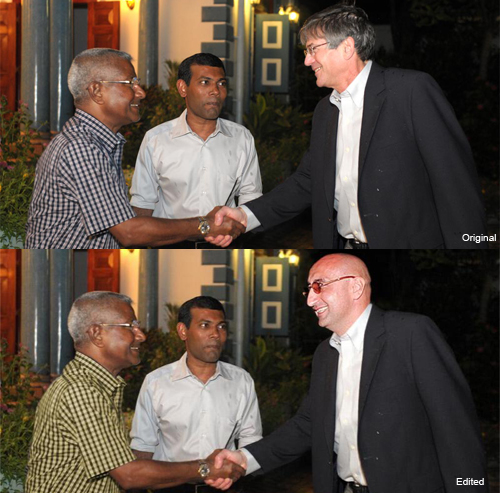
A photograph widely distributed by local media outlets depicting former President Mohamed Nasheed and his Special Envoy Ibrahim Hussain Zaki meeting the infamous Armenian ‘Artur Brothers’ has turned out to be a hoax.

The Armenian brothers – linked with drug trafficking, money laundering, raids on media outlets and other serious crimes in Kenya – were recently photographed with current Minster of Tourism Ahmed Adheeb and Defence Minister Ahmed Nazim during the Piston Motor Racing Challenge, organised by the Maldivian National Defence Force (MNDF).

The two ministers initially denied any involvement with the brothers or their apparent business interests in the Maldives, however a letter from the Tourism Ministry to immigration authorities requesting a residency visa for Margaryan and Sargsyan Artur, dated January 27 and signed by Adheeb, was subsequently leaked on social media.

Zaidul Khaleel, General Manager of the Club Faru resort which is operated by the state-owned Maldives Tourism Development Corporation (MTDC),  has also reportedly been sacked after he was found to have paid the brothers’ US$6000 bill.

Meanwhile, on Sunday a photo depicting former President Nasheed and Special Envoy and former SAARC Secretary General Ibrahim Hussain Zaki apparently meeting Artur Sargsyan was leaked on social media and widely republished by local media.

Local media outlet Channel News Maldives (CNM) reported that the photograph was originally leaked by the former Immigration Controller and current State Minister for Defence, Ilyas Hussain.

However the photograph turned out to be an edited photo taken during a formal reception for US Deputy Secretary of State James Steinberg, held at the former Presidential residence of Muleaage in January 2011, with Sargsyan Artur’s head carefully photo-shopped onto Steinberg.

According to CNM, Ilyas at the time confirmed to the media outlet that the photo of Nasheed with Artur Sargsyan was real and authentic.

Speaking to Minivan News, Ilyas Hussain stated that he no longer wished to comment on the matter.

Following the publication of the leaked photo, a member of President Waheed’s Gaumee Ithihaad Party (GIP) told Minivan News that Waheed had prepared a press conference following the release of the edited photo, but later called it off after the photo was discovered to be a hoax.

Minivan News was unable to confirm the claim as President’s Office Spokesperson Masood Imad was not responding at time of press.

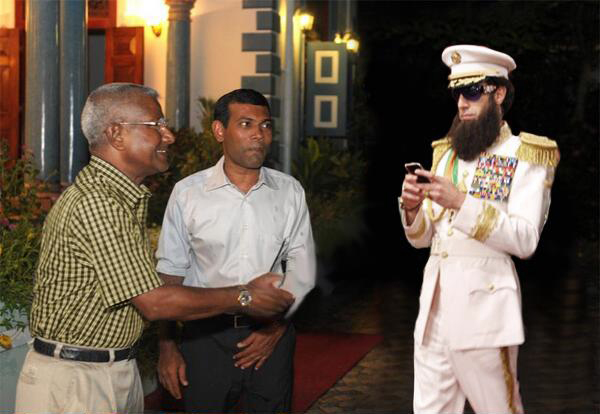
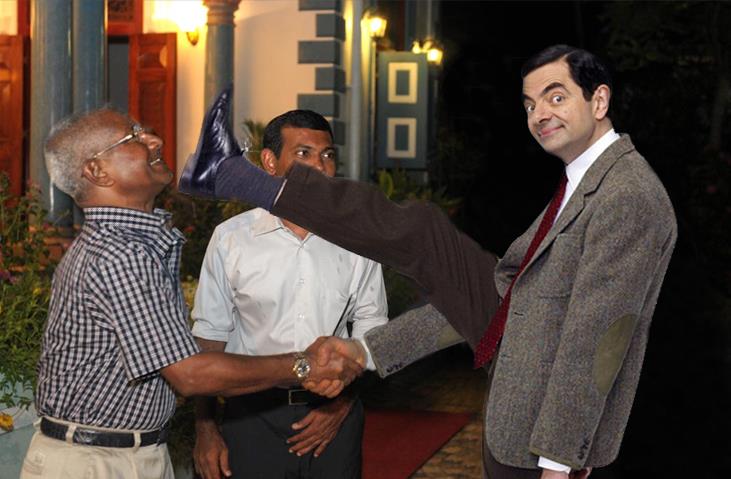
The photo has since gone viral across Maldivian social media and has been widely photoshopped to depict Nasheed meeting a wide variety of celebrities and fictional characters.

The meme has blossomed to include Nasheed encountering deceased Chairman of Apple Inc, Steve Jobs, Albert Einstein, Justin Beiber, Professional Wrestler/Rapper/Actor John Cena, the Pope, popular antagonist of the Star Wars franchise Darth Vader, fictional lead character in the Sacha Baron Cohen comedy ‘Dictator’ Admiral General Haffaz Aladeen, DC Comics superhero Batman, Rowan Atkinson’s UK comedy icon Mr Bean, and ‘Big Bird’ from US children’s television show Sesame Street.

Likes(0)Dislikes(0)

Ministers slam Nasheed for “bluffing” over guesthouse commitments

Former President Mohamed Nasheed’s pledge to expand guest house tourism in the country has been strongly criticised by senior government figures, who accuse him of lacking sincerity and “bluffing” over his commitments to mid-market tourism.

State Minister for Finance Abbas Adil Riza and Minister for Tourism Ahmed Adheeb both this week slammed Nasheed, claiming guesthouse bed numbers more than doubled last year after President Dr Mohamed Waheed came to power.

The ministers, who represent the government-aligned Gaumee Ithihaad Party (GIP) and  the Progressive Party of Maldives respectively, also criticised Nasheed over previous remarks he made in international media calling for a boycott of the country’s tourism sector.

However, Nasheed’s Maldivian Democratic Party (MDP) has claimed that after reintroducing the guesthouse concept to the Maldives during its administration, the party’s latest manifesto gave further importance to growing mid-market tourism.  The MDP claims such growth will be vital to tackling what it called a “total disconnect” between the lucrative island resort model and local people.

With the inclusion of development of small and medium businesses – particularly in the emerging guesthouse sector – in a “mini-manifesto” drawn up by the MDP, mid-market tourism has emerged as a key potential issue for elections in September 2013.

Bed numbers

Speaking to Minivan News, Abbas Adil Riza accused Nasheed of lying in regards to his commitments to mid-market tourism development, criticising him for a wider failure to protect small and medium businesses in the country.

“My concern is that Nasheed is bluffing. Between 2009 to 2011, there were 16 new guest houses built,” he said, claiming these properties amounted to some 180 tourism beds.

Abbas said that in 2012 alone, the number of guesthouse beds available to tourists in the country had almost doubled as a result of programs implemented by the Waheed government to provide smaller-scale loans leading to 37 guest houses being developed.

“During Nasheed’s administration, outsiders were given public land and there was no funding supplied,” he said. “After February 7, we gave small-scale loans to 37 individuals.”

Abbas also accused former President Nasheed of failing to support small and medium enterprises and local industry in general.

He added that small and medium scale businesses had to be set up in harmony with local culture and traditions, particularly on small islands.

“He can’t just say that he is the champion of these things,” Abbas added.

Boycott concerns

Traditional holiday staples for large numbers of tourists coming to the Maldives, including being able to wear bikinis and drinking alcohol, are not permitted by law on local islands that are classed as being inhabited.

Speaking to local media, both Abbas and Tourism Minister Adheeb have hit out at claims by the MDP published in international media last year calling for travellers to boycott Maldives tourism.

Adheeb told Sun Online that Nasheed had not made sense by previously calling for the promotion of guest houses in the build up to this year’s presidential election after calling for a boycott last year.

“President Nasheed had made a global call to boycott Maldives tourism, and now he is calling to promote guest house businesses, targeted at Maldives tourism. This does not make sense,” he was quoted as saying.

Nasheed last year called for a tourism boycott of the Maldives, as he continued to question the legitimacy of the government of President Waheeed – his former vice president.

However, these calls were soon dropped by Nasheed and supporters of the now opposition MDP.

The Ministry of Tourism last year fell short of its stated aim of welcoming one million visitors to the country during 2012, citing difficulties resulting from media coverage of political turmoil following the change of government that brought President Dr Mohamed Waheed to office.

However, authorities in the country have since pledged to surpass the one million visitor goal in 2013, claiming late last year that the “hard days” were over for tourism in the country following 2012′s political turmoil.

Despite this stance, as part of a so-called silent protest at this year’s ITB event, anti-government campaigners distributed leaflets entitled ‘the cloudy side of life‘ – a play on the country’s official ‘Sunny Side of Life’ tourism slogan to draw attention to alleged human rights violations under the new government.

“Paradigm shift”

MDP MP and Spokesperson Hamid Abdul Ghafoor responded that Nasheed’s government had sought to reintroduce and expand guest houses in the Maldives – a development the party claimed was needed to bring a “paradigm shift” in general thinking and economic development in the Maldives.

After 40 years of concentrating primarily on exclusive island-based resort tourism, Hamid accused former President Maumoon Abdul Gayoom during his 30 years of power of creating a “total disconnect” between local people and the country’s famous high-end tourism product.

“They local people Islamic rhetoric while talking something very different to tourists,” he claimed.

Pointing to the ‘mini-manifesto’ released by the MDP in the build up to this year’s elections, Hamid claimed that was capacity for an additional 600,00 tourists to travel to the Maldives annually, yet there was not enough options to accommodate them.

“All across this country, you see that many islands are ready for [middle-market tourism]. There are impressive cafes. People who have worked in the tourism industry are setting up businesses based on their experiences,” he said. “Tourism is very much a business we know and some of these places are quite sophisticated.”

As part of the MDP’s election pledge, Hamid claimed that some MVR120 million was set to be pledged as part of a policy to provide “seed money” to help establish guest houses and supporting industries.

He said that guest houses have always been a central policy of the MDP to support national development.

By comparison, Hamid claimed that before coming to power, the previous government under former President Gayoom had tried to paint tourism on local islands as “haraam” to discourage interest and investment.

He claimed such a strategy was overseen by certain resort owners and tourism magnates alleged by the MDP to being central in bringing the present government to power on February 7, 2012.  Nasheed himself resigned following a mutiny by sections of the police and military.

Both Nasheed and the MDP have continued to contend that the transfer of power was a “coup d’etat”, despite the findings of a Commonwealth-backed Commission of National Inquiry (CNI) last year.

Responding to the party’s previous reported support for a tourism boycott, MP Hamid claimed the party had always committed itself to what it called selective boycotts – rather than calling for tourists to outright reject the destination.

“We are not saying that all resort operators are bad. But some of them were directly involved in the coup and have sought to exploit their positions,” he said.

Hamid denied the party had sought to boycott the industry outright, claiming instead to be targeting resort owners that he alleged ran their businesses unethically in the style of “cartels”.

Nasheed’s tourism potential

Just last month, in an open-editorial piece reprinted in Minivan News, former President Nasheed claimed that only 50 people directly profited from the resort industry in the Maldives, limiting what he claimed were a wealth of economic and social policies.

“What the average Maldivian wants is basic. We want a way to increase our income. We want to broaden our narrow financial horizons through development.

It is not that we lack this capacity to develop. We have plentiful natural resources. If we settle for the current economic status quo, believing that what we have now is the limit to what we are entitled to, it will mean that our true wealth potential remains untapped,” he wrote at the time.

“What the MDP and I have always pointed out is this basic fact: we want to develop. To upgrade beyond the current status quo. The ordinary Maldivian’s complaint is that of poverty, of financial anxiety. We want a wallet with the wads; we want to realise that financial progress is possible. The political office is a place that should offer solutions to these complaints. This is its responsibility and obligation.”

Meanwhile, an island owner involved in the country’s burgeoning mid-market holiday sector last week slammed new regulations imposing financial restrictions on tourism joint venture projects with the government, claiming the legislation outright excludes small and medium-scale investors.

Likes(0)Dislikes(0)

High blood pressure “silent killer” of one in 10 Maldivians

High blood pressure is the leading risk factor for Maldivian deaths, and is much more prevalent among women than men nationwide.

One in 10 deaths in the Maldives, equaling over 100 yearly, can be attributed to this “silent killer” which often presents no symptoms.

High blood pressure – also referred to as hypertension – is a condition where blood vessels have a persistently raised pressure which can lead to heart attacks, heart failure, stroke, kidney failure, loss of vision, and premature death.

In the Maldives 32.9 percent of women, compared to 29.7 percent of men, are affected by hypertension, although the prevalence of men with hypertension is higher regionally and globally.

Hypertension has been increasing over the past decade in the Maldives. Economic progress has caused lifestyles to change drastically, reads a World Health Organisation (WHO) World Health Day report.

“In the era of globalisation, all countries are interrelated, rapid urbanisation, transition from agrarian life to wage-earning, and modern city life are considered to be the major contributors in the elevated blood pressure in urban areas,” WHO Representative Dr Akjemal Magtymova told Minivan News.

Unhealthy lifestyle and behavior risk factors for hypertension have increased, including consumption of processed foods containing excessive salt, low levels of physical activity, tobacco use, and obesity.

“Increasing levels of mental stress contribute to the adoption of unhealthy behaviors thus putting people at a higher risk of acquiring hypertension and related noncommunicable diseases,” the WHO South-East Asia Regional Director Dr Samlee Plianbangchang stated in his World Health Day 2013 message.

Magtymova explained “Some of the factors that may contribute to the higher prevalence of hypertension among Maldivian women include: no enough physical activity (affecting 41 percent of women in the Maldives compared with 37 percent of men), unhealthy diet (higher intake of salt, sugar and fat, – total cholesterol level in women is higher than in men), higher stress level, malnutrition in childhood and during reproductive age.”

For both men and women the prevalence of being overweight or obese is the highest in the Maldives compared to other countries in the South-East Asia Region.

“The 2008 data from the Maldives shows that among the adult population, 53 percent of women are overweight and 30 percent of men are overweight,” said Magtymova.

Over the past 14 years there has been an increasing trend of hypertension at the Indira Gandhi Memorial Hospital (IGMH), physician Dr Ali Abdul Latheef explained in the WHO World Health Day report.

“What is alarming is that we now see a lot of young hypertensive patients. Many patients are in their early thirties and sometimes as young as early twenties,” said Dr Latheef.

Prevention

High blood pressure is both preventable and treatable, but remains a growing global public health issue, which is why ‘control your blood pressure’ is the WHO’s World Health Day 2013 (April 7) theme.

The WHO recommends at least 150 minutes of moderate physical exercise weekly to prevent diseases like hypertension, according to the WHO World Health Day article.

Eating a healthy diet including fruits and vegetables, while reducing salt and processed foods is also important.

Stopping tobacco use and reducing harmful alcohol intake must also be addressed.

However, regular blood pressure checkups are essential, because there are rarely warning signs of hypertension and it can also develop as blood vessels harden with age.

Magtymova stated the WHO recommends implementing evidence based strategies to address all behavioral risk factors for preventing hypertension.

“High level commitment is needed to reverse the growing burden of noncommunicable diseases in the Maldives.

“The WHO is assisting the Government of Maldives and working closely with the Ministry of Health to improve available data on risk factors, prevalence and trends, as well as address risk factors by establishing preventative measures,” said Magtymova.

She further detailed that the WHO closely collaborates and supports non-governmental organisations (NGOs), such as the Diabetes Society of Maldives, SHE (Society of Health Education), Aged Care, the Autism Association, and Care Society.

Magtymova emphasised “A multi-sectoral approach is a key in addressing prevention and control of noncommunicable diseases as many determinants of non-communicable disease lie outside of the health sector.”

Thus, other UN agencies are also promoting healthy lifestyles, eating habits, school health education, as well as monitoring trends in malnutrition among children and mothers.

Likes(0)Dislikes(0)

Actor Ali Seezan newest addition to government’s list of political appointees

Local Actor Ali Seezan has been appointed as technical advisor to Minister of Tourism Arts and Culture Ahmed Adheeb, reports local media.

According to the President’s Office, Seezan was appointed to the position last Thursday with a salary of MVR 15,000 (US$ 972.76) and an additional allowance of MVR 10,000 (US$ 648.50), a total monthly income of MVR 25,000 (US$1,621.27).

Seezan – who is the nephew of opposition Maldivian Democratic Party (MDP) Chairperson MP Moosa ‘Reeko’ Manik – has won National Film Awards and Maldives Film Association Award twice and is a member of business tycoon and MP Gasim Ibrahim’s Jumhoree Party (JP).

He has recently been seen attending President Mohamed Waheed’s Gaumee Iththihaadh Party (GIP) rallies.

Minister Adheeb – who was recently pictured in the media with an infamous pair of Armenian brothers linked with drug trafficking, money laundering, raids on media outlets and other serious crimes in Kenya – told local newspaper Haveeru that he had no role in the appointment of Seezan.

According to statistics obtained by local media outlet Sun Online, the government is spending MVR 5 million (US$325,000) a month on 136 political appointees, approximately US$4 million a year.

The monthly spend includes 19 Minister-level posts at MVR 57,500 (US$3730), 42 State Ministers (MVR 40,000-45,000, US$2600-2900), 58 Deputy Ministers (MVR 35,000, US$2250), five Deputy Under-Secretaries (MVR 30,000, US$1950) and 10 advisors to ministers (MVR 25,000, US$1620).

President Mohamed Waheed is officially paid (MVR 100,000, US$6500) a month, Vice President Waheed Deen (MVR 75,000, US$4850).

Waheed’s Special Advisor Hassan Saeed, the Chancellor of the National University and the Controller of Immigration are paid at ministerial level.

The country’s 77 MPs are meanwhile paid a base salary of MVR 42,500 (US$2,750) per month, a further MVR 20,000 (US$1,300) per month in allowances for phone, travel, and living expenses, and a further MVR 20,000 in committee allowances.

The Maldivian Democratic Party (MDP) has meanwhile criticised President Mohamed Waheed for appointing family members and activists “who took part in the coup that ousted the democratically elected president.”

President Waheed’s Gaumee Iththihaadh Party (GIP) was earlier accused of offering illegitimate inducements to join his party to people ranging from youths to employees of government companies, in a bid to shore up the party’s membership base ahead of parliament’s dissolution of parties with less than 10,000 members.

In October 2012, a number of young people came forward and alleged to Minivan News that they were offered government positions, promotions, jobs with salaries of more than MVR 10,000 (US$650) a month, music equipment and even hosted parties, if they joined GIP.

GIP Secretary General Ahmed Mushrif dismissed the allegations at the time as an “outright lie”, and said that the party from its formation had never attempted to add members illegally.

A young Maldivian working in the tourism sector told Minivan News on condition of anonymity that a parliament member and prominent figure in the industry had called him and asked him to sign with GIP “as a favor”.

“He told me that in return for me joining the party, I would be rewarded with a position in the current government that I could never have even imagined. He further tried to convince me that all I needed to do was join the party – I could vote for anybody I wanted,” he said.

Another person who has worked in the civil service for the last 15 years told Minivan News that he was contacted by GIP with a promise that he would “easily be promoted” to a supervisor level job if he joined the party.

“A GIP member called me and told me that I could easily get promoted to supervisor level if I left my current party and joined GIP. Even though I am not an active MDP member I said I would think about it, but later did not respond to his calls,” the civil servant said.

A third person – aged 20 – claimed that he and his group of friends aged around 18 to 22 were approached by GIP through a friend and were invited to the party’s office where they were received by the party’s Deputy Leader  and the former Maldives High Commissioner to Malaysia, Mohamed ‘Nazaki’ Zaki.

“When we arrived we were received by ‘Nazaki’ Zaki and treated with pizza. He said that in return for joining GIP, he would offer each of us a job with a salary not less than MVR 10,000, but asked us not to question where the jobs would be allocated from,” the youngster claimed.

Apart from the job, the source alleged that Zaki had offered him and his friends “music equipment and a place to play for free” to those among them who wished to play music. He added that the group were also promised various entertainment activities such as “hosted shows and parties”.

“They asked us to join the party and work in the party’s youth wing,” the source said.

When they asked what they were supposed to do as members of the party’s youth wing, the source said Zaki had told them that their main task would be to increase the party’s membership as it was “currently very low”.

At the end of the meeting, the high commissioner reportedly suggested the holding of a party event that would be fully funded by GIP.

“They said we should all party sometime. Maybe they said that because we had long hair and looked stylish,” the source suggested.

Download a ‘Who’s Who’ spreadsheet of Dr Waheed’s ministerial appointees (English)

Likes(0)Dislikes(0)

JSC rejects complaint by High Court judges against Chief Judge Ahmed Shareef

The Judicial Service Commission (JSC) has rejected the case submitted by eight members of the High Court against Chief Judge Ahmed Shareef over his suspension of former President Mohamed Nasheed’s trial in the Hulhumale Magistrate Court.

Last Wednesday eight of the High Court’s nine-member bench filed the case claiming that the chief judge had issued the stay order without registering the case, had failed to assign a case number to the case, and had not discussed the matter with the other judges.

The judges also accused the chief judge of taking the matter into his own hands by not discussing the matter with them before issuing the order.

A spokesperson from the JSC confirmed to Minivan News at the time that the commission had received a “letter” from the eight judges regarding Judge Shareef.

A High Court official denied the allegations made by the judges, stating that the case concerning the stay order was registered at the court the previous week and that the former President’s legal team had paid the charges the following day.  He also added that the order was issued after the court had received the payment.

During a meeting held on Thursday the JSC decided to not look into the case, claiming that a conflict of interest existed in the commission probing the matter, as it had appointed the three member judges panel to the Hulhumale Magistrate Court. The court is currently hearing all trials concerning the arrest of Chief Judge of Criminal Court Abdulla Mohamed.

The members of the judicial watchdog also came to the conclusion that the case filed by the eight judges included issues concerning High Court procedure, which it claimed could only be looked into after the Supreme Court made a decision regarding the matter.

Six of the 10-member commission were reportedly against looking into the case while only one member was voted in favour, according to local media.

The High Court Chief Judge issued the injunction after the Hulhumale Magistrate Court rejected a request by former President Nasheed’s legal team to defer his trial until the end of the scheduled presidential elections, despite no objection from the state prosecutors.

The former president – who stands charged of unlawfully detaining the Chief Judge of Criminal Court during his last days in power in January 2012 – appealed the decision at the High Court while also contesting that the JSC had appointed the panel of judges to the magistrate court arbitrarily.

Following the appeal, the High Court granted a stay order ordering the magistrate court to halt Nasheed’s trial until it decided on the legitimacy of the panel of judges appointed to examine his case. The stay order was signed by Chief Judge Ahmed Shareef, and stated that the court was of the view that Nasheed’s ongoing trial must come to a halt until the legitimacy of the bench was established.

Concerns

Following the filing of the case at the JSC against Chief Judge Ahmed Shareef, member of former President Mohamed Nasheed’s legal team Hassan Latheef has expressed his concern as to whether JSC would look into the matter impartially and transparently.

Speaking during an opposition Maldivian Democratic Party (MDP) rally held on Wednesday evening, Latheef – who was the minister for human resources, youth and sports during Nasheed’ presidency –  argued that the decision by the Chief Judge of High Court regarding the stay order was made in accordance with the High Court’s normal procedures.

Latheef claimed that based on the documents published at the high court website, out of the 15 stay orders issued in 2012 by the High Court in 2012, 10 stay orders had been signed by just one High Court judge.

“The Hulhumale Magistrate Court which is hearing the case of President Nasheed was ordered to be suspended by High Court in according to its usual practice in such cases. The case was registered at the High Court and even before there were instances were stay orders had been issued that had only one signature,” Latheef said.

Latheef also dismissed the claims that the case had not been registered at the court.

“We filed the case on March 31. The stay order was issued the afternoon of the following day, after we had even paid the charges for filing the case in the court,” he contended. “Another question is who will look into the case impartially – all the other judges have filed this case at the JSC against Chief Judge Shareef. Eight judges are on one side while the chief judge is on the other side. These are new issues which have come out of the case.”

He noted that this was the first time in Maldivian legal history where an entire panel of judges had teamed up against the chief judge following a decision on a case.

JSC under heavy scrutiny

The JSC has come under heavy scrutiny over its appointment of the panel of the judges to Hulhumale Magistrate Court to hear cases concerning the arrest of Chief Judge of Criminal Court Abdulla Mohamed – which several lawyers and members of the JSC itself have claimed exceeded the JSC’s mandate.

Among the JSC’s critics include JSC member Sheikh Shuaib Abdul Rahman – the member appointed from among the public.  Sheikh Shuaib Abdul Rahman previously claimed the JSC had arbitrarily appointed three magistrates from courts across the Maldives to Nasheed’s case after dismissing the three names first submitted to the commission by the Hulhumale’ Magistrate Court.

Speaker of Parliament Abdulla Shahid – who is also a member of the JSC – stated that he believed that the judicial watchdog had acted unconstitutionally in assigning magistrates to a particular case.

“In deciding upon the bench, the JSC did follow its rules of procedures. As in, it was voted upon in an official meeting and six of the seven members in attendance voted on the matter. The seventh member being the chair, does not vote in matters,” Shahid explained.

Other critics included United Nations Special Rapporteur (UNSR) on the Independence of Judges and Lawyers, Gabriela Knaul, who also said the appointment was carried out arbitrarily.

“Being totally technical, it seems to me that the set-up, the appointment of judges to the case, has been set up in an arbitrary manner outside the parameters laid out in the laws,” Knaul said, responding to questions from media after delivering her statement in February.

Likes(0)Dislikes(0)

PPM to decide whether to discipline Umar Naseer for allegations of corruption in party primary

The Progressive Party of the Maldives (PPM)’s disciplinary committee has accepted a case forwarded to the committee by the party council against PPM Deputy Leader Umar Naseer, after he refused to publicly apologise for the claiming the party’s recent primaries were rigged in favour of PPM Presidential Candidate Abdulla Yameen.

Head of the PPM Disciplinary Committee, MP Abdul Azeez Jamal Abubakur, said the deadline for Umar Naseer’s apology expired on Sunday at 10:00am.

Abdul Azeez told local newspapers that within two days the committee will conclude its investigation of the case, in which “Umar Naseer violated the party charter and made huge accusations.”

He also said the committee will refer to the party’s charter when deciding on what action to take against Naseer.

After losing the PPM Primary, Umar Naseer held a rally and declared that despite admitting defeat, the party’s internal election had involved discrepancies including the influencing of voters, vote buying and intimidation of his supporters.  He also alleged that many of his supporters were denied the right to vote, claiming that their names had not been on the lists.

“Former President Maumoon Abdul Gayoom’s children were with Yameen, the largest gangsters in the country were with Yameen, all the drug cartels in the country were with Yameen, the most corrupted people were with Yameen, the whole elections committee was with Yameen and a large chunk of PPM’s parliament members gathered around Yameen.

“We came out knowing that the referee, the linesman and even the match commissioner along with his 11 players were playing on his side. Our team had the poor and the middle class players,” Naseer said at the rally.

“We even witnessed that those who are heavily involved in drug trafficking were present at the polling station wearing Yameen’s campaign caps,” he said. “Not only did they exert undue influence, they travelled to islands with stashes of black money and attempted to turn the votes. In fact they even did turn some votes.”

In September 2010, Umar Naseer was the Deputy Leader of Dhivehi Rayyiithunge Party (DRP), the DRP Council in a meeting decided to file a case against Umar at the Disciplinary Committee for forging a press release and for causing division in the party.

Later in December 2010, Umar Naseer was dismissed from the party – an incident that eventually led to a splintering of the DRP into a new party under Gayoom, the PPM.

Umar Naseer’s mobile phone was switched off at time of press.

Likes(0)Dislikes(0)

Maldives government denies US$160 million arbitration talks with Axis Bank

The Attorney General (AG’s) Office has denied receiving any notice of arbitration from Axis Bank, one of the lenders backing a US$511 million airport development project voided by the government late last year.

In November 2012, President Dr Mohamed Waheed’s government declared void a concession agreement signed by the previous government with Indian firm GMR, to manage and build a new terminal at Ibrahim Nasir International Airport (INIA), and ordered the company to leave the country within seven days.

Following the decision – later cleared by Singapore’s Supreme Court – project lender Axis Bank announced its intention to seek a repayment of loans taken out for the project, which were guaranteed by the Ministry of Finance and approved by the AG’s Office under the former government.

“Arbitration process”

The India-based Financial Express publication reported yesterday (April 5) that Axis Bank had initiated an arbitration process with the Maldives government as part of efforts to recover loans granted to GMR with an estimated value of US$160 million (MVR 2.4 billion).

Ahmed Usham, Deputy Solicitor General for the AG’s Office, told Minivan News today that although some discussions had been held with Axis Bank, there had been no notice of arbitration given to the state by the finance group over the loan issue.

“We have requested some documents from [the bank] and we are set to meet with them after receiving these,” he said.  “There has been no talk of arbitration.”

Usham added that the documents requested from Axis Bank by the AG’s Office pertained to loans taken from GMR as part of the INIA development.

Acting Minister of Finance Ahmed Mohamed said he too was not aware of any arbitration hearings concerning Axis Bank, or even if talks had been held on the matter.

“All I am aware of is that there was a teleconference held Thursday (April 4),” he stated.

GMR arbitration

The government meanwhile is set to participate Wednesday (April 10) in the preliminary hearing of a separate arbitration case with GMR over the decision to void its airport concession agreement .

Authorities have previously told local media that the meeting, scheduled to take place in London, was not an official arbitration hearing, but rather a means to outline the timeline for both parties to present their case. Once the process for the arbitration is agreed, official hearings are expected to begin in Singapore.

According to the Attorney General’s office, the Maldives will be represented by Singapore National University Professor M Sonaraja, while former Chief Justice of the UK, Lord Nicholas Addison Phillips, will represent GMR.

The arbitrator mutually agreed by both GMR and the government is retired senior UK Judge, Lord Leonard Hubert Hoffman.

Concession agreement

In 2010, GMR-Malaysia Airports Holdings Berhad (MAHB) consortium, the government of former President Mohamed Nasheed and Maldives Airport Company Limited (MACL) entered into a 25-year concession agreement worth US$511 million (MVR 7.787 billion) – in which the GMR-MAHB Consortium was contracted with the management and upgrading of Ibrahim Nasir International Airport (INIA) within the 25 year contract period.

However in November 2012, the government of President Dr Mohamed Waheed Hassan Manik declared the developer’s concession agreement void and ordered it to leave the country within seven days.

A last minute injunction from the Singapore High Court during arbitration proceedings was overturned on December 6, after Singapore’s Chief Justice Sundaresh Menon declared that “the Maldives government has the power to do what it wants, including expropriating the airport.”

GMR is seeking US$800 million in compensation for the sudden termination, while the Maldivian government is contending that it owes nothing as the contract was ‘void ab initio’, or invalid from the outset.

If decided in GMR’s favour, the outcome of the case could potentially see the Maldives facing sovereign bankruptcy, with millions of dollars in additional debt emptying the state’s already dwindling reserves, crippling the country’s ability to obtain further credit, and potentially sparking an economic or currency crisis.

If decided in the Maldives’ favour the case risks setting a legal precedent for effective nationalisation of foreign investments signed under previous governments, and placing existing investors further at the mercy of the country’s turbulent politics.

Kuwaiti interest

Discussing the future of INIA on Thursday, President Waheed was reported in local media as stating that authorities in Kuwait had expressed an interest to “assist in the development” of INIA, following a recent official visit to the country.

“Kuwait is really interested in the airport. It’s because we have received a great deal of assistance from the Kuwait Fund to develop the airport so far. They are well aware of it,” he was quoted in newspaper Haveeru as saying.

“They really believe that we have managed to develop the airport with the assistance of Kuwait. So there is a lot of interest. They are very happy that the government has now taken the initiative to develop the airport.”

President’s Office Media Secretary Masood Imad said he was in a meeting and unavailable for comment when contacted by Minivan News.

Likes(0)Dislikes(0)

Fair trial for Nasheed “difficult to see” when judicial bench “cherrypicked to convict”: BHRC trial observers

Read the BHRC’s second independent trial observation

The UK’s Bar Human Rights Committee (BHRC) has expressed “serious concern” over the appointment of judges by the Judicial Services Commission (JSC) in the trial of former President Mohamed Nasheed.

Accounts of the appointment process, “if accurate, suggest egregious unconstitutional behaviour by the JSC in selecting the judicial bench to hear Mr Nasheed’s case,” stated BHRC Executive Committee member Blinne Ní Ghrálaigh, who visited the Maldives to observe recent proceedings against Nasheed.

The committee has conducted several independent trial observations of proceedings involving the former President, who is charged over the detention of Chief Judge of the Criminal Court, Abdulla Mohamed, during the final days of his presidency.

Nasheed and his Maldivian Democratic Party (MDP) maintain that the charges are a politically motivated attempt to prevent him contesting the 2013 presidential elections, challenging both the legitimacy of the Hulhumale’ Magistrate Court hearing the case, and the JSC’s appointment of judges to the case. The JSC itself includes several of Nasheed’s direct political opponents, including rival presidential candidate, resort tycoon Gasim Ibrahim.

The Nasheed trial was meanwhile suspended by Chief Judge of the High Court last week pending a ruling into the legitimacy of the bench’s appointment – an action which led all other High Court judges to file a complaint against the Chief Judge with the JSC.

“It is difficult to see how proceedings presided over by a judicial bench, cherrypicked for their likelihood to convict by a highly politicised JSC, which includes a number of Mr Nasheed’s direct political rivals, could in any way be deemed to comply with constitutional and international fair trial rights, including the right to an ‘independent court established by law’,” stated Ghrálaigh, in her concluding remarks.

“The BHRC welcomes the current investigation by Parliament’s Independent Commission’s Oversight Committee into the judicial selection process in the case, but notes with concern the refusal by the JSC to cooperate with that investigation,” she added.

“Lack of transparency in the constitution of judicial benches and in the assignment of cases fundamentally undermines the proper administration of justice: fair trial guarantees and the requirements of natural justice demand not only that justice be done, but that it be seen to be done,” her report states.

The report provides a detailed overview of state of the judiciary and political context in the lead up to Nasheed’s resignation and prosecution.

Ghrálaigh states that given concerns about the JSC’s politicisation and “serious questions” concerning its appointment of judges to the Hulhumale’ Magistrate Court, “it is perhaps surprising that the court should have decided of its own motion (“ex proprio motu”) to deny the request made by Mr Nasheed’s legal team to postpone the proceedings until after the elections, in the absence of any objection by the prosecuting authorities to such an adjournment.”

“Although there is nothing to prohibit courts from making decisions governing their process ex proprio motu, the allegations concerning the manner of selection of the Hulhumalé Magistrates’ Court panel render the Court’s stated reasoning for its decision all the more disquieting,” she stated.

The BHRC was not seeking to downplay the seriousness of the charges against Nasheed, she noted.

“However, what is clear is that the case is far from straightforward. Central both to the context of Judge Abdulla’s arrest and to the nature of the criminal proceedings against the former president are fundamental questions of judicial independence in the Maldives.”

“The charge against Mr Nasheed is that he acted “in a manner contrary to law” in ordering the arrest and detention of a senior judge. Although the details of the prosecution case have yet to be set out, it is clear that the Article 81 offence with which Mr Nasheed is charged is not a trivial one,” the report states.

“The BHRC notes with concern the increasing number of reports and statements by international bodies, including those referenced in this report, which conclude that the Maldives does not have an independent and impartial judiciary,” the report states.

“The BHRC further notes the view inside and outside the Maldives that the failure by the institutions of the State, in particular the JSC, properly to implement constitutionally mandated reforms to create an impartial judiciary, independent from political pressures, and the failure properly to investigate and/or sanction allegations of egregious, unlawful and/or unconstitutional judicial conduct, have served significantly to derail the State’s transition to a functioning constitutional democracy,”

Given extensive local and international concern over the state of the Maldivian judiciary, Ghrálaigh observes that the context for the criminalisation of Nasheed’s detention of Judge Abdulla, hangs on whether the Chief Judge is, as stipulated by Article 81 under which Nasheed is being charge, “an innocent person”.

“It is against that background, and in the context of a number of serious complaints against Judge Abdulla, that the order for his arrest was made. That background is intrinsically bound up in the nature of the charge against Mr Nasheed: the wording of Article 81, which criminalises a public servant for “us[ing] the authority of his office to intentionally arrest or detain an[…] innocent person contrary to the law” suggests that the context to the arrest, and in particular the allegations against Judge Abdulla, will necessarily be central to the determination of the charges against the former President,” the BHRC report states.

Ghrálaigh notes that the JSC was “also subject to significant criticism for its failure properly to oversee individual complaints against individual judges. One judge against whom a number of serious complaints were levied was Judge Abdulla, accused inter alia of “implicat[ion] in 14 cases of obstruction of policy duty”, including “strategically delaying cases involving opposition [Gayoom loyalist] members”, “twist[ing] and interpret[ing] laws so they could not be enforced against certain politicians”, “accepting bribes to release convicts”13 and “hijack[ing] the whole court”.

“I was informed that a JSC complaints committee charged in December 2009 with investigating Judge Abdulla, failed to issue any findings, following an injunction sought by, and granted to the judge by the Civil Court, preventing his further investigation by the JSC and/or the publication of any report concerning his conduct,” Ghrálaigh noted.

The JSC, responsible for reappointing judges including Judge Abdulla in 2010 at the conclusion of the constitutional interim period, “failed properly ‘to fulfill its constitutional mandate of proper vetting and reappointing of judicial candidates’, a failure regarding which international bodies, including the International Commission of Jurists, have expressed concern,” she added.

“Rather, in August 2010, amidst much controversy, it proceeded to confirm almost every Gayoom-regime judge, qualified or not, in office for life, finding that the constitutional provisions regarding judicial appointment were merely “symbolic”.

“Consequently, the Maldivian judiciary remains largely unchanged since the country’s transition to a constitutional democracy: the vast majority of judges in office, including Judge Abdulla, are political appointees of former President Gayoom, and many still lack any formal training in law.”

Furthermore, “The blocking in the People’s Majlis of key pieces of legislation including the Penal Code and the Criminal Evidence Act, that would provide for equality and uniformity in the application of a codified body of law, means that mainly untrained judges continue to wield considerable discretion in their determination of cases.”

Read the BHRC’s second independent trial observation

Likes(1)Dislikes(0)

Maldives’ satellite bid, Chinese involvement leads to India’s alleged security concerns

The Indian government is intervening at the “highest levels” to “push” the Indian Space Research Organisation (IRSO) to submit a proposal for the joint manufacturing, launch and operations of a Maldives’ communications satellite as a means to improve bilateral relations, claims the Hindustan Times.

The IRSO did not initially submit a proposal, considering the project “not viable” given China’s interest and presence in the Indian Ocean Region. They later requested the Indian Ministry of External Affairs to partly subsidise the project, according to Indian media.

The High Commission of India (HCI) in the Maldives is unsure whether the report’s claims are accurate.

“The HCI knows of the [Communications Authority of Maldives (CAM)] request for proposals and discussions with the Maldivian government did occur,” HCI official Shri P S Karthigeyan told Minivan News today.

“However, beyond that the current status of the project is not known,” he added.

Karthigeyan confirmed that Maldivian Defence Minister Colonel (Retired) Mohamed Nazim is traveling to India April 15 to 18, was its unaware if his agenda includes discussions regarding the satellite project.

“The topic is on the bilateral agenda and will be taken up with Nazim. Not only Chinese companies but others too are interested in the Maldivian project,” media quoted an anonymous Indian Ministry of External Affairs official as saying.

Indian security agencies are concerned about increased Chinese participation in neighboring countries’ communication satellite projects, according to various Indian media outlets.

The Indian government plans to discourage giving orbital slots to China through a “mix of investments and diplomatic negotiations”.

India’s Antrix Corporation could bid for this project to scuttle any possible venture with the Chinese, reported the Hindu Business Line.

“ISRO may consider sending a delegation to Maldives to explore the possibility of cooperation in space technology. Maldives could be sensitised to India’s security concerns with regard to the presence of third countries in areas close to its borders,” an Indian government official was quoted as saying.

A meeting was held in late March with Indian intelligence agencies, ministries, and the department of space to discuss China’s growing influence in South Asia, according to Indian media.

“Analysts suspect a Chinese hand behind recent setbacks India has suffered in the region, such as the scrapping of GMR’s airport deal in Maldives and Sri Lanka raising duties on Indian auto imports. China’s economic rise is gradually eroding India’s ability to wield influence in its immediate neighbourhood,” claimed the Economic Times.

The CAM Chief Executive Officer Ilyas Ahmed has denied receiving an official proposal from India, however a proposal from the Indian government “must be considered,” according to local media.

“We are looking to complete the process during this month. The selecting of a company had been delayed due to the processing,” Ahmed stated.

Companies from China, UK, Netherlands, Cyprus, Luxembourg and Thailand had “expressed interest” prior to the proposal submission deadline, claims local media.

The CAM extended the proposal deadline from January 31, 2013 to February 28, 2013 after interested parties expressed difficulties because the previous time period for submission was too short.

Nazim’s dealings with China

The initial CAM project announcement was made while Nazim was on an official five-day visit to China, where he signed a military aid agreement with Chinese National Defence Minister General Liang Guanglie.

Nazim met with two Chinese companies interested in launching and operating a satellite designated for the Maldives during a December 2012 visit to China, former Minister of Communication Dr Ahmed Shamheed previously claimed.

According to Shamheed, Defence Minister Mohamed Nazim has already been approached by various Chinese companies who have expressed interest in the satellite venture.

“At first, I had been involved in casual meetings with these companies, but now it seems to getting more serious. Nazim had even questioned as to why we have not yet signed an agreement with them,” Shamheed alleged.

Shamheed previously told Minivan News that the Maldives government was potentially entitled to an “orbital slot” for a satellite from the International Telecommunication Union (ITU). However, because the Maldives’ currently lacks the capabilities to launch and operate a satellite, the state would have to lease out the slot to an external party.

Defence Minister Mohamed Nazim, the Communications Authority of Maldives, and the Indian Space Research Organisation had not responded to calls from Minivan News at time of press.

Likes(1)Dislikes(1)