VVIP airport lounge opens after four month project period

“Tourism begins here. The resort begins here.”

Plaza Premium Lounge Executive Director Linda Song described the newly-opened Koimala Executive Lounge at Ibrahim Nasir International Airport (INIA) as “everyone’s apartment” during today’s inaugural event, which included a ribbon-cutting ceremony, speeches and a reception.

The lounge, which includes three sitting rooms, two verandas, a kitchen and a presidential sitting room, is part of GMR Infrastructure Ltd.’s project to expand and upgrade INIA by June 2014. GMR shares the venture with Malaysian Airports Holdings Berhad in a 77 to 33 percent relationship.
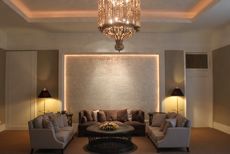
The Presidential Lounge offers privacy to government officials.

During a tour of the facility, Mrs Song commented on the facility of working with GMR. “I think its international experience has shaped GMR as a very flexible, open-minded company,” she said.

Tourism Minister Dr Mariyam Zulfa made a similar observation during the opening ceremony, reinforcing her praise of GMR from the earlier opening of INIA’s Plaza Premium Lounge.

“GMR is a company that listens to the stakeholders in the tourism industry, and that pleases the government to no end. I’m always delighted to come to the airport with stakeholders from the industry to open the dialogue for tourism,” she said.

Noting that Plaza Premium was invited to undertake the project only four months ago and with the caveat that the area is due for demolition in two years’ time, Zulfa said the lounge was an impressive and valuable accomplishment.

“Everything to do with the socioeconomic development of the Maldives should center arround tourism,” she said. “Because tourism, of course, is our number one industry, and everything we do should center around making the product even more perfect than it is today.”
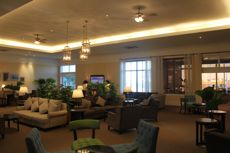
The common area features television, wi-fi, and a variety of seating areas.

For a reservation of US$150, VVIP lounge guests are relieved of their luggage at a private security screening while their flights are monitored and their schedules arranged by the lounge concierge. Meanwhile, guests can enjoy an open kitchen and cafe, wi-fi, plasma screen televisions, and spacious seating arrangements.

Plaza Premium Lounge Management Ltd currently services 17 international airports and 60 locations with infrastructural development. The Hong Kong-based company is the world’s first ‘pay-in’ lounge.

Several people noted that the lounge’s opening was well-timed with the SAARC summit, which will bring heads of state from across the region to the Maldives.

Plaza Premium Founder and Chief Executive Officer, Song Hoi See said he did not agree with the project’s constraints but appreciated the challenge.

“Airports and tourism don’t always work together. But the Maldives is a special place, and the airport is the first and last place to impress the tourists,” he said, adding that he anticipated the new airport’s design.

Mrs Song attributed the success to Plaza Premium’s high level of preparation to overcome constraints of the Maldives’ industry. “We are well planned, and we shipped most interior design materials here pre-made. There aren’t many resources here for interior design development, so it would have been difficult otherwise.”

Designer Kinney Chan said the project was enjoyable in spite of the short notice. “It’s great to do something for comfort here, to blend with the resort feel, without getting too heavy.”

GMR CEO Andrew Harrison noted that the design had improved a formerly low-ceiling, dark room by bringing in natural light and creating “a home feel, supported by the excellent service that staff provides.”

“It’s a beautiful country full of beautiful people, and now we’ve delivered a beautiful lounge to match that,” Harrison concluded.

Likes(0)Dislikes(0)

Tourism industry will benefit from France visit: Sun Travel Shiyam

Independent MP Ahmed ‘Sun Travel’ Shiyam, chairman of the Sun Travel Group, has said the tourism industry will benefit from President Mohamed Nasheed’s official visit to France last week, reports Miadhu.

The MP for Meedhoo told the newspaper that tourist arrivals from France will increase by 20 or 30 percent as a result of discussions that took place with French travel and tour operators. Shiyam was part of the Maldivian delegation.

The delegation also discussed the importance of establishing a promotional unit in France to advertise the Maldives as a tourist destination.

Shiyam, a former deputy leader of the opposition Dhivehi Rayyithunge Party (DRP) prior to the 2008 presidential election, has been voting with the ruling party on the government’s economic reform bills.

Likes(0)Dislikes(0)

US company scraps US$180m agreement to provide utilities to upper north province

Merciel International, a US multi-national, has dissolved its US$180 million agreement with the Upper North Utilities (UNU) Ltd to provide electricity, drinking water, gas and drainage services to 44 islands in the upper north province.

The agreement was signed in August 2010 to form a joint venture company to provide utility services to islands in the four northernmost atolls in what would have been one of the largest development projects in the country’s history.

Sun Online reported that Merciel informed UNU Managing Director Abdulla Waheed in a letter that the decision to withdraw from the deal was made following the utility company’s failure to provide details of its assets and capital, which were required to form the joint venture.

“As UNU has failed to respect our commitment and to provide the necessary cooperation, we have decided to withdraw from our agreement and to bring an end to all talks on the joint-venture company immediately,” reads the letter from Merciel CEO Bradley Smegal.

Likes(0)Dislikes(0)

3-week-old tests positive for drugs

A three week-old baby has tested positive for drugs and is being treated at the Indira Gandhi Memorial Hospital (IGMH) in the capital Male’.

According to Haveeru, the baby had been affected by it’s mothers drug habit; police records indicate that the mother has a history of drug abuse.

Although police are investigating the case, the mother is staying with the baby at the hospital and has not been arrested due to her child’s young age. However, reports indicate that the baby has not been handed over to the mother.

Previously, the mother of an eight month-old baby who tested positive for drugs was sentenced to six months in prison for negligence, reports Haveeru.

Likes(0)Dislikes(0)

Jumeirah Dhevanafushi launches ‘Ocean Pearl’ water villas

The Jumeirah hotel group’s first property in the Maldives, the all-suite Dhevanafushi, has announced the opening of the Ocean Pearls, “a cluster of water villas located 800 meters from the main island, suspended on platforms above the most iridescent sea in the world and entirely self dependent.”

The Ocean Revive (270 square metre) and Ocean Sanctuary (340 square metre) villas share an infinity pool, bar, restaurant, in-library and spa, with a boat shuttling guests to the main island on request.

The Ocean Pearls dedicated restaurant, Johara, offers lounge dining contemporary cuisine with influences of Japanese, Southeast Asian, and Maldivian, according to a statement from Jumeirah.

Likes(0)Dislikes(0)

Chinese artist to exhibit in National Art Gallery

Chinese artist Yuan Xikun will present an artist’s talk at the National Art Gallery in Male’, in conjunction with the Maldives’ Embassy in China and the Jin Tai Art Museum in Beijing.

Xikun is a prominent Chinese artist, curator, environmentalist and the founder of the very first private museum in China. He will be accompanied by Chinese Representative Zhang Zhenshan of the United Nations Human Settlements Programme (UN-HABITAT), Project Official Hu Shaofang from the United Nations Environment Programme (UNEP), and young soprano singer Liu Bing.

Chinese media including CCTV (Central China Television), CETV (China Education Television) and Xinhua News Agency are also attending.

Yuan Xikun’s 11 paintings, 6 posters and 2 sculptures will continue to remain on display at the National Art Gallery until (Tuesday) October 18, 2011. Opening hours are 10:00am to 4:00pm.

Likes(0)Dislikes(0)

Audience involvement in news changing journalism, observes visiting professor

“No matter how technologically advanced things are, you can’t take away the journalist’s role as a traditional gatekeeper of the truth.”

Dr William Silcock used these words to describe Maldivian journalism student Lujain Ismail Shafeeq’s video, “The Future of News”. Shafeeq’s video was a finalist in the Joan Shorenstein Center on the Press, Politics and Public Policy’s 25th Anniversary video contest at the Harvard Kennedy School in the United States.

Dr Silcock is an assistant professor at the Walter Cronkite School of Journalism in Arizona, one of the largest universities in the US. He was selected as a Fulbright Scholar in Ireland and Sweden, has received several awards over his 25 years of broadcasting, and is considered a pioneer in the research of global television news culture. Dr Silcock has previously organised workshops for journalists in Croatia, Bosnia, Albania, Macedonia, and Montenegro, among others.

He spoke to journalism students at the Maldives’ National University on Sunday, October 16 regarding topics in communications such as ethics and the evolving nature of the press.

He observed that Lujain’s video presented modern journalism as a function of technology: using phones, cameras and global positioning systems (GPS), the journalist covering a story is relieved of the tasks of identifying a story, verifying sources or selecting quotes.

“In his vision, machines do a lot of the work for us. The traditional facts of who, what, where, when and why don’t need to be asked anymore.” But as Silcock points out, one flawed Tweet could jeopardise the journalist’s value as a messenger. “The audience contributes to the story, but what if the information is bad?”

Silcock used this and other videos at Sunday’s lecture, “Social Media and Online Journalism”, sponsored by the United States State Department in Colombo, to explore the concept of free expression.

Silcock began by identifying the original meaning of a message.

“Sacred texts were the first ‘Word’. Across the spectrum of religious belief we have lots of varieties of sacred texts. I once asked a Muslim student to teach me the value of the Word in the Qur’an. She taught me this: words are synonymous in Islam with responsibility. She quoted from the Qur’an: ‘Man does not utter any word except that with him is an observer prepared to record. Each word we utter we are responsible for in front of Allah.'”

Today, however, the nature of a message and the responsibility it entails is morphing.

“We are in an era of the ‘visual village'”, said Silcock. “We all want more images across the news.”

Although visuals have been attached to words in many religious and mythical texts throughout history, Silcock pointed out that those detailed images required attention and appreciation. Today, however, audiences want immediate satisfaction.

Noting that “journalism is market-driven” and “advertising is fundamental to the free press,” Silcock observed that, “we now have so many devices, so many platforms to communicate, that the audience attention has become fragmented and fractured.”

The impact on journalism, he said, was serious.

“There’s the traditional legacy media, papers such as the New York Times which have been around. But now we have ‘down in the valley’ media. The audience is actively engaging in and contributing to the news.”

Referring to the blogs and websites that many news outlets use to provide further information about their stories, including the process of creating them, Silcock also highlighted the effect of Twitter: “It’s microblogging, a story comes out in under 140 characters.”

Turning the focus on Facebook, Silcock suggested that social media outlets were adapting to a growing concept of “tribal journalism: people sharing information across platforms.” In the interest of free expression, everyone’s voice is given room for consideration.

Yet it remains the journalist’s task to navigate the possible pitfalls of so much information. Not only can journalists get false information through social media, they can also get too close to the spotlight.

“It’s important to put up a firewall between show business and journalism,” Silcock said. “TV news in the US, for example. Anchors sit in front of a fancy desk with all kinds of monitors that make the place look like something from Star Trek or outer space. But we don’t need all that.”

Silcock consolidated the ethics of ambushing a source for a story-breaking quote in the following terms: “Heat for light’s sake. You want to clarify the story. The negative side to that is heat for heat’s sake.”

In his concluding remarks, Silcock recognized the impressive and useful influence of social media on the news industry.

“Historically, we got through lots of transitions with technology. The typewriter, radio came along and then the television,” said Silcock, showing slides of these items. “But notice this picture of America’s famous pioneer of television Edward R Murrow. What is he doing? He’s reading a newspaper.”

Silcock advised his audience to apply social media forums in innovative ways for positive results. Referring to American documentary maker Ken Burns’ concept of the computer as “the electronic campfire,” he said, “we can compare people sitting at a campfire late at night, to people at a computer. They’re fueling the fires of free expression.”

Likes(0)Dislikes(0)

Kulhudhufushi islanders protest plans to sell reclaimed land

A group of islanders on Kulhudhufushi in Haa Dhaal Atoll gathered outside the island council office this morning to protest plans to sell plots of land from the reclaimed area of the island.

The protest was organised in response to the Kulhudhufushi Development Corporation putting up 20 plots of reclaimed land for sale through a bidding process. Plots measuring 1,000 square feet were to be sold at a rate of Rf300 per square foot.

Speaking to Minivan News, Ibrahim Ahmed, 43, a resident of Kulhudhufushi who participated in the protest said that islanders gathered outside the council office at 8:00am this morning and were met with police officers in riot gear.

“We prepared a petition or a letter expressing our concerns with the plans to sell land and were going to submit it to the chair of the island council,” he explained.

The gathering was peaceful until two protesters attempted to enter the council office, he continued, alleging that police used force and pepper spray to disperse the crowd.

“They used pepper spray without any warning and took away people in handcuffs,” he claimed, adding that police used disproportionate force against the protesters.

“It was a completely peaceful gathering before that,” he added. “But that was how it turned into a protest.”

The islanders then met with Council Chair Jamsheed Mohamed, who asked for a three-day period to discuss with the relevant government ministries.

The ruling Maldivian Democratic Party (MDP) made a clean sweep of the seven-member Kulhudhufushi island council. The island is the largest population hub north of Male’.

Ibrahim said the MDP councillor assured the protestors in writing that the council would seek to find a solution in the next three days.

The Kulhudhufushi resident explained that the main concern of the protesters was the decision to register the reclaimed plots under the Kulhudhufushi Development Corporation.

“We want that land to be registered under the council,” he said. “We don’t mind if it leased for 99 years, but selling the plots is completely unacceptable to the people of this island.”

Islanders were not consulted before the land use plan for the reclaimed area was drawn up, Ibrahim said, adding that the people of Kulhudhufushi would prefer the area to be used for industrial or business purposes.

Meanwhile, opposition Dhivehi Rayyithunge Party (DRP) MP Dr Abdulla Mausoom, the party’s deputy parliamentary group leader, held a press conference this afternoon and called on the government to “not test the people to see how much their blood will boil.”

The protest in Kulhudhufushi today was the result of the government’s failure to consult with the public before formulating policy, Mausoom argued.

Island development plans should “come from the people” and not from the central government, Mausoom said, adding that the government’s actions were defeating the purpose of the landmark Decentralisation Act.

Likes(0)Dislikes(0)

PPM approves party constitution, council and logo at inaugural convention

The incipient Progressive Party of Maldives (PPM) approved the party’s constitution, manifesto, interim council, leadership posts, logo and colour at its inaugural convention last night.

Party figurehead former President Maumoon Abdul Gayoom was elected acting leader while his half-brother MP Abdulla Yameen was elected parliamentary group leader.

Gayoom was the only candidate who stood for the post of party leader.

The convention took place at Dharubaaruge with 971 delegates and was assisted by officials of the Elections Commission (EC). A minimum of 300 participants were required for the inaugural meeting.

Large number of supporters queued outside Dharubaaruge before 8:00pm while registration difficulties caused a delay of almost two hours. As voting went on late into the night, the convention concluded shortly before 6:00am this morning.

Prior to the inaugural convention, the EC had verified and approved the membership forms of 3,019 party members.

The convention was chaired by former Speaker of Parliament ‘Seena’ Ahmed Zahir, who also served as Justice Minister in the previous government.

PPM logoA crescent and palm tree logo designed by Hussein Mazin and MP Ahmed Mahlouf was adopted with 751 votes while the colour magenta was chosen with 603 votes.

The senior members elected to the interim council were Umar Naseer (fromer Dhivehi Rayyithunge Party deputy leader), Mohamed Hussein Shareef ‘Mundhu’, Aishath Azima Shukoor (former Attorney General), Mohamed Waheed Ibrahim, Faris Maumoon, Aneesa Ahmed (former MP and minister), Ahmed ‘Maaz’ Saleem, Ibrahim Nazim, Rashida Yousuf (former minister), Dr Aishath Shiham (former minister), Ahmed Siddeeq, Dr Abdul Samad Abdulla, Mohamed Nimal, Asma Rasheed, Ibrahim Muaz Ali and Ahmed Naseem.

A provision in the party constitution required that at least four women be elected to the council.

Eleven MPs were meanwhile elected to the council through the parliamentary group. They were Abdulla Yameen (Mulaku), Ahmed Mahlouf (Galolhu South), Ahmed Nihan (Vili-Male’), Abdul Raheem Abdulla (Laamu Fonadhoo), Hamdhoon Hameed (Raa Inguraidhoo), Ilham Ahmed (Gemanafushi), Ahmed “Redwave” Saleem (Eydhafushi), Dr Afrashim Ali (Ungoofaru), Mohamed Mujthaz (Hanimaadhoo), Ali Arif (Vaikaradhoo) and Abdul Muhsin Hameed (Nilandhoo).

In his closing remarks at the end of the convention, former President Gayoom insisted that PPM “does not belong to a particular person.”

Former President Maumoon Abdul Gayoom enters the meeting to a standing ovation.

“PPM is not going to try to create opportunities in the political arena for a particular person or group,” he said. “PPM is being formed for the whole nation. It is being formed for the holy religion of Islam. This party will always serve Islam and the Dhivehi nation.”

Likes(0)Dislikes(0)