A 16 year-old boy was stabbed by a group of four men last Thursday night.
The men came on motorbikes when the victim was near Fen building on Ameenee Magu, a person familiar with the victim told Minivan News.
”There were some friends of the boy nearby,” he said, ”but before they could help him, the attackers fled.”
He said the victim was stabbed once in the back and that he was not seriously injured.
”The attack on the boy was not because he was looking for a fight. It was a random attack,” he said. ”When they see anyone of us alone, they will come and stab that person. It doesn’t matter even if he is a friend.”
He said that the gangs have been fighting with each other for a long time, and sometimes stop for a while, but the battle is never really over.
The victim was admitted to Indira Gandhi Memorial Hospital (IGMH) for treatment.
One suspect has been arrested, says police sergeant Abdul Muhsin.
The man was stabbed four times, said a person familiar with victim.
”He had a deep cut in the back and injured lungs. His left arm was cut very seriously when he tried to block an attack aimed at his head,” said a friend of the victim.
The victim stabbed on Wednesday night told Minivan News that he was attacked on his way home.
”I was near Petral teashop when I met an old friend and he called out to me,” said the victim. ”I stopped to have a chat with him.”
Suddenly a crowd circled around and stabbed him in the back three times, according to the victim.
”Then they all ran away,” he said. ”I was unconscious till I reached hospital.”
When they reached the hospital, he fainted and when he gained consciousness he could not breathe properly because he had been stabbed in the lungs.
He said that his attackers used a normal knife, ”but it had a very thick blade.”
The UK has banned Islamic speaker Dr Zakir Naik from entering the country, preventing him from giving a series of lectures in Sheffield and northern England on ‘Freedom of Expression: An Islamic Perspective’.
Dr Naik recently presented a series of lectures in the Maldives at the invitation of the Ministry for Islamic Affairs. One session in particular made headlines when Naik was confronted by a self-declared apostate, who later reconverted to Islam after two days of counselling in police custody.
News agency Reuters reported that Conservative Home Secretary Theresa May had barred Dr Naik from entering the country because “numerous comments made by Dr Naik are evidence to me of his unacceptable behavior.”
“Coming to the UK is a privilege not a right, and I am not willing to allow those who might not be conducive to the public good to enter,” she said.
The UK’s Daily Telegraph newspaper reported Ministry sources as saying the decision to refuse entry to Dr Naik was based on footage in 2006 in which he appeared to endorse terrorism against the United States: “If he [Osama Bin Laden] is terrorising the terrorists, if he is terrorising America the terrorist … I am with him. Every Muslim should be a terrorist,” Naik says in the clip.
Naik has argued that these comments were taken out of context, and has since issued a statement saying he “unequivocally condemns acts of violence including 9/11, 7/7 and 7/11 [the serial train bombing in Mumbai], which are completely and absolutely unjustifiable on any basis.”
The Telegraph also claimed Dr Naik had said Western women made themselves “more susceptible to rape” by wearing revealing clothing.
“Western society has actually degraded (women) to the status of concubines, mistresses and social butterflies, who are mere tools in the hands of pleasure seekers and sex marketeers,” the paper quoted him as saying.
One of the topics of Dr Naik’s planned speeches in the UK was ‘freedom of expression’, and the decision to deny him entry to the country has sparked vigorous debate in the UK among civil rights campaigners.
The Muslim Council of Britain has also expressed “grave concern” over the decision, with Secretary General Dr Muhammad Abdul Bari stating that “this exclusion order demonstrates the double standards practised by the government concerning freedom of speech. While preachers of hate such as Geert Wilders are free to promote their bigotry in this country, respected Muslim scholars such as Dr Naik are refused entry to the UK under false pretences. It is deeply regrettable this is likely to cause serious damage to community cohesion in our country.”
A spokesman for Dr Naik told the BBC that the Home Ministry’s decision was “deeply regrettable” and that the UK had “bowed to pressure” from “certain groups” to exclude him.
He said Mr Naik had been holding talks in the UK for 15 years and the decision to bar his entry was “disappointing.”
The origin of Maldivians has part of roots from the African continent. It’s been written in history books and is openly talked about by elders in some islands, especially one in Alif Atoll where the complexion of the entire community is 100 percent black and most people have curly hair.
For over thirty years, the African community has been very productive in various sectors of the economy and social structure in Maldives. We have Black African GM’s & Financial Controllers, Engineers, Doctors, Divers in resorts. The Red Cross / IFCR have were managed by Africans until Maldivians took over recently. The agriculture sector derives its consultancy from an African expert and a number of new resorts have been constructed by African engineers.
Every top football team, basketball team or volleyball team have Africans as key players and they bring joy to thousands of fans.
We are black and we are proud of who we are. It is not our choice to have the dark complexion and as human beings we consider ourselves similar to other races of people. As recently stated by one of the religious scholars, we are all the same and no one is higher than the other except the Almighty God.
TVM (Television Maldives) has publicly and openly mocked and disgraced the African race on its comedy clips last night during the Nigeria match. A few of us understand Dhivehi very well, and a number of us married to Maldivians.
It is shameful and prejudiced to suggest that our colour is a mistake from God. Something so horrible and bad, that we Africans are trying to become lighter, cannot be further from the truth.
I do not need to rewrite the ‘crude jokes’ TVM telecasted last night, however, on behalf of the African community in Maldives, we find such comments disgraceful, personal, racist, and this clearly show the unprofessionalism of TVM. We may be a handful but we play a major role in this economy and social welfare, and the least we or anyone could expect is respect for what we are.
We demand an apology, not written, but announced as this issue goes against our rights. No individual, body or government has a right to discredit or disgrace race, culture or religious beliefs of others.
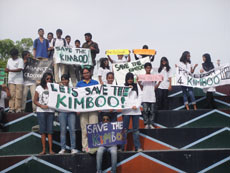
As 30 odd students from Billabong High EPSS International school traipsed to Kudakudhinge Bageecha (children’s park) on the southeast side of Male, one might have thought they were on an outing for enjoyment.
But these students were on a mission. To save the crocodile, or ‘kimboo’ as they say in Dhivehi.
Grade eight student Shiman Shiyam had come to see the kimboo before. It is one of the major attractions at the park along with some birds in cages, and tortoises.
“It was sad to see it before also like that, but we never got a chance to do anything about it,” she says.
Shiman is busy painting a banner on the grounds of the park along with five other students, calling for the freedom of the kimboo.
Here and there pockets of students milling about preparing banners. From time to time, some go to take a peek at the kimboo.
The kimboo was caught off an island in Maldives in 1998. When it was first displayed in the little enclosure at the park, you could sometimes barely see it as it was so small the water at the enclosure could completely cover it.
But after 12 years in captivity it has grown to nine feet in length, and the water in the enclosure no longer even covers it. It can stretch its body, but the enclosure is too small for it now.
Billabong High School’s Biology Teacher, Kate Wilson, was out running with a friend when a detour in the park led them to discovering the crocodile.
Billabong students are on a mission to save the Kimboo, a nine foot crocodile
“We were horrified by the size of the enclosure,” she says.
Calls were placed to Environmental protection Agency (EPA). The EPA told them that they had already tried to rescue the crocodile in conjunction with a Sri lankan outfit, to try and send it to a better place, “but for some reason it didn’t work out.”
Kimboo occasionally makes it into local media and even has his own Facebook page calling for his release, but so far nothing has eventuated.
Kate shared the story with her students, who were very keen to help and do what they could to begin the process of finding the crocodile a better home.
“We got in touch with an international agency in Australia, which rescues crocodiles that are injured or in bad conditions,” she says. The agency is currently holding discussions to see if it is feasible to rescue the crocodile.
To encourage the agency to take action, today the students were making banners and producing a video with messages calling for support.
Shiman is confident kimboo will be rescued.
Aishath Suha, also in grade eight, says she volunteered for the operation ‘because I don’t want to see kimboo suffer.”
She points out the lack of space and says “it will be better off somewhere else in a better habitat.”
Like Shiman, Suha had also come to see the crocodile before and been concerned.
“This is all part of marking World Environment Day, albeit belatedly,” says Billabong’s Principal, David Key.
Billabong High could not mark the day, as it fell on a holiday.
But now, as part of the activities, groups of students are planting 30 trees along the beach front area, and the beach near the tsunami monument.
“This is to create awareness among students about what they can do, and how they can help in contributing positively to preserving the environment,” says David.
Reasons for rescuing kimboo
Banners completed, the students gathered on the steps in the park. Each group of students gave the message they wanted to say for the video.
A group of young boys likened the kimboo’s captivity to “holding a person in a cage, through no fault of his own.”
Most students mentioned the small enclosure as the prime reason for wanting it to be rescued.
“It would be better off in a better home with others of its kind,” was another reason.
Sadly, after 12 years in captivity, the kimboo can most likely never be set free. But for the grade 7, 8, 9 and 10 students of Billabong, the fact it might get a better home is reason enough to try.
Meanwhile the kimboo lies in its enclosure, its powerful jaws wide open, oblivious to the fact that its future might soon change dramatically for the better.
Former President Maumoon Abdul Gayoom has confirmed he is pursuing legal action against newspaper Miadhu, after it reported that the New York Times had published a story containing allegations he embezzled US$400 million during his time in government.
Spokesman for Gayoom, Mohamed Hussain ‘Mundhu’ Shareef, confirmed that Gayoom was also building a case against Finance Minister Ali Hashim, who was quoted in the NYT article, and former Auditor General Ibrahim Naeem, upon who’s 2009 report the article was largely based, as well as the proprietor and managing editor of Miadhu.
Contrary to earlier reports, Gayoom was not seeking to sue the NYT or the author of the article, Matthew Saltmarsh, Mundhu said.
“I think that’s been misinterpreted, we have no interest in Saltmarsh,” Mundhu said.
“We don’t know him but we’re sure he’s a good journalis, and the NYT is obviously reputed and widely circulated globally,” he said, adding that Gayoom’s response had been to send a letter the NYT editor.
Mundhu noted that according to the NYT article, the journalist Saltmarsh had claimed he attempted to contact Gayoom for his side of the story.
“Mr Gayoom was not in town, but has confirmed he received no calls, either to himself or his secretary,” Mundhu said. “I too was not in town, but my Maldivian mobile was switched on. Mr Saltmarsh says he could not get through, but there was not even an email or a message.”
Mundhu said he did not believe such an article was justified without a right of response, and that Gayoom had written to the NYT editor requesting a right of reply, or a correction.
“This is not the first time we’ve come across issue. We can only ask for the right to respond and the opportunity to put forward our point of view – our letter serves that purpose and there is no need to take Saltmarsh or the NYT to court.”
Mundhu said Gayoom was more concerned with the story being reported in the local media.
“We want to address [the matter of] the ruling party’s engineering of the article for political benefit,” he said.
The foundation of the NYT article was the former Auditor General’s report, he said, “and the Auditor General has been discredited – by the Anti-Corruption Commission, not just us. The report doesn’t stand to scrutiny.”
But he added that comments made by Finance Minister Ali Hashim in the NYT report did not come from the Auditor General’s report – “this US$400 million [alleged embezzlement] is something he’s conjured up in the Haruge (MDP headquarters),” Mundhu said.
“The issue is that whether as a former president or an individual, Mr Gayoom has rights, a family and a reputation to protect.”
Miadhu’s Managing Editor Abdullah ‘Gabbe’ Latheef said he would “be glad to go to court”, and that “already three international journalist associations have offered support and want to send observers to the hearings.”
“Until a court rules that the Auditor General’s report was fabricated, the media has a right to report it – it is a public document. Until then, the media can write about it five times daily if they wish,” he said.
Latheef added that he was looking forward to the opportunity the court case would provide to open the orginal audit reports to public review.
“Then everyone will understand where the US$400 million has come from,” he claimed. “Some people misunderstand the government budget – when you include the private-public companies, such as STELCO, Dhiraagu and MIFCO, US$400 million is nothing.”
Latheef said he believed the local media had done a “responsible job” in reporting the NYT story, “as the NYT is the number one newspaper in the world and is a credible source. There’s no obligation on us to clarify all the facts that the NYT has reported, because it is such a credible source. What about when the Israelis attacked the aid flotilla recently? Should we have gone to Israel to check all the facts for ourselves? No – we have to rely on credible sources, and the NYT is not an anonymous blog.”
“Gayoom is used to attacking people who speak out against him. They used to be taken to jail, now they are taken to court. Maybe one day he will invite them to coffee on the beach,” Latheef said, adding that “there are a lot of diplomats here who are very scared the media will die off because of threats like these.”
Speaking yesterday at the Commonwealth’s media development workshop, Attorney General Husnu Suood acknowledged that if an article was published in the Maldives, even if the source was from abroad, the onus was still on the particular journalist to prove its truth.
“But there are defences available,” Suood noted. “In the regulation on defamation there are certain defences – one is the the defence of truth. In this particular instance, if you are relying on figures given by the government’s Auditor General, then I think that might be a defense.”
Hashim had not responded to Minivan News at time of press.
 (0)Dislikes
 (0)
(0)