Judicial independence, rule of law “severely jeopardised” in the Maldives, says Commonwealth organisations

The sudden removal of former Chief Justice Ahmed Faiz and Justice Muthasim Adnan has “severely jeopardised” the independence of the Maldives judiciary and the rule of law, three Commonwealth bodies have said.

The Commonwealth Lawyers Association (CLA), the Commonwealth Legal Education Association (CLEA) and the Commonwealth Magistrates’ and Judges’ Association (CMJA) in a statement on Tuesday said the judges’ removal was unconstitutional and constituted a clear breach of the Commonwealth Principles to which the government of Maldives has subscribed.

Faiz and Muthasim were removed by a two-third majority of MPs present and voting at an extraordinary session on Sunday following amendments to the Judicature Act that reduced the seven-member Supreme Court bench to five judges.

Expressing concern, the CLA, CLEA and CMJA said the removal contravened Article 154 of the Maldives Constitution that says a judge can only be removed if the watchdog Judicial Services Commission (JSC) find the judge guilty of gross misconduct or incompetence.

The JSC did in fact rule the two judges unfit, but the ruling has not been made available to MPs or the public, despite repeated requests by opposition MPs.

In passing the revisions to the Judicature Act and removing the two senior judges, the Government of Maldives have breached the Commonwealth (Latimer House) Principles on the Accountability of and the Relationship between the Three Branches of Government (2003), said the statement.

“As a result the independence of the judiciary and the Rule of Law have been severely jeopardized”.

The Principles state that “Judges should be subject to suspension or removal only for reasons of incapacity or misbehavior that clearly renders them unfit to discharge their duties.”

They further state that disciplinary procedures must be fairly and objectively administered and should include appropriate safeguards to ensure fairness.

“The Associations urge the Government and Parliament of the Maldives to respect the independence of the judiciary and to comply with the relevant constitutional provisions, Commonwealth Principles and other relevant international standards,” the statement urged.

President Abdulla Yameen appointed Justice Abdulla Saeed as the new Chief Justice on Sunday. Faiz has condemned the Majlis vote as unconstitutional, and said the move raises doubts over the separation of powers and the continuation of judicial independence in the Maldives

Three lawyers mounted a challenge to the Judicature Act’s amendment at the High Court on Sunday, but the court’s registrar has thrown the case out claiming it has no jurisdiction over the matter.

Acting registrar Mariyam Afsha said the complaint’s original jurisdiction lay with the Supreme Court.

Critics have pointed out the High Court registrar’s decision effectively means only the Supreme Court can now hear the challenge and have pointed to a Supreme Court’s conflict of interest in the case.

The opposition Maldivian Democratic Party had also lodged a complaint with the Civil Court challenging the legality of the JSC ruling, but the Supreme Court on Sunday took control of the case minutes after the first hearing began.

The Supreme Court’s writ of prohibition ordered the Civil Court to “to hand over case files, with all relevant documents, to the Supreme Court before 20:45 tonight, 14 December 2014, and to immediately annul any action that may have been taken on the matter.”

The decision followed a declaration by Civil Court Chief Judge Ali Rasheed Hussein, and Judges Aisha Shujoon, Jameel Moosa, Hathif Hilmy, Mariyam Nihayath, Huseein Mazeed, and Farhad Rasheed in which they declared the move to dismiss the two judges to be against principles of natural justice and several international conventions, and could “destroy judicial independence” in the Maldives.

“We believe we are obliged to comment on the issue for the sake of the democratic and judicial history of the Maldives, and we believe keeping silent at this juncture amounts to negligence” the bench said.


Related to this story

Supreme Court takes control of MDP’s Civil Court complaint on Faiz, Muthasim dismissal

High Court claims “no jurisdiction” in Supreme Court bench reduction challenge

Abdulla Saeed appointed as new Chief Justice, dismissed Justice Faiz laments “black day”

Civil Court condemns move to dismiss Chief Justice Faiz and Justice Adnan

Likes(1)Dislikes(0)

High Court claims “no jurisdiction” in Supreme Court bench reduction challenge

The High Court on Tuesday threw out a challenge to Judicature Act amendments that reduced the seven-member Supreme Court bench to five judges and resulted in the sudden removal of Chief Justice Ahmed Faiz and Justice Muthasim Adnan.

High Court Registrar Mariyam Afsha said the complaint’s original jurisdiction lay with the Supreme Court, and not the High Court.

The case lodged by Lawyers Shaheen Hameed, Hassan Ma’az Shareef and Mohamed Faisal, contended the revisions to the Judicature Act were unconstitutional as they forced the removal of sitting Supreme Court judges without due process.

Critics have pointed out the High Court registrar’s decision effectively means only the Supreme Court can now hear the challenge and have pointed to a Supreme Court’s conflict of interest in the matter.

According to Article 11 of the Judicature Act, the Supreme Court has original jurisdiction in controversies that may lead to a constitutional void, cases where two branches of the state or two institutions of the state disagree on interpreting the constitution, and in constitutional matters that affect public interest.

Article 37 of the Judicature Act gives the High Court original jurisdiction in controversies where a law or part of a law is unconstitutional or where regulations or part of a regulation is against laws and the constitution.

Removal of judges

According to Article 154 of the Constitution, a judge, once appointed, can only be removed if the watchdog Judicial Services Commission (JSC) found the judge guilty of gross misconduct and incompetence, and if the Majlis subsequently removed the judge by a two-thirds majority of MPs present and voting.

Within hours of the amendment’s ratification on Thursday (December 11), the JSC in an emergency meeting recommended the two judges unfit for the position.

However, the JSC’s reasons were not made available to the public or MPs when the vote to dismiss the two judges proceeded on Sunday.

Shaheen, also President Yameen’s nephew, told local media that the JSC had failed to afford Faiz and Muthasim the opportunity to speak in their defense.

“[The JSC] is saying that it is alright to dismiss these first two judges by flouting all procedures, but that due process must be followed in dismissing other judges. This is gross violation of equality before the law,” he said.

The MDP had also lodged a challenge to the JSC decision with the Civil Court, but the Supreme Court took control of the case on Sunday minutes after the first hearing started.

The Supreme Court’s writ of prohibition ordered the Civil Court to “to hand over case files, with all relevant documents, to the Supreme Court before 20:45 tonight, 14 December 2014, and to immediately annul any action that may have been taken on the matter.”

The decision followed a declaration by Civil Court Chief Judge Ali Rasheed Hussein, and Judges Aisha Shujoon, Jameel Moosa, Hathif Hilmy, Mariyam Nihayath, Huseein Mazeed, and Farhad Rasheed in which they declared the move to dismiss the two judges to be against principles of natural justice and several international conventions, and could “destroy judicial independence” in the Maldives.

“We believe we are obliged to comment on the issue for the sake of the democratic and judicial history of the Maldives, and we believe keeping silent at this juncture amounts to negligence” the bench said.

The Judicature Act amendments will also divide the nine-member High Court into three branches, with three members each.

The two regional branches in the North and South will only be allowed to hear appeals in magistrate court verdicts. Only the Malé branch will be allowed to hear challenges to laws and regulations.


Related to this story

Supreme Court takes control of MDP’s Civil Court complaint on Faiz, Muthasim dismissal

Abdulla Saeed appointed as new Chief Justice, dismissed Justice Faiz laments “black day”

Civil Court condemns move to dismiss Chief Justice Faiz and Justice Adnan

Likes(1)Dislikes(0)

Parliament approves import duty hikes

The People’s Majlis yesterday passed government-sponsored amendments to the Export-Import Act to raise import duties on 17 items from April 2015 onward.

The amendments (Dhivehi) submitted on behalf of the government by Maldives Development Alliance (MDA) MP Mohamed Ismail were approved with 49 votes in favour and 16 against.

Following ratification by the president, import duties for tobacco would be raised from 150 to 200 percent and from 90 laari to MVR1.25 for a single cigarette.

Finance Minister Abdulla Jihad told parliament’s budget review committee last month that the government anticipated MVR533 million (US$34.5 million) in additional income from import duties.

Among other items, custom duties for luxury cosmetics and perfume would increase from the current zero rate to 20 percent.

Additionally, duties for liquor and pork would be raised to 50 percent and a 200 percent custom duty would be levied for land vehicles such as cars, jeeps, and vans.

While the day prior to the budget’s approval the cabinet’s economic council reversed a decision to impose a 10 percent tariff on staple foodstuffs such as rice, flour, and sugar, the import duty for oil or petroleum products was raised from the current zero rate to 10 percent.

About 30 percent of the Maldives’ GDP is spent on importing fossil fuels. In 2012, US$486 million was spent on oil imports, and the figure is estimated to rise to US$700 million by 2020.

According to the Maldives Customs Service, of the MVR7.2 billion (US$466.9 million) worth of goods imported in the first quarter of 2014, one-third was spent on petroleum products.

The latest monthly economic review from the Maldives Monetary Authority noted that “the price of crude oil fell by 4 percent in monthly terms and by 12 percent in annual terms and stood at US$95.9 per barrel at the end of September 2014,”

Revising import duties was among several revenue raising measures in the record MVR24.3 billion (US$1.5 billion) state budget for 2015 currently before parliament.

The forecast for additional revenue for the 2015 budget was MVR3.4 billion (US$220 million), including US$100 million expected as acquisition fees for investments in special economic zones and MVR400 million (US$25.9 million) from the sale and lease of state-owned land.

The other measures included introducing a green tax of US$6 per night in November 2015 and leasing 10 islands for new resort development.

Tariffs were last revised in April this year after parliament approved import duty hikes for a range of goods proposed by the government as a revenue raising measure.

During last month’s parliamentary budget debate, opposition Maldivian Democratic Party (MDP) MPs strongly criticised the proposed tax hikes, contending that the burden of higher prices of goods and cost of living would be borne by the public.

The current administration’s economic policies – such as waiving import duties for construction material imported for resort development as well as luxury yachts – benefit the rich at the expense of the poor, MDP MPs argued.


Related to this story

Government scraps plan to impose import duty on staple foodstuff

Parliament approves state budget for 2015 with 60 votes in favour

Government proposes import duty hike for oil, staple foodstuffs

Likes(2)Dislikes(0)

Dunya thanks foreign partners for help during water crisis

Minister of Foreign Affairs Dunya Maumoon has written to the foreign ministers of India, China, Sri Lanka, Bangladesh, Japan, Singapore, and Malaysia to express gratitude for assistance given during the recent water crisis.

“The people and the Government of Maldives are heartened by the strong show of solidarity and humbled by the generosity of our friends,” wrote Dunya.

“With your kind support and the resilience of the Maldivian people, the crisis has been resolved and normal water supply has resumed.”

Relief efforts included the arrival of fresh water supplies in multiple Indian military aircraft as well as passenger aircraft from China and Sri Lanka. Additionally, India sent two naval vessels, with China and Bangladesh also sending ships.

Singapore provided technical assistance in repairing the damaged panels in the Malé Water and Sewerage Company’s desalination plant after a December 4 fire left 130,000 people in the capital without running water for 7 days.

Likes(1)Dislikes(0)

Japan donates medical equipment worth MVR26 million

Japan has donated medical equipment worth ¥200 million (MVR 25.94 million) to the Maldives, reports Sun Online.

The donation – said to be part of the ¥100 million (US$840,000) non-project grant aid agreement signed yesterday – was announced at the Ministry of Health today.

Acting Minister of Health Colonel (retired) Mohamed Nazim accepted the donation from the Japanese International Cooperation System, reported Sun.

Source: Sun Online

Likes(1)Dislikes(0)

STO to pay off debts in three years

Managing Director at the State Trading Organisation (STO) Adam Azim has said the state-owned company’s debts will be paid off within three years.

Azim told Haveeru that the STO’s US$144 million (MVR1.7 billion) debt was unprecedented, and that US$51 million had been paid off during his tenure as a result of reductions in expenditure.

Immediately upon assuming office last November President Abdulla Yameen – once head of the STO – declared the company bankrupt.

In January the company announced a campaign to cut operational costs by MVR50 million (US$3,242,542) in 2014 , before posting profits of MVR44 million (US$2.8 million) in May.

The STO is the country’s primary wholesaler, responsible for bringing in the vast majority of basic foodstuffs such as rice and flour, as well as other imported commodities such as electrical goods.

Source: Haveeru

Likes(1)Dislikes(0)

Maldives should forget about mitigating climate change, says Bluepeace

The Maldives should forget about stopping the effects of climate change and focus instead on adaptation, says environmental NGO Bluepeace.

“Mitigation is something we have to forget about at the national level,” said Bluepeace Executive Director Ali Rilwan.

Rilwan’s comments come after the conclusion of UN climate change talks in Peru, which have resulted in an agreement slammed as “very weak” by environmental groups.

“We don’t have much faith,” said Rilwan, citing the international community’s failure to follow through on previous commitments. “Locally, we have to look at adaptation. Maldives is the most low-lying country – we have to have dry land.”

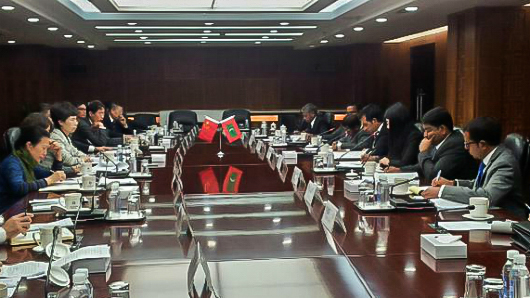
As talks concluded in Lima, a delegation of cabinet ministers headed to Beijing for economic talks that will include plans for oil exploration in Maldivian territorial waters – a policy Rilwan described as “ironic”.

China-Maldives Joint Committee on Trade and Economic Cooperation

“On paper, there are a lot of adaptation programmes, but in reality you don’t see it happening,” he said, perceiving a lack of concern about climate change within the Maldives.

Former President Mohamed Nasheed, who has gained international acclaim as an environmental activist, has recently expressed his concern that the chance to mitigate the effects of climate change has been missed.

“The world has lost the window of opportunity to mend its ways,” he told the International Bar Association in October, suggesting Maldivians were likely to become the world’s first climate change refugees.

“Big emitters have sentenced us. The world temperature will rise, and the seas will rise over our nose.”

“And what restitution, if any, can be made for the damage done to us – damage we warned about, but did not cause? I fear that these questions will be answered one day, not in the abstract, but in a court of law. And I fear that we, the people of the Maldives, will be the star witness.”

Lima Declaration

The Lima Declaration sets out a framework which further differentiates developing and rich states, as well as retaining plans for a “loss and damage” scheme to provide financial support to “vulnerable” developing nations.

However, plans to determine what information countries should provide in future emission reduction pledges were watered down after fierce negotiations.

The word “may” instead of “shall” was eventually used in the final text regarding quantifiable information to show how states intend to reduce emissions targets.

WWF officials have said the declaration text “went from weak to weaker to weakest and it’s very weak indeed”, while Friends of the Earth International said fears the talks would fail to deliver “a fair and ambitious outcome” had been proven “tragically accurate”.

The reduction pledges are required prior to the COP 21 climate change talks in Paris next December, which will seek to decide upon a new framework for a universal and legally binding agreement on climate change.

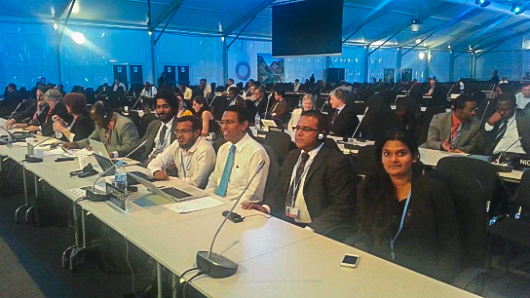
Maldivian representatives in Lima told the conference this week: “We do not want to be in Paris to get perished”.

Maldives delegation at UN climate conference in Peru

Noting the recent pledges to the Green Climate Fund – intended to raise $100 billion a year by 2020 – Ambassador Ahmed Sareer said that “as a small island developing state that is constantly facing an existential threat, the current pledges are simply not enough”.

Officials from the environment ministry were not responding to calls at the time of press.

The Maldives has recently become chair of the Alliance of Small Island States (AOSIS), while former President Maumoon Abdul Gayoom has called on larger nations to allow vulnerable states to take a lead in climate change policy.

Ambassador Sareer said this week that the Maldives’ share of global emission is negligible, and that the government of Maldives was striving to make the country resilient.

The Ministry of Environment and Energy reported that Sareer also attended a number of fringe events in Lima, telling attendees at a Japanese event of the Maldives’ plans to reduce dependency on fossil fuels.

As part of a move to reduce this dependency – which consumes around 30 percent of the country’s GDP – the current government has pledged to work with international groups to explore the potential of oil and gas reserves in the country.

Minister of Fisheries and Agriculture Shainee told media that the government would discuss the issue with two Chinese companies this week as a delegation headed to Beijing for the first China-Maldives Joint Committee on Trade and Economic Cooperation.

India has already offered to assist in oil exploration within Maldivian territorial waters, while a seismic survey was carried out by a German research vessel in August.


Related to this story

Maldivians could be among first climate refugees, warns Nasheed

Silk road deal to be concluded in China-Maldives economic committee

Former President Gayoom calls for leadership of small island states in climate change

Likes(4)Dislikes(0)

President Yameen welcomes restrictions on right to silence and legal counsel

Expressing concern over the rise of dangerous crime in the Maldives, President Abdulla Yameen has welcomed restrictions on the constitutional right to remain silent and right to retain a lawyer.

“The constitution guarantees many rights for citizens. But to my interpretation, these rights are only afforded if they do not obstruct the other’s rights. If they abuse their rights and violate those of others, their rights must be narrowed,” he said speaking at a ceremony to inaugurate a link road to be built by China in Laamu Atoll.

At least five people have been stabbed to death this year alone. Today also marks the 130th day since Minivan News journalist Ahmed Rilwan disappeared.

The People’s Majlis on Monday amended the 2010 law banning threats and possession of dangerous weapons and sharp objects to curb the right to remain silent of any suspect arrested for assault with sharp objects.

Suspects who are accused of murder, or of causing death or loss of limb and organ by assault, cannot exercise the right to remain silent “to any extent” and would only be able to speak to their lawyer for the first 96 hours of arrest in the presence of the police.

Further, suspects would only be allowed six hours to appoint a lawyer. If the suspect fails to appoint a lawyer or if the lawyer is not able to present a valid reason for absence from interrogations, police are authorised to question the suspect without a lawyer.

The amendments also relax requirements courts must consider in extending pre-trial detention.

“The most important aims of this administration is to ensure the streets of Malé and the islands are safe. Today, the strongest bill required for this task has been passed,” Yameen said.

Safety and security are crucial for investor confidence, Yameen said.

“If foreign investors are to invest, start mega projects here, they will first consider if they would be able to work in a secure and peaceful environment.”

“Then they will consider if their assets would be safe here. Third, if they would be able to take back the benefits of their work to their countries. Fourth, if any issue they may have can be resolved speedily, free and fairly through the courts,” he added.

Law enforcement agencies would not take undue advantage of their new powers, Yameen pledged.

The amendments passed with 47 votes. Two MPs abstained while 17 opposition Maldivian Democratic Party (MDP) MPs voted against the revisions.

Advocacy NGOs the Maldivian Democratic Network and Commonwealth Human Rights Initiative (CHRI) on November 30 said the amendments “absolutely violates rather than limits fundamental rights of the people” and that, if passed, “will seriously hinder the democratic system Maldives has transited to”.

Opposition leader and former President Mohamed Nasheed has recently expressed concern over deteriorating public safety and said the government’s failure to investigate and prosecute serious crimes are tantamount to “deliberate state-sponsored terrorism.”

He also accused senior government officials and elements of the police of complicity in abductions, murder, arson attacks, and gang violence.

“I note that the government has not investigated such incidents that have occurred throughout the year and serious criminals are on the loose. The state has not pressed charges against them.”


Related to this story

Failure to prosecute serious crimes tantamount to “state-sponsored terrorism,” says Nasheed

Civil society groups condemn proposed restrictions to constitutional rights

Yameen pledges to end violent crime at ‘Successful 365 Days’ rally

MPs debate restricting constitutional rights after arrest

28-year-old man stabbed to death in gang-related violence

Likes(1)Dislikes(0)

MDP votes to discipline MPs absent from Supreme Court vote

The opposition Maldivian Democratic Party (MDP) has asked its disciplinary committee to take action against six MPs who failed to turn up for the parliamentary vote to dismiss former Chief Justice Ahmed Faiz and Judge Muthasim Adnan.

All 36 members present at the party’s National Executive Council at the Malé City Hall voted for the resolution submitted by Mohamed Ibrahim Manik.

The six MPs are Vaikaradhoo MP Mohamed Nazim, Velidhoo MP Abdulla Yamin Rasheed, Mulaku MP Ibrahim Naseer, Felidhoo MP Ahmed Marzooq, Kurendhoo MP Abdul Bari Abdulla, and Hulhuhenveiru MP Reeko Moosa Manik.

Yamin has since apologised for his absence on Twitter, saying he had left the country for Thailand before the vote was scheduled. The MDP secretariat, however, said Yameen had initially promised to make arrangements to be present for the vote, but later said he had not been able to get a seat on the flight.

MDP members of Vaikaradhoo constituency issued a statement last night condemning MP Nazim’s absence from the vote, claiming he had prioritised personal interest and betrayed his constituents.

Critics have described Faiz and Muthasim’s dismissal as unconstitutional and said the move allows President Abdulla Yameen to assume total control of the judiciary and destroy the system of separation of powers.

The two were voted out with a two-thirds majority of MPs present and voting. 53 MPs of the ruling Progressive Party of the Maldives (PPM), coalition partner the Maldives Development Alliance and Jumhooree Party (JP) MPs voted for the move.

Four JP MPs and 17 MDP MPs voted against the dismissal. The ruling party would have required 57 votes to dismiss the judges with all 85 MPs present and voting.

Opposition leader and former President Mohamed Nasheed said organised political party activities were key to development.

“A dignified life for Maldivian citizens is possible when we are able to get organised and conduct peaceful political activities. The majority of people who support this principle are with the MDP,” he said.

He also condemned Prosecutor General Muhuthaz Muhsin’s order on the Elections Commission to take all legal action possible against the MDP for its recent resolution calling on the government to hand over the presidency to Jumhooree Party (JP) leader Gasim Ibrahim.

“The prosecutor general has spoken on a party resolution to have Gasim Ibrahim assume the presidency. This was done as per fundamental rights afforded to citizens such as freedom of expression, freedom of assembly and right to conduct peaceful political activity. No institution, including the prosecutor general, can infringe on our decision,” he said.

Internal unrest

Moosa – who has also declared he would contest MDP’s 2018 presidential primaries – said the MDP must first take action against the members who voted for the transfer of power resolution.

Speaking to Haveeru, Moosa said he would accept any disciplinary action taken against him “with respect” but said the party must treat all members equally.

He has also called on MDP to reprimand the ministers who had recommended detaining Criminal Court Chief Judge Abdulla Mohamed in January 2012, pointing out Nasheed had last month said the move was “wrong”.

“I believe first things must come first. Then only can you take action against other matters. I will accept any [disciplinary] action with respect. But I call on [on the party] to treat everyone equally in taking disciplinary action,” he said.

MDP’s disciplinary committee meeting held last night, following the national executive council’s request.

PPM parliamentary group leader Ahmed Nihan said the party would not take any action against Kulhudhuffushi MP Mohamed Nasheed from abstaining from the vote.

“This is the second time he voted against the whip line. But he did not run away, he is with us,” Nihan told CNM.

The ruling party is still in the process of compiling regulations for the 43 member parliamentary group, Nihan said. He claimed the PPM’s parliamentary group was unified, unlike the MDP’s.

All PPM MPs, except Nasheed, voted for Faiz and Muthasim’s dismissal.

Meanwhile, PPM’s Deputy Leader and Tourism Minister Ahmed Adeeb thanked Gasim for allowing a free whip in the vote to elect Saeed “as agreed”.

Gasim has rejected Adeeb’s claim in a tweet saying, “the whip line for the vote to remove former Chief Justice and Supreme Court Judge was based on consensus reached by JP PG group only.”

The MDP has submitted 14,500 new membership forms to the Elections Commission this year.


Related to this story

Supreme Court takes control of MDP’s Civil Court complaint on Faiz, Muthasim dismissal

PG orders Elections Commission to reprimand MDP for resolution on transfer of power

Majlis removes Chief Justice Ahmed Faiz, Justice Muthasim Adnan from Supreme Court

JSC recommends dismissal of Chief Justice Ahmed Faiz and Justice Muthasim Adnan

Likes(1)Dislikes(0)