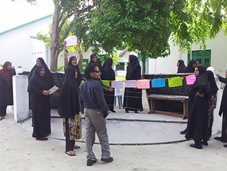
Maalhos islanders shut down school, health post in protest

Residents on Maalhos in Alif Alif Atoll have today closed down the island’s school and health centre and staged a sit down protest to demand the government send a doctor and solve an issue concerning “lazy” teachers.

Speaking to Minivan News today, Maalhos Island Council President Ahmed Rashid said that the islanders had been demonstrating since 6:00am this morning.

“They are angry because the school does not have a principal and the teachers are not coming out for work,” he said. “If the school is run by teachers they would not have anyone to oversee their work, so they are not coming to work.”

Rashid said that the school principal was previously transferred to another island because someone complained at the ministry that he had been watching Maldivian Democratic Party (MDP)-aligned private broadcaster Raajje TV since he came to the island.

women of Maalhos Island protesting outside island school

“We have tried to solve this issue through the education ministry, but they haven’t responded to us and we have also tried calling the health ministry’s person in charge of sending doctors to the island and he is not answering to calls,” he said.

He alleged that the island health centre and school were both dysfunctional.

Rashid also said that protesters had warned that if there was no response from the government by tomorrow, they would also look to close down the island council.

According to Rashid, there are currently 74 students in the island school.

“We can only get things like panadol from the health center,” he added.

An islander who spoke to Minivan News alleged that the local teachers on the island had not been regularly attending work. The source added that in cases when teachers did turn up, they did were always angry at students and used inappropriate language when interacting with their pupils.

“The school and health centre in this island haven’t been functioning properly and today all the parents and senior islanders came out to protest,” he said. “It’s been three months without a doctor and we can only get treatment for minor injuries and common fevers.”

The islander claimed almost all the parents and islanders had joined the protest.

Permanent Secretary at the Ministry of Health Geela Ali told Minivan News that she had not personally received any information today of protests on the island and could not therefore comment on the matter.

Geela added that she could not say whether the Education Ministry may have been notified of the matter.

Meanwhile, Education Minister Dr Asim Ahmed was not responding to calls at time of press.

Likes(0)Dislikes(0)

Political parties condemn escalation of ‘paint war’ as capital temporarily turned pink and yellow

The government-aligned Progressive Party of Maldives (PPM) has warned of an escalation in the so-called ‘paint war’ between rival political supporters in the capital unless authorities can address the practice of painting buildings, walls and even plant-life in party colours.

Supporters of the PPM have been accused this week of covering state property and government buildings, such as walls outside the new Supreme Court compound in Male’, in the party’s official colour of pink.

However, PPM MP Ahmed Nihan today condemned the practice, requesting that any supporters or “sympathisers” of political parties in the country refrain from painting public property in any political colour.

Unless the Male’ City Council (MCC), the police and the Elections Commission (EC) did more to prevent the painting of public property in pink, yellow and other political colours, the issue could become increasingly problematic ahead of September’s presidential election, Nihan told Minivan News.

The ‘paint war’ has seen “sympathisers” and supporters of both the opposition Maldivian Democratic Party (MDP) and the PPM accused of daubing walls and buildings in their respective party colours of yellow and pink in the Henveiru ward of Male’.

In recent days, the painting has expanded to other areas of the capital, although authorities have in some cases worked to restore affected structures, specifically government buildings, to their original colour.

A group of women recently painted the walls of the Henveiru stadium in the MDP’s yellow after PPM supporters painted a large section of the low walls dark pink, according to local media.

The PPM’s official colour was also painted on the walls of a compound in Sosun Magu designated for a new Supreme Court building, as well as on the walls at the artificial beach area of Male’.

However, on Saturday (June 15), a group of MDP supporters painted over the pink and turned a section of the artificial beach wall in front of the State Bank of India back to yellow.

Following the incident, the MDP urged its members, well-wishers and supporters, as well as members of rival parties to “immediately cease” painting party colours on public property.

PPM MP Nihan however has accused the opposition party’s supporters of instigating the painting throughout Male’ by covering entire areas of the capital such as its Usfasdgandu protest camp in yellow, leading to reprisals from rival supporters.

He said that with MCC having provided the MDP with its own campaign ground and protest camp in the form of Usfasgandu, rival parties had grown concerned they had not been provided with the same opportunities from the council.

Nihan alleged that it was a sense of disparity that had seen a surge in the painting of political party colours.

He also criticized the MDP for further exacerbating the situation in recent weeks, taking the example of an incident outside PPM Presidential candidate Abdullah Yameen’s campaign office in Male’. After the office was established, MDP supporters were accused of painting an area of land opposite in yellow and decorating it in flags.

PPM “sympathisers” soon retaliated by painting the surrounding area in the party’s own pink colour, according to Nihan.

Rather than being just a matter of graffiti, he expressed concern that attempts to cover walls and property throughout the country in different political colours could escalate political tensions into violence between rival supporters if unchecked.

Despite these concerns, Nihan added that covering buildings and structures in party colours was nothing new for the Maldives, with similar activities being conducted across the country’s inhabited islands ahead of the 2008 presidential election.

While pink and yellow are the predominant colours presently seen in Male’, he said that five years ago “every corner” in the country was painted yellow or blue to reflect support either for the MDP or the government-aligned Dhivehi Rayyithunge Party (DRP) – then headed by former President Maumoon Abdul Gayoom.

Despite having previously founded the DRP, Gayoom later left the party, taking a faction of its supporters with him to form the PPM back in 2011 following a war of words with current Leader Ahmed Thasmeen Ali.

On the back of current concerns about the capital being painted in political colours, Nihan ultimately accused the MCC of turning a “blind eye” to the escalation of the so-called ‘paint wars’ between his party and the opposition.

He therefore requested that the MCC, in which the MDP has a majority, take proper action to prevent any further state buildings like the country’s courts from being painted.

“Male’ is only a small place, yet the MCC use their hall as a campaign post for the MDP,” he said. “The Decentralisation Act requires the council to keep the entire city clean.  The police have to stop [property being painted in political colours] from happening and the MCC must assist them.  In America, you wouldn’t see people painting over the White House in different colours.”

While the majority of political painting in the capital over the last week had been in the colours of the PPM and MDP, Nihan also accused President Mohamed Waheed of purposefully using white to cover buildings and pubic property painted by rival parties as part of his own campaign efforts ahead of the election.

The official colour of President Waheed’s party is registered as green.

MCC Mayor Ali Manik told Minivan News today that he had issued a warning to all political parties that it was illegal for them to post promotional material or paint on government property.  He added that ahead of the election, all political stakeholders wishing to win over the public should also be wary of breaking such laws.

However, Manik said that it was not the council’s responsibility to clean the affected areas, adding that the political parties would be required to take responsibility for areas that had been re-coloured against the law.

A spokesperson for the Maldives Police Service (MPS) said that while officers had begun a clean-up program targeting graffiti suspected of being created by gangs, the painting of public property in party colours was not within its mandate.

Responding to Nihan’s allegations that the country’s only opposition party had an unfair campaign advantage in Male’, MDP MP and Spokesperson Hamid Abdul Ghafoor claimed that the MDP had been leased Usfasgandu by the MCC after requesting land for political purposes.

He therefore questioned why other parties had not in turn requested similar arrangements from the council, adding that he could see no justification for what he alleged had been PPM supporters painting the walls of government buildings pink in response to the MDP’s campaigning.

The party meanwhile said in a statement on Sunday (June 16) that the Male’ City Council had shared concerns of party colours being painted on walls of government-owned buildings and facilities.

“We note that painting party colours on the walls of buildings of the government and other institutions is prohibited by the Elections Commission’s regulations and that painting party colours, sticking posters, logos and banners as well as any expression involving a political party on public property has been prohibited,” the MDP press release stated.

The party advised supporters to paint walls or put up banners and posters on the walls of their own residences as part of the re-election campaign of former President Mohamed Nasheed.

Government concerns

Despite clean up efforts going on across the capital, the government of President Mohamed Waheed today also expressed concern over public property and state buildings being painted.

While the public and political parties were free to decorate their own property how they liked, the government requested that people refrain from painting public areas in political colours, said President’s Office Media Secretary Masood Imad.

“People are free to do this in their homes or on party property, but we wish for government institutions and buildings to be kept free of these colours,” he said. “I do not really think this is politically helpful to any party and simply alienates people not interested in politics.”

Masood added that from the perspective of President Waheed’s own Gaumee Ihthihad Party (GIP), there was no intention to begin painting walls and state property in its official colour of green.

Masood argued that the main concern about a rise in painting of political colours was the eventual cost to public finances, adding that the Supreme Court has decided to yesterday paint walls outside the compound designated for a new Supreme Court building public grey.

“Yesterday, independent of the government, the Supreme court decided it waned to change the colours of the walls outside the complex which I believe had been recently painted pink or purple,” he said.

“The cost incurred to do this as a result of the misjudgment by some member of the public will have to be paid from state funds.”

Likes(0)Dislikes(0)

CSC Chair Fahmy will not resign from post “out of fear”

Civil Service Commission (CSC) Chair Mohamed Fahmy Hassan has said he will only resign from his post when the time is right and not as a result of intimidation or fear, dismissing a parliamentary no-confidence vote passed against him last year.

Speaking in local media this week, the CSC chair contended that he remained in his post legally with the backing of President Dr Mohamed Waheed.

Parliament voted to dismiss Fahmy from his CSC post in November 2012 in a no-confidence vote following an inquiry by the Independent Institutions Committee into allegations he sexually harassed a CSC employee.

Both Fahmy and the alleged victim were summoned to the committee after the complaint was lodged in the first week of June.

Fahmy was alleged to have called the female staff member over to him, before asking her to take his hand and stand in front of him so that others in the office could not see, and caressed her stomach. He was than accused of saying, “It won’t do for a beautiful single woman like you to get fat.”

MPs voted 38-32 to approve the committee’s recommendation to remove Fahmy from the post.

However, in March this year, the Supreme Court ruled that parliament’s decision to remove him from the CSC was unconstitutional.

The Supreme Court declared by a 6-1 majority that Fahmy would receive two punishments for the same crime if he was convicted in court following his dismissal by parliament (double jeopardy).

The apex court contended that the Independent Institutions Committee violated due process and principles of criminal justice procedure in dealing with the accused.

In an interview to local media outlet Channel News Maldives (CNM) today, Fahmy referred to the Supreme Court decision that overruled his parliamentary impeachment, saying it was everyone’s responsibility to uphold Court rulings.

“Everyone will have to uphold the rule of law and the decisions made by the courts of law. Whether it is the president or me or anybody, it has to be that way,” he was quoted as saying.

Fahmy also said that President Dr Mohamed Waheed Hassan himself has shown his support for him remaining as the CSC Chair by asking him to make a decision on his own capacity.

Fahmy had previously stated that he would only make a decision on whether to continue being part of CSC after President Waheed made a decision on the issue, noting that it was the president who had given him the letter of appointment.

President Waheed speaking on the issue to local media previously said it was “very complicated” for him to make a decision about Fahmy and suggested that it “would be best” for Fahmy to decide on his own.

Waheed said that two state powers, the legislature and the judiciary were in dispute over the matter and at such a complicated time, “Even individuals must help in resolving conflicts peacefully”.

“Always doing something that puts the President or the government in a trap is not a very good thing. I think the best thing to do at this time is let Fahmy take the initiative and decide on the matter. That is my position,” he said.

However, both former Attorney General Azima Shukoor and her successor Aishath Bisham have told media that President Waheed was advised against reinstating Fahmy in the post.

Both attorneys general argued that despite the Supreme Court ruling that Fahmy’s removal by parliament was unconstitutional, the apex court had not ordered his reinstatement.

Speaker’s warnings

Meanwhile, Speaker of Parliament Abdulla Shahid sent out a strong warning to Chair of Judicial Service Commission (JSC) Adam Mohamed informing the Supreme Court Justice that he would boycott the commission’s meetings should Fahmy continue to attend meetings of the judicial oversight commission.

Shahid’s warning came shortly after Attorney General Aishath Bisham conceded during a meeting with Parliament’s Executive Oversight Committee (EOC) that any JSC meetings with Fahmy present would not be legally valid.

In response to a question by the committee chair, opposition Maldivian Democratic Party (MDP) MP Ali Waheed, Bisham insisted that Mohamed Fahmy Hassan would not have to be reinstated.

In a letter sent at the time, Speaker of Parliament Shahid – who is an ex-officio member of JSC – stressed that even though the chair of CSC is also by virtue of his position a member of JSC, Fahmy cannot sit on commission because he had been dismissed from his position by parliament.

He added the parliament had informed President Waheed about its decision.

“In that letter, when the parliament came to the decision [to remove Fahmy], then-Attorney General Aishath Azima Shukoor and current Attorney General Aishath Bisham stated that Mohamed Fahmy Hassan could not sit in JSC as the President of CSC as that position had become vacant with the parliament’s decision.”

“The Attorney General Aishath Bisham had also said that JSC meetings attended by Fahmy cannot be deemed legal, during the 46th committee meeting of parliament’s executive oversight committee on June 4, 2013,” Shahid wrote.

Therefore, Shahid said he would not take part in any meetings attended by Fahmy.

The parliament has meanwhile invited interested candidates to apply for the “vacant” position of CSC President.

President Waheed however maintained that, prior to any appointments to the commission, the parliament should discuss the matter with the Supreme Court to avoid any further conflict.

Fahmy was not responding to calls from Minivan News at time of press.

Likes(0)Dislikes(0)

President Waheed removes ‘Reynis’ Saleem from JSC

The government has today dismissed Mohamed ‘Reynis’ Saleem from his role as the president’s member to the Judicial Service Commission (JSC) over allegations he commissioned gangs to retrieve money owed to him.

An official from JSC –  the judicial watchdog institution – confirmed receiving a letter from President’s Office informing the commission of Saleem’s removal from the oversight body.

In May, Saleem was summoned to the police for questioning over allegations he had used gangs. Police have now concluded the investigation and sent Saleem’s case to the Prosecutor General’s Office for prosecution.

Newspaper Haveeru reported last week that attempts made by police to arrest Saleem stalled after the Criminal Court refused to grant an arrest warrant.

An appeal by the police following the denial also failed after the High Court backed the Criminal Court’s decision to deny the arrest warrant.

Saleem has meanwhile denied allegations of wrongdoing, claiming in local media that he had not resorted to illegal means in retrieving money owed to him.

A police media official told Minivan News that no further details could be provided on the case at present as investigations were ongoing.

According to local media, the President’s Office stated that the decision to remove Saleem from the JSC had been prompted by the potential criminal prosecution expected to follow as a result of the police investigation.

Saleem was appointed to the JSC after President Mohamed Waheed took office in February 2012 following former President Mohamed Nasheed’s controversial resignation amidst a violent mutiny by elements of the police and military.

Apart from the President’s appointee to the JSC, the commission is comprised of the Attorney General, the Speaker of Parliament, a representative from the Parliament, a representative from the High Court, a representative from the Supreme Court, a representative from the lower courts, Chair of Civil Service Commission, a representative from the public appointed by parliament and a representative from registered lawyers in the country.

Saleem has also been accused of having close ties with aides of former President Maumoon Abdul Gayoom and his family.

Saleem was also the defence counsel of Deputy Speaker of Parliament Ahmed Nazim – a member of Gayoom’s Progressive Party of Maldives (PPM) – in criminal cases concerning an alleged scam to defraud the now-defunct Ministry of Atolls Development.

Earlier this week, the High Court concluded hearing witness statements in the state’s appeal of a Criminal Court decision to acquit Nazim on charges of corruption.

Nazim stands accused of receiving more than US$400,000 through fraudulent transactions made by a company he was found to own.

Likes(0)Dislikes(0)

Health Protection Agency warns of viral fever in Male’

In light of what it claims is a rapid spread of viral fever in Male’, the Maldives Health Protection Agency (HPA) issued a warning Sunday (June 16) urging the public to take precautionary measures.

Local media quoted HPA Epidemiologist Dr Aishath Aroona as saying that those who contract fever were advised to avoid crowded places, cover their mouth when coughing or sneezing, and consult a doctor if the fever persists for more than three days.

“Increasing viral fever is a sign of spread of dengue. Hence the best way to counteract dengue is to guard against breeding grounds for mosquitoes,” Aroona told Haveeru.

Amidst concerns about recent growth in the number of cases of viral fever and increase in patients at both ADK and Indira Gandhi Memorial Hospital (IGMH), the HPA has refused to label the current situation as an epidemic, according to local media.

“Such spread of fever is always common in June and July. Now only we’re starting to see it. So everyone must take precautionary measures,” said Aroona.

Likes(0)Dislikes(0)

Maldives achieves 5 of 8 Millennium Development Goals

The Maldives has achieved all but three of the eight Millennium Development Goals (MDGs), local media has reported.

However, the country must do more to promote gender equality and empowering women, ensuring environmental sustainability, and creating global partnerships for development, according to Haveeru.

The United Nations Development Programme (UNDP) made the announcement Monday (June 18), adding that the Maldives’ country report on the MDGs will be released this year.

The last report on the Maldives’ progress in trying to achieve the eight MDGs was published in 2010.

Thus far, the Maldives has achieved the MDGs of universal primary education, reducing child mortality rates, improving maternal health, as well as combating HIV/AIDS, malaria and other diseases.

However, the UN Food and Agriculture Organisation (FAO) recently announced that the Maldives has also met part of the goal to eradicate extreme poverty and hunger by halving the percentage of hungry people in the country.

The MDGs are a blueprint agreed upon by all the world’s countries and leading development institutions to galvanize efforts to meet needs of the world’s poorest, with the achievement target date of 2015.

Likes(0)Dislikes(0)

Male’ City Council, MDP deny receiving notice to clear Usfasgandu site by June 27

Male’ City Council (MCC) has denied receiving any notice from the Housing Ministry requesting it hand over the Usfasgandu grounds, which it continues to lease to the opposition Maldivian Democratic Party (MDP) for campaign activities and rallies.

Male’ Mayor Ali Manik said this evening that despite hearing rumours Housing Minister Dr Mohamed Muiz had given the council ten days from tomorrow (June 18) to clear and hand over the plot of land, he had not received any information on the matter from the government.

“I can’t say anything about something that I haven’t even received.” he told Minivan News. “The only things I have heard on the issue have been from the lips of other people.”

Housing Minister Dr Mohamed Muiz however told Sun Online today that a notice had been sent to the MCC today for them to clear and vacate the area by June 27 – or else police would be requested to assist in clearing the area.

The housing minister was quoted as saying that the state would not be taking responsibility for any damage caused to items of equipment left on the site after the requested handover date.

Dr Mohamed Muiz also told local media today that the MCC had previously been sent a notice on February 25 requesting it hand over Usfasgandu to his ministry within seven days, a request that was not made following a court ruling.

The ministry sent the notice in February just a day after the High Court overturned a Civil Court ruling backing the government’s order that the land be handed over to state authorities.

The High Court claimed at the time that the lower court had not followed legal procedures in the case.

Usfasgandu was handed back to the MDP by the MCC in March of this year. The council claimed at the time that no other party had requested use of the land at the time.

Muiz was not responding to calls from Minivan News at time of press.

MDP claims intimidation

MDP MP and Spokesperson Hamid Abdul Ghafoor said today that the party had not received any official notice from the housing ministry regarding calls to clear the site within ten days.

He alleged that the reports of the Housing Ministry seeking to reclaim Usfasgandu reflected an attempt by the state to intimidate political rivals such as the MDP and its supporters ahead of an election in an attempt to destabilise the country ahead of September’s presidential election.

Ghafoor refused to speculate at present on whether the MDP would hand back the land should an official request be received.

He responded that authorities had previously sought to take Usfasgandu back from the MDP in the past, but had been unsuccessful due to what he claimed was “public pressure”.

“Our thinking is this is not a valid government, it therefore has no authority and this is why we are advocating in parliament for a transitional government ahead of the election,” he said. “Otherwise, how can we go through an election like this.”

A media official for the Maldives Police Service (MPS) told Minivan News that it had received no request or notice from the Housing Ministry for assistance in clearing the site.

Male’ City Council leased the Usfasgandu area to the ousted ruling party in March 2012, prompting repeated attempts by the government to reclaim the area on the grounds it was being used for criminal activity, including the practice of black magic.

The MDP had moved to the area after a previous protest camp at the tsunami monument was dismantled and completely repainted by police and military on March 19, 2012.

On May 29,2012, police raided the Usfasgandu site after obtaining a search warrant from the Criminal Court, ordering the MDP to vacate the area. The Maldives National Defence Force (MNDF) then began dismantling the protest camp.

The Housing Ministry filed a case with the Civil Court after the MCC refused to hand the land plot to the ministry.

Likes(0)Dislikes(0)

Three Burmese nationals rescued after jumping overboard

Three Burmese expats who jumped off a boat to get to Male’ have been rescued, report police.

In a statement today, police said the three men jumped off the boat in an attempt to leave the country and return to Myanmar, after their employer failed to pay their wages for three months.

Police said the men were found in the sea by a small dingy that was out fishing this morning at 5:30am.

Likes(0)Dislikes(0)

Jumhoree Party Leader Gasim Ibrahim confident of securing presidential election in first round

Business tycoon and leader of the government-aligned Jumhoree Party (JP), MP Gasim Ibrahim, has expressed confidence he will win the upcoming presidential election in the first round of voting.

Speaking at a rally in the party’s Male’ headquarters yesterday (June 16), Gasim was quoted in local media as claiming that he was well placed to become the Maldives’ next president based on a recent spike in the JP’s membership.

According to the latest statistics from the Elections Commission (EC), the JP’s current membership stands at 12,154 members (five percent of eligible voters) with a further 1,374 membership forms pending approval.

The JP, a member of President Dr Mohamed Waheed’s coalition government, recently announced that it would decide whether to contest the election alone or within a coalition after the conclusion of its national conference later this month.

However with the party expected to officially unveil its leader during the congress, MP Abdul Raheem Abdulla said the JP anticipated fielding its own candidate during the election.

“What I will say is that our articles and regulations state that our leader has to run as a presidential candidate. We have to run for the seat on our own,” he said last week.

Raheem added that the party did nonetheless have criteria under which it would look to join a coalition.

Speaking last night, Gasim predicted a growing number of MPs would join his party and unite behind him in order to back a candidate he claimed could steer the country from corruption.

“[That leader] is Gasim Ibrahim,” he said.

Gasim is also the chairman of the Villa Group, which owns resorts, shipping lines, electronic stores and a cement packing factory in the Maldives. Gasim also owns private broadcaster Villa Television (VTV), and is a member of the Judicial Services Commission (JSC).

The MP for Maamigili claimed a surge in his party membership suggested that people were now thinking about what was best for the country and which party offered the best solution to the nation’s woes.

Gasim maintained that the public ultimately did not wish to elect a leader who would defy them, claiming instead that they wanted an experienced person capable of running the country.

“Even a fishing vessel must be handed over to a good captain,” he stressed.

Gasim claimed that with his wealth he had provided education for a lot of students, as well as covered medical expenses for a number of citizens.

If elected president in September, Gasim pledged to continue providing further help to the people, something he claimed the public were already aware of.

JP Spokesperson Moosa Rameez was not responding to calls at time of press regarding the comments.

The election is set to take place on September 7, and the Elections Commission (EC) has announced that a total of 241,000 people will be able to cast their vote in the second multi-party presidential vote to be held in the country since ratification of the 2008 constitution.

Two major political parties in the country – the opposition Maldivian Democratic Party (MDP) and former President Maumoon Abdul Gayoom’s government-aligned Progressive Party of Maldives (PPM) – have so far announced their intentions to field candidates.

Incumbent President Dr Mohamed Waheed has also announced his intention to stand, backed by a coalition including his own Gaumee Iththihaadh Party (GIP), the Dhivehi Rayyithunge Party (DRP), Dhivehi Qaumee Party (DQP) and religious conservative Adhaalath Party (AP).

The opposition MDP is fielding former President Mohamed Nasheed, who controversially resigned from office following a violent mutiny by sections of the police and military on February 7, 2012.

Both Nasheed and his party continue to allege his government was toppled in a bloodless coup d’etat, accusations that were later rejected by a Commonwealth-backed Commission of National Inquiry (CoNI).

The PPM will meanwhile be fielding former President Gayoom’s half-brother, MP Abdulla Yameen Abdul Gayoom, as its presidential candidate. Yameen secured the party’s ticket after a fierce presidential primary against former PPM activist Umar Naseer. Naseer was later dismissed from the party after making accusing Yameen vote rigging in the primary.

First round claims

Election rules dictate that a candidate must secure over 50 percent of the popular vote to secure the presidency in the first round. Should no candidate secure a simple majority, a run-off second round election is then required to be held 20 days later between the top two candidates.

Former President Nasheed, who commands the single largest political support base in the country in terms of party membership, has previously predicted that he would win the election within the first round with a 57 percent popular vote. The party claims to have been pledged 125,000 votes already – 52 percent of total eligible voters, or almost 60 percent of the first round assuming an 85 percent voter turnout (as the figure stood in 2008, another ‘high stakes’ election).

Former DRP Spokesperson Ibrahim Shareef said the party, which is backing President Waheed in the election, did not believe there was a single party in the country capable of securing an outright win in September.

“No party in the country will get more than 35 percent of the vote during the first round, even the MDP which remains the biggest single party,” he said last month.

Likes(0)Dislikes(0)