Roadmap parties agree on agenda, order of preference to follow: Mujuthaba

President Mohamed Waheed Hassan’s nine-party “Roadmap” talks – an attempt to diplomatically resolve the current political crisis – have resulted in a series of agenda items, mediator Ahmed Mujuthaba told media today.

“We held the first meeting on February 20, but unfortunately because one of the relevant parties (the Maldivian Democratic Party) was not present we could not continue with the meeting. So we just had some informal consultations on that day,” he said.

The MDP initially boycotted the first round of talks – initiated by Indian Foreign Secretary Ranjan Mathai – “when it became clear that the talks were to include political parties with no democratic mandate, and that they would focus on procedural issues such as the timing and venue for future talks – a clear effort to delay substantive discussions,” the party said at the time.

MDP’s Parliamentary Group Leader MP Ibrahim Mohamed Solih has since represented the MDP at the talks.

On Tuesday afternoon, Mujuthaba said agenda items had now been agreed, although the order of preference remained under discussion. The items, he said, were:

  • Which laws have to be amended, and what new laws are needed.
  • Discuss and determine the changes that need to be brought to independent institutions and independent positions in the Constitution
  • To discuss amendments that need to be brought to the Constitution
  • To determine a date for the next Presidential elections
  • Find out the present condition of the budget
  • How to have the March 1 Majlis opening proceed in a peaceful manner
  • How can to tackle and solve the present discord in Maldivian society

Speaking to the press, Mujuthaba acknowledged frustration at the speed of the talks.

“I am not happy at the speed of this. I would wish today or tomorrow that there would be some kind of agreement,” he said.

Asked his opinion as to whether early elections – the MDP’s primary demand – were a likely outcome of the talks, he replied that “until a time when I can say really there is a deadlock I don’t want to give up hope on any option in this agenda.”
He acknowledged concerns from the MDP over the composition of the talks and whether the other parties in attendance had a democratic mandate, but said this had only been raised with him minutes before commencement of the first meeting on February 20.

“I said look, you can come to the meeting and say these reasons. It would have been better if you had told me [earlier]. What you say is probably right, but I wish I knew about it before the first meeting,” Mujuthaba said.

Mujuthaba was a former Tourism Minister and was the first chairman of the Human Rights Commission of Maldives (HRCM), appointed by former President Maumoon Abdul Gayoom.

Dr Waheed appointed him to chair both the roadmap talks and to the government’s independent inquiry into the circumstances of the change of power. Mujuthaba subsequently excused himself from the latter.

“From the way these discussions were going I thought there would be a terrible conflict of interest if I was involved in both at the same time,” he noted. “Better to concentrate on one.”

Solih said Tuesday evening after another round of talks that no agreements had been reached.

The MDP has meanwhile maintained that it will escalate protests until an early election date is declared. Despite the present calm, both the resultant political stalemate and the prospect of chaos when parliament resumes remain a key source of tension in the capital Male’.

Minivan News understands that Indian Foreign Secretary Ranjan Mathai briefly visited the Maldives today for the second time since the political crisis erupted on February 7.

Likes(0)Dislikes(0)

EC Secretary General resigns

Secretary General of the Elections Commission, Ahmed Shareef, has resigned reports newspaper Haveeru.

President of the Elections Commission Fuad Thaufeeq confirmed Shareef’s resignation, the paper said.

Fuad told the paper that Shareef had not mentioned the reason for his resignation in his resignation letter.

Shareef originally joined the EC after leaving his role in the People’s Alliance (PA), the party headed by Gayoom’s half-brother, MP Abdulla Yameen.

Likes(0)Dislikes(0)

Criminal Court acquits MP ‘Red Wave’ Saleem

The Criminal Court today ruled that MP ‘Red Wave’ Ahmed Saleem not guilty in the corruption case filed by the state, accusing him of paying Neyza Enterprises Private Limited 50 percent of the money given to the former atolls ministry to buy sound systems for mosques in the islands.

“Redwave” Saleem, who was the former director of finance at the Atolls Ministry, faced charges of conspiracy to defraud the former Atolls Ministry in the purchase of the mosque sound systems.

The alleged corruption was uncovered in the audit report of the now defunct Atolls Ministry, released in 2009.

The court ruled that according to witnesses and statements, Saleem was not the person assigned to make announcements for bids.

The court also ruled that none of the statements or witnesses produced to the court proved that Saleem has abused his position to defraud the Atolls Ministry.

Following a police investigation requested by the Presidential Commission, the Prosecutor General’s Office had charged Deputy Speaker Ahmed Nazim, MP Saleem and former Atolls Minister Abdulla Hameed with three counts of conspiracy to defraud, abuse of power and violation of the state finance and asset regulations.

According to newspaper ‘Sun’, witnesses told the court that Saleem was not the person who was announcing for bids. The person who handled that duty, witnesses said, was Naseema Moosa, who was dead.

Last week the Criminal Court dropped all charges against Nazim, an MP in the party headed by Gayoom’s half-brother, Abdulla Yameen.

The dismissed the three remaining counts of fraud against Nazim, stating that his “acts were not enough to criminalise him”.

The Supreme Court has disqualified former ruling Maldivian Democratic Party (MDP) MP Mohamed Musthafa over a decreed debt which the court concluded makes him constitutionally ineligible to remain in the seat.

MDP MP Mohamed Musthafa was also that week disqualified from his seat by the Supreme Court which upheld a verdict concerning a decreed debt, which the court concluded made him constitutionally ineligible to remain in the seat.

Two judges, including the Chief of Justice Ahmed Faiz, concluded that it cannot be ruled Musthafa had a decreed debt as the loan had been taken on the name of Musthafa’s company Seafood and Trade International and added that in August 1997 the lower court had ordered the “company” to repay the loan.

Earlier this week the Supreme Court upheld criminal charges against Independent MP for Kaashidhoo Ismail Abdul Hameed, who has a record of voting alongside the MDP, and also stripped him from his seat.

The Criminal Court had last year sentenced the Independent MP to one and a half years banishment for corruption. The charges were upheld by the High Court in November.

The MDP meanwhile today accused the Dr Waheed’s government of using the courts to “purge” parliament of MDP MPs and MDP-leaning MPs, “in order to secure a controlling majority.

“While in government, MDP consistently maintained that key parts of the judiciary are in the hands of the supporters of former President Gayoom. Now we are seeing the truth of that claim. Dr Waheed’s regime is using the courts to settle old scores, to reduce MDP’s parliamentary majority and to wipe the slate clean for government supporters,” claimed MDP Spokesperson Hamid Abdul Ghafoor.

Likes(0)Dislikes(0)

MDP and PPM clash in Kulhudhufushi during former President’s visit

A group of pro-government supporters clashed on Monday with Maldivian Democratic Party (MDP) supporters that went to Kulhudhufushi in Haa Dhaalu Atoll with former President Mohamed Nasheed.

According to Vice President of Kulhudhufushi Council Farooq Mohamed, a group of government supporters gathered at the harbor opposing the former president’s visit to the island.

“They gathered at the harbor before Nasheed arrived and started yelling that Nasheed would have to kill them all if he wanted to step on Kulhudhufuhsi,’’ Farooq said. “Then a boat full of MDP supporters arrived at the island and the government supporters threw stones and other things at the boat.’’

He said that MDP supporters and government supporters then clashed “and threw things at each other.”

“There were no major injuries reported but they vandalised one of the boats that arrived with MDP supporters,’’ Farooq said.

He also alleged that the police officers on the island sided with government supporters.

According to Kulhudhufushi’s online newspaper, supporters of the government tried to block former President Nasheed’s planned visit to the island and threw stones and water bottles at the boat that arrived to the island with supporters of MDP, prior to Nasheed’s arrival.

In a statement, police said that there was unrest in Kulhudhufushi when the former President arrived, but said it was controlled.

Several police officers who worked to control the unrest were injured, police said in the statement, adding that police were still active on the island to control unrest.

Progressive Party of Maldives (PPM) Media Coordinator and MP Ahmed Nihan and PPM MP and Spokesperson Ahmed Mahlouf did not respond at time of press.

On January 25, 2011, Kulhudhufushi was the scene of the first cabinet meeting to be held outside Male’.

Nasheed’s cabinet discussed developing roads on the island, harbours, house construction, utilities and how to use recently reclaimed land on the island.

In October 2010 the dredging vessel Queen of the Netherlands increased the size of the island by a third within two weeks.

The growth of the island has left islanders a little disconcerted, Kulhudhuffishi Councillor Jamsheed Mohamed told Minivan News at the time.

“When we wake up in the morning, the island is bigger than we left it the night before,” Mohamed said.

Not everybody was pleased with the island’s expansion. Fisherman Mohamed Iqbal said the new harbour “is very far from where people live, which means that anybody wanting to buy fish has to walk a longer distance on Kulhudhuffushi than they ever have had to before.”

Likes(0)Dislikes(0)

Comment: Urgent appeal from a deeply concerned community

The Velidhoo Future Foundation (VFF) was founded on March 2010 to develop the island of Velidhoo in Noonu Atoll and for the progression of its youth, whilst looking at environmental sustainability for the community, an issue which has emerged as vital the past few years.

Since its establishment, the VFF has developed many initiatives, and as the name indicates, they were all effectively undertaken for the future of the island of Velidhoo. This is done working with the society at grass root level, encouraging participation from everyone, be it local, national or international. Many successful projects have been jointly executed. The advantages of the combination of knowledge and skills of international volunteers together with local expertise and enthusiasm were realised and used to the benefit of the community in Velidhoo.

We are proud of our contribution to the development of our island, disseminating good practice and experience outside our own community too. Our aim is to make Velidhoo an example to be emulated in the field of effective household waste disposal, clean and usable beaches and enlightened, progressive citizens. We were well on our way of doing this, and the co-operation from local businesses, resorts, international volunteers, and particularly from the Velidhoo residents themselves has been over-whelming, very encouraging and definite steps in the right direction.

However, very sadly, the recent developments in both our country and our local community have abruptly halted our ongoing projects. Our community has now become deeply divided. Where before there was unity, solidarity and a real sense of working together for the good of all, now there is hate, suspicion and discontentment.

We are extremely worried that our common religion will be used as a means of sowing hate. We are already facing threats (like SMS and speeches) towards the European volunteers in our region, who are accused of preaching Christianity and therefore “should be thrown out of the country”. These accusations have no base and are completely unjustified, as the volunteers have done nothing but genuinely care for communities without religion ever coming in the context.

An ongoing cooperation with the State of Limburg (Belgium) has put been on hold. We were supposed to have hosted them in February. This project would have given the area a huge impetus for progress and growth, and ultimately it is the communities who will lose out and suffer from this delay.

We are extremely worried that the many NGOs and international organisations in Maldives would be considered “unwanted foreigners”. We desperately need international aid and projects for development. The influence of our volunteers has been positive and far-reaching – in education, training, tourism, environmental issues, marine conservation, even giving local enterprises more business through their activities. We are concerned that these partners will not be wanted.

So far, because of the good nature of these international bodies and volunteers, they have kept the true Maldivian situation to themselves, and tourism has not been affected much yet. But if this situation is allowed to continue, then the repercussions would be horrific. The main body of international tourists would start pulling out. Why would western societies wish to patronise a country where foreigners are generally regarded with hostility and malign ill-will and tolerated through gritted teeth only because of the dollars they bring in?

Furthermore, having had discussions with our members and people in different areas and regions, we can have only one conclusion: “what has happened” was a coup d’état – independent bodies, various local communities and organisations and the international press have confirmed it.

Being a grass roots organisation, I speak not only for my organisation, but also for most of the common Maldivian citizens: A new government should be decided by the ballot box. I am sure you will agree that this is the only way to resolve the current unrest and feelings of discontent and frustration which is draining our nation and giving us a negative image globally.

No one will be able to dispute the outcome of the ballot box.

Prompt elections will bring a solution which ensures a free, democratic and prosperous future for youth, people and our nation. Only fresh elections – for both Parliament and the President’s position can bring a peaceful solution for our now deeply divided nation.

Ibrahim ‘Shoppe’ Mohamed is the Chairperson of the Velidhoo Future Foundation.

All comment pieces are the sole view of the author and do not reflect the editorial policy of Minivan News. If you would like to write an opinion piece, please send proposals to [email protected]

Likes(0)Dislikes(0)

Former President Nasheed’s authorisation was not required to open the armory, says MNDF

The Maldives National Defence Force (MNDF) has released a statement dismissing the claims of former President Mohamed Nasheed that they could not access the armory because he did not grant them the permission to do so, during the events of February 7.

Former President Nasheed, in a rally held on the island of Dhidhdhoo in Haa Alif Atoll, claimed that a lot of senior MNDF officials repeatedly asked his permission to access of the armory but he had denied all such requests because he did not want to resort to bloodshed and violence, and had no desire to shoot his own people.

Nasheed during the rally questioned the armed forces: “Twelve days ago, people were not shot [by the military] because I did not let them open the armory. I wonder on what basis are the [MNDF] coming out with live arms now?”

MNDF officers were deployed with firearms to protect President Dr Mohamed Waheed during his recent visit to Addu City.

Nasheed continued, saying “Listen when I say this. Don’t come out with live arms in front of the people. What you are trying to do is something that could ruin generations to come.”

The MNDF said in its statement that they had decided that the situation of February 7 did not require the use of the armory, and that they had not seen the necessity to resort to the use of weapons to crack down on the anti-government protesters.

The MNDF statement also said that regulations regarding access to the armory did not require the approval or authorisation from the Commander in Chief (President) or the Chief of Defence.

The statement read: “In the situation that took place on 7 February 2012, MNDF decided that there wasn’t a circumstance where the requirement of live arms was a necessity.”

“As per the regulation of access to the armory, there is no requirement to obtain an authorisation from either the Commander in Chief of the armed forces or the Chief of Defence force when the need to access the armory arises. Also, there aren’t any stipulations in the regulation which requires informing the President every time the armory is accessed or opened.”

“Despite the full knowledge of these regulations, the remark made by former President Mohamed Nasheed regarding access to armory is a false and untrue statement,” the MNDF said.

The Maldives Defence Force Act (Act no.1/2008) states in Article 9, clause (d) that Commander in Chief has the power to exercise any legal power or authority vested in the Minister of Defence, Chief of Defence or any other Senior Defence Force official.

Speaking to Minivan News, former Defence Minister Tholhath Ibrahim Kaleyfaanu said “According to the Maldives Defence Force Act, the President, as Commander in Chief of the Defence Forces, has the authority by law to exercise any power vested to any senior official of the Defence Force or the Minister.”

“Especially when peace and order of the society is in question, the president has the authority by law to authorise or reject any such request access to armory. I think the officers had not understood this when they released such a statement,” Tholhath said.

The MNDF’s spokesperson had not responded at time of press.

Likes(0)Dislikes(0)

Analysis: Economy at stake as political turmoil grips Maldives

The tourism industry stands to lose as much as US$100 million in the next six months, the Maldives Association of Tourism Industry (MATI) has warned, due to widespread media coverage of the country’s political unrest.

“Potential visitors are questioning the safety and security in the island nation as the political turmoil in Maldives makes headlines in a large number of international media,” claimed MATI in a recent statement, adding that resorts had registered 500 cancellations in the first week following the change of government.

“Various allegations such as the installation of an Islamic regime, possible enactment of full Sharia law and Anti Semitic remarks made by politicians at public gatherings have also caught the attention of the international press,” MATI stated.

With no election date in sight, the economic consequences of the ongoing political turmoil in the Maldives are likely to be far reaching. The ongoing climate of uncertainty – anathema to business, foreign investment and especially tourism – is likely to persist while the ousted Maldivian Democratic Party (MDP) continues to challenge the legitimacy of the new government, which in turn has resisted setting a date for early elections despite pressure from a growing number of international bodies.

Image problem

The Maldives’ resort industry is so insulated from the rest of the country that few arriving tourists are likely to be even aware of the unfolding political crisis – let alone be impacted by it. Arriving guests are collected at the airport and whisked off by resort representatives the moment they step through the departure gate – Male’ is nothing more than an interesting piece of scenery as the seaplane lifts off.

“That message is not going out,” says newly appointed Tourism Minister Ahmed Adheeb. “People don’t know that the resorts are separate [from the rest of the Maldives], and international headlines have made people panic.”

The need for an economy is one of the only subjects the major parties agree on – and the US$3 billion tourism industry is by far the biggest earner, and indirectly responsible for over 70 percent of the economy.

“Tourism is so much connected to the economy. We cannot afford to involve politics in the industry,” Adheeb says.

MATI’s Secretary General, Sim Mohamed Ibrahim, agrees: “The travelling public don’t always know that it is one resort, one island, and that the resorts are cushioned from the unrest. This has mostly taken place in in Male’ and Addu. The resorts are far removed from the unrest.”

That policy of segregation is now being tested after weeks of turbulent headlines in international media, focusing not only on the political crisis and police crackdowns, but other issues such as the contrast between the Western hedonism of the resorts and rising religious fundamentalism in other parts of the country.

“The main problem is that the media is now portraying the Maldives as a hardcore Islamic country, which is putting people off,” reported Tourism Review.

MATI’s concerns appeared echoed in the new government’s aggressive response to negative media coverage on Friday, during a strident speech by the formerly demure President Dr Mohamed Waheed Hassan.

“We are not afraid to die as martyrs. We are not afraid of the enemies we face,” Dr Waheed told the crowd of over five thousand, while sharing the stage with several of the country’s wealthiest resort tycoons.

“We must be sad that the enemies and traitors of the Maldives are spreading lies in various places of the world to tarnish the country’s image. They are the real conspirators. Those who defame the Maldives to destroy its industries and tourism are enemies of this country,” he said.

The true impact of recent events on tourism is hard to gauge, amid the industry’s efforts to play down negative media coverage and preserve the country’s reputation as a safe, peaceful and relaxing travel destination for well-heeled visitors.

“There have been some reported cancellations, although no data is available yet,” a senior tourism official told Minivan News. “A lot of resorts are very concerned and are asking what’s around the corner. We’ve no answer to that yet.”

Adheeb said the Tourism Ministry was presently “crunching the numbers”.

Reports at the height of the crisis in early February suggested that tourists hardly put down their cocktails: “We are having a great time. We heard about the coup, but it doesn’t matter to us,” a professor of American literature told Reuters, between sips – “And even if there is trouble, the airport is on another island, so no trouble.”

The situation was not considered so severe that people were cancelling their holidays, the tourism official told Minivan News, but a lot of resort owners were expressing concern about forward bookings, he said.

Furthermore, while the guests might be unconcerned about the Maldivian political situation, many of the Maldivian staff serving them certainly were.

“The beauty of the Maldivian tourism product is that resorts are safe even if there are local problems,” the official told Minivan News. “But 50,000 Maldivians work in the industry, and they are largely from the Maldivian Democratic Party (MDP). Morale of the staff may be affected – staff are talking and unsettled, and they will pass that onto guests. Tourism is a contact sport and many visitors will build a rapport with their waiter or butler, and it will spill out.”

One resort manager expressed concern that the combination of staff morale and isolation was a “powder keg” for strike action.

Lack of information and fears for the safety of family members appears to be another factor – visiting a resort on Baa Atoll recently, Minivan News was approached by staff members concerned for family members in Addu Atoll, following the police crackdown after the destruction of their buildings on February 8.

‘Travel Advisory’

A travel advisory issued by Salisbury-based NGO Friends of Maldives (FOM), urging visitors to avoid Bandos and all Villa properties (Sun, Paradise, Royal and Holiday Islands), has received a mixed reaction.

“These are places linked to individuals or groups who we suspect to be involved in the subversion of democracy and in human rights abuses in the Maldives,” FOM said in its accompanying statement, but emphasised that it was not a blanket boycott of the Maldives.

“We appreciate the Maldives economy relies hugely on the tourism economy, and so we aren’t asking for tourists to avoid the Maldives – rather we are asking them to make an informed and ethical decision to choose out of around a hundred resorts that aren’t associated with the the coup d’état and the human rights abuses that occurred following the event,” said FOM’s founder, David Hardingham.

MATI meanwhile condemned “in strongest possible terms” the “call for a boycott of some Maldivian tourist resorts”.

“MATI believes that any action detrimental to the tourism industry of the Maldives will have serious implications for the country’s economy. We believe that those who refer to themselves as friends of the Maldivian people must realise that such damaging measures taken against he tourism industry result in harming public welfare and those most vulnerable in society.”

The travel advisory was “very hurtful”, added Adheeb.

“Something like this can really affect the whole industry and bring a lot of sorrow,” the tourism minister said. “A lot of Maldivians work in these resorts. We say to FOM that it’s too early to judge – there are a lot of negative things happening in our country, so let things unfold first. We request that they not play with our industry.”

The senior tourism official also expressed concern about the potential impact of the advisory on resort staff – many of whom were MDP. He also warned against rhetoric suggesting that resort owners were responsible “for the coup” – a theme begun by Nasheed after his ousting, and picked up by several international publications.

“This cannot blamed on resort owners,” he said. “That a few businessmen who own resorts toppled the government does not means that all resorts are ‘pro-coup’ – many actually supported Nasheed, and he still has a lot of support there.”

The official also questioned whether an ‘appeal-to-conscience’ would really affect tourists’ decision to come to the Maldives, regardless of whether it was a democracy or dictatorship.

“Most people don’t really make travel decisions based on ethical or moral concerns. It’s a small percentage of the market,” he said.

Sim agreed – “People do not travel to the Maldives based on questions of morality” – but said the impact remained to be seen.

“People do not travel to destinations that are in any way not peaceful, or are experiencing civil unrest,” he said.

The Maldives tourism industry began in the 70s and grew in a peaceful environment under the autocratic stability of former President Maumoon Abdul Gayoom.

Now, however, unhappy supporters of Nasheed have been bolstered by the growing ranks of the democratically disenfranchised, who seem in no hurry to relax their demands for early elections.

The uncertainty in such a climate of political statement can hardly be good for business – and the signs are beginning to show.

Investor confidence

On February 17, just over a week after the change of government, India’s Economic Times reported that the State Bank of India (SBI) had issued a moratorium on fresh loans in the Maldives until June.

SBI held a quarter of all deposits in the Maldives and had issued 42 percent of all loans, according to the Times.

“In 2009, SBI bailed out Maldives from a severe foreign exchange crisis when it subscribed to US$100million dollar-denominated treasury bonds issued by the Maldivian Monetary Authority (MMA),” the paper added, citing an Indian government official.

Given SBI’s contribution to the tourism industry in the Maldives, “that is something we are very concerned about,” Adheeb acknowledged.

“I would like to give confidence to investors that we will make sure we are stable and consultative, and will not bring politics into tourism,” he added.

Sim pointed out that if SBI had taken such a stance, “it is likely that other people will also view it this way. Stability in the country is most important to investors,” he said.

“SBI has also previously said they have a problem with the judiciary, and that this has contributed to a [lack of] investor confidence.”

Concerns about the impartiality of the justice system and its resistance to reform eventually led Nasheed’s government to detain Chief Judge of the Criminal Court, Abdulla Mohamed, and call for the UN and Commonwealth to help resolve the crisis. Two weeks later, opposition supporters and rogue elements of the police and military toppled Nasheed’s government, prompting his resignation.

“This is a problem for potential investors. If you invest and something goes wrong, all roads lead to a Maldivian court – and who’d want that?” the tourism official asked Minivan News.

In the immediate aftermath of what Nasheed’s supporters contend was a coup d’état, “a lot of contracts that are half completed have been stopped, and those by the previous government politicised and halted. We’ve become a nightmare client by not following through on agreements,” the official told Minivan News.

“Anyone who has not been paid for goods delivered is in a bad situation right now – it’s not good for our reputation,” he said.

Wider economic impact

The tourism industry is not only culturally insulated from the rest of the Maldives, but also economically.

Most resorts charge in dollars – a practice that technically contravenes monetary authority regulations but is widely overlooked – and bank overseas in more financially and politically-stable economies, such as Singapore.

Beyond import duties, credit card fees and assorted taxes, very little foreign currency trickles into the country, given the size of the tourism industry. Which, with the introduction of the 3.5 percent tourism GST last year, was found to be two to three times larger than previous estimates.

At the same time, with little to no demand for the local currency at even a transactional level, the rest of country suffers from an enduring dollar shortage.

Furthermore, 50 percent of tourism industry employees are expatriate and remit their income, while local staff are typically paid in Maldivian rufiya – tips and service charge aside.

The result is a troubled economy that remains dependent on foreign aid, despite having a per-capita income high enough to in 2011 see the Maldives become one of only three countries to ever graduate from the UN’s definition of a Least Developed Country (LDC), to ‘Middle Income’.

That progression limits the country’s access to concessional credit, removes certain trade concessions, and some donor aid – as well creating a perception in the donor community that the Maldives is ‘less deserving’ than countries still on the LDC list.

Swedish Ambassador accredited to the Maldives, Lars-Olof Lindgren, said as much in May 2011. Sweden, he said, “has very strict of GDP per-capita criteria and has decided to focus its aid elsewhere on least developed countries, particularly in Africa.”

“At the same time, certainly I think we have to look at other aspects of the Maldives – the fact the country taking first steps as a democratic country, steps towards getting the party system to work – that is one reason why the international community should support this – support not only government, but the whole society,” he told Minivan News last year.

Climate aid to a great extent filled the void, with countries ranging from Denmark to the US lining up to commit to infrastructure projects – harbours, water treatment plants, waste management centres – under the banner of climate adaption and mitigation.

Much of that was prompted by Nasheed’s high profile on the world stage as an environmental campaigner, with wealthy countries happy to share the limelight and demonstrate eco-credentials to their own, increasingly climate-conscious public.

That environmental focus also “absolutely changed how the destination was marketed”, the tourism official told Minivan News.

“Nasheed was synonymous with that, and the photo of the underwater cabinet meeting is one of the most famous in the Maldives. It was a brilliant gimmick that summed up the challenges,” he said.

Now, several foreign diplomats from current donors have privately expressed concern that with the political instability, Commonwealth jitters and contentious legitimacy of the new government, such funding will be a harder sell to the public and aid agencies in their home countries: “We will fulfill our existing commitments,” one promised.

The Chinese bellwether

The weathervane on the Maldivian tourism economy is likely to be the Chinese market. With belts tightening in the Maldives’ traditional lucrative markets in Europe – particularly Italy and the UK – surging interest in the Maldives tourism product from China has cushioned the industry in the wake of the 2008 financial economic crisis.

In the first seven months of 2011, Chinese visitors accounted for 19.9 percent of the total arrivals. By the end of the year the figure had increased to 23 percent – figures backed by Beijing’s stamp of approval that the Maldives was an acceptable destination for Chinese tour operators to send customers by the thousand.

“We don’t deal with numbers like that from any other country,” the tourism official told Minivan News.

“Chinese guests tend to respect authority – and currently the Chinese government is saying that the situation is OK. As soon as the Chinese authorities say they are concerned, 23 percent of the market will disappear. We can regard the Chinese as either directly in or out,” he said.

Adheeb observed that the Chinese market was “sensitive to international headlines”.

There had been a dip in Chinese arrivals, he noted, but this could be attributed to the aftermath of Chinese New Year.

Sim said the Chinese market was “particularly vulnerable, as they make decisions based on information they are given. It has been Chinese New Year so the dropoff in numbers is hard to separate from those put off by the political unrest,” he said.

Most Chinese arrivals come through package tour operators, who are extremely sensitive to travel warnings. The Chinese government currently has no warning for the Maldives, however neighbouring Hong Kong on February 8 placed the country on an “amber alert”, alongside Pakistan, Russia and Iran.

The language barrier can complicate efforts to reassure the market, particularly on the Chinese side.

One Shanghai-based travel agent, Sun Yi, told Minivan News she was faced with many cancellations just two days after the events of February 7.

”It has seriously affected our business. Many guests cancelled the Maldivian holiday package which used to be very popular,” she explained, adding that her company had suspended plans to hold a commerical event at a Maldives resort this spring.

“Quite a lot of Chinese customers are very concerned of this situation. Some of them are hesitant to make reservations now,” said Emy Zheng, a Chinese national working at Villuxa Holidays.

Recent reports in Chinese media have been reassuring: one honeymooner, Zhou Xiaoyi, told China Daily that he had considered cancelling his trip, but had only been offered a 2.5 percent refund on his prepaid ticket.

“The travel agency said most of our prepayment had been spent on reservations on flights and hotels,” Xiaoyi told China Daily. “So we decided to come anyway and found that our honeymoon was little influenced. We also saw other Chinese people here.”

Much of the tourism industry in the Maldives maintains a wary distance from Maldivian politics, but ongoing political turbulence, protests, confrontational rhetoric, dark mutterings from the staff quarters and ultimately an economic threat such as a loan crisis or plunge in Chinese interest could haul the problem into the industry’s backyard.

With 70 percent of the economy at stake, were that to happen the matter of the government’s legitimacy and the colour of the flag in the President’s office would fast become the least of the country’s worries.

Likes(0)Dislikes(0)

Supreme Court upholds charges, removes MP Ismail Abdul Hameed from parliament

The Supreme Court has upheld criminal charges against Kaashidhoo MP Ismail Abdul Hameed, reports Haveeru.

The Criminal Court had last year sentenced the Independent MP to one and a half years banishment for corruption. The charges were upheld by the High Court in November.

The charges concerned Hameed’s use of his position as then Director of Male Municipality to buy a barge for the waste management unit, claiming that it had been received when it had not, and paying the remaining 50 percent of the bill to the company concerned.

MPs sentenced to more than one year’s prison or banishment are disqualified from their seats.

Likes(0)Dislikes(0)

Police use teargas, batons to subdue demonstrators in Addu

Dozens of Maldivian Democratic Party (MDP) supporters, including women, were injured in Addu city last night and the party’s headquarters attacked in a brutal police crackdown on demonstrations against President Dr Mohamed Waheed Hassan, sources from Addu have claimed.

Police, however, have denied the allegations.

Speaking to Minivan News, several eye witnesses claimed that “police used unjustifiable and brutal force” to suppress MDP members protesting against Dr Waheed while he attended a ceremony at Muhibbuddhin School in Hithadhoo.

MDP Haruge vandalised

According to a source, the streets outside the school were blocked and heavily guarded by police and Maldives National Defence Force (MNDF) officers armed with shield and batons, forcing the MDP demonstrators to continue the protest several metres from the school.

“MDP members requested permission to get closer to Muhibbuddin School but were rejected by the police. So they started shouting for Waheed’s resignation near the police barricade,” the source said.

Shiyara Mohamed, a women’s rights activist and wife of Addu City’s Mayor Abdulla Sodig, who also at the demonstrations, observed that it was “mostly women” calling for Waheed’s resignation. They were tear-gassed by the police “without any warning”, she claimed.

“It was just around 100 people and most were women. We were standing near the police barricade and calling for Waheed’s resignation when all of a sudden the Star Force charged from behind us and tear gassed the whole area without any warning,” she claimed.

“Women started screaming and everyone ran away in panic. Many hid inside nearby houses and others were pushed back using batons,” she said.

Another source claimed that “several women who were in the front line were mercilessly beaten with batons and boots,” and subsequently rushed to the hospital with injuries.

Meanwhile, “some youth from the crowd retaliated by throwing anything they could get their hands on,” the source noted, adding that some policemen were also injured in the clashes.

The police allegedly chased several demonstrators back to the MDP Haruge [headquarters] situated just few metres away from the scene, and ransacked the place.

Furthermore, several members inside the Haruge were  injured in the attack, the source said.

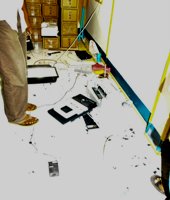
“They tear gassed Haruge first. Then [police] started vandalising the MDP office. Window glass was shattered with batons; computers and other equipment was smashed against the floor. Chairs were broken. People inside the Haruge were brutally beaten and dragged outside,” a third source from Addu said.

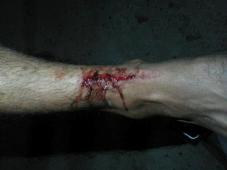
Photos and dramatic footage of the damage to Haruge circulating over the social media show injuries allegedly inflicted by the police during the crackdown, and women being taken to the hospital by ambulance. The MDP Haruge in the capital Male’ was similarly attacked by rogue police during the chaotic events of February 7 which culminated in the resignation of President Mohamed Nasheed.

A man's hand injured in the attack

In one image, a woman is also seen on the ground, with what seems to be an injured hand.

Shiyara,who spoke to Minivan News earlier, said that she was the one who took the injured woman to the hospital.

“Apparently, there was something already wrong with her hand – so when the police dragged her outside Haruge by holding that hand, it was fractured,” Shiyara claimed.

Another image also show injuries to a man’s hand, allegedly injured in a baton strike.

In a press statement released last night, police dismissed the allegations as “lies” and said that the police only stopped the demonstrators who attempted to break into the area blocked by the security forces.

Home Minister Dr Mohamed Jameel Ahmed meanwhile told local media that 11 cases concerning violence incidents in Addu Atoll on February 8 had been forwarded to the Prosecutor General (PG)’s Office.

Dr Jameel blamed former President Mohamed Nasheed for leading the attacks, reported Haveeru, stating that “Nasheed and his traitors” inflicted extensive damage on the country over his three years of rule.

President Dr Mohamed Waheed Hassan said that anyone who witnessed the damage to police and court buildings first hand would “surely shed tears”.

President Dr. Waheed pledged that he and his government will do everything in their power to bring the criminals behind the Addu incidents to justice.

Likes(0)Dislikes(0)