President Dr Mohamed Waheed Hassan has announced an “independent and impartial investigation” into developments in the Maldives from January 14 to February 8, according to a statement on the President’s Office website.
Dr Waheed did not reveal who would conduct the inquiry, but he acknowledged the need for it yesterday after Germany and the UK to establish the legitimacy of his government.
The dates given include the period of incarceration of Chief Judge of the Criminal Court, Abdulla Mohamed, and subsequent protests held by 200-400 opposition-led demonstrators, which culminated in a press conference on January 31 in which opposition parties called for Dr Waheed to take over the government with the assistance of police and military. The event itself took place on February 7.
In the statement, Dr Waheed said the investigation would create “factual and legal clarity” around events with a “direct bearing on the constitutional transfer of executive power that took place on February 7.”
“The investigation would also help establish accountability for any human rights violations which have taken place and thus set the groundwork for national reconciliation and dialogue,” Dr Waheed’s statement read.
“Reiterating his commitment to free and fair elections in 2013, the President urged all political parties to work together in creating a climate of trust and confidence in the build-up to next year’s elections. The President is also hopeful that the investigation, together with his offer to create a strong National Unity Government that would provide impetus for building trust and the establishment of the rule of law, would facilitate the resumption of normal democratic processes in the country,” the statement read.
Nasheed and his Maldivian Democratic Party (MDP) maintain that Dr Waheed’s government came to power after Nasheed was forced to resign under duress, and have refused to participate in a “national unity government” they claim is illegitimate.
President Dr Mohamed Waheed Hassan Manik made seven new appointments to the cabinet on Sunday morning.
The majority are hard-line opposition figures, while several are long time supporters of former President Maumoon Abdul Gayoom. Only two of the new appointments (the tourism and and health portfolios) have previously undeclared political affiliations.
Dr Waheed has faced pressure from his predecessor former President Mohamed Nasheed, who has challenged the legitimacy of Dr Waheed’s government claiming that he was forced to resign in a bloodless coup d’etat on February 7 at the hands of rogue police and military officers.
Dr Waheed said yesterday that he wanted cabinet to “represent all major political parties”, hoped that Nasheed’s Maldivian Democratic Party (MDP) would be represented, and said he would “keep posts vacant for them”. The MDP has so far rejected any participation in Dr Waheed’s government.
Mohamed Hussein Shareef ‘Mundhu’ was appointed as the Minister for Human Resources Youth and Sport. Shareef has been the spokesperson for former President Maumoon Abdul Gayoom since his last term in office and also holds the Acting Secretary General’s post in Gayoom’s Progressive Party of the Maldives (PPM).
Aishath Azima Shakoor was appointed as the Attorney General. She once held the same post under the former administration and is known be one of the most successful lawyers in the country with a record number of wins in controversial cases against Nasheed’s administration. She is a council member of Gayoom’s PPM.
Ahmed Mohamed ‘Andey’, Deputy Leader of leading opposition party Dhivehi Rayyithunge Party (DRP), was appointed as the Minister of Economic Development. He has been an outspoken critic of Nasheed’s privatisation policies and the state’s budget formulation. He was the former CEO of the State Trading Organisation (STO) under Gayoom’s administration, the organisation implicated in blackmarket oil trading with the Burmese military junta under the former chairmanship of Gayoom’s half-brother, Abdulla Yameen.
The DRP was the first official party registered by Gayoom before he announced his resignation from politics in February 2010, becoming the party’s ‘honorary leader’. He became increasingly politically active and later fell out with his anointed replacement, Ahmed Thasmeen Ali, and formed the PPM after an acrimonious split.
Dr Asim Ahmed, a member of the DRP, was appointed as the Minister of Education. He has not been a particularly active member in the country’s political spotlight.
Dr Ahmed Shamheed was appointed as the Minister of Transport and Communication. He is a member of minority opposition Jumhooree Party (JP) and works as a Director at Villa Shipping and Trade, owned by JP Leader Gasim Ibrahim. He served in the ministry of planning and development under Gayoom’s administration. He is also a director of the Maldives Tourism Development Corporation Board (MTDC).
Ahmed Adheeb, was sworn in as the Minister of Tourism Arts and Culture. Adheeb is the President of the Maldives National Chamber of Commerce and Industry (MNCCI) is well known as a critic of the Nasheed’s economic policies. Under his leadership, the MNCCI made a failed attempt in court to halt the enactment of the Goods and Services Tax (GST) Act, citing worse economic ramifications and violations of law. He is a widely respected economic analyst.
Dr Ahmed Jamsheed was meanwhile appointed as the Minister of Health and Family. Jamsheed, formerly Director General of the Centre for Community Health and Disease Control (CCHDC) resigned from his post, over concerns about reduced workloads, and later joined as the Cheif Operating Officer (COO) at ADK hospital. He is one of the leading and most outspoken public health experts in the country, and has been extremely active in promoting both public health and combating malaria epidemics in the Maldives.
Dr Waheed earlier appointed Deputy Leader of minority opposition Dhivehi Rayyithunge Party (DQP) Dr Mohamed Jameel as the Home Minister and retired colonel Mohamed Nazim as the Defence Minister last week. Both are also notable supporters of Gayoom. Most recently Dr Jameel, Gayoom’s Justice Minister prior to the separation of powers, was an outspoken critic of Nasheed’s religious policies, authoring a pamphlet entitled ‘President Nasheed’s devious plot to destroy the Islamic faith of Maldivians’ and attacking his “business dealings with Jews”.
Dr Jameel is the only member in the cabinet from DQP, Dr Shamheed only member from JP while including Nazim the ministerial posts held by DRP members reach three and PPM stands at two.
Meanwhile ministers are yet to be appointed to the Finance Ministry, Islamic Ministry, Foreign Ministry, Fisheries Ministry and the Housing Ministry.
Abdullah Riyaz, former Assistant commissioner dismissed by Nasheed was appointed as the Commissioner of Police and Major General Ahmed Shiyam, appointed as Chief of Maldives National Defence Force (MNDF).
“No self interest”
Speaking after the appointments, President Dr Waheed said that remaining cabinet ministers will be appointed in a week, and expressed his hopes for MDP’s participation.
“We all are with that hope. Because, today the country needs all of us to work together to establish peace, and take the country out of the deep pit of economic and political [problems] to find a prosperous future for our children,” Dr Waheed said.
He also added that: “I cannot do this work without the benevolent and sincere help of the [cabinet ministers]”, who he claimed had the full potential to serve the nation with “no self interest” during these “special circumstances”.
The newly appointed cabinet ministers must be approved by the parliament, in which MDP currently holds 35 seats, a single seat behind total opposition combined.
Minivan News could not get MDP’s comment on the new appointments as no member was available at the time of press – however, MDP has steadily rejected the legitimacy of Dr Waheed’s government accusing him of participating in what they call an opposition backed coup to force Nasheed out of office.
MDP Thodoo MP Ali Waheed has earlier stated that MDP will do everything to “stop the implementation of Dr Waheed’s every order” through parliament if he continues to remain in office, and ignores the party’s call for new elections in the next two months.
One of society’s biggest fear factors is uncertainty, and in Addu it appears to be fueling a violent social divide in the isolated MDP stronghold – the second most heavily populated area in the Maldives after Male’ and the scene of the SAARC Summit in November 2011.
On Saturday several members of the international press flew to the southern-most atoll to investigate claims of firey protests, beatings and unjustified arrests. While the torched remains of every police building and most courts between Gan and hithadhoo are proof that destruction of public property – and many legal records – has taken place, the back-and-forth ‘whodunnit’ accusations color fears of revolution with a strong shade of small-town politics.
“The police’s personal property, their computers, was burned inside the stations,” observed Alif Fahumy Ahmed. “This isn’t necessarily political.”
On Wednesday night police stations and court houses in six southern atolls were torched after police violently cracked down on a Maldivian Democratic Party (MDP) march in the capital Male, in which thousands marched in support of ousted president Mohamed Nasheed.
Nasheed’s decision to order the detention of Chief Judge of the Criminal Court on January 16, in an attempt to push forward judicial reform, prompted three weeks of opposition-led protests with a nightly attendance of 200-400 people, culminating on Tuesday in what many have called a military coup.
While the southern protests were said to be the work of MDP supporters, in Addu, which claims a majority MDP population, people have begun slicing and dicing the duty.
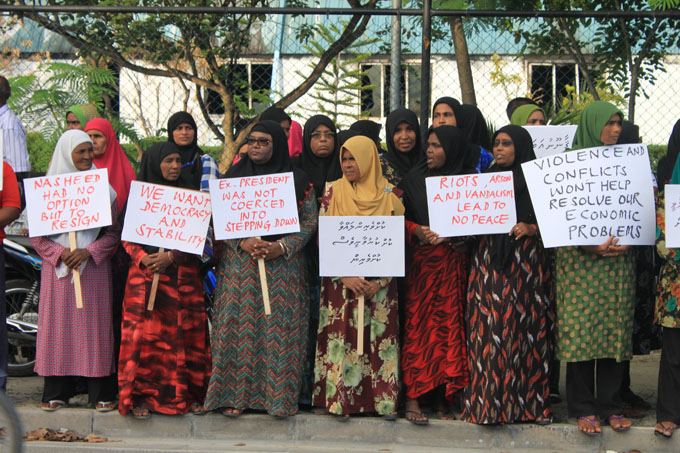
“Maldivians are a very innocent people, but this violence was brought by MDP,” said Ani Luthfy, who yesterday organised a ‘protest for safety’ in Addu, with the rapidly-formed and ‘non-political’ Addu Alliance.
The placards that greeted journalists included “Ex-President was not coerced into stepping down” and “Violence and conflicts won’t help resolve our ecomonic problems”.
“Addu MDP [Councillor] Hussein Shahid gave 30 young people alcohol and when they were drunk he led them out to do the burning,” he alleged, adding that MDP activists have acted like “hooligans”.
Police meanwhile yesterday reported the arrest of MP Moosa Rasheed, Addu City Hithadhoo Medhu Dhaairaa. His arrest reportedly followed an investigation into a spate of attacks in Addu City that occurred on February 8, following a brutal police crackdown on protesters in Male’. Police say that he was arrested lawfully, under a warrant issued by the court and in consideration of various evidence including video footage and eyewitness accounts that connected him to that night’s incidents.
According to police yesterday, tensions escalated in the islands after rumours of serious injury and the death of former President Mohamed Nasheed at the hands of security forces on Wednesday reached the islands.
Luthfy said, “we have a motto: live and let others live.” He said the alliance would continue to protest until Addu was “100 percent safe”, a point in time he defined as “When the police have taken all MDP who are in hiding.”
Meanwhile Muaz Saleem, a prominent MDP supporter on Hithadhoo, said the group “was just going in front of Gan police station to express our concerns” on Wednesday.
“Who knows if police may have started [the fire]? They left before people went in, where was the tear gas? We strongly believe the opposition encouraged people to start the violence, it was a plan. ”
A former member of Hithadhoo council, who requested anonymity and did not wish to discuss his resignation last year, suggested the opposite. “The funniest thing is that the mayor [MDP member abdullah sodig] hasn’t issued a statement about this,” he said, estimating the damage at Rf200-300 million (US$13-20 million).
Sodig has been in hiding since he was attacked Wednesday evening.
The former council member confirmed that many have followed Sodig’s lead. “Because of this protest most people are on a wanted list, ” he explained, suggesting that to some extent the list was justified: “There are CCTV camera tapes with evidence.”
Amid speculation, police have taken action. MDP supporters said they have been targeted by police and military forces, who were deployed to Addu after Wednesday. They claim the “hit list” has been drawn up by members of opposition parties Progressive Party of Maldives (PPM) and Dhivehi Rayyithunge Prty (DRP), and that those individuals are assisting security forces to beat and arrest MDP members – often without evidence.
One 22 yr old man, who claims not to have participated in any recent gathering, said he was handcuffed and pepper sprayed in his eyes and genital area along with 40 other people. ” because of the violence, they said, I was a terrorist. They said we had dstroyed everything.” he added that some members of the detained group were told to take off their shirts and were taken to a separate area of the burned Gan police station “to be beaten. I could hear the shouting, and cries.”
Minivan News received unconfirmed reports that the Elections Commission’s SMS service – which allows people to send their national ID number and find out what party they are registered to – was being abused by groups of police aided by opposition supporters, to ‘hunt down’ MDP members.
While sources claim the attacks are directed at MDP, their stories suggest that the security forces are not operating with a political-or evidence-based motive.
Two young men interviewed, one of whom sported a bruised right eye, denied being part of any political party. Another said he wasn’t even part of the protest. Yet none would give names “because it might not be good, they said if I talked about what I saw they would come back.”
Muaz Haleem’s wife said the violation of her right to privacy at home, and the lack of an explanation, are her biggest concerns.
She reports seeing several policemen run into her home with raised batons yelling an unfamiliar name. “I said it was the wrong house, wrong name. But they pushed me down and said, ‘now we want Muaz ‘ and began beating him and dragging him out of the house.”
“I asked about the court order, and they said, ‘What court order? You guys burned down the court house. What rights do you want?'”
She explained that her neighbors have been far from helpful – in fact, they were part of the problem.
“Most people on the other side of the road are PPM (Gayoom’s Progressive Party of the Maldives). Mr Hamid was out there directing the whole thing, pointing at the house and everything.”
The family of Mohamed Saeed, whose detention has been extended by 15 days, said they too had not been informed of Saeed’s arrest, and that their neighbors are only cautiously supportive.
“They ask for news, but they are afraid to help because they could also be taken,” his wife explained.
Saeed is one of approximately 80 men who are still being held in the remains of Gan police station, reportedly in terrible conditions.
“He has asked to go to the hospital but they say they have no vehicle,” his brother in law said.
Others, such as Haleem, appear to have been detained on an aggressive whim, in retaliation for the destruction of police property.
“They gave me a cup for tea and then struck it down. They just dumped people in the courtyard of the station amid the broken glass and burnt debris, and pushed me down to the ground for sleeping,” he said. Haleem currently has a swollen left wrist and cuts where he claims the handcuffs were squeezed closed.
While Haleem believes the security forces are targeting MDP members, he suggests that their motive is more personal than political.
“It looks like there is a massive financial factor,” he said. “We have had the trust of the Maldives National Defence Force (MNDF) for ages in this country, but under Nasheed individual police have shown they are motivated by something. I don’t have proof, but that’s what I strongly believe.”
He further explained that “The opposition has fewer numbers, but now that they have the security forces with them, they can act.”
Meanwhile most who claim to support the current government are consistently saying “It’s not the opposition, and they’re not beating people. The police have just asked the public for assistance,” explained a former councillor.
No members of opposition parties have been reported beaten, arrested, or detained.
Meanwhile, the arrival of the Human Rights Commission of Maldives (HRCM) has triggered some over-excitement. One MDP member yesterday informed the author that the police had lied to HRCM about the whereabouts of a detainee, and that HRCM was arguing with police over the matter.
HRCM’s delegation in Addu later stated that the detainee had been released from the hospital by the time HRCM had gone to look for him, and that he is now at home.
As high level delegations hold conference with President Dr Waheed and former president Nasheed, and HRCM surveys police operations in Addu along with the Police Integrity Commission (PIC), police and military appear only watchful. Still, the tense mood is palpable.
“We are not safe because we don’t know when again it will start,” said one man outside Feydhoo’s smoldering court house.
Ahmed said he had no confidence that the political issues in Male will be quickly resolved: “Things in Addu have calmed at the moment, but they may continue once HRCM and the reporters leave.”
It remain to be seen whether similar violence and revenge attacks will grip Male’, once the international community departs and visiting foreign journalists run out of stories.
The 'Addu Alliance' greeted foreign journalists, in support of Dr Waheed's government.
As tear gas rained down on citizens marching in favor of ousted president Mohamed Nasheed’s government a day after what has been called a coup d’etat, hundreds of Maldivian metal fans attended a live concert by Swedish heavy metal Opeth at the Dhaarubaruge concert hall in Male’.
Nasheed, the Maldives first democratically elected president, resigned on Tuesday, February 7 following street clashes between national police and military forces. He has since stated that he resigned to protect the Maldivian people from further bloodshed.
Opeth, supported by home-grown Maldivian band Nothnegal, played a sell-out gig to eager crowds on Wednesday, February 8 – in spite of the chaos developing across the urban island.
Organisers said the political and civil unrest which has rocked the paradisaical archipelago for the past two days had forced them to postpone the concert, originally scheduled for February 7, by one day. It also made it impossible to hold the gig outdoors, they said.
Yet the band could not be cancelled, nor their fans deterred – offering a surreal insight into the Maldivian psyche. Much like the Lebanese who continued to celebrate as bombs rained down on Beirut, heavy metal fans refused to cancel the show as government hospital IGMH declared a state of emergency.
Rather, Maldivians embraced the chance to take a break from the situation and enjoy the show.
Nothnegal’s lead guitarist and Maldivian national Hirlal Argil reflected on the situation. “There still is hope for democracy, if only everybody would start working together to resolve all that’s happened rather than fighting for power,” he said.
“We Maldivian youth love heavy metal. I am not sure why but perhaps it is our rebellious spirit, our in-your-face attitude,” he continued. “It was a much needed change for the people to see Opeth after all the trouble of the past few days.”
Opeth flew into Male’ with Nothnegal after both performed at the Summer Storm music festival in Bangalore.
Argil said that Opeth, despite their fame, were a well-grounded group and loved being in the Maldives. “They are all really nice and we hung out before and after the show,” he said. “Opeth is our favourite band. They drew the most people and they know how to do a good show, Mikael is one of the best frontmen in the world,” he added.
Argil also looks to Metalica, Iron Maiden and Megadeth for inspiration.
Argil and his cousin Fufu have listened to heavy metal all their lives. Connecting with musicians Kevin Tailey (American) and Marco Sneck (Finnish) online in 2006, the band released their first EP “Antidote to Realism” in 2009. Since then, they have enjoyed growing levels of success, shooting their own music video “Web of Deceit” and releasing the album “Decadence” this year.
Since 2009 Nothnegal has toured with a number of heavy metal bands including Fintoll in 14 countries across Europe. They report that playing with Opeth in their native capital Male’ was the pinnacle of their career thus far.
The devil’s music?
For the past few years heavy metal music has captured the zeitgeist of a young Muslim democracy itching for change – death metal is the country’s most commercially successful musical export, especially, for some reason, in Scandinavia.
However, under the government’s coalition agreement with religious Adhaalath party Islamic fundamentalists became more outspoken against the genre. Some heavy metal fans have reported practicing or playing music in semi-secretive settings, while concerts of Opeth’s scale have not been held in the Maldives for years.
Andu, a fan who attended the event who is also part of heavy metal outfit The Damned Ones, said, “My frustration is that no government, neither Maumoon’s nor Nasheed’s, has done anything to help the musicians in here. Whatever we had has been wearing out for a long time,” said Andu. “There is hardly even a place to have a show. Do you know that it costs like US$20,000 (Rf308,400) to have a good show?!”
While talent abounds in the Maldives, there is virtually no record industry in the Maldives, and artists find it difficult to get signed. Nothnegal is the only Maldivian band to be signed to a record label to date, due in part to their online release of “Antidote to Realism”, which caught foreign interest and led to the band’s signing with metal label Seasons of Mist.
Furthermore, music is still seen by some Maldivians as haraa’m, even though there is nothing in Islam to say that music is banned. Perhaps it is a rebellion against an overtly religious society as interestingly the choice of music of the majority of youths is angry, loud and political metal.
“Music should not be haraam, there is nothing in the Quran that says so,” said Andu, discussing the attitude of the older, more conservative demographic including religious fundamentalists, “who see any music, never mind heavy metal music – as the devil’s work,” he said.
“They believe that one of the signs for end of days is the saying that when the Anti-Christ comes lots of musicians will follow him….I think this is maybe one reason for them to believe that, but the same signs of the end of days state that buildings will rise to touch the skies….but that does not mean you can’t build high buildings!”
In fact, Andu writes ‘”for religion” rather than against it, he says, and rejects any argument that he is propagating the devils music. “I have faced lots of religious people and none can show me a verse from the Quran that says music is haraam. There are a few people who would say we worship devil and sleep in coffins because we dress up in all black and have long hair but I don’t care. They can believe what they want as they don’t want to open their minds.”
“When David Cameron referred to Mohamed Nasheed as his “new best friend” last November, I wonder if the then President of the Maldives, who was forced from office at gunpoint on Tuesday, believed that Britain’s prime minister meant what he said,” writes Sholto Brynes for the UK’s Independent newspaper.
Mr Nasheed would certainly have cause not to now. True, initially he announced that he was stepping down in order to avert bloodshed after weeks of protests and a police mutiny. But, on Wednesday, he revealed that he had been marched off by soldiers with guns.
“They told me they wouldn’t hesitate to use them if I didn’t resign,” he said.
On that same day Mr Nasheed and his supporters took to the streets of the capital, Male, in protest, only to be greeted by tear-gas grenades from riot police; Mr Nasheed himself and many others were beaten.
If it was an extraordinary reversal for the diminutive leader, who has won worldwide acclaim for environmental policies such as making his country carbon neutral by 2020, the response of the international community must have been a still more bitter pill to swallow. It seemed many had bought the line that Mr Nasheed had gone too far in ordering the arrest of the chief judge he accused of holding up corruption investigations and wrongly releasing an opposition politician. Also that the protests against his economic policies and supposed lack of commitment to Islam in this 100 per cent Muslim nation were proof that he was beginning to act in a high-handed manner and had dissipated his popular mandate.
On Wednesday, India’s Prime Minister, Manmohan Singh, was extending his “warm felicitations” to Mr Nasheed’s successor, the former vice president, Mohammed Waheed Hassan. On Thursday, the US State Department declared that it recognised the new government. And although Mr Nasheed somewhat bizarrely thanked him for drawing attention to the coup, nevertheless William Hague tacitly followed suit by calling on the Maldives’ “new leadership to establish its legitimacy with its own people and with the international community”.
The facts are these. Mr Nasheed came to power in 2008 in the Maldives’ first democratic election. Blocked from carrying out many reforms because his Maldivian Democratic Party has never enjoyed a majority in parliament, Mr Nasheed has had to deal with a judiciary almost wholly appointed by the former regime, which, therefore, has never had any wish to delve into its violence and corruption.
Taking advantage of this, and other factors over which the president has had no control – such as the rising cost of the foodstuffs that have to be imported into a country that subsisted on a diet of nothing more than coconuts and tuna for centuries – elements of the old regime formed an alliance. They teamed up with the minority of hard-line Islamists and with corrupt businessmen, who knew that greater transparency would threaten their interests, to force Mr Nasheed out.
There was nothing remotely constitutional, legal or even popular about his removal. It was a coup backed by associates of his predecessor, Maumoon Abdul Gayoom, a dictator under whose 30-year rule Mr Nasheed and countless others had been tortured. The current incumbent, Mohammed Waheed Hassan, pretends otherwise: but he has already appointed two of Mr Gayoom’s former ministers to his cabinet, in the key departments of Home and Defence, and rewarded other Gayoom loyalists with the positions of presidential spokesman and Inspector-General of Immigration. It is believed that he struck a deal at the end of January: he would get the presidency, and Mr Gayoom’s men would return to power.
Mr Hague further displayed no sense of irony in the House of Commons when he said: “We hope that the new leadership will demonstrate its respect for the rule of law,” blithely ignoring the fact that it owes its position to a willingness to dispense with such democratic niceties.
A patina of Islamism is likely to overlay the new regime, and there will be much hollow talk of the need to preserve democracy, but underneath it is a return to the autocratic kleptocracy that preceded Mr Nasheed’s election. A proper taxation system did not exist before he came to power, and Mr Nasheed pointed to that yesterday as another of the motivations for the coup, which he said was “financed by resort owners. They liked the old order of corruption. We were rocking the boat, taxing them.”
Such words should be shaming indeed to the British government. We should never rush to foreign intervention. Frequently it is unjustified and catastrophic, as in Iraq, or diplomatically and practically impossible, as in Syria and Burma. But in the Maldives the case is clear-cut. It is a nascent democracy whose elected leader, admirably, chose the difficult path of reconciliation over retribution. “I’m trying not to prosecute the previous regime,” he told me when I interviewed him at the opening of a new Hilton on Noonu Atoll in 2009. “I’ve never removed my own jailers, only the chief of police. The rest of the top brass are my own interrogators.” Sadly, he appears to have been a victim of his statesmanlike and magnanimous behaviour. For there can be no doubt that it was forces allied to Mr Gayoom, who has been openly advertising his desire to return to power for months, who brought him down.
The international community acted without consideration last week. “It was a clever coup,” Mr Nasheed’s adviser Paul Roberts tells me from the Maldives. “Forcing him to resign, then locking him away so the vice president took office. It appeared all very normal and the diplomats moved too fast. They didn’t get all the facts before speaking out and suggesting the new regime was legitimate.”
Several countries have since rowed back slightly from their premature recognition of the new government. The US Assistant Secretary of State, Robert Blake, arrived in Male yesterday to assess the situation, while India’s special envoy, M Ganapathi, has returned to New Delhi admitting that it was “complex”.
A coup is a coup. Much of what transpired at MNDF headquarters the morning of February 7 remains unclear, but several key facts have come to light, and placed in the context of Maldivian politics, leave no doubt in my mind that President Nasheed was ousted in a cleverly executed coup.
Following Nasheed’s forced resignation, the entire country burned. Key law enforcement institutions became Enemy Number One overnight. In contrast to the relative professional and non-violent reaction to protests against Judge Abdulla’s arbitrary detention, police used brutal force and violently targeted key MDP officials on February 8. Controversial appointments to key posts in Dr Waheed’s government, particularly the Minister of Defence and the Commissioner of Police, who served as the main interlocutors with President Nasheed at MNDF HQ, with no legitimacy whatsoever, further deteriorate MDP supporters’ faith in the police and the MNDF.
In an atmosphere so emotionally charged and tense, it is an elephantine task to remain rational, to stick to facts, and to make decisions that will save our democracy in the long run. It is even harder to do so when media channels, on either side of the political divide, are biased and resorting to propaganda. Nasheed and his supporters have unleashed a deluge of hyperbole to rile up crowds and chip away whatever is left of the public’s trust in the police and the armed forces.
Nasheed showed Waheed’s government and the international community his ammunition when he led his supporters into a direct, violent confrontation with the police and armed forces on Wednesday. He is using the threat of violence to force elections in two months, when it is very clear that an election in two months will not be free and fair. In the meantime, Waheed has come out to say he will not hold elections until 2013. What has been lacking in our democracy since 2008 stands in the way of restoring democracy today. Democracy is about compromise. Nasheed and Waheed need to meet each other half way so that our democracy is not flushed down the drains of history.
Even if Waheed’s government is illegitimate, what is done is done. And protracted civil unrest and violence in small communities, which may take generations to heal, is not the way forward. At a time when people are divided and emotional, we need strong leaders who place the good of the nation above personal gain. Waheed must have the balls to ensure that his government does not go after senior leaders in the MDP in the run up to elections in six months. In return to agreeing for elections in six months, Nasheed and his co must be given guarantees by Waheed’s government that the MDP leadership and supporters will not be made political prisoners. In my mind, there is really no other way forward and if people have suggestions, it is time we start a national debate on how to overcome this impasse in a conciliatory manner.
You say a liberal?
That said, the coup d’etat of February 7 is also a window of opportunity for the people to demand more and better from of our political leadership. One person had written on facebook that we might have been too tolerant of President Nasheed’s runaway administration. True, opposition political parties under Nasheed’s administration did not play by the same lofty rules we set for the government. But with more power comes more responsibility. Nasheed was in power, the opposition parties were not, hence the double standards in expectations. With our civil society so weak from 30 years of authoritarian rule, the political leadership had a massive responsibility. Nasheed had the power to write the story of our democracy differently. He may have lost elections in 2013 if he did, but he would have been a mighty hero in my mind had he focused on strengthening our democratic institutions over forcing and bypassing democratic institutions to ensure the fulfillment of the MDP’s five key pledges.
A 30-year dictatorship left a legacy: an uneven playing field; a weak civil society; a small and toothless middle class; a dearth of self-thinking peoples; and a biased media. The vestiges of dictatorship remain and they matter. History matters. But it only directs, it does not determine. The many constitutional crises, the political posturing, and the name-calling we see today are not inevitable results of a 30-year dictatorship. It is the combined result of a 30-year dictatorship, and a conscious choice by the Nasheed administration to play power politics instead of fostering the slow, painful and perhaps, in the short run, self-defeating, democratic reforms that would have strengthened our democracy.
When Nasheed came to power in 2008, he inherited not only a massive budget deficit, but also a political system that operated on political patronage. Nasheed did not try to change this informal system. He adopted masters of such politicking, including Ibrahim Hussein Zaki and Hassan Afeef into his administration, indicating that political realism would provide Nasheed government’s ideological grounding. To outwit Gayoom et al, Nasheed decided to play the power game instead of democracy. In doing so he acted like an astute politician, not a liberal democrat. Those who expected the latter, mostly liberals, are deeply disappointed with the Nasheed administration. The handful of young and educated who were convinced that an MDP defeat in 2013 would spell out the end of democracy, and those who foresaw an end to their innings with the end of Nasheed’s government, were glad that he played the part of a clever politician. But then the coup happened.
In a very real way, Nasheed himself is to blame for presenting coup planners with ample fodder and opportunity. Arbitrarily detaining Chief Judge of the Criminal Court Abdulla Mohamed for nearly 20 days, in spite of the arrest’s unconstitutionality, in spite of continued street protests that often turned violent, and in spite of escalating police fatigue, Nasheed defended the arrest to the last minutes of his administration and continues to defend it today. But to this day, Nasheed has not explained the precise national security threat that justified the military detention of Abdulla Mohamed. By commanding the MNDF to arbitrarily arrest Abdulla Mohamed and detain him on their training camp, Nasheed unnecessarily plunged one of Maldives’ few professional institutions into disarray and opened it up to politicisation. Presidents who are concerned with consolidating democracy do not issue such orders. They do not think in “either or” terms. Creativity and compromise are fundamental characteristics of a strong democratic leadership.
You say a revolution in 2008?
History matters. Those who were rich and powerful under Gayoom, remain rich and powerful today. In short, our democratic “revolution” in 2008 failed to change the status quo. The aristocrats and merchants who own the tourism, fishing, construction, and shipping industries act like an oligarchy. They have the means to ensure that they maintain their monopolies and deflect any harm that come their way. Take for example what happened with the penalties for tax evasion. And where is the minimum wage bill? What happened to workers’ right to strike? When democratic institutions, such as the parliament, become monopolised by aristocrats and merchants, and when the main rule of law institution, that is the court system, remains dominated by unlearned persons who are easily manipulated by the aristocrats and merchants, the middle class that is the key to democratic consolidation, has no representation and no space to assert itself.
To his credit, Nasheed did attempt to foster a middle class. He implemented a long overdue taxation system that forced tourism tycoons to pay their fair share for state bills. His policies sought to improve access to basic services. And he faced huge challenges. But in playing power politics, he also ensured that the rich and powerful remained so, and nurtured a new group of rich and powerful people who would ostensibly protect his presidency and candidacy in 2013. To that end, a number of development projects continued to fall into the hands of those affiliated with the MDP, and sometimes those hands were not the most capable and able. And the lease of Ibrahim Nasir International Airport is anything but transparent. If justice is fairness, Nasheed government’s corrupt activities fell short of delivering justice, and served to exacerbate the already existing crisis in the judiciary.
Way Forward
The way forward is in compromise and learning from mistakes. It is not in taking sides and refusing to budge. Peace is not a platitude. To characterise peace, conciliation, and negotiation as platitudes and “bullshit” is to reject the essence of democracy. And being “colorless”, and withholding blind support for the MDP or any other political party is not a wholesale rejection of democracy. Restoring Nasheed, whichever way possible, will not restore democracy.
No to street violence, No to political witch hunts, No to destroying the social fabric of our small nation, and No to politicising our armed forces and the police. But Yes to elections in six months. The current government is illegitimate and the nation cannot afford to wait until 2013 for presidential elections. At the same time, MDP supporters will risk the nation by going out on to the streets. The political leadership of this country should go to the negotiation table fast if we are to restore democracy. And people of this country should step back from pledging blind support to leaders. Learn from mistakes. Pledge your support to democratic processes. Pledge your support to negotiations and elections, not in two months when an election would be impossible, but in six months, when it has a better chance of translating your vote freely and fairly.
All comment pieces are the sole view of the author and do not reflect the editorial policy of Minivan News. If you would like to write an opinion piece, please send proposals to [email protected]
United States’ Assistant Secretary of State Robert Blake has encouraged the coalition of “former opposition” political parties affiliated with the new government to “work with all parties to reform and improve the capacity of the judiciary, the police and the election commission to ensure the election can be held in an orderly and peaceful manner.”
Large crowds gathered at MDP rally
Meeting the press this afternoon in the National Art Gallery, Blake said that “a number of good ideas” were being explored to “try and bring former President Mohamed Nasheed’s Maldivian Democratic Party (MDP) into the national unity government.”
Blake’s suggestion follows that of new President Dr Mohamed Waheed Hassan, who said on Saturday morning that he hoped some cabinet posts would be taken by the MDP: “I hope MDP will be part of my cabinet, and I will keep posts vacant for them.”
Nasheed’s supporters have criticised the legitimacy of Dr Waheed’s government and have refused to participate in his proposed ‘national unity’ government.
Challenged by a foreign journalist as to the legality of the transition, Blake said that US commitment was to the new government of the Maldives.
““The United states remains committed to working with all Maldivian people to ensure democratic and prosperous future for this important friend of the United States,” Blake said.
However he added said that there were “some questions regarding the transfer of power” and suggested that some sort of independent Maldivian commission be formed to investigate the issue, before arriving at conclusions.
As per the constitution, the Vice President is next in line for the presidency and the speaker of the parliament “has already said that the transfer of the power was constitutional.”
“Some people say it was a coup, some people say it was a peaceful and constitutional transfer of. power. That not for the US to decide, that is for Maldivians,” Blake said.
He did express concern over the “anti-semetic commentary” and strongly condemned it, and also praised Nasheed’s government “for working to improve [the country’s] relationship with Israel and show themselves as a modern and progressive government.”
Nasheed and his party supporters gathered in their thousands at the Artificial Beach in Male’, where they were shown a chronology of videos leading up the change of government. Crowd control police or military were nowhere to be seen, and the crowd eventually dispersed peacefully.
When retired Colonel Mohamed Nazim addressed the press for the first time following his appointment as the country’s new Defence Minister, he strongly asserted that there was no pressure from the armed forces on President Nasheed to resign.
He further claimed in front of journalists that the armed personnel gave no indication either way even when the President had asked them for advice.
However, in a video broadcast afterwards on RaajjeTV, the retired colonel is seen addressing the mutinous security forces at the Republican square on the morning of seventh February. In the video, he is seen coming out of the MNDF barracks, and telling the assembled forces over a loud speaker that he has conveyed their demands, which included the President’s ‘unconditional resignation’.
Clearly, the new Defense Minister needs to rethink this statement, and be more forthcoming about the day’s events.
Furthermore, why the new Commissioner Abdulla Riyaz – who had been sacked earlier – was seen carrying the President’s resignation letter is another question worth asking.
How Nazim and the Abdulla Riyaz, both civilians at the time, were allowed to freely walk into the MNDF barracks and closely accompany the President remains a mystery.
What is clear is that when the President is forced by the armed forces to resign under the threat of violence, held in military detention, brutally beaten up on the streets along with his supporters by the police, has an arrest warrant against him within a day of his resignation, and all the appointments made by his successor are known allies and associates of the former dictatorship that have been hostile to his presidency, then it is time to acknowledge the incident for what it is – a coup d’etat.
A puppet government
To be absolutely clear, Dr Waheed is a admirable man. He is an articulate and accomplished person, with a ton of experience and is eminently worthy of handling the responsibilities of the Presidency – arguably much more so than any candidate the main opposition parties has to offer.
However, the circumstances leading to his acquisition of power are vague, and the little that is known is corrosive to the country’s democratic ambitions.
Noteworthy among them is that the main opposition parties had publicly called upon the armed forces and the police to plead allegiance to the Vice President a week before the police mutiny even happened.
In a democracy, the transfer of power has to absolutely remain the sole prerogative of the people, exercised through the ballot box. This is a sacred writ of democracy that cannot – and should not – ever change.
A few hundred policemen should not be able to forcibly execute a regime change.
There is an ongoing effort by the opposition parties to portray the coup d’etat as a ‘popular’ uprising. But thankfully, it is trivial to discredit this assertion.
While there were 20 days of sustained protests by several opposition parties in the days leading up to the coup d’etat, the sparse attendance at these rallies – considering the sheer number of political parties behind it – proves that it wasn’t representative of the general public will.
Furthermore, Dr Waheed’s appointment brings with it greater portents.
Dr Waheed has little political influence or grassroots support to implement any independent decision. His fledgling political party hasn’t a single elected member in either the Parliament or a local council.
He is, thus, in a poor position to enforce or carry out the mandate of the people. Without the backing of the MDP, it is likely that the only policies he can realistically achieve are opposition demands that, again, have no electoral mandate.
“Rule of law”
Dr Waheed has also failed to strongly condemn the excessive police brutality against civilians on February 8, the day President Nasheed was released.
Despite having repeatedly vowed to uphold the ‘rule of law’, people were beaten unconscious, the ousted President was roughed up, and at least one senior member of Parliament was beaten mercilessly by the police under his watch.
His failure to reassure the people might have very well contributed to the arson and violence in the southern atolls, as supporters of President Nasheed torched police buildings and courts in response to the heavy-handed police crackdown.
The silence of the new President was only matched by the apalling insensitivity of the newly appointed Commissioner of Police who, when asked to respond to the excessive use of force by the police, insisted that the police always used ‘minimum force’ – and that he would leave it to the Police Integrity Commission (PIC) and the Human Rights Commission HRCM) to judge if they had stepped out of line.
On the other hand, the armed forces forcibly took control the Maldives National Broadcasting Corporation State media, renamed the station to ‘TVM’, as it was known during the Gayoom dictatorship.
The station is now a police propaganda outlet, and refuses to cover massive MDP rallies around the country, or the police brutality that has attracted condemnation from Amnesty International and other bodies:
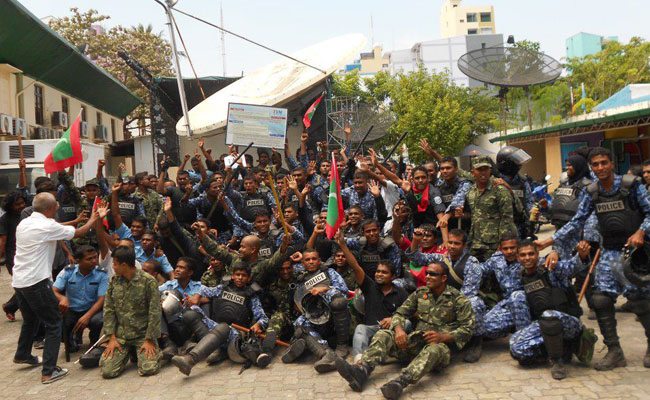
A photo circulating on Facebook apparently showing defected police and MNDF celebrating in the courtyard of the state broadcaster, after taking it over on Tuesday.
Unity government
Dr Waheed has also said that he’s looking forward to forming a “unity government” and find common ground.
However, his appointment of Dr Mohamed Jameel as his new Home Minister puts a dark cloud over the sincerity of this effort.
By all measures, Jameel is a hawk. He led a strong, high rhetoric Islamist charge against the government when he was in opposition. His responses during his initial press conference were politically charged and combative, instead of the conciliatory tone Dr Waheed promised his government would have.
Jameel has vowed to raise terrorism charges against “those involved” – including President Nasheed. To his credit, Dr Waheed has called the comments “unwelcome”. However, if he is sincere about building peace, perhaps he needs to rethink his cabinet appointments.
The string of appointments of Gayoom regime loyalists and apologists to the cabinet and as heads of armed forces does nothing to quell the charges of political conspiracy.
When the legitimacy of the government is in doubt, and its willingness and capacity to deliver on the people’s electoral verdict is in doubt, and when these factors have created an atmosphere of extreme volatility, then the solution seems to be rather obvious.
An immediate election would restore the mandate of the people, and grant legitimacy and authority to an elected party, which would bring back some much needed order.
However, key foreign governments like India and the United States have failed to advocate this position, choosing instead to recognise the legitimacy of the newly installed government, backed by Gayoom regime forces, tainted business interests, and Islamists.
This decision has the potential to permanently reverse the democratic gains made by the country since the democratic uprising.
Dr Waheed himself argues that the political climate of the country is not conducive to elections – whatever that means.
Perhaps more likely is the contrary view that the conditions in the country are not suitable for the present government to continue, nor is it advisable for another – much larger – reason.
Setting a precedent
Other countries in the region, such as Pakistan, have experimented with letting the armed forces dictate the rulers of the country. And in the bargain, Pakistan has become a failed democracy mired in chaos and conflict.
It is therefore tragic that the Maldives is all set to follow in Pakistan’s footsteps, without even having experienced two election cycles.
Could future political parties in the Maldives come to power simply by winning influence in the police and armed forces? Will the demands of a few hundred uniformed personnel strip 300,000 people of their democratic verdict?
If the currently installed government is granted legitimacy, what would stop the country’s defense forces from pointing a gun at future elected governments?
The Maldivian constitution says that the ultimate power rests with the people, and the people alone. This is the central tenet of the constitution – the one line that decides that we the people are in charge of our democracy.
However, if this coup – this travesty – is allowed to take place unopposed, then we would have set the unwelcome precedent that a few men with guns can override the mandate of the people.
All comment pieces are the sole view of the author and do not reflect the editorial policy of Minivan News. If you would like to write an opinion piece, please send proposals to [email protected]
Inside the MNDF base during Nasheed’s last moments in power:
Translation (provided by the MDP, Minivan News is currently verifying accuracy).
President Nasheed: Nikumey, nikumey, nikumey {Go out, Go out, Go out}
00:10 – 00:13 Nasheed: Anekahves…..alhe mee {Not again……..then this}
00:14-00:17 Nasheed: Nikan Kameh kobbala, Nikah kameh kohbala ,kaleymen {Please do something, please do something, you guys}
00:29-00:42 Nasheed: Nilaam, Nilaam ………gossa nikumey…. mulhi rajje halaaku kuranee kaleymen thibegen….Nukunashey. {Nilaam,Nilaam…..get out there…the whole of Maldives is being destroyed, by your inaction}
Unkown: Nukumeveytha? {Is it possible to get out?}
01:00-1:03 Unknown: Mariyamen rulhi aiss gen Male thalhaalanee. {Mariya and them has gotten angry and destroying Male.’}
The Maldives used to be a paradise for tourists but not its inhabitants. Honeymooners went there to explore each other, not the country,” writes Moorcraft for South Africa’s Business Day.
“Until 2008, it was the longest-lasting dictatorship in Asia. Then a diminutive but charismatic human rights activist, Mohamed Nasheed (known to everyone as “Anni”), defeated the old dictator, Maumoon Abdul Gayoom, in the country’s first free elections.
Just 41, the young president was compared with Nelson Mandela and Barack Obama, though he told me of his respect for Mahatma Gandhi. I got to know “Anni” when he was an opposition leader who had been imprisoned 23 times, sometimes in solitary confinement, and tortured by the Gayoom regime. I made TV documentaries about him and his beautiful country, an archipelago of more than 1200 islands.
“Anni” had promised he would give me the first TV interview on his first day in power. He kept his word as we chatted in his office, with furious ambassadors from major states pacing outside his office. The islands are strategically placed amid major (oil) shipping lanes, of interest particularly to India and China.
“Not many Islamic countries have had free and fair elections to form a multiparty democracy,” he said. Despite his own mistreatment, he preached forgiveness to the old regime, because it was an Islamic principle and practical politics. He said Mandela and SA’s truth and reconciliation process were his inspiration.
The previous regime had emptied the treasury. “Our finances are in bad shape,” he admitted. “We can’t consolidate democracy if we can’t pay wages.”
He was always a man of his word, but he faced a huge task of rebuilding his country. Nasheed became a green icon worldwide, not least because he held one of his cabinet meetings underwater, with his ministers wearing scuba gear, to publicise the dangers of global warming. He talked to me about eventually relocating his 350000 citizens to Sri Lanka, India or even Australia — as his country sank beneath the waves.
His victory was a beacon to the Islamic world. Free elections and multiparty democracy without a drop of blood spilled and not a single western soldier present.
So why was such an inspirational leader deposed this week? His supporters claim he was ousted in a military and police coup-cum-mutiny, although it was not that simple. The main issue was that he won the presidency but his reformist party was in a minority in parliament — Gayoom’s supporters were in the majority. Cohabitation was difficult. Also the judiciary, largely composed of ill-educated placemen appointed by the old dictator, was often at loggerheads with the new president. Tensions came to a head in the past month, when the army detained a senior criminal court judge.
Economic factors were also in play — like Obama, the new president created a crisis of expectations. Job prospects, especially for the young, did not suddenly improve when he took over. Even some reformers felt that the human rights activist of old was being heavy-handed with his political (or family/clan) opponents. And, crucially, he was attacked by the Islamist right wing, which argued he was too secular. The Islamist parties had never achieved much in electoral terms, but they were influential — as the increasing use of the veil indicated. And even foreign intelligence agencies fretted about Jihadist growth in some of the outlying islands.
Street protests in the past few weeks were met by police crackdowns, and then old-regime elements of the police joined the protesters. Nasheed explained that his only recourse to this was to call in the small and divided army, or resign. It was a bloodless coup.
Nasheed may decide to contest the forthcoming election or not, but the forces of the old regime led by Gayoom, an Egyptian-trained cleric, in alliance with the fundamentalists, could defeat the more secular reformists.
The deposed leader is, in effect, under house arrest, enjoying the “protection” of the army.
Nasheed became a world icon not least for the environmentalists. A stirring movie about his achievements, The Island President, has recently won awards at the Sundance and Toronto film festivals. Perhaps the visionary leader became more popular abroad than at home; a sad comment on a man who promised so much.
As in SA, lesser men are likely to replace the icon.
Moorcraft is a visiting professor at Cardiff University’s School of Journalism, Media and Cultural Studies.
 (0)Dislikes
 (0)
(0)