Domestic air transport price sees 18 percent hike

The price of domestic air transportation increased by 18 percent between December 2010 and December 2011, statistics from the Department of National Planning (DNP) indicate.

International flights increased by an even greater 20 percent over the past year.

The transportation sector contributed a total of 8 percent to last year’s total inflation, while Capital Male’ saw an 11.27 percent increase in inflation.

According to DNP statistics, major price hikes also occurred in the food, fish, education and health sectors.

Likes(0)Dislikes(0)

MNBC journalists beaten, tasered during protest

State television journalist Moosa Naushad was attacked by approximately 15 individuals while filming the opposition-led protest outside Maldives National Broadcasting Corporation (MNBC) last evening.

Naushad was struck down from behind. After showing his media badge the badge was taken from him and he was continuously kicked and beaten while lying on the ground, MNBC Director Adam Shareef said.

MNBC Editor Thoyyib Shaheem intervened by showing his own media badge, but was tasered in the stomach. Naushad was taken to Indira Ghandi Memorial Hospital (IGMH) at 1:00am on January 24 where he was treated for a broken hand. Shareef said the journalist had sustained fractures in his shoulder blades and feet, but had no internal damage. Naushad had not been released from IGMH at time of press.

The protesters, including opposition Progressive Party of Maldives (PPM) MPs Ilham Ahmed and Ahmed Mahlouf, allegedly made violent gestures with stones and wooden sticks while advancing on the MNBC building. MNBC have asked why their offices and staff have been targeted, “as if MNBC was ruling this country.”

MDP supporters were also reported protesting near the judiciary, before heading south towards the Haruge and clashing with opposition supporters.

“Over the past several nights our reporters have been verbally abused, threatened and warned they would would be killed by hanging or drowning,” said an MNBC official.

Shareef said he had “no idea” why the media organisation has been targeted, but “we are a government company so perhaps that’s the reason.”

The opposition has claimed that the attackers came from the MDP Haruge and attacked Naushad after reportedly mistaking him for a VTV reporter.

Last night marked the tenth consecutive demonstration since two minority opposition party members were questioned for “hate speech” against the government. The situation developed after military forces took Chief Judge Abdulla Mohamed into custody on January 16, after the government accused him of endemic corruption and political favoritism.

Although journalists have been targeted for the past several nights, Naushad’s beating was the most severe instance, Shareef said.

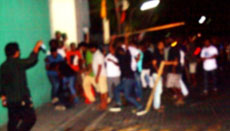
A photo of the attack on Naushad taken by a bystander

According to Shareef the two sides have not had any direct communication over the situation: “the opposition doesn’t want to talk to us, they are boycotting us as a state broadcaster. But we don’t want to speak with them either,” he said, adding that Maldives Journalist Association (MJA) and the Broadcasting Commission have released statements on the matter.

President of the MJA Ahmed ‘Hiriga’ Zahir on Wednesday said that the MJA had released a statement condemning both the attack on Naushad and damage to the offices of DhiTV as soon as he learned of the attacks.

President Mohamed Nasheed’s Press Secretary, Mohamed Zuhair, meanwhile blamed the attack on opposition parties and condemned them for “lurching towards violence, thuggery and intimidation in order to achieve their political ends.”

In a statement, he called on opposition parties to “respect journalists’ right to report the news free from fear or intimidation.”

While MNBC journalists “are not afraid”, Shareef said the state broadcaster will no longer be covering anti-government protests on-site.

“I don’t want to lose my staff. If possible we will have a live feed, but in any case we will cover the whole story, every point,” he said.

Police estimated that between 300 and 400 protesters turned out last night, and claimed that aside from the attack on Naushad only “a few minor injuries” were sustained. After being dispersed at midnight the crowd spread “throughout the city, between the Maldives Monetary Authority building and the [ruling] Maldivian Democratic Party (MDP) Haruge.”

Police understand that another protest is scheduled for 9:00pm on Tuesday evening.

As the protests continue opposition leaders are calling for extreme measures.

Speaking during last night’s protests, firebrand opposition politician Umar Naseer said bloodshed was not beyond the group’s means, according to MNBC reports. The station also reported that the Adhaalath Party’s Sheik Imran Abdulla, another protest leader, had called for jihad. Hours earlier Sheikh Imran had stated that “non-stop protests are maybe not the best way, even if it’s fighting for the citizens’ rights, as their time and businesses are affected” at a press conference.

PPM MPs Mahlouf and Illham were not responding to calls at time of press.

Likes(0)Dislikes(1)

Rising fundamentalism oppressing Maldivian women: Sydney Morning Herald

When the United Nations High Commissioner for Human Rights, Navi Pillay, visited the Maldives late last year, she urged that the practice of flogging women for having sex outside marriage – while very rarely punishing men for the same – should be abolished, writes Ben Doherty for the Sydney Morning Herald.

”This practice constitutes one of the most inhumane and degrading forms of violence against women,” she told local reporters then.

The response was as fierce as it was unexpected. The next day protesters rallied outside the UN building, carrying placards that read ”Ban UN” and ”Islam is not a toy” and threatened to ”Flog Pillay”. A website later promised to ”slaughter anyone against Islam”.

Shadiya Ibrahim, member of the newly formed Gender Advocacy Working Group and a long-time campaigner for women’s rights, said Maldivian society was growing more oppressive towards women.

”Being a woman is harder now. The religious Wahhabist scholars preach more forcefully than anyone else can. They have this backing of religion as a tool.

”No one can make the argument to have a more liberal, a more positive attitude towards women. Day by day, it is becoming harder for women to live in this country,” she said.

Ms Ibrahim said women were excluded from positions of power, from taking jobs and even from education, particularly beyond primary level.

The practice of flogging women for extramarital sex was common across the Maldives, she said.

”It happens everywhere. Normally, this punishment is given when you give birth, which is why it is almost always women. If you have 140-odd women being flogged, you have only two or three men.” The flogging is public and done with a paddle or a cane, and is intended more to humiliate than to cause serious injury.

Ms Ibrahim said flogging was accepted by many Maldivians, and there were other, more serious issues emerging, including a growing number of instances of sexual violence.

”This week, there have been two cases of a gang rape of [a] minor, one 16-year-old, one 12-year-old and, very often, while there is an effort to catch the perpetrators, eventually, the media will turn it into ‘the girl was wearing this’, ‘the girl had gone there’,” she said.

Domestic violence is common. A nationwide survey done in 2007 found one in three Maldivian women had been abused, sexually or physically.

Aneesa Ahmed, president of advocacy organisation Hope for Women, said a domestic violence bill before the Maldivian parliament would raise awareness of an issue rarely discussed in the Maldives. But the legislation has been stuck in parliament more than 14 months. Only five of the Maldives’ 77 parliamentarians are women.

Ms Ahmed said Maldivian women’s control over their lives was being eroded. ”Men in the Maldives feel that the women’s role is reproductive and in the home. That’s what women should do and that’s all we should do.’

Read more

Likes(0)Dislikes(0)

Cultural tradition and religious values at heart of “fresh, expanded nationhood”: President Mohamed Nasheed

In honor of the Maldives’ 69th National Day President Mohamed Nasheed has advised that Maldivian nationhood be rooted in universal values as taught by Islam and centuries-old tradition.

National Day remembers the heroic efforts of 16th century Maldivian leader Mohammed Thakurufaanu.

Speaking today, the President identified “conviction, beauty, humility, kindness, equality, justice, and caring” as the main bases of Maldivian nationhood. He advocated for “a fresh, expanded nationhood” in alignment with Islam and national tradition.

The question of the Maldive’s status as a 100 percent Muslim country was recently debated during protests in late December, when opposition parties and religious NGOs called for stronger Islamic policies.

The government’s all-or-nothing response included a shut-down of all spas and a proposed nation-wide ban on pork and alcohol–moves which drew anxious attention from international media and tourism officials.

Although asked to rule on the Islamic value of allowing the sale of pork and alcohol in resorts, the Supreme Court dismissed the case but said it found no reason why those items should be prohibited according to constitutional regulations on tourism goods and services.

Advocating democracy and human rights as elements critical to the Maldives, President Nasheed said a refreshed sense of nationhood should provide for “a just judiciary, freedom of expression, and other human rights; and an economic system that provides for a prosperous, clean livelihood for all citizens.”

Recently, the government instituted universal health insurance program Aasandhaa, providing free medical coverage for all Maldivian citizens for the first time in the nation’s history.

“For the sake of development and the prosperity of all citizens… the Maldives has already seen tremendous changes to the system of governance,” said the President.

However, the government has wrestled with freedom of expression. In late 2011, controversial blogger Ismail ‘Khilath’ Rasheed’s blog was swiftly shut down on the exclusive order of the Islamic Minister. He was also arrested and held for extended periods of detention after participating in a peaceful protest for religious tolerance on International Human Rights Day, during which he was beaten.

Rasheed’s arrest and detention were scrunitised and condemned by Amnesty International and Reporters without Borders (RSF).

Recognising the ongoing political unrest in Male’ since Chief Judge Abdulla Mohamed was arrested on January 16 by military forces, President Nasheed said separation of powers and “a judiciary free from all undue influence,” are essential for future progress and growth.

In recent days the government has requested international legal assistance in bringing judicial reform to the Maldives, while lawyers contending that the judge was unlawfully arrested and detained have forwarded the case to the International Criminal Court (ICC), of which the Maldives became a member late last year.

Likes(1)Dislikes(0)

Comment: One captain, one course

These past weeks’ demonstrations, protests, and proclamations continually evoke the principle that constitutional powers must be separated, but conveniently ignore the checks and balances which are meant to be inherent to any functional democracy.

We have had one constitutional crisis after another precisely because our system is broken. The checks don’t work and our system is anything but balanced. The opposition claims the executive is all powerful, while the ruling party claims that both the legislature and the judiciary are trying to hijack the government. The only way forward is through leveling the playing field. I propose we do this in two ways; implementing a real power of veto and meeting our constitutional obligations regarding the judiciary.

At Democracy’s Doorstep

It is self-evident that the democracy we fought for against 30 years of tyranny has not come to pass. In November of 2008, we merely started the next leg of a voyage that pioneers like the President and Vice President started two decades earlier.

In that moment, it was fitting that they embarked on this next leg together. And though much hailed as the fruition of hopes and dreams for democracy, what we failed to grasp is that the journey was not yet complete. The legislature, when controlled by a hostile opposition can bring the state to a standstill, while the judiciary remains with strong political bias and an ethos that should have ended when the middle ages did.

Democracy is meant to function with representation from the people. The people choose a president and a plan for five years, and while the implementation of that plan should be vetted through the legislature and the rule of law safeguarded by the judicature, neither of the two subsidiary bodies are supposed to take the helm of the country. A ship is supposed to have one captain, who is advised and guided, but whose direction and vision guides the course that the ship takes.

The reason why we have a presidential system is because we have the right to choose the vision to guide our nation. We choose our President and Vice President as they are directly elected by us. We choose our path for five years.

But say they both, God forbid, die tomorrow. Our Speaker becomes interim President till elections are held. In parliamentary systems, those who control parliament head government as well, and they do fine – right?

Wrong. If the Speaker led government, we would have a man who represents only 0.2 percent of the voting population (having won his seat with a total of 305 votes). A delightfully clearheaded and capable man though he is, he would not represent the people. We would not have a say in how our country should progress.

In 2008, when we voted, we had our say. Fine, a bunch of people voted against the former President, rather than for this one – but that is one of the growing pains of overcoming dictatorship. We chose this path, so it is time we stopped institutional mechanisms from hindering it.

We stand here at democracy’s doorstep, afraid to cross the threshold because of our authoritarian past. But the point of government is not to constantly bicker and make governing impossible, but rather to provide for those who elected you to power – not through handouts but rather through policy that changes things rather than causes stagnation.

The Point of Majlis

All the Majlis has done for the last three years is to find ways to cause stagnation rather than governance. The opposition believes that every government policy is wrong and that instead of dialogue, the only avenue available is to block policy. It is not about helping the people – it is about making sure the government fails.

That is not the way a government is supposed to function. Apart from the fact that our newly elected Majlis members have no resources, guidance, or staff to assist them – we are also encumbered by a significant institutional failing: the President has no veto.

When the President sends a bill back to Parliament because it is either inconsistent with his vision, or because it may be damaging to the people, it is but a symbolic gesture in our country. In other nations, such an action can only be overturned by a stronger majority (such as two-thirds).

Yet in the Maldives, a simple majority can force a bill through. A simple majority can hijack government and change the course of our ship. This is not the way it was meant to be. Because of the electoral system by which our parliamentarians are chosen, and because of the other factors that influence parliamentary functions, that simple majority can never equal the weight of the office of the President. To change our course and to change the direction which our country follows, we must empower our president with the authority to stand against the tyranny of a minority, and only ever let the will of the majority override the vision we chose.

An Independent Judiciary

Yet a nation cannot function, unless the rule of law is safeguarded. We worked long and hard to ensure that the judiciary would be one that was independent and free from political and social bias. There is but one mechanism to keep the judiciary accountable; the Judicial Services Commission. Alas, this mechanism has failed. It was tasked with thinning the herd, with vetting our judges, and with maintaining some level of dignity on the Maldivian bench. As described by Dr Azra Naseem, we had our moment to hold the judiciary to some standard, and we collectively dropped the ball.

The constitution clearly empowers this commission to take disciplinary action, including dismissal proceedings, against judges for incompetence or gross misconduct. And yet, when they finally get around to finding that Abdulla Mohamed failed to comply with the required standard of conduct, on the 26th of November 2011, the same judge managed to have a court order issued preventing further proceedings. The one body charged with keeping our courts in check has proven itself powerless to fulfill its constitutional mandate.

Here, we have a judge whom most agree is corrupt – or at the very least unfit to sit in so high an office; we have a judge who is blatantly politically biased and admits as much on national television; we have a judge who has released criminals including rapists and drug dealers and who has been seen cavorting with defendants after his rulings; and yet we as a nation and a people are powerless to remove him from the office which he so flagrantly disgraces. Can there be a constitutional failing that is more evident than the one embodied in this man?

A Constitutional Amendment

Our path and our national progression are being hindered by mechanisms that do not function. We have a President determined to follow through on the promises he made when elected; to provide housing, healthcare, transportation, less drug abuse and a better standard of living. Yet even basic policies are refuted, not by the merit of the program, but rather by the party which proposed it. And now there are few avenues that are open to move forward. We need to move beyond stagnation as a policy for politics. We need to change the game. There is but one captain of this ship. For five years, we choose one captain, one direction and one path. In 2013 the path might change, but before that happens – let fix these mechanisms. Let’s become the democracy we were always meant to be.

www.jswaheed.com

All comment pieces are the sole view of the author and do not reflect the editorial policy of Minivan News. If you would like to write an opinion piece, please send proposals to [email protected]

Likes(3)Dislikes(0)

Comment: Citizen sheep

A Maldivian chronicler once recounted an anecdote of the late Prince Hassan Farid Didi who remarked back in the 1930’s that granting democracy to Maldivians is like giving a handkerchief to a monkey. “The monkey doesn’t know what a handkerchief is used for and soon it will wipe its bottom with it,” the Prince reportedly said.

A lot of Maldivians take offense at being compared to primates, but the past few weeks of political volatility has definitely called into question the country’s ability to shoulder the responsibilities of being a democracy.

The current crisis was sparked after the armed forces were commanded to forcibly detain Chief Judge Abdulla Mohamed of the Criminal Court, after he ordered the release of two opposition leaders who were being prosecuted for “hate speech”.

The DQP leaders, Dr Jameel and “Sandhaanu” Ahmed Didi, had publicly accused the government of coming under the influence of Jews and Christian missionaries “to destroy Islam”. Religious hyperbole is frequently used for political slander in the Maldives – an unfortunate outcome of the country’s failure to adopt a secular constitution in 2008.

The military detention of the judge has led to a series of increasingly violent, opposition-led street protests in Male’ for the past 10 days. Protesters have allegedly attacked journalists, uprooted trees, damaged public property and vandalised a Minister’s house.

Meanwhile, the Supreme Court, High Court, the Opposition parties, the SAARC Secretary General and the Vice President have all spoken out against the detention calling it unconstitutional. Even the Prosecutor General has declared the detention unlawful.

This wouldn’t be the first time President Nasheed has exercised his uncanny willingness to shake things up.

In August 2010, he commanded the armed forces to lock down the Supreme Court after the Interim Supreme Court bench boldly decided to declare itself permanent. Following the siege, the major political parties managed to do some quick backroom negotiations to appoint a new panel of judges.

While the President’s latest salvo has successfully brought into the mainstream public conscious, for the first time, the long ignored issue of the runaway judiciary, it does raise concerns about the Executive setting unwelcome precedents for the future.

Runaway Judiciary

Aishath Velezinee, the former Judicial Services Commission whistle-blower, has publicly alleged that there is a collusion between senior opposition parliamentarians and the judiciary, which exercises undue influence over the JSC.

The JSC, which is supposed to be the independent watchdog of the judiciary, is itself dominated by judges and opposition allied politicians – and its record thus far is less befitting a watchdog, and more indicative of a lap dog.

Velezinee alleges that this is tantamount to a ‘silent coup’, where the judiciary is hijacked by a nexus of corrupt judges and opposition leaders, and the courts are used as an instrument to protect members of the old establishment that was overthrown during the democratic uprising.

The Criminal Court

The charges against Judge Abdulla Mohamed are extremely serious – ranging from corruption, to obstruction of police duties, to questionable judgments and poor professional conduct.

In February 2010, the judge ordered the release of a murder suspect – who would then stab another man to death within the next month.

The judge has in the past demanded that an underage sexual abuse victim re-enact her abuse in the public courtroom. These allegations were first reported in 2005 by then Attorney General Dr Hassan Saeed, whose political party is now among those leading the charge to release him.

The police have in the past accused the judge of delaying search warrants by several days, allowing major drug traffickers to get away. The Home Minister accuses him ordering the release of suspected criminals “without a single hearing”. He also stands accused of arbitrarily dismissing court officials.

It does not help allegations that the courts are in bed with tainted politicians when the same Criminal Court Judge also bars the media from covering corruption proceedings against opposition-allied Deputy Speaker Nazim.

A February 2011 report released by the International Commission of Jurists (ICJ) also highlighted the failure of the politicised courts to be impartial in providing justice.

The Rule of Law

While there are obviously dark clouds looming over Judge Abdulla Mohamed’s record, and the state of the judiciary is less than acceptable, does this automatically excuse the executive’s decision to forcibly detain the judge on a whim?

The unilateral actions of the very first democratically elected executive sets a rather poor precedent.

Will it be the case in the future that any elected President can arbitrarily command the armed forces to detain errant officials or citizens without the any court approval, or warrant or legal backing?

Will all future presidents be similarly entrusted to be the ultimate judge of when the Rule of Law can be subverted – if they feel it is in the larger interests of society? Will their judgements always be enforced through the brute force of the military?

The ruling party and the President’s apologists offer the explanation that given the nature of the allegations against Chief Judge Abdulla Mohamed, and the cartel-like behaviour of the judiciary, drastic action needed to be taken to ensure justice.

Yes, drastic action was indeed required – but did it necessarily need to be initiated from the President’s Office? Does not ultimate power rest with the voting public anymore?

Citizen Sheep

It has proven surprisingly difficult to get the public involved in a debate over the many, many allegations against the judiciary – that less glamorous wing of state power where the primary actors work behind closed doors, hidden from the media limelight.

When former MP and Chairman of the Special Majlis Drafting Committee Ibrahim “Ibra” Ismail expressed alarm in September 2011 over the growing excesses of the judiciary, the Supreme Court fantastically reprimanded him in a press release, asserting that criticising the Courts went “against the principles of civilisation” and that the constitution forbade such criticism.

In a democracy, the power rests with the people. However, Maldivians so far have shown little inclination to hold their state office bearers accountable.

In the neighbouring country of India, tens of thousands of outraged members of the public poured out onto the streets in recent months to protest against corruption in high offices.

The impact of overwhelming public sentiment and the willingness of the Indian public to hold their elected officials accountable worked. Several cabinet ministers and powerful provincial leaders previously thought to be untouchable by law suddenly found themselves behind bars.

Despite their every natural instinct, both opposition and ruling party leaders in India were forced to bend to public will and draft legislation that would create a new constitutional authority – an ombudsman that would be empowered to investigate corruption at the highest levels, including the Prime Minister’s office.

In contrast, the Maldivian public seems to be lethargic, and content with mindlessly echoing whatever slogan is aired by whichever party they happened to plead allegiance to.

Thus, we had ten thousand protesters mindlessly follow their sloganeering political leaders last month to complain about monuments and a host of other trivial non-issues, but there wasn’t a murmur to be heard about the serious charges of corruption and undermining of the judiciary by the same politicians who were on stage blathering about some imagined grief caused by invading Jews.

Pray where were the hordes of MDP loyalists that today defend the President and speak in angry tones against the Criminal Court judge, when the judiciary made a mockery of the constitution throughout the whole fiasco involving the appointment of judges?

Does anyone know the views of the opposition protesters on the state of affairs of the judiciary?

Are they not concerned about the under-qualified, under-educated, and sometimes convicted criminals of poor moral calibre that now occupy the benches of their courts?

If they are worried about the abuse of executive power, why are they not concerned about the abuse of judicial and legislative power?

Perhaps the Maldivian public is simply uneducated on the gravity of these issues due to the lack of any avenue for factual, impartial information – and having access only to a bunch of partisan propaganda outlets masquerading as ‘the media’, with the choice to pick one that most panders to their views.

The slant of the State media coverage of the recent protests is eerily similar to the language employed by Gayoom-era news propaganda. Similarly, the bias and sensationalism spewed by opposition-allied TV networks would make Fox News and The Daily Mail blush.

A second revolution

An argument can be made that the task of democratic transition still lies incomplete, and that democratic reforms only changed things in the executive, leaving the judiciary and parliament to remain bastions of the old guard.

The President and the ruling party have the right to educate the public and complete the task of democratic reform in all areas of governance.

However, if they feel that more drastic, revolutionary actions are necessary, then perhaps they ought to relinquish the position of the executive, return to the streets as ordinary citizens, and organize a grassroots campaign to cleanse the country’s courts and Parliament.

It simply does not bode well for the country’s democracy when the powers bestowed to one arm of the State is unilaterally employed to twist the other arm.

The country has already had one failed attempt at democracy before. If the actions of the democratic leaders causes the general public loses faith in democratic institutions and the rule of law, then there’s no reason to believe it won’t fail again.

The Maldivian public needs to realize that the ultimate Constitutional power is not vested in the President’s residence of Muleeage, but in the hands of voting citizens, and that if they are serious about completing the task of Judicial reform, then it is up to the citizens themselves to rise up and sort out the Judges.

Echoing the sentiments of the Prince Hassan Farid Didi, Former President Maumoon Abdul Gayoom once said in an interview that Dhivehin are not ‘ready’ for democracy.

Recent events suggest that both the Pharaoh and the Prince appear to be correct.

Four years after we voted in our first democratic government, the Maldivian public continues to be as clueless as the monkey with the handkerchief – and it is under our watch that politicians and judges wipe their bottoms with the constitution.

All comment pieces are the sole view of the author and do not reflect the editorial policy of Minivan News. If you would like to write an opinion piece, please send proposals to [email protected]

Likes(2)Dislikes(0)

High-risk behaviour leaves Maldives at risk of HIV/AIDS “explosion”

A new report has revealed that the health authorities detected 18 HIV positive cases and over 400 cases of Sexually Transmitted Infections (STIs) in last year – a “significant” finding which has highlighted the need for additional research to understand the prevalence of STI’s and HIV in the Maldives.

The report, “Annual Communicable Disease 2011” from the Centre for Community Health and Disease Control (CCHDC), revealed that among the 31,016 people tested under the Voluntary Counseling and Testing (VCT) program last year, a total of 438 cases of STIs were reported, out of which 97 percent affected females.

The report says among the 426 females with STIs, 395 involved vaginal discharge cases and 31 ulcers. Meanwhile, males with STIs were reported significantly low at 12 – eight cases of urethral discharge and four cases of ulcers. The report does not specify the age group, however all participants in the study were volunteers.

CCHCDC director Director Moomina Aboobakuru told local media that the authorities are deeply concerned about the increased detection of STIs such as chlamydia and gonorrhea – both conditions that can cause infertility if left untreated.

As the surveillance is limited to the number of people volunteering to take the tests, and with no nationwide survey, Aboobakuru believes that more people are likely to be living in with STIs “undetected”.

Meanwhile, Dr Ahmed Jamsheed, public health expert and former Director General of the CCHDC, argued that it could not necessarily be deduced from the report that the sexually transmitted diseases are on the rise in the Maldives.

He explained that as this was the first published general finding on STIs in the Maldives, there was no reference to determine whether cases were on the rise nationwide without previous data to compare it with.

“But certainly there is an urgent need for additional research for STI’s , including HIV to understand the prevalence of these diseases in the country,” Dr Jamsheed asserted.

Risk of HIV/AIDS ‘explosion’

Jamsheed and CCHDC officials fear that increasing rates of “high risk behaviour” risk the historically low rate of HIV prevalence in the Maldives, putting selective groups such as drug users, resort workers and people travelling abroad at greater risk.

Meanwhile, a total of 18 HIV positive cases were reported last year alone – including 17 expatriates and one local.

Between 1991 and 2011, 15 HIV cases were reported among Maldivians, compared to 168 among expatriate workers. Of the Maldivian cases 13 were males, and two females, and all patients cited heterosexual transmission as the cause.

Despite the country’s conservative exterior, Dr Jamsheed wrote on his blog in June 2011 that Maldivians have always been sexually very active: “High divorce and re-marriage rate, which increases the number of sexual partners any individual have over the lifetime. It is also a known fact that despite being a Muslim community, a lot of Maldivians have multiple extramarital relationships.”

Human trafficking for purposes including sexual entertainment has put more locals at risk, while in 2010 police arrested an HIV-positive prostitute.

Further risk factors include falling rates of contraceptive use, Dr Jamsheed wrote, particularly among high risk groups.

“The condom prevalence rate in the Maldives is very low and on a negative curve, though this data comes from married couples. Studies also show that condom use by the high-risk groups (commercial sex workers, men having sex with men, clients of sex workers) is also very low. Condom is the most effective preventative tool we have to protect from HIV transmission through sexual intercourse,” Dr Jamsheed wrote.

Furthermore, “However much we deny, there is a significant number of gay men in the Maldives, a lot of who are married and having bisexual relationships. There is also reason to believe that the gay community in the Maldives is increasing and becoming more organized and open about their sexual orientation,” he wrote.

Without any formal sexual education in schools and a general stigma around purchasing condoms, the basic defenses against HIV transmission are low.

“With all these extremely high risk factors, it could be said that we are sitting on a ticking bomb for an explosive HIV epidemic,” Dr Jamsheed warns.

“It’s [only] a matter of time for the virus to be introduced to the high-risk circle, especially the IV drug users. Unless we escalate our preventive efforts and introduce new and more effective measures, the low HIV prevalence in the Maldives might change to a very high prevalence in no time.”

Likes(0)Dislikes(0)

Volvo Ocean Race boats skirt pirates, set sail for China

Six Volvo Ocean Race boats set off for China from the Maldives on Sunday, January 22, to complete the second of the race’s three legs. The boats first set sail from Spain in early November 2011.

The boats–allegedly worth several millions of dollars–were brought to the Maldives by an armed ship from the United Arab Emirates in order to avoid the piracy threats of the Indian Ocean. It was the first time in the 38-year-old offshore race’s history that the boats had been shipped, reports Haveeru.

The choice of the Maldives as a safe port was kept secret until Saturday morning. Race staff and team members had previously signed a non-disclosure document to guarantee boats’ security, according to security experts’ advice.

The next leg takes competitors over 3,000 windy and hazardous nautical miles through the Malacca Strait and into the South China Sea. The crews expect to arrive in Sanya, Hainan Province in China next week.

According to local media the boats rankings are currently Telefonica (Spain) 71, Camper (Spain/New Zealand) 64, Groupama (France) 51, Puma (United States) 36, Abu Dhabi 31, and Team Sanya (China) 11.

Likes(0)Dislikes(0)

Lawyers forward Chief Judge’s case to International Criminal Court

A group  of lawyers have forward a case concerning the government’s arrest and detention of Criminal Court Chief Judge Abdulla Mohamed’s by military forces has been forwarded to the International Criminal Court (ICC).

The Maldives became a member of the ICC after acceding to the Rome Statute late last year.

According to the Rome Statute, “the jurisdiction of the [ICC] shall be limited to the most serious crimes of concern to the international community as a whole”, notably genocide, crimes against humanity, war crimes and crimes of aggression. The ICC does not deal with small cases, even if the victims may be in the hundreds.”

The case was forwarded by a group of lawyers contesting the conditions of the judge’s arrest and detention at a Maldives National Defence Force (MNDF) training facility on Girifushi.

Maumoon Hameed, a member of the legal team, said the case was submitted “as the continued detention of Judge Mohamed is in clear violation of the International Convention on the Protection of all Persons against Enforced Disappearance.”

Hameed told local media that ICC prosecutor, Luis Moreno-Occampo, would investigate the matter. Minivan News is currently waiting for a response from the ICC.

The judge was arrested by MNDF forces upon police request after he attempted to block his own police summons in the High Court. Allegations against him include corruption, political bias and poor professional conduct, such as requiring underage victims of sexual abuse to re-enact their experiences during court hearings.

MNDF did not release details of the judge’s whereabouts for 48 hours following his arrest, prompting the opposition to define the act as “enforced disappearance”.

The military has not complied with High and Supreme court orders to release the judge. Officials from the military and police forces were today questioned on the matter by Parliament’s 241 Committee for safety and security, and further hearings are pending.

Opposition parties have claimed the judge’s detention as a ‘crime against humanity’, leading to a string of increasingly violence protests since last week. Over 40 people have been arrested in the past four days, and several individuals have been sent to the hospital.

Opposition Dhivehi Quamee Party (DQP) President Ibrahim Shareef termed the arrest an inhumane “kidnapping”, while Vice President Dr Mohamed Waheed surprised the govenrment by expressing shame over the action calling it “the first possible violation since the dawn of democracy in our country”.

The European Union (EU) also expressed concern over the judge’s arrest in a statement in which it encouraged all parties to “act in accordance with these [democratic] principles and to refrain from inflammatory language or other action which could incite hatred.”

Acting on these and other concerns, Human Rights Commission of Maldives (HRCM) last weekend visited the judge on Girifushi and reported that he was in good health and conditions, drawing criticism from the opposition for allegedly “backing down” from its duties.

Meanwhile, the government has maintained that the judge’s arrest was lawful and that invoking the term ‘crime against humanity’ is only a political strategy.

“The government of Maldives is taking appropriate action in extraordinary circumstances involving allegations of serious corruption and gross misconduct by a senior judge. Public statements seeking to define his detention as a human rights issue are part of the web of protection which surrounds Judge Abdulla Mohamed,” said a government legal source.

Citing the ICC’s Rome Statute, the legal source has noted that “detention of a person can only be construed as a ‘crime against humanity’ if that detention is committed by a State as part of a widespread systematic attack on a civilian population, and if that detention is followed by the refusal to acknowledge the deprivation of freedom, and or to give information on the fate or whereabouts of that person with the intention of removing the person from the protection of the law for a prolonged period of time.

“The detention of Judge Abdulla Mohamed is not part of a systematic attack on a civilian population and the government has acknowledged his detention to both his family and the public at large,” the source stated.

The source described the allegations against the Chief Judge as “of serious concern to the Maldivian government and community” and claimed to hold evidence of “gross misconduct” against the Judge.

In particular, the government claims that the judge exercised “undue influence” over at least one member of the Civil Court to prompt a ruling against the Judicial Services Commission’s (JSC) investigation of the Judge last year.

Observing that the High and Supreme courts remained silent during the affair, the government accused the judge of “tacit acceptance of a ploy to prevent the JSC from exercising is powers under the constitution.”

Furthermore, by accepting the Civil Court’s ruling the JSC indicated its own subscription to biased input, the source claimed.

Speaking today to Minivan News, in his own capacity, opposition Progressive Party of the Maldives (PPM) member Abdul Rasheed Nafiz endorsed the gesture of sending the case to the ICC.

“Right now, this is a legal argument. The opposition says the military cannot arrest judges, and the President says he has the authority as commander-in-chief. The Supreme Court tried to resolve the matter but it has had some problems. We need a mediator, and now it’s time for the international community to get involved”, he said.

Among the criteria for the ICC to take on a case in the Maldives is doubtful willingness and capacity of the country’s own judiciary to handle the case in question.

Speaking to Minivan News in September, President’s Press Secretary Mohamed Zuhair said it was important for the Maldives to have access to an international judiciary

“This is a big step for a country whose previous leaders have been accused of human rights violations. I believe their cases would be fairly addressed in the ICC,” he said, while an ICC official hoped membership would help the Maldives proceed with judicial reform.

Towards that end, the Foreign Ministry has requested an international legal delegation from the United Nations’ Human Rights Commission to help resolve the current impasse in the nation’s judicial system.

Meanwhile, former President’s Member on the Judicial Services Commission (JSC), Aishath Velezinee, today told Minivan News “I would like it if the ICC were to accept this. Not because of Abdulla Mohamed, but because it will mean they will have to look into why he was taken.”

Velezinee has accused the opposition of subverting the judiciary for political purposes, with the aim of protecting their supporters from prosecution and retaining control over the judges as previously held by the former Ministry of Justice.

“It was a coup,” she told Minivan News today. “Now they are asking the Supreme Court to investigate – the same Supreme Court which has asked the authorities to investigate people who criticise the judiciary. No single person has criticised the judiciary more than me – and I say this because I have all the evidence, and all the papers.”

Likes(1)Dislikes(0)