Government seeks US$600 million from China and Japan for airport development

The government of Maldives is in talks with the Japan Bank for International Cooperation (JBIC) and China Exim Bank to secure a US$600 million for airport development.

Tourism Minister Ahmed Adeeb said the government is seeking US$200 million from JBIC and US$400 million from China’s Exim Bank to develop a terminal and runway respectively.

Sinagpore’s Changi Airport Group will be hired as consultants as they are better qualified to work with Chinese and Japanese contractors, he added.

The government is in the process of finalising an agreement with Changi, he said.

Speaking to the press on Tuesday, Adeeb said he does not expect a Singaporean tribunal’s ruling ordering the government to pay damages to former airport developer GMR Infrastructure for wrongful termination to affect the government’s new plans.

In abruptly terminating the contract, the government had chosen to protect the country’s multibillion-dollar tourism sector, Adeeb said. He claimed major airlines had threatened to cease operations in the Maldives following the GMR takeover – a move that may have led to collapse of tourism.

Compensation

Adeeb has dismissed opposition fears of an imminent sovereign debt crisis if forced to pay GMR’s initial claim of US$ 1.4 billion, repeatedly stating the government has the capacity to pay compensation.

“God willing, our airport will be developed. Our economy will grow with the special economic zone bill, and our government will become rich, we will overcome our budget deficit and god willing we will be able to pay any amount we have to,” he said.

Adeeb also said the arbitration tribunal had ruled out the US$1.4 billion claim as a large percentage of the claim is business opportunity losses.

The exact amount of compensation is to be set in a second phase of arbitration and will factor in concession fees and the amount GMR invested in INIA.

President Abdulla Yameen has previously predicted compensation to be approximately US$300 million, while former Attorney General Azima Shakoor in 2012 said the figure may be as high as US$700 million.

The World Bank in December said GMR’s compensation will place severe pressure on the country’s already “critically low” reserves.

As of April 2014, the Maldives’ gross foreign reserve stood at US$434.8 million, while total outstanding debt at the end of 2013 stood at US$793.6 million dollars.

GMR or tourism?

The concession agreement was “lopsided,” “biased” and negatively affected airline operations in the Maldives, Adeeb said.

“[I]t was either tourism or GMR contract. Only one of them would survive in the Maldives. Airlines were complaining, some airlines were moving out – as you know, for big airlines like Qatar, it is no big deal for them to stop operations here. For them, this is a very small market. If airlines stop operations, a country’s tourism will go bankrupt. We have seen the decline to tourism in Seychelles and Mauritius. We had to take action,” he said.

“IATA research shows seat capacity from Europe decreased from 2010 – 2012, and it was not affordable for charter airlines to fly to the Maldives. They were increasing fuel prices, by week, by month, for big scheduled airlines, without considering world prices, because they had a monopoly. Due to the agreement, there was nothing the government could do,” he added.

However, a 2013 Auditor General report presented a “mixed picture”, stating only Sri Lankan airlines definitively ceased refueling due to increased price of fuel.

Adeeb said he believed airport infrastructure are tourism investments, and pledged to integrate tourism and regional airport development.

“We want responsible investors, not just investors,” he said, adding that the government will sue former government officials who have caused losses to the government through lopsided business contracts.

Likes(1)Dislikes(0)

Majlis standing committees’ composition approved as parties reach compromise

A five-member select committee tasked with constituting parliament’s standing committees has finalised the composition of the 13 committees after political parties reached a compromise today.

Following weeks of disagreement, a proposal by opposition Maldivian Democratic Party (MDP) MP Ibrahim Shareef – seconded by MP Ahmed Amir from the government-aligned Maldives Development Alliance (MDA) – was passed with three votes in favour at the 12th meeting of the select committee.

In addition to Shareef and Amir, the select committee included MP Riyaz Rasheed as the chair from the ruling Progressive Party of Maldives (PPM), MP Gasim Ibrahim from the Jumhooree Party (JP), and MP Anara Naeem from the Adhaalath Party (AP).

JP Leader Gasim Ibrahim did not participate in the vote after objecting to a change in the number of seats in some committees.

The committee decided to increase the number of seats in the public accounts oversight committee to 13 and reduce the number of seats in the petition committee and ethics committee to 10.

A proposal by MDA MP Amir to constitute the ‘241’ security services committee with 14 seats was also approved with six seats for the PPM, three seats for the MDP, two seats for the JP, one seat each for the MDA and AP, and one seat for Independent MP Muaz Mohamed Rasheed.

Article 241 of the constitution states, “A committee of the People’s Majlis shall be established to exercise continuing oversight of the operations of the security services. The committee shall include representation from all the different political parties within the People’s Majlis.”

Aside from the 241 committee, Muaz – the sole remaining independent – was assigned to the ethics committee.

Reflecting the ruling coalition’s majority with its 46 MPs in the 85-member parliament, the PPM-MDA secured a voting majority on all standing committees with the exception of the privileges committee.

Parliamentary rules dictate proportional representation on the standing committees based on the number of MPs in each party.

Concluding the select committee meeting today, Chair Riyaz Rasheed said the committee’s report will be submitted to the Majlis floor, where it would be put to a vote.

The PPM MP for Thaa Vilifushi expressed gratitude to political parties for agreeing to compromise.

The protracted dispute over the allocation of seats on standing committees has left parliament deadlocked since the first regular sitting on June 2.

Two consecutive sittings had been called off amid disorder in the chamber after MDP MPs insisted that preliminary debate on bills could not begin in the absence of standing committees to review legislation.

Speaker Abdulla Maseeh Mohamed adjourned yesterday’s sitting to hold discussions with political party leaders.

At last week’s sitting, pro-government MPs had accused the opposition of obstructing the Majlis to thwart the government’s legislative agenda, while MDP MPs accused the ruling coalition of attempting to create “a one-party state” without parliamentary oversight.

Today’s sitting was meanwhile adjourned to allow the select committee to conclude its work. Speaker Maseeh has since announced that the next sitting will take place at 10:30am on Monday (June 30).

The first piece of legislation up for debate is the bill on establishing special economic zones, the centrepiece of the government’s legislative agenda.

Majlis composition:-

PPM – 41 MPs (48.2%)

MDP –  24 MPs (28.2%)

JP – 13 MPs (15.3%)

MDA – 5 MPs (5.9%)

AP – 1 MP (1.2%)

Independents – 1 MP (1.2%)

Standing committees:-

Public Accounts Committee – six seats for PPM, four seats for MDP, two seats for JP, and one seat for MDA.

Government Oversight Committee – five seats for PPM, three seats for MDP, two seats for JP, and one seat for MDA.

Independent Institutions Committee – five seats for PPM, three seats for MDP, two seats for JP, and one seat for MDA.

‘241’ Security Services Committee – six seats for PPM, three seats for MDP, two seats for JP,  one seat for MDA, one seat for AP, and one seat for the Independent MP.

National Security Committee – five seats for PPM, three seats for MDP, two seats for JP, and one seat for MDA.

Social Affairs Committee – five seats for PPM, three seats for MDP, two seats for JP, and one seat for AP.

Economic Affairs Committee – five seats for PPM, three seats for MDP, two seats for JP, and one seat for MDA.

National Development Committee – five seats for PPM, three seats for MDP, one seat for JP, one seat for MDA, and one seat for AP.

Rules Committee – six seats for PPM, three seats for MDP, one seat for JP, and one seat for MDA.

Ethics Committee – five seats for PPM, three seats for MDP, one seat for JP, and one seat for the Independent MP.

Privileges Committee – six seats for PPM, three seats for MDP, and two seats for JP

Petition Committee – six seats for PPM, three seats for MDP, and one seat for JP

General Affairs Committeefive seats for PPM, three seats for MDP, two seats for JP, and one seat for MDA.

Likes(0)Dislikes(0)

Tourism minister defends under-fire economic zones bill

With additional reporting by Zaheena Rasheed

Tourism Minister Ahmed Adeeb has responded to critics of his government’s Special Economic Zones (SEZ) bill, arguing that stimulating regional infrastructure will lead to long term development.

“I think the critics have got it wrong, they believe we are trying to centralise all the housing and everything to Malé – bringing all the people from here and there and then giving all those islands to corporates,” Adeeb told Minivan News today.

The SEZ bill – recently introduced to the People’s Majlis – gives the government the authority to relax regulations for foreign investors in designated regions, prompting fears that local autonomy will be lost.

Adeeb – also head of the cabinet’s economic council – said that his government strongly believed in a model of development followed by decentralisaton, arguing that the Maldives did not yet have enough resources to facilitate devolution.

“Land, labour, and capital – the central government and the regional governments are fighting for it as we don’t have enough resources even for the existing government to cover the budget deficits.”

“I believe when there’s enough economic activity we can give more powers to the councils,” he continued.

The aim of the bill was to encourage further development of tourism outside of the central atolls – or the ‘sea plane zone’, he added, referring to the proximity from Malé’s international airport.

“Even you see even President Nasheed’s guest houses, it’s getting centralised in Malé because it’s more feasible here,” he explained.

“I believe that by doing the SEZ Act, we will bring the investment to these regions and this is the real decentralisation of investments.”

Incentives

The bill has been touted as a way to incentivise investors as the government works to attract new development after years of political instability.

“Our total focus in on economics – we are not running behind our political opponents and we have stopped political rhetoric now – we have stopped responding to that but we are responding to economic issues,” said Adeeb.

Envisioning up to nine zones designated by a 17-member board consisting largely of government officials, the legislation includes the development of industrial, free-trade, offshore finance, and high-tech zones.

Article 33 makes clear that, once designated an SEZ, local councils will no longer have authority over the area.

Adeeb explained that, while consultations would be held with local authorities, the details of the incentives granted to incoming investors would be at the discretion of the central government.

“There will be consultations with the local councils, but the decision making power will be here because we want to take decisions very fast and we want development as soon as possible.”

“If Singapore had been reluctant, and had not taken the decisions they had taken, they would never have reached the economic development they have,” he added.

Although the government has expressed hope that the move could pave the way to an economy less reliant on the tourism industry, Article 74 allows up to 40 percent of any zone to be tourist-related development.

The bill requires the Maldives Customs Service to formulate regulations for each zone, while a zone administration office will provide security services.

Article 77 mandates that only 10 percent of technical experts can be foreign, though this can be overridden by the investment board – which can also add a number of additional incentives to contracts such as extended tax relief, and leasing land to foreign companies for up to 99 years.

“It will be according to investment size and scope,” explained Adeeb. “The law gives the power to give even one hundred percent of those [incentives] but that doesn’t mean that the government will act on that.”

Critics

The bill’s most prominent skeptic so far has been MMA Governor Dr Azeema Adam who has suggested that, without enhancing local employment, the bill will offer little immediate regional benefit the regions.

“In the special economic zones, developers have the right to bring any amount of expatriate workers as well, so we might be able to generate jobs, but if those jobs go to expatriates we are not going to reap the benefit of such development activities,” said Dr Azeema – who will sit on the investment board should the bill be passed.

Salma Fikry, a former recipient of a President’s Award for services to decentralisation, has suggested that the bill works against the spirit of devolved government – shifting power from elected representatives to corporations.

“Corporations don’t work for the public good, they work for corporate profit. Is Adeeb saying he is satisfied with trickle down economics?” she asked.

“This is leading the ownership of this country’s resources into the hands of a handful of corporations driven by the quest for short-term power and financial gain. It is not sustainable nor empowering for the Maldivian population,” continued Salma.

Elsewhere, the decentralisation advocacy group the Rajjethere Meehun Party has described the bill as “a monster in the making”, while members of the social community ‘The Maldivian Economist’ have questioned the bill’s logic.

“If it is for other industries, why so many benefits to tourism sector in SEZ bill?” asked the group, noting that the industry is currently thriving – with resorts often in close proximity to local councils.

Likes(0)Dislikes(0)

Home Ministry dissolves Bar Association

The Ministry of Home Affairs has dissolved the Maldives Bar Association (MBA) for failure to change its name as per a Supreme Court ruling and appoint a governing committee.

A Home Ministry letter also said the organisation had failed to submit an annual report as per regulations.

The Bar Association – formed in April 2013 to empower, lobby, and advocate on behalf of legal practitioners – is headed by veteran lawyer and former Attorney General Husnu Al Suood.

On April 9, Supreme Court told the Home Ministry to ask the organisation to change its name within 14 days, claiming the Bar Association title could only be used for an official  body regulated by law with the participation of the entire legal community and judicial sector.

Speaking to Minivan News, Suood he believed the government had dissolved the Bar Association claiming it posed a threat to national security.

“We are aware that one of the reasons for dissolving the Bar Association is that it poses a threat to national security and sovereignty of the Maldives as per national security intelligence,” he said.

Suood said the organisation would challenge the Home Ministry’s decision at court and condemned the limited space for civil society in the Maldives.

“We feel that there is no space for civil society in the Maldives. It has come to our knowledge that the Home Ministry has temporarily suspended registration of NGOs until they have received legal opinion from the Attorney General’s Office,” he added.

The Bar Association had refused to change its name, but said it would step aside should new legislation on the legal profession provide for a Bar Council.

A 2013 UN report recommended that a “self-regulating independent bar association or council” be established to oversee the legal profession.

Suood noted that the MBA currently has over one hundred members, representing around one fifth of the country’s practising lawyers, with a full membership drive waiting until new legislation is completed.

The Supreme Court’s initial letter to the Home Ministry came in the aftermath of a Bar Association statement calling for the suspension of Supreme Court Judge Ali Hameed pending an investigation into the judge’s alleged appearance in a series of sex tapes.

Hameed’s continued presence on the Supreme Court bench contravenes the Islamic Shariah and the norms of justice, the organization said.

“Given the serious nature of the allegations against Ali Hameed, that the judge continues to hold trial contravenes norms of justice, conduct of judges, and established norms by which free and democratic societies deal with cases of this nature,” the statement read.

Suood was on a watchdog Judicial Service Commission’s sub committee to investigate the matter. The Supreme Court had suspended Suood from practicing law in January for alleged contempt of court.

Meanwhile, lawyer and former Minister of Youth and Sports Hassan Latheef condemned the Home Ministry’s decision as a violation of the right to freedom of association.

“I believe this is an attempt to stop us lawyers from advocating in our defense,” he added.

Likes(1)Dislikes(0)

All licensed lawyers, including judges and MPs, can vote to elect JSC lawyer, rules Supreme Court

Additional reporting by Zaheena Rasheed

Any individual with a lawyer license, including judges and MPs, will be allowed to vote in electing a lawyer to the ten member judicial oversight body, the Supreme Court has ruled on Monday.

The order voids a clause in new regulations compiled by the Attorney General’s office which prohibits judges and parliamentarians from participating in the vote to elect a lawyer to the Judicial Services Commission (JSC).

The JSC is comprised of the Speaker of the People’s Majlis, a Supreme Court judge elected by the bench, a High Court judge elected by the judges of the High Court, a judge of the lower courts elected by the judges of the lower courts, an MP elected by the MPs, a member of the public appointed by the Majlis, a presidential appointee, the Attorney General, President of the Civil Service Commission and a lawyer elected from the licensed lawyers.

The order – signed by Chief Justice Ahmed Faiz Hussain – said lawyers do not lose their license despite serving in other professions. It further noted that the High Court had rescinded a Civil Court order of 2009 which prohibited judges from voting in the lawyer election.

Faiz advised against discrimination between licensed lawyers based on their profession, and ordered the state authorities to ensure all lawyers, regardless of their current positions, are able to vote in the election.

Speaking to Minivan News, lawyer Husnu Suood said the ruling compromised the independence of the legal profession.

“I feel that allowing judges to vote in the election of a member representing legal profession in JSC compromises the independence of the legal profession. It is high time that we expedite the enactment of the much awaited legal professional Act to ensure independence of the legal profession,” he said.

Meanwhile, Hassan Latheef said the Supreme Court’s ruling was “wrong” and appears to be an attempt to limit the space for lawyers to advocate on their behalf.

The lawyer slot must be occupied by a practicing lawyer, Latheef said pointing out that judges are not allowed to practice despite having licenses. Further, judges from the Supreme Court, High Court and lower courts already have designated slots in the JSC, he added.

Meanwhile, the Attorney General’s office has extended the application deadline – set to expire at 2 pm today – to Monday (June 30).

Latheef said the extension may allow judges or MPs to apply for the lawyer slot.

“If they can vote, they probably can stand for the position? This undermines the spirit of the whole election,” he said.

The election is currently scheduled for July 13.

Minivan News was unable to contact AG Mohamed Anil at the time of press.

At present, AG office lawyer Ahmed Rasheed represents the lawyer community on the JSC.

The four lawyers who have applied for the position are former deputy Prosecutor General Hussein Shameem, Mohamed Fareed, Anas Abdul Sattar and Mohamed Faisal.

Likes(1)Dislikes(0)

Housing minister informs MPs of Addu City development plans

Housing Minister Dr Mohamed Muiz has told the Majlis of plans for a large number of infrastructure projects in Addu City this year.

Construction of housing units, harbours, roads, health centres, sports facilities, and mosques as well as upgrading of schools are among development projects in the pipeline for the Maldives’ southernmost atoll.

Responding to a query from Addu Meedhoo MP Rozaina Adam at today’s sitting of parliament, Muiz said that developing the second city was a priority of President Abdulla Yameen’s administration.

Muiz noted that harbour construction in the Hithadhoo and Hulhumeedhoo wards were underway and were expected to be completed by the end of the year.

A project for deepening the Maradhoo harbour is also expected to commence this year, he said.

Preparations were also underway to commence a road construction project in Addu City, Muiz revealed, adding that the ministry expected to award the project to a contractor in July.

Questioning of ministers resumed in parliament today after a hiatus of more than two years. Under parliamentary rules of procedure, MPs are allowed to pose questions to cabinet ministers at parliament sittings following a 14-day notice.

Continuing the list of development projects, Muiz said permits have been secured from the Addu City council for a housing project financed by a loan from the Chinese EXIM bank, for which “detailed drawings” have now been completed.

“The work that is currently ongoing is putting up fences around plots of land designated for this project and preparing the site,” he explained.

Application forms have also been processed for 25 row houses built in the Feydhoo ward by the Housing Development Corporation (HDC), said the minister, noting that the final list was announced on June 11 – while the lottery draw took place yesterday (June 23).

Moreover, projects overseen by the Office of Programmes and Projects – which functions under the Housing Ministry – include the upgrading of the Addu zone stadium ahead of May’s AFC Challenge Cup and the construction of classrooms in Hithadhoo, he said.

Projects in the bidding stage meanwhile include construction of a mosque in Meedhoo with a capacity of over 700 worshippers, the addition of eight classrooms to the Hithadhoo Nooranee School, and construction of a four-storey building in Feydhoo with 12 classrooms.

The ministry expects these projects to commence during 2014, Muiz said.

A “design and supervision consultancy agreement” has also been signed for the construction of a 100-bed hospital in Hithadhoo with loan assistance from the OPEC fund, Muiz revealed.

Discussions were presently ongoing with the Addu City council on designating a different site for the hospital as the plot of land initially chosen was adjacent to a football stadium, Muiz added.

The minister explained that changing the site would require approval of the financier, which could see the project halted for some months.

Harbour construction in the Meedhoo ward is meanwhile expected to be complete by the end of November.

Following Muiz’s answer, opposition Maldivian Democratic Party MP Rozaina inquired about stalled road construction and installation of street lamps in Hulhumeedhoo.

She noted that the road construction project was launched by the Road Development Corporation in May 2013 under an agreement to complete the work within a year.

In response, Muiz said discussions were ongoing with the Finance Ministry to secure finances for the stalled road construction project.

Installation of street lamps was a municipal task undertaken by the city council, he noted.

Likes(0)Dislikes(0)

MDP MP Ali Mohamed defects to PPM

Opposition Maldivian Democratic Party (MDP) MP Ali Mohamed has joined the ruling Progressive Party of Maldives (PPM), Speaker Abdulla Maseeh Mohamed announced at today’s sitting of parliament.

The defection of the MP for Noonu Holhudhoo brings the PPM’s number of MPs to 41. The opposition MDP has 24 MPs followed by the Jumhooree Party (JP) with 13 MPs and the Maldives Development Alliance (MDA) with five MPs.

The religious conservative Adhaalath Party has one MP while Madaveli MP Muaz Mohamed Rasheed remains the sole independent.

With the new signing, the PPM-MDA coalition has now secured a comfortable majority of 46 MPs in the 85-member parliament.

Although the PPM won 33 seats in the March 22 parliamentary polls, four out of five independent MPs along with MDP MP Mohamed Musthafa and two JP MPs switched to the ruling party.

Elected to the 17th parliament on a Dhivehi Rayyithunge Party (DRP) ticket, Ali Mohamed quit the party in mid-2011 and joined the MDP in April 2013.

Cancelled

Today’s sitting of parliament was meanwhile adjourned by Speaker Abdulla Maseeh Mohamed after proceedings were disrupted by MDP MPs raising consecutive points of order and subsequent verbal sparring between opposition and pro-government MPs.

MDP MPs insisted that the legislative process could not begin in the absence of standing committees to review bills after preliminary debate.

Maseeh had also called off last week’s sitting under similar circumstances after announcing that discussions would be held with political party leaders to resolve the dispute.

However, raising points of order, JP Leader Gasim Ibrahim and MDP Parliamentary Group Leader Ibrahim Mohamed Solih denied that the parties were consulted before a sitting was scheduled for today and accused the speaker of misleading the public.

Shortly thereafter, Maseeh adjourned the sitting after PPM Parliamentary Group Leader Ahmed Nihan suggested a recess to hold discussions with party leaders.

At last week’s sitting, pro-government MPs had accused the opposition of obstructing Majlis to thwart the government’s legislative agenda, while MDP MPs accused the ruling coalition of attempting to create “a one-party state” without parliamentary oversight.

Referring to MPs crossing the floor, JP MP Ilham Ahmed had accused the speaker of stalling as the government had not finished “hunting” for new MPs.

Deadlock

The protracted dispute over the allocation of seats on standing committees has left parliament deadlocked since the first regular sitting on June 2.

A five-member select committee – comprised of representatives from the five political parties – was formed at the sitting to constitute the 13 standing committees.

The committee has so far been unable to reach an agreement while a two-week deadline stipulated by parliamentary rules elapsed last week.

Following the cancellation of last week’s sitting, the select committee held a meeting on Saturday at the request of the speaker. However, the meeting was cancelled due to loss of quorum after MDA MP Ali Mauroof walked out ahead of a vote on a proposal by the MDP.

As parliamentary rules dictate proportional representation in standing committees for political parties based on the number of MPs in each party, the PPM-MDA coalition with its 46 MPs are entitled to a majority of seats on all 13 committees.

While not insisting on a majority on key government oversight committee, the MDP has demanded four seats in the government oversight committee, independent institutions oversight committee, and public accounts committee.

“After PPM, MDP holds the highest number of seats. So as per regulations, after PPM selects its committees, it is MDP that must get the second choice. However, in reality, PPM is allowing MDA – which holds only five seats – to have its say over that of the MDP. This is not how it should be done,” MP Ibrahim Mohamed Solih explained to Minivan News last week.

“The question that has given rise to so much debate and disgruntlement is which three committees will the MDP get four seats in. We are saying we want the seats in committees with oversight functions.”

The select committee meanwhile held a meeting following the adjournment of today’s siting. However, with the MDA unwilling to forego any seats on oversight committees, MPs on the select committee has not been able to reach an agreement as of the time of press.

Likes(0)Dislikes(0)

Pneumonia patient dies on sea ambulance en route to Malé

A 31-year-old woman diagnosed with pneumonia has died on the sea ambulance en route to Malé on Sunday night.

Fathimath Naeem of Faafu Atoll Nilandhoo Island died at 10:30, approximately 30 minutes after a sea ambulance left Nilandhoo, the island’s council has said.

Fathimath is survived by her husband and a five-year-old daughter.

A pregnant woman also gave birth on a Nilandhoo street while waiting for the same sea ambulance, the council said. Both the mother and child are in good health, the Faafu Atoll Nilandhoo Hospital has said.

President Abdulla Yameen’s administration introduced sea ambulance services in May to provide emergency transportation from all inhabited islands in the country.

There are no sea ambulances stationed at Faafu Atoll and the atoll’s islands use neighboring Dhaal Atoll’s speedboat. According to the island council, the hospital had called for a sea ambulance at midday, but the speedboat only arrived at 10pm.

According to Nilandhoo Council President Ahmed Ali, health services at Faafu Atoll Hospital are poor. He also said pregnant women routinely go to Malé to give birth, as there are no gynecologists, surgeons or anesthetists at the hospital.

The sea ambulance incident is the latest in a series of service failures in recent weeks.

The Health Ministry appealed to island councils to refrain from criticising health services, claiming councils were spreading false information in the media.

The ministry said such claims lead to a loss in confidence in health services and said it did not have the required budgetary support to buy new equipment and renovate health posts.

On Saturday, northern Haa Dhaal Atoll Kulhudhuffushi islanders held a protest over deteriorated healthcare conditions in the region.

The Haa Dhaal council released a statement expressing concern over “comatose” health services and condemned a severe lack of doctors, equipment and facilities at the regional hospital.

The council said a woman had to be flown to Malé to sew up a cut to the vagina during childbirth and an infant suffered damages to the head during a caesarean.

“The council calls on the Ministry of Health and all relevant authorities to recruit two more gynecologists, a physician, a cardiologist, ultra sound scanning machine, an x-ray machine, 4 ECD machines, two fetal Doppler and adequate supplies for and facilities in the twelve health centers in Haa Dhaal Atoll,” the statement read.

In response, Shakeela told regional newspaper Kulhudhuffushi Online work is underway to improve regional health facilities and said the ministry is recruiting doctors to staff regional hospitals.

The Health Ministry is also in the process of purchasing a new x-ray machine and laboratory equipment for the Kulhudhuffushi hospital, she said. But the process will take time, as equipment is imported from abroad, she added.

The government in May announced it is seeking 225 additional doctors, and said it will place 91 medial officers in health centers across the country.

On June 3, councilors of the southern Fuvahmulah Island held a press conference blasting Health Minister Dr Mariyam Shakeela for “worsening conditions” at the hospital after a case of stillbirth and the death of a soldier on the island.

In February, the Indhira Gandhi Memorial Hospital in Malé transfused HIV positive blood to a patient due to an alleged technical error.

Likes(0)Dislikes(0)

Authorities perservere in efforts to create a litter free Malé

As authorities continue efforts to eradicate littering from the capital city Malé, the council has today revealed the scale of the problem.

Statistics released by Malé City Council showed the litter collected on the streets of Malé on a single day amounted to nearly one ton’s worth.

Among the waste collected was 18,499 empty bottles of water, 1,868 bottles of soft drinks, 4,198 juice packets, 8,740 soda cans, and 8,384 empty cigarette packs.

“I would like to call upon those living in Malé to keep the streets clean,” said Director General at the Environmental Protection Agency (EPA) Ahmed Naeem.

“It’s not just your homes you should clean for Ramadan. Malé is a small, congested island with a large number of inhabitants. Every one needs to do their bit to keep the island more habitable.”

Naeem stated that the amount of waste observed on streets has increased tremendously with the approach of Ramadan, during which household waste is expected to double.

Earlier in June, the council displayed a day’s litter collected from Malé’s streets – amounting to 1,600 large garbage bags – in an attempt to raise awareness of the issue.

“We are doing all this in the hope that seeing the amount of waste they are producing, the people of Malé will become more responsible and stop such actions,” said Malé City Mayor Mohamed Shihab.

Responsibility

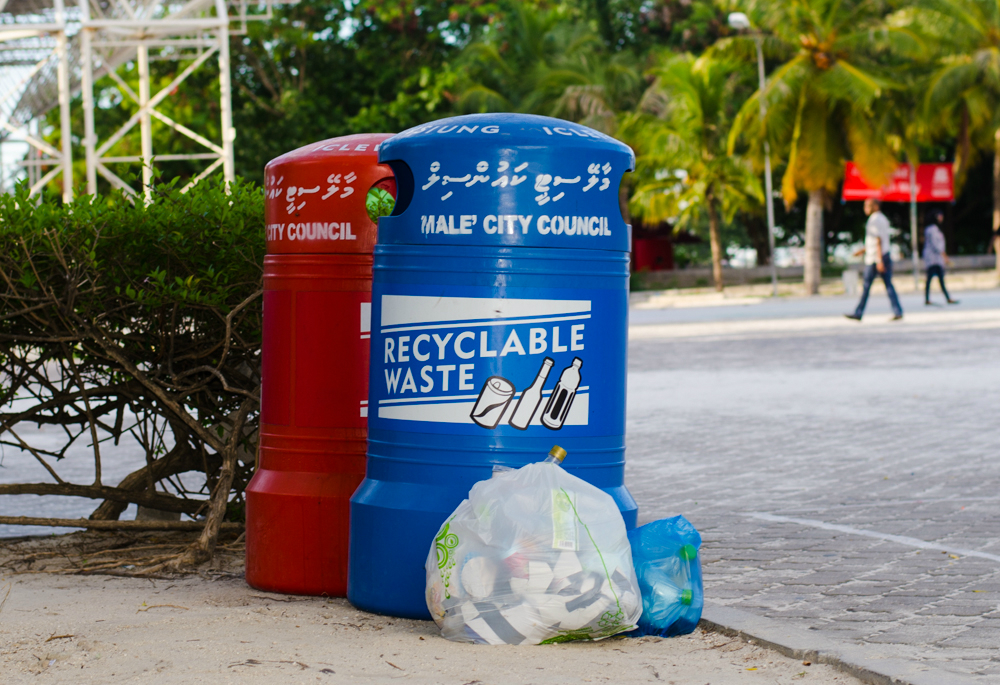
Meanwhile, some locals continue to complain that, while the dustbins placed around Malé for public use are often “difficult” to use.

“Have you even gone near one of those bins? There’s rotting food and fish guts in there. It’s gross. I would much rather toss my soda can near the side of the street then go up to one of those bins,” 18-year-old Hawwah Nashwa opined.

Waheeda Ali, meanwhile, said that the dustbins are “always full that it is not worth the effort to walk a few blocks to find one”.

Mayor Shihab noted that the dustbins are meant for the disposal of waste produced while on the streets, like candy wrappers, soda cans, and so on, and not for household waste.

“People should not be disposing household waste in these bins. It is labelled clearly and people need to be more responsible. Household waste is to be disposed in the barge we have in the harbour for the purpose,” Shihab responded.

Another individual complained about there not being sufficient dustbins in the streets.

“You have to walk a dozen blocks to find one of those. No one is going to go to the trouble, not after a culture of littering has already set in to people’s mindsets,” said Jailam Ali.

“If the council can’t afford to place more dustbins, maybe they should make it mandatory for shops to place dustbins out on the streets near their establishments,” she added.

Mayor Shihab responded to these comments by explaining that too many dustbins has been seen to result in issues with the disposal of household waste.

Referring to this larger issue, Shihab stated that while the council is ready for implementation, the agreement with Tatva Global Renewable Energy remained on hold due to the Finance Ministry’s failure to sign the final approval.

Finance Minister Abdulla Jihad was not responding to calls at the time of press.

Fines for littering

Meanwhile, the EPA began imposing fines on those who litter on the streets of Malé City earlier this month – in accordance with new waste management regulations.

The regulation – which came into partial effect on February 5 – imposes an MVR100 (US$6.5) fine for littering and a fine between MVR10,000 (US$648.5) and MVR100,000 (US$6,485) if any authority in charge of public spaces fails to provide dustbins.

EPA Director General Ibrahim Naeem stated that so far the fine is only being levied against those who litter on streets of the capital. In addition to EPA staff, the police’s Environmental Protection Unit and the council itself are mandated to issue fines.

“We will begin implementing the other fines, and littering fines in other islands, when the councils and other relevant bodies become ready for enforcement. So far, it only applies in Malé,” he said.

Police media confirmed that they had begun implementation of the regulation, but were unable to provide statistics.

While not providing figures either, Naeem assured that many fines have been issued so far, and that positive effects can be seen in areas of Malé, especially around the local markets in Maafannu.

Naeem added that currently most of the fines have been levied against shops and vendors, instead of individuals.

“It’s far easier to fine shops who leave their garbage outside their shops than it is to catch an individual in the act of littering. But that is where we aim to go. We aim to reach the level where a person can be fined for throwing a tissue or cigarette butt on the street,” he continued.

Likes(2)Dislikes(0)