Nasheed proposes constitution change to parliamentary system

The Maldives constitution may have to be amended to address issues arising from the dissolution of the ruling Progressive Coalition, opposition leader and former President Mohamed Nasheed told diplomats in Colombo.

The split between Progressive Party of Maldives (PPM) and the Jumhooree Party (JP) has resulted in a government lacking popular support and will ultimately harm the Maldivian public, he said.

Nasheed called for amending the system of governance from a presidential system to a parliamentary system. He has long argued coalitions could only work in a parliamentary system of government.

The PPM last week announced the dissolution of the ruling coalition after the two parties clashed over control of the speakership in the newly elected People’s Majlis. The vote saw a win for PPM’s Abdulla Maseeh against the JP’s Gasim Ibrahim.

Gasim had won 23.35 percent of the vote in the first round of presidential polls last year, and his backing was crucial for the PPM’s win in the second round. The PPM had gained 29.72 percent of the vote in the first round and narrowly won the election against Nasheed with 51.39 percent.

Nasheed himself required the backing of the JP and a number of smaller parties to win the presidential election of 2008. The coalition led by Nasheed’s Maldivian Democratic Party (MDP) also fell apart shortly after Nasheed assumed power.

Speaking to private broadcaster Raajje TV last week, Nasheed said he would work through the newly elected parliament to amend the constitution and facilitate a transition to a parliamentary system.

The challenges faced in implementing the system of governance dictated by the constitution indicates that the Maldives needs a parliamentary system, Nasheed said.

He said he is ready to work with leader of the PPM and former President Maumoon Abdul Gayoom as well as Gasim to change the constitution.

“It is time for the system of governance in Maldives to be changed into a parliamentary system. When we move to a parliamentary system there won’t be any need to have a cabinet,” said Nasheed.

“The cabinet is very costly, we can cut down that as well [by moving to a parliamentary system]. What I want to say to President Maumoon is to think about how the Maldives have been governed in the past and what happened during the drafting of the constitution,” he was quoted as saying.

Nasheed had raised the same issue during his presidency in July 2010, again citing difficulties in governance. At the time, Nasheed’s MDP controlled a minority in parliament while the then-opposition opposed and blocked several flagship laws.

In response, Nasheed proposed to amend the constitution to either “complete the presidential system” or move to a parliamentary system. He had declared he was ready to go for a re-election following the change if all political parties could reach an agreement on the issue.

Speaking to Minivan News in February, Nasheed said: “Coalitions work in parliamentary systems where you can actually have ministers coming out from the parliament and therefore it’s possible to come to an arrangement. But when the cabinet is not in the parliament, an alliance doesn’t necessarily work.”

“The shuffling or the portions given to different parties are given from the cabinet, and the cabinet is a very superficial layer on the government. The actual essence is the parliament where you make the laws.”

But, Ibrahim ‘Ibra’ Ismail, who was the chairman of the committee responsible for drafting the 2008 Constitution, spoke against the change today, saying the public had already voted for the presidential system in a 2007 referendum and that any change must come through public consultation rather than an agreement between political parties.

“We were unable to reach an agreement on that in 2007, so it was decided that we should go for a public referendum, to let the people decide,” Ibra said.

“The people decided on this matter directly, so I don’t think representatives can change it back. Even if they do it they should consult the public, there should be a public discussion. I don’t think changing in any other way is beneficial for the nation,” he added.

Approximately 62 percent of the public backed the presidential form of governance in 2007. At the time both the MDP and incumbent President Abdulla Yameen’s former party, the Progressive Alliance (now dissolved), supported the parliamentary system while Gayoom supported a presidential system.

While in Colombo, Nasheed met the US ambassador to the Maldives Michele J. Sison, British High Commissioner to the Maldives John Rankin, Australian High Commissioner to the Maldives Robyn Mudie and the French Ambassador to the Maldives Jean-Paul Monchau.

In addition to this he also met International Finance Corporation country manager to the Maldives Adam Sack.

Likes(0)Dislikes(0)

Maldivian asylum seekers assured of prosecution upon return, says President’s Office

Maldivians seeking asylum abroad on grounds of religion or sexuality can be assured of prosecution should they return, says the President’s Office.

“The threat from the state they speak of is in actuality our law and regulations. That will not change,” President’s Office Spokesman Ibrahim Muaz explained.

Muaz’s comments come in response to a story in the New Zealand media that a homosexual Maldivian asylum seeker has become an prize-winning drag queen in Wellington.

Abraham Naim told the Dominion Post that he had been granted asylum in 2013 after facing persecution in the Maldives.

The article quotes New Zealand’s Ministry of Business, Innovation, and Employment as stating that Naim was “at risk of serious harm from state agents” and that “there is a real chance of persecution if he returned to the Maldives”.

Naim also told the news website that he has been prey to numerous online threats and hate mail. “My entire existence is controversial,” he said.

Asked to comment on the matter today, Mushrif Musaid (Supervisor) at Ministry of Islamic Affairs Jannath Saeed stated that acts of homosexuality are clearly anti-Islamic and against the country’s laws, and thereby subject to legal action.

“Such acts of homosexuality are haraam in Islam. However, this ministry has not so far received any complaints from anyone claiming to be a persecuted homosexual,” said Jannath.

“We will need to check if the ministry has issued any threats or statements against a homosexual. The fact remains that such an act is without doubt against Islam,” he commented.

Ministry of Foreign Affairs Media Official Zaaid Ahmed stated that he would comment on the matter on a future date after consulting with the relevant officials in the ministry.

Speaking on the issue of Maldivian asylum seekers last month, President Abdulla Yameen referred to the act of leaving the Maldives as “treason”, though he suggested those who returned would be welcomed.

“If they want to leave the shelter of Maldives, we say, you are welcome, go somewhere else. But if they want to come back to the Maldives, we will again say, welcome back to the Maldives,” said the president.

“Too much to lose”

Spokesman Muaz told Minivan News today that instances of Maldivian youth committing criminal acts under the protection of foreign states had been seen before.

“No one can get away with committing such acts for as long as they are using a Maldivian identity card or passport,” he added.

In his interview with the Dominion Post, Naim – who performs under the name Medulla Oblongata – explained that he had been disowned by his father.

“I’m definitely in a better place now,” he told the paper.

Speaking with other Maldivians currently living abroad for reasons related to their sexuality, Minivan News was told that most preferred to refrain from publicly revealing their sexuality as there was “too much to lose”.

Some said it would be difficult to get employment, while others spoke of being ostracised from society, fearing the repercussion their families might face.

“I prefer to stay quiet about it in my country of origin and instead live elsewhere where I can live comfortably with my sexuality. I’d lose everything from my family connections to friends if I come out,” said 23-year-old Ahmed Matheen*.

Moosa Farih* suggested that the situation for gay Maldivians had deteriorated in recent times.

“Until now, Maldivian LGBT have been largely left alone, but I feel that the focus has gradually been shifting onto us lately, and this is because there is increasing number of people who are trying hard to create the platform for our voices to be heard.”

“I am glad that Naim is out there spearheading this change. In Islam, there is no compulsion in religion, but that is never practiced. If the government and the people of Maldives wanted LGBT to be out of their system, asylum seekers shouldn’t be threatened with extradition and prosecution,” said Farih.

One 28-year-old Maldivian man, still living in n the capital Malé said that only a few “trusted persons” were aware of his sexuality.

“I could easily seek asylum elsewhere, but the point is, my life does not revolve around my sexuality,” he said.

“Yes, I am homosexual. But that is just an unavoidable fact like the colour of my eyes or my skin tone.

I’d rather keep it secret and live here and achieve my dreams of working to make this country a better, more progressive place,” he said, on account of anonymity.

*Names changed on request

Likes(1)Dislikes(0)

Amnesty International urges Maldives to investigate brutality at Anbaraa

Amnesty International has urged the Maldives to investigate allegations of police brutality during a raid on a music festival on Anbaraa Island in April.

Although police claimed they carried out the raid on suspicion of drug abuse, their actions on Anbaraa seems to have been focused on stopping the festival and forcing women to cover themselves up, said Amnesty.

The organisation highlighted claims of unnecessary force, arbitrary arrest of 79 festival goers on alleged possession and use of drugs, ill treatment of detainees in police custody and denial of rights to freedom of assembly and freedom of expression.

Festival participants told Amnesty that the police manhandled many of them, verbally abused them, threw them to the ground, and forced them to lie face down.

Police also ransacked and looted their belongings, said festival-goers. Some detainees were beaten up while other suffered sexual harassment, Amnesty was told.

The Police Integrity Commission (PIC) said it has not received any requests to investigate police brutality during the festival.

Police were not responding to calls at the time of press.

Arbitrary arrest

Of the 200 festivalgoers, police only arrested 79 – including 19 women and a 17-year-old girl. The rest were set free.

It was only in remand hearings that the detainees learned they had been taken into custody for the possession and use of drugs.

Contrary to police statements that all detainees had tested positive for drugs at the time of arrest, drug tests were only performed after the court hearings at the Dhoonidhoo detention center, Amnesty said.

“The police said they raided the Anbaraa festival because the participants were using drugs. However, the delay in carrying out drug tests, and the fact no one has been charged with any offence, raises concern that this was only a pretext.”

The raid occurred despite approval from the authorities including the Ministry of Tourism to hold the festival, Amnesty said.

“However, in the very early hours of 20 April, the police raided the island from the sea in full riot gear and masks, shot off flares and rubber bullets and rounded up festival goers,” Amnesty’s statement said.

The organisation reminded the Maldives Police Service that law enforcement officials shall “as far as possible apply nonviolent means before resorting to the use of force and firearms” as per UN basic principles number four on use of force and firearms.

Festivalgoers told Amnesty that officers beat them up when asked to explain why they were being arrested.

One participant told Amnesty that she was kicked hard in the back by a policeman for not putting her hands up when ordered to, because in a state of shock she did not know what she was supposed to do.

Police officers also used pepper spray without provocation, they said.

Sexual abuse

Female participants told Amnesty of sexual abuse and humiliation. Police officers allegedly told female detainees they would “shove their batons up them.”

Another woman recounted: “We were separated from the men and then the police draped the women, some of whom were wearing shorts and shirts, with material because they said we were not decent.”

“They also filmed us. They meant to humiliate us and refused to say why we had been arrested. We spent the night in handcuffs, with little water and no food until morning,” she continued.

Police action seems to have focused on forcing women to cover themselves up, Amnesty said.

“Although there are no laws banning music in the Maldives and Islamic dress is not mandatory, police action appears to have focused on stopping the music festival and forcing women wearing skirts and shirts to cover themselves,” the statement said.

The last of the three Maldivians in custody were transferred to house arrest on June 2. A Malaysian national is still at the Dhoonidhoo Detention Center, Amnesty said.

Amnesty International has called attention to the police’s frequent use of excessive force against demonstrators, especially in the aftermath of the controversial transfer of power in February 2012.

A previous version of this article incorrectly said five of the Anbaraa detainees are still in custody.

Likes(0)Dislikes(0)

EU elections observers recommend legislation to improve future polls

The European Union’s Election Observation Mission (EOM) has recommended the Maldives take steps to clarify jurisdictional overlaps and to ensure the transparency of campaign finance.

“Our recommendations are focused on improving the environment for the next elections here in the Maldives,” said Chief Observer Edward Kukan.

“They are potential solutions, cornerstones for debate,” he added.

Presenting the final report of the mission conducted during the Majlis elections in march, the observers also advised further efforts to reduce vote buying and to guarantee secrecy of the vote.

As well as highlighting Supreme Court “interference” in the electoral process, the EU mission suggested that the dismissal of senior elections commissioners less than two weeks prior to polling violated both the constitution and the Elections Commission Act.

“Legislation should clearly define the division of the competencies of the courts, the Election Commission, the police and the Anti-Corruption Commission during the electoral process,” read the report.

The EOM also noted the lack of clarity surrounding the legal validity of the 16-point guidelines introduced by the Supreme Court during last year’s presidential elections.

“These guidelines did not appear to improve the elections process and they were not always practical or implementable.”

The mission – which also conducted media monitoring – called for an amendment to Article 27 of the constitution, which relates to freedom of expression that is not deemed contrary to the tenets of Islam.

The report recommended changing the article to bring it into alignment with the Maldives commitments under the International Covenant on Civil and Political Rights (ICCPR).

Article 19 of the ICCPR calls for everyone to have the freedom to “seek, receive and impart information and ideas of all kinds, regardless of frontiers, either orally, in writing or in print.”

Additional recommendations made by the group included greater efforts to promote the participation of women, whom the report described as being “acutely under-represented in public life”.

The decrease in the percentage of female MPs elected in March was viewed in the report of growing conservatism and de facto discrimination across society.

Securing votes

Following suggestions of local civil society that the fairness of the poll had been threatened by ‘money politics’, today’s report called for the overhaul of campaign finance rules.

“The area of campaign finance is insufficiently regulated and there were widespread allegations that over-spending as well as vote-buying were common practice.”

Regulations regarding “third party spending and in-kind” contributions” ought to be implemented, said the mission, while there should be an effort to minimise the use of state resources and a moratorium on candidates’ opening public works during campaigning.

Mission members noted that road construction projects were inaugurated in Addu atoll in the presence of President Abdulla Yameen and Progressive Party of Maldives candidates – a task normally reserved for the city council.

“Numerous reports of excessive campaign expenditure, as well as abuse of state resources, suggest the playing field was not level.”

Observers noted receiving reports of widespread vote-buying, threats, and bribery – these included the distribution of TVs and washing machines, scholarships, loans, and medical treatments.

Representatives of all parties aired allegations of endemic corruption following the March 22 vote, which saw pro-government parties win a handsome majority

It was also noted that the deadline for the declaration of campaign spending by candidates currently comes 14 days after period for legally challenging results expires.

Further recommendations made today included measures to protect the secrecy of small numbers of voters casting their ballots outside of their constituency.

The report argued that people should be allowed to register as voters in the constituencies in which they permanently reside in order to be effectively represented by their MP. Currently, Maldivian citizens are permanently registered on the island on which they were born.

With regards to the media environment, the mission suggested a merger between the Media Council and the Broadcasting Commission in order to provide a “clear delineation of responsibilities” for oversight during future elections.

The EU’s mission involved 30 observers from 16 EU member states, observing the entire electoral process including the legal framework, campaigning, media conduct, voting, ballot counting, and the general electoral environment.

Likes(0)Dislikes(0)

Doctor at Fuvahmulah Hospital refuses to deliver stillborn baby

A doctor at Fuvahmulah Hospital has refused to do C-section surgery on a nine-months pregnant woman whose baby had died in the womb.

The gynecologist refused to do a cesarean, saying she was not ready to take the risk as there was no surgeon or a pediatrician present, local media has reported.

A relative of the patient told Haveeru that they were now waiting for her to give birth naturally as the hospital does not have obstetric gel which is required to ease birth in such situations.

The Ministry of Health and Gender is currently investigating both incidents, telling the press that it would not comment before it had finished.

Citing the family member, Haveeru reported that the patient was first taken to the hospital after she started having labour pains and was immediately taken into the labour room around 10:45pm on May 31.

The hospital reported the next day that both the baby and the mother were in good health, said the relative.

“And this evening (June 1) around 5:30pm, the doctor came out of the labour room and suddenly said the baby has died. According to the doctor the baby’s heart beat went too low. They didn’t provide any further information,” they added.

According to local media reports the female doctor, a Pakistani national who joined the hospital four months ago, is the only gynecologist working at the hospital and had been involved in a similar incident the previous evening.

Media reported that the doctor had refused to do cesarean surgery on a 25-year-old woman brought into the hospital, stating that she was scared to go ahead with it.

Reports say that after making an incision into the patient,  the doctor then sewed it up before the woman was transferred to Hithadhoo regional hospital in the neighbouring atoll for delivery.

Meanwhile, opposition Maldivian Democratic Party MP Rozaina Adam has today submitted a medical negligence bill to the parliament stating it to be “very important in light of the current medical situation in the Maldives”.

Rozaina told Minivan News that the bill, drafted in 2011, was delayed as she was awaiting both comments and two other bills from the Health Ministry, which medical professionals had told her would complement her proposed legislation.

Following the transfusion of HIV positive blood to a patient due to a technical error at IGMH earlier this year, Rozaina opted to submit the bill without the ministry’s comments.

“We didnt receive any comment from the gender ministry, earlier they said this bill has to come with legislation concerning health professionals and with health services,” explained the Addu Meedhoo MP.

“But three years has passed waiting for their comments, so I decided to submit it – especially considering that such incidents are taking place. From the perspective of patients this cannot be delayed, and I think the government will speed up the other bills once this bill is in the Majlis,” said Rozaina.

Likes(0)Dislikes(0)

18th Majlis prepares to review procedures and form standing committees

Parliament began regular sittings today, with reviewing the rules of procedure and constituting standing committees the first orders of business.

“This will be a Majlis that produces results. We will debate and discuss. But it will be done to produce results,” said newly elected Speaker Abdulla Maseeh Mohamed.

A proposal by Maseeh to form a five-member select committee to draft standing orders, and to follow the rules used by the outgoing parliament in the interim, was approved with unanimous consent of 72 MPs.

Mohamed ‘Kutti’ Nasheed from the ruling Progressive Party of Maldives (PPM), Ahmed Amir from the Maldives Development Alliance (MDA), Anara Naeem from the Adhaalath Party (AP), Hussain Mohamed from the Jumhooree Party (JP), and Mariya Ahmed Didi from the opposition Maldivian Democratic Party (MDP) were chosen for the select committee.

Article 88(a) of the constitution states that parliament shall “determine and control its administrative arrangements, hiring and firing of employees, determination of salaries of employees, and manage all matters concerning the sittings of the People’s Majlis. The People’s Majlis shall make regulations concerning these matters.”

The article also requires parliament to “make regulations and principles concerning its business, with due regard to representative and participatory democracy, accountability, transparency and public involvement. Such regulations may include rules of decorum and attendance requirements, and, subject to the consent of two-thirds of the members, may provide for non-payment of salary and allowances.”

A second five-member select committee – consisting of Riyaz Rasheed from the PPM, Gasim Ibrahim from the JP, Ali Mauroof from the MDA, Anara Naeem from the AP and Ali Azim from the MDP – was meanwhile formed to constitute the 13 standing committees of parliament.

Parliamentary rules dictate proportional representation for political parties in the standing committees based on the number of MPs in each party. The rules stipulate that the committees must be constituted within two weeks of the session beginning.

The 13 standing committees includes four committees dealing with affairs of parliament in addition to nine oversight committees.

Both select committees formed at today’s sitting held their first meetings today, electing chairs and deputy chairs.

Mohamed Nasheed and Anara Naeem were elected chair and deputy chair, respectively, of the committee selected to review the regulations. Riyaz Rasheed was elected chair of the select committee formed to constitute standing committees while Anara Naeem was elected deputy chair.

After adopting committee rules, Chair Riyaz Rasheed requested that political parties notify the committee of the number of its MPs as well as any changes to party affiliation.

The ruling PPM is the majority party in the 18th People’s Majlis with 38 MPs while the opposition MDP is the minority party with 25 MPs.

The PPM-MDA coalition has 43 MPs while former coalition partner JP has 15 MPs. The religious conservative AP has one MP while Madaveli MP Muaz Mohamed Rasheed remains the sole independent.

Speaker Maseeh meanwhile commenced his first sitting in the speaker’s chair with an appeal for all MPs to provide assistance and cooperate for fulfilling parliament’s constitutional responsibilities.

The veteran PPM MP said he was mindful of the challenges parliament would face as well as the considerable amount of work to be done, adding that the current parliament had the “capacity” to fulfil its duties.

Likes(0)Dislikes(0)

Comment: Does this government support Maldivian jihadists in Syria?

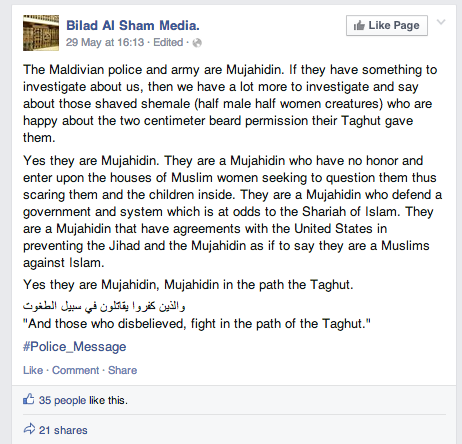
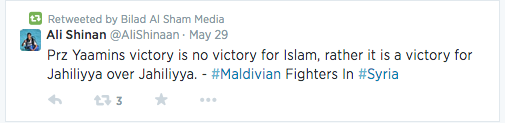
In the last week two Maldivians died in the Syrian conflict. About twenty more are fighting in the war. The news was brought to local papers by a group calling itself Bilad Al Sham Media, which insists furiously that it is run by a group of Maldivians based ‘in Syria, not in the Maldives’.

Bilad Al Sham refers to what is known as Greater Syria, currently the main attraction for the world’s jihadis who are lured to the conflict by what many believe is a divine promise that jihad there ‘will set the stage for the emergence of the true Islamic state’.

According to the Lebanon-based newspaper Al-Akhbar, the various nationalities currently fighting in Syria—Lebanese, Jordanians, Iraqis, Palestinians, Kuwaitis, Tunisians, Libyans, Saudis, Yemenis, Afghans and Pakistanis—are divided among many factions and schools of thought.

Three among them espouse the most hardline takfiri ideology – al-Qaeda’s Abdullah Azzam Brigades, the Doura Fighting Group, and the Jabhat al-Nusra li-Bilad al-Sham. The Bilad Al Sham Media group, which appears to have been set up for the purpose of publicising the activities of Maldivian ‘jihadis’, has confirmed that the Maldivians are with Jabhat al-Nusra, the deadliest of the three.

Al-Nusra first announced its existence in January 2012, pledged allegiance to al-Qaeda in 2013 and in April 2014, started its own weapons factory. To remove any doubt about Maldivian fighters being affiliated with Jabhat Al-Nusra, Bilad Al Sham Media posted an Al-Nusra issued identity card which it says belonged to the second Maldivian who died in the conflict. Affiliation with Al-Nusra is a matter of great pride for them.

Bilad Al Sham Media has a strong online presence—it has a Facebook page, a Twitter handle, a YouTube channel, and a blog. The group is making full use of all the platforms to bring detailed news of their activities in Syria to the Maldivian public. According to its Facebook page discussions with followers, the decision to go public was not made lightly. It was aware that being out in the open could mean that future jihadists would find it more difficult to leave the country and join others in Syria as authorities crack-down on them. But, in the end, it decided that the gains of going public — calling others to ‘Jihad’ and attracting them to their cause — far out-weighed the potential harm.

Bilad Al Sham Media appears to have been spot on in its calculations – they have got a far bigger response from their followers and wanna-be jihadis than from the government. Whereas the glorification of their ‘martyrdom’ has increased with the publicity, the government response has been virtually non-existent.

Maldivian jihadists, it appears, have nothing to fear from this government. In fact, the government appears to be tacitly condoning the whole enterprise if not actively encouraging it.

Bilad Al Sham Media warned the police not to investigate them, and instructed the Islamic Ministry to stay out of it.

Government’s response

The Islamic Ministry is following the instructions to a tee. Minister Sheikh Shaheem Ali Saeed responded to news of the Maldivian suicide bomber by saying that while he personally disapproved of Maldivians fighting in wars abroad, the Islamic Ministry itself had nothing to say on the matter.

President Yameen, meanwhile, has come out with a statement that makes suicide bombing in Syria sound similar to a minor transgression such as throwing some rubbish on the streets of Singapore where there are strict regulations against such behaviour.

Yameen said that the government had always urged Maldivians to maintain discipline abroad, adding that the responsibility for any crime wilfully committed by an individual must be borne by the individual himself.

Bilad Al Sham Media has made it clear that Maldivians in Syria are well trained fighters killing in the name of God – not ‘a family of Maldivians’ who, while travelling abroad, have somehow found themselves in a bit of a kerfuffle in Syria, as Yameen appears to suggest.

The rest of the president’s utterances on the subject, offering financial assistance to the fighters if they have found themselves stuck in Syria, smacks of someone who is totally ignorant of the phenomenon of violent radicalisation or is having a private laugh about it.

Does the government’s astonishingly blasé attitude to one of the most pressing security concerns in the world today stem from ignorance, or is it calculated? Is the government deliberately turning a blind eye to the radicalistion—both violent and non-violent—of Maldivians? Does it consider the ‘jihadists’ to be engaged in a Holy War to protect Islam?

Its actions, or lack of them, since the news broke certainly suggests this to be the case.

Most people were still reeling from the shocking news of the Maldivians killing and being killed in Syria when the national Martyr’s Day rolled around on Friday, 30 May. The death of the second Maldivian had been announced only three days before. Bilad Al Sham Media was busy putting out statements promoting their deaths as martyrdom, a jihad for Islam, when Foreign Minister Dunya Maumoon addressed the nation on the occasion of Martyr’s Day.

Shockingly, in all the talk of martyrdom, she had nothing to say about the Maldivians dying in Syria. Still conspicuously not remarking on the Syrian ‘jihadis’, she defined martyrdom as ‘loss of one’s life from an attack by the enemy in a jihadi war being fought for religion and for the country’s freedom’. She later said, ‘if we were to lose our lives during a sincere effort to protect our country’s sovereignty, that death will without a doubt be martyrdom.’

Support?

There was no such clarification of whether or not the government considers those killing themselves and others in Syria fits into her definition of martyrs for religion.

Other government officials were even more vague. Here is, for example, Vice President Mohamed Jameel Ahmed’s tweet to mark the occasion:

Which martyrs is he speaking of? The Maldivians ones of days long gone who died fighting for the country’s freedom, or the self-proclaimed jihadis killing and being killed in Syria?

Never the sort to waste an occasion for nationalistic rhetoric, on Saturday evening the government held an official ceremony to mark Martyr’s Day. As Chief Guest, Home Minister Umar Naseer added to the ambiguity. He focused on the changed nature of modern warfare, saying that days of fighting with swords and guns are long gone.

Today’s war, he said, is ideological – what is under attack are ‘how people think of their countries, and their religion.’ There was no mention of whether or not he, or the government, considers Maldivian ‘jihadis’ fighting in the Syrian war as soldiers in that ideological war.

Added to this recurring ambiguity is total inaction. Although it is the Maldives Police Service (MPS) which has a dedicated counter-terrorism department, recent media reports have quoted the police as saying Maldives National Defence Force is responsible. In this case, however, the buck seems to have been passed to MPS.

Bilad Al Sham Media, which has warned the police that probing into their activities is anti-Islamic, is right not to be too concerned. The MPS was unable to identify Justice Abdulla Hameed from the leaked sex videos despite his identity being obvious to the naked eye. And, it was only in last October that the MPS Counter-terrorism chief flew to London with a ballot box for the presidential election and disappeared only to be found when he posted pictures of himself at an Arsenal football match.

In addition to the cluelessness, it is not just Bilad Al Sham Media that is warning police that investigating their ‘jihad’ is anti-Islamic.

Screen Shot 2014-05-31 at 7.46.53 PM

They were recently told the same thing by hardline Salafi preacher Sheikh Adam Shameem Ibrahim (of Andalus fameselected by the government to address the police on the occasion of Martyr’s Day. What he had to say to the police is not the least bit surprising. He recast national heroes of history in today’s Islamist terms— ‘Mujahedin who had martyred for Islam’ and the country.

He said all police should always be determined to become a martyr, and took pains to tell the force just what a glorious position Islam has for martyrs. Nothing, of course, was said about it being wrong to blow themselves up, and kill others, in the name of Islam in the Islamists’ ‘Holy War.’

The government’s non-action, its sanguine reaction to the news of Maldivians fighting in Syria, its complete lack of any counter-extremism or counter-radicalisation initiatives, its failure to state its position on whether or not it regards the Maldivian fighters who died in Syria as martyrs or not, and its sanctioning of an Islamist preacher to glorify martyrdom to the Maldives Police Service all combine to make a very loud statement — this government tacitly supports Maldivians fighting and killing themselves in the ‘Holy War’ to establish an Islamic state in Syria.

Interesting, given that the jihadists themselves have little respect for it – and we have already had some experience of what Islamists do to governments they have no respect for.

Screen Shot 2014-06-01 at 11.10.19 AM

Likes(0)Dislikes(0)

Poor security measures at fault for cyber attack, say government IT experts

IT experts have suggested that the scale of yesterday’s attack on government sites was due to poor security mechanisms.

Government IT experts have told Minivan News today that the hosting of multiple government sites on a single server was a security concern of which government was aware.

“Shared hosting is cheap, while having a dedicated server could be expensive. So this is a price versus security choice. But even with shared hosting if the server is secured properly it would minimise the risks,” said a cyber security official at one government institution.

Dhiraagu has today confirmed that the 117 websites defaced in yesterday’s cyber attack by a Syrian anti-war group were hosted on a single Dhiraagu server.

The Maldives’ oldest telecommunications company noted that all affected websites were fully restored last night, within twenty four hours of the attack.

“Attacking government websites is a criminal act and this is being investigated by the police now. Such attacks are carried out against many corporations and organisations around the world, even the most secure,” said Dhiraagu Public Relations Executive, Ibrahim Imjad Jaleel.

“Our engineers have assure that assured that security will be upgraded even further to ensure such an incident is not repeated in the future. It is equally important for developers to increase the security features of websites,” he added.

Shared hosting issue previously flagged

IT experts have told Minivan News today that the attack was likely to have been carried out by the manipulation of one or more vulnerable government websites hosted on a single Dhiraagu server.

“It seems that after accessing the server and gaining elevated privileges, the attacker decided to deface the websites. If it was someone with really malicious intentions they could have done more,” explained a local software engineer.

“Defacement is the least of our worries – think about what somebody could do or have probably done already. Load in exploit code on the pages and nobody would notice. It is possible to compromise thousands of Maldivians and offices,” they warned.

The case is now being investigated by the cyber crime division at the Maldives Police Services (MPS).

Ahmed Athif, head of Information & Communication Directorate at MPS said police will conduct an assessment and share the information and recommendations with the National Centre for Information Technology (NCIT) and other relevant authorities.

While he noted that this is the biggest attack of this nature to be carried out against the Maldives government, he said specific details of the case could only be revealed after a thorough investigation.

The NCIT has made no official comments regarding the issue, but a source within the centre today told Minivan News that the shared hosting of sites and other security concerns have frequently been raised during security assessments of government institutions.

In August 2013 the Elections Commission reported that their servers were continuously under attack at the time, while in the same month the Department of National Registration’s (DNR’s) ID card database with political party affiliations was leaked online.

Police later said the database was stolen from an Elections Commission web server after it had been hacked.

In March 2013 the United Nations (Maldives) website was also defaced in order for a hacker to deliver a message saying that securit on their website was insufficient.

Responsibility for yesterday’s attacks was claimed by Dr. SHA6H – an anonymous figure who has claimed to have infiltrated hundreds of similar sites across the globe over the past two years.

“This site has been hacked because of the world’s silence of three years of massacres that occur in Syria and this is still happening,” read the message left on the defaced websites, attributed to a group called the Syrian Revolution Soldiers.

Likes(1)Dislikes(1)

“Invisible war” being waged against nationalism and faith, says home minister

An invisible war is being waged against the Maldives’ nationalism, claimed Minister of Home Affairs Umar Naseer when commemorating Martyr’s Day last Thursday (May 29).

“We are under attack even today, at this very moment, and this minute and second – but in a different way. Today the targets are our thinking, creed, the good views we hold of our nation – the love for the nation, the respect for national history.”

“Today there are great efforts destroy these. This is an invisible war, weapons that cannot be touched,” said Naseer during an event held at the Olympus Theater in Malé.

Martyr’s day has been officially commemorated since 1979, in remembrance of Sultan Ali VI – commonly known as Ali Rasgefaanu – who is said to have died fighting Portuguese invaders in 1558.

The occasion was also observed by the police service, with the controversial Sheikh Adam Shameem Ibrahim advising officers of the importance of martyrdom in Islam.

Additionally, Foreign Minister Dunya Maumoon warned of attempts by outside actors to enslave the nations politically and economically.

Beware of hidden enemies: home minister

The four pillars on which the Maldives stands are the Dhivehi language, Islam, the Dhivehi culture, and independence said the home minister.

Naseer stated that the foundation of Maldivian culture was Islam alongside social values such as respecting elders and women, and showing kindness towards one another.

Naseer requested people be vigilant of anyone who “casts a gaze filled with hatred” towards national properties, land, religion, and peace.

“Today we will have to face such experiences within the Maldives and from abroad. This is today’s war. You will not be martyred in this war, instead you will face death. Thinking and ideologies will be corrupted. The result would be unhappiness in both worlds,” said Naseer.

The home minister’s sentiments were also reflected in Foreign Minister Dunya Maumoon’s statements on the occasion.

Recalling the sacrifices of various national heroes Dunya said that today’s globalised attacks were not waged with guns.

“In today’s world, most of the time we are uncertain about how or from where the enemies attack [us]. Attacks indented to enslave [us] come in many different forms,” said Dunya.

“In today’s world, instead of colonisation countries are being enslaved economically and politically.”

Asking whether a nation dependent on others for its basic needs can be considered independent, Dunya noted the importance of an economically independent Maldives that can protect its religion and identity.

Police commemoration

The Maldives Police Service also held a special parade at Iskandar Koshi on Thursday in order to mark the day.

Chief Guest at the ceremony, attended by Commissioner of Police Hussain Waheed and Deputy Commissioner of Police Ahmed Saudi, was the controversial preacher Sheikh Adam Shameem Ibrahim.

Addressing the police parade, Sheikh Shameem said police officers should always posses the will to be martyred in defending the people and the nation.

Remarking that the country was passed onto the present generation with the hard work of Mujahidin who were martyred in defending Islam and the nation, the sheikh explained the high regard for martyrdom in Islam.

Shameem has recently prayed for the acceptance of the martyrdom of Maldivians killed in the Syrian civil war, stating that anyone who fights to glorify Islam against disbelievers are Mujahideen (Holy warriors).

He also said on his Facebook page that Nusayri (Shiah Muslims) of Syria are disbelievers “worse than Christians and Jews”.

Sheikh Shameem first came to public attention following his ‘mega-lecture’ ‘Andalus‘, during the 2013 presidential elections.

Live broadcasts of this lecture were interrupted by authorities for violating state broadcaster’s guideline, while the opposition Maldivian Democratic Party condemned the lecture accusing Shameem of inciting hatred in order to sway the electorate.

Likes(0)Dislikes(0)