Comment: The enigma of the Adhaalath Party and their radical politics

In the autumn of the first elected democratic government, the Adhaalath Party (AP) brought in major radical reforms and sidelined their original party leadership. The freedom they enjoyed after the 2008 elections became a chance for opportunists among them to seek personal vendettas in politics.

The radicalisation of the AP became most prominent when they gathered on the 23rd of December in 2011 to honour and glorify Allah by becoming the judges of Allah. This reminded me of the assassin who brutally murdered Caliph Ali Ibn Abi Tholib saying, “There is no judge other than Allah” portraying himself as the judge in killing the leader of Muslims.

In a similar fashion, the 23rd December alliance portrayed themselves as judges in becoming the triggermen for ousting their ‘un-Islamic’ president, proclaiming him an infidel. These repercussions were the result of a speech given by President Mohamed Nasheed in Denmark to a predominantly non-Muslim audience regarding the growing fundamentalism of Islam.

The gist of his speech suggested that the way the holy Quran and Prophets words or Hadhith was interpreted by some sheikhs created polarisation among Muslims – a theory widely agreed upon by several Muslim scholars around the world. The radical ideology created by the AP, however, was that they were the only learned Islamic scholars who could glorify Islam – in a country which has been practicing Islam for hundreds of years without any radicalisation or polarisation.

The opposition of Nasheed’s government at the time intelligently utilised the AP as bait in instigating continuous and consistent public strikes, by deceiving the minds of faithful Muslims. The AP was given the role of labelling the government un-Islamic and creating fear among the faithful Muslims that ‘God’s treasured nation’ with one hundred percent Muslims will become a Christian or an atheist nation.

The public became more engaged when small radical groups sponsored by envious politicians came out in public demanding religious freedom. The fall of democracy began with more and more hatred and with the charismatic sheikhs becoming highly pragmatic and vocal against Nasheed -calling him and his regime un-Islamic, accusing him of forming allegiances with Christians and Jews.

The more moderate sheikhs kept their mouths shut and hence did an injustice to naive Islam-loving citizens. One exception was an apolitical sheikh who, through media, spread a silent interpretation in which he claimed the ousting of the leader of a nation who is in Islamic faith is against prophet’s teaching. However, the media turned a blind eye to these words, being more interested in bad news – as bad news is always good news for them.

On the February 7th of 2012 the storm struck and the elected president was ousted. The AP completed their assignment with high distinction. Hence they became powerful and vocal, and got a fair share from the government labelled as a “coup regime” by the Maldivian Democratic Party (MDP).

To most people, the AP was Sheikh Imran, the ‘mighty mouth piece’ of AP who seemingly acts as God’s judge in giving verdicts to defame their opponents as infidels. The people became nostalgic and now could not decide what was right or wrong. The arrogance, pride, and prejudice the sheikh holds against his opponents in fact became so controversial that many in the public came to regard him as a disgrace to Islam. The irony was that no sheikh or learned scholar was able to criticise him. The reality was that most of the learned Islamic scholars were behind the AP, supporting them and looking for opportunities to promote their political careers.

When the time came for parties to prepare for 2013 presidential elections, the AP had a misconception that they were the playmakers in the game, as they believed their high distinction in toppling governments could always change things in their favour. However, the incumbent president was not well convinced and disagreed with them. The opportunists among them demanded large amounts of money according to pundits, which turned off Dr Mohamed Waheed.

This rejection led them to join with Ibrahim Gasim.  They went through the first round with Gasim and were unable to beat the MDP. The obvious second round dragged them to a dilemma and they could not keep their word. It was strange for such people acting on behalf of God and claiming to glorify Islam to show such hypocrisy in their decision-making.

The watchful public then started feeling disgust over the so called truthful, honest, Islam-glorifying sheikhs. The public in fact saw them as unable to make up their mind and lacking in any principles or political ideologies, but rather becoming hitch-hikers and opportunists.

To make matters worse, the AP became much weaker in the new government than they had been under the governance of their arch-rival Nasheed. To their dismay, the old loyal sheikh and classmate of Gayoom – who was cartooned and lampooned by AP sheikhs previously – became their superior in a ministry they had sole control of in the past.

The hitch-hikers finally realised their position when their coalition partners defied their request to allocate some constituents for them to compete for parliament. For them the AP was just a parasite and a pain in their rears. Overwhelmed with lack of support they contested against their partners with the hope of winning over them. However, the already intimidated public rejected their candidates, with the exception of a famous woman with a high reputation for being modest and open minded.

The AP have gradually understood their position in the coalition and have become so weak, they now have to bow down to politicians far more ‘un-Islamic’ than Nasheed. The dilemmas and the enigmas now made them see that ‘There is no judge other than Allah’ and no one can claim to be a judge on behalf of Allah.

The educated elite behind AP want a reform, but regaining public trust is an issue they must overcome. To make matters worse, all major political parties want them to be sidelined as radical fundamentalist Islam is not accepted anywhere in the world, and the supreme leader of the PPM has a powerful aversion to sheikhs. Most of the AP sheikhs also have gone into hiding from public, realising that they had abused a naive public into believing an ideology they created with no basis or principle.

Their arrogance has led several sheikhs allied with them to fall silent and perhaps even to repent for their mistakes in throwing the state in to chaos in the name of Islam. For AP to rise up they need to create a political ideology to play politics equally well with their competitors. The use of Islam, and claiming to be the sole authority of glorifying Islam is no longer a slogan they can sell to public as their competitors now all have equally learned sheikhs with them.

All comment pieces are the sole view of the author and do not reflect the editorial policy of Minivan News. If you would like to write an opinion piece, please send proposals to [email protected]

Likes(0)Dislikes(0)

Police arrest another two suspect in a growing series of child abuse reports

The Maldives Police Service (MPS) yesterday arrested two people suspected of sexually abusing children as the number of cases reported in recent weeks continues to grow.

The latest addition to a series of child abuse arrests in the past weeks saw a 38-year-old man accused of sexually abusing his three-year-old stepdaughter in Hulhudhoo, Seenu atoll.

He was arrested last night from the tourist resort in which he works.

A 51-year-old Indian migrant worker accused of sexually abusing an eleven-year-old boy was also arrested last night from Feeali, in Faafu atoll. Both cases are currently under investigation by the MPS.

While it has been suggested that the rise represents a greater willingness to report existing abuses, the Human Rights Commission (HRCM) has suggested child abuse is rising, urging parents to be more alert.

In the past few weeks, similar incidents across the country have seen police making a number of arrests for alleged abuses including child sex trafficking by a 45-year-old man, and the arrest seven men of age 18 -30 years arrested from Thinadhoo for forcing a 16 year old girl into prostitution

While the cause of this increase has yet to be established, it has been suggested that the current trend may simply reflect an increase in the number of cases being reported – previously, the discussion and reporting of such cases had been considered taboo in the Maldivian community.

Commenting on the issue, Vice President of the HRCM Ahmed Tholal said that the increasing number of child abuses cases is an issue the state should be taken very seriously.

“I believe it is not merely an increase in reporting, I think it is becoming more common. During our trips to twenty two islands around the country for our ongoing National Inquiry on Access to Education for Children with Disabilities , almost in all islands there were cases of physical, mental and sexual abuse of children,” said Tholal.

Other arrests have  included a 44-year-old man arrested for exposing himself to a twelve-year-old to whom he had shown pornography, and the case of a 29-year-old man arrested  from Rasdhoo for sexually abusing a thirteen year old girl.

45 year old man was arrested from Villimalé late last month for sexually abusing his one-year-old daughter and raping two stepdaughters under 12-years of age, while March also saw a 55-year-old man arrested  for abusing an 11-yearold girl.

A number of people have also been sentenced for child abuse during this period including a 78 year old man who was sentenced for ten years imprisonment by the Kulhudhufushi Magistrate court for sexually abusing a seven-year-old on multiple occasions.

An alarming number of child abuse cases have been reported in the past few years, supporting suggestions of widespread child prostitution across the country.

Stating that a special focus needs to be given to the issue, the HRCM’s Tholal said it is important to take a holistic approach in prevention of child abuse.

“Definitely more work needs to be done in many areas including awareness, research and legal protection. One very important thing is for parents to be more responsible in taking care of children,” he said.

“We need to address it legally as well by holding parents accountable for their neglect.”

Likes(0)Dislikes(0)

Losing PPM Majlis candidate asks for police intelligence to prove bribery

The Progressive Party of Maldives (PPM) candidate Ibrahim ‘Hiyaaly’ Rasheed – recent runner-up in the Mid-Hithadhoo constituency seat – has today asked the High Court for police intelligence regarding the bribery allegations he has made.

Rasheed’s lawyer – PPM MP-elect Ibrahim ‘Wadde’ Waheed – is reported to have told the High Court that was unsure whether police intelligence had information regarding bribery involved in this specific poll, though he knew there was evidence of bribery in some races.

Rasheed lost the constituency seat to Maldivian Democratic Party (MDP) candidate Ibrahim Mohamed Didi, who won just over 43 percent of the popular vote.

Wadde alleged that the other two candidates in the Mid-Hithadhoo contest had distributed money and other things as bribes to influence the election, and also that they had withheld the ID cards of constituents.

Wadde had submitted the names of 10 witnesses to prove his client’s allegations that there was bribery involved in the parliamentary elections.

Local media also reported that Ibrahim Mohamed Didi was involved in to the case today, with Didi’s lawyer reportedly telling the court that there were procedures to follow when issues arose regarding elections, before filing a lawsuit at the court.

The judge inquired as to whether Rasheed had filed the complaints with any other institution and his lawyer told the court that he had not.

Ibrahim Mohamed Didi won the Mid-Hithadhoo constituency seat with 1,099 votes. Rasheed got 898 votes, while independent candidate Hussain Solih got 554 votes.

Ibrahim Didi is still facing charges for the controversial military detention of Chief Judge of Criminal Court Abdulla Mohamed in January 2012, though the case has been stalled for over 12 months.

Didi was also the Malé area commander in a special operation conducted by the military ‘Operation Liberty Shield’ to control unrest in Male’ following the arrest of the judge.

On 3 April, the opposition MDP condemned alleged attempts by government-aligned parties to influence voting in the recently held parliamentary elections through coercion and threats.

“The MDP expresses concern and strongly condemns the actions of government-aligned political persons to buy votes, threaten people with losing their jobs, and instruct some voters to make a special marking on ballot papers – thereby compromising the confidentiality of votes cast,” the party said in a statement issued that day.

The MDP accused the ruling parties of threatening that individuals would lose their jobs, and requiring these people to specially mark their ballot paper in order for observers and party representatives to see how the vote was cast.

Following the conclusion of the election, Transparency Maldives stated that while it was well-administered and transparent, “wider issues of money politics threatens to hijack the democratic process”.

On March 27, The Adhaalath Party spokesperson Sheikh Ali Zahir told Minivan News that the party lost many seats it ought to have won in the Majlis elections due to bribery and undue influence from competing candidates on all sides.

“It was really sad that a lot of money transactions were involved in it, it was an obstacle to electing the most capable person to the parliament,’’ Zahir told Minivan News at the time.

Likes(1)Dislikes(0)

Teachers across Maldives take part in ‘black protest’

Teachers across the Maldives have today (April 6) taken part in a ‘black protest’ – wearing black clothes to school – to raise awareness of pay discrepancies and what they see as the state’s failure to improve the education sector.

“This is the first step, we want to draw attention to these issues. For the sake of our students we will go to work until we exhaust all other ways,” said Teachers Association Maldives (TAM) president Athif Abdul Hakeem.

One teacher told Minivan News that the move has come after repeated attempts to work through official channels.

“The reason we are doing this to express our grievances. Our discontentment with salary and allowances, lack of resources and and other issues we face in teaching,” stated Mausoom Saleem of Thaajuddheen School, Malé.

Athif had previously explained to Minivan News that teachers were working overtime without being paid for it.

“Independent institutions haven’t noticed this. If they don’t do this work it could be reflected in their appraisal, and they even fear termination. So they work. But without getting paid for the work,” he said.

Teachers’ overtime allowances have been reduced to just five percent of the basic salary, which on average amounts to less than MVR300 per month. But teachers have complained that school will not run without teachers doing overtime work.

In a letter sent out to schools prior to the protest, the Ministry of Education had said that pamphlets distributed by the TAM consist of false allegations that might create conflict and unrest, it has been reported.

The ministry also stated that since school premises are “dignified”, teachers must not do anything that may have a negative effect on students, reported local media Haveeru.

“Therefore, no one must participate in an an activity encouraged in the documents distributed under the name of Teachers’ Association on April 6. Please inform the teachers working in your institutions accordingly,” the letter was said to have read.

One ministry official with whom Minivan News spoke today denied there was any protest happening, and was unwilling to provide further comment.

Show of solidarity

Saleem – who has worked as a teacher for 10 years, with 8 of those at Thaajuddheen – explained that an estimated 60% of the teachers were taking part in the black protest.

“I don’t think wearing a specific colour to school will have any impact on the students. I believe they will understand that we are doing this for them. This is not just about teachers, this is about the education system.”

Parents, too, he noted were taking part in the protest by dropping off the children today wearing black.

“I think this was a display of solidarity. We are also seeing a lot of pictures [of people wearing black] on social media, with supportive comments.”

Teachers from Thaajuddheen School take part in the 'Black Protest'

Another teacher taking part in the protest– who wishes to stay anonymous – spoke with Minivan News today. The source stated that as well as marking, there are other demanding after school and weekend functions that teachers are expected to work without getting any overtime pay.

“I have never been paid any overtime,” stated the source, who has taught in the Maldives for three and a half years. They gave the example of working the Founder’s Day celebration which took place across many schools and organisations- “we had to work the function and we didn’t have a choice. This was 8 hours work during the day on our day off, with no payment and no choice.”

“I personally don’t have adequate time to plan, I have too many lessons after they recently changed my timetable.” In a previous school, the source stated they had taught for 18 periods per week – that has recently gone up to 31.

Free periods are often time that teachers will use for planning, marking, ensuring children get to their next lessons safely, or after school activites.

“I have 11 free periods, but we also do after-school clubs, I run an extra support class where I teach children for an extra hour after the lesson.”

“I may not be teaching, but these things are not taken into consideration,” the source stated.

TAM President Athif said  in February of this year that meetings with the Education Ministry had resulted only in the promise of more meetings.

“So in late January (2014) we requested to arrange a meeting but there was no response. So sent another letter this month. now we are waiting to discuss our issues. our next step will depend on how that goes,” Athif said.

According to TAM the organisation has 1,500 permanent member and an estimated 4,000 Maldivian teachers across the country who will participate. Recent Civil Service Commission data shows there to be 5,676 teachers in the Maldives – 4,855 of them are locals.

Likes(1)Dislikes(0)

MDP seeking public opinion over party reform

The opposition Maldivian Democratic Party (MDP) has invited its members and the general public to submit suggestions and ideas for reforming and restructuring the party in the wake of electoral defeats in the presidential and parliamentary elections.

The party’s national council last week voted to form a three-member committee to study a reform paper (Dhivehi) submitted by a group of members and collect opinions and ideas for reform.

At a press conference on Thursday, the committee – comprised of MDP Youth Wing Leader Aminath Shauna along with Ali Niyaz and Ahmed Mujthaba – announced that it would be accepting suggestions for a two-week period.

Party members were invited to submit a form (Dhivehi) either to the party office or [email protected].

Alternately, members could use the #tellmdp hashtag of social media or visit the secretariat office in Malé between 11:00pm and 1:00pm and 3:00pm and 4:00pm on weekdays to share their views in person.

Speaking at Thursday’s press conference, Youth Wing Leader Shauna assured members that the committee would not censor or amend any suggestions.

At the end of the two-week period, she said, the committee would compile a report and submit it to the national council.

Shauna noted that the committee also welcomed opinions and ideas from members of the general public who were not registered MDP members.

Niyaz explained that while some suggestions could be approved by the national council by adopting resolutions, other reforms would have to be passed at the next national congress.

The national council decided last week to hold the party’s congress on June 6 and 7. The last congress took place in October 2010.

Among the ideas shared on social media so far, supporters have suggested clearly delineating the role of the chairperson and president or abolishing one of the posts, strengthening the administration of internal elections and primaries to ensure fairness and transparency, improving engagement with the media and increasing involvement of youth.

Likes(0)Dislikes(0)

Thirty percent of cases rejected by Criminal Court in past three months

The Prosecutor General’s Office has revealed that the Criminal Court has rejected 120 out of 383 cases submitted over the past three months.

At a press conference held on today (April 3), Deputy Prosecutor General (PG) Hussain Shameem stated that the total number of cases rejected and returned by the Criminal Court had now reached 435.

The Criminal Court had previously refused to accept new cases from the PG’s office, citing the Majis’s failure to approve a new candidate within the constitutionally stated period after or Ahmed Muiz’s November 2013 resignation.

The backlog of cases pending at the PG’s Office reached 533 as a result of the Criminal Court’s stance, before the court resumed acceptance of cases after a Supreme Court intervention.

Shameem stated today that the Criminal Court has still returned 120 cases since that time.

After the Criminal Court introduced new regulations governing the procedures for submitting cases in February, it subsequently rejected 60 cases forwarded from the PG’s Office, prompting Shameem to accuse the court of usurping powers reserved by the Supreme Court.

Shameem today revealed that one of the justifications given by the court when returning cases is that the accused is not originally from the capital city Malé where the court is located, claiming that hence the jurisdiction therefore falls to the relevant island magistrate court.

Shameem claimed that the Criminal Court can indeed preside over these cases as the crimes were committed in Malé and also because referring the cases to island magistrate courts would five rise to further administrative complications.

“The objective of the law is also to provide services conveniently. This is why the law is in such a way that allows superior courts to preside over all types of cases,” said Shameem.

“However, things are currently not proceeding in a way that fulfills the objective of this law,” Shameem claimed.

He further added that the PG’s Office has again appealed to the Supreme Court to assist in finding a solution to the matter.

According to Shameem, another reason the courts have used in returning cases is the state’s failure to appoint interpreters in cases where there are foreign witnesses.

Shameem explained today that the law states the provision of interpreters to fall under the mandate of the court presiding over the particular case in question.

After disputes with court staff over unpaid overtime, local media reported the court had been forced to curtail working hours due to budgetary restraints.

The deputy PG stated that police had sent 829 cases in the past three months to his office after completion of investigation.

He further revealed that the office had sent 932 cases to various courts in the past three months, adding that 356 other cases were currently prepared to be forwarded to a court after the prosecution’s work has been completed.

According to Shameem, the cases recently submitted include 383 cases forwarded to the Criminal Court, 210 cases submitted to the Drug Court, 22 cases submitted to the Juvenile Court, and 317 cases submitted to various magistrate courts around the country.

Likes(1)Dislikes(0)

MDP accuses government-aligned parties of corruption and bribery in Majlis election

The opposition Maldivian Democratic Party (MDP) has condemned alleged attempts by government-aligned parties to influence voting in the recently held parliamentary elections through coercion and threats.

“The MDP expresses concern and strongly condemns the actions of government-aligned political persons to buy votes, threaten people with losing their jobs, and instruct some voters to make a special marking on ballot papers – thereby compromising the confidentiality of votes cast,” a party statement read.

The party’s allegations are said to be based on what it calls “valid complaints” it has been receiving – actions it beleives constitutes corruption and bribery.

“Furthermore, it is also a breach of law to coerce the revealing of confidential votes, and to act upon such coercion,” the statement continued.

The MDP accused the ruling parties of threatening that individuals would lose their jobs, and requiring these people to specially mark their ballot paper in order for observers and party representatives to see how the vote was cast.

“The recently completed parliamentary elections is one which many citizens claim – and has been proven – to have been tainted by corruption, threats against job security, compromising of the Elections Commissions independence and legal mandate, large amounts of dirty money being used as bribery, and vast cases of vote buying.

The MDP will therefore further investigate these claims and take possible action against them. We further call on the Elections Commission and and other relevant state authorities to look into the matter,” the statement concluded.

The parliamentary elections held on March 22nd were observed by local NGO Transparency Maldives, as well as delegations from the European Union and the Commonwealth.

Following the conclusion of the election, Transparency Maldives stated that while it was well-administered and transparent, “wider issues of money politics threatens to hijack the democratic process”.

As well as previous suggestions of undue influence from the MDP, the Adhaalath Party has also blamed its poor showing on bribery and coercion – accusing both sides of such practices.

“We saw it both from the ruling party and opposition Maldivian Democratic Party but we really did not want to buy votes –  instead we tried to change the way people think,’’ party Spokesperson Ali Zahir told Minivan News last week.

Ruling Progressive Party of Maldives MP Ahmed Nihan and President’s Office Spokersperson Ibrahim Muaz Ali were not responding to calls at the time of press.

Likes(1)Dislikes(0)

President reveals vision for foreign investment at Hulhumalé project launch

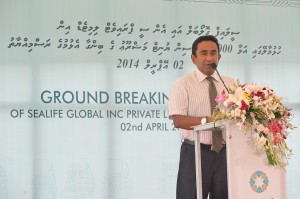
President Abdulla Yameen inaugurated a project yesterday for the construction of 3,000 housing units in Hulhumalé by a joint venture company, Sealife Global Inc – formed by two Dubai companies with a local partner.

Speaking at the groundbreaking ceremony, President Yameen said his administration’s vision was to develop a “youth village” in Hulhumalé with a population of 50,000 people.

“The youth village will not involve only housing [projects]. It will also include other projects related to the youth village such as the creation of light industries to provide job opportunities, as well as arrangements for food and beverages required by modern youth and restaurant facilities for [fast food],” he said.

Yameen said he hoped the government would be able to realise this vision during its five-year term.

During the launch, Yameen also outlined his vision for “freeholds” for foreign investors who will feel the Maldives to be a “second home” in which to conduct long-term projects.

The vision for the youth city meanwhile includes a “technopolis park” as well as entertainment and sports facilities, he said, in addition to facilities for the tourism and fisheries industries.

The government would also prioritise the inclusion of housing projects in Malé and Hulhumalé as the corporate social responsibility (CSR) component when leasing islands for resort development, Yameen said.

Hulhumalé will become “a paradise on earth” for migrants from across the country, he said.

The construction of a bridge between Malé and Hulhumalé would further open up economic opportunities in the reclaimed island city, Yameen said.

In February, Economic Development Minister Mohamed Saeed pledged to complete the bridge project in two years.

Plans of the Housing Development Corporation (HDC) for the second phase of Hulhumalé development were also being revised to achieve the new administration’s goals, Yameen said, which included providing affordable housing to residents of the capital without adequate shelter.

“Any government upon assuming office will attempt to make the best use of a country’s resources. Everything is subject to change. Charts will change when they are redrawn,” he said.

The 243 flats – ranging from one to four bedroom apartments – to be constructed in the first phase of the new project will be targeted to mid to high-income families, explained Sealife Global’s Managing Director Ahmed Moosa.

The six towers or 10 to 12-storey buildings will include other facilities and services such as a swimming pool and gymnasium, he added. The joint venture company would also construct a 12-storey office complex on the site.

“Adventurous path”

Addressing foreign guests in English, President Yameen said he was pleased to “see you actively engaged in our socio-economic development.”

“I hope this project is going to be rewarding in terms of both profitability as well as catering to the need of the Maldivian people,” he added.

The government was committed to “improving the well-being of Maldivian youth,” he continued, adding that youth were presently deprived of the “opportunity to be gainfully employed and also the opportunity of shelter.”

The government therefore welcomes any project that caters to these “dual needs,” he said.

“We are embarking on a very adventurous path at this point in time,” he said, noting that economic development was essential for maintaining the current environment of peace and stability.

“What we would like to confirm for the foreign investors who come to the Maldives is that foreign investors should feel that Maldives is your second home here,” he said, adding that “a landmark law” will be passed in the next Majlis to strengthen the foreign investment regime.

“We are going to open up the Maldives in a huge way to foreign investors. Our thirst cannot be quenched. The opportunity to foreign investors is going to be enormous. So have faith and trust in us,” Yameen said.

Legislation will also be proposed to the next parliament to create special economic zones, he continued, which would be “likened to cities in Dubai or the Emirates” and “the [business] environment we have in Singapore.”

The new laws would enable investors to have “freeholds” in the country and allow investors “to engage in really, really long gestative projects,” he said.

Yameen assured foreign investors that “your money is safe with us.”

“So I reach out to proprietors and investors in Dubai, in Abu Dhabi, in Qatar and also the Emirates – please, here you have an island, here you have a country where you can invest and where you can be content with your investments,” he said.

“We are embarking on an era of growth,” he said, adding that 52 percent of the country’s population was comprised of young people.

Yameen noted that Hulhumale’ was a vision of former President Maumoon Abdul Gayoom.

“He wanted to find breathing space for the overly congested people in Malé. Nobody at that time would have thought that Hulhumalé is going to be the city it is now. There is tremendous opportunity in Maldives and there is tremendous love in us for the Arab-Muslim entrepreneurs. So please come and invest in the Maldives,” he entreated.

Likes(1)Dislikes(0)

ACC seeks prosecutions over Malé City night market contract

The Anti-Corruption Commission (ACC) has asked the Prosecutor General’s (PG) office to press corruption charges against three former Malé City councillors in relation to the 2013 night market.

In addition to former councillors Ibrahim Shuja, Ahmed Hameed ‘Fly’, and Ahmed Samah Rasheed, the ACC asked the PG office to press charges against the council’s Assistant Directors Aishath Jumana Mohamed Rasheed and Ahmed Mizhath Naeem.

The three ex-councillors and senior staff are accused of corruption in the awarding of a contract to Go Media Pvt Ltd to manage last year’s night market. The market is held annually before Ramazan, usually on the south eastern side of the capital island.

In a letter to Malé City Mayor Mohamed Shihab – shared with local media – the ACC explained that Go Media Pvt Ltd was registered eight days before the city council’s announcement seeking a party to organise the night market.

However, the council awarded full marks to the company for experience during its bid evaluation process, the ACC revealed.

While the committee that evaluated the proposal determined that Go Media’s team had experience in organising such events, the ACC noted that the company did not submit any documentation as proof of experience.

Moreover, the council’s request for information document did not state that marks would be awarded for experience.

The two assistant directors were on the committee that evaluated the proposal.

Based on its findings, the ACC concluded that the contract was awarded fraudulently for the benefit of a third party.

The ACC also asked the PG office to prosecute Malé City Council Secretary General Mohamed Anwar as the agreement signed with Go Media included provisions that were not included in the council’s announcement.

Of the three ex-councillors facing corruption charges, Shujau and Hameed were elected on Dhivehi Rayyithunge Party tickets in 2011 before defecting to the Maldivian Democratic Party (MDP) and he Jumhooree Party, respectively. Former Deputy Mayor Samah was elected on an MDP ticket.

Shujau meanwhile contested in last month’s parliamentary elections as the MDP’s candidate for the Galolhu South constituency, losing to incumbent MP Ahmed Mahloof.

Likes(0)Dislikes(0)