High Commission in Dhaka closes due to “unprecedented fiscal problems”

The Maldives High Commission in Bangladesh has closed its operations, with acting high commissioner Ahmed Adil reportedly citing “unprecedented fiscal problems”.

“Even the foreign ministry’s budget has been slashed by 40 percent,” he told the Bangladeshi media. “It’s a very big cut.”

Adil stated that despite the closure, the excellent bilateral relations Maldives and Bangladesh would continue, and that an alternative arrangement would be sought to bridge the absence of a mission in Dhaka.

An unnamed source from the commission also told the Dhaka Tribune that severe budgetary constraints had prompted the shutdown, suggesting that diplomatic services would continue to be provided from New Delhi.

In a comment piece produced earlier this week, former Bangladeshi High Commissioner to the Maldives Professor Selina Mohsin described the decision as a “wrong move”.

“Diplomatic continuity is a necessity and reciprocity is essential to foster good relations with a friendly Saarc state. But countries are not always ruled by rational consideration of advantages, but often by unthinking foolhardiness.

High Commissioner between 2008 and 2010, Mohsin argued that the Dhaka mission played an important role in strengthening the bond between the island nation and Bangladesh.

“Bangladesh has over 70,000 migrant workers in the Maldives – more than from India or Sri Lanka. They face dubious recruitment procedures, their passports are seized by unscrupulous brokers on arrival, and often wages are withheld,” she argued.

Minivan News was awaiting a press release from the Ministry of Foreign Affairs, which failed to be published at the time of press.

A World Bank report produced late last year suggested that excessive state expenditure risked derailing the economy. Over seventy percent of the current budget is allocated for recurrent expenditure.

Similarly, the departing MMA governor urged the government to reduce expenditure. After proposing a record MVR17.95 billion budget in December last year – later passed – the MMA’s published response called for cuts that included a reduction in state apparatus to reflect the country’s size and income.

The Bangladeshi High Commission, opened in 2008, was one of the Maldives’ 13 overseas diplomatic missions. The country currently has embassies in China, Saudi Arabia, and Japan, with high commissions in Sri Lanka, Pakistan, India, Malaysia, Singapore, and the United Kingdom.

The country also has permanent missions representing the country in Brussels, Geneva, and New York.

Estimates of migrant workers currently in the Maldives range from 70,000 to as high as 110,000 with undocumented workers estimated to be as high as 44,000.

Employment trafficking scams and fraudulent recruitment it is nearly impossible to reach a conclusive number.

The Department of Immigration and Emigration recently revealed that, in an effort to curb the numbers of illegal workers, it is strengthening action taken against those who employ or provide housing for undocumented migrant individuals.

It was also revealed that a voluntary repatriation scheme for undocumented workers had seen 4,400 workers out of 5,134 that registered for the programme leaving the Maldives since December.

Likes(1)Dislikes(0)

Anti-money laundering and combating financing of terrorism bill passed

Parliament yesterday passed legislation on anti-money laundering and combating the financing of terrorism (AML/CFT) following review by the national security committee.

All 53 MPs in attendance at yesterday’s sitting voted in favour of passing the bill.

Presenting the committee report (Dhivehi) to the Majlis floor, MP ‘Reeko’ Moosa Manik, chair of the national security committee, explained that the legislation introduces rules governing financial transactions and the inflow and outflow of money from the Maldives.

The bill will also address the persisting dollar shortage, the foreign currency black market, and counterfeiting of dollars, Moosa added.

Moreover, a limit would be placed on the amount of cash that can be taken out of the country, which has to be declared to customs, the opposition Maldivian Democratic Party MP said.

The new law would also benefit investors as it would inspire confidence in the legal system and offer security to foreign investments, Moosa said.

In the ensuing debate, Jumhooree Party Leader Gasim Ibrahim contended that the parallel market for dollars sprang up as a result of the Maldives Monetary Authority (MMA) not allowing the price of dollars to fluctuate.

Gasim suggested that the economy suffered adverse effects due to discrepancies between monetary and fiscal policy.

“Negative consequences”

Moosa noted that noted that a high-level delegation from the Asia/Pacific Group on Money Laundering (APG) had urged MPs to expedite the passage of the legislation.

MPs were warned of “negative consequences” such as restrictions in conducting international financial transactions and credit card transactions as well as transferring money to overseas bank accounts should the bill not be passed before June.

In a meeting with committee members in February, APG Co-chair Andrew Colvin warned that the organisation along with the Financial Action Task Force (FATF) “would be left with little option but to take certain measures that would be negative for the Maldives” should the legislation not be passed.

APG Executive Secretary Dr Gordon Hook noted that implementing AML/CFT laws was “an obligation that the Maldives undertook voluntarily when you joined the APG in 2008″ as a condition of membership.

“There are 41 countries in the APG. They include every country in the Asia/Pacific region with the exception of North Korea and three tiny Pacific states. Among those 41 countries of which Maldives is a member, you are the only country without a comprehensive AML/CFT framework,” he observed.

The anti-money laundering bill was submitted to parliament in late 2013 and sent to the national security committee for further review.

The absence of legislation “makes Maldives very vulnerable to money laundering and terrorist financing,” Dr Hook said.

He added that the vulnerabilities were identified by the International Monetary Fund (IMF) in a report prepared in 2011.

MMA Assistant Governor Neeza Imad meanwhile told MPs that the Maldives received a very low rating in an assessment by the APG in 2011, after which the central bank began drafting legislation on AML/CFT.

Technical assistance was provided by the APG and the IMF, she noted.

Countries that are listed by the APG for non-compliance with its standards on AML/CFT face “hindrances” in securing foreign direct investment, opening accounts overseas, and conducting international financial transactions, Neeza said.

Likes(0)Dislikes(0)

HRCM members summoned to Juvenile Court again over confidential report

With additional reporting by Ahmed Nazeer

Members of the Maldives Human Rights Commission (HRCM) refused to attend a Juvenile Court meeting yesterday (April 1), after having asked the Supreme Court to rule on the legitimacy of the court’s actions.

The commission has contended that the Juvenile Court is in violation of “the legal principles and procedures followed in contempt of court cases.”

A press statement from HRCM released yesterday evening noted that the Prosecutor General’s Office had not charged the commission with contempt of court because only the Supreme Court could initiate such cases of its own accord.

Deputy Prosecutor General Hussain Shameem has told Haveeru that the court does not have the authority to summon HRCM members over contempt of court charges.

The court has been requesting the meetings in order to question HRCM members about a confidential report concerning the sentencing of a 15 year old rape victim to flogging and house arrest in 2012.

”We are trying to summon the HRCM members regarding a report they sent to the Juvenile Court on 5 December 2013, in which the HRCM has included false information about the Juvenile Court and it also contained things that could be considered as an attempt to influence the court’s work,” Juvenile Court Spokesperson Zaima Nasheed told Minivan News today.

Zaima has argued previously that the constitution states no public officials can “interfere with and influence the functions of the courts”, instead they must “assist and protect the courts to ensure the independence, eminence, dignity, impartiality, accessibility and effectiveness of the courts.”

The HRCM press release added that the report referred to in the media was a confidential document, which had only been shared with relevant authorities or state institutions.

“We assure that the report does not include any false statements that hold the Juvenile Court in contempt,” the press release stated.

Previous meetings

After refusing to attend the meeting yesterday, the Juvenile Court sent an official court summons  for today (April 2) to each individual commission member, according to local media.

Following the official court summons, the HRCM members appeared before the court this morning at 10am and were told to respond in writing before 3pm.

The HRCM was first summoned to the Juvenile Court on March 12, with a further request to meet made on March 17 after members failed to accede to the previous requests – all five members of the HRCM subsequently attended on March 17.

The HRCM is reported to have agreed to cooperate at this meeting, on the condition that it was given a period of ten days after the parliamentary elections scheduled for March 22 before the first questioning session.

The 15-year-old rape victim from the island of Feydhoo in Shaviyani Atoll was convicted of premarital sex at the Juvenile Court and sentenced to 100 lashes and eight months of house arrest.

In June 2012, the girl gave birth to a baby that was discovered buried in the outdoor shower area of her home. Her stepfather was later charged with child sexual abuse, possession of pornographic materials and committing premeditated murder.

An official from the Prosecutor General’s Office told Minivan News in January last year that the fornication charges against the minor were related to a separate offence of premarital sex that emerged during the police investigation. The charges were filed on November 25, 2012.

In its verdict, the Juvenile Court ordered the state to transfer the girl to the Children’s Home in Villingili to enforce the sentence of eight months house arrest, according to local media reports.

Following the 15 year-old’s conviction, local NGO Advocating the Rights of Children (ARC) called on the Maldivian government to pass legislation concerning the treatment of sexual abuse victims.

ARC also previously called for reforms of the juvenile justice system and reform of the current protection mechanisms provided to minors who are kept in state run institutions, such as homes and foster programs.

Likes(1)Dislikes(0)

President Yameen grants clemency to 169 convicts

President Abdulla Yameen has granted clemency yesterday to 169 convicts serving banishment, house arrest, or jail sentences.

According to the President’s Office, Yameen granted pardons or commuted sentences in accordance with Article 29 of the Clemency Act.

Some 116 individuals were released on parole with conditions following consideration of “age, health, type of medical treatment, time and circumstance, compassion, and behaviour,” the President’s Office revealed in a statement.

Convicts sentenced for drug abuse would be required to complete rehabilitation programmes, the statement noted.

Moreover, released inmates would be returned to jail to serve out the remainder of their sentences if they violate parole or commit a crime.

Persons convicted of murder, a crime with a punishment (hadd) prescribed in Islamic Shariah, terrorism, child sexual abuse, sexual assault or rape, and homosexuality were not among the 169 released convicts, the President’s Office said.

“In addition to the above-mentioned [exceptions], sentences were commuted based on records from the Maldives Police Service without including persons who could pose a threat to society’s safety and security,” the statement read.

It added that President Yameen had announced his intention to release prisoners at a campaign rally in Fuvahmulah last month.

Home Minister Umar Naseer told Minivan News in the wake of President Yameen’s announcement that the release of inmates would not present any difficulties to ongoing efforts to combat drug trafficking.

“It will not be a hindrance because the present Clemency Act prevents serious offenders from being released. Furthermore, this process will be monitored by the Home Ministry,” he said.

President Yameen also commuted the sentences of 24 inmates in January while his predecessor Dr Mohamed Waheed released 39 convicts during his last days in office.

Article 115 of the constitution states that the president has the authority “to grant pardons or reductions of sentence as provided by law, to persons convicted of a criminal offence who have no further right of appeal.”

On January 9, police cleared or expunged criminal records of 1,023 young persons who were arrested for various criminal offences, as part of the government’s pledge to facilitate youth employment.

“Political stunt”

Following President Yameen’s announcement last month, opposition Maldivian Democratic Party (MDP) Spokesperson Imthiyaz Fahmy described the move as “a very irresponsible political stunt”.

“This is a stunt they are pulling off as elections approach – an act without any form or structure. This is a stunt like they used to pull during the Gayoom administration – as every election nears, they’ll let out numerous prisoners and the streets will be teeming with drug abusers,” the Maafanu North MP said.

Fahmy also defended the release of convicts under the MDP government’s ‘Second Chance Programme,’ which he stressed was “a structured effort, under which applicable prisoners were released under parole to be under the guardianship of a family member.”

They were given training in various skills and were provided with employment opportunities. They were monitored constantly and were taken back in when there is a risk of re-offending crimes.”

“Yameen and the people around him were those who most criticised our ‘Second Chance Programme’. And now look at what they are attempting to do. This clemency plan has no structure and will prove detrimental to the society,” he said.

Vice President Dr Mohamed Jameel Ahmed – who served as Home Minister during the Waheed administration – shut down the ‘Second Chance Programme’ in March 2012, alleging that the MDP government had used it to “release unqualified criminals under political influence and without any clear procedure”.

In July 2012, Jameel blamed a “surge in crime” partly on the ‘Second Chance Programme’, claiming that over 200 convicted criminals released under the scheme had been returned to prison for re-offending.

Jameel also published a comment piece in newspaper Haveeru in September 2011 criticising the programme and emphasising the importance of granting clemency in accordance with the Clemency Act.

Likes(1)Dislikes(0)

Nasheed appointed acting president of MDP as ‘Reeko’ Moosa resigns chairmanship

MP ‘Reeko’ Moosa Manik announced his resignation as chairperson of the opposition Maldivian Democratic Party (MDP) at a meeting of the party’s national council today, which also saw former President Mohamed Nasheed appointed MDP’s acting president.

At the conclusion of today’s meeting, the outgoing chairperson said he decided to resign because he believed in democratic principles, urging other members in the party’s leadership to follow his example.

He added that former President Nasheed was in charge of the MDP’s election campaigns, which were conducted based on “his instructions and under his supervision.”

Moosa assured council members that there was no “negligence” on his part that was to blame for the MDP’s losses.

Today’s meeting was called to discuss restructuring and reforms following electoral defeats in the presidential and parliamentary polls, and to decide a date for the party’s next congress.

MP Moosa Manik announced his resignation at the start of the council meeting in Dharubaaruge this afternoon.

In the wake of the party’s poor performance in the Majlis elections, Nasheed told the press that the leadership should bear responsibility and called for new leaders to take the party’s helm.

The main opposition party fielded 85 candidates and won 26 seats in the March 22 elections, while the ruling Progressive Coalition secured a comfortable majority.

The coalition’s numbers in parliament grew to a two-thirds majority with yesterday’s defection of MDP MP-elect Mohamed Musthafa to the Progressive Party of Maldives.

A resolution to appoint Nasheed acting president was adopted with the support of 47 members out of the 54 in attendance at today’s council meeting.

The post of the MDP’s president has been vacant since the national council removed former party president Dr Ibrahim Didi with a no-confidence vote in April 2012.

The MDP national council today also decided to hold the party’s congress on June 6 and 7.

Among other decisions approved today, the national council voted to form a three-member committee to study reforms (Dhivehi) suggested by a group of party members. The committee consists of Youth Wing President Aminath Shauna, Ali Niyaz, and Ahmed Mujthaba.

A proposal by MP Ahmed Hamza to appoint members to vacant leadership posts within the next six months and a proposal by former National Social Protection Agency Chairman Ibrahim Waheed to make former presidents elected to office on the party’s ticket permanent members of the council were also passed.

Likes(0)Dislikes(0)

Against the current – Turtle conservation in the Maldives

Collecting turtle eggs is still legal and will remain so until at least 2015, according to government regulations, despite recent scientific reports stating that the population of the majority of turtle species is declining.

“We have a moratorium that will end at 2015, then we will look at other measures that we have to take,” explained Minister of Fisheries and Agriculture Dr Mohamed Shainee.

With turtle population numbers declining and some species at serious risk of complete extinction, organisations are working hard to protect turtles from further degradation at the hand of both humans and the environment.

The biggest threat to turtles, according to Sam Hope – Marine Discovery Centre Manager at Four Seasons Kuda Huraa – is egg collection and trade.

“There is a ban on catching and killing turtles in the Maldives, and that has been in places since June 1995, however, there isn’t a ban on egg collection,” stated Hope.

According to the fisheries regulations, the” catching, fishing, collecting or killing” of sea turtles is illegal across the entire country. The collection of sea turtles and eggs is also illegal say the regulations, but this is only applicable to 14 islands out of a possible 1,192.

The continuing secret slaughter of turtles was demonstrated last year after photographic evidence the practice emerged, showing dozens of dead sea turtles loaded onto a dhoni.

More recently, an article by Dr Agnese Mancini – an expert on turtle conservation – reported a decline in the population of  the majority of turtle species found in the Maldives.

Published by the International Union for the Conservation of Nature (IUCN), the report established that while quantitative data on turtle numbers is scattered, the data collected recently from the entire Indian Ocean indicates negative trends in population numbers for all of the species, barring the Olive Ridley species.

Despite these findings, the laws governing the collection of turtle eggs remains the same and will do until at least 2015, stated Dr Shainee.

“Before that we will start planning for the next steps, and increasing our understanding – we will try and get stakeholders on board,” he said.

When asked if he thought the ban on egg collection should cover all islands of the Maldives, Shainee said that all islands would be protected, but that efforts needed to be focused.

“The rest of the islands we will do, but if they are not nesting islands there’s no point in unnecessarily restricting. For those areas that we know, we want to protect.”

Conservation efforts

Protecting endangered sea turtles is vital given the environmental pressures the Maldives already faces – pressures which themselves amplify threats to turtles.

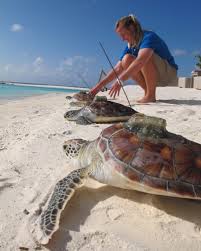
In response to some of these threats, Four Seasons has teamed up with local environmental agency Seamarc to implement a number of valuable conservation programmes across the Maldives – based from their two on-site Marine Discovery Centres.

Among the pair’s successful projects is the ‘Head Start’ programme run from the Kuda Huraa resort – a fledgling project which has shown great potential to help increase the local turtle population.

The likelihood of turtle hatchlings surviving is estimated to be around 150:1, and so marine biologists have been hand-rearing a select few young turtles at the Marine Conservation Centre in order to give them a greater chance of survival.

“Where we do get a hatchling nest, we allow all of them to run down to the sea – because that’s very important for their development – but when they reach the sea we collect just two for our Head Start programme,” explained Hope.

Marine Biologists at the Marine Discovery Centre, Four Seasons

“The Head Start programme is aiming to provide a safe environment so those turtles can go through the early stages of development and avoid those early stages of danger.”

“Because turtles have got a pretty rough deal- anything from ants to rats, cats, seabirds, fish and sharks- its really tough when you’re only 4-5 inches long with no defence techniques at all -apart from looking incredibly cute.”

“So we bring them back here, place them into our pools where we do a weekly check up where we weigh and measure them. The weight is very important to their health, and we’re working hard to understand the sea turtle dietary requirements,” Hope continued.

“When the Head Start gets to 18cm – which takes about 13 months – we put a satellite tracker on their back and we send them out into the big blue. We download from the satellite every two days, and download the data into google maps.”

The tags are semi-permanent, meaning the researchers can see how far the turtles have travelled for up to 10 months.

To date, the Head Start programme has reared and released 37 turtles, with 16 tagged for satellite tracking.

There are a number of resorts which are contributing valuable work to environmental conservation, but in order to push this movement to the next level, Hope notes that the links between resorts and local communities need to be stronger.

“There needs to be more trust between resorts and local communities” he states. “What would really benefit the movement is a bottom up management, led by a greater amount of community work and community led projects.”

Regarding the laws against turtle egg collection, Hope said that it was unlikely all islands are being used for turtle nesting, but admitted there was a dearth of local knowledge which Seamarc was attempting to address with local surveys and community assessments.

“Turtles sometimes switch nesting beaches if the beach condition becomes degraded which means that they may start using unprotected islands in the future if they are not already. Before we can decide on scientific policy we require scientific fact on which we can base decisions.”

“It is our hope that our work will shed more light on the extent of turtle nesting activities in order to further protect these endangered species.”

Likes(2)Dislikes(0)

Foreigners’ enrollment extended while Majlis considers amendments to Pensions Act

The Maldives Pensions Administration Office (MPAO) has extended enrollment for foreign employees onto its retirement pension scheme until May 15 following an amendment introduced in the Majlis earlier this week.

The enrollment of foreign workers into the scheme – mandated by the first amendment to the 2009 Pensions Act – was scheduled for completion today (April 1).

“We had decided that the date of enrollment should be before 1st April 2014, but now there is a proposed amendment to the Pensions Act in the parliament to make it voluntary for foreigners,” said MPAO Director Ismail Sujau.

“We are giving the delay for one and a half months for foreigners to complete their enrollment and also pay the contributions,” he added.

Sujau confirmed that the scheme will require a contribution of seven percent of employees’ earnings, matching a seven percent contribution from their employers.

The collection of contributions will be still be collected by employers before the end of April, to be handed over to the pensions office by May 15 as originally planned, he explained.

The proposed amendment – submitted by Maavah MP Abdul Aziz Jamaal Abubakr earlier this week – has been welcomed by many expatriates who fear they will struggle to reclaim their contributions upon leaving the Maldives.

“My biggest concern is not getting our money back when we leave, and if we do get it back, getting it back in rufiyaa,” said Varsha Patel, a teacher at Lale Youth International School in Malé.

“Why don’t they just call it an income tax rather than pension?” asked former teacher Rachel Evans*, aged 35.

“Nobody is dumb enough to believe we’re ever going to see that money again. It takes six months to get work visas processed. No way will they ever be able -or willing – to refund this pension at the end of a foreigner’s contract,” she added.

After submitting the amendment this week, Abubakr told local media he felt it would be better for both employees and employers to make the scheme voluntary for foreigners.

“Its enforcement may create difficulties for the employee – it may even result in monetary problems. If he can’t attain his money when he is about to leave the country, then he would face many difficulties. That would even be against his rights,” the Maavah MP told Haveeru.

Contribution concerns

Speaking with Minivan News today, Sujau assured that the regulations allowed for the retrieval of funds, but admitted that specific details of the rebate mechanism were yet to be decided upon.

“There has been a lot of concern – we understand that – even when we have had so many public information sessions,” he said.

“We have heard many concerns, especially when they withdraw the funds. We are collecting the funds in Maldivian rufiyaa and definitely we are paying out in Maldivian rufiyaa so they have a concern because local currency they make not be able to take it back and trade. They can only trade to dollars or some other foreign currency.”

Sujau said that the contributions will be transferred to rufiyaa denominated accounts, or given out in cash, though he acknowledged that transfers to foreign currency accounts had not yet been organised.

“That arrangement we have not been able to make yet. This something we will look into as it progresses.”

A heavy import-export imbalance in the Maldives results in a perennial foreign currency shortage, while a dominant tourism sector – which deals almost exclusively in US dollars – results in a weak local currency.

“What’s the point of them refunding a worthless currency when they could just call it an income tax and keep the money”, asked Rachel.

Meanwhile, Varsha – 26 -suggested that employees had been given inadequate notice of the scheme and insufficient information about how to reclaim contributions.

“We were not really given enough notice – I was only told last month. I’m not very happy to be having a pay cut for no reason.”

After the introduction of the 2009 Pensions Act, the initial regulations made no distinction between local and foreign employees – who were both included in the first phase of the scheme for public sector workers, explained Sujau.

However, just prior to the adoption of private sector workers into the scheme in  May 2011, an amendment was passed requiring separate regulations for foreigners to be drafted within 12 months, and for enrollment to be completed within three years.

Regarding complaints about the scheme, Sujau noted that his office was responsible only for the practical application of governmental decisions.

“As far as the MPAO is concerned, we are an implementing agency, we don’t make policy – we just adopt whatever is in the Pension Act and follow,” he said.

*Name changed as individual wished to maintain anonymity

Likes(0)Dislikes(0)

Parliament passes revised penal code

Parliament passed the revised penal code today more than four years after it was resubmitted to the 17th People’s Majlis.

If ratified by the president, the new penal code will replace the existing law that was drafted and enacted in the 1960s.

The new law will come into force one year after ratification and publication in the government gazette.

The revised penal code (Dhivehi) was passed with 48 votes in favour, one against and three abstentions.

The penal code was first put to a vote in December, 2013, after review by a select committee. It was rejected 36-34 with one abstention and returned to the committee.

Parties in the ruling coalition issued a three-line whip to defeat the bill on the grounds that principles of Islamic Shariah law were not adequately reflected in the final draft.

The bill passed today was however the same draft voted on in December with three amendment submitted by an MP. MPs had been required to submit amendments before January 20.

The first draft of the penal code was prepared in 2006 at the request of then-Attorney General Hassan Saeed by Professor Paul Robinson, a legal expert from the University of Pennsylvania.

Following its initial submission to the 16th People’s Majlis in 2006, the draft legislation was resubmitted in late 2009 after the election of the 17th Majlis, where it remained in committee stage until December last year.

Opposition Maldivian Democratic Party MP Ahmed Hamza – chair of the select committee that reviewed the draft legislation – told Minivan News in December that delays in completing the review process was due to the long periods required for seeking commentary and consultation from state institutions such as the Attorney General’s Office and the Islamic Ministry.

During the parliamentary debate in December, MP Ibrahim Muttalib insisted that “no human being has the right to rephrase divine laws in Islamic Sharia into separate articles in a law.”

Progressive Coalition MPs contended that some penalties in the final draft were in conflict with provisions of Shariah law.

Religious conservative Adhaalath Party Sheikh Ilyas Hussain had also previously criticised the bill, claiming that it would “destroy Islam”. Ilyas’ remarks subsequently prompted a parliamentary inquiry.

Likes(0)Dislikes(0)

Majlis committee approves candidates for PIC and MMA, rejects prosecutor general nominee

Parliament’s independent commission’s oversight committee has interviewed and decided upon appointees to the posts of Maldives Monetary Authority (MMA) Governer, and Prosecutor General (PG), as well as a member of the Police Integrity Commission (PIC).

The committee’s Deputy Chair Rozaina Adam told Minivan News that the committee had approved nominees based on a grading scheme, and that each nominee needed to get over 75 percent of marks to be approved.

“Nominees for two of the posts we discussed yesterday received the required percentage of marks, the other didn’t. Approvals are based on a preset grading scheme, and not on members’ opinions,” Rozaina explained.

The committee approved Dr Azeema Adam for the post of Governer at MMA and Aiminath Rukshana to be a member of the five member PIC.

Presidential nominee for the post of Prosecutor General, Maumoon Hameed, did not receive sufficient marks for approval.

Dr Azeema Adam has served at the MMA since 1991. She is currently serving as Assistant Governor and Chief Economist, Monetary Policy, Research and Statistics at the MMA.

Adam has a PhD in Economics from the University of Canberra and a Masters Degree in International Development and Finance from the University of Leicester.

Her nomination for the governors role came after Yameen had previously forwarded the name of Ibthishama Ahmed Saeed, an associate director at the Bank of Maldives, before withdrawing it amid suggestions the candidate was not qualified for the role.

Previous governor, Dr Fazeel Najeeb, resigned in December citing personal reasons – though he urged the government to reduce expenses and refrain from printing money during his final press conference.

Presidential nominee to the police watchdog body, Aiminath Rukshana, also received the required 75 percent marks. Rukshana is originally from Liyaage in Maafannu ward of Malé City.

Presidential nominee to the post of prosecutor general, lawyer Maumoon Hameed was not able to receive the required percentage of votes.

The PG’s position has been vacant since former PG Ahmed Muiz resigned from the post prior to a scheduled no-confidence vote. The duties of the PG are currently being temporarily conducted by Deputy Prosecutor General Hussain Shameem.

After a running dispute with the PG’s Office over the acceptance of cases following the expiry of the constitutionally mandated period for appointing a new PG, the Criminal Court resumed accepting new cases after repeated interventions by the Supreme Court.

President Abdulla Yameen has recently accused the opposition Maldivian Democratic Party – holder of a majority of seats in the oversight committee – of obstructing the government’s attempt to appoint a new PG.

Lawyer Maumoon Hameed is the son of the Gayoom administration’s Atolls Minister Abdulla Hameed, and the nephew of incumbent President Yameen and ruling Progressive Party of Maldives leader Maumoon Abdul Gayoom.

MP Rozaina Adam stated that the committee will present the report on its decision to the parliament speaker on Tuesday.

A final decision on the appointments will be taken through a parliamentary vote. The vote has thus far not been scheduled on agenda.

Likes(1)Dislikes(0)