Youth Minister and spokesperson for former President Gayoom, Mohamed ‘Mundhu’ Hussain Shareef, has hit back against the Dhivehi Rayithunge Party (DRP)’s allegations that the government had not made “adequate efforts” to address the country’s recent economic and political upheavals.
Mundhu’s response followed allegations last week from DRP Deputy Leader Ibrahim ‘Mavota’ Shareef that some top officials in the present coalition government – of which the DRP is one of several parties represented – had not shown themselves to be “capable” or “proficient”.
Speaking to online publication Channel News Maldives, Mundhu said the DRP’s criticism targeted ministries headed by the Progressive Party of the Maldives (PPM) because ministries headed by the DRP had themselves not done sufficient work after the government came into power.
Mundhu also claimed that the criticism leveled against the PPM was with the intention of helping the government sort out its challenges, but was instead a personal attack. He also stated that when Shareef criticised the youth ministry, he did not realise that it was one of the most efficient ministries in the current government.
“If one had looked into Male’ alone, there has been significant progress made since I assumed the position,” Mundhu claimed.
He said that renovations had been brought to the youth centres in Villimale and Galolhu wards, and also the youth center in Hulhumale. He added that maintenance works were being carried out in Maafannu Stadium leveling its ground and fixing the lighting system, and that his ministry had planned further enhancements to the National Stadium as well.
“These are just a few works to date. The Youth Ministry is one of the most efficient ministries since Dr Waheed came to power,” he added.
Mundhu alleged that the DRP had been making up stories “because the ministries that they control are failing.”
“They want to say the government is not functioning properly so they can walk away from the government. President Waheed will know of this,” Mundhu said.
Mundhu was not responding at time of press.
During a press conference held last week, DRP Deputy Leader Ibrahim Shareef expressed particular concern over the conduct of the Foreign Ministry, which he alleged had not sufficiently explained to the international community the current situation in the Maldives since the new government came to power. Both the Foreign Minister and State Minister are from the PPM. State Minister Dunya Maumoon is also Gayoom’s daughter.
Shareef also raised criticised accusations by the Foreign Ministry that the Commonwealth Ministerial Action Group (CMAG) had sided with the now opposition Maldivian Democratic Party (MDP) – a claim he did not agree with.
Shareef told local media that despite the “major achievement” of the coalition remaining in power for its first 100 days, it had been difficult for the DRP to “execute its policies and beliefs” in line with other parties.
He said he was confident that several ministries overseen by DRP representatives, including areas such as finance and tourism, were functioning “efficiently”.
Tempers have been flaring between the two parties, who make up the majority of the now ruling coalition of political parties backing President Mohamed Waheed Hassan. Waheed was sworn in on February 7 after former president Mohamed Nasheed’s controversial resignation.
Vice President of the PPM Umar Naseer has alleged to local media that DRP’s recent criticism of the government was due to their intention to leave the ruling coalition, an argument the DRP has denied to this date.
Speaking to newspaper Haveeru at the time, Naseer accused DRP leader Ahmed Thasmeen Ali of trying to “get things done in his favor” through the present government.
“The DRP is seeking to get a sovereign guarantee to pay off Thasmeen’s debts. As soon as they know it can’t happen, they will break away from the coalition”, Naseer claimed.
However, Shareef denied Naseer’s allegations and accused Naseer of continuously attempting to defame Thasmeen.
“Umar accused Thasmeen and Abdulla Shahid of being involved in the [awarding of the airport] to GMR. If that is so, why aren’t they investigating the matter now that they are in the government? There is never any truth to what [Umar Naseer] says,” Shareef said at the time.
Naseer claimed that PPM deserved more positions in the current government than the DRP, as PPM had played the “most important role” in the transfer of power in February.
“Ninety-nine percent of the anti-government protesters were from PPM. 99 percent of the injured were from PPM. Our members sacrificed the most to change the government. And DRP does not deserve to get an equal number of government positions as PPM,” Naseer said.
Naseer’s comments follow last week’s press conference by the DRP criticising certain government officials and describing them as incompetent.
The Progressive Party of the Maldives formed from a splinter group in the DRP, under the leadership of former president Maumoon Abdul Gayyoom. Gayyoom and Thasmeen came to blows after Gayyoom’s faction alleged that Thasmeen had been running the party through “authoritarian” means.
Convenor of the All Party talks, Ahmed Mujthaba, confirmed at a press conference this morning that party representatives would attend a three-day retreat at Bandos Island Resort from Thursday, to try and reach a consensus on the six-point agenda.
The India-sponsored roadmap talks were put forward to try and break the political deadlock following the controversial ousting of the Maldivian Democratic Party (MDP) on February 7.
Despite stalling several times due to disagreements over the subject and order of the agenda, challenges from the Progressive Party of the Maldives (PPM) over the legality of the MDP’s representation, and the higher profile of the Commission of National Inquiry (CNI) into the circumstances surrounding the change of power, the roadmap talks have continued.
The six items on the agenda on the agenda are, in order:
Discussion on how to solve the problem of public disturbances carried out in the country;
Discussion on assessing the state budget situation;
Discussion on identifying reforms needed for institutions and independent posts;
Discussion on assessing the laws to be amends and new laws to be enacted;
Discussion on amendments to the constitution;
Discussion on determining a date for a presidential election.
The next round of talks had been scheduled at Bandos – a resort owned by Vice President Waheed Deen – to allow the parties to focus on the issues without the distractions of a normal working day, Mujthaba said.
MDP representative at the talks, former Tourism Minister Dr Mariyam Zulfa, said she felt the atmosphere was now conducive towards productive discussion, and said the MDP was trying to get the leaders of all the parties assembled on the final day – “there might be something to sign,” she suggested.
“I think the Commonwealth’s insistence on changing the composition of the Commission of National Inquiry (CNI) has driven home to the government the seriousness of of these talks,” she added.
The original objective of the talks, as put forward by President Mohamed Waheed, was to “restore peace and harmony in the country”, Dr Zulfa noted. “Disruption of peace and harmony was not something that just fell out of the sky. At least a third of the country are upset about the rights that have been taken away from them.”
Deputy Leader and Spokesperson of the Dhivehi Rayithunge Party (DRP) Ibrahim ‘Mavota’ Shareef was not responding at time of press, while Vice President of the PPM Umar Naseer was in Singapore.
UN Mediator Pierre Yves Monett, who is assisting Mujthaba with the talks, also attended the press conference this morning. Mujthaba noted that Monett had been provided with interpreters as the talks would be conducted in Dhivehi.
Approval by parliament’s Finance Committee to three judges occupying state-owned apartments to purchase the flats was granted in violation of the constitution and Judges Act, the Anti-Corruption Commission (ACC) revealed today, informing the committee to review its decision.
A press statement by the ACC explained that it investigated a complaint alleging three senior judges were occupying state-owned apartments while simultaneously receiving living allowances.
“The complaint states that giving flats only to certain judges is giving them unjust privileges,” ACC Deputy Chair Muaviz Rasheed told Minivan News in April.
The three judges living in flats leased during President Maumoon Abdul Gayoom’s administration by the former Justice Ministry and High Court – under terms that would see the now-defunct ministry and High Court gain ownership upon completion of full payment – are Supreme Court Justice Ali Hameed, High Court Judge Ahmed Shareef and Civil Court Judge Abdullah Adheeb.
The three judges had reportedly been paying rent for the flats in the government-owned Sina-Male’ apartment blocks when the committee decided to grant them ownership upon completion of full payment.
According to its statement, the ACC found that the Finance Committee’s decision to register the flats to the judges was in violation of article 102 of the constitution and article 38 of the Judges Act as well as section 100(a)(11) of the parliamentary rules of procedure.
Article 102 of the constitution states that salary and allowances for members of the judiciary and independent commissions shall be determined by the People’s Majlis.
The Finance Committee’s decision – which was not endorsed by a vote on the Majlis floor – was officially communicated to the Judicial Service Commission (JSC) and Department of Judicial Administration (DJA) on February 6 this year.
“If the decision is implemented, the result will be three judges receiving living assistance or additional benefits not afforded to other judges of the court in direct violation of article 39(b) of the Judges Act,” the ACC statement reads.
Article 39(b) of the Judges Act states that judges in the same court shall be given the same amount as living allowances and prohibits “different kinds of living allowance or benefits for different judges.”
Following its investigation, the ACC informed the Finance Committee on May 23 (Wednesday) to review the decision. The financial oversight committee is chaired by People’s Alliance MP Ahmed Nazim, who was cleared of corruption charges in February.
Misappropriation
Meanwhile, the audit report of the Department of Judicial Administration (DJA) for 2010 revealed that Supreme Court Justices used state funds in violation of the Public Finance Act to settle phone bills, cover expenses for an anniversary celebration and repair a state-owned car.
According to the audit report, the interim Supreme Court bench on October 23, 2008 decided to provide for each Justice “a post-paid line, a phone and to pay the phone bill without a set limit out of the court’s budget”.
“From October 2008 to December 2011, a total of Rf281,519.71 (US$18,256) was spent on phone bills,” the audit revealed, noting that phone expenses for Supreme Court Justices were not included in the salary and allowances approved by parliament.
In addition, the audit found that expenses for the Supreme Court’s annual anniversary celebrations were covered from the court’s budget, which included Rf22,100 (US$1,433) for corsages, Rf12,177 (US$790) for catering and Rf44,000 (US$2,853) to prepare two video documentaries.
To avoid a public announcement to seek estimates for the documentary, the audit found that the work was divided and awarded to the same party under two agreements.
The audit also discovered that Rf13,200 (US$856) was spent out of the apex court’s budget to repair a state-owned car used by a Supreme Court Justice.
According to the police report, the driver of the Justice’s car was responsible for the accident, which occurred on January 23, 2011. However, the official driver insisted the car was undamaged when he left it the previous night.
In a second case, the audit found that the Chief Justice Ahmed Faiz used two court drivers for his official car instead of taking the monthly car allowance of Rf6,500 (US$421) approved by parliament.
A total of Rf255,832.92 (US$16,590) was spent in 2011 to pay salaries and allowances for the two drivers, who had previously been used by the interim Chief Justice Abdulla Saeed.
Despite the findings of the audit report, in March 2011 the Supreme Court dismissed allegations of corruption reported in local media regarding phone allowances and use of court funds to repair Justice Ali Hameed’s car.
Meanwhile in September 2011 the ACC was asked to investigate an official trip to Addu City by Justice Abdulla Saeed from August 30 to September 2, which took place during a four-day government holiday for Eid al-Fitr.
Local daily Haveeru reported in the same month that the ACC was investigating allegations that over Rf50,000 (US$3,200) of state funds was spent on plane tickets for Justice Ali Hameed’s official visit to China in December 2010.
Minister of Finance and Treasury Abdullah Jihad said today he would avoid cutting the salaries of civil servants in order to tackle the budget deficit which has spiralled to 27 percent of GDP.
He told Minivan News that he would seek to make savings in other areas of expenditure first.
“Civil servants are the lowest down of all government employees. We will try to cut all non-wage expenditure by 15 percent. Salaries will be considered after this,” said Jihad.
The minister’s comments today came after local newspaper Haveeru reported him as having said on Friday that the government was to review the pay of all state employees.
Jihad was reported as having said that the government may have to consider cuts of between 10 and 15 percent in order to save up to Rf2.5billion (US$162 million) from the state budget.
The Finance Ministry’s most recent weekly figures revealed the state’s expenditure to have been 140 percent of its income this year, resulting in a Rf1.5billion (US$97 million) overspend which has been predicted to reach over Rf9 billion (US$584 million) by the year’s end.
However, speaking with Minivan News today, Jihad said that the view expressed in the article was “just an opinion” although he did confirm that a pay board, mentioned in Haveeru, was being formed in order to “harmonise” the pay of all government employees.
The minister said that the review of public salaries will be conducted by a pay review board which will include independent commissions in order to reach an agreement on the necessary reductions.
Sun Online has quoted a senior official at the Finance Ministry as saying that the cabinet had already decided to make cuts of 15 percent to all executive branch agencies although Jihad stressed to Minivan News that no decisions had been made regarding any wage cuts.
“The Cabinet has not yet decided on any cuts,” said Jihad, “we cannot just impose these cuts, we have to agree.”
Parliament’s Financial Committee revealed earlier this month that expected revenue for 2012 had plunged 23 percent , whilst spending was set to increase by almost 24 percent.
Between 2004 and 2009, the country’s fiscal deficit increased exponentially on the back of a 400 percent increase in the government’s wage bill. The year’s 2007 to 2009 included the most significant largesse as the World Bank found wage expenditure to have increased from Rf2billion to almost Rf5billion even as revenues began to recede.
According to statistics from the Civil Service Commission (CSC), the number of permanent civil servants has more than halved between 2006 and June 2011. There has been some contention in the past, however, that the transfer of many civil servants to state owned companies under the previous government masked the true figures.
The Maldives Monetary Authority (MMA) published figures for May estimated that the government will spend Rf2.6billion (US$168million) on salaries and wages in 2012.
This represents only 12 percent of the GDP figures for 2012, predicted in November last year. The figures announced by the finance ministry earlier this month, however, suggest that salaries and wages will now make up 31 percent of the government’s income.
The Governor of the MMA Dr Fazeel Najeeb was reported as saying that the country was experiencing the worst financial crisis in recent history during a finance forum held last week on Bandos Island resort.
“Expenditure in the country has exceeded income, and as a result the budget deficit is increasing. From November 2010 inflation has also been going up,” he said.
The country last year spent 63.1 percent of its GDP on state expenses, Dr Najeeb claimed, adding that only four countries had worse percentages, including Cuba and Zimbabwe.
The Maldives Monetary Authority (MMA) figures for May estimated that the government will spend Rf2.6billion on salaries and wages in 2012.
The previous administration of President Mohamed Nasheed saw the government’s balance of payments fall from 21 percent of GDP in 2009 to an estimated 10.2 percent last year, according to the statistics provided by the Ministry of Finance and Treasury.
Jihad contended in Haveeru that it was the expenses of the former administration that had left the current government in financial dire straits.
The Commonwealth has condemned as “misleading” a statement issued to international media by the Maldivian government, claiming that Commonwealth Special Envoy Sir Donald McKinnon had endorsed the Commission of National Inquiry (CNI) as “impartial, credible and broadly acceptable”.
The offending statement was circulated on May 25 using the PR Newswire service, which PR agencies subscribe to in order to widely distribute releases to publications all over the world.
“We welcome Sir Don McKinnon’s support for the Committee of National Inquiry and are delighted that all the concerns expressed by the Commonwealth will be resolved,” the statement quoted President Mohamed Waheed Hassan as saying.
The Commonwealth Secretariat issued a statement on Saturday in response: “Sir Don has not stated that the Commission of National Inquiry as currently constituted is ‘impartial, credible and broadly acceptable’.”
Instead, the government’s efforts to implement a commitment made to the Special Envoy, to strengthen the powers of the CNI and broaden its composition with an international co-chair and nominee of former President Nasheed, “are still ongoing”.
“Indeed, [Sir Donald McKinnon’s] efforts while in Maldives, and since his departure have been focused on achieving that objective, so that a truly impartial, credible and broadly acceptable Commission of National Inquiry can be put in place within the agreed time-frame,” the Commonwealth stated.
‘Coup’ inquiry
The CNI was established by President Waheed to investigate the controversial circumstances that brought him to power on February 7, following what the ousted Maldivian Democratic Party claimed was a coup d’état orchestrated by members of the former 30 year autocracy.
President Nasheed subsequently resigned on camera, but later claimed this was under duress. In an audio recording obtained by SBS Australia and aired soon after the events, Nasheed is heard pleading with members of the armed forces for the safety of his wife and children.
President Waheed appointed a three member panel to inquire into the legitimacy of his presidency, including Dr Ibrahim Yasir, Dr Ali Fawaz Shareef and Chair Ismail Shafeeu, Defence Minister under former President Maumoon Abdul Gayoom.
The panel was derided by the MDP as lacking independence, a view subsequently shared by the Commonwealth which gave the government a four week deadline to change the composition of the commission to include both a foreign co-chair and a “suitable” nominee to represent Nasheed.
The government agreed to a new June 1 deadline, and then immediately rejected nine of Nasheed’s nominees on the grounds of their “unsuitability”. Conditions imposed by the government included requirements that Nasheed’s appointee not have served in a political position in the past two years, not taken a public stand on the transfer of power, and must “be of good behavior and integrity”.
On Saturday the government issued a second statement – also circulated on PR Newswire – rejecting Nasheed’s latest appointee, Lt. Colonel Zubair Ahmed Manik, whom it argued “does not meet the basic requirement of having an undergraduate degree as per the agreed terms of reference.”
The government expressed “disappointment at former President Nasheed’s continued inability to nominate an appropriate candidate who meets the agreed criteria for inclusion on the Commission of National Inquiry (CNI).”
“The repeated proposal of generally unacceptable candidates by the former President Nasheed suggests a lack of seriousness and willingness to cooperate. The administration has already agreed to change the original terms of reference of the CNI following advice from the Commonwealth and to agree on including a foreign judge as co chair of the CNI,” the government said.
“I suspect this is Ruder Finn at work,” said MDP Spokesperson Hamid Abdul Ghafoor, commenting on the statements put up on PRNewswire. The New York-based PR agency was recently hired by the Maldivian government to counteract negative international media, in a deal thought to be worth US$150,000 a month.
Ghafoor said the MDP had initially demanded equal representation on the CNI panel, and the evening before the announcement was made, had been expecting two: “We got one, and gave up on co-chairing it,” he said.
The conditions imposed by the government were paternalistic and a stalling tactic, he suggested.
“Nobody of sane mind thinks the transfer of power wasn’t suspicious,” Ghafoor said. “This government does not have the moral high-ground to paternalistically prescribe conditions.”
While the situation might appear calm during the negotiations, Ghafoor said tensions on the street and during protests remained high, and that it would not take much for it to combust – “I’ve started seeing signs of impunity [on behalf of police],” he said.
“We are under threat – right now, the Commonwealth is the only thing stopping us from all being arrested,” Ghafoor claimed.
Maldivian Democratic Party (MDP) Chairperson and MP ‘Reeko’ Moosa Manik has called on candidates running for the MDP Presidency and Vice Presidency to halt their campaigns, after the MDP National Council has questioned whether the positions were necessary.
The MDP said in a statement that members of the council had questioned the responsibilities of the President and Vice President, and some proposed the positions be removed.
‘’Because of the way the MDP Charter states the responsibilities of the President and Vice President of the party, during the last meeting of the National Council members questioned whether the positions were necessary,’’ Moosa said. ‘’Some members of the National Council proposed a meeting to remove the two positions from the party, while others called to amend the inconsistencies in the party’s charter that makes the responsibilities of the two positions conflict with the responsibilities of other positions in the party.’’
Elections for the party’s President and Vice President are due to be held on August 31, and several senior members of the party running for the posts have already started campaigning.
Former Chairperson of MDP and MP Mariya Didi has recently told local newspapers that she was interested in running for the party’s presidency.
Mariya said she would work to enhance the democracy of MDP and to take the party out of the current situation that it is now in.
The positions were declared vacant last month after the MDP National Council almost unanimously voted (95 percent) to oust President Dr Ibrahim Didi and Vice President and MP Alhan Fahmy in a no-confidence motion.
The MDP stated that the motion was triggered after both Dr Didi and Fahmy made public statements contradicting the party’s position as established by a resolution passed on February 8, recognising that former President Mohamed Nasheed and his cabinet were ousted illegitimately in a coup d’état.
Meanwhile, a statement issued by the MDP Feydhoo Wing in Addu said that it fully supported the decision made by the National Council to oust Dr Didi and Fahmy, both of whom are Adduan. Feydhoo is also Alhan’s constituency.
Alhan and Didi claimed that their dismissal was unlawful and reported the matter to the Elections Commission (EC), however the EC dropped the case. The pair subsequently filed the case in court, and the trial has not commenced yet.
The issue of dissolving the role of President and Vice President was submitted to the National Council several years ago, after then-President of the MDP Ibrahim Ismail ‘Ibra’ left the party, however the National Council at the time voted against the decision.
The Maldivian Democratic Party (MDP) maintains a Commonwealth-backed Commission of National Inquiry (CNI) is “on track” to commence its work, despite the government rejecting the latest nominee forwarded to represent former President Mohamed Nasheed.
The government has announced that the latest nominee, Lt Colonel Zubair Ahmed Manik, was not deemed fit to serve on the Commission. All of Nasheed’s previous nine nominees for the revised commission were immediately dismissed.
Lt Colonel Zubair was said to lack an “undergraduate degree as per the agreed terms of reference”, according to the government. The President’s Office told Minivan News today that it was unsure as to why Nasheed could not come up with a candidate “acceptable to the government and the people.”
The CNI was set up by President Dr Mohamed Waheed Hassan following the controversial transfer of power that saw him succeed Mohamed Nasheed into office on February 7. The now opposition MDP has alleged that Nasheed was forced to resign under duress in a “coup d’etat” staged by opposition politicians, businessmen and sections of the military and police.
On April 16, The Commonwealth Ministerial Action Group (GMAG) warned it would consider taking “stronger measures” against the Maldives government should it not revise the composition and mandate of the CNI within 30 days over concerns about its impartiality.
A day before CMAG’s deadline, the government agreed to allow a retired Singaporean judge to co-chair the CNI, and also permit former President Mohamed Nasheed to appoint a representative to the commission. These revisions were endorsed by Commonwealth Special Envoy Sir Don Mckinnon.
Following the visit of Mckinnon to the Maldives earlier this month, the government gave a press conference during which Attorney General Azima Shukoor outlined the conditions for Nasheed’s appointee. These conditions were that an appointee must not have served in a political position in the past two years, must not have taken a public stand on the transfer of power, and must “be of good behaviour and integrity”.
The initial nine candidates fielded by Nasheed include MP and former MDP chairperson Mariya Ahmed Didi, former Environment Minister Mohamed Aslam, former Youth Minister Hassan Latheef, former Education Minister Shifa Mohamed, former President’s Member on the Judicial Services Commission (JSC) Aishath Velezinee, Nasheed’s cousin Hudha Ahmed, former Airports Company board member Ibrahim Saleem, and former President’s Office political appointee Fareesha Abdulla.
The Commonwealth has requested a “suitable nominee” from former President Nasheed be appointed to the CNI by June 1, 2012, so that the revised commission could begin its work by the beginning of the month.
“On track”
MDP Spokesperson Hamid Abdul Ghafoor said today that the party had no comment on the government’s rejection of Lt Colonel Zubair as a nominee to sit on the CNI, whilst processes were “ongoing”.
Ghafoor did raise some concern that it did not “make sense” that the government, whose rise to power would form part of the CNI’s mandate, was allowed to impose conditions on an independent panel.
“I believe that CMAG will work under the assumption that the terms of reference for the CNI has to fit in with the wider guidelines for an independent investigation,” he said. “I therefore see that CMAG’s resolution [for an independent investigation into the transfer of power] will be completed and that everything is on track to ensure this.”
Having rejected the appointment of Lt. Colonel Zubair Ahmed Manik to the CNI, the government said it was also confident that work to appoint a Commission composition acceptable to itself and the Commonwealth was “on track”.
In a statement on the President’s Office website, the government claimed that former President Nasheed had continued to propose “generally unacceptable” candidates under a criteria it said had been agreed with the Commonwealth and CMAG.
“The administration agreed to the terms of reference of the CNI with Sir Don McKinnon, Commonwealth Special Envoy, including the criteria that all nominated candidates have to meet, to serve on the commission. The administration has invited former President Nasheed to nominate a candidate for the commission”, the statement read.
“The latest nomination is Lt Colonel Zubair Ahmed Manik who is a serving officer in the Maldives National Defense Force (MNDF) and does not meet the basic requirement of having an undergraduate degree as per the agreed terms of reference.”
President’s Office Media Secretary Masood Imad today told Minivan News that it was “unacceptable” for Nasheed to send his “family members and cronies” as nominees to represent him on the CNI.
“Can [Nasheed] not come out a someone who is acceptable to this government and the people of the Maldives? At this point, Nasheed has not sent someone with the basic degree qualifications agreed on,” he claimed.
With the Commonwealth’s preferred date of June 1 to have the new CNI in place approaching, Masood added that the government would not itself be forwarding any potential candidates to represent Nasheed.
“We have decided at present to give the benefit of doubt to Mr Nasheed,” he said.
Composition
Alongside the representation of a retired Singaporean judge and Nasheed’s own potential representative, President Waheed has himself appointed three people onto the CNI.
The president has appointed Dr Ibrahim Yasir, Dr Ali Fawaz Shareef and Chair Ismail Shafeeu, Defence Minister under former President Maumoon Abdul Gayoom.
The Commonwealth has previously said that the criteria outlined for members of the CNI must extend to all members, including the government’s own appointees as part of an agreement reached earlier this month.
Ling Ya is fighting a challenging battle to protect young girls forced into sex slavery in Cambodia. She is a survivor of the sordid crime which is destroying lives of thousands of young girls in the turbulent region.
Khadija is among several lobbyists in Pakistan who are tirelessly working to push authorities to expedite the endorsement of stalled legislations on ending the sexual harassment and domestic violence Pakistani women are suffering.
Bothaina from Jordon is fighting with a system that allows a man to kill his wife for suspected infidelity and escape harsh punishment. Similar to several other Muslim communities, Jordanian young girls and women are forced to marry their rapists or abusers while some parents often dictate decisions for daughters who have to oblige in silence or face unimaginable consequences.
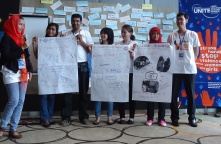
These are just only few stories shared by participants at the UNiTE Global Youth Forum held in Bangkok with a focus on strengthening the youth movement in ending gender inequality and violence against women and girls.
Forty participants aged 18-30 from 29 countries participated and shared their experiences and challenges they faced in ending violence against women and girls. The forum began on May 22 and came to a close on May 24 with all participants pledging to carry forward the UNiTE Campaign in their personal and professional lives.
Listening to these horrifying stories at the workshop, I was naturally prompted to ponder on the comparative successes my small island nation has achieved in ensuring the rights of women and girls. Indeed, we have come a long way forward.
UNiTE Global Youth Forum particpants
Progress in Maldives
In the Maldives – despite our religious conservative exterior – women can choose their spouses, marry, get divorced and even re-marry more easily than anywhere else in the world, while openly engaging in relationships outside marriage is not so taboo.
Not only do Muslim women and girls have equal access to education, health services and opportunities in Maldives – but these rights are guaranteed under the country’s constitution.
Women are also encouraged to be economically active in small and medium scale businesses to jobs in public officesor private companies. They receive equal protection under laws and are subjected to same punishments as men.
There is no institutional discrimination or barriers to political or social activism, thus allowing women to be teachers, police officers, judges, parliamentarians or even the President should she choose to be.
Accessible healthcare to mothers and newborns in Maldives have drastically reduced the maternal deaths and child mortality rates. Today, Maldives ranks as 45th best place to be a mother among 80 developing nations compared in international NGO Save the Children’s 13th State of the World’s Mothers report.
Participants from other countries noted the aforementioned legal frameworks, equal legal provisions and opportunities as some key solutions to solving several problems faced by women.
Perhaps it is these positive approaches that drive some people to ask, “What rights don’t women have in Maldives?” whenever the issue of women’s rights is raised here.
However, I was not surprised when a facilitator commented, “All things we say are needed for ensuring women’s rights are already in Maldives, but the numbers are yet so disturbing.”
What are these disturbing numbers?
Widespread domestic abuse and child molestation
Although the Maldives’ women development performance has been admirable with long standing pro gender equality policies, statistics available from multiple sectors indicate gross violations of women’s rights.
The country is faced with major challenges in addressing gender inequality and combating the widespread violence perpetrated against women and girls while growing religious conservatism is threatening the pace of women’s progress.
The first numbers showing the magnitude of women and girl’s suffering in Maldives was found in a 2007 survey namedMaldives Study on Women’s Health and Life Experiences which revealed that one in every three women aged 15 to 49 have experienced some form of physical or sexual violence during their life time.
Half of the women had experienced ‘severe’ injuries, such as gashes, fractures, broken bones or internal injuries while 6.3 percent women, who have ever been pregnant, reported having been physically abused during at least one pregnancy. Of those, 41 percent were punched or kicked in the abdomen.
“He (my husband) tied me up “face down” on a bed with a woven rope. I was eight months pregnant then…I had to stay like that for four hours. When he untied me, my hands and feet were swollen and cut. My stomach hurt really badly because I was tied “face down”…I cried. I had a stillborn child and the midwife told me that it was probably due to the violent act of my husband,” a respondent reported during the survey.
The survey also flagged that the violence is not limited to intimate relationships either.
Girls reported that male family members, particularly father or step-father perpetrated ‘physical violence’ while family friends, work colleagues and strangers ‘sexually abused’ them.
Meanwhile, the statistics analysed in the report also substantiated the high prevalence of childhood sexual abuse.
“We found that 12.2 percent of women aged 15-49 had been sexually abuse before the age of 15,” the report read. “Approximately 10 percent of women reported that their first sexual experience was either coerced or forced and that the younger the girl at the first sexual encounter, the more likely it was that sex was forced.”
The data also reflected the fact that girls are at greatest risk of sexual abuse by male family members and male acquaintances – this, and several sordid cases of inter-familial or incest cases prompted the authorities to endorse a legislation in 2010, stipulating harsher punishments for child abusers who are in a “trusted position” or otherwise guardians of victims.
However, the enactment of the Domestic Violence Bill in April has filled the gap in the legal system, which has been a great challenge in preventing violence against women and providing justice and protection to survivors of domestic violence.
However, we are yet to witness the positive outcome the important piece of legislation brings while much is needed to raise public awareness on it.
Little or no economic emancipation
Although the 2008 constitution has removed the bar on women from holding the highest political office and there is no institutional discrimination against women in politics and decision making per say—the numbers show a grim reality.
Only five out of 77 elected parliament members are women and 57 out of 1086 elected island and atoll council members are women. Even among the few women who are currently politically active, almost all are notably linked to high status families, or have been appointed to the position.
Only a staggering two percent of the economically active women hold senior decision making position compared to the eight percent of men while, according to planning department, the the unemployment rate for women is nearly double compared to male counterparts.
Over one third of working age women are economically inactive due to the gender stereotyping that demands house work and child care from women, the 2006 Census found. The absence of childcare facilities makes it difficult for women to remain employed after they have children
“I was a teacher for five years. But I had to stop working after birth of my child. I always hoped to start teaching when my son turned four. I did start even. But stopped because my husband’s family complained about looking after my son all the time and there is no child care facility here,” a 28 year old woman with a degree in education told this author.
“Besides, I don’t think my husband will approve putting our son in child care,” she added.
Human Rights Commission of the Maldives (HRCM) has also reported that some employers discourage women from marriage or pregnancy, as it could result in employment termination or demotion.
Meanwhile, the Maldives has the highest divorce rates in the world, with up to 47 percent households headed by females and single mothers.
An audit of the courts found that large amounts of money received as child support has not been distributed to the recipients while some remains uncollected – indicating that single-mothers are bearing the financial burden of raising children.
A monthly allowance of Rf2000 (US$130) is distributed by state to single-mothers; however, flaws in the system and miscommunications leave many mothers empty-handed, especially in the atolls.
“I have a five year old son. His father has not provided child support since we got divorced. But I do not get child support because I am a civil servant. That is very upsetting because I can barely cover the costs,” a school supervisor working on Hithadhoo island commented.
Meanwhile, the high level of drug abuse results in many women co-dependent on drug users, the UNFPA Maldives says. It puts women at high risk of violence and abuse while those women who have experienced violence are significantly more likely to have health problems, emotional distress and thoughts of suicide.
Rising sexual health-illnesses
Reports also suggests that Maldivian women are greatly at the risk of reproductive illnesses due to unavailability of information on reproductive health.
Centre for Community Health and Disease Control (CCHDC) flagged high prevalence of Sexually Transmitted Infections (STIs) in a report released last year. Eighteen 18 HIV positive cases were detected and over 400 cases of STIs, of which 97 percent were women.
Detection STIs included chlamydia and gonorrhea – both conditions that can cause infertility if left untreated.
Rising STIs were associated with high risk behaviors such as increased sexual activities with reduced contraceptive use, lack of awareness and human trafficking for purposes including sexual entertainment.
Even though no specific statistics are available, anecdotal evidence additionally suggests that the number of unwanted pregnancies and unsafe aborions have dramatically increased – particularly among adolescents.
The current Health Minister Dr Ahmed Jamsheed acknowledged these disturbing trends in his blog last year.
Dr Jamsheed wrote on his blog in June 2011, “I believe that a high rate of abortion by our women, both in the Maldives and in neighbouring countries have been going on for some time.”
He made the comments following the discovery of three abandoned babies in the same year, out of which two were premature foetusus while the third was a dead new born.
“This is very much a public health and social issue, strongly related to societal values and faith. Criminalisation will never solve it and this will go on unless we address the root causes or have upstream interventions,” Dr Jamsheed argued.
Broader reproductive health should be taught in the schools, either incorporated to the curriculum or as a separate programme, he said. Furthermore, he contended, all barriers to access contraceptives must be removed.
He admitted: “I understand that some people would condemn this opinion, arguing that this will promote unlawful and out of wedlock sex. However, I don’t believe that the availability or non-availability of condom or contraceptives would ever be a factor determining whether two people who want to have sex will have it or not!”
UNFPA Assistant Representative Shadiya Ibrahim also echoed Jamsheed’s remarks contending that research has proven “sex education does not increase promiscuity”. Of 68 studies on family life and sex education in a scientific review, she said, 65 studies found no associated increases in sexual behavior.
“Young people taking part in such programs had higher levels of abstinence, later start of sexual activity, higher use of contraceptives, fewer sexual partners and/or reduced rates of STDs and unplanned pregnancy,” according to Ibrahim.
She added: “Non-health factors such as lacking education, lacking status in family, early marriage make girls highly vulnerable to unwanted pregnancy. It could be lacking basic knowledge and information about sexual and reproductive health and the means to prevent conception.”
“Other unintended pregnancies result from rape, sexual abuse and incest. Sexual education to boys and girls help reduce these instances and provide strategies for girls to reduce their vulnerability,” she observed.
Overwhelming majority of the married young girls are getting pregnant, which brings “high costs in lost opportunities, limited life options and poor health, according to her.
“It also affects the ability to provide opportunities for their children too. When young girls delay starting their families, they have better opportunities for further education and skill development and mean to fulfill whatever dreams they may have and contribute to productive integrated members of the society and economic development.” she further explained.
However, these contemporary strategies have fallen short from being transformed into concrete actions amid religious pressures in Maldives.
In addition, Education Ministry reported last year that girls are not being vaccinated and female school enrollment rates are falling. Both were associated with “religious reasons” which have been described as misinterpretation of religion by some Islamic scholars.
Meanwhile, claims that female circumcision is rising in practice in the Maldives also triggered alarm across the government and NGO sector in 2011.
“We are beginning to hear reports of this occurring, and I have heard on radio and television people justifying the practice. It is quite disheartening,” said President Dr Mohamed Waheed Hassan, who was Vice President at the time.
Though he did not pinpoint a specific area where female circumcision was taking place, but attributed the “general trend” to “rising conservatism and traditional values imported from other parts of the world.”
These perceived influence from growing conservative religious groups in the country, according to gender experts, “are causing fear that recent gains in addressing gender equality could be reversed.”
Therefore, they argued that the authorities must prioritise gender mainstreaming to achieve the international goals of gender equality and also expand the efforts into eliminating all forms of violence against women and girls.
In many cases social scientists have observed that multiparty systems, especially in a presidential political system, have inevitably transformed into two-party contests. While many parties are usually present at birth of a nascent democracy, as it matures the contest for power between these parties slowly become a fight for survival ensuring that only the strongest parties survive.
The video below demonstrates how multiparty systems filter out smaller parties as the democracy matures:
We are not of the view that a two-party system is better than a multiparty system. In fact a multiparty political system allows for more voter choice. We however do think that a multiparty system is much less likely to occur in a presidential system compared to a parliamentary political system (which is perhaps why MDP was right in endorsing a parliamentary political system when it was put to referenda). Maldivian politics too, seems like it is moving towards a two party political system. While it might be too soon to jump to conclusions, here is how we think it might happen;
The reason why we think MDP and PPM are the most likely two parties to survive is because we believe that they are the two parties with strong and exclusive principles. MDP was the founding party of Maldivian Democracy. It has stood boldly for individual freedoms, social welfare and has continuously opposed the use of force in maintaining social order (at least in principle). PPM on the other hand has endorsed a system Maldivians saw for 30 years where the emphasis is on social order, even at the expense of individual freedoms.
DRP though part of Ithihad (coalition), we predict that them moving away from it. First of all they took the bold move of forcing Gayoom to leave the party, and since then tension between DRP and PPM have been unresolvable.
Most PPM supporters feel bitter about DRP and are less likely to work with them. We think that feeling is mutual from DRP supporters towards PPM as well. The only thing now keeping MDP and DRP separated seems to be their disagreement with Mohamed Nasheed. Even then, we think if the earliest elections move to a second round DRP is much more likely to endorse the MDP candidate over Gayoom.
Given that we feel that both MDP and DRP will maintain similar ideologies the question must be answered as to why we believe MDP will survive over DRP. This is because MDP by far has a larger support base than DRP; whose members seem to be still stuck on crossroads after Gayoom left the party to form PPM.
Secondly, MDP is the party that founded democracy, and has continued to mature with these same principles while DRP was a party used to support an autocrat who they seem to disagree with now. In terms of number and consistency, it’s easy to see why MDP will win over DRP. We also predict PPM to win over DRP in the first round of the next election.
Apart from the fact that PPM continues to win former DRP members, PPM also enjoys the potential support from AP and JP as part of the Ithihad. Furthermore, we think that the lack of an exclusive principle in DRP means that swing voters who decide to vote for democracy will vote for MDP, leaving DRP expecting to win votes only from their own members.
The Adhaalath Party (AP) seems to be losing a lot of support it used to enjoy from the highly religious community in Maldives. The recent scandals, as well as the contradictory statements regarding political activism by their leaders have casted doubt on their sincerity, credibility, and commitment to Islamic principles.
Though AP leadership is expected to campaign with PPM in the second round of the upcoming elections, overtime the votes of AP members are most likely to transfer to a party which they feel, can accommodate a favorable Islamic environment.
If the Jumhooree Party (JP) was to support a principle; it would be in favor of liberalised markets and maximum commercial freedom. They seem to support least possible taxation and most possible freedoms in terms on investment and commerce. We argue that the party is likely to make coalition with a party that agrees to maintain the trade liberalisation ideology. We also would like to point out that such a coalition makes perfect sense for PPM since there seems to be no conflict of interest in adhering to the principles of JP.
Overall, our conclusion is that Maldives is likely to move towards a two-party political system as the political history matures. Perhaps parties like AP or JP might not completely die out, but it can be said with relative certainty that the main battles for presidency is to most likely happen between MDP and PPM.
All comment pieces are the sole view of the author and do not reflect the editorial policy of Minivan News. If you would like to write an opinion piece, please send proposals to [email protected]
 (0)Dislikes
 (0)
(0)