Maldives debate intensifies in UK Parliament

Whilst the UK government professed its commitment to the India-brokered road map talks in the UK’s House of Lords this week, in less official forums MPs appeared to have reached a damning verdict on the current Maldives administration, discussing punitive measures and demanding apologies for perceived sleights.

Lord Howell of the Foreign and Commonwealth Office (FCO) avoided any conclusive statements in the face of questions from the House regarding the legitimacy of President Mohamed Waheed Hassan’s government, promising only support for the work of the Commonwealth and the Commission of National Inquiry.

This followed a meeting the day before of members of the All Party Parliamentary Group (APPG) on the Maldives who used offices provided by the UK Parliament to hold a meeting entitled “Democracy Derailed: Political turmoil in the Maldives”. A source present during the meeting has given Minivan News their full account of the discussion.

The source, who wished to remain anonymous, said that those who spoke about the current situation in the country were the MP for Salisbury, John Glenn; Queen’s Counsel, Sir Ivan Lawrence; former Foreign Minister for the Maldives government and current UN Special Rapporteur on Iran, Dr Ahmed Shaheed, and former Deputy Health Minister Mariya Ali.
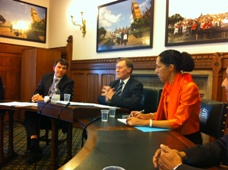
Also said to have contributed to the panel were Helen Grant MP, Mike Gapes MP, and former Maldives High Commissioner to the UK Dr Farahanaz Faizal.

Dr Faizal has actively opposed the current administration since resigning from her position, shortly after the departure of former President Mohamed Nasheed. She has since remained in the UK, working on behalf of the Maldivian Democratic Party (MDP) in raising awareness of perceived human rights abuses and democratic failings in the Maldives.

The former Deputy High Commissioner and brother to President Dr Mohamed Waheed Hassan, Naushad Waheed, was also present as were Maldivian students and families from the UK. Representatives of civil society organisations including the Commonwealth Human Rights Initiative and Third World Solidarity were also in attendance.

Chairman David Amess reportedly opened the meeting by expressing his disappointment that the Maldives government had declined to send a representative from the UK High Commission, despite being offered the opportunity to do so.

This has been disputed by Acting High Commissioner to the UK, Ahmed Shiaan, who claimed that the UK High Commission had received no official invitation.

The MP from Salisbury, John Glenn, expressed “no doubt” that there had been a coup d’etat in the Maldives, our source reports.

“[The] democratic will of the people of Maldives has been tossed aside,” Glenn is alleged to have told the group before mentioning his distress at the comments recently aimed at both the UK and the Commonwealth by the Maldives’ new governing coalition.

Glenn’s Salisbury constituency served as the base for former President Mohamed Nasheed during his exile in the UK. The Friends of Maldives (FOM) organisation, responsible for a recent travel advisory which pleads with tourists to avoid any resorts associated with alleged coup conspirators, is based in Salisbury.

Strained relations

Perceived interference from the Commonwealth, whose Secretariat is based in London and whose figurehead remains Queen Elizabeth II, has attracted scathing criticism recently in the Maldives.

Dhivehi Qaumee Party (DQP) MP Riyaz Rasheed accused the Commonwealth Ministerial Action Group (CMAG) as having been “bought by the Maldivian Democratic Party (MDP)” after it had urged the current government to establish its legitimacy with early elections.

CMAG released a strongly worded statement last week, arguing that the “the earliest possible expression of the will of the people was required to establish universal faith in the legitimacy of those who govern the country.”

That the group had seen a “lack of progress” in this respect caused it to express “disappointment and deep concern.”

Special Envoy Sir Donald McKinnon, who departed on Friday, attended the Opening Session of the People’s Majlis on 19 March, emphasised the need for parliament to “function effectively so that parliamentarians can return to debating issues of national interest.”

President’s spokesperson Abbas Adil Riza last week went as far as to suggest to Minivan News that the Maldives may consider its position in the Commonwealth, although the reporting of his statement was later dismissed by Abbas in other media as “politically motivated”.

Addressing the all party group, Sir Ivan Lawrence is said to have spoken of his lack of faith in the Maldives’ judicial system, based on his visits to the country during the Maumoon Gayoom era.

“It is now surely important for the same international community that helped to bring about the first democracy, to underline the importance to the new regime of holding speedy free and fair elections, so that power may be restored as quickly as possible to the people of the Maldives,” Sir Lawrence purportedly quoted from a letter he had recently sent to UK newspaper, The Times.

Mariya Ali is alleged to have discussed human rights violations in the Maldives as well as police brutality, before giving the floor to Dr Shaheed who is reported to have suggested that the Gayoom coterie lost their grip on power as a result of attempts to placate the international community.

Dr Shaheed apparently expressed his opinion that they were unlikely to repeat this mistake, citing Dunyha Maumoon’s comments regarding “civil war” as evidence of this resolve. Shaheed stated that the current government will not hold early elections, but rather will work to enfeeble the opposition MDP between now and the scheduled poll date.

Shaheed is also said to have expressed his concern that the independently minded Election Commissioner Fuad Thaufeeq would now be targeted by the current government due to his reputation for impartiality.

Insult and injury

The debate is also said to have included mention of the recent insults leveled at the Queen, the Commonwealth, and the UK government.

During DQP MP Riyaz’s diatribe on DhiTV, he argued that the British public had funded the MDP in return for the establishment of churches in the Maldives and also that they hated the Maldives for gaining independence from Britain.

“The English hate us. Why? Because Ibrahim Nasir saved us from slavery and brought us independence, since then what have the English done for us?” he said.

Riyaz then turned his attention to the Queen herself, “After 50 years, the English Queen, she is physically challenged. But she is still Queen, and if she wants she can remove the Prime Minister. Where is democracy? Where is democracy? That is not a democracy.”

In agreement with the opinion of a member of the public in attendance, David Amess is reported to have said that the government of Maldives should issue a full apology for Riyaz’s outburst and, in concurrence with the other members of the APPG, he argued that the issue should be brought before Parliament.

Additionally, Amess is reputed to have stated his feeling that the attendance of President Waheed at the Queen’s Jubilee celebrations this year would be inappropriate.

Minivan News has obtained video footage of this section of the discussion and can confirm an unidentified voice from off-camera suggesting an early-day motion regarding this topic.

Early day motions are a tool used by MPs in the House of Commons to introduce a subject for discussion. They are often used to publicise certain events or subjects and to gauge the level of parliamentary support for such motions.

Finally, the meeting is said to have moved on to punitive measures. The alleged consensus was that European travel bans had greater potential to damage those alleged to be behind a coup. The option of resort boycotts was dismissed as too damaging to the Maldives’ economic lifeblood.

The video footage received also includes Mr Amess’s concluding statements and so the following quote can be confirmed:

“Ladies and gentlemen, we started off our meeting asking has democracy been derailed, is there political turmoil in the Maldives? Well, listening to the contributors before us this afternoon, the answer to the first part is ‘yes’. Political turmoil in the Maldives? Again we’ve heard the answer, ‘yes’.”

Official comments

The validity of this meeting has been questioned by the Acting High Commissioner, Ahmed Shiaan.

“This was not a UK parliamentary initiated event. If this was an official APPG event, we should have been invited. It is very disappointing,” said Shiaan, “[If it were] they would have to get our perspective, even the Foreign and Commonwealth Office [FCO] wasn’t invited.”

Shiaan pointed out that the discussion initiated in the House of Lords on March 22, at which the FCO was represented, should receive more prominence as it better represents the official line of the government.

When Lord Howell of the FCO was in the Lords about the potential suspension of the Maldives from the Commonwealth, his response was that this decision was up to the whole of the Commonwealth to decide upon, not just one member.

“We must move to encourage democratic elections, and that is what is proposed in the India-brokered plan, which we welcome and support,” said Lord Howell.

One member of the House asked if Lord Howell felt the government was doing enough to ensure an independent international enquiry after what was regarded by some as a coup.

“We do not recognise this as a coup, although obviously there has been a change,” replied Lord Howell, “We still need to establish the full circumstances of what occurred and we hope that the commission of inquiry will do that.”

Lord Howell was also anxious to make clear the view of the FCO that the Maldives remained a safe tourist destination. “At the moment we do not judge that there is any danger in the tourist areas.”

Next, Lord Howell was asked what steps CMAG might take if they were not successful in pushing for early elections, to which he responded:

“If they are not, of course we would have a new and more difficult situation that would require further resolution and effort. For the moment, we concentrate on following the plan which the Indians have so helpfully brokered.”

Dhivehi Qaumee Party (DQP) MP Riyaz Rasheed, part of the new governing coalition, accuses the Commonwealth of seeking to build a church in the Maldives, Special Envoy Sir Donald McKinnon of taking bribes from the MDP, and the Queen of being “physically challenged”:

Likes(1)Dislikes(0)

Somali castaways in Maldives say “no” to repatriation

Forty Somali castaways under the custody of Maldivian authorities have recently refused to return home despite arrangements that were made for their safe repatriation, Minivan News has learned.

According to a top government official, who spoke to Minivan News on condition of total anonymity, the government had devoted “immeasurable amount of time and effort” over the past three years to safely repatriate several Somali nationals who have been discovered in Maldivian waters in dinghies lost at sea.

Many were found in frail health conditions due to dehydration and malnourishment, and had to undergo long treatments before being transferred to Dhoonidhoo Detention Center, where they were provided temporary refuge until negotiations on repatriation were finalised.

“However, after all their identities were verified, passports and a chartered flight was arranged for their safe transportation, they refused to go back to Somalia,” said the source, who has worked closely with the case.

“The United Nations High Commissioner for Refugees (UNHCR)’s delegation arrived in Maldives to confirm their preference because no refugee can be repatriated without consent under the international conventions,” he said. “So the delegation asked them one question – Are you willing to go? All of them said ‘no!'” he recalled.

He observed that the Maldives cannot resort to the option of forced repatriation as Somalia is recognised as a unsafe state.

Maldives has not ratified the 1951 Refugee Convention or its 1967 Protocol citing “financial and technical capacity constraints” but the convention prohibits all states, regardless of whether they have acceded it, from returning a “refugee to a territory where his or her life or freedom is threatened”.

“So the project is now a big failure,” he concluded, adding that the Maldives can face “increasing pressures from the international community if it continue with the forced repatriation.”

Minivan News could not get a comment from the foreign ministry at the time of press on how the state intends to move forward in solving the repatriation block.

Authorities have earlier echoed concerns over the increased financial burden to the state in providing shelter to the Somalis, who are said to be now in good health and actively involved in prison-based agricultural projects.

A Maldivian expert on combating human trafficking meanwhile noted in an interview to Minivan News that “if repatriation does not work out, the only legal solution would be for Maldives to sign the international conventions on refugees and Rights of Migrant Workers Families and accept the Somalis as refugees, and provide necessary protection granted under these conventions.”

“The Maldives will be pressured to sign the conventions. But, the question is are we ready to face that? We are already in a crisis with the current 100,000 expatriate population in the country which accounts to one third of the Malidives population. If these conventions are passed, it means, the expat population will be doubled or tripled,” he warned. “Are Maldivians willing to become a minority in their own country?” he asked.

Likes(0)Dislikes(0)

Government questions Nasheed’s eligibility for former president privileges

The President’s Office has raised questions over former President Mohamed Nasheed’s eligibility for constitutionally-provided immunity and privileges.

Article 128 guarantees “the highest honour, dignity, protection, financial privileges and other privileges” to any person who has served in the office of the president and stepped down without committing any offenses.

However, President Mohamed Waheed Hassan’s spokesperson Abbas Adil Riza said Nasheed’s eligibility was in question since he had not completed a full-five year term. Nasheed resigned in his fourth year of office, an act he later claimed was “under duress”.

Riza pointed to Article 3 (a) of the Former Presidents’ Immunity and Privileges Act, which affords a monthly allowance of RF 50,000 (USD 3243) for a president who has served one term, and Rf 75,000 for a president who has served two terms (USD 4864).

Riza said the clause specifies that a president has to complete a five-year term in order to be eligible for financial benefits.

But Nasheed’s former Legal Affairs Secretary Hisaan Hussein said the constitution overrides the Former Presidents’ Immunity and Privileges Act, and said Nasheed had a “right” to immunity and privileges.

Further, Article 12 of the Immunity and Privileges Act, interprets former president to be one “who stepped down after completion of term or resigned from office” without committing an unlawful act, she noted.

Even if the government’s concerns were valid, a full term is specified only with regards to financial benefits, and not in clauses relating to accommodation allowances, health care coverage, security, and travel arrangements, she said. Yet, except for the provision of security, the government had refused to extend any privileges to Nasheed, Hisaan said.

Riza said President Waheed had only arranged for Nasheed’s security “through special privileges afforded to the President.”

International bodies have expressed concerns over Nasheed’s safety, after Criminal Court Judge Abdulla Mohamed issued a court order for Nasheed’s arrest following Nasheed’s resignation on February 7.

The Maldives National Defense Forces (MNDF) had held Judge Abdulla in military detention for three weeks prior to Nasheed’s resignation. The order was never acted upon.

The Human Rights Commission of the Maldives (HRCM) summoned Nasheed on Wednesday for questioning regarding his role in Judge Abdulla’s detention.

Riza said the President’s Office has now requested legal advice from the Attorney General Azima Shukoor on providing immunity and privileges to Nasheed. “As soon as we get legal advice, we will proceed,” he said.

Minivan News was unable to contact Shukoor at time of press.

In addition to monthly financial allowances, the Former Presidents’ Immunity and Privileges Act provides for a monthly accommodation allowance up to Rf 50,000 (US$3243). The President and his/her spouse are also entitled health care coverage, security and travel assistance.

Further, if a former president wishes to conduct charitable work, the act allows for an allowance of Rf 175,000 (US$11,349) to cover overhead costs.

Maumoon Abdul Gayoom, who served as president from 1979- 2008, set up the nonprofit Maumoon Foundation in 2010. The organisation’s stated aims are to assist the poor and needy. It awarded nine scholarships for higher education abroad in 2011.

Likes(1)Dislikes(0)

Civil Court conducts second hearing of MDP’s case against clearing of protest sites

The Civil Court has conducted a second hearing of the case presented to the court by Maldivian Democratic Party (MDP) against security forces, after the police and Maldives National Defence Force (MNDF) dismantled MDP’s protest camp near the tsunami monument.

The MDP’s official website reported that the state attorney had denied the allegations made by MDP and contended that a court warrant is not required to dismantle the area.

MDP lawyer Hisan Hassan told the judge that the police could only search the area with the presence of MDP senior persons and that the MDP wanted to clarify why the area was destroyed.

Hisan also told the judge that the police did not even have a list of items they confiscated from the area.

According to local media, state attorney Ahmed Usham told the court that the area was dismantled because the protesters threw bricks at the security forces, and that the dismantling of the protest was not an action that was taken to narrow freedom of speech.

Usham also said that alcohol and items “used to conduct sexual activities” were discovered in the area, and that those were items disallowed under Islamic Sharia.

The state attorney claimed knives and sharpened iron bars and other materials were also found.

He futther alleged that MDP protesters had been attacking police officers that have went there to investigate violence that occurs in the area.

Usham claimed that people gathered in the area had been using filthy words to speak and had been encouraging violence.

He also alleged the education of children living in the area had been affected and that their rights had been violated.

The local media reported that Usham had told the judge that many crimes have been conducted in Male’ after the area was used for “planning and organising crime”, and that criminals had used the area “to flee from police”.

MDP reported that the next hearing of the case is scheduled for Sunday.

The tsunami monument area was dubbed ‘Justice Square’ by the MDP following the outside of former President Mohamed Nasheed on February 7, in what he claimed was a police and military led coup de’tat. Thousands of by MDP supporters had used the area as a camping site during the ongoing protest against the legitimacy of President Dr Mohamed Waheed’s new government.

Following a day of protests on Monday, police and army in a sudden raid on the camp ordered everyone in the area to leave without giving reason, and arrested some of the people who refused.

The police then dismantled the tents, removed all the lights, speakers, megaphones, banners, flags and the stage in the area built by the MDP, and cleared political slogans and graffiti from the sea wall.

Likes(0)Dislikes(0)

Nasheed first president summoned before Maldives Human Rights Commission

Mohamed Nasheed has become the first Maldivian president to be summoned before the Human Rights Commission of the Maldives (HRCM), in connection to his role in the controversial detention of Criminal Court Chief Judge Abdulla Mohamed earlier this year.

Nasheed had been requested to attend a HRCM hearing filed to try and understand who was responsible for taking the decision to arrest the judge. The former president attributed the initial arrest call to his Defence Ministry, on the grounds of “protecting” national security relating to alleged ethical concerns about the judge.

Today’s summons of the former president is said to be the first of three cases filed at the HRCM involving himself. These cases all relate to potential human rights abuses allegedly carried out both by and against Nasheed during the lead up and aftermath of a controversial transfer of power that saw President Mohamed Waheed Hassan installed as his successor.

The former president has since alleged that his resignation from the presidency was performed under duress.

Nasheed’s arrival today was heralded by a few hundred supporters who gathered around the HRCM building carrying banners alleging abuse at the hands of police earlier this week. Many of those gathered waited for the former president to deliver his account to the commission. Riot police arrived briefly at the area outside the commission, but the crowd later dispersed without confrontation.

The arrest of Judge Abdulla Mohamed itself occurred on January 16 in relation to a police request. The judges whereabouts were not revealed until January 18 however, leading to international condemnation of Nasheed as well as domestic criticism reflected in ongoing protests over several weeks that observers later suggested were partly linked to his eventual downfall on February 7.

HRCM spokesperson Jeehan Mahmoud told Minivan News that while additional cases relating to the former president would be focused on alleged human rights abuses against him after the build up and transfer of power, today’s hearing related to specifically identifying the party who placed the order to arrest the judge.

Jeehan added that the HRCM had previously unsuccessfully attempted to  summon former defence and home minsters, as well as senior police officials who had served under Nasheed during the time the arrest decision was taken.  However, today’s  move was taken to request that the former president explain what had occurred himself.

“If these ministers and [police] representatives would have attended [the HRCM hearings], I think thing would have been a lot clearer,” she said. “We wanted to collect more responses on this as it hasn’t been clear where the order [to arrest the judge] had came from.”

Possible outcome

The commission spokesperson said that the group had not yet decided on what methods it would look to take to readdress any potential abuses of the judge’s human rights.  Therefore she said it was too early to say whether this could include filing a case against any of the decison makers involved at the Prosecutor General’s Office.

Malé MP Imthiyaz Fahmy, who formed part of nasheed’s legal team today, told Minivan News that the former president gave testimony alleging that the decision to arrest the judge was related to a number of possible misdemeanour’s that had been attributed to him dating back several years.

In November, the national court watchdog, the Judicial Service Commission (JSC), was ordered to cease an investigation into Judge Abdulla Mohamed by the civil Court under an action he himself instigated.

Amidst developments such as these, Fahmy claimed that Nasheed used his testimony to claim that he had been informed by the Home Ministry that the judge had allegedly posed a “national threat” – prompting his eventual detention.

The MDP MP added that Nasheed then claimed that the Home Ministry had communicated with the Defence Ministry on the situation, which in turn led to the decision to arrest the judge after bodies like the Judicial Service Commission has raised alleged concerns over his ethical conduct.

“I was told Abdulla Mohamed would not comply with the police’s summons to investigate allegations [against him],” Nasheed later stated at a press conference following the meeting with the HRCM.

“The Home Minister wrote to the Defense Minister that Abdulla Mohamed’s presence in the courts was a threat to national security. And to take necessary steps. And that step, the isolation of Abdulla Mohamed, was what the [Defense] Ministry deemed necessary.”

Nasheed claimed additionally that he had sent representatives to Girifushi to check on Judge Abdulla Mohamed’s well-being during his detention, alongside allowing the HRCM to visit the judge.

Fahmy alleged that it was ironic that Nasheed, a leader he said who had openly discouraged the use of torture and actively campaigned against human rights abuses, had become the country’s first former leader to have been called in front of the HRCM.

However, HRCM spokesperson Jeehan said that Nasheed would be called back for two additional cases – expected to be sat at the same time – that would look into alleged abuses of human rights against the former president. The first case would be focused on the events of February 6 and February 7 this year, the two dates surrounding Nasheed’s “resignation” from office, a decision later claimed to have been part of a “coup d’etat” against him.

The third and final case would then concern any claims of human rights abuses against Mohamed Nasheed by police on February 8, the day after he tendered his presidency ended.

Likes(1)Dislikes(0)

“Consensus” now to appoint foreign expert to inquiry panel: government

As the European Union reiterates calls for “urgent agreement” on a process for political reconciliation and elections in the Maldives, the government has said it would welcome international independent assistance on ratifying its legitimacy – but only by an organisation accepted by all parties.

The inclusion of international experts in the Committee of National Inquiry (CNI) has been urged by numerous international actors as well as the Maldivian Democratic Party (MDP) and former President Nasheed.  The CNI has been charged with looking into legality of the transfer of presidential power last month to ascertain the legitimacy of the current government.

It currently consists of three members: Ismail Shafeeu, former minister of defence and national security during President Maumoon Abdul Gayyoom’s administration; Dr Ali Fawaz Shareef, Deputy Vice Chancellor at Maldives National University; and Dr Ibrahim Yasir, former Director General of Health Services.

President Mohamed Waheed Hassan’s spokesperson Abbas Adil Riza told Minivan News today that there was now “consensus” among politicians for a foreign expert to sit on the panel of the CNI to ascertain the truth over the controversial transfer of power. However, Abbas claimed that the government was presently seeking UN assistance for the inquiry panel following allegations of bias by former opposition MPs and government ministers against  “British interference” within the Commonwealth.

The opposition Maldivian Democratic Party (MDP) claimed in response that efforts by certain MPs and government members to discredit the Commonwealth in favour of the UN were nothing but a stalling tactic to delay appointing international assistance.

The Commonwealth, whose ministerial action group (CMAG) last week backed early elections in the country has been criticised by some former opposition MPs and government figures in the Maldives for the comments. The organisation has nonetheless been backed by the EU in its decision to send Special Envoy Sir Don McKinnon to the country over the last few days to hold dialogue with all parties and several former presidents.

Although, not directly echoing the Commonwealth’s calls that “the earliest possible expression of the will of the people was required to establish universal faith in the legitimacy of those who govern the [Maldives],” the EU stressed concern over the continued political unrest in the Maldives.

“I believe it is of utmost importance that political parties and authorities abstain from taking any action that could further complicate matters. Moreover, the security of the leaders of political parties has to be guaranteed,” stated Catherine Ashton, High Representative of the European Union for Foreign Affairs and Security Policy.

“Agreement on the holding of early elections, on the independent investigation of the transfer of power of February 7 and on the re-establishment of the correct functioning of government and parliament is now more important than ever.”

International assistance

Responding to the comments, Abbas Adil Riza said that President Waheed and his government appreciated the consideration of international bodies like the Commonwealth and EU regarding the current political situation in the country.  He added that the government had therefore pledged to do everything they could to follow their advice.

The president’s spokesperson said the government was presently trying to work in line with international calls to host fresh presidential elections and a independent enquiry into the events leading to Dr Waheed coming to power on February 7.

“We are working hard to put together the most independent commission for the enquiry so we can have all parties to agree on its outcome,” Abbas stated. “Sadly MDP MPs have made accusations questioning the pointed panels independence so we have called on the UN to assist with this matter.”

When asked about the nature of this UN “assistance”, the government spokesperson said that discussions has so far related to securing an international expert to be appointed to the CNI panel.

However, Abbas stressed that the government favoured UN assistance – a body which has been noticeably silent amid the country’s growing political crisis. Abbas said some of the former opposition political parties, now in government, had accused the Commonwealth of being bribed by the MDP in local media.

“Since the MDP accusation questioning the independence of the current panel, the PPM and indeed some in the government have raised issues of British involvement in the Commonwealth. The international party has to play a role that is unbiased,” he said.

“The PPM, which is a major political party in this country, has outright accused the Commonwealth of bias.”

Abbas told Minivan News that amidst these allegations, acquiring the direct assistance of the UN, which represented a much wider scope of countries was a more preferable “solution to ensuring legality” of the government.

To this end, the spokesperson added that the foreign Ministry has been in touch with the UN over obtaining international assistance with the independent investigation and that responses had so far been “positive”.

However, he stressed that ensuring true independence in the Maldives was extremely difficult.

“The government is trying to find a balanced solution that all sides can agree upon. However, in a third world country like the Maldives the solutions are often very complex,” Abbas claimed. It is very complicated to maintain neutrality.”

However, MDP spokesperson, Hamid Abdul Ghafoor said the party remained cautious over the government’s commitments to secure an international expert to oversee the independent investigation.

“What we have noticed is evasiveness by the government to finalise international involvement in the enquiry,” he said. “I believe the UN talks are a deviation.”

Ghafoor claimed that this alleged “reluctance” by the Waheed government to involve international experts in its affairs was reflected in what he called the disproportionate response from some MPs towards dismissing and insulting the Comonwealth.

To support this claim, he pointed to comments made by Foreign Minister Dhunya Maumoon, who dismissed calls by the Commonwealth for early elections as showing bias towards one particular party – presumably the MDP and former President Mohamed Nasheed.

Despite these concerns, Ghafoor said he was very encouraged by the latest EU statement issued by Catherine Ashton.  The MDP spokesperson claimed the statement raised additional concerns regarding the current political situation from its previous statement last month, such as in the manner that government and parliament was presently functioning.

“We believe that this shows the situation has deteriorated further,” he claimed.

Likes(2)Dislikes(0)

Free media too much for Maldives to digest: Maldives Media Council

Following the attacks on media property during Monday’s unrest, Maldives Media Council (MMC) President Mohamed Nazeef has expressed doubt over whether a free media can flourish in the Maldives at the present time.

“We see that although we talk of democracy and freedom of media and expression, I don’t think society is ready to digest a free media,” said Nazeef.

After protests against the reconvening of the People’s Majlis turned violent, Villa Television (VTV) bore the brunt of the angry demonstrations. Projectiles aimed at the studio included bricks – and in one instance, a bicycle – while the Maldives National Defense Force (MNDF) personnel manned the building’s entrance.

The anger of Maldivian Democratic Party (MDP) supporters towards VTV has been building since the events of February 7 when staff of the then-state broadcaster Maldives National Broadcast Corporation (MNBC) were ordered to patch through the VTV broadcast.

VTV is owned by Jumhoree Party (JP) Leader and MP Gasim Ibrahim, also a member of the Judicial Services Commission (JSC). Gasim’s chain of Villa Island resorts have been placed on a recent travel advisory of UK-based pro-democracy organisation Friends of Maldives (FOM).

“These are places linked to individuals or groups who we suspect to be involved in the subversion of democracy and in human rights abuses in the Maldives,” reads the advisory.

In a video aired on Raajje Television earlier this month, Gasim was seen celebrating inside police headquarters upon hearing of former President Mohamed Nasheed’s decision to resign.

MDP spokesman Hamid Abdul Ghafoor alleged at the time that the video proved “Gasim’s blatant complicity in the coup d’état.”

The nation watched VTV on state television before the feed was cut off and came back on, re-branded as Television Maldives (TVM), the name of the state broadcaster during Gayoom’s regime.

The MDP have since alleged that the national broadcaster is “being blatantly used as propaganda outlet of the coup regime, while the ongoing peaceful political activities of the MDP are being sidelined with little regard to the MBC’s mandate and the nation’s laws under which the MBC is functional.”

When asked if the MNDF had been stationed outside the television studios in anticipation of an attack, Colonel Abdul Raheem responded, “We didn’t get any intelligence that there would be attacks. It was not only VTV [that was guarded], we had persons around all key locations.”

The camera of a photographer from the Haveeru paper was also destroyed by protesters during Monday’s unrest, although Editor Moosa Latheef said he did not believe this instance was politically motivated.

Latheef reported no increase in aggression towards his reporters during the recent political strife.

In January, journalists working for the then state broadcaster MNBC were badly beaten during a protest outside the corporation’s headquarters. Preceding these attacks MNBC reporters received death threats, an MNBC official reported at the time.

Free Media?

MMC President Mohamed Nazeef lamented the politicisation of media outlets and the animosity that this produced from sections of the public: “It is a very sad situation.”

The MMC consists of fifteen members elected to preserve, promote and maintain the freedom of the press.

“The media is owned by political and business leaders. Do journalists have freedom to report what they like?” asked Nazeef. “It doesn’t happen.”

Nazeef blamed a lack of financial independence for a dearth of balanced content. “Media organisations are not financially viable. They are dependent on the owners.”

Government subsidies have been used before to try and tackle this issue, but Nazeef argued that this method was not without its problems: “It goes into the pockets of the owners.”

Whilst deploring the violence that was directed at VTV on Monday, Nazeef was not surprised.

“It shouldn’t happen, but you see the media provoking it. [Media] know [they] are taking sides… Media should balance their content.”

Aiman Rasheed of Transparency Maldives was of a similar opinion: “The media situation is clear – different media are aligned behind different people… [We] see conflict extended to the media.”

Transparency Maldives conducted a study last year into the performance and potential bias of six media organisations of which VTV was included (as was Minivan News). The amount of coverage devoted to its owner’s JP was noted as “significantly high” and largely positive.

Meanwhile, the Maldives dropped 21 places on Reporters Without Borders’ press freedom index between 2010 and 2011. The organisation also expressed its concern over the takeover of MNBC on February 7.

Fathimath Ibrahim Didi of the NGO Maldives Democracy Network agreed that a free media was a crucial concept but added, “What we want to stress is that, at the same time, it is very essential for the media to be responsible.”

“Most of the media stations in Maldives are owned by businessmen in who are somehow affiliated with a political party. Hence there is a very high probability for the media to be biased towards one side while reporting.”

Private station DhiTV is financed by ‘Champa’ Mohamed Moosa, a local businessman and political benefactor of the former opposition, while the recently opened Raajje TV belongs to Akram Kamaaluddin, state minister at Nasheed’s administration.

Among the most popular local news websites, newspaper Haveeru is owned by Dr Mohamed Zahir Hussain, who filled various cabinet posts under Gayoom’s administration and has now been appointed as chancellor of the Maldives National University by Dr Waheed, replacing his former party member Dr Mustafa Luthfy.

Sun Online belongs to Meedhoo MP and resort tycoon Sun Travel Ahmed Shiyam.

Minivan News was itself often been accused of MDP bias due its inception as a party news source. Following the change of power in 2008, all funding from politically-affiliated sources was removed. Since then the site has relied on income generated through banner advertising and has passed to a succession of foreign editors who have attempted to establish it as a credible and objective source of news in the Maldives.

Despite the ownership of media, Fathmath thinks reporters can play a crucial role in maintaining neutrality.

“Reporters themselves should also maintain neutrality at all times. We as citizens would like to see non-contradictory information or interpretation regarding one incident from all the media outlets of the Maldives,” Fathimath concluded.

Correction: An earlier version of this article incorrectly stated that DhiTV was owned by Hassan ‘Champa’ Afeef. DhiTV is financed by Mohamed ‘Champa’ Moosa. Minivan News regrets any confusion caused.

Likes(1)Dislikes(0)

Elections Commission expresses concern over police attacks on peaceful protest gatherings

The Elections Commission (EC) has issued a statement expressing concern that the police have been attacking and arresting Maldivian Democratic Party (MDP) supporters during peaceful protest gatherings.

The commission also said it had noted that the police had dismantled all MDP protest sites across the country.

‘’We are especially concerned with how the police dismantled the MDP protest camp at Lonuziyaarai Magu (tsunami monument area),’’ the commission said. ‘’Security forces have to act within the law.’’

The Elections Commission advised police not to use unlawful force against political parties.

President of the Elections Commission Fuad Thaufeeq today told Minivan News that the commission did not know of any reason why the area should be closed for protesting.

”According to the information we have the area belongs to Male’ City Council and the MDP did get the required permission from the council,” Thaufeeq said. ”The police dismantled the area after the MDP had been there for a long time.”

‘’It is the right of all the political parties to conduct political activities any where except those areas prohibited for political activities by law,’’ the EC said in the statement. ‘’No one has the right to unlawfully obstruct anyone from obtaining this right.’’

Police pepper spraying a demonstrator

Police Superintendent Ahmed Mohamed said “certain institutions” were making statements “without asking the police their side of the story”, and appealed to these institutions not to do so.

Yesterday in a statement police said that ‘’the major operation that took place yesterday evening was to restore the peace to the capital city as well as to investigate the complaints received from public sources that criminal activity was taking place at the camping site.’’

‘’Police had definite reason to believe that the violent attacks in Male’ was connected to the protestors who started demonstrations from the Lonuziyaarai Magu ‘Raalhugandu Sarahadhu’,’’ the statement said. ‘’The police acted in this operation empowered by law under the clause 244 of Constitution of Maldives and clause 6 of Police Act 5/2008.’’

The police said the area was vacated in order to preserve the site for inspection and to search for evidence suggesting any illegal activity in the area.

‘’The public is informed that items confiscated from the area will be returned to their rightful owner in accordance to the proper police procedures, and local media is advised to report facts responsibly to the community,’’ the statement added.

The area was initially closed to journalists as police moved in to dismantle the protest site on Monday night. Police subsequently allowed journalists access and displayed a number of beer cans they claimed had been found at the site.

The protest camp has been running near the tsunami monument since the MDP government was ousted on February 7, in what former President Mohamed Nasheed maintains was a police and military-led coup de’tat, sponsored by several wealthy resort owners affiliated with the former opposition.

Likes(0)Dislikes(0)

“No Freedom! No Expression”: artists hijack art gallery

A group of artists hijacked a joint National Art Gallery and Japan Foundation exhibition on Tuesday, to call attention to alleged abuse of fundamental rights and freedoms since the controversial transfer of power on February 7

The exhibition, titled “Breathing Atolls: Japan-Maldives Contemporary Art Exhibition 2012,” celebrates 45 years of friendship between Japan and the Maldives and highlights the impact of climate change in small island nations.

The campaigners, who call themselves the ‘Suntzu Platoon’, silently tailed the Tourism and Foreign ministers holding placards depicting scenes of police brutality.

“We hoped to gain empathy from Japan for Maldivian artists,” a spokesperson from Suntzu said. “Japan is still recovering from a national scale disaster [2011 earthquake]. We are in the midst of one. We live in a police state. They are beating up people. We wanted Japan to extend us that cultural sensitivity.”

Tourism Minister Ahmed Adeeb told Minivan News he did not agree with the campaigners’ calls. “They were saying we do not have freedom of expression. I do not agree. Their claims have no basis,” he said.

“No Freedom! No Expression!”

Suntzu’s spokesperson, who wished to remain anonymous, told Minivan News that the group wanted to reveal the interconnection between politics and art. “No Freedom! No Expression!” read the group’s flyer distributed at the exhibition.

“We were just four people,” she said. “We went there with 12 placards and 50 flyers. Many visitors to the gallery agreed with our message and took up the placards. It was very spontaneous.”

The Suntzu platoon alleges the February 7 transfer of power was a coup d’état. “Maldivian Artists suppressed under illegitimate government protests for the freedom to express,” Suntzu’s flyer read.

Under former President Maumoon Abdul Gayoom local artists had not been able to utilize the gallery to exhibit local work, Suntzu claimed. Under recently ousted President Mohamed Nasheed, very slight improvements had been made, with a few selected local artists’ work exhibited and an elementary system that allowed artists to request the space set in place.

“We wanted to tell Maldivian visitors that art is not just an oil painting hanging on a gallery wall or a commodity for tourists. Politics and art are not separate segments. Politics allows you to tweet or watch TV series at home in comfort,” Suntzu spokesperson added.

Photos and videos show campaigners tailing ministers, at times cornering them with brutality placards. The placards also called for early general elections to restore order. Police initially expelled one campaigner tailing Adeeb only to let him into the gallery a few minutes later.

“We did not organize this exhibition. It was organized by the Japan Foundation,” Adeeb said. “These types of actions taint Maldives’ name. Artists have freedom. They have the freedom to protest as well.”

Urban Art Intervention

Despite Adeeb’s assurances of freedom of expression, Suntzu pointed to the security forces’ dismantling of opposition Maldivian Democratic Party (MDP)’s protest camp at Raalhugandu (Surf Point) in Malé on Monday.

The site, known to MDP supporters as Insaafuge Maidhaan, was an “urban artistic intervention,” a Suntzu spokesperson said. “We saw types of art never seen before in the Maldives.”

Police dismantled the camp after violent confrontations between security forces and protestors on Monday. Protestors sought to obstruct President Mohamed Waheed Hassan from delivering a constitutionally-mandated address at the Majlis’ opening session for the second time, claiming his presidency was illegitimate.

Police said violence and unlawful acts were planned at the camp. Alcohol and condoms were also found at the site, police said.

Suntzu said the police also took down an exhibition against police brutality and wiped out political graffiti drawn on the sea wall. Insaafuge Maidhan was also home to unconventional art, such as performance artists, Suntzu said.

A man, who had come to Malé after February 7, had waved the MDP flag every night from 9:00 pm to 1:00 am in protest. “He may not see himself as an artist. But to us, he is one,” Suntzu spokesperson said.

“After they destroyed art at Insaaf, the next day they hold a gallery opening. Such acts are a smokescreen masking reality,” she said.

The police “want to wipe out the entire yellow spectrum [MDP]. But they are fighting against an ideology. They may destroy Haruge [MDP camp], but they cannot wipe out an idea.”

Suntzu Platoon’s flyer also said: “Freedom of expression is a fundamental right, yet, a space for creative and artistic flourishing has been denied to us violently and brutally by this police state.”

Breathing Atolls exhibits the work of eight artists, of which two are Maldivian and six are Japanese. Artists took inspiration from the geographically and culturally distinct atolls of the Maldives to highlight the risk of submersion due to rising sea levels.

The exhibition will be showing from March 20 through April 19 at the National Art Gallery.

Likes(0)Dislikes(0)