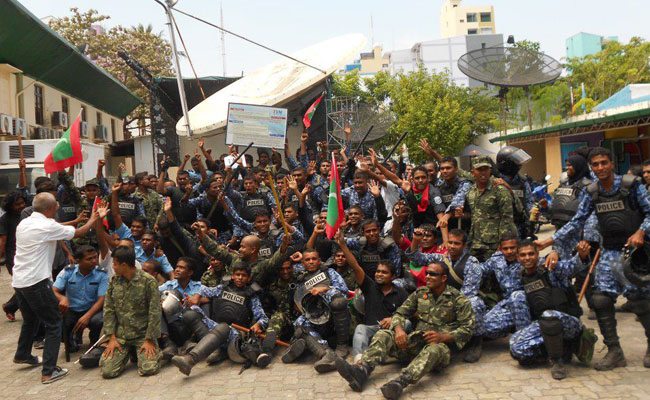
“I told them to surrender; otherwise Nasheed might lose his life”, Umar Naseer tells PPM rally

The Deputy Leader of Progressive Party of Maldives (PPM) Umar Naseer has claimed that he warned the close aides of Former President Mohamed Nasheed during the unrest of February 7 that Nasheed “might lose his life” if he did not comply with the calls for his resignation.

“I kept telling them to surrender or else you might even lose your life. I kept telling them repeatedly,” he said, adding that Nasheed had asked for security guarantees for his family.

There are also videos of the ex-colonel and former assistant police commissioners going into the MNDF headquarters, coming out and addressing the crowd, informing them that Nasheed has been told to “immediately and unconditionally resign” and then escorting him to the President’s Office under military guard.

Umar made the remarks while addressing nearly 1,000 supporters of former president Maumoon Abdul Gayoom’s PPM party, gathered at Artificial Beach on Sunday night, in its first rally since Nasheed was ousted from office and appointment of Gayoom’s hardline supporters into the new cabinet formed by President Dr. Mohamed Waheed Hassan Manik.

According to Umar, he was at the “commanding center” and mediating with Nasheed’s close aides, while political unrest escalated on Male’ during the late hours of February 6, as rogue elements of police  and  military joined the opposition protesters culminating into what the MDP claims was a coup.

“While the operation [protest] was going on that night, I was at the commanding center. I was talking to Nasheed’s close aides. I told them to surrender; otherwise [he] might lose life. I told them that repeatedly. But, firstly, they responded arrogantly saying they do not have to surrender [because] such a circumstance has arrived,” Umar claimed.

But around 8:30 the next morning, Umar claimed that Nasheed called him saying that he wanted to resign. Nasheed said that he would not participate in any political activities hereafter, Umar added.

“Nasheed called and said that he is prepared to resign. He requested arrangements to be made for him and his family to leave for somewhere else. I told him that it will be arranged and to prepare for resignation,” Umar claimed.

Following media coverage of those remarks, Umar released a statement today pointing out that he did not imply that President Nasheed’s life was threatened by police and Maldives National Defence Force (MNDF).

During the unrest, Umar said that he spoke to Former Defence Minister Tholhath Ibrahim Kaleyfaanu and told that their lives were in danger because of the large number of protestors on Republic Square.

“I said his life could be in danger because of the large number of people gathered there [Republican Square] and it seemed that police, MNDF did not have the capacity to control the crowd – not even us,” Umar said.

Umar said that “we feared from our hearts” that if the civilians [protesters] had entered the MNDF headquarters by using any means, Nashed, Tholhath and MNDF and police inside the building [at the time] would have been at danger.”

Nasheed and his Maldivian Democratic Party (MDP) have however denounced the legitimacy of the new government, and accused Dr Waheed of participating in the coup.

Meanwhile last night, some MDP supporters also took to the streets near parliament, where some MPs were staging a sit-in calling for the release of MDP MP Mohamed Rasheed, who was among those arrested from Addu for vandalising and setting fire to police and public property on February 8.

“Six of our MPs were taken away last night, I was badly beaten myself,” said MP Mariya Didi last evening, describing the aggression done to her by police forces. “I’ve got bruises all over. I’ve still got a black eye.”

Didi referenced her colleague MP ‘Reeko’ Moosa Manik, who was flown to Sri Lanka following a police attack on a peaceful march around Male’ last week. “We’ve all been beaten up for many days in a room” by police and security forces, Didi summarised.

Although charges are being issued they appear to have no base. Didi compared the allegations made against her to those made during Gayoom’s administration. “The same politicians, the same members, are doing the same thing all over again. They think they can charge us with terror charges. If this is the case then we will get huge sentences of 12 years or more,” she said.

MP Hamid Abdul Gafoor seconded Mariya’s statements, adding, “This is a coup, there is no doubt about it, and we [MDP MPs] are feeling the brunt of it.

Gafoor claimed that many MDP MPs are blacklisted and unable to leave the Maldives, although officials have denied the existence of such a list.

Protesters last night put down their signs reading “You cannot terrorise our MPs” around 9:00pm and took up the cry “Lari Lari! Yes Sir!”, mocking the police as corrupt servants of opposition party leaders.

The protests continued without turning violent until 1:00am.

Rasheed was moved to house arrest today, along with three Addu city council members detained by the police.

Likes(0)Dislikes(0)

Police fired gun in takeover of MNBC, video reveals

Video footage taken during the storming of Maldives National Broadcasting Corporation (MNBC) on February 7 reveals that a police officer used a firearm to break down the gates of the station headquarters in capital Male’, allowing dozens of police and military forces (MNDF) as well as some civilians in plain clothes to forcefully take over the station.

According to Maldivian law police officers are not issued firearms.

Approximately two hours before former president Mohamed Nasheed resigned from office “under duress” in what his government has called a “coup d’état”, a group of rogue security forces armed with batons, iron rods, wooden planks and evidently firearms “hijacked” the state media station, forcing it to change to Television Maldives (TVM), its title under former president Maumoon Abdul Gayoom.

A video obtained from an unidentified source captured the event from an upstairs window within the MNBC compound, looking down on the television station’s locked gates.

The video begins as tear gas canisters are thrown at a group of MDP activists attempting to protect the building outside the gate, billowing yellow smoke and forcing then to retreat from the area. A woman inside the MNBC headquarters screams, “Oh Mother! Mother!” as another comforts her, asking to “stop crying.”

Riot police with shields charge the gate as the tear gas clears, accompanied by several men who are not wearing uniforms. As the scene unfolds, a male voice is heard saying,  “Look there’s the police coming, they have guns”, while another man exclaims: “Oh no! That’s the bad police”.

The mob then attempts to break the heavy chain on the gates while a man inside shouts, “Oh my God, they’re opening [the gates], they’re opening”.

At the height of the attack on the gates, a uniformed police officer sticks a gun through the circular hole on the right-hand side of the gate and fires. Smoke from the weapon’s discharge floats up into the air. The crowd then bursts through the gates into the courtyard. Some of the men throw stones and one of the men, who isn’t wearing a uniform, is brandishing an iron rod in his hand. The mob then advances towards the main entrance of MNBC before the video cuts out.

“We felt trapped, kidnapped”

Minivan News spoke to some of the then-MNBC staff on duty inside the headquarters that morning, who recounted the “frightening experience” of February 7 on condition of total anonymity.

“They just stormed into the building and broke the doors and windows to force their way in. Some slapped the paper stacks and equipment off the tables. The first guy who came into the newsroom was a protestor and he ordered us to stop all the work we were doing. He kept on stomping his feet on the ground to frighten us and threatened to ‘finish us’ if we didn’t listen. So we stopped. We were all so scared,” one reporter recalled.

“In just a few minutes the whole place was filled with protesters shouting at us, police and MNDF took over the main control room. There were shouts and cries of girls everywhere. We felt trapped, kidnapped,” the reporter added.

“A policeman shouted that we [MNBC] have brought enough of what government wanted. Now its time for them to broadcast what they want,” another station employee claimed.

The employee added that they were ordered to patch through the VTV channel, owned by minority opposition Jumhooree Party (JP) Leader and MP Gasim Ibrahim. The nation watched VTV on state TV before the feed was cut off and came back on, re-branded as TVM.

Another staff member said that the security forces let the staff that wanted to leave the building exit, and assured them, “No harm will come to the rest”.

Newsroom sub-editor Ahmed Muhsin was taken home under police custody, another staff member told Minivan News.

“But we were surrounded by armed opposition protestors. We were scared for our lives,” the source continued. “The first anchor who went on air could not continue even because of the intimidation. So someone else had to take over”.

Police sub-inspector Ahmed Shiyam said that President Dr Mohamed Waheed Hassan has ordered an investigation into the events of February 7, and that police will not comment on the events of that day until the investigation is concluded.

Dr Waheed’s alleged involvement

MNBC Managing Director Adam Shareef told Minivan News that he was “advised to hide to guard his life” when the protestors stormed in threatening to attack Muhsin and himself for alleged alignment with Nasheed and his Maldivian Democratic Party (MDP).

“I was hiding inside the light room until the security forces assured me I would be given protection. When I came out Dr Waheed’s brother Ali Waheed was there. He shook my hands and said that he was there to take over MNBC on behalf of Vice President Dr Waheed. This was before Nasheed resigned.”

Shareef also claimed that Ali Waheed came earlier that morning asking to handover the state media but he refused. “I told him that MNBC had the authority to run the state media and we would not hand over it unless the security forces came. So that’s why they [police and MNDF] came with the protestors,” Shareef observed.

He said that he waited at the station to ensure the safety of his staff, while Muhsin was escorted home.

Several sources at the newsroom confirmed that members of Dr Waheed’s Gaumee Ithihaad party including Ahmed Faiz and Alim Shakoor, younger brother of newly appointed Attorney General and opposition-friendly lawyer Aishath Azima Shakoor, were in the news room “giving orders” that day.

Previously, Azima Shakoor represented parliament’s state broadcaster Maldives Broadcasting Corporation (MBC) in a drawn out tug-of-war with state owned MNBC for control of the assets of the state broadcaster, formerly Television Maldives (TVM) and Voice of Maldives (VoM).

Its also notable that after taking office, the first presidential decree passed by President Dr. Waheed was to transfer assets to MBC, although Nasheed’s administration had repeatedly contended that the MBC board is stacked with opposition supporters and that its attempt to control of MNBC is effectively a “media coup”.

Meanwhile, MNBC was criticised for favouring MDP.

State media liberated or hijacked?

The MNBC staff, who earlier spoke to Minivan News, insisted that “in the name of liberating state media, the police, MNDF and the protestors hijacked [MNBC]”.

“We know the lawful state broadcaster is MBC. But this is not the way they should take over. If the rule of law was respected as Dr Waheed promised in his first presidential address, he would not have let the security forces take control over us,” said a senior member of the MNBC staff.

Minivan News could not reach Maldives Broadcasting Commission at time of press.

The commission has however given a license to MBC, which is now preparing to take over management of the national broadcasting station’s assets, local media reports. President Waheed has replaced the MNBC board and tasked it with overseeing the transfer of assets to MBC, which the MDP has previously alleged has a board stacked with opposition figures.

Meanwhile, speaking to Minivan News, the Maldives Journalist Association (MJA) President Hiriga Ahmed Zahir claimed that the organisation has not reacted to the take over of MNBC because the police were “enforcing the law”.

“MNBC was operating the state media unlawfully, despite repeated calls from us and court orders to hand it over to the parliament-created state broadcaster,” Zahir continued.

He claimed that MNBC was “abusing the state assets, and tax payer’s money” to make the state media a “propaganda machine” of MDP, in the non-existence of a fair editorial policy.

“I am not saying it was done in the most appropriate way. It was a chaotic situation. But we will always welcome bringing unlawful actions within the legal bounds. Police is the body to enforce the laws and I see no reason to object to the police taking over the state media to hand over it to the lawful body,” Zahir said.

He added that it would have been a problem if they had destroyed MNBC’s equipment or intimidated the staff, but said the organisation had not received any official complaints although some concerns have been raised informally.

Former National Security Advisor and former Defence Minister Ameen Faisal meanwhile observed that it looks “very strange” to see the police in the video firing a gun outside the MNBC office.

“It’s very strange to see. It’s very clearly seen in the footage that they were firing from the main outside gate inside [the MNBC compound] and our police force has never been issued with guns. The big question is how they got the guns. Evidently it was from the MNDF because they are the only people authorised to carry guns.”

He further added that the Maldives witnessed a “police mutiny turn into an armed mutiny” on February 7, which forced a democratically-elected president to resign.

“Any democratic country will not accept a government which used the police force and mutiny to forcefully resign a democratically-elected president. They have to condemn [the new administration], with this video footage and with all the torturing by the police. They should not accept the legitimacy of the government and should ask the people of the Maldives to decide who their president should be,” Faisal contended.

A photo circulating on Facebook apparently showing defected police and MNDF celebrating in the courtyard of the state broadcaster, after taking it over on Tuesday.
Likes(0)Dislikes(0)

“The country I want to go most eagerly is not safe anymore”: WEIBO China

In the poll “Has the coup affected your holiday plans in the Maldives?” hosted on a Chinese website on February 12, a little more than one third of the 8,107 votes chose “it has affected them more or less”, while one third of Chinese voters indicated “it has no influence on them”. Less than one third were unaware of the political situation.

Following the abrupt resignation of former president Mohamed Nasheed early last week China’s embassy in the Maldives, which opened in November, 2011, notified Chinese agencies and media outlets in an unofficial advisory that capital Male’ is currently unsafe for tourists and advised tourists to make only necessary trips to Male’.

“We have been trying our best to ensure Chinese nationals’ personal safety. Tourists reach the international airport and then can directly go to the resort. They will be safe on the resorts,” said Sun Jianbo, Second Secretary of China’s Embassy in Male’.

“As far as I know, no harm to Chinese tourists has been caused by these political events yet,” he added.

In 2011, China rose to become the No.1 source of tourism, surpassing the Maldives’  traditional European market with over 700,000 arrivals last year. The jump in business has re-shaped the industry- local travel agencies and resort staff are now keen to hire Mandarin speakers and are working to stay current on Chinese cultural habits.

Although many have projected that China will remain a stable, even growing partner in tourism, the Chinese market was quick to respond to what Nasheed’s government has called a coup d’etat on February 7.

A few Maldivian travel agencies who work closely with the Chinese market told Minivan News that the current politics has started to influence their bookings. “Quite a lot of Chinese customers are very concerned of this situation. Some of them are hesitant to make reservations now,” said Emy Zheng, a Chinese national working at Villuxa Holidays. She noted that only a few bookings have been cancelled, while several others have tried to postpone their holiday.

Zheng suggested that most Chinese nationals responded well to explanations of the situation, and assurances that the Maldives one-island one-resort mantra guarantees vacationers distance from local events.

“I told guests about the real life in Male’, which is more reliable than news they get from media in China. Some friends in China are very worried about my life here after seeing news on TV, but personally I don’t feel threatened living in Male’ as my friends and I just stay at home after work,” Zheng explained, adding, “I don’t think many Chinese have the access to know the real life here.”

Like Zheng, many Chinese national workers in Male’ have stuck to their routines. For them, the tourism industry has only been minimally affected. In China, however, travel agencies say the market is taking a heavy hit.

Shanghai travel agent Sun Yi said she was faced with many cancellations just two days after the coup. ”It has seriously affected our business. Many guests cancelled the Maldivian holiday package which used to be very popular,” she explained.

Yi continued that her company has also decided to suspend its plan to hold a commercial event at a Maldives resort this spring.

Although a Chinese tourism industry professional on the marketing of holiday destination Maldives, Yi has not yet visited the country. She said she is very worried about the current state of affairs.

Social media suggests that the average Chinese traveler is barely informed.

Before most Chinese media outlets had reported news of the Maldives’ change of government, travelers-to-be noticed a post in WEIBO (Chinese version of Twitter) by Maldives resort-based Chinese diving instructor Jai He.

Mr. He received the news of Nasheed’s resignation while watching national television during his lunch hour on Male’. After posting the news on WEIBO he was immediately contacted by a few Chinese media.

But now, a WEIBO search for “Maldives” yields only a few incomplete statements of the actual events; most posts voice poetic concerns of a tainted dream holiday or honeymoon, or an exaggerated description of the current situation in paradise.

One forum user wrote, “Fires of war are burning through the country. The country I want to go most eagerly is not safe anymore.”

Among the posts the word “democracy”- a concept politicians on both sides of the divide are using as weapon and shield – was uncommon.

WEIBO has undoubtedly become a platform for some Chinese to enjoy a moderate amount of free speech. While the Maldives is a definite topic of conversation, WEIBO users are more concerned with the damage to their holiday dreams than the threats on Male’s streets- or the connection between the current change of government and China’s own so-called “democratic centralisation”.

But the government is more cautious.

While the US and India have recognised the Maldives’ new regime under former Vice President Dr Mohamed Waheed Hassan, China has not officially expressed any political leaning.

Second Secretary Jianbo told Minivan News he had no idea what would happen to the regime, but “things seem to gradually be calming down now as the new government has appointed new officers today.”

In spite of the uncertainty, the Chinese tourism board has not issued a travel alert for the Maldives.

“We are not able to release anything now towards the current situation until the Chinese
foreign affairs department speaks,” Sun said, indicating that more information would be available in a few days’ time.

“The Embassy’s most important function is to maintain and deepen the two countries’ relationship,” Sun explained. Asked whether China will continue to foster a close relationship with the new government, Sun said, “No comments”.

Likes(0)Dislikes(0)

Comment: MDP should rethink strategy

So much has happened in the last few days. A democratically elected popular government has been ousted from power and the VP has been sworn in as the new president. The country is in turmoil amid fears that three years of democracy could be undone with the change in government.

Police brutality has made an apparent comeback and the public is nervous and sometimes afraid. It is time for the MDP to take stock of the events of the past week and change the party’s current action strategy now.

I don’ t think confrontation or aggression against the current government is the way to win majority of Maldivian hearts.

Currently the MDP is presented with an opportunity to win a clear majority of Maldivian hearts and sweep an election easily. But it can only happen provided the MDP changes their strategy and plays its fortunes correctly.

There are many reasons why a change in strategy is important.

One of the main reasons is that their opponents control the majority of media organizations in town in their favor. The only news service favorable to MDP are;

1. Raajje TV
2. Minivan News

Let us keep in mind that none of these news organizations has a nationwide reach. They are mostly accessible only to people in Male’ or people who have access to the internet. By rough estimates, that is just about 1/3 of the population, if not less.

MDP needs to get their message across to the total population for them to be successful in their goals. A new strategy should include how to make the “enemy” media work for MDP as well.

How to do this?

It is not that easy, but a few changes in current course – or “mid-way course correction”, as Anni once called it – could be a good place to start.

MDP should immediately do two important key things right now.

1. Consult with all party members.
2. Correct action course according to the consultation of party members.

One might say, that MDP is acting now as per consultation of the party members.
I disagree. What is happening is, irrational thinking fueled by surprise, hurt and humiliation of being ousted in a coup (I believe there is sufficient evidence to suggest this is a coup and I don’t support any non-constitutional change in government – but that is my personal opinion) is responsible for bad judgement in setting the current course of the party.

Saner minds would say the current course of the party is heading towards conflict that would be difficult to resolve later on. After all, we are a very small community and people on different sides are effected equally (by way of family relations, friendships and business contacts). We simply can’t afford to be enemies in this tiny land of ours. Our future depends on how we navigate the current political crisis.

Coming back to the two key points I mentioned earlier. How do we consult the members of the party? And how to structure the consultation so that the decision of the members of the party are clearly defined and useful?

By way of a poll.

MDP has good credentials when it comes to polling its membership. Free and fair elections have been held at party level in the past and there is no reason why it cannot be done now or in the future.

Poll the membership to find out what they want. A simple poll could be like this:

Now that the MDP leadership has been ousted from the presidency of the Maldives (illegally, if it makes the MDP happy – the party can phrase this any way they like), and we are faced with the current scenario, what would you as a member of the party have us do next?

1. Protest the current governments legitimacy, request for the resignation of President Waheed and call for fresh elections in 2 months or “threaten” with street protests if they don’t not comply.

(This is what the MDP is doing right now – basically its asking the party membership for a full endorsement of the current course of action.)

2. Request for a full independent investigation into the events surrounding the “forced at gunpoint” resignation allegations, and if this is proven to be true, request for fresh elections and then “threaten” street protests if Waheed’s government doesn’t comply.

3. Accept what has happened (albeit illegal) and start preparing the party for 2013 elections. Meanwhile the party should restructure its leadership if necessary and establish a shadow government and contribute meaningfully to protect the reforms achieved during President Nasheed’s leadership in the past 3 years, and ensure they remain in place and are not reversed or rolled back.

4. Join the coalition government of President Waheed and work for a solution by working with the “enemy”.

By conducting such a poll, MDP reiterates in action its commitment to a democratic process and its actions would be endorsed by its membership.

While such a poll is conducted, media on both sides will have no choice (if they have an ounce of credibility) but to give publicity to the poll and thus, to the MDP and its future actions.

I do hope that reason and sense will eventually prevail and that our tiny nation is not thrown to the dogs in this politically turbulent climate.

I wish the MDP much success in the future, because I honestly believe that it is by far the most democratic party in town and currently the best solution for the country.

I do not wish to see this country go through an autocracy ever again. I wish the people of Maldives much success today and in the future. Please let good judgement take the lead as you tackle the future of our country and our people. Promote democracy and rule of law!

Muzaffar ‘Muju’ Naeem is a media strategist and consultant. He currently works in the public relations sector. He is a member of the Maldivian Democractic Party and a contributor to the initial democracy movement when he co-founded the Dhivehi Observer.

All comment pieces are the sole view of the author and do not reflect the editorial policy of Minivan News. If you would like to write an opinion piece, please send proposals to [email protected]

Likes(1)Dislikes(0)

Comment: Appeal for help

On the 7th of February, 2012 the lawfully elected Government of Maldives was overthrown by a mutiny carried out by joint factions of the Maldives National Defense Force (MNDF) and the Maldives Police Service. Maldives President Mohamed Nasheed was forced at gunpoint to write a letter of resignation addressed to the Speaker of Parliament Abdulla Shahid.

Using the above mentioned letter that was processed under duress, was used as a pretext to usher in the then Vice President Dr Mohamed Waheed Hassan Manik to the President’s chair. Soon thereafter, Dr. Waheed appointed a new Home Minister, a new Defense Minister and a new Police Commissioner. It has now been revealed that these new posts are taken up by the leaders of the coup.

The self-claimed government of Dr Waheed is using the military and the police force to beat and arrest MPs and others loyal to the former government. This large scale crackdown on the members of Parliament and supporters of President Nasheed is continuing.

At the moment, the UN, Commonwealth and other bodies are trying to diffuse the situation.

Meanwhile, the leaders of the coup including Dr Waheed are using their newly assumed powers to suppress free media, conduct extra-judicial arrests and utilise the Criminal Court in issuing court orders for the arrest of President Nasheed and his supporters. We believe they are trying to wipe out the democracy movement by destroying the Maldivian Democratic Party.

As indicated by the popular uprising in the aftermath of the coup, a great majority of the Maldivian people do not accept the newly established government in power.

President Nasheed won the Election in 2008, after 30 years of autocratic rule by Maumoon Abdul Gayoom. New President Waheed named ministers on Sunday who are almost all veterans of the government of Maumoon Abdul Gayoom, who ruled the Maldives for 30 years until Nasheed beat him in 2008 in a presidential election.

We believe that despite counter claims of Dr. Waheed, his move up from vice president to the head of state did not follow constitutional procedures after Nasheed was forced to resign.

We call upon citizens of all democratic countries to condemn this coup and to demand from the government of Dr. Waheed to hand over power to the Speaker of Parliament in accordance with the Maldives Constitution, until a free and fair election can be held. We also demand from the international community to conduct an independent inquiry of the process that lead to the forcible removal of President Mohamed Nasheed from office.

Help us save this young democracy, before the coup leaders and the mutinous military and police take back our democratic rights.

All comment pieces are the sole view of the author and do not reflect the editorial policy of Minivan News. If you would like to write an opinion piece, please send proposals to [email protected]

Likes(1)Dislikes(16)

Commonwealth to send urgent ministerial team to Maldives “to ascertain facts surrounding transfer of power”

The Commonwealth Ministerial Action Group (CMAG) will send an urgent ministerial mission to the Maldives to “ascertain the facts surrounding the transfer of power, and to promote adherence to Commonwealth values and principles.”

The meeting was convened by Secretary-General Kamalesh Sharma and chaired by Surujrattan Rambachan, Minister for Foreign Affairs and Communications of Trinidad and Tobago.

Other members of the Group who participated in the meeting were: Kevin Rudd, Minister for Foreign Affairs of Australia, Dr Dipu Moni, Minister for Foreign Affairs of Bangladesh, John Baird, Minister for Foreign Affairs of Canada, Senator Hon Arnold J Nicholson, Minister for Foreign Affairs of Jamaica, and Joseph Dauda, Minister for Foreign Affairs of Sierra Leone.

“CMAG received a briefing from the Foreign Secretary of Maldives, Mr Mohamed Naseer, on the events leading up to and following the resignation of President Mohamed Nasheed on 7 February 2012. The Group was also briefed by former President Nasheed. The Secretary-General advised the group regarding his own interactions with President Waheed and former President Nasheed, and the findings of the Commonwealth Secretariat team currently in Maldives,” the statement read.

Meanwhile, new President of the Maldives Dr Mohamed Waheed Hassan had today asked the Australian government to recognise the new government of the Maldives, which ousted President Mohamed Nasheed alleges is illegitimate following his resignation on February 7 “under duress”.

In an interview with The Australian newspaper, Dr Waheed said blamed international concerns about the situation on a “very biased message that has gone out”, claiming that “it could have an effect on how friendly countries like Australia view the situation.”

“I hope in the next two or three days there will be more understanding of what’s going on here,” he told the paper.

Dr Waheed said he was “not happy” about the arrest warrant for Mr Nasheed, but he would not intervene, the Australian reported.

“One of the problems that led us into this crisis was the involvement of the executive in the judiciary,” he said.

“I know there are some problems with the judiciary, but our democracy is still very young so the solution is not to have one branch of government fight with the other but to find ways of resolving matters.”

He conceded to an investigation into the allegations that Nasheed’s duration was under duress, and “that a half-brother of former president Gayoom had, just days earlier, offered financial inducements to any police officers who were prepared to mutiny”, the paper reported

“I think at the end of the day, he (Nasheed) is responsible for whatever has happened to him, and he should not be looking for scapegoats,” Dr Waheed said.

In the statement, the Commonwealth noted that heads of government had increased the body’s mandate in Perth in 2011 “to consider situations of concern in member countries in a proactive, engaged and positive manner.”

CMAG recognised “the impressive gains made by Maldives in recent years in consolidating multi-party democracy”, and “expressed its solidarity with the people of Maldives to select a government of their choice through democratic means.”

“CMAG stressed that the way forward must be determined by Maldivians themselves, through inclusive political dialogue in an atmosphere of non-violence, restraint and stability.”

The mission to the Maldives will be followed by a report, and a further extraordinary meeting.

Likes(0)Dislikes(0)

Dr Waheed appoints majority opposition, Gayoom supporters to cabinet

President Dr Mohamed Waheed Hassan Manik made seven new appointments to the cabinet on Sunday morning.

The majority are hard-line opposition figures, while several are long time supporters of former President Maumoon Abdul Gayoom. Only two of the new appointments (the tourism and and health portfolios) have previously undeclared political affiliations.

Dr Waheed has faced pressure from his predecessor former President Mohamed Nasheed, who has challenged the legitimacy of Dr Waheed’s government claiming that he was forced to resign in a bloodless coup d’etat  on February 7 at the hands of rogue police and military officers.

Dr Waheed said yesterday that he wanted cabinet to “represent all major political parties”, hoped that Nasheed’s Maldivian Democratic Party (MDP) would be represented, and said he would “keep posts vacant for them”. The MDP has so far rejected any participation in Dr Waheed’s government.

Mohamed Hussein Shareef ‘Mundhu’ was appointed as the Minister for Human Resources Youth and Sport. Shareef has been the spokesperson for former President Maumoon Abdul Gayoom since his last term in office and also holds the Acting Secretary General’s post in Gayoom’s Progressive Party of the Maldives (PPM).

Aishath Azima Shakoor was appointed as the Attorney General. She once held the same post under the former administration and is known be one of the most successful lawyers in the country with a record number of wins in controversial cases against Nasheed’s administration. She is a council member of Gayoom’s PPM.

Ahmed Mohamed ‘Andey’, Deputy Leader of leading opposition party Dhivehi Rayyithunge Party (DRP), was appointed as the Minister of Economic Development. He has been an outspoken critic of Nasheed’s privatisation policies and the state’s budget formulation. He was the former CEO of the State Trading Organisation (STO) under Gayoom’s administration, the organisation implicated in blackmarket oil trading with the Burmese military junta under the former chairmanship of Gayoom’s half-brother, Abdulla Yameen.

The DRP was the first official party registered by Gayoom before he announced his resignation from politics in February 2010, becoming the party’s ‘honorary leader’. He became increasingly politically active and later fell out with his anointed replacement, Ahmed Thasmeen Ali, and formed the PPM after an acrimonious split.

Dr Asim Ahmed, a member of the DRP, was appointed as the Minister of Education. He has not been a particularly active member in the country’s political spotlight.

Dr Ahmed Shamheed was appointed as the Minister of Transport and Communication. He is a member of minority opposition Jumhooree Party (JP) and works as a Director at Villa Shipping and Trade, owned by JP Leader Gasim Ibrahim. He served in the ministry of planning and development under Gayoom’s administration. He is also a director of the Maldives Tourism Development Corporation Board (MTDC).

Ahmed Adheeb, was sworn in as the Minister of Tourism Arts and Culture. Adheeb is the President of the Maldives National Chamber of Commerce and Industry (MNCCI) is well known as a critic of the Nasheed’s economic policies. Under his leadership, the MNCCI made a failed attempt in court to halt the enactment of the Goods and Services Tax (GST) Act, citing worse economic ramifications and violations of law. He is a widely respected economic analyst.

Dr Ahmed Jamsheed was meanwhile appointed as the Minister of Health and Family. Jamsheed, formerly Director General of the Centre for Community Health and Disease Control (CCHDC) resigned from his post, over concerns about reduced workloads, and later joined as the Cheif Operating Officer (COO) at ADK hospital. He is one of the leading and most outspoken public health experts in the country, and has been extremely active in promoting both public health and combating malaria epidemics in the Maldives.

Dr Waheed earlier appointed Deputy Leader of minority opposition Dhivehi Rayyithunge Party (DQP) Dr Mohamed Jameel as the Home Minister and retired colonel Mohamed Nazim as the Defence Minister last week. Both are also notable supporters of Gayoom. Most recently Dr Jameel, Gayoom’s Justice Minister prior to the separation of powers, was an outspoken critic of Nasheed’s religious policies, authoring a pamphlet entitled ‘President Nasheed’s devious plot to destroy the Islamic faith of Maldivians’ and attacking his “business dealings with Jews”.

Dr Jameel is the only member in the cabinet from DQP, Dr Shamheed only member from JP while including Nazim the ministerial posts held by DRP members reach three and PPM stands at two.

Meanwhile ministers are yet to be appointed to the Finance Ministry, Islamic Ministry, Foreign Ministry, Fisheries Ministry and the Housing Ministry.

Abdullah Riyaz, former Assistant commissioner dismissed by Nasheed was appointed as the Commissioner of Police and Major General Ahmed Shiyam, appointed as Chief of Maldives National Defence Force (MNDF).

“No self interest”

Speaking after the appointments, President Dr Waheed said that remaining cabinet ministers will be appointed in a week, and expressed his hopes for MDP’s participation.

“We all are with that hope. Because, today the country needs all of us to work together to establish peace, and take the country out of the deep pit of economic and political [problems] to find a prosperous future for our children,” Dr Waheed said.

He also added that: “I cannot do this work without the benevolent and sincere help of the [cabinet ministers]”, who he claimed had the full potential to serve the nation with “no self interest” during these “special circumstances”.

The newly appointed cabinet ministers must be approved by the parliament, in which MDP currently holds 35 seats, a single seat behind total opposition combined.

Minivan News could not get MDP’s comment on the new appointments as no member was available at the time of press – however, MDP has steadily rejected the legitimacy of Dr Waheed’s government accusing him of participating in what they call an opposition backed coup to force Nasheed out of office.

MDP Thodoo MP Ali Waheed has earlier stated that MDP will do everything to “stop the implementation of Dr Waheed’s every order” through parliament if he continues to remain in office, and ignores the party’s call for new elections in the next two months.

Likes(0)Dislikes(0)

SAARC to dark: Violent social divide in Addu as uncertainty grips southern-most atoll

One of society’s biggest fear factors is uncertainty, and in Addu it appears to be fueling a violent social divide in the isolated MDP stronghold – the second most heavily populated area in the Maldives after Male’ and the scene of the SAARC Summit in November 2011.

On Saturday several members of the international press flew to the southern-most atoll to investigate claims of firey protests, beatings and unjustified arrests. While the torched remains of every police building and most courts between Gan and hithadhoo are proof that destruction of public property – and many legal records – has taken place, the back-and-forth ‘whodunnit’ accusations color fears of revolution with a strong shade of small-town politics.

“The police’s personal property, their computers, was burned inside the stations,” observed Alif Fahumy Ahmed. “This isn’t necessarily political.”

On Wednesday night police stations and court houses in six southern atolls were torched after police violently cracked down on a Maldivian Democratic Party (MDP) march in the capital Male, in which thousands marched in support of ousted president Mohamed Nasheed.

Nasheed’s decision to order the detention of Chief Judge of the Criminal Court on January 16, in an attempt to push forward judicial reform, prompted three weeks of opposition-led protests with a nightly attendance of 200-400 people, culminating on Tuesday in what many have called a military coup.

While the southern protests were said to be the work of MDP supporters, in Addu, which claims a majority MDP population, people have begun slicing and dicing the duty.

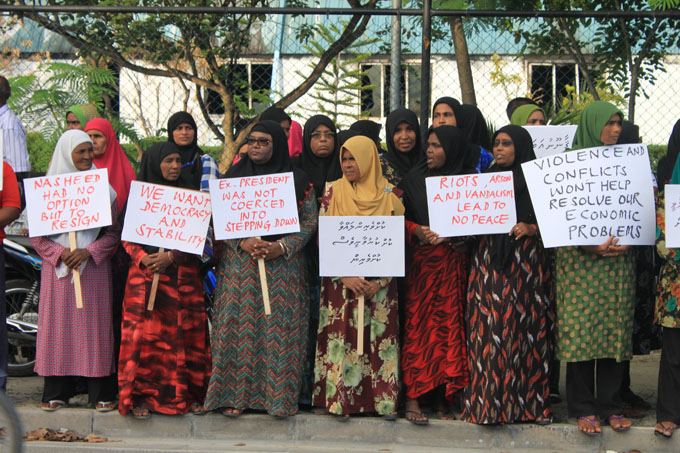
“Maldivians are a very innocent people, but this violence was brought by MDP,” said Ani Luthfy, who yesterday organised a ‘protest for safety’ in Addu, with the rapidly-formed and ‘non-political’ Addu Alliance.

The placards that greeted journalists included “Ex-President was not coerced into stepping down” and “Violence and conflicts won’t help resolve our ecomonic problems”.

“Addu MDP [Councillor] Hussein Shahid gave 30 young people alcohol and when they were drunk he led them out to do the burning,” he alleged, adding that MDP activists have acted like “hooligans”.

Police meanwhile yesterday reported the arrest of MP Moosa Rasheed, Addu City Hithadhoo Medhu Dhaairaa. His arrest reportedly followed an investigation into a spate of attacks in Addu City that occurred on February 8, following a brutal police crackdown on protesters in Male’. Police say that he was arrested lawfully, under a warrant issued by the court and in consideration of various evidence including video footage and eyewitness accounts that connected him to that night’s incidents.

According to police yesterday, tensions escalated in the islands after rumours of serious injury and the death of former President Mohamed Nasheed at the hands of security forces on Wednesday reached the islands.

Luthfy said, “we have a motto: live and let others live.” He said the alliance would continue to protest until Addu was “100 percent safe”, a point in time he defined as “When the police have taken all MDP who are in hiding.”

Meanwhile Muaz Saleem, a prominent MDP supporter on Hithadhoo, said the group “was just going in front of Gan police station to express our concerns” on Wednesday.

“Who knows if police may have started [the fire]? They left before people went in, where was the tear gas? We strongly believe the opposition encouraged people to start the violence, it was a plan. ”

A former member of Hithadhoo council, who requested anonymity and did not wish to discuss his resignation last year, suggested the opposite. “The funniest thing is that the mayor [MDP member abdullah sodig] hasn’t issued a statement about this,” he said, estimating the damage at Rf200-300 million (US$13-20 million).

Sodig has been in hiding since he was attacked Wednesday evening.

The former council member confirmed that many have followed Sodig’s lead. “Because of this protest most people are on a wanted list, ” he explained, suggesting that to some extent the list was justified: “There are CCTV camera tapes with evidence.”

Amid speculation, police have taken action. MDP supporters said they have been targeted by police and military forces, who were deployed to Addu after Wednesday. They claim the “hit list” has been drawn up by members of opposition parties Progressive Party of Maldives (PPM) and Dhivehi Rayyithunge Prty (DRP), and that those individuals are assisting security forces to beat and arrest MDP members – often without evidence.

One 22 yr old man, who claims not to have participated in any recent gathering, said he was handcuffed and pepper sprayed in his eyes and genital area along with 40 other people. ” because of the violence, they said, I was a terrorist. They said we had dstroyed everything.” he added that some members of the detained group were told to take off their shirts and were taken to a separate area of the burned Gan police station “to be beaten. I could hear the shouting, and cries.”

Minivan News received unconfirmed reports that the Elections Commission’s SMS service – which allows people to send their national ID number and find out what party they are registered to – was being abused by groups of police aided by opposition supporters, to ‘hunt down’ MDP members.

While sources claim the attacks are directed at MDP, their stories suggest that the security forces are not operating with a political-or evidence-based motive.

Two young men interviewed, one of whom sported a bruised right eye, denied being part of any political party. Another said he wasn’t even part of the protest. Yet none would give names “because it might not be good, they said if I talked about what I saw they would come back.”

Muaz Haleem’s wife said the violation of her right to privacy at home, and the lack of an explanation, are her biggest concerns.

She reports seeing several policemen run into her home with raised batons yelling an unfamiliar name. “I said it was the wrong house, wrong name. But they pushed me down and said, ‘now we want Muaz ‘ and began beating him and dragging him out of the house.”

“I asked about the court order, and they said, ‘What court order? You guys burned down the court house. What rights do you want?'”

She explained that her neighbors have been far from helpful – in fact, they were part of the problem.

“Most people on the other side of the road are PPM (Gayoom’s Progressive Party of the Maldives). Mr Hamid was out there directing the whole thing, pointing at the house and everything.”

The family of Mohamed Saeed, whose detention has been extended by 15 days, said they too had not been informed of Saeed’s arrest, and that their neighbors are only cautiously supportive.

“They ask for news, but they are afraid to help because they could also be taken,” his wife explained.

Saeed is one of approximately 80 men who are still being held in the remains of Gan police station, reportedly in terrible conditions.

“He has asked to go to the hospital but they say they have no vehicle,” his brother in law said.

Others, such as Haleem, appear to have been detained on an aggressive whim, in retaliation for the destruction of police property.

“They gave me a cup for tea and then struck it down. They just dumped people in the courtyard of the station amid the broken glass and burnt debris, and pushed me down to the ground for sleeping,” he said. Haleem currently has a swollen left wrist and cuts where he claims the handcuffs were squeezed closed.

While Haleem believes the security forces are targeting MDP members, he suggests that their motive is more personal than political.

“It looks like there is a massive financial factor,” he said. “We have had the trust of the Maldives National Defence Force (MNDF) for ages in this country, but under Nasheed individual police have shown they are motivated by something. I don’t have proof, but that’s what I strongly believe.”

He further explained that “The opposition has fewer numbers, but now that they have the security forces with them, they can act.”

Meanwhile most who claim to support the current government are consistently saying “It’s not the opposition, and they’re not beating people. The police have just asked the public for assistance,” explained a former councillor.

No members of opposition parties have been reported beaten, arrested, or detained.

Meanwhile, the arrival of the Human Rights Commission of Maldives (HRCM) has triggered some over-excitement. One MDP member yesterday informed the author that the police had lied to HRCM about the whereabouts of a detainee, and that HRCM was arguing with police over the matter.

HRCM’s delegation in Addu later stated that the detainee had been released from the hospital by the time HRCM had gone to look for him, and that he is now at home.

As high level delegations hold conference with President Dr Waheed and former president Nasheed, and HRCM surveys police operations in Addu along with the Police Integrity Commission (PIC), police and military appear only watchful. Still, the tense mood is palpable.

“We are not safe because we don’t know when again it will start,” said one man outside Feydhoo’s smoldering court house.

Ahmed said he had no confidence that the political issues in Male will be quickly resolved: “Things in Addu have calmed at the moment, but they may continue once HRCM and the reporters leave.”

It remain to be seen whether similar violence and revenge attacks will grip Male’, once the international community departs and visiting foreign journalists run out of stories.

The 'Addu Alliance' greeted foreign journalists, in support of Dr Waheed's government.
Likes(1)Dislikes(0)

Comment: I am for democracy too

A coup is a coup. Much of what transpired at MNDF headquarters the morning of February 7 remains unclear, but several key facts have come to light, and placed in the context of Maldivian politics, leave no doubt in my mind that President Nasheed was ousted in a cleverly executed coup.

Following Nasheed’s forced resignation, the entire country burned. Key law enforcement institutions became Enemy Number One overnight. In contrast to the relative professional and non-violent reaction to protests against Judge Abdulla’s arbitrary detention, police used brutal force and violently targeted key MDP officials on February 8. Controversial appointments to key posts in Dr Waheed’s government, particularly the Minister of Defence and the Commissioner of Police, who served as the main interlocutors with President Nasheed at MNDF HQ, with no legitimacy whatsoever, further deteriorate MDP supporters’ faith in the police and the MNDF.

In an atmosphere so emotionally charged and tense, it is an elephantine task to remain rational, to stick to facts, and to make decisions that will save our democracy in the long run. It is even harder to do so when media channels, on either side of the political divide, are biased and resorting to propaganda. Nasheed and his supporters have unleashed a deluge of hyperbole to rile up crowds and chip away whatever is left of the public’s trust in the police and the armed forces.

Nasheed showed Waheed’s government and the international community his ammunition when he led his supporters into a direct, violent confrontation with the police and armed forces on Wednesday. He is using the threat of violence to force elections in two months, when it is very clear that an election in two months will not be free and fair. In the meantime, Waheed has come out to say he will not hold elections until 2013. What has been lacking in our democracy since 2008 stands in the way of restoring democracy today. Democracy is about compromise. Nasheed and Waheed need to meet each other half way so that our democracy is not flushed down the drains of history.

Even if Waheed’s government is illegitimate, what is done is done. And protracted civil unrest and violence in small communities, which may take generations to heal, is not the way forward. At a time when people are divided and emotional, we need strong leaders who place the good of the nation above personal gain. Waheed must have the balls to ensure that his government does not go after senior leaders in the MDP in the run up to elections in six months. In return to agreeing for elections in six months, Nasheed and his co must be given guarantees by Waheed’s government that the MDP leadership and supporters will not be made political prisoners. In my mind, there is really no other way forward and if people have suggestions, it is time we start a national debate on how to overcome this impasse in a conciliatory manner.

You say a liberal?

That said, the coup d’etat of February 7 is also a window of opportunity for the people to demand more and better from of our political leadership. One person had written on facebook that we might have been too tolerant of President Nasheed’s runaway administration. True, opposition political parties under Nasheed’s administration did not play by the same lofty rules we set for the government. But with more power comes more responsibility. Nasheed was in power, the opposition parties were not, hence the double standards in expectations. With our civil society so weak from 30 years of authoritarian rule, the political leadership had a massive responsibility. Nasheed had the power to write the story of our democracy differently. He may have lost elections in 2013 if he did, but he would have been a mighty hero in my mind had he focused on strengthening our democratic institutions over forcing and bypassing democratic institutions to ensure the fulfillment of the MDP’s five key pledges.

A 30-year dictatorship left a legacy: an uneven playing field; a weak civil society; a small and toothless middle class; a dearth of self-thinking peoples; and a biased media. The vestiges of dictatorship remain and they matter. History matters. But it only directs, it does not determine. The many constitutional crises, the political posturing, and the name-calling we see today are not inevitable results of a 30-year dictatorship. It is the combined result of a 30-year dictatorship, and a conscious choice by the Nasheed administration to play power politics instead of fostering the slow, painful and perhaps, in the short run, self-defeating, democratic reforms that would have strengthened our democracy.

When Nasheed came to power in 2008, he inherited not only a massive budget deficit, but also a political system that operated on political patronage. Nasheed did not try to change this informal system. He adopted masters of such politicking, including Ibrahim Hussein Zaki and Hassan Afeef into his administration, indicating that political realism would provide Nasheed government’s ideological grounding. To outwit Gayoom et al, Nasheed decided to play the power game instead of democracy. In doing so he acted like an astute politician, not a liberal democrat. Those who expected the latter, mostly liberals, are deeply disappointed with the Nasheed administration. The handful of young and educated who were convinced that an MDP defeat in 2013 would spell out the end of democracy, and those who foresaw an end to their innings with the end of Nasheed’s government, were glad that he played the part of a clever politician. But then the coup happened.

In a very real way, Nasheed himself is to blame for presenting coup planners with ample fodder and opportunity. Arbitrarily detaining Chief Judge of the Criminal Court Abdulla Mohamed for nearly 20 days, in spite of the arrest’s unconstitutionality, in spite of continued street protests that often turned violent, and in spite of escalating police fatigue, Nasheed defended the arrest to the last minutes of his administration and continues to defend it today. But to this day, Nasheed has not explained the precise national security threat that justified the military detention of Abdulla Mohamed. By commanding the MNDF to arbitrarily arrest Abdulla Mohamed and detain him on their training camp, Nasheed unnecessarily plunged one of Maldives’ few professional institutions into disarray and opened it up to politicisation. Presidents who are concerned with consolidating democracy do not issue such orders. They do not think in “either or” terms. Creativity and compromise are fundamental characteristics of a strong democratic leadership.

You say a revolution in 2008?

History matters. Those who were rich and powerful under Gayoom, remain rich and powerful today. In short, our democratic “revolution” in 2008 failed to change the status quo. The aristocrats and merchants who own the tourism, fishing, construction, and shipping industries act like an oligarchy. They have the means to ensure that they maintain their monopolies and deflect any harm that come their way. Take for example what happened with the penalties for tax evasion. And where is the minimum wage bill? What happened to workers’ right to strike? When democratic institutions, such as the parliament, become monopolised by aristocrats and merchants, and when the main rule of law institution, that is the court system, remains dominated by unlearned persons who are easily manipulated by the aristocrats and merchants, the middle class that is the key to democratic consolidation, has no representation and no space to assert itself.

To his credit, Nasheed did attempt to foster a middle class. He implemented a long overdue taxation system that forced tourism tycoons to pay their fair share for state bills. His policies sought to improve access to basic services. And he faced huge challenges. But in playing power politics, he also ensured that the rich and powerful remained so, and nurtured a new group of rich and powerful people who would ostensibly protect his presidency and candidacy in 2013. To that end, a number of development projects continued to fall into the hands of those affiliated with the MDP, and sometimes those hands were not the most capable and able. And the lease of Ibrahim Nasir International Airport is anything but transparent. If justice is fairness, Nasheed government’s corrupt activities fell short of delivering justice, and served to exacerbate the already existing crisis in the judiciary.

Way Forward

The way forward is in compromise and learning from mistakes. It is not in taking sides and refusing to budge. Peace is not a platitude. To characterise peace, conciliation, and negotiation as platitudes and “bullshit” is to reject the essence of democracy. And being “colorless”, and withholding blind support for the MDP or any other political party is not a wholesale rejection of democracy. Restoring Nasheed, whichever way possible, will not restore democracy.

No to street violence, No to political witch hunts, No to destroying the social fabric of our small nation, and No to politicising our armed forces and the police. But Yes to elections in six months. The current government is illegitimate and the nation cannot afford to wait until 2013 for presidential elections. At the same time, MDP supporters will risk the nation by going out on to the streets. The political leadership of this country should go to the negotiation table fast if we are to restore democracy. And people of this country should step back from pledging blind support to leaders. Learn from mistakes. Pledge your support to democratic processes. Pledge your support to negotiations and elections, not in two months when an election would be impossible, but in six months, when it has a better chance of translating your vote freely and fairly.

All comment pieces are the sole view of the author and do not reflect the editorial policy of Minivan News. If you would like to write an opinion piece, please send proposals to [email protected]

Likes(0)Dislikes(0)