Comment: India-Maldives ties moving forward

Nothing explains the width and depth of bilateral relations between India and Maldives than the speed with which the People’s Majlis passed a special legislation unanimously for the visiting Heads of State and Government to address members in a special session, only days before Prime Minister Manmohan Singh was to arrive in Male for bilateral talks with President Mohammed Nasheed.

Despite the deep divisions within the Maldivian polity, which often gets reflected in Parliament, as in other democracies, Maldives offered a near-full House when Singh became the first visiting Head of Government to address the House.

“The People’s Majlis is a testimony to the strong faith the people of Maldives have shown in democracy. As a fellow democracy, we take delight in your achievements,” the Prime Minister said.

“India will be at your side in your transition to a fully functioning democracy. We will assist the Majlis by way of training, formulation of rules and regulations, and any other assistance that you may desire,” he said, touching upon the democratic milestones achieved by this “pearl of the Indian Ocean” in a short span since 2008, when the nation adopted a new Constitution providing for multi-party democracy and elected a new President.

Singh also touched upon the formation of the India-Maldives Parliamentary Friendship Groups. The Indian Prime Minister also met with the Leader of the Opposition in the Majlis, Thaseen Ali of the Dhivehi Rayyathunge Party (DRP), setting a healthy precedent.

In a way, the Prime Minister’s references to the ushering in of democracy in Maldives and the strengthening of democratic institutions in the country were an acknowledgement of the initiatives taken by President Nasheed and his Government since his Maldivian Democratic Party (MDP) began a movement for the purpose while in the opposition.

As Singh pointed out in his Majlis speech, Maldives has “undertaken the reforms necessary for the independent functioning of the judiciary and other vital organs of the State. The People’s Majlis has upheld the freedom of speech and expression of the people and the media which are the pillars of democracy,” he said.

The Prime Minister’s references to capacity-building thus included Indian assistance to all sections and sectors of Maldivian Government and democratic institutions. When put into action, it would go a long way in furthering democratic linkages, whose institutional mechanisms would go a long way in deepening and widening the ties and trust between the two Indian Ocean neighbours.

Agreements

After structured talks between President Nasheed and Prime Minister Singh, the two sides signed six agreements. Topping the list was the Framework Agreement on Cooperation in Development. The agreement committed India to aiding and assisting Maldives in a series of development projects over the coming years. India is already committed to setting up the Maldivian National University in Male, for which buildings are already coming up.

Another agreement provides for New Delhi renovating the Indira Gandhi Memorial Hospital in the capital, a gift from India. Prime Minister Singh said that India would also undertake a feasibility study on constructing a port in northern Kulhudhuffushi. India also contributed substantially to the development of Addu City and Atoll into the ‘convention capital’ of Maldives to help integrate the southern part into the nation at a faster pace.

Given the economic realities in which Maldives is placed, combined with some of the politically-driven decisions of the Government in the past, Indian assistance for the atoll-nation has always been substantial and readily forthcoming. Immediately after President Nasheed came to office in November 2008, India extended a US$100 million line of credit, as sought by the Maldivian Government. In 2009, India fully subscribed the $ 100-m treasury bonds floated by Maldives.

Among the agreements signed during the prime ministerial visit this time, one provided for a US$100 million standby credit facility for the country.

Sensitivity to security concerns

The second item on the list of six agreements was a ‘Memorandum of Understanding on Combating International Terrorism, Trans-national Crime, Illicit Drug Trafficking and Enhancing Bilateral Cooperation in Capacity-Building, Disaster Management and Coastal Security’.

As the long title indicates, the agreement reads all-inclusive, to cover all aspects of security, starting with human security. At the news conference held after the conclusion of the agreements and bilateral talks, both the leaders touched upon the decision to introduce ferry services between the two countries.

Considering the logistics and other issues involved, the two sides would be holding further talks in the matter, to dovetail Indian concerns, if any, and Maldivian interests, given the continuing family and cultural linkages between the peoples of the two countries in some islands.

“In furtherance of the shared recognition that the security interests of both the countries are inter-lined in the region, they (the two leaders) reiterated their assurance that each side would be sensitive to the concerns of the other on the issue and that their respective territories would not be allowed for any activity inimical to the other and by any quarter,” the Joint Statement issued at the conclusion of the visit said.

Though tugged in between commitments on fighting international terrorism, piracy and drug-trafficking, the message was clear. In this context, the joint statement said, “The two leaders agreed to strengthen cooperation enhance maritime security in the Indian Ocean Region through coordinated patrolling and aerial surveillance, exchange information, capacity-building and the development of an effective legal framework against piracy.”

India’s concerns in the shared Indian Ocean neighbourhood do not stop with terrorism, piracy and drug-trafficking, though, among them, there is always a greater concern about the first in the list. Strategic analysts in India and elsewhere have often been writing about the perceived increase in fundamentalism in Maldives. At the conclusion of the SAARC Summit, fundamentalist elements in southern Addu set fire to, and later decamped with, the monument erected by Pakistan as part of a SAARC custom. To them, the motifs at the foot of the monument depicting the artefacts of the Indus Valley Civilisation had idols of worship, which was not allowed in Islam. The reference was to motifs resembling Buddha, worshipped in some of the SAARC nations.

While the fundamentalist Adhaalath Party has gone to court, charging the Government with going against the letter and spirit of the Constitution, some leaders of the newly-formed Progressive Party of Maldives (PPM), founded by former President Maumoon Gayoom, said those who destroyed the monument were ‘national heroes’. PPM and Adhaalath Party youth also held demonstrations, something that not all the senior leaders in the former reportedly relished. The strategic community reads all this in the context of the 26/11 experience, when sea-borne terrorists had attacked Mumbai, the nation’s business capital. For the Maldivian authorities, it is a concern about the increasing permissiveness and acceptance of fundamentalist elements, if not ideology. However, the dividing line, as they understand, is also thin.

India’s concerns are also directed at China, whose increasing interest in Maldives came to the fore with the opening of an embassy in Male on the eve of the SAARC Summit. India is alive to diplomatic and political realities, where the opening of an embassy by any country in any other by itself should not be a cause for concern. But New Delhi’s concerns now are because of China’s increasing military might and strategic ambitions, particularly in the immediate Indian Ocean neighbourhood. However, India draws clear distinction between China’s economic interests and investment potential in all nations in the neighbourhood and beyond, though New Delhi is not unaware of the political clout and dominance that it could facilitate over time.

While the neighbourhood countries are hungry for huge investments, Indian private sector, unlike their Chinese counterparts, if the latter could truly be called so, has not been so forthcoming. The result is that the countries are left with little choice. In this regard, the Indian Government may have to do as much at home as overseas to encourage the Indian industry to put big money in the neighbourhood, combining economic interests with a sense of national duty, and not crib that China and Chinese are everywhere and that they had no space to play out when they enter overseas markets belatedly.

The writer is a Senior Fellow at the Observer Research Foundation

All comment pieces are the sole view of the author and do not reflect the editorial policy of Minivan News. If you would like to write an opinion piece, please send proposals to [email protected]

Likes(0)Dislikes(0)

Maldivian Islamic groups call for arrest of UN High Commissioner on Human Rights

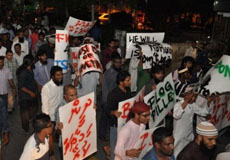
Protestors gathered outside the United Nations Building in Male’ on Friday afternoon to condemn UN Human Rights Chief Navi Pillay for her criticism of the Maldivian constitution, namely its provisions endorsing flogging and mandating that every Maldivian be a Muslim.

The protestors carried signboards with angry slogans, including “Islam is not a toy”, “Ban UN” and “Flog Pillay”, and called on authorities to arrest the UN High Commisioner.

Police Sub-Inspector Ahmed Shiyam told Minivan News that the sizeable protest was contained and there were no confrontations.

“Police cordoned off the area so people could not enter the UN building or the roads leading to the building. The protest was pretty heated, but there were no confrontations or arrests,” he said.

After a break for Sunset Prayer, protesters renewed their efforts at the Tsunami Memorial.

Shiyam said police guarded the UN building during the evening protest, and kept appraised of its movements.

No concerns have been voiced to the police by the UN.

During a press conference on Thursday evening, Pillay again called for the government and the judiciary to issue a moratorium on flogging.

“Flogging is a form of punishment that is cruel and demeaning to women. I have as High Commissioner traveled to very many Islamic countries, and apart from the Maldives and one other country that practices stoning, flogging is not a practice that is condoned,” she said.

“The issue needs to be examined, and therefore I called for a countrywide discussion. It is much better if the issue is transparent and debated.”

Challenged by a local journalist that the Maldives was both obliged to protect the religion of Islam, she replied: “You have a constitution which conforms in many respects to universal human rights. Let me assure you that these human rights conform with Islam.”

She added that the Maldives had signed international treaties that are legally-binding obligations, “and such a practice conflicts with these obligations undertaken by the Maldives.”

Pillay said she had raised this matter with President Mohamed Nasheed and the judges during her visit, “and they are all looking into this matter. The President is sympathetic because each time he travels outside the Maldives the issue is raised with him. He says he can only look at it on a case by case basis, but if there is a judicial decision, that may apply to all cases.”

She renewed her call for a moratorium, and noted that the Maldives “has an excellent track record regarding the death penalty. The death penalty is unIslamic and is not practiced in the Maldives. When I travel to places where the death penalty is used, I hold up the Maldives as an example of that.”

Asked to comment on the requirement under the Maldivian constitution that all Maldivians be Muslim, Pillay respond that “Such a provision is discriminatory, and does not comply with international standards. I would urge a debate again on the issue to open up entrance of the constitution to all.”

Asked by another local journalist to respond to the religious groups criticising her requests, “my response is that as the UN High Commission of Human Rights I look at the norms and standards that all the governments of the world have drawn up.”

“It is not that I am plucking principles from the air. I point my critics to universally accepted standards on human rights are consistent with Islam. Many governments and scholars have told be there is no conflict between human rights and Islam.”

Pillay also highlighted the plight of expatriate labourers in the Maldives, who make up a third of the population and in many cases have been lured to the country by unscrupulous employment brokers.

“The Minister of Foreign Affairs [Ahmed Naseem] is very aware of the suffering of foreign workers, and agreed that something needs to be done for these people,” Pillay said.

“You can’t have 60,000 people suffering here while performing work for the benefit of Maldivians and the tourism industry, and pretend this is invisible. The media has a role to give these people a voice so they can explain their problems.

“Many of them are trafficked and the little money they earn is exploited. This is of grave concern to me, because people like this are are protected under the UN Convention on Migrant Workers and their Families. I have urged the Maldives to ratify this, and regularise the presence of 60,000 people

“I also call for an end to the stereotyping of these people as a threat and unwanted.”

Likes(0)Dislikes(0)

Salaf asks PIC to take action against police for protecting ‘idols’

Religious NGO Jamiyyathul Salaf has sent a letter to the Police Integrity Commission (PIC) demanding it investigate and take action against police for protecting the ‘idolatrous’ SAARC monuments in Addu.

In its letter, Jamiyyathul Salaf noted that Islamic Minister Dr Abdul Majeed Abdul Bari had declared that the SAARC monuments kept in Addu were un-Islamic and unconstitutional.

Salaf said that after the Islamic Minister publicly revealed his stand on the issue, police had worked to protect the monuments and said that it showed that police “have no respect for the laws.”

Salaf claimed that some police officers had refused to go out and protect the monuments, and that those police officers were threatened and forced to protect the monuments.

In the letter Salaf also said that the police were aware that the idolatrous monuments were banned in the Maldives by more than one article of the law.

A police spokesperson today told Minivan News that police were not protecting any “idols” but was active in some parts of Addu to control possible unrest.

‘’Those were properties of other nations and police are legally obliged to protect people’s property,’’ he said.

When the SAARC Summit was held in Addu, each member state left a symbol of their nation in Addu City. Some of the monuments were determined by religious groups and the Islamic Minister as un-Islamic.

The monument from Pakistan representing the Indus Valley Civilization and Sri Lankan monument representing its nation’s lion were attacked. Some parts of the Pakistan monument were stolen and later replaced.

Opposition Adhaalath Party and Progressive Party of the Maldives [PPM] heavily criticized the government for keeping the monuments in Addu and claimed that the monuments cannot be kept in the Maldives according to the laws.

PPM Council members recently reported the Maldives Customs Department to police for allowing the monuments to be imported to the country.

The Islamic Minister recently asked the President’s Office and other institutions to remove the monuments.

Likes(0)Dislikes(0)

PPM accuses government of setting Luthfee free from prison

The Progressive Party of the Maldives (PPM) has alleged that the government has set free Abdull Luthfee, who was sentenced to life during the time of Former President, for playing a senior role in the November 3 coup attempt in 1988.

Former Deputy Leader of Dhivehi Rayyithunge Party [DRP] and current interim council member of PPM Umar Naseer yesterday held a press meeting and told the media that the government has said that Luthfee went to Sri Lanka for medical purposes and escaped.

Luthfee, Umar said, did not escape but was ‘escaped’ with the assistance of the government and alleged that the government have been still supporting his stay at Sri Lanka.

Umar said it has been years after he left for medical purposes and added that the government has not even tried to look for him.

He said he was not astonished that the government has not searched for him because one of President Mohamed Nasheed’s brothers-in-law was also a senior figure in the November 3 attack.

‘’The PPM will very seriously look in to this issue of government letting a senior figure involved in the November 3 coup attempt in which 19 Maldivians were killed escape,’’ said Umar, adding that many other figures involved in the November 3 attack were currently filling senior government posts.

Sri Lankan newspaper The Island reported Luthfee as saying on the 23rd anniversary of the November 3 coup attempt, “I wanted to get rid of [former President Maumoon Abdul] Gayoom at any cost. As the election process in my country never gave a reasonable opportunity to the opposition, I felt an outside force should be used to oust Gayoom,”

In May this year, before the PPM was created and supporters of Gayoom were in Dhivehi Rayiithunge Party as a faction, Gayoom’s faction of the opposition Dhivehi Rayyithunge Party (DRP) protested outside the Prosecutor General’s Office and marched through the streets of Male’  with coffins, demanding justice for the martyrs who died in the November 3 coup attempt.

Press Secretary for the President Mohamed Zuhair denied the allegations and referred Minivan News to State Home Minister  Mohamed ‘Monazer’ Naeem for more details.

Naeem said that Government will never help a detainee escape and denied the allegations made by PPM.

‘’The Department of Penitentiary and Rehabilitation Service [DPRS] will not hold anyone in detention if a doctor advises to send an inmate abroad for medical reasons, but that does not mean that we are making way for him to escape,’’ Naeem explained.

He said anyone can point fingers at the DPRS or Home Ministry.

‘’We are confident that no staff or anyone here will held him to escape,’’ he added.

Likes(0)Dislikes(0)

Flogging for fornication “inhumane and degrading violence against women”: Navi Pillay tells Majlis

The Maldives’ peaceful transition to democracy has “set an important precedent in the Asia-Pacific region and serves as a beacon in the broader Muslim world,” UN High Commissioner for Human Rights Navi Pillay said in parliament today.

In a keynote address titled ‘Responding to the Past while Safeguarding the Future: the Challenge of Protecting Human Rights in the context of Democratic Transition,’ Pillay observed that as democratic transitions “are always fragile,” the recent history of the Maldives contained lessons for newly-established democracies.

Pillay praised the reform milestones achieved by the Maldives since 2003, including the establishment of a Human Rights Commission, the introduction of political parties, accession to main international human rights instrument, the drafting of a “new and very progressive constitution” and the first multi-party elections that followed its ratification in August 2008.

“This year, we have witnessed the same strong aspirations for democracy and human rights in the Middle East and North Africa which have brought dramatic and positive changes to the political environment of the region,” she said.

“After decades of oppression and systemic human rights violations, men and women of different ages, political orientations and social origins have come together in an unprecedented movement to bring about political change and to demand social justice.”

Strong and stable institutions

Pillay noted that successful transition to a functioning democracy was “very much contingent on the existence of independent institutions” and separation of powers between the executive, legislature and judiciary.

While acknowledging that the new institutions started working “with limited resources and within a volatile and politicised environment,” Pillay said it was imperative for all parties to “embrace the path of reform and develop a culture of dialogue, tolerance and mutual respect.”

She urged parliament to enact long-delayed legislation and the judiciary to be “independent and forward-looking in applying the law in accordance with the constitution and international human rights obligations of the Maldives.”

The executive should meanwhile “respect the roles and independence of the other arms of the state and ensure effective implementation of the rule of law.”

Islam and democracy

The reform movement of the Maldives and public uprisings of the Arab Spring has established “the congruence between rights guaranteed by Islam and universally recognised human rights,” Pillay stated, which is “proof that Islam is not incompatible with human rights and democracy.”

She welcomed the ‘House of Wisdom’ initiative led by the Maldives, “which will help to promote an open and constructive debate, both inside and outside the Maldives, on how to reconcile international human rights standards and Islamic law.”

Social media

A third lesson for democratic transitions, said Pillay, was use of the internet and new social media to mobilise the public.

Activists, journalists and bloggers in the Maldives “opened new spaces for debate,” she observed, noting the changes to “repressive habits of the past” through decriminalising defamation and removing restriction to freedom of assembly.

The Associated Press (AP) however reported yesterday that Pillay expressed concern with reports of rising religious intolerance in the Maldives during a meeting with President Mohamed Nasheed.

The AP referred to the vandalism of monuments donated by Pakistan and Sri Lanka for the recently-concluded SAARC summit over allegedly “idolatrous” and un-Islamic imagery.

Women’s rights

While women were involved in the political mobilisation of countries in the Middle East and North Africa, Pillay stressed that “rights and opportunities for women in these societies still face many challenges.”

“I strongly believe that democracy for the half the people is no democracy at all,” she asserted.

Acknowledging efforts by both previous and current administrations to promote gender equality and the removal of the gender bar for public office in the 2008 constitution, Pillay however noted that discrimination against women and girls continued in the country.

“A powerful illustration of this trend is the flogging of women found guilty of extra-marital sex,” she explained. “This practice constitutes one of the most inhumane and degrading forms of violence against women, and should have no place in the legal framework of a democratic country.”

Pillay urged the authorities to foster national dialogue and debate “on this issue of major concern,” and called on parliament to pass legislation on domestic violence as well as other laws to ensure women’s rights.

In response to a Minivan News report in 2009 of an 18 year-old woman fainting after a 100 lashes, Amnesty International called for a moratorium on the “inhumane and degrading punishment.”

Of the 184 people sentenced to public flogging in 2006, 146 were female, making it nine times more likely for women to be punished.

“I also urge you to discuss the withdrawal of the remaining reservation to the Convention on the Elimination of all forms of Discrimination against Women concerning equality in marriage,” Pillay said. “These are necessary steps, not only for protecting the human rights of women and girls in Maldives, but securing Maldives’ transition.”

On the problem of migrant workers in the country, Pillay urged the government to enforce the non-discrimination clause in the constitution by adopting a comprehensive law and ratifying the ‘Convention on the Protection of the Rights of All Migrant Workers and Members of their Families.’

Transitional justice

Lastly, the UN High Commissioner observed that new democracies faced a common problem of transitional justice or “establishing accountability for past human rights violations.”

“Addressing the past is often a complicated political dilemma, but we should never lose sight of the right victims have to truth, justice and redress,” she said.

Without coming to terms with human rights abuses and injustices committed by ousted regimes, said Pillay, “transitional democracies will face continued challenges in the path towards democracy, respect for human rights and ending impunity.”

Referring to the Truth and Reconciliation Commission in South Africa, Pillay revealed that she urged President Mohamed Nasheed to “lead a national consultation on this important subject.”

Pillay concluded her address by predicting that the Maldives “will increasingly have a special role to play in the region and the Muslim world as it has pioneered a democratisation process that is both modern and Islamic.”

“I firmly believe that the Maldives can make history as a moderate Islamic democracy. This opportunity cannot be missed, for the benefit of Maldives and of the wider region,” she said.

“Difficult road ahead”

Pillay, a South African national of Tamil descent who served as President of the International Criminal Tribunal on Rwanda for eight years, today concluded her three-day stay in the first-ever visit to the Maldives by a UN High Commissioner for Human Rights.

Meanwhile, in his remarks after the speech, Speaker Abdulla Shahid said the parliament was “honoured to have you here, a person who has fought tremendously for human rights in your country and is committed to the promotion of human rights all over the world.”

“As you have rightly said, Maldives has pioneered many of the experiences that the Arab Spring is spreading through the Arabian peninsula and the North African region,” he said.

“I can assure you, Madam High Commissioner, that we will not let our guard down. We know how difficult the job has been. We know how difficult the road ahead of us is. And we will continue to work in the national interest of this nation and we will succeed in this endeavor.”

He added that the leadership of the legislature, judiciary and executive is “fully committed” to upholding the liberal constitution of 2008, which is “a living document which we are going through everyday.”

“The experiences that we have had are strengthening the democratic structure of this country,” he said.

Likes(1)Dislikes(0)

Court case completion rate drops 29 percent

The Judicial Administration Department completed 29 percent fewer cases in 2010 than in 2009, in spite of a decrease in cases submitted to the court.

Only 2,484 out of the 3,057 cases submitted last year were concluded. In 2009, 3,488 were completed.

Meanwhile, magistrate courts in the islands closed 840 criminal cases while 1,644 cases were completed by the superior courts, reported Haveeru.

Nearly 1000 fewer criminal cases were reported to the courts in 2010 than in 2009.

The magistrate courts in the islands received 900 criminal cases in 2010 compared to the 1,433 cases received the previous year while 2,157 cases were filed at the superior courts in capital Male.

Phone calls made to the Criminal Court were dismissed at reception, and media personnel were unavailable at designated times and phone numbers. One media contact would not address the issue.

Chief Judge Abdullah Mohamed refused to comment on the matter, and forwarded the phone call to a media officer who had previously refused to comment as well.

Registrar Ali Adam also said he was unable to discuss the matter.

Likes(0)Dislikes(0)

Island President opens to packed audiences

The pre-release premiere of the Island President opened last night in Dharubaarge to packed audiences.

Tickets that had originally been sold for Rf 80 (US$5) were selling for Rf 150 (US$10) on the black market yesterday afternoon. Such was the demand that organisers squeezed an extra 50 chairs into the auditorium at the last minute for on-the-door sales.

The film details the lead up to President Mohamed Nasheed’s election and the introduction of multi-party democracy. This is by no means an objective film: former President Maumoon Abdul Gayoom is treated harshly by the filmmakers and portrayed as thoroughly creepy, as in one scene where he stares unblinking at the camera while soldiers goose step past and a tinny patriotic song plays in the background.

Neither is it propaganda – rare archival footage of brutal military crackdowns and photos of the battered body of Evan Naseem lead up to one of the film’s strongest moments: time-lapse footage of the tin shed in which Nasheed was incarcerated in solitary confinement for 18 months.

“You walk in your mind,” he explains. “Even if you can only take 4-5 steps, you walk it over and over again.”

Nasheed’s seriousness on the subjects of democracy and climate change is given contrast as the filmmakers home in on endearing personal touches – the President’s assistant struggling to do up his tie, Nasheed’s request that the Muleaage staff fetch his mother’s spicy fish recipe, his bitter asides expressing frustration with diplomatic bureaucracy, his phone call home to tell his mother he had secured a deal in Copenhagen, and photos from the days he sported an afro.

The film portrays him as a very human and accessible leader, qualities which are sure to make the film a success among the liberal university student demographic when it is released to cinemas in the US in February.

Foreign audiences with more interest in global climate politics than in the Maldives will find much to take from the film. Nasheed serves as a fascinating behind-the-scenes ticket to the Copenhagen Summit and the diplomatic wrangling of 192 world leaders. In one scene he bullies the President of Grenada into rewriting a document on the climate change ambitions of small island states, in another he disappears behind a palm tree to speak to the Australian Prime Minister over the phone – the filmmakers follow.

Descriptions of The Island President as ‘the West Wing of climate change’ are apt – in one scene, a Chinese diplomat is filmed asking a protocol officer to identify the Maldivian President. “Your government should know this,” she snaps.

The impact of the film locally will be hard to predict. Whatever the politics of the viewer, there is a great deal for Maldivians to be proud about in The Island President. In one scene, Nasheed and Environment Minister Mohamed Aslam argue bitterly about whether to compromise on 1.5 degrees in order to at least secure an adaptation deal.

“People listen to you. We don’t want to look like we’ve been bought,” Aslam insists. Nasheed’s explosive reaction quickly dispels any doubt that his is a calculated attempt to milk foreign aid – he is clearly convinced the threat is existential, but is forced to come to terms with compromising his global ambitions for the sake of his country.

The first screening last night was predictably brimming with Maldivian Democratic Party (MDP) supporters, but the second session was a mixed – and younger – crowd. With 40 percent of the population aged between 15-24 and many disenfranchised by the ‘he said, she said’ nature of Maldivian politics, the film could well have political ramifications in 2013 if it proves popular with this set.

Eleanor Johnstone:

“The Island President” sets a mood of gravity and hope. Using footage and interviews original and historic, television broadcasts, and moments intimate as well as highly public, the film offers a cinematic collage of President Nasheed’s pursuit of democracy and in putting, and keeping, the Maldives on the map.

A combined sense of crisis and action dominates the film, particularly on the environmental issue. But threads of hope are strung throughout, most notably in the Maldivian government’s negotiating style. Regularly confronted with the baby-step methods of many foreign powers, Nasheed’s strident style may unnerve his own delegation but it presents him as a man of action, keen to keep his word.

Everyone knows someone who disdains politics as a sport of chatter and show. Nasheed is one of them. At Copenhagen he regularly vents of the slow-moving discussions and hesitant delegations to his own group of ministers. The Island President might leave Maldivians in fear for their homeland. But with a leader who speaks his mind without reservation, the country has more than many world powers can boast.

Extra showings of The Island President will be held at Athena Cinema on Friday
and Saturday, following unprecedented demand.

Friday 25 November at Athena Cinema: 14:30; 17:30; 20:30; 23:30.

Saturday 26 November at Athena Cinema: 17:30; 20:00.

Tickets can be bought from Athena Cinema between 16:30 – 23:00. Planned screenings for Dharubaarge on Thursday will be moved to Athena Cinema to meet demand. Ticket hotline: 9797356.

Likes(1)Dislikes(0)

MP Musthafa blames ‘Reeko’ Moosa over finance controller’s resignation

Finance Controller at the Ministry of Finance and Treasury, Ahmed Assad, resigned yesterday after attempts were made by MP ‘Reeko’ Moosa Manik to exert undue influence over the senior government official, claims Maldivian Democratic Party (MDP) MP Mohamed Musthafa.

In a text message circulated to several media outlets, Musthafa alleged that several “capable professionals and technocrats” were quitting the MDP government in protest of acting chairperson Moosa’s outsize influence and “corrupt dealings” for personal gain.

Speaking to Minivan News today, Musthafa claimed Moosa had asked Assad for Rf5 to 6 million (US$320,000-390,000) to complete a project awarded to Moosa’s company Heavy Load Maldives to construct the jetty off the island of Kumundhu in Shaviyani Atoll.

Assad was unavailable for comment today as his mobile phone was switched off.

“Assad refused to issue the money and he went into a quarrel with Moosa and Moosa attempted to use his position and authority to exert influence over him,” Musthafa alleged. “He also tried to influence Abdulla Ziyadh, civil engineer of Works Corporation and tried to collect money for a Heavy Load project before it was completed. They completed 20 percent of the work and asked him to pay for 70 percent of work.”

Ziyadh had resigned from his post at the Works Corporation under the Housing Ministry in the wake of the incident, Musthafa claimed.

“Moosa has also taken Rf4 million (US$260,000) worth of oil for credit from Fuel Supply Maldives (FSM) and tried to get more oil for credit without paying for the oil he purchased earlier,” he alleged.

Musthafa said he planned to submit an amendment to the MDP charter to ensure that a businessman could not hold the post of chairperson.

Responding to remarks made by Moosa in the local media that Musthafa was “using my name to gain fame for himself,” Musthafa said: “,I ‘Seafood Musthafa’, was more famous and a millionaire in this country when Moosa was riding a bicycle around Henveiru.”

Contacted for a comment today, MP Moosa Manik said he did not wish to comment on the issue.

Meanwhile, President’s Press Secretary Mohamed Zuhair said Assad had not divulged the reason for his decision to leave the government in his resignation letter.

“Unless he confirms the allegations, I would say that is just political speculation and theories,” said Zuhair, referring to Musthafa’s allegations.

Likes(0)Dislikes(0)

Former member of interim Elections Commission deny corruption allegations by ACC

Former member of the interim Elections Commission (EC), Ahmed ‘Saabe’ Shahid, has denied allegations of corruption made by the Anti-Corruption Commission (ACC) over the purchase of over 50 laptops without a public tender ahead of the October 2008 presidential election.

In a statement issued to the media yesterday, Saabe insisted that the procurement of the laptops was a necessary expense for the commission’s preparations for the historic multi-party elections in October.

The first 20 laptops were purchased after considering prices proposed on September 22 in response to a public announcement on September 16. The first round of the presidential election was held on October 8 and the second round run-off on October 28.

“To my recollection, additional laptops were bought on three further occasions,” reads the statement from Saabe. “Of these, the 10 laptops purchased on October 4 with my authorisation were bought on very short notice just four days before the 2008 presidential election.”

The former deputy chair of the EC explained that normal procurement procedures takes at least six days between the public announcement and the purchase.

The 10 laptops were therefore procured based on the September 16 announcement “after considering the period and [quoted] price of the previous transaction” and the company that could provide the notebook computers at the earliest possible date.

“A quotation was received from the company for this and the reason for the purchase was stated in that quotation,” he wrote.

Saabe noted that the EC was afforded a very short period of time to conduct the first multi-party presidential election and the first election where voters had to be registered.

In addition to considerable efforts in preparation, said Saabe, the commission had to make arrangements for Maldivians living abroad to participate in the election and register workers at resorts and industrial islands “to ensure the right to vote for every Maldivian citizen in a very short space of time.”

Saabe observed that while Rf99 million was allocated for the two rounds of the presidential election, the EC actually spent Rf65.1 million and “saved the state Rf30.9 million.”

The savings were the result of measures taken by the commission to reduce cost and wastage, he suggested.

“Section 18 of the Elections Commission Act states that the commission cannot be charged for actions taken with good intentions,” he said, adding that the transactions were made with the intention of doing “the best possible work in an extraordinarily short period of time.”

Likes(0)Dislikes(0)