Drug-testing machines normal, no cases pending, say Police

Delayed caused by broken drug-testing machinery have been resolved, Police Sub-Inspector Ahmed Shiyam told Minivan News today. Shiyam was responding to allegations that procedures at the Criminal Court had been delayed by malfunctioning machinery.

The Criminal Court could not confirm that there are no more pending cases.

Earlier today, Haveeru reported that drug-testing machines have been malfunctioning since June 14, causing a three-month delay in court procedures.

The report stated that police were unable to submit test reports to drug-related cases since mid-June, and that there was no alternative drug-testing method.

Police Sub-Inspector Ahmed Shiyam told Minivan News today that the issue has been generally resolved.

“The machine for drug detection normally works on an on-and-off basis, so this is not completely unusual for us” said Shiyam. “If there are problems, its our responsibility and we will fix it.”

Shiyam added that the police do have other means for detecting and testing illegal drugs, such as a forensics department.

“It is really important to get details and evidence to the court as soon as possible in these drug cases,” he said.

The Criminal Court reportedly learned of the malfunction when it enquired about a delay in drug-test reports. The court said several suspects in drug-related cases have complained about the processing delay, reports Haveeru.

Haveeru reported that the police were unable to verify the alleged drugs confiscated from the high profile drugs smuggling network busted on June 23.

About 1kg of alleged drugs and large amounts of cash were seized from the network.

Likes(2)Dislikes(0)

World should rejoice that governments have forever lost the ability to control information, Nasheed tells UN

The chain of protests that rocked the Arab world this year have shown that governments have forever lost the ability to control information, President Mohamed Nasheed has said in a keynote address to the United Nations, including the 47 members of the UN Human Rights Council.

“Those of us who believe in individual liberties should rejoice at this fact because, quite simply, it changes the rules of the game,” he said.

Describing himself as a protester, “as someone who has spent much of his adult life speaking out against leaders who place their own interests over those of their people, leaders who seek power for power’s sake,” Nasheed observed that globalisation and the democratisation of information now meant that “governments simply have no option” but to listen to the demands of pro-democracy protesters.

“In a time of awakening, Muslims across the world are standing up, governments must see peaceful protests not as a threat but as an opportunity,” Nasheed said.

“It is a a moment when Muslims across the world are standing up as one to demand equality, human rights, democracy and the rule of law. These developments provide a fitting rebuttal to those, inside and outside of Islam, who claim that our religion is not compatible with democracy.”

Nasheed predicted that 2011 would come to be seen “as a tipping point for peaceful protests, as the moment when the balance of power swung, irreversibly, from the state to the streets.”

“In the past, when news and information were more malleable, governments had the option of suppressing protests in the hope of breaking them before news spread. Swift, decisive and often violent action at the outset could, in this sense, nip the problem in the bud. Life, especially for those in positions of power, could go on as normal,” he observed.

“In the past, facts and truths could be constructed and controlled by a few. Today they can be discovered and learned by everyone. The use of modern communication technology has allowed those with grievances to mobilise and spread their message. And, crucially, modern media also provides a lens through which the outside world can witness events unfold and learn the truth.”

As a result of globalisation and the communication revolution, “the more a government tries to control, the less control it actually has. The more those in power try to tighten their grip, the more power slips through their fingers,” Nasheed said.

“Today, the only way to rule sustainably is to rule with the trust and consent of the governed.”

Protests in the Maldives began eight years ago, changing the course of the country’s history, Nasheed explained.

“At one level we were protesting against something – against an autocratic system of government which had monopolised power for thirty years. But we were also protesting for something – for a better, fairer system of government, for equality and for justice.

“Today, we have succeeded in sweeping away the old. In 2008 the previous government was peacefully removed from power in free and fair elections under a new Constitution.”

Nasheed emphasised that the country’s first democratic multi-party elections were just the beginning of true democratic reform. The present challenges faced by the Maldives – not just the strengthening of independent institutions but also confronting the past – would be mirrored in Tunisia and Egypt, he predicted.

“One challenge is to establish and strengthen independent institutions, to ensure that democracy and human rights are guaranteed regardless of who is in power. A second challenge relates to transitional justice and reconciliation – how to deal with the past without endangering the future,” he explained.

“There can be no doubt that serious human rights violations were committed in the Maldives and that the victims of those violations deserve justice. But we must draw a clear line between reconciliation and revenge. To move forward, the search for truth and justice must be placed within an overall framework of national reconciliation – we must look forward, not back.

“A third challenge is to rebuild the economic fabric of the country. People cannot properly enjoy democratic freedoms if their basic needs are left unfulfilled. Without socio-economic development, political transitions quickly unravel.

“These challenges are relevant not only for the Maldives. They are also relevant for other countries that have dismantled autocratic regimes.”

Likes(0)Dislikes(0)

Details lacking in government expenditure statement: DRP

The first of weekly government expenditure and income statements made public by the Ministry of Finance and Treasury this week lacks detail and does not serve to promote transparency, contends the main opposition Dhivehi Rayyithunge Party (DRP).

DRP MP Dr Abdulla Mausoom, also a member of the parliament’s Public Accounts Committee, told Minivan News today that the party “welcomed” the government following through on its pledge to publicise government expenditure on a weekly basis.

“But half the truth is often more deceptive than lies,” he said. “First of all, there were no details in the statement. It was just categorised expenditure without any detail of the expenditure.”

While the Health Ministry has spent Rf744 million (US$48 million) this year, said Mausoom, “we don’t know what the money was spent for or where it went.”

“The whole health sector was corporatised,” he said. “But basic health services have not improved. There is a lack of equipment or facilities that need to be renewed and there’s always talk of how more doctors are needed.”

DRP Deputy Leader Ahmed ‘Andey’ Mohamed meanwhile explained that if a household servant was given Rf100 for shopping and asked to provide details of expenditure “for him to say I spent Rf50 at shop A, Rf30 at shop B and Rf20 at shop C does not mean he provided any details of what he bought.”

Citizens should be made aware of details of expenditure and the services provided with public funds, he added.

One of the “main areas of concern”, said Dr Mausoom, was Rf1.9 billion (US$123 million) spent out of the Finance Ministry’s contingency budget.

“That is almost Rf2 billion. Where did that money go?” he asked, adding that reduced amounts from civil servants salaries that the government was ordered to pay back by the courts had not been released.

The DRP MP for Kelaa also questioned whether the Rf489 million (US$31.7 million) released to state-owned enterprises so far this year could be categorised as “investment.”

A number of “dodgy companies” were dealing with domestic corporations, such as regional utilities and health corporations, he continued, and planning for “unfeasible business projects” with surveys and Memorandums of Understanding.

“A lot of cost would be incurred for that and it can’t really be considered investments,” he argued, revealing that there were 62 government-owned corporations.

Moreover, as a footnote of the expenditure and income summary stated that the figures were taken from reports that “have not been reconciled or audited,” Dr Mausoom suggested that “the numbers are likely to be understated” and subject to change.

“So there are a lot of unanswered questions,” he said. “But it is good that this has been made public because we are able to raise these issues. If the government wants to dispel all doubts, they should provide full details down to the last laari, which won’t be that hard to do.”

Finance Minister Ahmed Inaz was not responding at the time of press.

Deficit spending

Meanwhile among the highest spending line ministries and institutions were the Education Ministry with Rf1.2 billion (US$77.8 million), the Home Ministry with Rf751 million (US$48 million), Housing Ministry with Rf652 million (US$42 million) and local councils with Rf359 million (US$23 million).

According to the statement put out by the Finance Ministry, government expenditure (Rf7.5 billion) outstripped revenue (Rf6.3 billion) by 20 percent between January 1 and September 8, 2011.

As a consequence, the fiscal deficit reached Rf1.3 billion (US$84 million) at the end of last week.

In addition to Rf3.2 billion (US$207.5 million) spent on salaries and allowances for state employees – the single largest source of expenditure – Rf2.4 billion (US$155.6 million) was needed to cover recurrent expenditure or administrative costs.

Capital expenditure was meanwhile Rf1.2 billion (US$77.8 million) while spending on debt service reached Rf563 million (US$36.5 million).

DRP Deputy Leader Ahmed Mohamed observed that capital expenditure – capital outlays for local component of development projects, fixed assets maintenance and investments for state-owned enterprises – was “only 17 percent of the budget” while recurrent expenditure was over 75 percent.

In December 2010, parliament approved a Rf12.37 billion (US$802 million) annual state budget with a projected revenue of Rf8.8 billion (US$570.7 million) and recurrent expenditure of Rf9.8 billion (US$635.6 million) – 49 percent of which was to be spent on salaries and allowances.

The forecast for recurrent expenditure was 79 percent of government spending.

In March this year, the International Monetary Fund (IMF) warned that “significant policy slippages” have undermined the country’s ability to address its unsustainable budget deficit.

“On the expenditure side, there have been no net fiscal savings from public employment restructuring, public sector wages will be restored to their September 2009 levels earlier than expected, and the new Decentralisation and Disability Bills will lead to considerable spending increases,” the IMF noted in a statement.

The IMF said that while it recognised “the difficult political situation facing the authorities”, “decisive and comprehensive adjustment measures” were required to stabilise the economy, allow sustainable growth and reduce poverty. In particular, it raised concern about the “lack of significant progress in public employment restructuring.

Dr Mausoom meanwhile insisted that as government revenue was expected to exceed previous forecasts because of new tax revenue and reach almost Rf10 billion (US$648.5 million), “the deficit should be reduced by a corresponding amount to the boost in income.”

Likes(0)Dislikes(0)

“Don’t marginalise Sri Lanka”: Nasheed to Human Rights Council

UN Secretary General Ban Ki-Moon has submitted a report documenting alleged war crimes in the closing days of the Sri Lankan Civil War to the UN Human Rights Council.

The report accuses the Sri Lankan military of killing tens of thousands of civilians through shelling in the closing days of its war with Tamil separatists, and increases the likelihood that the Human Rights Council may be called on to vote for a full international, independent investigation.

Sri Lanka has meanwhile rejected the report’s findings and stated that it opposes an outside investigation. Instead, the government has appointed its own ‘Learnt and Reconciliation Commission’ (LLRC), which is expected to publish its findings on November 15.

Central to the UN’s case is graphic footage of the execution of bound and gagged prisoners, which the UN’s Special Rapporteur on Extrajudicial, Summary or Arbitrary Executions, Christof Heyns, described as reflecting “crimes of the highest order — definitive war crimes.”

Heyns analysed the video in consultation with a forensic pathologist, firearms expert and two forensic video analysts, and concluded that the footage was authentic, however the Sri Lankan government has maintained that the video is fake.

It has also stated that civilian casualties were unavoidable during the final offensive, due to the Tamil Tigers’ use of 300,000 people as human shields.

As an outspoken member of the UN Human Rights Council and a vocal proponent of intervention during the Libyan uprising – and also Sri Lanka’s neighbour – the situation is likely to challenge the Maldives diplomatically.

Yesterday, as the international community was ratcheting up the pressure on Sri Lanka, President Mohamed Nasheed called for an “amicable solution”.

“As long as we argue about Sri Lanka, the government is increasingly marginalised and we are losing the government and the country outside the fold of the international community,” Nasheed warned.

“We must understand that a number of very, very bad things happened but we must be able to move forward,” he said.

Current Maldivian Foreign Minister Ahmed Naseem has previously described the UN report as “singularly counterproductive”, while during a recent interview with Minivan News, former Foreign Minister Dr Ahmed Shaheed said he felt the government’s position on Sri Lanka “has been misunderstood”, particularly its comparison with the government’s stance on Libya.

“But I think Naseem’s comments and the government’s position on Sri Lanka have been misunderstood. The Libyan situation is different from the current situation in Sri Lanka. Libya is ongoing – things are happening today on the ground, and we need to try to prevent further abuses tomorrow,” he said at the time.

“In Sri Lanka’s case these are post-conflict issues. What we say is that the most important thing in a post-conflict situation is to find a way forward and not live in the past. This does not mean we are condoning abuses, or saying such things are fine. But Sri Lanka needs to find common ground with the UN Human Rights Council in which both parties can move forward. The government of Sri Lanka needs to be able to enter into dialogue with the international community to achieve speedier reconciliation.

“You can’t have reconciliation and long-lasting peace unless you respect human rights and set up mechanisms to do so. But we should steer clear of politicisation, or the divisions that have kept the flame of terrorism alive in Sri Lanka for so long. We are saying let Sri Lanka find a way forward and achieve reconciliation – we are not saying we don’t care about the past,” Dr Shaheed said.

China and Pakistan have also expressed support for Sri Lanka.

Meanwhile Mahinda Samarasinghe, Sri Lankan President Rajapaksa’s special envoy on human rights, has called for the international community to wait for the findings of Sri Lanka’s own commission in November.

“It is disconcerting to note the haste with which some have sought to usurp the government of Sri Lanka’s prerogative in deciding its domestic process,” Samarasinghe has previously told the Council.

“We firmly believe that our home-grown process is capable of addressing the nuances of our unique situation.”

However several international human rights organisations, including International Crisis Group (ICG), Human Rights Watch (HRW), and Amnesty International (AI) have refused to appear before the LLRC claiming it fails to meet minimum international standards, noting that its members were appointed by the government, it had no mandate to investigate war crimes in the closing days of the conflict, and lacked any mechanism to protect witnesses.

“The LLRC’s mandate, its composition, its procedures, and the human rights environment in which it is operating all conspire to make a safe and satisfactory outcome for victims of human rights violations and their families extremely unlikely,” said Amnesty International’s Deputy Director for the Asia-Pacific region, Madhu Malhotra, in October 2010.

“Amnesty International is particularly concerned about the lack of any provisions for witness protection and the fact that former officials who have publicly defended the Sri Lankan government against allegations of war crimes serve on the commission.”

Warning: some readers may find the following footage disturbing

Likes(0)Dislikes(0)

Details of government spending and revenue made public

Government expenditure outstripped revenue by 20 percent between January 1 and September 8, 2011, according to the first of weekly expenditure statements made public by the Ministry of Finance and Treasury yesterday.

While government income reached Rf6.3 billion (US$408.6 million) at the end of last week, government spending however stood at Rf7.5 billion (US$486.4 million), resulting in a fiscal deficit of Rf1.3 billion (US$84 million) financed by loans and sale of Treasury bills.

In addition to Rf3.2 billion (US$207.5 million) spent on salaries and allowances for state employees – the single largest source of expenditure – Rf2.4 billion (US$155.6 million) was needed to cover recurrent expenditure or administrative costs.

Capital expenditure was meanwhile Rf1.2 billion (US$77.8 million) while spending on debt service or debt repayment reached Rf563 million (US$36.5 million).

President Nasheed announced at a ceremony held in August to unveil the government’s ‘Fiscal and Economic Reform Programme’ that the government would publicise details of expenditure on a weekly basis.

In December 2010, parliament approved a Rf12.37 billion (US$802 million) annual state budget with a projected revenue of Rf8.8 billion (US$570.7 million) and recurrent expenditure of Rf9.8 billion (US$635.6 million) – 49 percent of which was to be spent on salaries and allowances.

Recurrent expenditure was expected to be 79 percent of government spending.

An additional Rf200 million (US$12.9 million) was injected to the budget in anticipation of the local councils that came into being in February this year.

Plugging the deficit

In March this year, the International Monetary Fund (IMF) warned that “significant policy slippages” have undermined the country’s ability to address the ballooning budget deficit.

“On the expenditure side, there have been no net fiscal savings from public employment restructuring, public sector wages will be restored to their September 2009 levels earlier than expected, and the new Decentralisation and Disability Bills will lead to considerable spending increases,” the IMF noted in a statement. “Also, the Business Profit Tax will come on stream eighteen months later than planned [the tax came into force on July 18, 2011].”

The IMF warned that the Maldives economy was presently unsustainable, on the back of “expansionary fiscal policies” from 2004 which left the country especially vulnerable to the decline in tourism during the 2008-2009 recession.

The country’s fiscal deficit exploded on the back of a 400 percent increase in the government’s wage bill between 2004 and 2009, with tremendous growth between 2007 and 2009. On paper, the government increased average salaries from Rf3000 (US$195) to Rf11,000 (US$713) and boosted the size of the civil service from 24,000 to 32,000 people – 11 percent of the total population of the country – doubling government spending from 35 percent of GDP to 60 percent from 2004 to 2006.

The IMF said that while it recognised “the difficult political situation facing the authorities”, “decisive and comprehensive adjustment measures” were required to stabilise the economy, allow sustainable growth and reduce poverty. In particular, it raised concern about the “lack of significant progress in public employment restructuring.”

An internal World Bank report produced for the donor conference in May 2010 meanwhile noted that increases to the salaries and allowances of government employees between 2006 and 2008 reached 66 percent, which was “by far the highest increase in compensation over a three year period to government employees of any country in the world.”

President Nasheed told delegates at the conference that the government was “committed to financial prudence and long-term stability.”

“We have scrapped the reckless policies of the past, which saw money printed to finance a growing budget deficit,” he said, adding that the government was working with “international multilateral organisations, to ensure we do not spend more than we can afford.”

On the size of the bloated civil service, Nasheed said, “In the past, the government offered people jobs not because there was work that needed doing. The government offered people jobs as bribes; to get their allegiance to a repressive regime. Almost 10 per cent of the population works for the government – a staggering amount.

“And there are more civil servants than there is work to be done. Many government employees are under worked; chained to demoralising jobs. Our administration will therefore dramatically reduce the number of civil servants. But we must provide loans for outgoing civil servants, to help them set up businesses or acquire new skills.”

In April, the government announced a programme to incentivise voluntary redundancy in the civil service.

“Political backlash”

A UNDP paper on achieving debt sustainability in the Maldives published in December 2010 meanwhile observed that former President Maumoon Abdul Gayoom responded to growing calls for democratisation in 2004 with “a substantial fiscal stimulus programme” of increased government spending, “much of which was not related to post-tsunami reconstruction efforts.”

When the impact of the worst global recession in decades struck the Maldives in September 2008, “the Maldivian economy was already in the middle of a severe economic crisis with substantial fiscal and current account deficits, high liquidity growth, double digit inflation, pressure on the fixed exchange rate, increases in public and private sector debt, rising inequalities between the capital and the atolls, and a costly civil service.”

However the new government’s efforts to reduce government spending with pay cuts of up to 20 percent along with plans to downsize the civil service – which employs a third of the country’s workforce – was met with “a severe political backlash from parliament.”

“In March 2010, the parliament passed a 2010 budget with amendments which increased the government’s proposed budget by 7 percent (or 4.5 percent of GDP),” the paper noted, referring to parliament’s addition of Rf800 million (US$51 million) to the 2010 budget.

“Three quarters of this increase funded a reversal in civil service wage cuts implemented the previous year. Progress on redundancies has also been slower than expected and reforms in this area are unlikely to be completed until the end of 2011 at the earliest. This will have important fiscal consequences.”

In July, the Finance Ministry publicised details of expenditure on state employees, showing that Rf1.6 billion (US$103 million) had to be spent on salaries and allowances for 20,476 civil servants.

State wage expenditureAnnual expenditure on salaries and allowancesPercentage of total wage bill or expenditure on employees
Civil servants or employees under the executive (excluding political appointees and councillors)Rf1,596,029,00739 %
Uniformed bodiesRf1,001,489,48624 %
Political appointees in the executive branchRf99,178,9802 %
Administrative staff at the President’s OfficeRf27,326,7301 %
CouncilsRf717,250,03017 %
JudiciaryRf210,282,4635 %
People’s Majlis or legislative branchRf79,210,7182 %
Institutions dependent on state budgetsRf393,620,94310 %
Likes(0)Dislikes(0)

JSC in contempt of court for attempting to influence ongoing proceedings, say lawyers

Making statements in the media and on public forums “in a way that could undermine the dignity and prestige of courts” could lead to lawlessness, social discord and the “destruction” of the nascent democracy in the Maldives, the Judicial Service Commission (JSC) has warned.

In a press statement issued yesterday, the JSC claimed that criticism of the judiciary by any individual or group could “pave the way for a [pervasive] spirit of not bowing to the constitution and legal judgments [among the public].”

“And making such statements could completely destroy the constitutional and legal system established in this country through the hard work of the Maldivian people while in its infancy and pave the way for disagreement and quarrel, division and discord, in the entire country,” it reads. “Therefore, the commission urges all parties not to make such statements or commit any action that could undermine the dignity and eminence of the courts.”

The JSC’s statement comes after the Supreme Court reprimanded President’s Advisor Ibrahim ‘Ibra’ Ismail last week for calling on the public to “rise up and sort out the judges” at a Maldivian Democratic Party (MDP) rally on September 2 in Kaafu Thulusdhoo.

The Supreme Court claimed that Ibra’s remarks encouraged “the illegal curtailment of the tasks of the judiciary” and could lead to “the loss of peace and security of the Maldivian state and plunge the nation into unrest”.

Prior to the Supreme Court issuing its statement, the JSC conducted “an emergency meeting” and decided to ask police to investigate Ibra’s remarks.

Ibra’s remarks came after the Criminal Court barred journalists from observing the corruption trial of Deputy Speaker Ahmed Nazim on August 25.

“Judges are issuing verdicts any way they please. The effort we have to make against this is not inconsiderable. It was citizens who came out and ousted Maumoon from power. The matter of judges too can only be sorted out by citizens rising up,” Ibra, former Male’ MP and first elected president of MDP, was quoted as saying in newspaper Haveeru.

Ibra told Minivan News last week that his remarks did not constitute a criminal offence and he strongly criticised the Supreme Court for considering themselves “above the law or a law unto themselves.”

JSC Chairman and Supreme Court Justice Adam Mohamed

Former President’s member on the JSC and outspoken whistle-blower, Aishath Velezinee, told Minivan News that Supreme Court Justice Adam Mohamed had in his capacity as JSC Chair asked that police investigate Ibra, and then had the Supreme Court issue its statement.

“What are the police going to do? It sounds like the highest court in the land has already issued its verdict,” she said.

Both the JSC and the Supreme Court in its respective statements referred to article 141(c) of the constitution, which states: “No officials performing public functions, or any other persons, shall interfere with and influence the functions of the courts.”

Ibra however pointed out that he did not “say anything about an ongoing case” that could be construed as either undue influence or interference.

“Contempt of court”

A group of lawyers meanwhile filed a case against the JSC at the Civil Court last week contesting the legality of the commission’s evaluation criteria for selecting judges to superior courts.

The group of lawyers, represented by Ali Hussein and Ismail Visham, contended that regulations drafted by the JSC containing the evaluation criteria conflicted with both the constitution and article 15 of the Judges Act. The lawyers requested that the regulations be abolished and the shortlist be cancelled.

Judge Abdulla Didi
Judge Abdulla Didi

In addition, the lawyers claimed that two shortlisted candidates had close ties with two members of the commission – the spouse of Judge Abdulla Didi and business partner of Lawyer’s Representative Ahmed Rasheed – suggesting a clear conflict of interest as neither had recused themselves from voting in the JSC panel.

The lawyers explained at a press briefing on Thursday that the evaluation criteria was skewed to favour graduates of the Islamic College by awarding higher marks for Kulliya certificates.

At the first hearing on Thursday night, the Civil Court granted a temporary injunction ordering the JSC to halt the appointment process pending a final ruling.

JSC Public Member Ahmed Rasheed
Lawyer's Representative on the JSC Ahmed Rasheed

The JSC responded with a press statement insisting that the process was legitimate and constitutional.

Following the Civil Court order, the JSC held a meeting on Friday and decided to appeal the court order at the High Court.

Prompted by the JSC’s two press statements in the past three days, the group of lawyers sent a letter to the commission today arguing that while the constitution assured the court’s dignity and respect, “in past years the commission has not acted in a way that upholds the dignity and eminence assured by the constitution.”

The “respect and dignity assured by the constitution” is not intended only for the courts, the lawyers noted.

Moreover, the lawyers argued that the JSC issuing two press statements in the space of three days was an “attempt to unduly influence judicial proceedings” since the case was ongoing at the Civil Court.

“Contempt of court is a rule applied against any attempts to influence the process of an ongoing court case,” the letter explained. “This is a crime under provisions 86, 87 and 88 of the Maldivian penal code.”

Moreover, the lawyers argued that the JSC’s actions obstructed a right guaranteed by article 42 of the constitution to every citizen regarding “justice, transparency and impartiality” of all judicial proceedings.

“Therefore, if the commission has planned to do anything that could influence the ongoing case, stop such efforts immediately,” the letter concludes. “And if it is not stopped, we will be forced to take legal action again.”

Representative for the lawyers suing the JSC, Abdul Hameed Abdul Kareem, told Minivan News today that the JSC was looking for a lawyer to appeal the court order.

“All prominent lawyers support this cause, providing assistance in different forms,” he said.

Likes(0)Dislikes(0)

How the US discovered the Maldives in the aftermath of 9/11

Before 2002, Maldives was over the horizon and off the radar of the American embassy in Colombo charged with following Sri Lankan and Maldivian affairs. Busy with the Sri Lankan civil war at its doorstep, the embassy kept no representative in Maldives. Following the 2001/9/11 attacks, US anti-terrorism responses required the Colombo embassy to fully engage with Maldives for the first time. The US diplomatic cables released by WikiLeaks show that it was a discomforting experience for both parties.

US officials wanted an interactive relationship with a government controlled for over two decades by President Maumoon Gayoom. After 24 years of his rule, the American diplomats knew almost nothing about him and his administration. Regardless, the US expected Maldives to enact anti-terrorism laws and sign an Article 98 agreement making Maldivian-US prisoner exchange procedures immune from the International Criminal Court. There was also the matter of Ibrahim Fauzee, a Maldivian terrorist suspect being held at Guantanamo Bay.

In December 2001, the embassy praised Maldives as ‘extremely cooperative in its dealings with the international coalition.’ The brief period of extreme cooperation was followed by a long hiatus.

Nearly a year later, ‘during coffee breaks and over lunch’ at a counter terrorism conference in Washington, US officials were told by Maldivian delegates that terrorist legislation was held up because Maldives ‘does not even have a formal criminal code and needs further assistance developing the legal framework for countering terrorism.’

In fact, Maldives has had a criminal code since 1968, which was updated in 1981. A broad anti-terrorism law had been ratified by President Gayoom in 1990. However, mention of administrative and legal inadequacy brought immediate rewards after the conference, with the US financing ‘two slots to the Maldives Law Commission to attend the Tulane University Legislative Drafting course in New Orleans.’

The Maldivian delegates also described a ‘back log’ of legislation awaiting ‘refinement’ by their Law Commission, including ‘a securities act, a telecommunications act, a customs act and a civil aviation act.’ The embassy could not assess this information. Similarly, details of a minor cabinet and diplomatic corps reshuffle by Gayoom in October 2002 were cabled by the embassy without comment or analysis.

Effective lobbying from Ibrahim Fauzee’s family prompted the Maldivian government in November 2002 to request access to him at Guantanamo Bay. For the US, Fauzee’s detention seemed to reinforce the importance of counter-terrorism legislation. It was time for a serious meeting.

In December 2002, US officials sat down with senior Maldivians in Male and demanded that Maldives sign an Article 98 agreement. Sri Lanka had already signed in November, and the US was impatient for Maldivians to comply. States that refused were being removed from US Aid programs.

This time the Maldivians did not blame the delays on bureaucratic ‘back log’ or the absence of a legal system. Rather, it was President Gayoom’s busy travel schedule, and the need for ‘weighing whether the U.S. proposal “conformed with Maldivian law” and was in the country’s “foreign policy interest”.’

The Maldivian officials linked consent to an Article 98 agreement with a request from Gayoom to meet with President George Bush. Gayoom would ‘deeply appreciate the honor of even a very short meeting… [He] was up for re-election next year and, as a politician, a meeting with President Bush was especially important to him at this time.’

At the December 2002 meeting the Maldivians learned that access to Fawzy in Guantanamo was being granted. The US seemed keen to have Maldivian security officers question him. In its cable, the embassy admits it had collected information about Fawzy ‘that surfaced on the anti-GoRM [Government of the Republic of Maldives] website “Sandhaanu”.’

The meeting’s final item was the desire of the Maldivian government for continued Least Developed Country (LDC) status, due for review by the UN Committee for Development Policy in April 2003. Maldives ‘would appreciate strong US support on this issue, as it had received in the past.’

In these secret negotiations, the US and Maldivian positions were clear: The Americans wanted an Article 98 agreement immediately, while Gayoom wanted cheap loans and a photo opportunity with Bush before the Maldivian Presidential referendum. Both countries wanted to question Ibrahim Fawzy when it was convenient.

During their stay in Male, US officials also took a keen interest in politics and subversion trials. In a second cable about the December visit, the Americans reported discussions with government officials and others about the 2003 Presidential referendum. The acting Indian High Commissioner ‘revealed Gayoom maintained strong support in a Majlis stocked with family members and close friends.’

The attorney-general Mohamed Munavvar told US officials that ‘Mohammed Zaki, Ahammaadhee, and Ibrahim Luthfee, all Maldivian nationals, had been convicted of subversion in July and sentenced to terms ranging from 15 to 25 years in prison… The objective of the group, according to Munavvar, was to undermine President Gayoom’s government and replace it with some sort of Islamist regime.’

This cable did not mention the actual reason for the subversion charges against the three men – the production of the emailed magazine Sandhaanu and its website – the same website used by the embassy to gather intelligence information on Fawzy.

Munnavvar confirmed to US officials that ‘Ibrahim Fareed, a Muslim cleric from Male was under arrest. Fareed would be tried soon on charges of disturbing “religious harmony”. Munavvar thought that Fareed would probably be convicted and sentenced to four years imprisonment. He said Fareed’s offense involved repeated sermons in which he asserted that the government was not following Islamic law. It was not clear whether Fareed had international connections, but he had studied in Qatar.’

The reality was that Ibrahim Fareed’s sermons were more a threat to religious apathy than harmony, for which the attorney general was predicting a four year sentence.

When asked about the banning of the Monday Times magazine, the attorney general ‘denied that the magazine had been banned, but he admitted that the government had urged its publisher not to print it any longer.’

US officials learned that ‘Gayoom, his family, and his allies hold virtually all of the top government jobs, and they also control most of the lucrative commercial enterprises.’ The officials noted that ‘a brittle response to the so far gentle requests for further democratization could provoke opposition.’

The embassy did not question the severity of the sentences handed out to Zaki, Ahammaadhee, and Luthfee, while Mohamed Bushry and his publisher and father-in-law Zahir Hussein (a long-term close friend and supporter of Gayoom) faced no charges or lengthy prison sentences for their efforts with the Monday Times.

The Gayoom government’s provocative responses ‘to the so far gentle requests for further democratization’ raised no misgivings among the US representatives, and they decided the President’s ‘grip on power seems solid into the foreseeable future.’

Undemocratic Maldivian political processes and human rights abuses aside, over the next few months the embassy remained focused on an Article 98 agreement.

In January 2003, the Maldives foreign minister Fatulla Jameel assured the US ambassador that Maldives considered an Article 98 agreement almost superfluous. ‘The Maldivian government would never turn over a U.S. national to the International Criminal Court,’ said Jameel. ‘The Maldivian government would not sign the ICC treaty and would not respect its claim to universal jurisdiction.’

In March 2003, the US invaded Iraq. The Colombo embassy reported there were no demonstrations in Maldives against the war, and that ‘government-controlled’ Haveeru was carrying reports of events without comment.

An article 98 agreement was ready for signing as the invasion occurred, but there were further delays for the impatient US embassy which was ‘in close and constant touch with the Maldivian government, pressing it to sign the non-surrender of nationals agreement as soon as possible… The Maldivians have, so far, made it very clear to us that they want Jameel to be the principal who signs the document for their side.’

The agreement was eventually enforced by Gayoom’s executive decree, but not before a US official suggested that ‘bureaucratic confusion leading to inertia in the government… is endemic’ in the Maldives. The problems were within the Majlis and administration, which as the embassy knew, were controlled by ‘Gayyoom, his family and his allies’. In such an environment, delays could be due to connivance as much as ineptitude.

With the Article 98 agreement finally concluded, US officials in July 2003 promoted the payoff to Maldives, namely a positive response to a request for continued Least Developed Country (LDC) status. ‘Embassy strongly believes meeting this modest request will go a long way towards reassuring the Maldives that their recent helpfulness to us (Article 98 signature, support for the war on terrorism) is not unrequited.’ Military and other diplomatic considerations were also listed in support of the LDC favour.

To be truly convincing, the embassy’s geo-political and great buddy arguments required an additional economic impact analysis. A US delegation spent three days in Male in July, where they heard first from foreign minister Fathulla Jameel, his senior officials and the Indian High Commissioner. All argued that continued LDC status would protect the country from ‘the threat of Islamic extremism’.

The US visitors were treated to meetings with other government officials and their associates, who repeated the same lines. The foreigners learned that Male had ‘a population density 50 percent greater than that of Manhattan’ and there were ‘vast inequalities in wealth between residents of Male and those of the outer atolls’ where many Maldivians lived in poverty. ‘Some NGO officials said 20 percent of the population is estimated to live on less than one USD a day.’ Maldives had 200 inhabited islands, the US officials discovered, and they heard tales of high atoll development costs and many unemployed young people, but these facts were not enough to change the delegation’s forgone conclusions.

Though LDC status was not delivering on the 199 inhabited islands outside Male, the US embassy cable chorused Gayoom officials and proclaimed ‘the development of the Maldives continues to hinge on the international aid and favorable trading agreements it receives as a result of its LDC status.’

That same month, the status of Ibrahim Luthfee, convicted subversive emailer and Sandhaanu producer, was raised with the embassy by ‘a United Nations High Commissioner for Refugees protection officer… [who] stated that Luthfee’s case was under review to determine possible refugee status. Pending the outcome of this review, UNHCR planned to contact Mission to ascertain possible resettlement in the U.S.’

The embassy’s understanding of Luthfee’s case was blinkered. It knew he was involved in ‘a website that carried anti-GoRM information.’ The embassy repeated what it had been told by Gayoom’s officials: ‘This individual, Ibrahim Luthfee, was convicted along with two other Maldivian nationals of subversion in July 2002 and sentenced to 25 years imprisonment. In explaining the long sentences, the Maldivian government had told us that the three were extremists bent on overthrowing President Gayoom’s government and replacing it with an Islamic state.’

Though they were happy to parrot a condemnation of Luthfee, the Americans seemed not to be aware that Maldives was already officially an Islamic state. Nor did the Americans share Gayoom’s belief in the extraordinary powers of Sandhaanu. The US officials noted without concern that the previous year it ‘carried some anti-U.S. and pro-Al-Qaeda content’, and many months later ‘the website is still in operation’.

In August 2003, the US embassy repeated the predictions of its informants in Maldives, reporting that ‘Gayoom and his ruling circles seem to be relatively popular’ with the proviso that ‘there are no polls, so this perception is anecdotal.’ Gayoom had ‘the wind of solid economic indices behind his back’, and this was expected to overcome criticism of the ‘only marginally democratic presidential selection process, which has chronically produced non-competitive races in the past.’ The US embassy suggests that ‘this system might well have to be adjusted and opened up.’

The same month, two senior Maldivian security officers questioned Ibrahim Fauzee at Guantanamo. The Maldivian officers reported the results of their interrogation to US officials in Colombo, and the embassy then distanced Fauzee from suspicious activities. He was ‘residing briefly in an apartment whose owner apparently had a tertiary connection to an individual who had connections to Al-Qaida/Taliban elements,’ according to their cable.

The Maldivian interrogators revealed that Fauzee had travelled to Pakistan from Maldives via Kenya in early 2000, staying in Kenya 10-12 days waiting for a Pakistani government No Objection Certificate. Maldivians travelling to Pakistan usually obtained these certificates in Sri Lanka, the Maldivian officers said. Also, Fauzee would not reveal the source of the US$1200 used to purchase his air ticket to Kenya, and he ‘claimed not to remember his activities during his time in Kenya.’

Nevertheless, the embassy cable exonerated Fauzee: ‘he did not subscribe to Islamic extremist thinking and he expressed sadness about the September 11, 2001, attacks.’ The Americans raised no objections when the Maldivian officers said that Fauzee would not likely face any charges should he be returned to the Maldives.’

Above all, the return of Fauzee would make Gayyoom’s government happy, and ‘in his 25 years in power, President Gayoom’s regime has been no friend of extremism, locking up a number of Maldivians who it felt strayed too far from the government-imposed moderate Islamic orthodoxy.’

For old times sake, and in recognition of those Maldivians already incarcerated, Fawzy was to be returned, freed and forgiven. It was curious behaviour from both the Maldivians and the Americans, given their proclaimed fear of Al-Qaeda-style Islamic extremism. Fauzee may have been only the friend of a friend with ‘connections to Al-Qaida/Taliban elements’ but he, and young Maldivians like him, were closer to real extremism than the jailed Maldivian emailers and the preacher facing 4 years in prison.

On September 15, the embassy continued to claim that there was ‘little sign of serious political dissonance’. Three days later the embassy cabled, without comment, a full copy of the 2003 Human Rights Report for the Republic of Maldives. It included a devastating critique of the Maldivian justice system and the powers of the President: ‘The Constitution does not provide for an independent judiciary, and the judiciary is subject to executive influence. In addition to his authority to review High Court decisions, the President influences the judiciary through his power to appoint and dismiss judges, all of whom serve at his pleasure and are not subject to confirmation by the Majlis.’

Before Gayoom had a decent opportunity to deny everything, there was a devastating display of social disorder on the weekend of September 20 and 21, with a torture death and mass shootings at Maafushi jail and riots in Male directed against government buildings and property.

On 23 September 2003, two days after the violence, the US embassy critically analysed Maldivian government statements for the first time. ‘These unprecedented riots were apparently triggered by mistreatment of prisoners but quickly mushroomed into a broader expression of discontent. Maldivian officials are quick to assert that the disturbances are not connected to the just-launched Presidential selection process, although we find it interesting that the Elections Commission was one of the buildings put to the torch.’

Likes(1)Dislikes(0)

Comment: Is the President serious about reforming the judiciary?

Has Anni given up the fight for an independent judiciary?

“We will reform the JSC”, President Nasheed said in May.

“When the powers were separated and the Maldivian Democratic Party (MDP) became the executive we came into a situation where the previous regime had a majority in the parliament.

“But in many minds the situation with the judiciary was far more worrying. Nothing had changed – we had exactly the same people, the same judges, the same manner of thinking and of dispensing justice.”

On Wednesday he appointed as his member at the Judicial Services Commission (JSC) Kurendhoo Hussein Ibrahim, a man who first came to public attention during the drafting of the 2008 Constitution as someone vigorously apposed to gender equality.

As a member of the Special Majlis, Hussein Ibrahim was vociferously opposed to the appointment of women as judges, and was particularly vitriolic in his comments against changing the Constitution to allow women to run for office of the President.

“He was very clear about where women should be in society – in a place where they have no say in the running of public affairs,” a senior member of the law community, who wishes to remain anonymous, told Minivan News.

“To be honest, I am very surprised that the President would appoint such an individual as Velezinee’s replacement,” he said.

Aishath Velezinee was the President’s Member at the JSC until 19 May this year, when she was unceremoniously removed from the position. Although there were unconfirmed reports, including in this newspaper, about a backroom deal that made her removal politically advantageous for MDP, neither President Nasheed nor Velezinee have so far spoken publicly about the reasons for her removal.

Hussein Ibrahim’s views are diametrically opposed not just to Velezinee’s, but also that of a President who frequently espouses his commitment to the democratic ideal of equality and non-discrimination.

The President’s Press Secretary, Mohamed Zuhair, said Hussein Ibrahim might have distanced himself from such hard-line views since he sat on the Special Majlis for redrafting the Constitution.

“It is quite possible that he has changed,” Zuhair said. Pressed on the question of whether he knew this for a fact, Zuhair said, “We believe that in accepting the position as the President’s Member, he is entering into a ‘social pact’.”

“It is our hope”, Zuhair said, “that he will work towards the realisation of the President’s goals and to further his views in his new job.”

Even if Hussein Ibrahim, seemingly appointed on a wing and prayer, does show himself capable of leaving behind his misogyny, there is still the question of his professional ability to push a reform agenda.

A misogynist with a sentencing certificate

Hussein Ibrahim has no formal qualifications and is one of the many ‘lawyers’ allowed to sit on the bench on the basis of a Sentencing Certificate – a legacy of the Gayoom era. Having served as a magistrate in two different lower courts, he later did a stint as an ‘Islam Soa’ at Aminiya School.

In other words, he is a member of the very same brigade of “exactly the same people, the same judges, the same manner of thinking and of dispensing justice” President Nasheed said he wanted removed from the judiciary.

Removing unqualified judges was a Constitutional requirement, stipulated by Article 285. Put in charge of carrying out the task, however, the JSC dismissed Article 285 as “symbolic” and allowed all but a handful of the unqualified judges to remain in the judiciary. The President has now appointed just such a man to represent him at the JSC.

Hussein Ibrahim’s presence at the JSC means that female members of the judiciary, few in number but who as a group represent the most qualified judges in the country, now have another man overseeing them who not only thinks they are biologically and intellectually inferior to him, but also knows less about the law than they do.

The International Commission of Jurists (ICJ), which in February this year published a highly critical report on the JSC, pointed to members’ lack of technical ability and knowledge as one reason for its inability to do its job of ensuring the judiciary’s ethical and professional standards.

Citing ‘administrative efficiency’, as the reason, the JSC abolished the Complaints Committee in May this year. It was the mechanism by which the JSC was to have investigated complaints against the judiciary.

The JSC’s 2010 annual report shows there are over 200 complaints – some involving judges at the country’s highest courts – that are yet to be investigated. Any attempts to force the JSC to investigate complaints using the courts system have so far been unsuccessful.

Meanwhile, any criticism of the judiciary is becoming increasingly difficult as the courts gag the media, or issue threats against those who speak against its actions – even when they are clearly unconstitutional.

Recent examples include the Criminal Court’s decision to ban the media from Deputy Speaker Ahmed Nazim’s alleged corruption hearings and the Supreme Court’s reprimanding of President’s Advisor Ibrahim Ismail (Ibra) for urging the public to fight for their right to an independent judiciary.

What is even more shocking is that the JSC convened an emergency meeting to discuss Ibra’s remarks where members agreed to ask ‘relevant authorities’ to investigate Ibra.

The JSC is constitutionally mandated to investigate complaints against the judiciary made by members of the public. It has no authority to investigate complaints against members of the public made by the judiciary.

Clearly the JSC needs someone who, at the very least, knows what its own role is.

As seen in the case of Velezinee, who was stabbed in the back in January this year, fighting for judicial reform is one of the most dangerous jobs in the country.

Hussein Ibrahim is a religious conservative who thinks women should be covered up and chained to the kitchen sink when they are not occupied with the holy task of breeding. He has no record of pushing a democratic agenda, and has no formal qualifications in any profession. It is hard to imagine him taking on the JSC let alone the judiciary.

Which begs the question: is President Nasheed serious about reforming the judiciary?

All comment pieces are the sole view of the author and do not reflect the editorial policy of Minivan News. If you would like to write an opinion piece, please send proposals to [email protected]

Likes(1)Dislikes(0)

“We have not forgotten your 30 years”: MDP to Gayoom

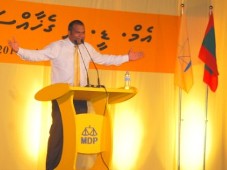
Leaders of the ruling Maldivian Democratic Party (MDP) launched vitriolic attacks against former President Maumoon Abdul Gayoom at a rally Tuesday night, following his departure from the Dhivehi Rayyithunge Party (DRP) to lead the newly-formed Progressive Party of Maldives (PPM).

In a series of fiery speeches, MDP MPs and party leaders dubbed PPM “the property inheritance party” created to “set up a family dynasty” and condemned the former President’s return to active politics.

“We thought the person who ruled this country for 30 years was finished, but we’re now seeing the formation of the Private Property of Maumoon,” said MP Ali Waheed, former deputy leader of the DRP who defected to the ruling party in May. “We stayed quiet but it was Maumoon who picked off one teeth after another from DRP and now he’s saying DRP is toothless and forming PPM with people who need false teeth.”

The MP for Thohdoo added that he “came to the MDP to put a stop to this”.

“I want to call on [DRP Leader] Ahmed Thasmeen Ali and [Speaker of Parliament] Abdulla Shahid today, if you’re toothless, come to a party that has teeth and bite Maumoon,” he said.

Ali Waheed claimed that in the wake of MP Alhan Fahmy’s dismissal from DRP in late 2009, Gayoom sent a text message to DRP MP Ahmed Nihan’s phone from Singapore asking Waheed to call Fahmy “a rat.”

On Gayoom’s stated reasons for forming a new party, Ali Waheed said that the Maldivian constitution protected Islam and national sovereignty, neither of which required the the former President’s protection.

Ali Waheed accused Gayoom of undercutting young leaders of the DRP, predicting that “at the last minute” the former President would ask Umar Naseer and Abdulla Yameen – potential contenders for the PPM presidential ticket – to step aside to make way for his presidential bid.

Meanwhile after verifying the required 50 application forms, the Elections Commission (EC) approved the PPM’s request to register the new party today with Gayoom’s son Farish Maumoon as the party’s temporary liaison. Gayoom’s four children, along with half-brother MP Abdulla Yameen and nephew MP Hamdhoon Abdulla Hameed, were also members of the Z-DRP council formed after the ‘Zaeem’ faction’s split from the DRP.

“We have not forgotten”

In her remarks, outgoing MDP Chairwoman Mariya Ahmed Didi criticised Gayoom for refusing to rule out an attempt to return to power after inviting “educated youth” to join his party.

Mocking Gayoom’s request to reporters at Monday’s press conference to ask only one question at a time “because I might forget,” Mariya said that “[Gayoom] might have forgotten how [he] ruled for 30 years, the Maldivian people experienced those 30 years and remember it well.”

President Mohamed Nasheed told her that if the government arrested Gayoom or sought retribution or revenge, said Mariya, it would discourage the emergence of strong opposition parties.

Nasheed explained that “we have come out for a bigger picture and must be patient and lower our hearts,” Mariya said, expressing gratitude to MDP member for “the patience you have shown.”

“We are seeing that when the public has been very patient, some people mistakenly thought that people have forgotten the experience of 30 years,” she continued. “I want to tell President Maumoon, we do remember. We remember the brutality, we remember Evan Naseem and those who were killed with him.

“We remember what happened to our ballot boxes, how island chiefs sat on it and replaced ballot papers to get 98 percent [in previous presidential referendums] so that you could say ‘I’m the President.’ I want to tell Maumoon we have not forgotten how you destroyed our young generation with drugs so that they will not oppose you. We remember the level of corruption in this country in the past.”

“Access Denied”

AlhanMP Alhan Fahmy – who was dismissed from the DRP for voting against the party line in a no-confidence motion against Foreign Minister Dr Ahmed Shaheed – meanwhile argued that the fledgling democratic system in the Maldives would not allow Gayoom to stage a come-back.

“There is only one way an autocratic ruler can come back,” he explained. “That is, the ruler can return to an autocratic government. Today our system is a democratic system. That means when Maumoon tries to enter the system, it will flash in big letters: ‘Access Denied’.”

Alhan said the “message MDP wants to send Gayoom” was that – as recent events in the Middle East have borne out – deposed autocratic regimes could not return to power.

“I have a two year-old child and whenever anyone asks him ‘what happened to Maumoon?’ he will immediately reply ‘he fell’,” Alhan continued, adding that presidents in democratic countries are not toppled from power but leave after completing their terms in office. “When you fall, you can’t climb back again. You have to stay on the spot where you fell.”

Meanwhile in his speech, President Nasheed asserted that there was no possibility of Gayoom returning to power.

“It is not something we should be concerned about in the least,” he said. “We know the history of this country and what happens to former rulers. [But] because what we want to see from this country is a different reality, we still keep saying ‘lower your hearts in victory’ and this is what we will keep doing in the future.”

Gayoom should be offered “the respect and honour due to a former President,” said Nasheed, assuring supporters at the rally that Gayoom’s political activities would not cause them “any harm whatsover.”

“That is not something that will happen in this country anymore,” he insisted. “Before concluding I do however want to tell you what happened to Ali Rasgefaan [Sultan killed in battle with an invading Portuguese garrison in 1558]. When he reached Maafanu [ward of Male’] and looked back, there were only two people behind him. He was buried there with those two. The Prime Minister of Andhiri Andhiri [Portuguese overseer] was Thufasha, who was Ali Rasgefan’s Prime Minister. Nothing new will happen in our country. This is a very ancient island. We are living with a thousand of years of history. Do not be worried at all.”

Likes(0)Dislikes(0)