Police arrested 52 persons during last night’s protest who they claim are connected to various gangs in Male’.
A group of youths, led by opposition MPs, have commenced series of protest demanding the resignation of President Mohamed Nasheed after the government decided to shift the fixed Rf12.85 dollar exchange rate within a 20 percent band.
Police said those arrested were known to be involved in crimes such as robberies, assault and battery and theft.
”We would like to note that gang members active on the front line of such protests at a time when the police are trying to curb the rise in gang related crimes could potentially obstruct the work of police,” said police in a statement. ”We advise people to conduct any activities that obstruct work by police to try make the society peaceful.”
”Some of the protesters who were covering their faces were reported to have sharp knives and such weapons with them,” police said, adding that some of the handmade explosives used in the demonstration could have potentially caused casualties.
Police also said that owners of shops near the intersection the protesters have called ”Tahrir Square” have repeatedly complained that the protest was causing damage to their businesses.
”Therefore, we would also like to remind protest organisers that the protest disturbs the residents of the area and causes damage to the business of shops located in the area,” said police.
Police appealed to politicians to cooperate with the work of the police to curb the rising crime rate in the Maldives.
The Police request for political cooperation comes after opposition MPs have said they would not pass the Crime Prevention Bill presented to the parliament which gives police the authority to search houses without a court warrant, suspend the right to remain silent all persons accused of crimes mentioned in the bill, and grants them the authority to hold persons in detention for 90 hours without a court warrant.
The bill has a ‘sunset clause’ making it active for 18 months, however the international community has expressed concern that the bill contradicts rights guaranteed in the constitution.
Dhivehi Qaumee Party (DQP) MP Riyaz Rasheed told the press that he did not trust the police to provide them so much power, alleging that that police were violent and brutal in dispersing Saturday night’s protest, and that police would misuse those powers to arrest politicians.
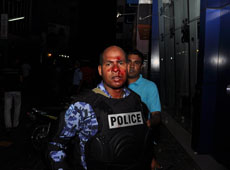
No force was used during last night’s protest, police said, however a number of officers were injured by rocks, paving stones and other thrown objects.
President Mohamed Nasheed has outlined tax reforms he claims will help to eventually alleviate concerns over the higher costs of goods and services at the heart of protests that have raged in Male’ over the last two days.
Beyond announcing that May 1 would now serve as a public holiday every year in celebration of International Labour Day, the president aso attempted to outline government plans for economic reform.
Speaking yesterday during a function to mark Labour Day, Nasheed unveiled plans to try and reduce costs for “everyday items” by between 10 to 15 percent by removing import duties, which the government estimates account for Rf2.3bn of budgeted state income during 2011.
The president said he believed these costs can be covered by tax reforms; both on the earnings of members of the public with a monthly wage of over Rf30,000 a month and increasing taxable income from the tourism industry.
“The reforms to our financial system involve creating a tax mechanism, like in other civilised societies, instead of depending solely on import duties,” he stated, while also pledging to introduce a minimum wage rate during the year.
Some prominent investment groups in the country, while supporting initiatives to reduce costs that have led to ongoing public protests in the country, say that the addition of a minimum wage and a Goods and Services Tax (GST) on all businesses operating in the country, needed to be gradually implemented to ensure the nation’s fledging economy can cope with any potential changes.
As part of his reforms, the president claimed that the government planned by next month to propose amendments that would remove import duties on basic items as of 2012.
According to Nasheed, these proposals would be backed by other amendments expected to be forwarded to parliament. This includes an increase in the Tourism GST, introduced on January 1 this year, to five percent from the 3.5 percent introductory rate, as well as implementing an entirely new GST of three percent on general trade outside of travel industry services.
“I have no doubt that these reforms will shift the government from its current sources of income to more sustainable income sources,” he claimed.
To try and counter the more pressing concerns of high costs that have allegedly led thousands of, mostly young, people taking to the streets in protest, the president claimed that it was purseuing a number of financial [instruments] to try and cut down on the impacts of higher living costs such as in establishing a minimum wage during 2011.
“This government came to power with hopes, to give a decent and an honourable life for Maldivians,” he said. The president said that the initiative was part of plans to promote employees rights as well as those of employers within the country through the establishment of “stronger labour relations frameworks.”
“Most political leaders are disinclined to restructure monetary systems, change wage limits, and reform tax regimes because they are pressured to consider the needs of few powerful people,” Nasheed claimed. “But I assure you that the leader you [Maldivian people] have elected is not like that.”
In addressing Nasheed’s plans, the Treasurer of The Maldives National Chamber of Commerce and Industry (MNCCI), Ahmed Adheeb Abdul Gafoor, said that he believed further development such as investment was needed to strengthen the Maldivian economy before taking on major reforms – at least in the short-term.
“Introducing these tax reforms and schemes like the minimum wage will be difficult over the next two years. The Maldives is at a disadvantage when it comes to economies of scale as it is,” he said. “What I would like to see is a transitional period rather than introducing these measures straight away.”
Adheeb claimed that with the planned introduction of the additional GST on general trade and corporate tax, the prospect of setting a minimum wage would need to be studied in terms of possible impact, particularly in the private sector.
“We [the private sector] could end up losing some of our competitive edge over other countries. What we need is some breathing space and for these reforms to be bought in gradually,” he said. “We have to build confidence in the economy especially with small and medium businesses. If the minimum wage is going to be introduced it should be set on an economic basis and not for short-term political benefit.”
Adheeb therefore urged the government to consult employers – especially in smaller and medium enterprises – before putting any initiatives like a minimum wage in place, adding that private enterprises had been a key component in the more successful developments of the Maldivian economy.
“The tourism industry here has been developed mainly by the private and not the public sector,” he said.
A second night of violent protests in the capital city ended with the arrest of several demonstrators after petrol bombs were thrown at police in the early hours of this morning.
Protesters gathered last night near the Tsunami Monument in Boduthakurufaanu Magu and marched towards the intersection of Male’s main road of Majeedhee Magu and the tourist street of Chandhanee Magu; the same location as Sunday morning’s sit-down protest.
Protesters demanded the government lower the cost of living and called on President Mohamed Nasheed to resign, claiming people were increasingly unable to afford basic commodities following the government’s effective devaluation of the rufiya.
Police blockaded the area to vehicles and maintained a presence, but unlike Sunday used no tear gas or force on the crowd.
Riot police at the scene were bombared with petrol bombs, stones, water bottles, chilli sauce, “and a hammer”, according to police Sub-Inspector Ahmed Shiyam.
“The protesters were trying to incite police. Some police were injured but not seriously,” he said.
Police yesterday issued a statement claiming that the the first round of violent protests was premeditated after discovering a ready supply of rocks stashed near the intersection.
Several police were injured when the protest turned violent
During last night’s protests, “police received information that petrol bombs were being made in the toilet area of a nearby mosque. Police attended the mosque and found petrol bombs and equipment used to make them.”
Police water cannon and tear gas were deployed in the area, but were not used. A number of violent protesters into custody who were later identified as known gang members. No MPs were arrested.
“We saw two journalists injured by a stone, although not seriously,” Shiyam said.
Senior political figures at the protest included dismissed DRP Deputy Leader Umar Naseer, and DRP MPs Ahmed Mahlouf, Ahmed Nihan. Jumhoory Party (JP) leader MP ‘Burma’ Gasim Ibrahim, and DRP leader MP Ahmed Thasmeen Ali visited the scene at around 1:00am.
Gasim addressed the crowd but did not stay long, while Thasmeen joined the protesters.
Spokesperson for the DRP, Irahim ‘Mavota’ Shareef, confirmed to Minivan News that the protest was authorised by the DRP Council – significant, as Umar Naseer was dismissed from the party last year for leading similar protests on behalf of the opposition without approval.
Meanwhile, Maldivian Democratic Party (MDP) parliamentary group leader and MP ‘Reeko’ Moosa Manik led a group of around 100 MDP activists in an apparent attempt to clash with the DRP supporters, but were quickly cut off from the demonstration by riot police.
Both crowds threw objects at each other, with Moosa’s crowd yelling that they did not believe that living costs had risen.
After warning protesters several times to leave the area, police dispersed the crowd by slowly moving into the intersection. The protest was finally dispersed around 3am early this morning.
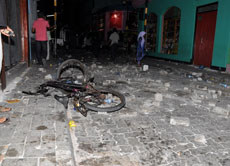
Thrown rocks left on the street in the aftermath of the protest
Speaking to Minivan News, DRP MP and leader of the party’s youth wing Ahmed Mahlouf claimed that last night’s crowds were larger than the previous protest – particularly the number of young people present.
“The crowds are much greater than last night and I am confident that the turnout will be even bigger tomorrow night,” he said.
The protests would be begin at the artificial beach area every night at 8:45pm ahead of a “huge” protest scheduled for Friday, Mahlouf said.
He acknowledged that the protests had descended into levels of violence that “could not be accepted” with some groups of people throwing stones and cans of petrol at police that at one point also threating to set a shop on fire.
“There is some suspicion that the MDP may have paid these individuals to do this. There were so many stones and petrol bottles thrown at police as well as hitting stores,” he said.
“We cannot accept these levels of violence and as protestors we just want to raise our voices and get our point across about high prices. Even last night we were asking police to arrest these people, though this difficult to do in large groups of people.”
The protests have been claimed by some opposition politicians to have been organised by, and represent, youth groups in the country rather than a single partisan interest.
Amidst plans by organisers for further protests throughout the week, Mahlouf said his party would nonetheless be having a meeting today to decide whether to talk with police about possible means to reduce potentially violent confrontations.
“A lot of these techniques were used by the MDP before they came into power,” he claimed. “I do not want to see a repeat of that.”
However, the MP claimed that a number of senior MDP activists had also joined the protests and spoke out concerning government economic policy, including some friends of President Mohamed Nasheed.
“We know people aren’t with them any more and that they don’t believe what he [President Nasheed] says,” he said. “Even in the MDP leadership elections where he supported the appointment of both Ibrahim Zaki and Mohamed Aslam, the party has voted against him.”
MDP spokesperson Ahmed Haleem Zaki claimed that the intervention of opposition groups like the DRP in the protests formed part of wider plans to create “drama” that distracted from a failure to pass so-called anti-gang legislation in the Majlis this week.
“Today parliament is supposed to be considering passing a bill that would give more power to police to arrest gang members,” he said. “This is a political problem where we have an important bill needing to be passed and the opposition parties do not want it to go through.
Haleem did confirm that fellow MDP MP ‘Reeko’ Moosa Manik had turned up with some supporters during the protest, but said he was not himself responsible for instigating violence.
“Moosa was hit by stones and was then taken to hospital, but I can’t confirm if he was seriously injured or not,” he said.
Haleem claimed that Moosa intended to try to call for an end to violent confrontations and denied that his presence may have exacerbated confrontations at the protest site.
“We do not want violence as we are the [country’s] ruling party. Moosa was there to support police and ask protests to go home peacefully,” he claimed.
When questioned over whether MDP supporters were amongst the young people protesting, Haleem said that the party accepted that the cost of living was a major issue and that the last two years had thrown up a number of difficulties for the government in balancing the nation’s finances.
“However, we had the previous government who treated Maldivian money as if it was their own family fortune for many years,” he said. “They left the economy in such a situation that the government has been forced to take drastic measures. People know that the cost of living is high all over the world from China, to the US and the UK.”
According to Haleem, opposition parties had sought to use the protests to court drama and political instability in order to try and garner negative press coverage of President Nasheed through major news networks like CNN and Al Jazeera.
“I think [Nasheed] is very popular right now and that is why the opposition want drama,” he said. “[The opposition] thought they could compare the protests to mass movements in Egypt’s Tahrir Square – a site linked to the fall of former Egyptian leader Hosni Mubarak – but people are not stupid and know very well that this isn’t the case. After four or five months we expect the economic situation to have improved.”
Meanwhile, MDP coalition partner the Adhaalath Party, led by State Islamic Minister Sheikh Hussein Rasheed, has issued a press statement in support of the anti-government protests.
The Adhaalath Party said it believed that the youth protest was “a peaceful gathering.”
”Lowerer living expenses is one of the main pledges of this government,” said the party. ”We call on the government to find a wise solution for this issue.”
The Adhaalath Party said that the protest was conducted lawfully and that ”it is not acceptable to use tear gas and batons to disperse a lawful protest.”
The party also expressed concern that police officers and protesters were injured during Sunday night’s protest.
Currency in crisis
The government has struggled to cope with an exacerbating dollar shortage brought on by a high budget deficit – triggered by a spiralling public sector expenditure – in comparison with the foreign currency flowing into the country. Civil service expenditure has increased in real terms by 400 percent since 2002.
Banks subsequently demonstrated reluctance to sell dollars at the pegged rate of Rf 12.85, and high demand for travel, commodities and overseas medical treatment forced most institutions to ration their supply or turn to the flourishing blackmarket.
After a short-lived attempt to crack down on the illegal exchange of dollars, the government floated the rufiya within a 20 percent band, effectively allowing it to be sold at up to Rf 15.42 to the dollar.
The International Monetary Fund (IMF), which has been critical of the government’s growing expenditure despite a large budget deficit, praised the decision as a step towards a mature and sustainable economy.
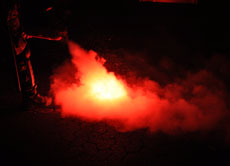
Police extinguish a thrown petrol bomb
“Today’s bold step by the authorities represents an important move toward restoring external sustainability,” the IMF said in a statement. “IMF staff support this decision made by the authorities. We remain in close contact and are ready to offer any technical assistance that they may request.”
However, many companies dealing in dollar commodities immediately raised their exchange rates to Rf 15.42, along with the Bank of Maldives.
The government’s move, while broadly unpopular, acknowledges the devaluation of the rufiya in the wake of increased expenditure and its own inability to overcome the political obstacles inherent in reducing spending on the country’s bloated civil service.
Yet as Maldives relies almost entirely on imported goods and fuel, and many ordinary citizens have found themselves harshly affected by short-term spike in prices of up to 20 percent as the rufiya settles.
“We do not really know, based on the breadth of the domestic economy, what the value of the Maldivian rufiyaa is right now,” Economic Development Minister Mahmoud Razee admitted at a recent press conference.
The government has said it hopes the rufiya will stabilise within three months.
The stated cause of the opposition-led protests in Male’ – the party claims the rallies are “youth led”, however opposition politicians are a leading fixture at the demonstrations – is the increase in the cost of living due to the government’s recent decision to implement a managed float of the rufiya, within a 20 percent band of the pegged rate of Rf 12.85.
An ongoing dollar shortage, reluctance of banks to exchange local currency, and a flourishing blackmarket that reached Rf 14.2-14.8 to the dollar, culminated in mid-April with the government finally acknowledging that the rufiya was overvalued – after a short-lived attempt to crack down on ‘illegal’ exchanges.
High demand immediately led to most banks and companies dealing in dollar commodities – such as airline ticketing agents – to immediately raise their rate of exchange to the maximum permitted rate Rf15.42.
With the Maldives almost totally reliant on outside imports, including fuel and basic staples such as rice, the government’s decision has effectively led to a 20 percent increase in the cost of living for most ordinary Maldivians.
Moreover the Maldivian economy is dependent on oil to such an extent that is spends a quarter of its GDP on it – US$245 million – the vast majority on marine diesel, making imported energy one of the single largest drains on the country’s economy.
Customs documents obtained by Minivan News in January showed that Maldives was spending almost US$100,000 more per day more on fossil fuels than it was in the summer of 2010. At that time, oil was US$86 a barrel. By the same calculations but with today’s oil price, the Maldives is paying an additional US$450,000 per day for oil compared to summer prices last year.
Amidst rising commodity costs and external pressures, the country’s insistence on maintaining a fixed rate while increasing government spending had late last year begun to affect shop shelves and raise the ire of the International Monetary Fund (IMF), which delayed the third tranche of its funding due to “significant policy slippages” concerning the government’s failure to curtail spending. That amount in itself was not substantial, but the IMF is used as a financial bell-weather by most major donors.
The government’s unwillingness to face the political difficulties inherent in its budget deficit of 21 percent – the legacy of a 400 percent increase in civil service expenditure since 2002 and a hot printing press – was compounded by the addition of an extra layer of local government added to the state payroll, and the country’s graduation from the UN’s ‘Least Developed Country’ status to ‘Middle Income’, and the loss of concessional credit and certain trade concessions.
In an article for Minivan News, Director of Structured Finance at the Royal Bank of Scotland Ali Imraan observed that ‘growth’ in the domestic economy had been driven by the public sector and “paid for by printing Maldivian rufiya and clever manoeuvres with T-Bills, which the government has used since 2009 to be able conveniently sidestep the charge of printing money. In simple terms: successive governments printed/created money to drive domestic economic growth.”
Imraan pressed for the Maldives to invest in private sector revenue growth “rather than building airports on every island”, and implement a progressive taxation system targeting high earners in the interest of income equality. He also urged the Majlis to uphold the constitutional stipulation whereby MPs – such as those with business interest in the tourism sector – removed themselves from voting on issue in which they had a vested interest, and further suggested that the government resolve the matter of stalled tourism developments “awarded to parties with no money or track record.”
“Moratoriums on lease payments or debt repayments may look innocuous enough, but they rob the country of vital growth opportunities and hence ultimately rob the people. We should not stand for it,” he said.
Imraan’s latter suggestion proved somewhat prescient when the Tourism Ministry renewed the lease for Hudhufushi in Lhaviyani Atoll, despite the resort island’s owner owing more than US$85 million in unpaid rent – most of it fines for non-payment.
The government’s decision to implement a managed float of the currency came as a least one local sales agent for international airlines operating in and out of the Maldives closed its doors to customers, blaming an inability to pay the airlines because of a lack of US dollars circulating within the economy.
Parallel economy
The Maldives’ profitable tourism industry is considered to be indirectly responsible for 70 percent of the country’s GDP, and certainly the vast majority of its foreign currency earnings.
However historically little of the industry’s financial success has reflected on the Maldives’ domestic economy, with the inflow of money limited to the flat rate bed tax, import duties and worker salaries – most of that in rufiya.
With the introduction this year of a 3.5 percent tourism goods and services tax, a business profit tax and a revision of the rents paid for resort islands, the government now has a number of economic levers it can pull to increase revenue in the future.
However it has struggled to explain that to people now paying 20 percent extra for basic commodities – an affront to the MDP’s pledge to reduce the cost of living – and seems have been caught unawares by this week’s populist protests.
Both factions of the opposition have meanwhile seized the political opportunity to take the focus off the party’s internal troubles, but have offered few alternatives beyond demanding the government “reduce commodity prices”.
“I believe a lot of people are very unhappy with rising prices. People are asking the government to bring down the prices,” opposition Dhivehi Rayyithunge Party spokesman Ibrahim ‘Mavota’ Shareef told Minivan News.
“It has been a sudden and tremendous jump and people were not prepared for it. This feeling is shared across party lines.”
Shareef accused the MDP of financial mismanagement and recklessly increasing spending, without investing “in productive resources that ensure future revenue for the country, and reducing expenditure in areas that do not affect the people – such as foreign missions.”
“They need not reduce the civil service, because these are the lowest paid government employees and reducing their numbers would have not tangible effect. But the top players in government – the political positions – and positions in the paper companies created by the government are many areas [that can be reduced],” Shareef claimed.
“Before the tsunami the country’s finances were very well managed, and even after the tsunami, given the circumstances, they were well managed. Tourism infrastructure was damaged, islands needed reconstruction and in some cases resettlement. We had to spend a lot of money, and increased the budget from Rf4 billion to Rf5.5-6 billion. It was still a manageable level, and although it was not the best option we had no choice at the time,” he claimed.
The opposition – and the Civil Service Commission (CSC) – for much of last year opposed the reductions in the 21,000-strong civil service demanded by the IMF, with the issue becoming mired in the court system.
The opposition contested that it is unfair to reduce the number of civil servants while increasing the number of political appointees. While the government now has only 170 political appointees on its books, Shareef claimed “they do not show up on paper because of the paper companies the government created in the name of corporatisation to try and fool the International Monetary Fund and the World Bank. I don’t think a country of this size – 350,000 people – needs to have so many political appointees.”
The government has since changed tactics, offering incentives to civil servants as young as 18 to leave the state payroll.
Under the scheme, the application deadline for which was May 31, civil servants and government employees are eligible for one of four retirement incentive packages: no assistance, a one time payment of Rf 150,000 (US$11,700), a payment of Rf 150,000 and priority in the small and medium enterprises loan scheme (for those 18-50 years of age), or a lump sum of Rf 200,000 (US$15,600) and priority in government training and scholarship programmes (for those 18-40 years of age).
The move to incentivise the departure of civil servants is likely to draw further support from the IMF, which has finished its Article IV consultation and may be weighing up the provision of further support.
Meanwhile, the government is unable to respond to demands from the constituency to reduce commodity prices without explaining the complexities of the situation it finds itself in. Yet neither is it realistic “to pin our hopes on some sort of tourism growth bonanza in the short term,” wrote Imraan. “We might as well play the Euro lottery every week if this is the only plan.
US President Barack Obama has declared the death of Osama bin Laden at the hands of US forces.
In a live broadcast to the US on Sunday night, Obama claimed that an intelligence lead in August 2010 had culminated in the tracking of bin Laden to Abbottabad, a town north of Islamabad in Pakistan far from the tribal belt where the US has been searching for the fugitive.
“It was far from certain, and it took many months to run this thread to ground. I met repeatedly with my national security team as we developed more information about the possibility that we had located bin Laden hiding within a compound deep inside of Pakistan. And finally, last week, I determined that we had enough intelligence to take action, and authorised an operation to get Osama bin Laden and bring him to justice,” Obama said.
“A small team of Americans” engaged bin Laden in a firefight, killing him. No US or civilian casualties were reported, and bin Laden’s body was recovered.
A US official told Associated Press that “We are assuring [his body] is handled in accordance with Islamic practice and tradition.”
Counter-terrorism cooperation with Pakistan “help lead us to bin Laden and the compound where he was hiding,” Obama said.
“We must also reaffirm that the United States is not – and never will be – at war with Islam,” he added. “Bin Laden was not a Muslim leader; he was a mass murderer of Muslims. Indeed, al Qaeda has slaughtered scores of Muslims in many countries, including our own. His demise should be welcomed by all who believe in peace and human dignity.”
Reaction
Crowds immediately gathered outside the gates of the White House singing the country’s national anthem, while news networks reported a “party atmosphere” spreading throughout the country.
British Prime Minister David Cameron said that confirmation of bin Laden’s death should “bring great relief to people across the world”.
“Osama Bin Laden was responsible for the worst terrorist atrocities the world has seen – for 9/11 and for so many attacks, which have cost thousands of lives, many of them British,” the PM said.
A Western diplomat based in Islamabad told the UK’s Guardian newspaper that bin Laden’s death was a “game changer” for US foreign policy in Afghanistan and Pakistan.
“I’m overjoyed, but what this exactly means is really not clear,” the diplomat said.
A number of analysts speculated that while bin Laden’s death was a significant symbolic victory for the US, it was unlikely to hamper al Qaeda’s operations as bin Laden was no longer involved in the day-to-day functioning of the terrorist organisation.
The US State Department meanwhile issued a travel alert to all US citizens warning of an outbreak of anti-American violence in the wake of bin Laden’s death.
“Given the uncertainty and volatility of the current situation, US citizens in areas where recent events could cause anti-American violence are strongly urged to limit their travel outside of their homes and hotels and avoid mass gatherings and demonstrations,” the State Department said.
US Assistant Secretary of State for South Asia, Robert Blake, is currently in Male’ for meetings with political leaders and civil society.
The Sri Lankan government is grappling with the political fallout of a leaked UN report accusing it – and the Liberation Tigers of Tamil Eelam (LTTE) rebels – of potential crimes against humanity in the closing days of the civil war.
The report on the final stage of the war between LTTE and the Sri Lankan authorities was leaked to the media, containing allegations, among others, that the army shelled hospitals, UN facilities and aid workers with the International Committee of the Red Cross (ICRC). The report further alleges that the government intimidated and in some cases silenced the media, even abducting journalists in “white vans”.
Meanwhile, UK television network Channel 4 last week said it will air what it claims is “probably the most horrific” footage the station has ever shown, after obtaining “trophy” videos of what it claims are Sri Lankan war crimes.
According to the network, footage obtained by the station includes “extrajudicial executions filmed by Sri Lankan soldiers as war trophies on their phones; the aftermath of shelling in civilian camps and hospitals alleged to have been deliberately targeted by Sri Lankan government forces; dead female Tamil fighters who appear to have been systematically raped; and pictures which document Tamil fighters alive in the custody of Sri Lankan government forces and then later dead, apparently having been executed.”
The director of ITN productions, Callum Macrae, told the UK’s Guardian newspaper that the filmmakers had “trawled through hours of devastating imagery shot by Tamils under attack and Sri Lankan soldiers as war trophies. The claims made by eyewitnesses in the film appear to be illustrated in each case by video footage or still images.”
The Sri Lankan government has reportedly complained to the UK’s media regulator Ofcom regarding the station’s intention to air the footage.
Channel 4’s announcement comes a week after a UN report on the closing days of the war between the Tamil Tigers and the Sri Lankan authorities was leaked to the media, containing allegations, among others, that the army shelled hospitals, UN facilities and aid workers with the International Committee of the Red Cross (ICRC). The report further alleges that the government intimidated and in some cases silenced the media, even abducting journalists in “white vans”.
“The government says it pursued a ‘humanitarian rescue operation’ with a policy of ‘zero civilian casualties’. In stark contrast, the Panel found credible allegations, which if proven, indicate that a wide range of serious violations of international humanitarian law and international human rights law were committed both by the Government of Sri Lanka and the LTTE, some of which would amount to war crimes and crimes against humanity,” the report reads.
“Despite grave danger in the conflict zone, the LTTE refused civilians permission to leave, using them as hostages, at times even using their presence as a strategic human buffer between themselves and the advancing Sri Lanka Army. It implemented a policy of forced recruitment throughout the war, but in the final stages greatly intensified its recruitment of people of all ages, including children as young as fourteen. The LTTE forced civilians to dig trenches for its own defenses, thereby contributing to blurring the distinction between combatants and civilians and exposing civilians to additional harm. All of this was done in a quest to pursue a war that was clearly lost; many civilians were sacrificed on the altar of the LTTE cause and its efforts to preserve its senior leadership.
A former UN spokesperson for the UN in Sri Lanka was reported in the UK’s Independent newspaper as saying that the report “damns the government of Sri Lanka’s so-called war on terror, which incidentally killed many thousands of civilians. The Tamil Tigers were equally rotten in their disdain for life.”
Sri Lankan media has meanwhile been busily criticising the veracity of the report, the UN panel involved, and UN Secretary-General Ban Ki-moon himself.
Yesterday, Ki-moon announced that he would welcome a mandate from the UN Human Rights Council, Security Council or General Assembly to launch an international war crimes investigation into the final two years of Sri Lanka’s civil war, as per the recommendation of the UN report.
Such a mandate would require consent from the Sri Lankan government – unlikely, given that it has labelled the report as “fundamentally flawed and patently biased” – or through a decision by the UN’s 192 member states.
The US Embassy in Sri Lanka has also privately expressed concerns about the Sri Lankan government’s actions during the closing days of the war.
In a leaked US Embassy cable sent on January 15 2010, Ambassador Patricia Butenis remarked there was a clear “lack of attention to accountability” following the mass killings of Tamils in the final days of the war, a situation she described as “regrettable” but unsurprising.
“There are no examples we know of a regime undertaking wholesale investigations of its own troops or senior officials for war crimes while that regime or government remained in power,” Butenis said in the cable.
“In Sri Lanka this is further complicated by the fact that responsibility for many of the alleged crimes rests with the country’s senior civilian and military leadership, including President Rajapaksa and his brothers and [then] opposition candidate General Fonseka.”
The UN report and subsequent international furore likely to be generated in the wake of the Channel 4 program places the Maldives in a difficult position, between its stated (and much promoted) human rights agenda, and its national and economic interest.
Sri Lanka is one of the Maldives’ key economic and regional partners, and a major transit hub for both trade and tourists visiting the country. President Mahindra Rajapaksa extended the Maldives a US$200 million credit line in November, and even travelled to the Maldives to mediate a dispute between the ruling Maldivian Democratic Party and opposition Dhivehi Rayyithunge Party (DRP) in July last year. President Mohamed Nasheed subsequently attended Rajapaksa’s swearing in ceremony.
At the same time the Maldives is a vocal member of the UN Human Rights Council and an avid proponent of human rights, with the Foreign Ministry only recently declaring that it was severing diplomatic ties with the Libyan government due of “clear evidence that the Gaddafi regime is guilty of crimes against humanity and war crimes.”
It is not inconceivable that were the UN’s case to gather momentum and international public opinion, the matter could go to vote and the Maldives could be compelled to publicly defend its neighbour from the international community.
President Nasheed’s Press Secretary Mohamed Zuhair emphasised that the Maldives saw the end of both the terrorist attacks and the civil war in Sri Lanka as “a very positive development.”
“The government has very close ties with [Sri Lankan President] Rajapaksa,” Zuhair said. “Our position is that the Maldives has very good relations with neighbouring countries, and has hundreds if not thousands of years of trade and bilateral relationships with Sri Lanka.”
The post-war situation, he suggested, was “fluid”.
“I’m concerned the UN report is a bit belated. Why say it now? Why not when the war was going on? My point is that this report only appeared after the war was over. We support the Sri Lankan government’s desire for peace and harmony, and any government that brought about that peace should be held in high honour.”
If an investigation was to take place, Zuhair suggested, “it should happen in an independent manner, with reconciliation on both sides.”
The Maldives’ Foreign Minister Ahmed Naseem is currently in the UK and was not responding at time of press.
Police have said that in an ongoing police special operation to reduce the crime rate they have searched guest houses and other places in Male’ and arrested a number of both females and males, reports Haveeru.
According to Haveeru, some items were also seized in the operation.
Police have declined to provide further information regarding the special operation and said more information will be provided later.
Syrian security authorities stand accused of storming a mosque in the city of Deraa yesterday as part of attempts to quell ongoing unrest in the country, resulting in several reported fatalities.
The BBC reported that 66 civilians caught up in ongoing anti-government protests were believed to have been killed by security officials on Saturday (April 30) as soldiers allegedly established a presence on the roof of Deraa’s Omari mosque after storming the building.
State officials have said that official fatality figures were a lot lower than those reported in international media and included the death of four soldiers. Local television also reported that “armed terrorists” had attacked security forces in the cities of Deraa and Homs.
Foreign journalists are reportedly banned from entering the country, making official clarification of events in the country difficult.
According to the Al Jazeera news agency, the son of an imam at the Omari mosque was amongst the dead after allegedly being shot by security forces as Deraa reportedly came under “heavy shelling and gunfire”. The alleged attacks were reported to have taken place while civilians tried to bury bodies left over from protests taking place on Friday.
Al Jazeera journalist Rula Amin, based in the national capital of Damascus, stated that Deraa was thought to have witnessed some of the most severe clashes between security forces and anti-government protesters.
Amin added that within this backdrop, state television broadcasts featured people “confessing” to being members of terrorist groups that are sponsored by individuals based in Deraa, including the imam of the Omari mosque.
“We are told by residents that the imam was always asking for calm, for dialogue, and when I went to Deraa and I met him myself he did not say that people should carry guns or should fire at security forces,” she wrote. “He was adamant that people have the right to protest, that things need to change in Syria.”
International news organisation Reuters said that security forces had yesterday also arrested two “veteran” opposition figures and 11 female protesters taking part in a silent march around Damascus as part of their crack downs on anti-government sentiment in the country.
Reuters added that local human rights group Sawasiah currently estimates that 560 civilians had been killed by security forces since protests kicked off about six weeks ago.
 (0)Dislikes
 (0)
(0)