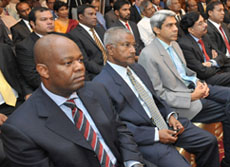
The Maldives national cricket team have been greeted back in Male’ by President Mohamed Nasheed after their triumph last week in the Asian Cricket Council (ACC) Trophy Challenge 2010, which he labelled as the country’s “biggest sporting achievement” to date.
The president congratulated the team for their efforts after they defeated Saudi Arabia by a single wicket during the tournament finale in Bangkok, after they had overcome a number of regional teams to secure the title.
Nasheed stated that the victory highlighted the potential for further development of cricket in the country.
This year’s Trophy Challenge tournament, which began December 4, 2010, saw eight teams including China, Brunei, Iran and Myanmar compete against the Maldives.
The victory sees both finalists promoted to the ACC Trophy Elite tournament in 2012, where they will face teams such as Afghanistan, Malaysia and Hong Kong.
A meeting of the opposition Dhivehi Rayyithunge Party (DRP) last night came to blows when Umar Naseer, the party’s Deputy Leader prior to his dismissal by the party’s disciplinary committee, and his supporters gatecrashed the venue.
The meeting was being held in celebration of last Thursday’s Supreme Court ruling, which saw seven cabinet ministers departing their posts after their reappointments were disapproved by the opposition-majority parliament.
“We don’t really know what happened,” said Sub-Inspector Ahmed Shiyam, of last night’s incident at Ghiyasuddin International School.
“We know the Vice President of the DRP Umar Naseer tried to enter and there was some disturbance inside. People tried to attack each other but police intervened.”
Shiyam noted that while some people were claiming to have been injured in the fighting, “police haven’t received any official reports.”
“There was damage to chairs and a table,” he said, but added that police would not be following the matter “as no one has requested an investigation.”
Local media reported that a glass table in front of DRP Leader Ahmed Thasmeen Ali was smashed after supporters of Naseer forced their way into the venue while former Attorney General Azima Shukoor was speaking.
According to newspaper Haveeru, Shukoor called an end to the meeting and described the clash as a “dark and regretful” night in the party’s history.
Deputy Leader of the DRP and Spokesperson Ibrahim Shareef alleged today that Umar Naseer was attempting to attack and hurt Thasmeen during the meeting, which he said was attended by 3000 people.
“There were two stages – at first [Naseer’s] supporters came in; there were about 25-30 of them. 40-50 including his security detail,” Shareef said.
“There was uproar and both Thasmeen and the Speaker [Abdulla Shahid] were removed by their security detail.”
Naseer’s dismissal from the party was followed by an acrimonious war of words with Thasmeen and allegations that he and Shahid were bribed by GMR – allegations Shareef described as “totally fake”, and “ a dirty tactic to discredit the Speaker and the Party Leader.”
The dismissal of Naseer led DRP MP Ahmed Mahlouf to speculate last week that “there will be a split in the party for sure.”
“[Naseer] is someone with a lot of support in the party, and to date he has done a lot of work for us. He is very loyal to the former President, Maumoon Abdul Gayoom,” Mahlouf said.
Shareef alleged today that the main goal of Umar Naseer and his supporters was now “to dislodge Thasmeen from the leadership of the party.”
“They are urging people not to vote for the official DRP candidates in the local council elections, over SMS and telephone,” he said.
“They are doing everything they can to rebel, and hope to change the party’s constitution in the 2012 congress so they can elect their man to the leadership post.”
He acknowledged that the factional fighting could have a have “a negative impact on our election prospects [in the local council elections], but not that much.”
“”Thasmeen as a leader is cool-headed and wise, and does not use such populist tactics,” Shareef said.
“We know that some of the new government’s policies are not right, such as the airport concession for GMR. But at the same time we would not support a hijacking of the airport – we have to use legal means and not damage the nation’s economy. We will not use terror tactics.”
Shareef observed that Naseer were saying they had the backing of “the Honorary Leader” – former President Maumoon Abdul Gayoom.
“We don’t know how true that is,” Shareef said. “I don’t think it is in anyone’s interest – including that of the Honorary Leader – for us not to unite and win the election.”
Shareef said he had observed among Naseer’s supporters “many activists belonging to the coalition [People’s Alliance] party”, which is led by the former President’s brother in-law, Abdulla Yameen, and together gives the opposition its parliamentary majority.
Despite the coalition partnership, Yameen filed a civil court case against Thasmeen in February seeking repayment of debts, reported in local media to be around US$100,000.
“I don’t know how involved the coalition leadership is in this,” Shareef said, adding that he did not believe the present factional infighting would jeopardise the coalition or its parliamentary majority.
Rather, he said, “I think the dispute comes from a belief that we are not being aggressive enough, that there is not enough direct activism, and that therefore we are not fighting the government.”
“Our view is that if the government is doing something good for the nation, we will back them. We believe we have a role to help govern.”
Umar Naseer and DRP MPs Mahlouf, Ilham Ahmed and Ahmed Nihan were not responding to calls at time of press.
Banks have been given authorisation by the Maldives Monetary Authority (MMA) to place a one percent commission on one and five US dollar bills to try and encourage greater exports of the currency.
Haveeru reported that the MMA had conceded to requests from banks for permission to charge commission on the notes as a result of the high cost and “risk” involved in exporting dollars.
“Banks need to export the dollar bills of small value being collected as a result of the low public demand,” the MMA reportedly said.
Any institutions with a licence allowing the exchange of foreign currency will be able to charge the commission, under the MMA ruling.
“There should be ‘modernisation’ of Shariah law to some extent,” claimed Shamrahayu A Aziz, a professor of criminal law and human rights from Malaysia’s International Islamic University, who visited the Maldives last weekend for a discussion on faith and legislature.
“However, Shariah cannot tolerate the denial of the basic teachings, especially when there is clear text in the Quran or sunnah,” she added.
Aziz made the claims to Minivan News this week after having been invited to speak in the country by the Justice Society of the Maldives for an academic discussion on the ‘Death Penalty in Law and Shariah’. The discussion was designed to provide a comparative approach between “traditional Islamic views” on corporal punishment and its contemporary use in certain jurisdictions, she added.
Under the Maldivian constitution, Shariah is turned to by the courts in areas where established law does not cover, though the number of people actually sentenced to sharia mandated punishments like the death penalty in the last few decades has been limited to three cases that have not been carried out to this date. The most recent call for the death penalty was issued just last month in relation to an alleged gang killing.
Aziz said that when considering the possible “modernisation” of Sharia concepts such as the death penalty, Islam has specific texts within the Quran relating to a “comprehensive system of life” that cannot be amended to better comply with external standards or humanitarian agreements.
“In analogy, [the] Islamic system is built in a chain or circle. There must not be any break in the chain. If a break happens, Islam therefore is not a complete chain and it cannot be a comprehensive system of life anymore,” she said. “In order to fit in the ‘modernisation’ process, the stringent requirement in [legal] proceedings and the conviction process is very helpful.”
According to Aziz, it remains a “misconception” to perceive Sharia solely as a form of justice built around corporal and capital punishment, particularly when Islam does not itself try to encourage violence.
However, Aziz claimed that particularly in consideration of international concepts and conventions on human rights, Sharia could play an important role in raising awareness “on the importance of protecting the general public.”
“No one can arbitrarily be killed by another without reason,” she said.
Taking the example of a hypothetical domestic violence case, Aziz asked that when a person is arbitrarily murdered, in order to respect the victim’s rights, should a murderer be liable for the arbitrary act that has been committed?
“I accept the fact that killing a person is cruel. But the Islamic punishment of death penalty is not something encouraged. As much as possible death penalty must be avoided,” she said. “That is the reason why the punishment can be imposed and the sentence may be carried out in some exceptional situations.”
Aziz claimed that these situations are outlined under stringent criminal law that requires specific procedural process, with only certain types of evidence being allowed to be used as a basis for proceeding with execution.
“The death penalty is not the first resort in the punishment list. It stands at the last, the bottom [of the list],” she said. “Islam encourages compassion and forgiveness. Islam does not teach Muslims to kill. There are various verses in the Quran which state the clear position on the prohibition of killing.”
In looking at how Sharia could and had been adapted in line with human rights, Aziz took the example of blood money as an indication of how Islamic law can be focused on benefitting victims.
In a case where a person in arbitrarily murdered and they may have a young family remaining, Sharia is said to call for provisions of financial support to ensure a more stable upbringing from the guilty party.
“At least, with the payment of the blood money the children can continue living. This is in line with human rights as the rights of the children for a living after the killing of a father and the only breadwinner of their family must also be taken care of,” Aziz said.
Aziz stressed that his lecture was not specifically meant to address the current situation and attitudes regarding the death penalty in the Maldives.
“I am not the right person to tell maldivians what is best for Maldives,’ she said. “It is left for Maldivians to address the issue and to tackle the sentiments of their [fellow countrymen].”
However, the issue of using the death penalty in Maldivian law was thrust back into public debate last month when the Criminal Court of the Maldives sentenced Mohamed Nabeel to death for the murder of Abdulla Faruhad, following a review of witnesses statements and finding him guilty of the crime.
The Judge said that article 88[d] of the penal code of the Maldives stated that murders should be dealt accordingly to the Islamic Shariah and that persons found guilty of murder ”shall be executed” if no inheritor of the victim denies the murderer to be executed, according to Islamic Shari’ah.
Correction: An earlier version of this article, sourced from an email interview, mistakenly referred to Aziz as a he. Minivan News regrets the error.
A very liberal sentiment was once expressed by Mohammed ‘Anni’ Nasheed (before he became the President of the Maldives), which many believe is now being proved to have been a naive and a false sentiment.
It was expressed during the course of a small debate held on a rooftop in Male’ before a journalist from Al-Jazeera between Mohammed Nasheed and the Honorable Mr Umar Naseer, at that time the leader of his own IDP (Islamic Democratic Party), and the Honorable Mr Mohamed Nasheed, the ‘then’ Information Minister under the Gayoom adminstration.
Opposing Umar Naseer’s opinion that the government needs to curb extremism through repressive measures for extremism to cease being a threat, Mohammed ‘Anni’ Nasheed expressed that he believed that a government cannot end extremist attitudes through repression.
Despite the fact that recent events in the Maldives (flag burning, the repression of women etc) really do seem to make Anni’s liberal belief seem optimistic to the point of being naive, I can still say that ultimately, I believe Mohammed ‘Anni’ Nasheed was correct.
Repression does not deal with the underlying issues which cause the hatred, it merely makes most people afraid of expressing that hatred openly. At the same time, repression causes that hatred to brew like a pressure cooker.
It has often been argued that these problems of religiously masked hatred were created due to the repression of people’s democratic hopes and ambitions (read some post-modern, pseudo-anarchist view’s on liberty such as Noam Chomsky for example).
US foreign policy is very often blamed by left wing think tanks for the existence of terrorism. However, despite these views, I am also of the opinion that Mr Umar Naseer’s view that the government must repress the expression of hatred, does seem to have some validity to it.
Such a view is becoming increasinly popular amongst Maldivians I have spoken to. Evidence that I have encountered does indeed suggest that the act of merely granting freedom and removing political repression are nowhere near enough to get rid of the hatred expressed through religious extremism.
When freedom is given, often the hatred does the opposite of dissipating – it vents itself fully. It reminds me of a cobra – lying still, wanting to attack yet afraid, then standing strong and venting – ready to attack once it has the power and freedom to do so!
For example, about a year before Khomeini came into power in Iran in 1979, the US felt it had made a mistake giving too much power to the Shah to repress any dissidence. The US encouraged the Shah to remove many restrictions on thought and belief.
The US did this because anti-US sentiment was reaching boiling point and the US felt it needed to alleviate some of the tension it created, and thought that hatred would die if freedom was given. However, Khomeini’s fierce anti-US tapes and messages, banned by the Shah, were all of a sudden made legal and reached EVERYONE, not only the ultra-religious and those in the game of smuggling propaganda illegally.
All of a sudden, the hateful felt the courage to vent that hatred like never before, that whipped the whole nation up into a frienzy of hatred as the ‘fire’ caught on, and WHAM! The Iranian people used the freedom they had been given to throw themselves straight into a darker, more brutal political and ideological prison than what they experienced under the Shah!
When the US encouraged the Saudis to remove certain restrictions, extremist opposition, which lay dormant through repression, came “out of the closet” like never before! The same thing happened in Iraq when Saddam was taken from power.
Yet I have said does not mean that I believe that hatred can be eradicated through repression! It only means that I believe that hatred can only be repressed through repression.
Sometimes, unfortunately, until hatred and violence can be removed from a person’s heart, it MUST be repressed for the protection of others. Ultimately, however, I do believe that only caring and personal humility can take away the disease of hatred in a person’s soul, and that the role of a government should not be merely to repress the expression of hatred.
A Government should also use its power to strive to create a situation where the hearts of the hateful can be transformed through the power of genuine caring and universal love. This may take years of pain and caring to achieve, but it must be achieved.
Ben Plewright
<em>All letters are the sole view of the author and do not reflect the editorial policy of Minivan News. If you would like to write a letter, please submit it to [email protected]</em>
As two legislators from the US state of Oregon, we are usually focused on the politics of our coastal state of 3.5 million people. But thanks to an initiative sponsored by the Maldivian Democracy Network and the US Embassy, we found ourselves this month half a world from home, meeting with close to 20 members of the Maldivian Parliament, the President and Vice President, NGOs, and members of independent commissions.
The visit was an opportunity for us to learn about the political process in the Maldives and to share some of our own experiences with democracy in the US.
Throughout our visit, we were impressed and heartened by the level of commitment we heard Maldivians express to making their young democracy work. We heard plenty about conflict, sometimes bitter, between the MDP and DRP, between the President and the Parliament, but over and over again we heard politicians and commissioners express a profound commitment to keeping the Maldives on a democratic path.
Three additional points stood out:
First, we were struck by inconsistencies between the system of government the Maldives has adopted and the language used to describe it. The new Maldivian constitution established a Presidential system of government where, like the US, power is divided between the executive, legislative, and judicial branches. In this context, it strikes us as odd that the President and his cabinet is known as “the Government,” that his party is said to “rule,” and that the majority coalition in Parliament is commonly referred to as the “opposition.” In a system where government’s power is separated and balanced between the executive, legislative, and judicial branches, each branch governs. Thus, Presidents (including our own) must recognise their responsibility to work with parliamentary majorities, even when that majority is held by a party different than his own. Likewise, parliamentary majorities must step up to their responsibility to work with the President to lead the country, not merely oppose him in an effort to win the next campaign.
Second, we were struck by the universality of many aspects of democratic politics. In multi-party democracies on both sides of the world, politics can be petty. Parties clash. Legislators don’t always act like adults. The process of change is messy and slow. Practically every complaint we heard about Maldivian politics was one that we commonly hear about our own as well. One advantage for us is that 230 years of experience has shown Americans that for all its faults, democracy generally works pretty well – when given enough time. Today’s defeats may be tomorrow’s victories. Politicians come and go. Thanks to an independent judiciary, our Constitution has been preserved. We hope that the Maldivian people will temper their short-term frustrations, however justified, with patience for the long-term peace and prosperity that democracy helps promote.
Finally, we were impressed by the rapid expansion of civil society in the Maldives and we hope that this sector will continue to grow. For democracy to flourish, it is vital that society maintain a robust and independent media, aggressive non-governmental organizations, and an education system that includes instruction in civics. We were particularly impressed by organizations like the Maldivian Democracy Network and Democracy House, whose Youth Parliament program is helping train the next generation of leaders. As civil society develops, we are especially keen for it to help strengthen the independence of the judiciary, demand additional government transparency, and to hold legislators accountable for what they accomplish – and what they don’t.
As a young democracy, there is a great deal at stake in the Maldives. Like so many others around the world, we are anxious to see you succeed. We hope that our visit serves as a springboard for deeper ties between our state and your nation.
Jackie Dingfelder is a State Senator; Ben Cannon is a State Representative. Both are from the state of Oregon in the United States.
All comment pieces are the sole view of the author and do not reflect the editorial policy of Minivan News. If you would like to write an opinion piece, please send proposals to [email protected].
Indian infrastructure giant GMR and Malaysia Airports Holdings Berhad (MAHB) have formally taken over the reins of Male’ International Airport, the beginning of an expansion project that includes the construction of a new airport terminal by 2014 and the refurbishment of the existing terminal in just 180 days.
Minivan News speaks to the CEO of GMR Male’ International Airport, Andrew Harrison, the man now in charge of making it happen.
JJ Robinson: What stage does the airport currently stand at following the official handover on November 25?
Andrew Harrison: The focus so far has been on engagement with employees, and bringing together various stakeholders. An airport is like a community, with customs, immigration, Maldives National Defence Force (MNDF), ground handling and all the other services involved. We want to ensure people work together as a community and recognise that each depends on the other to make sure the experience for the passenger best it can be.
The development aspect involves hard construction, but it is very important to look at development of the people – the greatest asset we have. If we develop our people they will look after our business.
JJ: How is the situation different now compared with when GMR first arrived?
AH: An initial challenge was that we had a ground handling company, MACL, and another company that did cleaning and inflight catering. We were not taking the catering but we were taking the cleaning. So you have three different companies with three different organisational cultures that now need to merge into one, and add the culture of GMR Airports.
People ask what apprehensions I had – I wondered how we were going to merge these organisational cultures together. That was the real challenge. Having said that, people responded very well. There were lots of issues where there were differences between those companies, so we had to work to iron out those differences,
JJ: What were an example of some of those differences?
AH: The amount of leave people received in the three companies was different, so we standardise that so one isn’t perceived as having more than another. There are obviously differences in pay scales as well, but that has to be addressed over a longer period of time.employees. to integrate and look at aspects skills, performance and reviews of 1513 employees takes a period of time.
JJ: You had a high success rate retaining employees to the new airport company?
Airport CEO Andrew Harrison at the handover ceremony (left)
AH: It was 100 percent. [Initially] we had a few people overseas on training and it took a bit longer to get the documentation to them. We had a process with the government of the Maldives and MACL. In the conditions for handover we had to demonstrate the implementation and success of the plan, and we had a daily report on how many people on the list passed to us accepted our offer and conditions. I’m pleased to say it was 100 percent.
In terms of people development we are now looking at training programmes. We are just about to send 25 fire and rescue staff to Malaysia for three and a half months of training.
I was interested in that training being not just an assignment, but something people will value and recognise and help to advance themselves. So I said we will invite the parents by surprise to go to the passing out parade of the two best students – best improvement and best overall student – so they can watch their sons be recognised for the distinction they have demonstrated in their learning. I think that is a way we are showing that we are going the extra mile.
In terms of development, the new terminal will be completed in late summer of 2014, and will be really designed to reflect the beauty of Maldives. The terminal will have large glass facades, and natural materials people are used to seeing in resorts, skylights to allow natural light in, and natural water bodies and water features surrounding terminal so you always have that feeling of being close to water. That’s one of the reasons people come to the Maldives.
As for the refurbishment of the existing terminal, we [have launched] a 180 day terminal improvement programme. In the concession agreement we are given one year to complete it, but we have decided to do it in six months.
In those six months we will look at improvements in processing capacity, such as baggage reclaim, capacity of the check-in counters, and centralised security screening – there are two at the moment. This will give passengers greater time in retail area and reduce queuing.
JJ: The GMR bid was particularly generous on the fuel revenue sharing with the government (27 percent from 2015), and less so with the sharing of airport revenue (10 percent from 2015). How will GMR justify such a low margin on fuel?
AH: Today in global airport development there is a balance between aeronautical revenue and non-aeronautical revenue. Aeronautical revenue includes typical revenue from aircraft landing and parking, direct charges to airlines and passenger fees.
But in these challenging times there is continuing pressure to reduce the burden of aeronautical charges. The development of the last few years has been an emphasis on non-aeronautical revenue, as the burden of fuel costs, and engineering costs has increased significantly.
We look at the non-aeronautical development as being part of the commercial arrangement, including the the utilisation adjacent land, conference facilities, hotels, things that actually compliment our services. Our strategy in the long term is a greater focus on these.
At same time, we will focus on the development of the economy as a whole. Because the airport is literally a gateway, an economic engine. It facilitates trade, travel and employment. Generations of Maldivians have worked at this airport and we see this as continuing.
We see ourselves as having a much wider remit – for example, today there is the resurgence of Sri Lanka. 10-12 years ago people booked a 14-day holiday, with 10 days in Sri Lanka, four days in Maldives. They would spend five days in Sri Lanka, come over to the Maldives for four days and go back for five.
When the Liberation Tigers of Tamil Eelam (LTTE) problems arose in Sri Lanka, people came to the Maldives because of the perception of increased security and reduced risk.
Now Sri Lanka has put the LTTE difficulties behind them, we now have the difficulty of the resurgence of Sri Lanka. Now we run the risk people going back to Sri Lanka because it cheaper – and you can do many things there that you can do in the Maldives. In my opinion it’s not as beautiful, and it’s not as exclusive, but not everyone wants to pay that [higher] price in the Maldives.
We are also looking at developing much better traffic between the Maldives and the United States. Today it is the most under-represented nationality in terms of visitors to the Maldives. We have airlines like Qatar Airways and Emirates so we know we have flight connectivity which will allow seamless transfer.
JJ: How do you convince a country like the US to fly to the Maldives instead of closer and more developed destinations such as the Caribbean and Bahamas?
AH: They will be other destinations the Maldives competes with – Hawaii for the US and the Canary Islands for the UK. Fiji to a much lesser extent, which serves Australia and New Zealand.
There is competition with Mauritius to far lower extent, because even though it is a far bigger island it doesn’t attract the number of visitors that the Maldives does.
Curiously, one of the reasons I discovered for this is because the temperature of the water is cooler so divers have to spend less time diving compared to here where our average water temperature is 26 degrees.
JJ: The fuel trade has historically been a key component of the airport’s income, will that continue?
AH: With the fuel trade today we have means of procuring and supplying fuel to the airlines. The airlines also have some of their own arrangements, because they take advantage of global purchasing deals, and companies that supply them in other countries also supply them here.
What we are doing is looking at the existing contracts, and simply reviewing how we can enhance consumer gets. Some airlines like greater term of credit, other airlines a term of time – we have to match various needs and at the same time remain a competitor in the region.
JJ: There have been concerns that such a high fuel share with will compress your own fuel revenue, which could involve passing on the cost and potentially make it more expensive for the airline.
AH: No, I think the strategy we recognise is that we have experience introducing efficiencies. MAHB has 39 airports, GMR has three airports. Between two of us we can leverage what we know and bring that advantage here, and that will make us more efficient.
Because what drives the price of fuel is the cost. If we become more efficient providing fuel we can manage the implications going forward. We have studied that very carefully so that it represents a very good deal for the people of the Maldives and us as business, and also the consumer, be they a passenger or airline.
JJ: How big a part of the airport’s revenue do you expect the fuel trade to be?
AH: It’s not an issue for us, to be honest. We have so many advantages through being able to help the government to influence amount traffic coming in, and in the airport. That doesn’t just mean duty free but food and beverage, transfer services – there are so many needs passengers have here because of the uniqueness of the way people arrive and depart from the Maldives.
The seaplane operation, for example, is an example of how we collaborate. In our original design for the terminal the arrivals section sat on top of the seaplane operation. We are now adjusting that because we recognise how important the seaplane operation is to the Maldives – 60 percent of arrivals are transferring to seaplanes.
What I’d like is that once you come out of arrivals after clearing customs, you have three choices: seaplane transfer, boat transfers to resorts, and passenger transfer to Male’. It is very straightforward and more importantly it is very efficient.
We see many opportunities with the non-aeronautical developments once we complete the terminal development. We have proposals in terms of developing the land area [around the airport],and that is where we see the opportunities.
The concourse of the new terminal
JJ: What is your own background, and what do you bring to the operation?
AH: I have worked for GMR for five years and before that the TBI group in the UK, which ran 26 airports.I have worked 13 airports around the world.
I guess what I bring is an understanding of how an airport can be developed efficiently within a stakeholder environment, looking at needs of a country as a whole, where we are a facilitator of the economy while ensuring the development of leadership qualities in people so they can take over managing the airport.
In a period of five years, we would like this airport to be managed entirely by Maldivians. And some of those Maldivians will move onto our other projects. My real role is to mentor and lead our team here and develop them to go onto bigger and better things.
JJ: An airport is a complex operation – has it been hard to find skills such as qualified engineers?
AH: It has not been a challenge because Maldivians are very talent and very dynamic. They are very self-sufficient. I have guys here in engineering who are able to do virtually anything. It’s amazing, it’s a new skill, and I think to myself, ‘Wow, if we’d had people like this working in India those projects could have been done in half the time.’
We have a lot to learn from Maldivians here, but at the same time we have a lot to share with them.
We recognise that a lot of people have gained their skills through time spent in that department – that doesn’t mean they are in touch with current trends, products and processes that have changed over time to make things more efficient. We are also going to send people to other airports in our group, to give them exposure.
It’s not a matter of finding technological capacity – what we recognise is that we can enhance skills greatly with training and exposure to other airports.
JJ: What have been some of the key challenges here?
AH: There have been a few. I think one of the challenges has been perhaps the misunderstanding people have had – and that’s really changed – about what we are here to do.
There was an earlier misconception that we were going to put a thousand Indians on a boat and set sail for the Maldives and replace everybody here with Indians because it was cheaper labour and would be our preference. But clearly it is not. We are not doing that. Our manage structure at the leadership level is a combination of Maldivians and non-Maldivians. We will learn from them, and share what we have learned. Our challenge is to transfer knowledge to them and harness what they have learned so we can use them in our other airports.
Then the next time we bid for an island airport I’ll know exactly who to call on to take leadership roles in that airport, because I know guys who run a great island airport here.
The second misconception has been that we have come in here to increase all the rates.
JJ: Former Deputy Leader of the opposition Umar Naseer famously stated that the airport deal “will allow Israeli flights to stop over after bombing Arab countries.” How do you respond to such rhetoric?
AH: We look at it, and the information in the media at moment. I find here that people are intelligent and forward thinking, and they able to determine what is fact and fiction. We have full confidence in general public’s ability to discern that.
I think a challenge we faced was the notion that we were coming in and increasing charges. The CEO of the International Air Transport Association (IATA) has said their members prepared to pay increased charges, provided they see improvement in the airport in terms level or service and the development of airport. Clearly they will see that [in the Maldives].
Our mandate is to review the cost of providing services, determine what every stakeholder wants, and determine at what cost we can provide that.
We have airlines who have come to us and told us that the lounge is not what they expect, and that they would like to build their own lounge – three airlines have come forward to build their own lounge – but cant have everyone building their own lounge because we don’t have enough space for that. But what we can say is, ‘What do you require?’
For instance, only one airline currently has a first class service into Male’. All the rest have a business class and economy service, and sometimes premium economy. But the airlines are telling us that some of the passengers arriving on business class are in fact first class passengers, who have flown from London to their hub in first class, but then in business as a downgrade. To all intents they are a first class passenger with first class expectations, and as a result of that the kind of lounge the expect is not the kind they get.
We are working to determine that. But the person on the street may decide ‘You’ve come in here and built a new lounge and now you’re charging more money for it.’ But what they don’t see is the airlines requirement to actually have that facility, because the facility that is there does not meet the standards they expect it to.
These are some of the areas there are misconceptions that are not clear to the public and may be misconstrued.
Exterior of the new terminal, at night
JJ: On the subject of fact and fiction, I’m sure you’re following Maldivian politics with great interest – one of the current issues involves bribery allegations concerning GMR, denied by the Speaker of Parliament Abdulla Shahid and Leader of the Opposition Ahmed Thasmeen Ali, involving them travelling to Delhi on tickets purchased by GMR. Once and for all – has GMR had any contact with the Speaker of Parliament or the Leader of the Opposition?
AH: I think for the interests of clarity, we are extremely privileged to have this opportunity to manage the airport, and the GMR Group will at all times want to confine itself to that responsibility – and nothing else. Because that’s what we’re good at – we are no good at politics. And so we try to stay away from issues such as those.
What I can tell you is that any of the meetings and discussions that we have with anyone in government today have been open, well-known and available to the public. We go to public meetings, and we have other stakeholders present in these meetings. So for us, there is no question of anything occurring that would be shrouded in secrecy, or not known to the public.
Certainly I can tell you I have no knowledge of anything like that taking place. This seems to be something going on between people outside of GMR, although somehow we have appeared in the frame.
Those parties allegedly involved will be able to determine between themselves what is fact and what is fiction.
JJ: Former Deputy Opposition Leader Umar Naseer has claimed he has a letter from Sri Lankan Airlines confirming the authenticity of tickets purchased by a travel bookings company used by GMR, FCM Travel Solutions [shows ticket]. Has GMR flown these two individuals to Delhi?
AH: We don’t have a travel company, we use different travel service providers – we don’t use a defined company. I can’t comment on what Sri Lankan is saying because that information is privy to the airline that made the booking. Certainly anything we do is in the public domain. So if that were the case, it would be something publicly known and something people would be aware of.
This is something between the parties, the airline, and those who allegedly have been involved in purchasing whatever, and who are making the allegations. We honestly wouldn’t be able to comment on that. Because we have no knowledge of this, to be quite honest.
JJ: Have GMR made any efforts to determine the the source of the opposition to the airport, or the concerns of the coalition of parties opposed to it?
AH: No, because we have decided very clearly that our remit is to manage the airport, and we feel it is important to confine ourselves to this remit.
Otherwise it becomes very easy to confuse our mandate here and what people may perceive we are here to do. All of our attention is focused on the airport and demonstrating that we are an airport operator that will be responsible and respectful of the society and culture, and the laws of the Maldives.
As a result of that, I don’t think you would find us doing anything that goes beyond the boundaries of this airport, other than the relationships with those involved who have anything to do with the development of the airport.
JJ: This opposition coalition group have previously said they may take back the airport if elected, suggesting this could potentially become a campaign issue. Are you worried that a change of government could precede nationalisation spree?
AH: No, it’s not really a concern for us. Because quite frankly we are very pleased with the transparent process in which the bid was managed and assessed and awarded, and supervised by an independent body.
I think once people see the new airport, nobody is going to want to undo what has happened to it. We have staff who are motivated and engaged and telling us that this is an environment very different to the one in which they were working before, and they are very excited by these changes. And we have stakeholders who have welcomed the changes we have made until today.
Passengers coming through this airport haven’t been telling us that there is something they don’t like about how the airport is being managed. So our job is to manage the expectations of consumers and stakeholders to transform the airport into a much better experience. I think by doing that, we will address any concerns people outside the airport community have about us being suitable people to run the airport.
I would like to say that this airport belongs to the people of the Maldives, and nothing is going to change that. We may have financial responsibility for the airport, but physical ownership of the airport will always remain with the people of the Maldives.
What we are doing is continuing the evolution of the development off this airport from the volunteers who in the 1960s came to build it through sweat and toil into what it is today. This evolution continue, as will growth in tourism and trade. We are simply a guardian, a custodian of this national economic asset.
JJ: No concerns about sea level rise?
AH: No. When we became involved in the bid process we engaged three leading companies who are at the forefront of analysing geophysical activity, climate change and the impact rising sea levels.
What we can tell you today is that the risk of rising sea levels coming above the land is so low that it’s not even considered in the insurance premiums for the Maldives.
Insurers are notorious for considering even unimaginable risks, so I can tell you that if no insurance company considers this in any of their policies for the Maldives, we think that the risk is pretty low.
We are the largest single investor now in the history of the Maldives, and to make this kind of investment we would have had to had confidence that this investment would survive not just the term, but leave a lasting legacy. Beyond 25 years we want people to remember what happened while GMR was here. So it is not in our interest to invest in something that may not be here for the full term – and that term goes beyond the concession period.
Parliament has allowed Acting Finance Minister Mahmood Razee to present the 2011 state budget, despite Speaker Abdulla Shahid remarking yesterday that he was seeking legal advice over whether this was permissible.
Deputy Speaker Mohamed Nazim put forward a motion to declare a “special situation” whereby Razee would be granted the authority to formally present the motion. The chamber voted 55-9 in favour.
Razee was appointed acting minister after Finance Minister Ali Hashim resigned over the weekend, following a Supreme Court ruling on Thursday that ministers rejected by parliament could not hold their positions.
The budget will be presented to parliament tomorrow.
Customs authorities have seized what they are calling a major shipment of hash oil during a routine search of perishable products that arrived at Male’ International Airport yesterday from Trivandrum, India.
Mohamed Ibrahim of the Maldives Customs Service confirmed that 1.07 kg of hash oil was found hidden in false compartments within cardboard boxes of perishable goods, a technique he said has been used by smugglers before to try and get drugs past border controls.
The seizure is the latest in a number of drug seizures made by Maldives customs coming from Trivandrumin southwest India over the last 16 months, which Ibrahim claimed reflected concerns among customs officials in the country about a “high level risk” for smuggling.
“This is a big seizure and we have been collaborating with Indian police following routine searches based on a number of risk management factors,” he said.
“These risk management factors are based on a number of concerns, such of the origin of shipments and sometimes the company involved in sending the goods.”
In collaboration with local and regional police services, Ibrahim added that Customs authorities were continuing investigations into both parties suspected of sending and receiving the seized perishable goods, but could not comment any further at this time.
Just last month, Minivan News reported that two Maldivian nationals have been arrested in Trivandrum Airport for allegedly trying to traffic drugs to the Maldives smuggled into the baggage of a 14 year-old passenger.
In September, police said they had arrested 23 people suspected of having links with the country’s drug trade that lead to 36 separate cases being sent to the Prosecutor General’s office.
These allegations follow a number of high profile drug seizures made by Maldives Customs Services during the last two years from areas such as Trivandrum that saw 12 separate attempts at illegal narcotics transportation – totaling 12.56 kilograms with a street value of Rf 11 million – uncovered during 2009 alone.
 (0)Dislikes
 (0)
(0)