Nasheed’s trial hearing scheduled for April 4

Former President Mohamed Nasheed’s trial has been scheduled for April 4, 2013, local media has reported.

The former President is charged with the controversial detention of Chief Judge of Criminal Court Judge Abdulla Mohamed during the last days of his presidency.

An official from the Judiciary Media Unit told local media that a summoning chit had been sent to Nasheed, and that the next hearing will see confessions of witnesses presented by the prosecution.

The trial had been postponed by four weeks following the last hearing that took place on March 5.

Likes(0)Dislikes(0)

February tourist arrivals to the Maldives increase by 25 percent on 2012

Tourist arrivals for February have increased by over 25 percent compared to the same month in 2012.

Figures from the Ministry of Tourism Arts and Culture reveal that an increase of 21,493 tourists visited the Maldives last month compared to February last year.

Tourism Minister Ahmed Adheeb told local media in February that he was confident the Maldives would reach one million tourist arrivals in 2012.

Despite the Ministry’s aim, January saw a 7.6 percent drop compared to the same month in 2012 – the first time the Maldives had seen a decrease in January arrivals in three years.

The Asian market – which holds a 43.7 percent share of the overall tourist market – increased by 106.8 percent in February compared to the same month last year.

China, which has the largest share of the market for a single country, saw an increase from just 12,237 tourist arrivals in February 2012 to a total of 33,592 in 2013.

The 174.5 percent increase from Chinese tourists could be attributed to Chinese New Year, which was held in February this year as opposed to January in 2012.

Despite the continuing rise in the Asian market, Europe – which holds the largest share of the tourism market at 51.6 percent – fell by 6.2 percent in February 2013.

Arrivals from the United Kingdom also continued to fall last month from 9,006 in February 2012 to 7,745 in 2013 – a 14 percent decrease.

Tourists from Italy, which has the second largest share of the European market after the UK at 7.5 percent, fell by 12 percent in February compared to the same month in 2012.

Whilst arrivals from southern, western and northern Europe continued to fall, the eastern and central European market grew by 22.9 percent from 9,376 in 2012 to 11,519 in 2013.

Political turmoil

Despite the sharp rise in tourist arrivals last month, February 2012 saw unusually low tourist arrivals following the political instability that took place on February 7, 2012, when former President Mohamed Nasheed was removed from power.

Following widespread media coverage of the country’s political unrest, Maldives Association of Tourism Industry (MATI) released a statement claiming that resorts had registered 500 cancellations in the first week following the change of government.

One Shanghai-based travel agent, Sun Yi, told Minivan News she was faced with many cancellations just two days after the events of February 7.

”It has seriously affected our business. Many guests cancelled the Maldivian holiday package which used to be very popular,” she explained, adding that her company had suspended plans to hold a commercial event at a Maldives resort this spring.

“Quite a lot of Chinese customers are very concerned of this situation. Some of them are hesitant to make reservations now,” said Emy Zheng, a Chinese national working at Villuxa Holidays.

‘Cup noodle’ scandal

Meanwhile, calls for a tourism boycott to the Maldives exploded across Chinese social media networks earlier this month, after allegations of discrimination against guests from China at one resort became widely circulated.

On March 1, dismissed Chinese employees of the Beach House Iruveli resort – formerly Waldorf Astoria – posted allegations on the Chinese forum Tianya that guests from the country were receiving inferior treatment to Europeans, despite paying the same prices.

The staff alleged that this discrimination extended to removing kettles from the rooms of Chinese guests, to prevent them making instant noodles in their rooms and thereby forcing them into the resort’s restaurants.

By Sunday, the employees’ post had been forward over 91,000 times across the Chinese blogosphere, according to one report from the International Herald Tribune, and sparked calls for a Chinese tourism boycott of the Maldives in Chinese media.

One Bejing-based travel agent specialising in the Maldives told the South China Morning Post that many Chinese tourists had started cancelling their plans to visit the country.

Minister of Tourism Ahmed Adheeb said no formal complaints had been received by Maldivian authorities over alleged discrimination at the country’s resorts.

However, Adheeb asked that in future, any tourists who had such complaints about their treatment file such concerns with the tourism ministry and other relevant authorities rather than through the press and social media.

Likes(1)Dislikes(0)

Construction of 100 housing units in Thulhaadhoo to begin

The foundations for 100 housing units have been laid down on the island of Thulhaadhoo in Baa Atoll in an attempt to alleviate housing difficulties on the island.

Local media reported that the project, which includes a total of 300 units, is to begin shortly and is expected to be completed within two years.

“As Housing is a big problem in Thulhaadhoo, former President Nasheed said he will reclaim land on Thulhaadhoo and that he will make the island habitable for 10,000 people.

“17 hectares were reclaimed and large stones were placed under that project,” Thulhaadhoo Council President Ahmed Rasheed was quoted as saying in local media.

Likes(0)Dislikes(0)

Summary: Testimony of former police intelligence chief to Government Oversight Committee

In January 2013, parliament’s Government Oversight Committee heard testimony from six of the highest-ranking officers of the police and military for its review of the Commission of National Inquiry’s (CoNI’s) report into the transfer of presidential power on February 7, 2012. Minutes of the closed-door sessions (Dhivehi) along with audio recordings were made public on January 16, 2013.

Following is a translated summary of the testimony from former head of police intelligence Chief Superintendent Mohamed Hameed to the oversight committee on January 9, 2013. Hameed was fired in August 2012 by the police disciplinary board over allegations of leaking confidential information. He has since sued the police for unlawful termination.

Mohamed ‘MC’ Hameed joined the Maldives Police Service (MPS) on April 8, 1995. He was appointed head of the police intelligence department on January 17, 2010 following completion of a state-sponsored Masters degree in policing, intelligence and counterterrorism from the University of Sydney, Australia.

“I attended CoNI on April 15, 2012 and in addition I also attended the reconstituted CoNI. I believe it is because they did not consider what I said there to have much weight that important points from my two statements to CoNI were not highlighted in the report. The reason I am saying this is because what happened on February 6, 7 – I am not a legal expert but I have worked in the police profession for a very long time – I believe what happened with the police those two days should not have been seen from those belonging to a professional police service.”

Hameed believed that elements of the police mutinied on February 6 and 7. The CoNI report however did not highlight police misconduct, alleged brutality and disobedience that he “emphasised” at the commission.

When the new administration took office in November 2008, MPS did not have “a professional intelligence setup.” The previous intelligence department, known as Omega Sector, was referred among police as the “black room”. It was headed by current Commissioner of Police Abdulla Riyaz.

Police intelligence was focused on the political opposition to the then-government and did not provide much assistance or cooperation for routine policing. Hameed’s “main purpose” as the new head of police intelligence in 2010 was “setting up an intelligence mechanism needed for policing or law enforcement.”

At CoNI, Hameed was asked why police intelligence had not learned of a plot to overthrow the government if the events of February 6 and 7 were orchestrated and planned in advance.

“I said very clearly, if intelligence operated in the way it did in the police service before 2008, the incidents of February 6 and 7 would not have happened. It would not have been allowed [to happen].”

Gathering information from the political arena was “not a priority at all” for the department. However, the intelligence department did monitor political activities, especially protests or demonstrations that affect public peace.

“Considering the information I was receiving in my post, I do not believe what occurred on those two days happened spontaneously.”

Police received intelligence that plans were made to carry out anti-government activities with police involvement to disrupt a mass gathering planned by the formerly ruling Maldivian Democratic Party (MDP) for February 17, 2012 as part of its campaign for judicial reform.

“We had learned that discussions took place. This information would be recorded in the Maldives Police Service intelligence department intelligence reports and intelligence logs.”

On the night of February 6, when clashes erupted between opposition protesters and government supporters at the artificial beach, the intelligence department was monitoring the situation. Communications from the mutinying police from the Specialist Operations (SO) department at Republic Square were being intercepted.

An off-duty platoon from the SO was active at the artificial beach without orders.

Following the military’s detention of Chief Judge of the Criminal Court Abdulla Mohamed on January 16, 2012, anti-government graffiti was discovered in the toilets of the SO accommodation block at Iskandharu Koshi. The graffiti called for Police Commissioner Ahmed Faseeh, Deputy Commissioner Ismail Atheef and President Mohamed Nasheed to be killed.

“I believe that police as a whole was not ready for democratic governance. There were serious problems in the institution.”

The judge’s arrest sparked demonstrations by the opposition coalition for 22 consecutive nights. During that period, police would gather at the Republic Square at 7:00pm every night and follow the protests until 2:30am or 3am.

“The sole focus of police was on these demonstrations. During the whole day, the police service was almost asleep.”

On January 23, 2012, the intelligence department prepared an assessment report of the situation with a recommendation for the Commissioner of Police to seek the release of Judge Abdulla from military detention and find “another settlement” of the issue.

At the demonstrations outside the Maldives Monetary Authority (MMA) building, opposition leaders were publicly claiming that police and army officers would join their protest.

On January 17, 2012, ten senior police officers above the rank of chief inspector met with the Commissioner of Police and informed him that they “did not accept” having to control the protests against the judge’s arrest. The ten senior officers were in charge of police operations.

“One of them indirectly proposed that the commissioner resign that very day.”

In the coming days, police intelligence learned that some of the senior officers had separate meetings with the current Police Commissioner Abdulla Riyaz, State Minister for Home Affairs Mohamed Fayaz ‘FA’ and Defence Minister Colonel (Retired) Mohamed Nazim.

The ten senior officers were also noticeably absent from the police headquarters during the operations to control the opposition protests.

On January 18, 2012, President Mohamed Nasheed met with police officers of commissioned rank at the police headquarters theatre hall and attempted to explain the reasons for the judge’s arrest. A few days later, an audio clip of President Nasheed’s talk was leaked and broadcast on opposition-aligned DhiTV and Villa TV.

A police officer of a junior rank was meanwhile caught relaying information of the operation to opposition politicians leading the demonstrations. Riot police officers were also seen to be reluctant in taking action against unruly demonstrators.

A few nights before February 6, opposition protesters marched to the Maldives National Broadcasting Corporation (MNBC) building, located near the ruling party’s Haruge (meeting hall). In response, a group of MDP activists led by MDP MPs made their way to the Supreme Court building and MMA area.

In contrast to their attitude towards opposition demonstrators, SO officers deployed at the MMA area forcibly broke up the MDP protest as soon as it reached the police lines.

Police intelligence learned that a SO officer called Progressive Party of Maldives (PPM) MP Ahmed Mahloof later that night and bragged of having beaten up MDP supporters. In the intercepted call, MP Mahloof asked the officer why they did not break the leg of MDP MP ‘Reeko’ Moosa Manik at the protest.

Based on such intelligence information, the assessment report prepared on January 23 warned that the likelihood of “police and army officers coming out against the government” was high.

In the early hours of February 7, the special assessment unit of the Maldives National Defence Force (MNDF) responsible for intelligence regarding domestic security relayed information that PPM council member ‘Marz’ Ahmed Saleem was coordinating efforts to send speedboats to Dhoonidhoo and Feydhoo Finolhu to bring more police officers to join the mutinying police at the Republic Square.

Police intelligence also learned that some army officers inside military headquarters told the mutinying police around 4:00am that the soldiers would join the mutiny if they held on for four more hours. The intercepted calls between army and police officers were provided by MNDF intelligence.

At 10:30am on February 7, mutinying police assaulted Hameed and other senior officers inside the conference room on the 5th floor of the police headquarters and dragged them out “by the cuff”.

Hameed made his way to the office of the Police Commissioner on the 4th floor. At 11:00am, Chief Superintendent Abdulla Fairoosh came into the office, sat down and informed the commissioner that a team was going into the military headquarters to give President Nasheed an ultimatum. Fairoosh asked the commissioner what he intended to do.

“I took that indirectly [to mean] ‘I am taking over, so the commissioner of police should step aside or resign.’”

The commissioner then went to the conference room and made his parting remarks. All commissioned officers in Male’ were present, some in uniform and others in plainclothes. After the commissioner left, a vote was taken among the senior officers to appoint Fairoosh interim commissioner. Two assistant commissioners were present.

After Fairoosh took charge, Chief Superintendent Ahmed Saudhee then told Hameed that he was no longer head of the intelligence department. Hameed was to be replaced by Chief Inspector Abdul Mannan Yoosuf, who had been studying Business Administration in the UK and was in Male’ at the time on holiday.

Following the appointment of Abdulla Riyaz as commissioner on the night of February 8, 2012, Hameed was made a member of the executive team and appointed head of the service development directorate.

Earlier in the day, confronted by thousands of MDP supporters in a march across Male’, Hameed saw that the senior officers were “in shock” and appeared not to have command and control. Individual officers at the scene acted without orders.

As vice chair of the promotion board, Hameed also noted that 1,112 police officers were promoted on March 31, 2012 while only 600 forms were submitted under the normal promotion procedure. Commissioner of Police Riyaz had instructed heads of directorates to submit a list of officers in their departments for promotion.

Under promotion rules that were supposed to have been amended by then, the commissioner is authorised to “deviate from the normal promotion routine” and promote officers who have shown “special” qualities or exceptional performance.

The new lists were hastily approved during a promotion board meeting after midnight on March 31 while the promotion ceremony was scheduled for 10:00am the next morning. The board meeting was chaired first by Commissioner Riyaz and then Deputy Commissioner Hussain Waheed. The latter was receiving phone calls as late as 3:00am to add new names to the list of officers to be promoted.

Hameed’s objection to promoting officers suspected of brutality and breach of ethics on February 6, 7 and 8 was ignored. SO officers involved in the events were given single and double promotions.

“What we saw was that officers with a disciplinary record from the floor to the ceiling were given promotion by the executive board.”

Hameed further noted that failure to preserve CCTV footage from February 7 cast doubt on the “integrity of the current [police] leadership.” The footage was automatically wiped out on March 7, 2012.

Likes(0)Dislikes(0)

“Difficult” to consider elections credible unless Nasheed is allowed to contest: European Union

The European Union (EU) has declared that it would be “difficult” to consider the Maldives’ upcoming presidential elections credible unless former President Mohamed Nasheed is allowed to contest.

Nasheed is currently being tried in the Hulhumale’ Magistrate Court over his detention of Chief Judge of the Criminal Court Abdulla Mohamed.

His Maldivian Democratic Party (MDP) maintain that the charges are a politically-motivated attempt to prevent Nasheed from contesting elections in September, and have condemned the former President’s repeated arrest on the court’s order by squads of masked special operations police.

A number of international institutions including the UN Special Rapporteur on the Independence of Judges and Judiciary, Gabriela Knaul, and the UK’s Bar Human Rights Commission, have recently expressed concern about the politicisation of the Judicial Services Commission (JSC), the legitimacy of the Hulhumale’ Magistrate Court it created, and its appointment of the three member panel of judges overhearing the Nasheed trial.

The JSC’s members include several of Nasheed’s direct political opponents, including rival presidential candidate, resort tycoon and Jumhoree Party (JP) leader Gasim Ibrahim.

Last week, several members of the JSC also testified to parliament’s independent commissions oversight committee that the creation of the court and appointment of the judges were politically suspect.

JSC Member appointed by the public, Sheikh Shuaib Abdul Rahman, last week revealed that the JSC had openly discussed their intent to eliminate Nasheed from the upcoming elections.

Chair of the Commission, Supreme Court Judge Adam Mohamed, had abused his post and powers as the chair to try and eliminate Nasheed from contesting the elections, said Shuaib, alleging that Adam Mohamed had “used the commission as a political tool”.

“The politics of the majority control the commission, hence the rule of law, due process and due diligence do not exist in the JSC,” Sheikh Rahman stated. “The commission has no amount of respect for constitutional principles.”

“It is common now to hear a lot of MDP and Nasheed bashing in commission meetings. This was not how things usually were before. I believe politically biased comments like this have increased since Gasim joined the JSC as a representative of the parliament,” Sheikh Rahman said.

In a statement on Thursday, the European Union said it “reiterates its view that the participation of the preferred candidates from all political formations in the Maldives is essential to ensuring the success of the forthcoming elections; it would be difficult to consider them credible and inclusive if Mr Nasheed and his party were to be prevented from standing or campaigning.”

“The EU takes note of the acceptance by the prosecution of a defence request to defer the trial until after the upcoming presidential elections in September and hopes that this would offer the means to ensure that ex-President Nasheed is able to participate in the electoral campaign, under the same conditions as other candidates,” stated EU High Representative Catherine Ashton.

In the statement, the EU also reminded Maldivian authorities of their “commitment to ensuring [Nasheed’s] personal safety and security.”

“The EU encourages all parties to exercise restraint, to act responsibly, and to work together to ensure that the outcome of these elections fully reflects the wishes of the Maldivian people, so safeguarding the Maldives’ democratic institutions and enabling its next government to confront the serious economic, social and environmental challenges which the country faces,” the statement concluded.

Following the EU’s comments, President’s Office Spokesperson Masood Imad tweeted on Saturday (March 16) that “it’s not proper for governments to discredit the independence and integrity of our judiciary. Doing so is undermining Democracy in Maldives.”

Masood added that the 2013 elections would be free, fair and exclusive, but would be “exclusive” of individuals who did not meet the legal criteria.

Nasheed’s trial is meanwhile due to resume on April 4 following a four week recess granted by the court.  The hearing has been scheduled despite the state prosecution stating it had no objection to delaying the trial until after the September 7 elections.

Likes(0)Dislikes(0)

Elections Commission to respond after Supreme Court issues injunction on dissolution of parties

The Elections Commission (EC) is to decide on how it is to proceed following Supreme Court’s temporary injunction on the dissolution of political parties.

The court issued the temporary stay order on Thursday (March 14) after Attorney General (AG) Azima Shukoor filed a case claiming that sections of the recently ratified Political Parties Act were in contradiction to the constitution.

Local media reported that Supreme Court had asked all authorities not to consider any party as dissolved until the case is decided.

President of the EC, Fuad Thaufeeq revealed that the commission would make a decision regarding what action would be taken in response to the Supreme Court’s order.

“The commission will sit tomorrow (March 17) to discuss and decide on how we shall proceed. We have to respect and obey court orders,” Fuad told Minivan News via SMS.

The Political Parties Bill – ratified by President Mohamed Waheed on Tuesday (March 12) – states that parties must now meet a minimum of 10,000 members before they can be recognised as such.

Following the bill’s approval by President Waheed, a total of 11 parties were removed of the EC’s political party registry, leaving five to compete in upcoming presidential elections later this year.

When asked whether the EC would now reinstate the parties removed off its registry prior the Supreme Court’s final decision on the case, Fuad stated: “We will follow the court’s orders.”

Out of the 16 parties that had previously existed prior to the ratification of the bill, only the Maldivian Democratic Party (MDP), Progressive Party of Maldives (PPM), Dhivehi Rayyithunge Party (DRP), Jumhoree Party (JP) and Adhaalath Party (AP) remain registered in the Maldives.

EC Vice President Ahmed Fayaz previously told Minivan News that the EC had removed parties that did not meet the required membership amount in “accordance to the law”.

“We followed procedure in accordance to the [Political Parties] bill. Within that bill there is a clause that clearly states, that when a party that has less than 10,000 members it is to become null and void,” he said.

It had been previously reported that upon ratification of the bill, political parties with fewer than 10,000 members would have three months to reach the required amount or face dissolution.

When asked about the clause, Fayaz stated it only applied to registered parties in accordance to the bill, and that therefore if a party does not meet the 10,000 limit it cannot be classed as such and is therefore exempt from the three-month clause.

Attorney General (AG) Azima Shukoor, Director Department of Judicial Administration Ahmed Maajid and Vice President of Elections Commission (EC) Ahmed Fayaz were not responding to calls from Minivan News at time of press.

Likes(0)Dislikes(0)

Cameroonian player owed over US$13,000 by Maldives football club from 2009

A second foreign footballer has come forward regarding his mistreatment by Club Valencia in the Maldives, claiming that he is still owed US$13,610 by the club since 2009.

Cameroonian national Nkemi A Rim Marcelin was signed to the Maldivian football team from 2007 to 2009, but left after he was allegedly unpaid for a total of five months.

Marcelin’s pay dispute mirrors that of another African player, Wright Charles Gaye, who was signed to Club Valencia in 2012.

On Sunday (March 10), Minivan News reported that Charles had been forced to stay in Male’ for six months whilst waiting for Club Valencia to pay him his remaining US$2,600 salary and a promised one-way ticket home to Liberia.

Unlike Charles, Marcelin was able to leave the Maldives despite being owed over US$13,000, after his new club Becamex Binh Duong Football Club in Vietnam paid for his flight out of the country.

“I feel very, very sad for the club [Valencia], I had helped to win cups in the Maldives, but they are still saying they cannot pay me my money,” Marcelin told Minivan News.

“The club’s management said they would send me all of the money in Vietnam, but I have not received anything yet,” he added.

According to Marcelin, he is still owed US$10,210 from January 2009 to May 2009, as well as a one-way ticket home worth US$1,500.

A number of emails obtained by Minivan News detailing contact between Marcelin and Club Valencia officials from 2010, show the Cameroonian striker pleading with team management and Football Association of Maldives to rectify the problem.

In a message addressed to both the former general secretary of Club Valencia Mohamed Ahmed and the club’s former Chairman Ahmed Saleem, Marcelin claims they had promised to send the money to him 10 months ago.

“I’m not good [at] this moment because my father is sick in Cameroon [and] I don’t have [the] money to give for a hospital,” reads the message, dated March 2010.

A single response sent on March 2010 from Club Valencia’s former Chairman, Saleem, reads: “Thank you for your mail. Sorry for being able to answer your call. I will try to settle your outstanding [payment] ASAP.”

Despite later pleas for the club to pay half of his owed salary for his father’s treatment and a complaint to Football Association of Maldives (FAM) – the most recent dated from February 2013 – Marcelin has received no response.

Club Valencia’s current Chairman Ibrahim Raai Rasheed was not responding to calls or text messages from Minivan News at time of press.

Football Association of Maldives

In regard to Marcelin’s complaint, FAM General Secretary Mohamed Hanim stated that the issue should have been addressed by the former FAM administration.

“We are a new administration that came in on January 26 this year. As soon as I receive a complaint on my table, I will address that problem accordingly.

“FAM will always stand for the rights of players and the clubs. If there is a player [who has a complaint] they should follow procedures for it to be addressed,” Hanim told Minivan News.

When asked if there was any concern from FAM regarding rumours that certain clubs were taking away the passports of foreign players, Hanim said: “We will not taken action on speculations and rumours, instead we take action on matters documented by players or the club itself.

In regard to the rights of players, the FAM Secretary said that the topic will be on the agenda for next Executive Committee meeting.

“The next meeting will involve discussing in more detail what actions we can be taken in regard to mistreatment of players.

“The meeting will highlight the rights of both foreign and local players and that they should be dealt with in a manner that could be regarded as inhumane. This goes for every club,” Hanim said.

Had to survive off handouts: Wright Charles Gaye
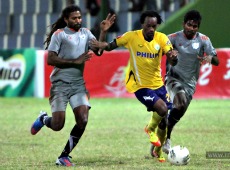
Former Club Valencia striker Wright Charles Gaye was finally able to return home on Sunday (March 10) after six months of living in poverty in Male’.

Charles, who resigned from Club Valencia in September 2012 due to a lack of salary, was left stranded in Male’ as he waited for two month’s worth of salary from the club and a promised one-way-ticket home.

Speaking to Minivan News the Liberian national said that he had been forced to live in accommodation with no water or electricity and had survived on just MVR 500 (US$32.49) a week.

Club Valencia’s management stated that the reason behind the delay in Charles’ payments, was because there had been a delay in securing financial assistance from both the sports ministry and from the club’s sponsorship.

Media coverage of Charles’ situation resulted in Club Valencia paying him US$2,600, a one-way ticket home and an extra month’s salary.

Likes(0)Dislikes(0)

Police officers find their names included on party registries against their knowledge

The Maldives Police Service have revealed that a number of its officers have had their names unknowingly included in certain political party membership registers.

Police Spokesperson Chief Inspector Hassan Haneef told local media on Thursday (March 14) that an unspecified number of police staff had been registered to political parties without their knowledge.

A tweet posted by Commissioner of Police Abdulla Riyaz on Thursday said that Assistant Commissioner of Police Ali Rasheed’s name was also found to be listed on a parties registry without his knowledge.

Article 69 (c) of the Police Act prohibits policemen from registering to political parties, being directly involved in political activities, and financially contributing to a such parties, local media reported.

Likes(0)Dislikes(0)

Supreme Court rules secret ballot, dismissal of CSC chair unconstitutional

The Supreme Court on Thursday ruled that contested decisions by parliament to remove Civil Service Commission (CSC) Chair Mohamed Fahmy Hassan and conduct no-confidence votes through secret ballot are unconstitutional.

On December 3, 2012, parliament voted 41-34 to approve amendments to the parliamentary rules of procedure to conduct no-confidence votes to impeach the President and remove cabinet members through secret ballot. The house rules were changed with pending no-confidence motions against President Dr Mohamed Waheed and Home Minister Dr Mohamed Jameel Ahmed submitted by the formerly ruling Maldivian Democratic Party (MDP).

In late November, parliament dismissed Fahmy in a 38-32 vote after the Independent Institutions Committee investigated a complaint of sexual harassment by a female employee of the CSC.

Both moves were challenged at the Supreme Court, which issued injunctions or stay orders to parliament to halt both conducting no-confidence votes through secret ballot and appointing a replacement to the CSC, pending rulings on the legality of the decisions.

In its judgment (Dhivehi) on the constitutionality of secret ballots for no-confidence votes, the Supreme Court ruled 6-1 to strike down the amendment to parliament’s standing orders as unconstitutional. The majority opinion contended that the move contravened article 85 of the constitution as well as parliamentary principles and norms of free and democratic societies.

Article 85 stipulates that meetings of the People’s Majlis and its committees must be open to the public.

In the second judgment (Dhivehi) on Thursday night, the Supreme Court noted that Fahmy was alleged to have committed a criminal offence and contended that the Independent Institutions Committee violated due process and principles of criminal justice procedure in dealing with the accused.

The Supreme Court ruled 6-1 that Fahmy would receive two punishments for the same crime if he was convicted at court following his dismissal by parliament (double jeopardy). Following the judgment, Fahmy would be reinstated and compensated for lost wages since December 2012.

Delivering the judgment, Supreme Court Justice Abdulla Saeed reportedly said that a person should be considered innocent unless proven guilty in a court of law and was entitled to protect his reputation and dignity.

Dissenting opinion

Meanwhile, Justice Ahmed Muthasim Adnan – the only Supreme Court justice with a background in common law – issued dissenting opinions in both cases.

On the constitutionality of the secret ballot, Justice Adnan noted that article 101(f) of the constitution states that “the regulations governing the functioning of the People’s Majlis shall specify the principles and procedures concerning a resolution to remove the President or Vice President from office as provided in this Constitution.”

Unless a clause added to the regulation was explicitly in violation of the constitution, Justice Adnan said that he believed it “could not be challenged in any court in the Maldives.”

He further noted that while article 85 of the constitution requires parliamentary proceedings to be open to the public, 85(b) states that a majority of MPs present and voting could decide to exclude the public or press “if there is a compelling need to do so in the interest of public order or national security.”

Moreover, article 85(c) states, “Article (b) does not prevent the People’s Majlis from specifying additional reasons for excluding the public from all or any part of a committee meeting of the People’s Majlis.”

He added that the secret ballot would be taken at a sitting open to the public.

In the case submitted by Fahmy contesting his dismissal, Justice Adnan’s dissenting opinion noted that article 187(a) of the constitution authorised parliament to remove members of the CSC “on the ground of misconduct, incapacity or incompetence.”

Article 187(b) meanwhile states, “a finding to that effect by a committee of the People’s Majlis pursuant to article (a), and upon the approval of such finding by the People’s Majlis by a majority of those present and voting, calling for the member’s removal from office, such member shall be deemed removed from office.”

Justice Adnan argued that an inquiry by a parliamentary committee into alleged misconduct would not be a criminal investigation. Therefore, he added, the oversight committee would not be required to prove guilt to the extent required at trial before making a decision.

He further noted that parliament’s dismissal under the authority of article 187 and a possible conviction at a late date could not be considered meting out two punishments for the same offence.

Separation of powers

Following the injunctions issued by the Supreme Court in December 2012, MDP MP Eva Abdulla told Minivan News that the supremacy of parliament was at stake in the cases before the apex court.

“By its actions, the Supreme Court is challenging the separation of powers that underpins the constitutional basis of governance,” Eva said.

Meanwhile, Independent MP for Kulhudhufushi South, Mohamed ‘Kutti’ Nasheed, contended in his blog on December 12 that the Supreme Court did not have the legal or constitutional authority to issue the injunctive orders against parliament.

Moreover, the Supreme Court “does not have the power to even accept those cases,” he wrote.

Article 88(b) of the constitution states: “Unless otherwise specified in this constitution, the validity of any proceedings in the People’s Majlis shall not be questioned in any court of law.”

Nasheed argued that decisions made by parliament could not be challenged in court except in instances clearly specified in the constitution, which did not include dismissal of members of independent institutions and amendments to Majlis regulations.

The purpose of article 88 was to prevent parliament’s decisions being challenged or overturned, Nasheed said, as in the absence of such a clause the Supreme Court would become a “People’s Appeal Majlis” with supremacy over the house of elected representatives.

“If every decision of the People’s Majlis is appealed at the Supreme Court in the manner that any judgement by the High Court can be appealed at the Supreme Court, then there is no difference between the People’s Majlis and the High Court,” Nasheed wrote.

This was against the separation of powers envisioned in the constitution, Nasheed said, which vested legislative powers in parliament and clearly specified instances where its decisions could be challenged at court.

Former legal reform minister Nasheed is chair of the Independent Institutions Committee. Asked by the Supreme Court to hand over minutes of the committee inquiry, Nasheed had refused.

Likes(0)Dislikes(0)