“Come and contest. This time, we will defeat you in a single round”: Nasheed challenges Gayoom

The Maldivian Democratic Party held a several thousand strong rally on Wednesday night despite a police takeover of Usfasgandu, the party’s rally ground in Male’, and a warning from Minister of Home Affairs Mohamed Jameel that the police would not allow the rally to be held in the area.

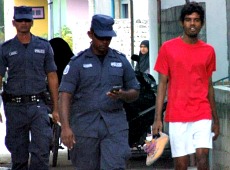
Police cordoned off the main rally ground and surrounding streets, with MDP members and supporters standing just beyond police lines. The rally was held adjacent to the protest site.

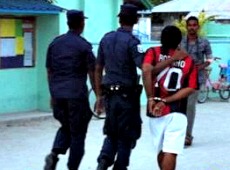
Crowds gathered an hour before the scheduled start of the rally and heated verbal exchanges took place between the protestors and approximately thirty police officers at the location. Minivan News observed two protesters being led away by police. However Police Media Official Sub Inspector Hassan Haneef said that no arrests were made in the area.

First a Maldivian, then a police officer

Many speakers at Wednesday night’s rally called on the police to step down and cooperate with the citizens, saying they were “first a Maldivian and then a police officer”.

“You should be ashamed to stay there in uniform when you are being used as political weapons,” said MP Ali Waheed, addressing the police officers.

Former MDP Chairperson Mariya Ahmed Didi called on police to back down, saying the party members would not step back until they had guaranteed their freedoms and rights.

“We don’t care how big a power tries to tell us this is not a coup, whether it be the Commonwealth or the UN. We have no doubts about what we saw with our own eyes. We have no doubts about which shoes, which batons have been beating us,” Mariya said.

“No member of MDP will go back to their homes before we rid this country of this culture of violence.”

Both Mariya and Nasheed stated that the party’s intention was not to protect the rally grounds, but rather the rights of the citizens.

“It is not Usfasgandu that we are trying to defend, nor any other land either. We are here to protect freedom of expression, freedom of assembly and the right to peaceful political activity. We will do this until our last breath,” Nasheed said.

“Take down these police lines,” Nasheed addressed the police. “There is no one in this country who can come out against the citizens of this country, to hold them back or restrict them. I call on the police and soldiers to step back now.”

“Maumoon is deceiving Yameen and Ilyas again”: Nasheed

Nasheed once again accused current President Mohamed Waheed Hassan of participating in planning a coup with former President Maumoon Abdul Gayoom.

“There is one thing I must say to my former Vice President Waheed. You cannot forever eat the world with deceit. You can only do so for a short while,” Nasheed said.

“If you think that by taking the lead to plan a coup with former President Maumoon Abdul Gayoom you people will succeed in getting this country back in your clutches, then you are very much mistaken. We will not let that happen.”

Speaking of the Progressive Party of Maldives (PPM), Nasheed said the party was absorbed in in-fighting while MDP was conducting its door-to-door campaign. He alleged that Gayoom was “once again deceiving his brother Abdulla Yameen and brother-in-law Ilyas Ibrahim” by feigning refusal to run in the presidential elections.

“Maumoon has been pulling the wool over Abdulla Yameen’s eyes for a good 15 years now, telling him he won’t be running for president,” Nasheed said.

“He creates rifts between Yameen and Ilyas, and then, in the name of peace making, takes the reigns himself. He has been doing this for ages, and will do so again. Come and contest. We will defeat you again. This time, we will defeat you in a single round,” Nasheed said.

At the end of his speech, Nasheed made reference to the recent allegations plans of assassination plots against him.

“You can plan to poison me, you can plan to shoot me, you can conspire to do anything at all. But the final will is not that of Jameel, Waheed or Saeed. Accept it, the final will is that of Almighty God,” Nasheed said.

“None of you must be mistaken, be it the judges or the police and army. I am repeatedly saying that on the 11th of November 2013, it will once again be me who is sworn in as President of this nation.”

Police have closed off the MDP rally grounds following an order from High Court released Wednesday, stating the area shall be kept under the care of the police and not used for any purpose until the court reaches a verdict on the matter.

Likes(0)Dislikes(0)

Court delays Afrasheem murder trial after suspect unable to afford lawyer

The Criminal Court has delayed the second hearing into the trial of Hussain Human, who is accused of murdering MP Dr Afrasheem Ali for the sum of MVR 4 million (US$260,000).

The Criminal Court told the media that the hearing was cancelled as Humam was unable to afford a lawyer.

Spokesperson for the Criminal Court Mohamed Manik told Minivan News that the defendant has asked the state to appoint a lawyer for him.

Maldivian law obliges the state to appoint lawyers for those who can’t afford one when dealing with murder cases.

Manik said the court has not yet decided a date to schedule the next hearing.

‘’A date will be decided after discussion with police and the Prosecutor General’s Office,’’ he added.

During the last hearing the state attorney read out charges against Humam, who pleaded not guilty and requested the court to grant him the opportunity to appoint a lawyer for his defence.

The presiding judge then asked Humam how soon he could appoint a lawyer. Humam replied that he would have to speak to his family. He was given one week and the second hearing was scheduled for Thursday.

Attorneys representing the state told the Criminal Court that on October 1, 2012, Humam and a group of people attacked and murdered Dr Afrasheem Ali.

Commissioner of Police Abdulla Riyaz has previously alleged that the murder of the MP for Ungoofaaru constituency was a well-planned murder worth MVR 4 million.

Likes(0)Dislikes(0)

Italian tourist dies in propeller accident while snorkeling

A 51 year-old Italian tourist died in a boat propeller accident while snorkeling on Thursday afternoon (January 31) near Elaa Island in Thaa Atoll.

Minivan News spoke to Veymandoo Regional Hospital Manager Abdulla Mauroof about the incident, who confirmed that the woman was pronounced dead on arrival.

According to Mauroof, the woman suffered a “major injury to her skull”.

“Her body is still being held under police charge at the hospital and a police forensics team has been dispatched,” Mauroof added.

The snorkeling accident was reported at 14:50. The dive boat operator has not been confirmed at this time.

Veymandoo police are currently investigating the incident.

Snorkeling deaths

During 2012, tourist deaths – usually while snorkelling – were disproportionately higher among Chinese tourists, who now account for a majority of Maldives tourist arrivals compared to the country’s traditional European markets.

In October 2012, a 26 year-old male from China staying at Alif Dhaal Atoll Vakafaru resort was suspected to have died in a snorkelling accident at the property.

Likes(1)Dislikes(0)

Budgetary constraints temporarily halt efforts to bring in foreign experts for CoNI report review

Efforts to bring in two international legal experts to review the Commission of National Inquiry (CoNI) report have been put on hold due to budgetary constraints, local media has reported.

The parliament’s Government Accountability Committee had attempted to seek the legal experts in order to look into the report of the controversial transfer of power in February 2012.

Parliament Secretary General Ahmed Mohamed was quoted as saying that there were no funds available to the committee in order to bring in the foreign experts.

The committee had earlier chosen a legal expert from Denmark’s Copenhagen university and two lawyers to review the report, who were scheduled to start on Friday and work for seven days, local media said.

Maldivian Democratic Party MP Ali Waheed said that the committee will make a decision and set a date based on “what is decided by the Parliament Speaker on the budgetary issues”.

Parliament Speaker Abdulla Shahid is currently abroad and is expected to return next week, according to local media.

Likes(1)Dislikes(0)

MTCC records MVR 24.1 million profit for 2012

The Maldives Transport and Contracting Company (MTCC) has made a MVR 24.1 million (US$1.5 million) profit for the year 2012.

The company’s records – according to local media – show that it made MVR 597 million (US$38.5 million) in sales last year and declared MVR 12 million (US$77,7201) as taxes.

Sun Online reported that in 2011, MTCC lost MVR 8.03 million (US$518,000) and failed to distribute dividends to its shareholders for that year.

Likes(0)Dislikes(0)

Maritime surveillance system launched with US assistance

A maritime surveillance system to monitor and identify vessels operating within Maldivian territorial waters has been established with the assistance of the US government.

The surveillance system will be used to collect data from seven Automatic Identification Systems (AIS) installed along major Maldives shipping channels and is a commercial system consisting of shore based receivers and transponders.

US Ambassador for Sri Lanka and the Maldives, Michele J Sison, spoke at the handover ceremony for the Maritime Surveillance System in Male’ on Thursday.

“As the Maldives seeks to become a greater contributor to maritime security in the region, these systems will increase their capabilities and open up even further opportunities for cooperation with its international and regional partners,” Ambassador Sison said.

The system will greatly enhance Maldives’ maritime domain awareness and increase its contribution to regional maritime safety and security, the US Embassy said in a statement.

“The AIS system provides data used to identify ships and their positions and allows for a common operational picture so that operators may view the information from all of the sensor sites,” the Embassy added.

During the launch ceremony Thursday (January 31) Defence Minister Mohamed Nazim called the system a “major boost to national security” and “the beginning of the many tasks ahead,” reports Haveeru.

Nazim also discussed the importance of “maintaining close ties” with India and Sri Lanka for the protection of Maldivian territorial waters and that the system will benefit neighboring countries in the Indian Ocean, according to local media.

The surveillance system will improve situational awareness by enabling the identification of and communications with vessels operating inside territorial waters, according to Head of the Maldives National Defence Force (MNDF) Communication Electronics Information Technology Service, Lieutenant Tholhath Hassan.

The seven strategic locations for the system include Villi-Male, Uligan Island in Haa Alif Atoll, Maafilaafushi Island in Kaafu Atoll, Kahdhoo Island in Laamu Atoll, Kaadehdhoo Island in Gaaf Alif Atoll, Gan Island in Seenu Atoll, as well as Fuvahmulah Island in Gnaviyani Atoll.

Likes(1)Dislikes(0)

High Court brings forward Nasheed’s appeal case

The High Court has brought forward former President Mohamed Nasheed’s appeal case, now scheduled for Sunday.

Nasheed is being tried in the Hulhumale’ Magistrate Court for the controversial detention of Chief Judge of Criminal Court Judge Abdulla Mohamed in January 2012.

The former President’s legal team lodged the appeal challenging the Hulhumale’ Magistrate Court’s ruling on three procedural issues raised during the court’s first hearing held October 9.

Speaking to Minivan News, MP Mariya Ahmed Didi confirmed the legal team had been informed of the decision to move the hearing.

“I understand from President Nasheed’s lawyers that they have received summons for February 3, as Nasheed had requested to depart the country the afternoon after the hearing. As far as I understand no particular reason was cited,” she said.

Didi however expressed concern over the High Court taking decisions on such short notice, stating that as Nasheed received legal council from abroad, such sudden changes in scheduling were inconvenient.

“These are Queens Counciler’s and their schedules are set in advance.  It is not possible to reschedule at such short notice. We have requested the High Court to bear with us on that,” she said.

Didi contended it was imperative that Nasheed be given “all opportunities to defend himself as a defendant in a criminal trial”. Nasheed “should not be an exception to that,” she said.

Spokesperson for the Department of Judicial Administration (DJA) Latheefa Gasim was not responding.

Meanwhile, Nasheed’s legal team has also sought an opportunity to highlight in court the Supreme Court’s ruling concerning the legitimacy of the Hulhumale’ Magistrate Court.

The Supreme Court has declared that Hulhumale’ Magistrate Court is legitimate and can operate as a court of law, following the Judicial Service Commission (JSC)’s request that it clarify the court’s legality.

MP Mariya said Nasheed’s legal team was of the opinion that the issue decided in the Supreme Court was different from the issue put before the High Court by the legal team.

“We hope the High Court will give our lawyers the opportunity to explain the distinction and consider all issues before they give a judgment on the matter,” she said.

Following the Prosecutor General (PG)’s decision to press charges against Nasheed in the Hulhumale’ Magistrate Court instead of Criminal Court, Nasheed’s legal team initially challenged the legitimacy of the Hulhumale’ court arguing that it was created in violation of the Judicature Act.

The team raised the issue during the first hearings of the trial, along with other procedural inconsistencies, but all were rejected. They later appealed the case in the High Court along with other procedural issues.

Despite its initial rejection of the procedural points, the High Court later accepted all points made by Nasheed’s legal team except that concerning the legitimacy of the Hulhumale’ Magistrate Court. It later issued an injunction ordering the magistrate court to suspend Nasheed’s trial until a decision on the procedural points raised by Nasheed’s legal team was reached.

Controversies

The case has been subject to controversy after Nasheed’s party  claimed the trial was a politically motivated attempt to bar Nasheed from contesting in the next presidential elections.

The UK Bar Human Rights Committee (BHRC) in a recent report concluded that the charges against Nasheed appeared to be a politically motivated attempt to bar the Maldivian Democratic Party (MDP) candidate from the 2013 presidential elections.

“BHRC is concerned that a primary motivation behind the present trial is a desire by those in power to exclude Mr Nasheed from standing in the 2013 elections, and notes international opinion that this would not be a positive outcome for the Maldives,” the report stated.

The report observed that the detention of the judge was “not a simple case of abuse of power”.

“Rather, the underlying narrative of the situation is that of a president desperate to bring change to a new democracy after decades of oppression, and finding himself thwarted by the inability of the organs of state set up by the constitution to deliver much needed reform,” the report stated.

Referring to “the large number of international reports” that have found the Maldivian judiciary to be flawed, the BHRC noted that the Judicial Service Commission (JSC) “failed in its twin tasks of ensuring that the judiciary has the appropriate experience and qualifications, and in bringing to book the judges who fail to fully and fairly implement the rule of law”.

“Implicit in these criticisms is that Mr Nasheed cannot be guaranteed a fair trial,” the report concluded.

Arrest of the judge

Chief Judge of the Criminal Court Abdulla Mohamed was taken into military detention of January 16, 2012 at the request of then Home Minister Hassan Afeef on the grounds that the judge posed a threat to national security.

The judge had successfully blocked investigation of his misconduct by the judicial watchdog and quashed his own police summons.

Abdulla Mohamed had “taken the entire criminal justice system in his fist,” Afeef said, accusing him of obstructing high-profile corruption cases, releasing murder suspects, colluding with drug traffickers, and barring media from corruption trials.

Judge Abdulla “hijacked the whole court” by deciding that he alone could issue search warrants, Afeef contended, and had arbitrarily suspended court officers.

The arrest triggered series of anti-governmental protests that eventually led to the sudden resignation of then President Nasheed on February 7, 2012.

Likes(0)Dislikes(0)

MDP accuses Home Minister of influencing former President’s trial

The Maldivian Democratic Party (MDP) have accused Minister of Home Affairs Dr Mohamed Jameel of attempting to influence an ongoing court case against former President Mohamed Nasheed.

The party has previously alleged the charges against Nasheed – of illegally detaining Chief Judge of the Criminal Court Abdulla Mohamed in the final days of his presidency – are a politically-motivated attempt to prevent him competing in the upcoming election.

Jameel was reported in local media as stating that it was “crucial to conclude the case against Nasheed before the approaching presidential elections, in the interests of the nation and to maintain peace in it.”

Jameel, who served as Justice Minister under the tenure of former President Maumoon Abdul Gayoom, said that delaying the trial against Nasheed for “the abduction of a judge” risked “compromising national interest”.

He alleged the delay was due to “various reasons”, and would very likely have “adverse effects on the political and social fabric of the nation”.

“If things happen  this way, people will start believing that it was due to the failure to address some issues in the Maldives’ judicial system, which need to be looked into. And in my opinion, the courts will have to take responsibility for this,” Jameel said in his interview with news website Haveeru.

Expressing concern that it would be an “extremely worrisome matter” if people started speculating that the reason for the delay in prosecuting Nasheed was that the country’s judiciary was not performing to par, Jameel said, “Every single day that goes by without the case being concluded contributes to creating doubt in the Maldivian people’s minds about the judiciary.”

Jameel stated that the case has a direct relation to the interest of the upcoming elections since the arrest of Abdulla Mohamed was a criminal case which involved citizens’ rights, trust of the judiciary, as well as the the running of the state.

Stating that the conclusion of the case was imperative for the sake of maintaining peace in the country in the upcoming days, Jameel added that it was constitutionally mandated for all involved to find methods to expedite such cases.

Minister attempting to influence courts: MDP

Following Jameel’s remarks, former President Nasheed released a statement condemning “attempts by the sitting Minister of Home Affairs, Dr Mohamed Jameel, to exert undue influence on the courts over the trial against President Mohamed Nasheed.”

The statement further expressed concern that a representative of the government had made such remarks while it had failed to date to act upon the recommendations of international organisations, including the UN Human Rights Commission (UNHRC), the International Commission of Jurists (ICJ) and the Commonwealth Ministerial Action Group (CMAG), to reform the judicial system.

“Just days after Commonwealth envoy Sir Don McKinnon left the Maldives, Dr Jameel calls on the judiciary to sentence the MDP’s presidential candidate,” said former Chairperson of the Maldivian Democratic Party (MDP), MP Mariya Ahmed Didi.

“MDP members believe Sir Don’s silence on the issue of Nasheed’s prosecution emboldened the Home Minister to make his comments,” she said.

“Jameel’s call on the courts to sentence President Nasheed prior to the presidential elections adds to the impression that the charges are politically motivated. We urge the Home Minister to refrain from intimidating and exerting undue influence on the the judiciary,” she added.

Nasheed  has previously alleged that the objective of the trial was to obstruct him from contesting the upcoming presidential elections.

“The Prosecutor General’s only objective is to ensure that I cannot contest in the next presidential elections. To do so, he has identified an article which would provide just the required period of detention to cancel my candidacy,” Nasheed told an MDP rally in October 2012.

Nasheed is being tried under Article 81 of the Penal for the arrest of Criminal Court Chief Judge Abdulla Mohamed.

Article 81 of the Penal Code states that it is a criminal offence for any employee of the state to use the constitutional powers to arrest vested on him to deliberately arrest a person who has not committed a crime. The article further details that the maximum penalty for this offence is either a jail sentence or banishment for a period of up to three years, or a fine of up to MVR 2000 (US$130).

Home Minister Mohamed Jameel Ahmed was not responding to calls at the time of press.

Likes(1)Dislikes(0)

Maldives plummets to 103rd in Reporters Without Borders Press Freedom Index

The Maldives has plummeted to 103rd in the Reporters Without Borders (RSF) Press Freedom Index, a fall of 30 places and a return to pre-2008 levels.

“The events that led to the resignation of President Mohamed Nasheed in February led to violence and threats against journalists in state television and private media outlets regarded as pro-Nasheed by the coup leaders,” RSF observed, in its annual ranking of 179 countries.

“Attacks on press freedom have increased since then. Many journalists have been arrested, assaulted and threatened during anti-government protests. On June 5, the freelance journalist and blogger Ismail “Hilath” Rasheed narrowly survived the first attempted murder of a journalist in the archipelago,” RSF noted in its report.

The index ranks countries according to levels of press and media freedoms. Countries with the best levels of press freedom rank highest, with northern European and Scandinavian countries filling the top three positions: Finland, Netherlands and Norway respectively. Turkmenistan, North Korea and Eritrea took the bottom three places.

The Maldives’ ranking places it alongside Mali (99th), which experienced a military coup last year, and Fiji (107th), which experienced a coup in 2006.

Prior to the country’s first multi-party democratic election in 2008, the Maldives was ranked 104th – an improvement on its 2007 ranking of 129th, and 2006 – 144th. The country’s ranking in 2009-2010 reflected dramatic improvements in press freedom, rising to 51st and 52nd respectively. The ranking slipped to 73rd in 2011.

Despite its plunge in 2012, regionally the Maldives still ranked higher than India (140th), Sri Lanka (162nd), Pakistan (158th), and Bangladesh (144th).

“Only three Asian countries are in the top 25 percent of the table, while 15 countries are among the bottom 45 places,” observed RSF.

“Unsurprisingly, one-party authoritarian governments figure more than ever among the predators of press freedom and languish at the bottom end of the table.”

“Press freedom has crashed”: former President

“Press freedom in the Maldives has crashed since Dr Waheed’s coup,” read a statement today from former President Mohamed Nasheed.

“Security forces have beaten up journalists, and the regime has targeted and threatened independent media outlets,” Nasheed wrote.

“One of the defining images of the coup was Dr Waheed’s own brother leading a gang of mutinying police and storming the Maldives National Broadcasting Corporation (MNBC), pulling the station off air and locking the journalists in a room. Suppression of the media has been the hallmark of Waheed’s rule.”

President’s Office Spokesperson Masood Imad was not responding at time of press.

The release of the RSF Press Freedom Index closely follows the release of the annual Freedom House survey of political rights and civil liberties, in which the Maldives was dropped from the list of electoral democracies alongside Mali.

The country’s political rights rating shifted from three to five (higher is ‘less free’) during 2012, “due to the forcible removal of democratically elected president Mohamed Nasheed, violence perpetrated against him and his party, the suspension of the parliament’s summer session, and the role of the military in facilitating these events,” Freedom House stated.

Police and military join demonstrators in storming the state broadcaster on February 7:

Likes(0)Dislikes(0)