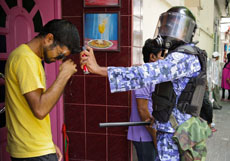
Elections Commission expresses concern over police attacks on peaceful protest gatherings

The Elections Commission (EC) has issued a statement expressing concern that the police have been attacking and arresting Maldivian Democratic Party (MDP) supporters during peaceful protest gatherings.

The commission also said it had noted that the police had dismantled all MDP protest sites across the country.

‘’We are especially concerned with how the police dismantled the MDP protest camp at Lonuziyaarai Magu (tsunami monument area),’’ the commission said. ‘’Security forces have to act within the law.’’

The Elections Commission advised police not to use unlawful force against political parties.

President of the Elections Commission Fuad Thaufeeq today told Minivan News that the commission did not know of any reason why the area should be closed for protesting.

”According to the information we have the area belongs to Male’ City Council and the MDP did get the required permission from the council,” Thaufeeq said. ”The police dismantled the area after the MDP had been there for a long time.”

‘’It is the right of all the political parties to conduct political activities any where except those areas prohibited for political activities by law,’’ the EC said in the statement. ‘’No one has the right to unlawfully obstruct anyone from obtaining this right.’’

Police pepper spraying a demonstrator

Police Superintendent Ahmed Mohamed said “certain institutions” were making statements “without asking the police their side of the story”, and appealed to these institutions not to do so.

Yesterday in a statement police said that ‘’the major operation that took place yesterday evening was to restore the peace to the capital city as well as to investigate the complaints received from public sources that criminal activity was taking place at the camping site.’’

‘’Police had definite reason to believe that the violent attacks in Male’ was connected to the protestors who started demonstrations from the Lonuziyaarai Magu ‘Raalhugandu Sarahadhu’,’’ the statement said. ‘’The police acted in this operation empowered by law under the clause 244 of Constitution of Maldives and clause 6 of Police Act 5/2008.’’

The police said the area was vacated in order to preserve the site for inspection and to search for evidence suggesting any illegal activity in the area.

‘’The public is informed that items confiscated from the area will be returned to their rightful owner in accordance to the proper police procedures, and local media is advised to report facts responsibly to the community,’’ the statement added.

The area was initially closed to journalists as police moved in to dismantle the protest site on Monday night. Police subsequently allowed journalists access and displayed a number of beer cans they claimed had been found at the site.

The protest camp has been running near the tsunami monument since the MDP government was ousted on February 7, in what former President Mohamed Nasheed maintains was a police and military-led coup de’tat, sponsored by several wealthy resort owners affiliated with the former opposition.

Likes(0)Dislikes(0)

Three police officers attacked, Chief Justice’s car damaged

Three police officers were attacked on Tuesday night and Chief Justice Ahmed Faiz Hassan’s car was damaged, police have reported.

The three separate incidents took place within hours of each other around Nalahiya Hotel in Malé’s Maafannu ward. The three policemen sustained severe injuries which required hospital treatment, while the tail lights of Faiz’s car were smashed, according to police. Three men are also alleged to have entered a policeman’s house with knives on Wednesday.

Police spokesperson Hassan Haneef said 13 people have now been arrested over attacks on the police, but no arrests have been made so far regarding the vandalism of Faiz’s car.

The attack on Faiz’s car is the second attack on a Supreme Court judge’s car this week. Judicial Services Commission (JSC) chair and Justice Adam Mohamed Abdulla’s car was attacked on Friday.

The situation remains tense between opposition Maldivian Democratic Party (MDP) supporters and the security forces, as well as the judiciary. The February 7 transfer of power, which MDP alleges was a coup d’état, took place after security forces mutinied following former President Mohamed Nasheed’s military detention of Criminal Court Judge Abdulla Mohamed in January.

President Waheed alleged on Twitter that Nasheed’s supporters were behind the violence: “Violence by Nasheed’s supporters keeps increasing,” he wrote.

Violence Against Police

The attacks on the police and chief justice’s car follow Monday’s violent confrontations between security forces and protestors who sought to obstruct Waheed from delivering a constitutionally-mandated address at the Majlis’ opening session – a second attempt after the first failed on March 1. Protestors claimed Waheed’s presence in the Majlis violates the institution’s integrity.

Police arrested 99 and said eight law enforcement officers were injured in Monday’s clashes. Police subsequently cleared out MDP’s protest camp at Raalhugandu (Surf Point) on the same day.

Superintendent Ahmed Mohamed said Tuesday’s assault on police took place while police were patrolling the streets of Malé. Two police officers were stopped by a crowd near Nalahiya Hotel at 11:30 pm, he said. One sustained injuries to the head while the other policewoman was hit on her chest and sexually harassed, claimed Mohamed.

The third police officer was also attacked near Nalahiya Hotel at 12:40 am. Mohamed appealed to the public to stop inciting violence against police at a press conference on Wednesday.

Meanwhile, posts on social media Twitter reveal a more complex picture of violence at Nalahiya Hotel. One photo shows a man with head injuries allegedly cause by police, and the other shows a man with extensive bruising on his upper arm. The third photo shows a policeman wielding a baton holding a crouching young man. The young man’s shirt is pulled over his face.

Superintendent Ahmed Mohamed said youth were involved in violence, and appealed to them to “take up responsible jobs instead of taking part in atrocities.”

Intimidation

Faiz’s car was damaged on Tuesday night by protestors gathered at the Defense Minister Mohamed Nazim’s house at 11:45 pm. Faiz was not in the car at the time.

Adam Mohamed’s car was also attacked by protestors after Friday prayers. Adam Mohamed and his child were in the car, but were not injured, reported local media.

The Supreme Court released a statement on Monday condemning attacks on judges and court buildings. It highlighted three separate attacks on judges, including that on Adam Mohamed, since January.

The other two incidents include a physical assault on Fuvahmula magistrate Ahmed Latheef in Fuvahmulah Island on March 8 and an attack on an unnamed judge on January 20.

The statement also condemned the torching of court buildings during the February 8 unrest in the atolls following police attack on MDP protesters in Malé.

“These attacks are aimed to cause irretrievable loss to justice system and to intimidate all working within the justice system,” the statement read.

Likes(0)Dislikes(0)

Comment: Reconciling to reconciliation

With the People’s Majlis, or Parliament, commencing its delayed inaugural session for the current year with the customary address by President Mohammed Waheed Hassan, even if in the midst of disturbances caused by the majority Maldivian Democratic Party (MDP), the stage may have been set now for political reconciliation in Maldives.

If nothing else, neither can the MDP be seen as continuing to stall parliamentary proceedings without increasing international opprobrium nor can the Government parties argue that in the absence of peace in Parliament, they could not be expected to discuss and vote on advancing presidential polls, as promised.

Addressing Parliament, President Waheed declared his intention to facilitate early elections, as promised to India and the rest of the international community after MDP predecessor Mohammed Nasheedpost facto claimed that a ‘mutiny’ by a section of the armed forces and police was the chief cause for his widely-telecast resignation on February 7.

On another note of concern to the MDP, both while in office and otherwise, he spoke about plans to “empower” the independence of institutions like the Majlis and the country’s judiciary by not “interfering” with their work. In his days in office and outside, President Nasheed and his MDP colleagues had often talked about ‘reforming’ the judiciary and other independent institutions, translating in effect into what the Opposition called ‘interference’.

“This is the time for all of us to work together in one spirit, the time to bring political differences to the discussion table in order to formulate solutions. According to the Constitution, the earliest date for a presidential election is July 2013. If a presidential election is required at an earlier date, changes need to be made to the Constitution. I will do everything in my power to bring together all the political leaders, to hold discussions on the matter,” President Waheed said in his inaugural address, when Parliament reconvened on Monday, March 19, after MDP members inside the Chamber and street-protesters had stalled the originally scheduled sitting on March 1 in an unprecedented manner.

Independent of the street-protests that have continued until after the security forces had swung into action a day after the presidential address and removed an ‘MDP camp’, in what is argued to be the land allotted to the Maldivian National Defence Force (MNDF), in turn leading to a court case, there now seems to be some scope for reconciliation in regard to the continuing political deadlock.

While arguing the MDP’s case on substantive issues, a Commonwealth ministerial team, on its second visit to the country since Nasheed quit office, did not take kindly to his party members disrupting parliamentary proceedings. Then as now, the International Parliamentary Union (IPU) too has decried the MDP behaviour inside Parliament, both on March 1 and 19.

Voices against violence

From within the MDP, there have been increasing voices against street-violence by party cadres, and also on the need for the party to return to the negotiations table for taking its agenda forward. Party president and former president Ibrahim Didi was among the first to criticise cadre-violence, targeting public and private property. Included in the list in recent days was the building housing the media establishment of former opposition Jumhooree Party founder and one-time Finance Minister Gasim Ibrahim, who in turn is among the richest in the country.

Sooner than later, the MDP will be called upon to test President Waheed’s constantly-reiterated commitment to early polls, by participating in the all-party talks, initiated at the latter’s instance weeks ago. Two other political parties, namely the DRP and the PPM, both founded by Nasheed’s predecessor Maumoon Gayoom, with he himself now being associated only with the latter, had decided to stay away from the talks after the MDP did so in the past. They too have now to be talked into returning to the negotiations table, if the reconciliation process has to go anywhere. They may want guarantees that the MDP would stick to the negotiations table until a clear picture emerged on the future course.

DRP leader Thasmeen Ali however has since reiterated his party’s original commitment to facilitate early presidential polls, pointing out however that the MDP would have to let Parliament function for that to happen. From within the MDP, too, a few voices are being heard about the need for the party’s participation in the all-party talks, if only for it to take the logical next step to early polls, and also let Parliament function normally — again, with the same end in mind.

Chicken-and-egg question

It is a chicken-and-egg question when it comes to finalising the date for the presidential polls. The MDP wants the Government to announce the poll-date first whereas the Government parties want the procedural issues in this regard addressed before they could take the logical next step. Or, that is the argument. The MDP is also unclear if they want a tentative date and a commitment to the effect from the Government — or, would want a formal notification before they could re-join the reconciliation process. The latter could prove problematic as the Election Commission — and by reverse extension, the Government — is not authorised to do so in the absence of a constitutional amendment.

Under the Third Republican Constitution of 2008, once-in-five-year presidential polls, now due in November 2013, could be conducted within three months of the due date. Any advancement, by implication, has to be facilitated by a constitutional amendment carrying two-thirds majority in the Majlis — and may require judicial concurrence, if contested. Though being the majority party in Parliament, the MDP too falls woefully short of the magic number. While the party was able to push its position from being the second largest group in the House after the parliamentary polls in 2009 to the top slot, the post-resignation period has not provided any comfort in pushing the numbers further up.

No time to lose

The MDP distanced itself from the negotiations process when the all-party meeting was scheduled to discuss the prioritisation of items in the outline agenda that had been mutually agreed upon. Apart from setting the priority list for the talks from the draft agenda, the all-party meeting will have to go into substantive issues falling under each of the subject-heads. The MDP wants the entire process fast-tracked so as to decide on the poll date first. The Government parties are keen also to discuss institutional reforms, as some of them are concerned about the existing estrangement between the security forces and sections of the national polity, which could spell doom, before, during and after the polls, if a meaningful reconciliation effort is not put in place and executed with elan.

Time is the essence for all concerned. Given their internal contradictions, the Government parties are sure to find mutual accommodation among themselves a tougher proposition than they may have bargained for. The younger elements in many of these parties may not have the same regard from Gayoom as the earlier generation, with the result, they may contest whatever compromise that might be arrived at on specific issues where his counsel could otherwise prevail.

In its turn, the MDP faces the danger of the focus of its current protests and political position slipping away, with extraneous factors coming to dominate the inner-party discourse. The Nasheed leadership has been able to streamline stray yet powerful voices within the party that has talked freely against street-violence and for the MDP to re-join the political process. Senior party leaders who have spoken on such issues have since been quick to point out that it was only a part of the internal mechanisms, and on all issues, including the continuance of street-protests without violence, they were with the leadership.

As the MDP leadership may have seen for itself already, the continuing non-cooperation with the Government on the commitments that the latter has made in relation to restoration of normalcy, and more importantly, early presidential polls, has not gone down well with friends of the party elsewhere and non-cadre sympathisers nearer home. The latter in particular are already feeling the pinch of street-protests interfering with the peaceful daily life that they had been used to — with financial consequences to individuals, too.

Islamic faith, national spirit

While referring to the economy, tourism and international relations, President Waheed in his parliamentary speech also mentioned Islam. “Being a 100 per cent Muslim nation, Maldives does not offer opportunities for the practice of other religions within the country,” he said. “The Government will work to revive the spirit and strengthen the principles of Islamic faith among the people.”

However, President Waheed followed this up with a more direct reference to nationalism, per se. Said he in this regard: “Special efforts will be made to strengthen national spirit and togetherness of Maldivians. Activities to understand our history, culture and nationality will be conducted.” This reference is less perfunctory than it may sound, though the more direct mention of Islam may or may not be as purposeful as it too may read.

As may be recalled, throughout the campaign for the introduction of multi-party democracy in Maldives, the MDP in the years before 2008 had constantly referred to what it propagated as President Gayoom’s efforts at Islamisation of Maldives – an idea that caught the imagination of the pro-Nasheed West in the post-9/11 era in particular. All efforts at removing President Nasheed throughout last year without the required two-thirds majority in the Majlis for his possible impeachment culminated not in any political protest but in the formation of a ‘December 23 Coalition’ by religious NGOs, to protect Islam in Nasheed’s Maldives, with the political opposition seeing in it a chance to evolve a national movement of sorts.

In the days and weeks after President Nasheed’s exit, President Waheed has been constantly and continuously referring to Islam in all his public appearances. While it makes sense in the larger context, his allies in Government have been careful not to make such references and thus possibly provide political space for religious groups outside the existing electoral spectrum. If it signals a fracture in electoral thinking between President Waheed and his political allies remains to be seen. Yet, in the context of the party’s calls for early polls, the MDP too has been silent on this score, after having chided and criticised the rest on what it called ‘fundamentalist religious’ counts during the run-up to the December 23 protest and before – but not afterward.

The writer is a Senior Fellow at Observer Research Foundation.

All comment pieces are the sole view of the author and do not reflect the editorial policy of Minivan News. If you would like to write an opinion piece, please send proposals to [email protected]

Likes(0)Dislikes(0)

President appoints two deputy ministers

President Mohamed Waheed Hassan appointed two deputy ministers on Tuesday to serve the tourism and transport ministries respectively.

Hussein Lirar (Gaaf Dhaal Hoadhedhoo, Finifenmaage) was appointed to the Ministry of Tourism, Arts and Culture, while Abdul Latheef Mohamed (Hulhumalé 10213) was appointed to the Ministry of Transport and Communication.

The new appointments come after President’s spokesperson Abbas Adil Riza told local media in early March that no new appointments would be made.

Waheed now has 14 ministers, 16 state ministers and 20 deputy ministers.

Likes(0)Dislikes(0)

Government sets new working hours

The cabinet has agreed upon new working hours for government institutions that will come in place from today.

The new hours will mean that government offices will be open from 8am until 3pm, Sunday to Thursday. As part of this new schedule, a 30 minute lunchtime break will be taken either between 12pm to 12:30pm or 1pm to 1:30 pm. An additional 15 minute break will also be provided for afternoon prayers.

In a statement on the President’s Office website, the government said that the decision had been taken after consultation with the Civil Service Commission, private sector bodies, independent state institutions and the Civil Servants Association.

Likes(0)Dislikes(0)

Elections and “judicial interference” among key topics in president’s inaugural address

Pursuing parliamentary-mandated early elections and avoiding interfering with the country’s judiciary are among a number of social and economic commitments outlined in President Waheed’s first state of the nation address.

In a heated Majlis session that took place yesterday, Waheed was finally able to deliver his constitutionally-mandated address to open parliament after several unsuccessful attempts.

However, he was still forced to give the speech amidst loud heckling and vociferous protests from within the Majlis chamber by Maldivian Democratic Party (MDP) supporters.

The MDP protests were designed to stymie parliamentary functions until a date was set for early elections amidst concerns over the legitimacy of the present government. These protests were condemned yesterday by Commonwealth Special Envoy Sir Donald McKinnon, whose organisation has backed early election calls.

Despite the interruptions, an unofficial transcript of the address can be found on the President’s Office website here.

The speech itself outlines some of the key policies that Waheed will hope to perform in his capacity as president.

Policies

These policies include measures for taxation, international relations and plans to “empower” the independence of institutions like the Majlis and the country’s judiciary by not “interfering” with their work.

Previous attempts to bring reforms to the Maldives courts, at least in line with certain international judicial standards, have proved a controversial issue in the recent political upheavals that saw former President Mohamed Nasheed “resign” from office in a move later alleged to be the result of a “coup d’etat.”

However, President Waheed used his speech to commit himself to constitutional rule, despite the “coup” allegations surrounding his rise to the country’s top office.

“My highest priority is to perform the duties of the president in line with the constitution and laws of the country,” read Waheed’s speech. “I assure you that I will not take any action that goes against the constitution or law. Neither will I interfere with the work of the Judiciary.”

Speaking to Minivan News today, President Waheed’s spokesperson Abbas Adil Riza said that the new government hoped to “strengthen” independent institutions like the parliament and the courts.

Riza claimed that over past three years, the executive branch under former President Mohamed Nasheed was often involving themselves in parliamentary and judicial affairs that were supposed to function independently as separate bodies under the constitution.

“We want to empower institutions not interfere with the decision they are taking,” the spokesperson said. “The president will give all the help he can to parliament. For instance on March 1, [a parliamentary session abandoned owing to anti-government protests in the chamber] President Waheed could have held the Majlis session with military officers to support him. Nasheed had done this in 2010 and 2011, but he chose not to. Even when he was being insulted.”

Beyond his own bodyguards, Riza said that President Waheed would not have any other external military forces in the Majlis.

Judicial interference

Amidst concerns over the independence and ethics of the nation’s judiciary by a former president-appointed member of national court watchdog, the Judicial Services Commission (JSC) as well as international bodies like the International Commission of Jurists (ICJ) and the EU, the conduct of judges became a major issue of the Nasheed presidency.

Upon eventually coming under international condemnation for the arrest of Criminal Court Chief Judge Abdulla Mohamed, Mohamed Nasheed’s government then requested assistance from the international community to reform the judiciary over claims that national security was otherwise threatened.

Although Nasheed is no longer in office, Riza stated that the new government would continue to work with organisations and legal teams from the commonwealth and the EU on judicial reform and the proposed all-party roadmap talks.

“The president is liberal enough to take advice on these issues.”

Referring to providing early elections, one of the key aims of MDP protesters that have attempted to stop the president from giving his speech at the Majlis, Waheed said that if that if a presidential vote was “required” at an earlier date, he would begin work on constitutional reforms to support it.

“I will do everything in my power to bring together all the political leaders, to hold discussions on the matter,” he said.

Riza said that the use of the term “required” related to a mandate from parliament to hold fresh elections, though he stressed constitutional reforms were vital in ensuring that any leader elected in early polls would have a full constitutionally-mandated term of five years.

“If parties are not willing to have two elections in 18 months, clauses need to be amended and the legal mandate to do this can only be through parliament,” he said.

International relations

In regards to diplomatic relations, President Waheed said that his government aimed to protect the Maldives’ sovereignty and Islamic identity, whilst collaborating with foreign governments in areas such as preventing terrorism, piracy and arms smuggling.

“The government will accord a high priority to strengthen relations with countries that respect our sovereignty and are concerned about our national well-being,” the president stated. “One of the key objectives of our foreign policy is to secure foreign aid for economic and social development.”

In addressing what the comments could mean for the country’s existing relationships with international partners, particularly in regards to the previous government’s decision to open diplomatic relations with Israel, Riza said it was too early to tell at present.

“Our position is being reviewed right now on this. The foreign Minister is working on what line to take,”

The country’s relationship with Israel under Mohamed Nasheed was deeply unpopular among some sections of the public, who called for the government to withdraw plans to allow Israeli airliners to bring tourists to the country. Some political parties at the time alleged that the Nasheed government itself held a “zionist agenda”.

Among other key points raised within the speech transcript were calls for no one individual in the country to endanger the country to protect the interests of a “few”.

“Political stakeholders should work to ensure that Maldives is free from political turmoil and that citizens live without fear,” read the statement.

Addressing the number of violent clashes that have taken place between security forces and civilians since he came to power last month, Dr Waheed said there were significant costs to be recovered.

“State buildings were burned down and destroyed as a result of these unlawful acts,” the address read. “In Addu City and Huvadhoo Atoll, which were among the most affected areas, the cost of destruction to Island Councils, buildings under the care of these councils, homes of citizens, and police stations is currently estimated at more than Rf 180m.

In considering the country’s religious heritage, the president reiterated the Maldives’ status as a 100 per cent Muslim nation that did not afford for other religions to be practiced.

“The government will work to revive the spirit and strengthen the principles of Islamic faith among the people,” the president stated.

Addressing economic factors, Waheed stressed that the country was currently undergoing economic vulnerability with a deficit between state expenditure and state income said to currently amount to slightly over Rf3bn (US$200m)

“Estimates for 2012 indicate that the debt component of the current account in our Balance of Payments will increase by 11 per cent as compared to 2011,” stated the president. “With respect to GDP, debt of our current account will go up to 28 per cent. This figure in 2011 was 26 per cent. The main reason for this rise is the expectation that imports will increase, resulting in an increase in expenditure for these imports.”

Riza said that the government was not willing to increase the state budget further and would look to find methods to “live within in its own means.” In order to try and balance its books, the government said it was looking into further financial reforms with the aid of the private sector.

While not presently wishing to review taxation reforms, Riza stressed that the government would not be looking to increase the current 3.5 percent rate tourism Goods and Services Tax (GST) introduced last year as had been suggested by the Nasheed government.

In areas of trade, the president said he would look to strengthen opportunities for small and medium enterprises, while also trying obtain “reasonable” prices for a Maldives fisherman’s catch.

“Work is in progress to obtain the Marine Stewardship Council’s Certificate which will enable Maldivian fishermen to get a better price for fish caught through the pole-and-line method,” Waheed said. “Last year, a number of training programmes have been conducted with the aim of increasing the skills of farmers and achieve greater productivity in our agriculture industry. A special school is to be established in Laamu Atoll to conduct agricultural research and training.”

Tourism

As the country’s foremost source of income, President Waheed claimed that the current government had already achieved a number of positive results regarding tourism. He claimed that counter measures against travel advisories issued in some major tourism markets along with potentially unfavourable headlines were one such example.

“I plan to form a Tourism Advisory Board to determine policy directions for tourism and address the challenges currently faced by the tourism industry,”

Like his predecessor, the new president pledged to be outspoken internationally in regards to the plight small nations faced from the potentially destructive impacts of climate change.

“The government will encourage the voice of small island nations to be heard in the global arena with regard to climate change,” added the president. “The Maldives will always participate in voicing out concerns of small island nations”

Issues relating to housing, sanitation and health were also mentioned in the speech transcript.

Likes(1)Dislikes(0)

Legal wrangling begins over MDP camp seizure

The seizure and dismantling of the Maldivian Democratic Party’s (MDP) camp in the south-east coast of the capital by security forces has sparked debates over the legality of their actions.

The camp, often referred to as “Justice Square” at Lonuziyaaraiy Kolhu had served as the base for MDP protests since the resignation of former President Mohamed Nasheed in February.

During a press conference at Iskandar Koshi last night, Police Superintendant (SP)Ahmed Mohamed noted that the “operation [at the camp] was executed with regard to complaints received that major illegal activities were taking place”.

Following the raid, police displayed a case of beer cans and a barrel of home brewed alcohol – reportedly seized from the camp – to local media.

The SP also cited constitutional obligations which include the maintenance of law and order in the face of criminal activities as a reason for the dismantling of the camp.

“The violence in Male’ was also linked to the protesters who started the demonstrations from the Lonuziyaaraai area,” Mohamed alleged.

MDP’s response

Meanwhile, the MDP has denied all allegations about the camp and filed a civil suit against the Maldives National Defence Force (MNDF) and the Maldives Police Service (MPS) arguing that the security forces had acted unconstitutionally on a number of counts when dismantling the party’s camp.

In the first hearing of the case last night, the Attorney General’s (AG) Office justified the raid.  She argued that the raid was executed without a court order, on the grounds of suspected criminal activity in the camp, according to the head of the MDP’s legal team, Hissan Hussian, in an interview with Minivan News today.

According to the AG’s office, the suspected illegal activities negate any need for a court ordered warrant.

Hisan explained that the MDP’s defence calls on Article 19 of the constitution, amongst others.  These articles provide freedom from restraint in any activities unless the activities’ restraint is expressly authorized by law.

Should the veracity of the police’s suspicions be supported, they could provide the legal cover necessary to nullify this aspect of the MDP’s argument.

Additionally, the apparent discovery of alcohol at the camp yesterday may jeopardise the MDP’s defense under Article 19 which does not guarantee protection of any activities prohibited under Shari’ah.

The finding of alcohol has been questioned by the MDP, which has argued that a media blackout immediately following the military occupation gave time for such evidence to be planted.

Hissan claimed that basic rights to private property had been infringed due to the actions of security forces.

MDP spokesman Hamid Abdul Ghafoor meanwhile has complained that property belonging to the party members were seized during the raid and “nothing has been returned”.

“They [police] have even eaten the food [at the camp].” Ghafoor alleged.

Police however have stated that all property owned will be returned to the rightful owners and that officers “had not inflicted any damage to any item confiscated from the area.”

The other “reasonable limits” to which the constitution’s basic freedoms are subject to will no doubt form a major part of the next hearing which is scheduled for Wednesday at 4pm.

Ownership debate

Should the MDP’s constitutional arguments prevail, it is likely that they will still have to overcome the issues of jurisdiction regarding the camp area.

Attorney General Azima Shukoor was reported as having told local media yesterday that the area around the tsunami monument belonged to the Maldives National Defence Force, invalidating any deals made between the MDP and the Maldives City Council (MCC).

This argument has been used before by the Defense Ministry who have argued that 3,800 square metres of the south-eastern corner of Male’ were granted to the MNDF in 1997 owing to its strategic significance. State Minister Muizz Adnan confirmed to Haveeru on March 14 that this was the case.

This claim is disputed by Hissan who felt this agreement was superseded by the 2010 Decentralisation Act, under which the land was transferred to the MCC. The land was then leased to the MDP, with the lease running until the end of July.

This view has been corroborated by Mayor of Male City, Ali Manik, who also told Haveeru that the council had not been informed of the security forces’ intentions.

The Attorney General’s Office explained during the court hearing on Monday night that the reason a court order was not required was because the space was a public one.  Attorney General Shukoor referred Minivan News to the police for further comment on the issue.

Hassan Latheef of the MDP’s legal team doubts that this argument is “watertight”.

“Ninety-five percent of Male’ belongs to the state, so this is a questionable policy. There should be a warrant. One should not go into private property,” said Latheef.

Controversy over the area’s use has been building for some time. The decision to extend the MDP’s use of the area until the end of July was contested, with Council member Ibrahim Shujau in particular feeling that it was unfair that one group monopolise a public space for such a length of time.

Local media recently alleged that the MCC had denied a medical emergency helicopter from using the area’s helipad.

Similarly, there have been reports of complaints being made regarding the noise created by the camp and the disturbances caused to local residents.

Likes(1)Dislikes(0)

EC employees strike over pay, demands resignation of 3 members

Employees of the Maldives Elections Commission (EC) have halted work this afternoon in a dispute over pay, while also demanding the resignation of three commission members they accuse of bias.

Around 45 EC employees who attended office today halted work at 2pm and moved to the commission’s meeting room where they staged a sit-down strike.  The list of reasons for the strike  were displayed on a projector screen, according to a senior employee who spoke to Minivan News on condition of anonymity.

The list included five separate accusations:

1.Employees doubt the impartially of commission members

2.Intimidation of staff

3. Lack of appreciation of staff

4. Making baseless accusations against employees

5. Commission members working for self-interest in violation of laws and regulations.

The strike concluded at 4pm today, though is scheduled to continue during tomorrow’s office hours, the employee noted, “until the commission agrees to the demands”.

“We are are mainly dissapointed over our pay, which is much lower than what the employees of other independent institutions are earning”, the employee claimed. “We receive 45 percent of our salaries as an allowance because the job prohibits us from working anywhere else and restricts our political freedom to prevent conflict of interest”

“Therefore, we are asking the commission to give us a monthly living allowance equivalent to that of Civil Service Commission (CSC)’s employees” the EC employee explained. “The living allowance will be a maximum of Rf3000 [USD194] only.”

Furthermore, he alleged that staff had serious concerns over the “lack of integrity and independence” of three members of the five seat commission; Mohamed Farooq, Ali Mohamed Manik and Ogaru Ibrahim Waheed.

“They are not working impartially,” he claimed, adding that Farooq had argued against giving living allowances to employees. “But if you look at the audit report alone, the members have spent thousands in violation of the public finance regulations in buying mobile phones, ipads and covering phone allowances”.

“We are demanding the resignation of Farooq, Manik and Waheed if our demand for living allowance cannot be fulfilled,” he added.

Minivan News could not reach commission president Fuad Thaufeeq or deputy Ahmed Fayaz Hassan at the time of press.

However, both were quoted in the local media saying that discussions were ongoing over releasing living allowances to the commission’s employees.  A final decision has not been made on the matter.

The pair have not responded to allegations of bias directed at three members of the commission.

Likes(0)Dislikes(0)

Police claim 99 arrested following yesterday’s unrest

Police have reportedly arrested 99 people following violent confrontations yesterday during protests led by the Maldivian Democratic Party (MDP) to disrupt President Dr Waheed Hassan Manik’s presidential speech.

Police have told local press that 80 men, 13 women and six minors were among those who were arrested.

Of those arrested, 14 suspects were said to have tested positive for illegal drugs, though security officials did not specify what substances were have said to have been found.

Speaking to the press yesterday Police Superintendent Ahmed Mohamed claimed that the demonstrations taking place near parliament were at first peaceful.

However, Mohamed added that the protests turned violent after demonstrators attacked officers and entered in to the green zone.

He said security forces attempted to disperse the crowd, but protesters then used pavement bricks and other objects as weapons to attack the security forces.

During the clashes,  Villa TV[VTV], owned by MP ‘Burma’ Gasim Ibrahim, the leader of the Jumhoory Party [JP] – part of Dr Waheed’s government coalition – was vandalised by the protesters.

Mohamed said the attack was itself an act of terrorism and that those involved should receive the harshest punishment possible.

He said 11 police officers were injured and one with serious injuries has been now sent abroad for treatment.

A police spokesperson today told Minivan News that some of the arrested persons have been taken to the court for an extension of their detention period.  The police official was unable to specify the exact number of people who were facing extended detentions at present.

‘’It is very difficult to say at the moment because I am not quite sure about the figures,’’ he said. ‘’This evening we will provide details of the arrests.’’

Protest camp

Police also yesterday dismantled a protest camp site near to the Tsunami memorial that had been home to some MDP supporters originally from islands around the country without any prior warning.

The area was cleared; with people inside moved by police back behind a blockade at the entrance of the surfpoint.

Normality appears restored as of today though, where there is not a single Maldivian Democratic Party (MDP) flag or a trace of the colour yellow seen in the area when the police left.

Likes(0)Dislikes(0)