Maldives could be a foretaste of the Arab Winter: Nasheed

Even after its democratic revolution in 2008, few saw the Maldives as a political trend-setter, writes former President Mohamed Nasheed for Foreign Policy magazine.

“Yet, in retrospect, the ousting of a 30-year dictatorship in a Muslim country was a precursor to the Arab Spring revolts that swept across the Middle East two years later. As in Libya, Egypt, Syria, and Tunisia, the Maldivians who took to the streets, confronting the regime’s riot police, and demanding change in 2008 were youthful, full of aspirations for a better economic future, and tired of the iron-fisted autocratic rule of a dictator – Maumoon Abdul Gayoom. I was elected president in the first-ever multi-party polls in the Maldives’ 2,500-year history, on a ticket of civil liberties, freedom of the press, and democratic change.

Fast-forward to this month, when the forces of autocracy in the Maldives staged a sudden and brutal coup d’etat. Rogue elements in the police and military joined together to seize the main television station, ransack the offices of the ruling Maldivian Democratic Party, and force my own resignation with threats of bloodshed. In the days that followed I, and many of my fellow democrats, were beaten and imprisoned, and the young democracy we have worked so hard to nurture has been left in mortal danger.

If the Maldives was a precursor to the Arab Spring, let us hope that it is not now a foretaste of a new Arab Winter. There is still time for democracy to recover in my country, but only if the wider world insists that a forceful coup against an elected government cannot be allowed to stand.

For the past three years, despite setbacks and sustained opposition from remnants of the old regime in the judiciary and parliament, things had been getting gradually better. My government inherited what the World Bank described as “the worst economic conditions of any country undergoing democratic reform since the 1950s,” yet with the help of the International Monetary Fund we managed to slash the budget deficit from 22 percent of gross domestic product (GDP) in 2009 to 9 percent last year.

Moreover, we were on track to deliver on nearly all of our election pledges: a public transport ferry system connecting all of our disparate islands was set up; a pension system for the elderly along with universal health insurance was put in place; the country’s first university was established; import duties on staple goods were removed; and drug addicts, of which the Maldives regrettably has many, were no longer treated as criminals but as victims in need of care and rehabilitation.

To help pay for the creation of a basic social safety net, a modern taxation system was also created. A “goods and services tax” was established, as was a corporation tax to provide a secure basis for government finances. And this year, we were planning to introduce a small income tax for the first time in the country’s history.

We also tried to reform the judiciary. Many judges remained under the effective control of the former regime and were blocking corruption and embezzlement cases involving members of Gayoom’s administration. This January, in a move that proved controversial, I ordered the military to arrest a notorious Criminal Court judge, who had quashed his own police arrest warrant, after he was found guilty of misconduct by the Judicial Services Commission – the body responsible for monitoring judges’ behavior.

The government requested the Commonwealth and the United Nations to intervene and help reform the judiciary root and branch. Following the arrest warrant, some of Gayoom’s supporters staged nightly protests calling for the judge’s release but the numbers protesting on the streets were small, just 200-400. Little did my government know the enormity of what they were plotting.

Read more

Likes(0)Dislikes(0)

Comment: Consensus the only way forward

The Maldivian Democratic Party (MDP) has not served its cause for early polls nor has it covered its democratic credentials with glory when it stalled Male and stopped President Mohammed Waheed Hassan from delivering the customary annual address to Parliament on Friday, March 1.

For their part, the government parties, while commendable as their conduct was in not allowing themselves to be provoked both inside and outside parliament on the occasion, seem to have backtracked on the spirit of the India-facilitated roadmap consensus document on restoration by being vague on early polls to the presidency than when due in November 2013.

The alternative to consensus is utter chaos that Maldives now or ever could ill-afford. That was also the spirit of pragmatism that attended on the Indian concerns for encouraging the roadmap document and subsequent roadmap discussions. Political stability being the touchstone for progress of democracy in any community or country — and Maldives is a combination of both than in most – the roadmap provided for this and more. Or, else, the rest of the world with their vast democratic experience would not have endorsed the Indian initiative to recognise the alternate government of President Waheed after President Nasheed had announced a vacancy through a much-televised resignation, as provided for in the nation’s constitution. Both the US and China were in the list though the latter cannot be called democratic by any stretch of imagination.

Having encouraged defections in a 77-member parliament where it did not have the numbers after the 2009 elections, the MDP cannot complain about democracy-deficiency in the rest of the polity – greater or lesser be its concerns. Having taken to the streets and encouraging individual policemen and MNDF soldiers to join forces for demanding President Nasheed’s exit as numbers would not help his impeachment through a two-thirds vote in Parliament, the present ruling combine cannot blame the MDP for adopting similar tactics to drive home its demand. The consequent deadlock cannot be allowed to hold the nation to eternal ransom, which it will be if parliament does not meet in cooler climes to address irritants and issues which in fact had facilitated democracy-deficit in the first place.

Singing a different tune

The solution lies in between. The ruling parties of the day need to acknowledge that functional democracy is not possible without a parliamentary majority even with an Executive President at the head. The MDP in turn has to acknowledge that with only 34 memb4ers, up from the post-poll 27 but excluding the one disqualified by the Supreme Court after President Nasheed’s exit, it is still short of an absolute majority. At the bottom of the MDP’s problems, both parliamentary and political, while President Nasheed was in office was its failed strategy for the parliamentary elections. The party compromised healthy parliamentary precedents that it should have set, and encouraged questionable prosperity in individual members, which did cause eyebrows to rise when they decided to support the Nasheed Government in the past.

President Waheed’s government cannot continue with the perceived pitfalls from his predecessor’s time and expect to give a government different from that of President Nasheed, and hope to win over the masses (read: voters) ahead of the presidential polls. Having argued that all economic and fiscal measures of the Government would require a parliamentary approval when the MDP Government was in a minority, the anti-MDP group that now backs President Waheed cannot sing a different tune if and when they want to change what they call the ‘faulty economic policies’ of the predecessor, even if only to win over the masses.

The less said about the complexities attending on early elections the better. Having faulted constitutional institutions other than that of the Executive, represented exclusively by President Nasheed and his Cabinet, which in turn was tied down to parliamentary endorsement based on majorities, the MDP now cannot rush the nation into elections, and then complain all over again, if candidate Nasheed were to return to power once more. The alternative to working with the existing institutions at the time would be outright autocracy. The party says it shuns autocracy, and is not tired of referring to Nasheed’s predecessor, President Maumoon Abdul Gayoom, as one – even while the reference otherwise are to people who had once served the latter and have since found a place in President Waheed’s team.

Burden, not a boon?

The MDP needs to cool tempers — not just of its leadership and cadres, who feel indignant and frustrated at what they claim to be the forced exit of President Nasheed. They need time even more for cooling the tensions that had built up between the party, the government of President Nasheed and various institutions and arms thereof. The MNDF and the police force are main components of such a scheme, and without addressing the issues triggered by the ‘mutiny charge’ and frequent changes at the top with them, an MDP President could be a burden to the nation than a boon. The latter, not the former, should be the case, post-poll.

The MDP needs to give the nation and parliament time to rework the institutional framework as they exist, though not time enough for imbibing in them a new sense of purpose and direction expected of them in a democratic scheme. The latter would take a lot more of time, and Rome, after all was not built in day. Putting the cart before the horse will also be a lop-sided approach which could only upset the MDP apple-cart, and the larger cause even more in a fledgling democracy with its inherent and institutional problems that have already shown up for what they are worth — or, not worth.

The inherent problem to post-Gayoom democracy in Maldives owes to the kind of constitution that they all produced in haste in 2008, with the sole aim of getting the incumbent out of their way, and of the nation’s way, as they had thought. That many political parties that are now against the MDP and are thus in the Waheed dispensation, had worked with the MDP to have their way when Gayoom was the sole power-centre. Just because they have fallen out even before the ink on the constitutional document had dried up, they, together with the MDP, cannot expect the inherent institutional inadequacies, to drop out, too.

Today, the MDP still wants to keep the political ghost of Gayoom alive, to try and win another election. It refuses to understand that after three years in office, and wide publicity that a thinly spread-out nation had not seen before, the voter would be judging the MDP by President Nasheed’s tenure, and not by that of his predecessor, per se. The near-dignified conduct of the government parties to the MDP’s street protests and parliamentary behaviour is a silent message that the MDP should be reading, instead. This coupled with the cost of living and dollar-rate are among the issues agitating the voters, and would be more so than democracy issues, as flagged by the MDP, if only after a time from now.

Electoral agenda

At the end of the day, both the MDP and its opponents in government are working on narrow political, rather electoral agendas, and are not on a national manifesto that the constitution still enshrines. The MDP would want to strike the electoral iron when people’s memory is still hot on the democracy and injustice issues that it now flags. The party does not seem to have the confidence to go back to the voters, based on its claims to be a better government than its predecessor. The government parties are also aware of the MDP strategy, and seem to be working with the sole aim of denying the MDP the pleasure of early elections.

The government parties also have the problem of having to decide early on about their own strategy for fresh presidential elections, and would want that date pushed as far back as possible. It would have been a different ball-game had presidential polls come in their natural course. The focus would then have been on President Nasheed and his completed five-year term. The question now is whether they would want to contest the first round of presidential polls independently or collectively, or in different combinations – and re-work their strategies for the second, run-off round, if they are confident of a second round in the first place. The last time round, all anti-Gayoom parties contested alone in the first round, but pooled their votes in favour of Nasheed, the first runner-up to give the latter his first electoral entry into the nation’s politics.

If the parties decide to go it alone now again, political morals dictate that their representatives on an otherwise apolitical Cabinet pull out before the presidential polls. One alternative to the possibility is to talk the MDP into joining what truly should be a ‘national unity government’, as propagated by President Waheed on assuming office, but not necessarily afterward. The other and worse alternative would be for the incumbent President to reconstitute his Cabinet, and yet hope that Parliament would clear the names.

It is a pre-requisite of the times that Parliament clear President Waheed’s team, as the Government parties had insisted upon when President Nasheed was in office. With Independents still holding key to a parliamentary majority, it could mean a lot in terms of compromises, if not corruption charges for purchasing their loyalties, which could at best be issue-based, and for obvious reasons. This is not the kind of democracy that Maldives and Maldivians deserve.

The ruling parties now have to record with appreciation the successive climb-downs that the anguished and aggressive MDP has made since President Nasheed’s exit. The peaceful conduct of successive rallies after the first one 24 hours after the exit had turned violent, should be a case in point. Maldives cannot even afford the police force clashing with the MDP cadres, and contributing to the continuance of peace in political rallies has become a condition-precedent for the Maldivian State to maintain a semblance of order and structure than at any time in the past decades. The alternative could be outright anarchy, and the dividing line is too thin for the nation to strain.

Likewise, the MDP has also begun participating in the roadmap talks, for which it had earlier laid pre-conditions. It may be true that the party has used the talks only to drive home its demand for early polls, and nothing more, it would soon (have to) realise how it needs the rest as they may need the party. Again, it can settle for a continued deadlock the kind of which that started the nation at the face under President Nasheed in 2010. This time round, however, such a deadlock could mean that the presidential polls may not become due until November 2013 — which is against the party’s demands and expectations.

There is a consensus that a new President should have a full five-year term, and not the residual term for which President Nasheed was elected in 2008 and a part of which President Waheed is now entitled under the Constitution. The MDP needs to acknowledge that it needs the rest of them all to have the constitution amended with a two-thirds vote, to facilitate an early election that they want. Not having compromised on issues in Parliament in the past, and having deflected the nation’s focus from one issue to another, the party may now find it difficult to take firm positions on the Roadmap even if in terms of reaching where it wants to reach.

Parliament, and not Male’s street, is the venue, and nothing is going to change inside the Chamber beyond a point by pressures from outside. If that were so, it would have happened even when President Nasheed was in office. Hoping to play the old game and paint President Waheed’s team as a revival of President Gayoom’s ‘autocracy’ has not convinced anyone who mattered elsewhere. It would remain so even more. The MDP, more than the rest, has to learn to work with other elements in a democracy and the government in a democracy. Possibly because they have to live down their ‘autocratic past’, the rest of them all seem to be less judgmental or unit-directional than the MDP.

Learning from others mistakes

It is unfortunate that mischievous sections tended to attribute motives to Indian Foreign Secretary Ranjan Mathai’s reported reference to the Roadmap propositions at the all-party meeting that he was invited to attend by President Waheed, during his second and more recent visit to Maldives after the political crisis blew up in the first week of February. As Indian officials have already clarified and explained, Secretary Mathai was only referring to the roadmap that all of them had agreed upon during his previous visit, and which the all-party conference chair too had circulated for fixing priority. That was the crux of the matter, and not the Indian position, of which there was none.

Coming from the world’s largest and equally complex of democracies, Foreign Secretary Mathai’s prescriptions, if any, would have been the quintessence of the Indian experience and exposure to a scheme that was alien to the shared sub-continental pride and traditions. Maldives can learn from other people’s mistakes. Alternatively, it could learn the lessons by going through the birth-pangs of democracy itself, which the nation anyway cannot avoid after a point, despite external prescriptions to induce pain at appropriate times and extinguish the same on other occasions. It is for Maldives and Maldivians to decide which, what and when they want them -and how, and how much of each. The rest of it all would follow, as if they were a natural course.

The writer is a Senior Fellow at Observer Research Foundation.

All comment pieces are the sole view of the author and do not reflect the editorial policy of Minivan News. If you would like to write an opinion piece, please send proposals to [email protected]

Likes(1)Dislikes(0)

Parliament cancelled after demonstrations by MDP MPs, protesters

Parliament was cancelled after Maldivian Democratic Party (MDP) MPs blocked Speaker Abdulla Shahid from entering the chamber, in protest against an address that was to be given by President Dr Mohamed Hassan Waheed.

At a press conference on Wednesday evening, Shahid said he was unable enter the chamber despite several attempts, and on one occasion had fallen and injured himself. Given the current political tensions, Shahid said he was unable to guarantee the safety of members and had decided to proceed through negotiation, rather than force.

Shahid further condemned MDP’s disruption and said it was unhealthy given the current political climate.

With the exception of the streets around parliament, which were locked down by police and military officers, the streets of Male’ were eerily quiet this morning.

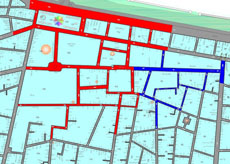
In the narrow alleys around parliament, protesters gathered and put pressure on police lines. The largest demonstration gathered around a group of women, some wearing face masks and goggles, who sat down in front of police at an intersection on Sosun Magu. The small group of police blocking the street to parliament appeared anxious but tolerant, and the mood was peaceful.

Roads blocked by police

Earlier this morning, police reported that four officers were hospitalised with serious injuries after protesters attempted to break through police lines near the Wood Apple and threw stones and poles. A further 10 officers suffered minor injuries before the area was reinforced by the military.

“44 people have been arrested and police have the area controlled,” said Sub-Inspector Ahmed Shiyam. A subsequent SMS from police suggested that some of those arrested were to be tested for possible intoxication.

As of 1:00pm there had been no reports of protesters injured, and Minivan News observed police showing restraint in holding back largely peaceful crowds.

MDP MP sitting on the Speaker's table

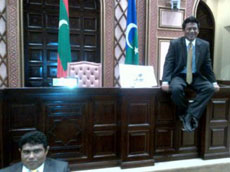
Inside parliament, MDP MPs – who make up 34 of the 77 member chamber, after the Supreme Court disqualified MP Mohamed Mustafa last week – were blocking the Speaker of Parliament, Abdulla Shahid from entering. Images being tweeted by MPs inside showed MDP MPs sitting on the Speaker’s table at the front of the chamber. MPs barricaded the doors and removed the chairs intended for the Speaker and Dr Waheed.

Shahid and a member of the Inter Parliamentary Union (IPU)  reportedly spoke with MPs to try and resolve the stand-off, while Haveeru reported that Indian High Commissioner D M Mulay was seen leaving the parliamentary office.

Telephone and internet connections inside parliament were reported to have been cut.

MDP made the decision to obstruct Dr Waheed’s address after the India-sanctioned ‘roadmap’ talks failed to produce an election date. A week of talks had established a seven point agenda, which included setting an election date and discussing necessary constitutional reforms, but no order of preference was agreed in yesterday’s meetings.

Rhetoric from key government figures, including Dr Waheed, has meanwhile suggested that they favour elections as normal in 2013. The MDP maintains that Mohamed Nasheed was ousted in a bloodless coup on February 7, and that Dr Waheed’s government is illegitimate.

Updates:

1:21: President Waheed’s Press Secretary Masood Imad said Dr Waheed remaining inside parliament waiting for the opportunity to give his address, but said MDP MPs had occupied the chamber and were obstructing the chamber.

2:20: Crowds in the streets outside parliament heated but non-violent. Chief of Defence Force Major General Ahmed Shiyam and Police Commissioner Abdulla Riyaz are reportedly conducting a meeting inside parliament, along with some members of Dr Waheed’s new cabinet.

2:55: The United States Embassy in Colombo has issued a statement expressing concern at the “disorderly protests in Malé and disruption of the opening session of the Majlis.”

“The US attaches great importance to our friendly relations with Maldives. We have welcomed the efforts of all sides to participate in a dialogue on a democratization process that could create the conditions for early elections. As the Majlis session opens, the United States encourages all parties to continue to work collaboratively and peacefully toward a solution as agreed with the Roadmap document, and not allow violence to further complicate the situation. The United States will continue to support Maldives in this process, and we stand ready to provide technical assistance on elections. In the interests of all Maldivians, we urge the parties to work together in a constructive and cooperative manner to reach agreement.”

5:30: A press conference has been called in parliament.

5:50: Spokesperson for India’s Ministry of External Affairs, Syed Akbaruddin,  said at a press conference that India’s “Foreign Secretary was [in the Maldives] to facilitate among Maldivian parties the next steps in trying to resolve this issue. The issue that remains contentious and that is the only issue left on the table is the date of elections. There were some that wanted the date to be announced prior to the Majlis and some wanted it to be dicussed inside the Majlis. As far as India is concerned, we are okay if there is discussion inside the Majlis or any other forum that they find suitable.”

6:00: Reports of MDP MPs being warned they would be removed by the military if they continued to disrupt the session.

6:30: MDP MPs Ibrahim Rasheed and Mohamed Shifaz have reportedly been removed from the parliament chamber by the military.

6:45: Rasheed was let back into the chamber after MDP Parlimentary Group Leader Ibu Solih negotiated with the Sergeant-at-arms.

7:00: A press conference that was earlier cancelled is back on.

7:30: Speaker Abdulla Shahid has announced the cancellation of the parliament session, after MDP MPs refused to let him into the chamber. On the last attempt Shahid said he fell and hurt himself slightly. The next session is scheduled for Monday.

8:00: President Waheed, Dr Mohamed Jameel and Azima Shukoor holding a press conference imminently.

Likes(0)Dislikes(0)

The Maldives and the Arab Spring: Institute of Development Studies

A number of recent editorials have referred to the recent coup in the Maldives as the undoing of the country’s own ‘Arab Spring,’ which began with the landmark 2008 elections that brought to an end 30 years of autocratic rule, write Gabriele Koehler and Aniruddha Bonnerjee for the Institute of Development Studies.

Indeed, while the status of democratic process in the Maldives more closely resembles other South Asian nations than nations involved in the Arab uprising, economic and social strains in the Maldives are akin to those that preceded the Arab Spring.

Economically and socially, there are three Maldives:

‘Maldives I’ is that of the sparkling tourist resorts isolated from the rest of the country on coral islands. Tourism is the Maldives’ largest industry and resort leasers represent a substantial and powerful economic interest group. The other Maldives are local economies.

‘Maldives II’ is made up of 1,192 islands dispersed across 90,000 square kilometres, where 205,000 Maldivians make a living from coastal fishing and related occupations.

‘Maldives III’ is the capital island of Malé, home to 103 thousand and one of the most densely populated places in the world.

Under the autocratic Gayoom regime, the Maldives made substantial progress on education and health criteria, despite the high costs of delivering services to widely-scattered islands. By 2000, the country had achieved universal primary and lower-secondary education and had almost eliminated communicable diseases.

In 2008, the central challenge for the newly-democratic government under President Nasheed was to maintain good performance on social services despite a high fiscal budget debt. At the same time, the global financial crisis affected the tourism sector as well as domestic prices of food and energy.

In response, Nasheed’s government focused on expanding inter-island transport, universalising health insurance, protecting the social sectors (health, education, child and family welfare) while trimming the public sector bill. It sought investment through a programme of public-private partnerships.

The financial strategy revolved around monetising the deficit, seeking grants and loans from donors, and rescheduling medium and long term debt obligations. Combined with rising food and fuel prices, this strategy fuelled inflation. Political opposition and low capacity restricted other reforms.

Read more

Likes(0)Dislikes(0)

Presidential Commission to investigate corruption and human rights abuses abolished

The new government of President Dr Mohamed Waheed Hassan has abolished the Presidential Commission, created by former President Nasheed to investigate corruption and human rights abuses under Maumoon Abdul Gayoom.

On February 1, a week before Nasheed’s government was toppled by opposition demonstrators and mutinous police, the Presidential Commission had forwarded a case for prosecution against Gayoom’s half brother MP Abdulla Yameen, for his alleged involvement in an illegal oil trade of up to US$800 million with the Burmese military junta, during his time as chairman of the State Trading Organisation (STO).

Yameen has publicly dismissed the allegations on several occasions, distancing himself from the Singapore branch of the STO where the trade to Burma took place, as well as disputing any illegality in the trade.

Grilled by parliament’s National Security Committee over the matter in November 2011, he denied any involvement in “micro-management” of STO subsidiary companies during his time as chairman until 2005.

The allegations first appeared in February 2011 in India’s The Week magazine, which described Yameen as “the kingpin” of a scheme to buy subsidised oil through STO’s branch in Singapore and sell it through a joint venture called ‘Mocom Trading’ to the Burmese military junta, at a black market premium price.

The article draws heavily on an investigation report by international accountancy firm Grant Thorton, commissioned by the Maldives government in March 2010, which obtained three hard drives containing financial information detailing transactions from 2002 to 2008. No digital data was available before 2002, and the paper trail “was hazy”.

As well as the four shareholders, former Managing Director of STO Singapore Ahmed Muneez served as director. The Week reported that Muneez informed investigators that Mocom Corportation was one of four companies with a tender to sell oil to the Burmese junta, alongside Daewoo, Petrocom Energy and Hyandai.

Investigators learned that Mocom Trading was set up in February 2004 as a joint venture and had four shareholders: Kamal Bin Rashid, a Burmese national, Maldivians Fathimath Ashan and Sana Mansoor, and a Malaysian man named Raja Abdul Rashid Bin Raja Badiozaman. Badiozaman was the Chief of Intelligence for the Malaysian armed forces for seven years and a 34 year veteran of the military, prior to his retirement in 1995 at the rank of Lieutenant General.

Under the contract, wrote The Week, “STO Singapore was to supply Mocom Trading with diesel. But since Mocom Corporation held the original contact, the company was entitled to commission of nearly 40 percent of the profits.”

That commission was to be deposited in a United Overseas Bank account in Singapore, “a US dollar account held solely by Rashid. So, the books would show that the commission was being paid to Mocom, but Rashid would pocket it.”

Yameen has previously described the allegations as “absolute rubbish”, and denied being under investigation by the Singaporean police saying that he had friends in Singapore who would have informed him if that were the case.

The article, he said, was part of a smear campaign orchestrated by Nasheed, a freelance writer and the dismissed Auditor General “now in London”, who he claimed had hired the audit team – “they spent two weeks in the STO in Singapore conducting an investigation.”

Gayoom also lashed out at comments made by the Presidential Commission, that top-level officials from the former administration were involved in blackmarket oil deals with the Burmese military junta.

Today President Waheed’s Press Secretary, Masood Imad, confirmed the Presidential Commission had been abolished but said he was unsure of the reasons why.

Likes(1)Dislikes(0)

MDP calls for peaceful demonstrations, police restraint, after talks delayed

The Maldives Democratic Party (MDP) has issued a statement calling for “all stakeholders in the Maldives to act responsibly and to conduct themselves peacefully during protests planned to coincide with the opening of the first session of the People’s Majlis” on Wednesday morning.

“MDP recalls that freedom of assembly is a Constitutional right in the Maldives and must be fully respected by the authorities. The right also entails responsibilities for all parts of society – both the protester who must conduct him/herself peacefully and within the law, and the police and security services who must show maximum restraint towards peaceful protesters, ensure the safety and well-being of all, and avoid violence,” the party said in a statement.

It was, the party said, “vital for the restoration of calm, for the future of democracy in the country and for the international reputation of the Maldives, for the police to avoid any repetition of the events of 8th February in the capital.”

The party has called for protests after roadmap talks failed to produce an election date ahead of parliament’s opening on March 1.

Roadmap mediator Ahmed Mujthaba told Haveeru the talks had been delayed due to the “sensitivity” of the issues.

Likes(0)Dislikes(0)

Amnesty condemns violent MNDF attack on a group of “peaceful women protesters” in Addu

Amnesty International has condemned attacks on a group of women in Addu Atoll by the Maldives National Defence Force (MNDF), after obtaining testimonies from victims of a crackdown on demonstrators at a rally during the recent visit to the MDP stronghold by new President Dr Mohamed Waheed Hassan.

“The 20 women were ahead of a crowd of about 70 when the police stopped them, saying they had been ordered not to allow Maldivian Democratic Party (MDP) supporters in. The women wore the yellow headbands usually donned by MDP members,” Amnesty reported,  in a statement published on Tuesday.

“The demonstrators halted their march and began to chant slogans against President Waheed, who was making his speech a couple of hundred metres away.

“They were then attacked by an army contingent which has been deployed alongside police in recent weeks.

“Army personnel arrived from a side alley behind the women, who were then caught between them and the police line.

“Separated from the rest of the demonstrators, the 20 were charged by soldiers who wielded batons and used pepper spray, pushed them around, and kicked them on their legs and ribs.

“Detailed testimonies from the [group of 20 women] revealed no evidence of the [female] protesters being involved in any act of violence.”

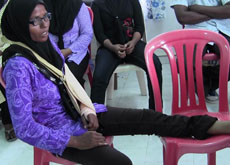
A woman with a sprained arm

“As the rest of the protesters ran away, army and police personnel chased them, allegedly beating anyone they caught.”

Security forces clashed with other demonstrators during the chase and a policeman was reportedly injured by a thrown stone, Amnesty noted.

Security personnel reportedly then entered the MDP office in Hitadhoo, where more than a dozen other women protesters had run for shelter.

“They chased the women into the storage room of the building and began to beat them,” Amnesty reported.

“Amnesty International learned that one woman had her arm twisted and sprained when MNDF soldiers grabbed her. They then took her glasses off, forced her to open her eye and sprayed it with pepper spray. She said they pressed her against the wall and kicked her with their boots.

“Another woman said that they began to beat her on her breast, repeatedly shouting they would see to it that she does not breast feed again.

“A third woman showed her badly bruised arm where she said that soldiers had severely and repeatedly beaten her.”

Amnesty noted that both sides had blamed each other for promoting violence, and that human rights in the Maldives “have become heavily politicised.”

“During clashes between the MDP supporters and security forces on 8 February, up to 10 buildings, including police headquarters and a court building, were burnt down in Addu city, an MDP stronghold,” Amnesty observed.

“The government has blamed MDP supporters for the destruction. Scores of people were detained in Addu following the 8 February clashes and were tortured or otherwise ill-treated in custody.”

“Police have continued to deny torturing the detainees or using excessive force against MDP protesters.”

In a press statement following the attacks, police dismissed the allegations as “lies” and said that the police only stopped the demonstrators who attempted to break into the area blocked by the security forces.

Likes(0)Dislikes(0)

India extends financial support to the Maldives

India has provided a standby loan of US$20 million to the Maldives as the country descends into political turmoil, reports the Economic Times.

Indian High Commissioner to the Maldives, D M Mulay, told the paper that the Indian government had expedited the delivery of the loan, which had been given to the Maldives government several days ago.

US$50 million in Maldives’ treasury bonds held by the State Bank of India “has also been rolled over for another year”, Mulay told reporters.

President Mohamed Waheed Hassan’s Political Advisor, Dr Hassan Saeed, in a recent leaked audio clip, expressed concern about the involvement of “a lot of foreign partners” and “huge bilateral pressures”, in particular a US$50 million owed by the Maldives to an unspecified lender: “Fifty million dollars has to be raised before the end of this month or there will be a sovereign default,” he said, in the recording earlier this week.

The same paper recently reported that SBI had issued a moratorium on loans in the Maldives until June.

Indian Foreign Secretary Shri Ranjan Mathai visited the Maldives on Monday to push ahead peace talks between parties in the Maldives.

Mathai was a key proponent of  a ‘roadmap’ document proposing early presidential elections, with necessary amendments to the constitution and  laws to be completed within a month’s time.

Former President Mohamed Nasheed’s Maldivian Democratic Party (MDP) has been pushing for an early election date, maintaining that Dr Waheed’s government is illegitimate, while the new government has insisted that “conditions have to be right”.

Likes(0)Dislikes(0)

“This was a coup, yet it has been accepted as a legitimate transfer of power”: Huffington Post

Mention the Maldives, and an image of an idyllic holiday paradise, clear blue water, pristine beaches and luxury resorts comes to mind, writes Jared Genser, a human rights lawyer and adjunct professor of law at Georgetown University Law Centre, for the Huffington Post.

The Indian Ocean archipelago with a population of little more than 300,000 rarely features on the world’s political agenda. On February 7, however, the tiny nation was gripped by political turmoil as its nascent democracy was strangled in its infancy. Mohamed Nasheed, the Maldives’ first democratically-elected president, was forced to resign at gunpoint by a cabal of rebel police, Islamists, and his own deputy, with the former dictator Maumoon Abdul Gayoom pulling the strings.

This was a coup, yet it has been accepted as a legitimate transfer of power. Reactions from around the world have been astonishing in their weakness. U.S. Assistant Secretary of State Robert Blake visiting Male’ merely said “some people say it was a coup, some people say it was a peaceful and constitutional transfer of power. That is not for the U.S. to decide, that is for the Maldivians.” Yet, even the new president’s own brother Naushad Waheed Hassan resigned from his position as Acting High Commissioner of the Maldives in the United Kingdom stating, “I cannot serve a regime that brought down the democratically-elected government in a coup d’etat” saying to his brother, “[D]o the right thing — resign and hold fresh elections. Let the people of Maldives decide.”

As president, Nasheed set about cleaning up the country’s corrupt institutions, instituting democracy and fighting climate change. Greeted as a hero by environmentalists for his efforts to secure an agreement on climate change at the Copenhagen summit, he warned that the Maldives would cease to exist due to rising water levels if the issue was not tackled. He became a role model for democratic transition in the Muslim world, and was a precursor to the Arab Spring.

It was his determined effort to take on vested interests in the Maldives, however, that led to his downfall. The judiciary is stacked with Gayoom’s appointees, who have done everything they could to obstruct reform and protect corrupt members of the old regime. A month ago, he ordered the arrest of Abdullah Mohamed, chief judge of the criminal court, on charges of corruption and political bias. The judge had a track record failing to follow the law, and now it was their turn to protect him. Demonstrations began, stirred up by Islamists who see Nasheed as too liberal.

Read more

Likes(0)Dislikes(0)