Foreign Minister Dunya slams Canada, Commonwealth statements on Nasheed prosecution

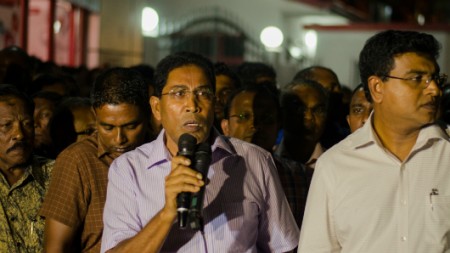
Foreign Minister Dunya Maumoon has slammed statements issued by the Commonwealth and Canada expressing concern over the denial of legal representation to former President Mohamed Nasheed at the first hearing of his terrorism trial yesterday.

At a press conference today, Dunya dismissed Canadian Foreign Minister Rob Nicholson’s statement as “blatantly untrue.”

Nicholson had called Nasheed’s detention and denial of constitutional rights “abhorrent.”

“[Nicholson] had described Nasheed’s arrest as unlawful or illegal. Nasheed was arrested in relation to the kidnapping or unlawful detention of the Chief Judge of Criminal Court in 2012. That act was illegal by all international laws and principles” said Dunya.

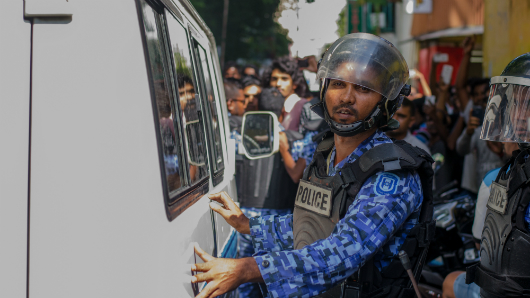
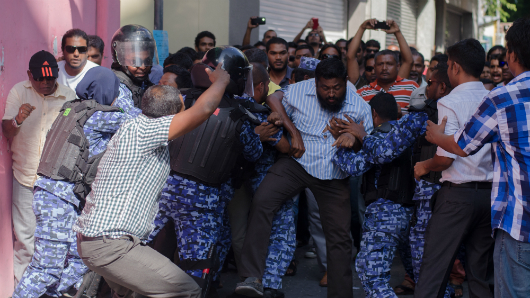
Nasheed appeared in court yesterday with his arm in a makeshift sling after police officers manhandled the former president outside the court building when he attempted to speak with journalists.

The Commonwealth meanwhile stated that Secretary-General Kamalesh Sharma was “concerned to note reports that former President Nasheed was denied the right to legal representation”.

Responding to the statements, Dunya said: “To criticise us in public statements with lies or biased with having only heard the oppositions point of view is not acceptable. The government will not accept these statements and will not pay any attention to them.”

She added that the Maldives has long been an independent and sovereign country, “and we do not want to be under any foreign influences or under a colonial power. No foreign power can tell Maldives what to do under President [Abdulla] Yameen.”

“Wronged”

Dunya said the Maldives does not have a significant relationship with Canada.

“I don’t think they know what actually is happening in here,” she suggested.

“Canada is a very influential country in the Commonwealth. Big countries do influence [the Commonwealth] and especially if they are funding and assisting the Commonwealth, then the organisation will do what they want.”

Dunya also said the Maldives would not accept the Commonwealth’s offer of expert legal assistance.

“[The Commonwealth] wants to provide us with their expertise but we simply do not want it. We have other ways, countries ready to help and even our own way of consolidating democracy here,” she said.

Questioning the value of the Maldives remaining a member state of the Commonwealth, Dunya said the organisation had “wronged” the Maldives by placing the country on a watch-list in the wake of the controversial transfer of power in February 2012.

While the Commonwealth Ministerial Action Group (CMAG) had suspended the Maldives and placed the country on its formal agenda, Dunya noted that a Commonwealth-backed Commission of National Inquiry (CoNI) later concluded that the transfer of power was constitutional.

“So we want to say to the Commonwealth, you have wronged us in the past and you are still mistreating us,” she said.

“We don’t get much aid or development from being a Commonwealth country. In 2012, Maldivians questioned the importance of us remaining in the Commonwealth. I am sure the question will arise again.”

She added that President Yameen would make a decision on whether to remain in the Commonwealth.

“Strategic misrepresentation of basic facts”

Dunya went on to say that she did not believe Maldivians could be adversely affected as a result of the government’s stand.

“Looking at the history, even if we are to face any problems [from the international community] we have to adhere to our principles, our methods and especially our independence and sovereignty,” she said.

Dunya also issued a statement today casting doubt on the Commonwealth’s assertion that it was “closely monitoring” the situation in the Maldives, noting that the Commonwealth Secretariat had not contacted the ministry over the past few days.

“On the contrary, I initiated a phone call to the Secretary General last night in which we exchanged views about issues of mutual concern in the Commonwealth and in the Maldives. I therefore regret the strategic misrepresentation of basic facts in the Secretary General’s statement,” reads Dunya’s statement.

It added that Nasheed was arrested with a court warrant and presented before a judge within 24 hours in accordance with “normal procedure,” after which the judge granted the former president the opportunity to appoint a lawyer.

However, Nasheed was brought to court more than 24 hours after the arrest for the first hearing of a trial on terrorism charges, rather than a remand hearing.

The former president appeared at the hearing without legal representation.

Citing new regulations, the Criminal Court informed Nasheed’s legal team on Monday morning (February 23) that the lawyers had to register at the court two days in advance despite being unaware of the trial until the former president’s arrest less than 24 hours ago.

Dunya, however, insisted that that police “followed the standard procedure and due process.”

“I wish to recall that the Commonwealth Secretariat had misread the situation in the Maldives once before, in 2012 and presented it to the CMAG, which took punitive measures against the country,” Dunya noted in her statement

“The Maldives, however, emerged from the situation vindicated by the CoNI Report. The government is hopeful that the Commonwealth will not repeat the same mistakes again.”


Related to this story

Commonwealth, Canada express concern over denial of legal representation for former President Nasheed

Former President Nasheed arrives in court with arm in makeshift sling

Nasheed denied right to appoint lawyer and appeal “arbitrary” arrest warrant, contend lawyers

Police arrest former President Mohamed Nasheed ahead of terrorism trial

Likes(4)Dislikes(0)

Nasheed’s lawyers name Judges Didi, Yoosuf as witnesses, request their withdrawal from terrorism trial

Additional reporting by Mohamed Saif Fathih and Ismail Humaam Hamid

Former President Mohamed Nasheed’s lawyers have named two of the three judges overseeing the opposition leader’s terrorism trial as witnesses, and requested the pair to excuse themselves from the bench.

In a letter to the Criminal Court today, lawyer Hassan Latheef asked Judge Abdulla Didi and Abdul Bari Yoosuf to step down, noting that the two were present with Judge Abdulla Mohamed at his residence during his arrest by the military.

The two judges witnessed the conversation between Judge Abdulla Mohamed and military officers, and could testify he had not been kidnapped as charged by the Prosecutor General, Latheef contended.

Nasheed is being prosecuted for the judge’s detention under the Prevention of Terrorism Act of 1990, which criminalises kidnappings and abductions. The offence carries a jail term between 10 and 15 years.

At a first hearing yesterday, Judge Abdulla Didi gave Nasheed three days to appoint a lawyer and answer charges. The former president is to be kept in police custody until the end of the trial.

Speaking to Minivan News, Nasheed’s lawyers continued to express concern over bureaucratic delays in both appealing the Criminal Court’s arrest warrant and registering to represent him at the next hearing on Thursday.

The Commonwealth, India, US, and Canada have expressed concern over the former president’s arrest and denial of right to legal counsel and appeal.

Medical attention

A police spokesperson confirmed to Minivan News that Nasheed was brought to Malé at 2:20pm today for medical attention upon his request. But neither his lawyers nor his family were informed. 

Nasheed limped into the courtroom yesterday using his tie as a makeshift sling for his arm. He claimed police officers had broken his arm and repeatedly asked for immediate medical attention.

The Maldives Police Services’ Superintendent Hamdhoon Rasheed denied allegations of police brutality last night, claiming Nasheed had staged his own fall.

Rasheed said Nasheed’s fingers and arms were not hurt according to doctors at the Dhoonidhoo Island Detention Center.

Nasheed’s legal team said they are not certain if police had arranged for an x-ray as advised by the doctor.

A police spokesperson declined to comment on the matter, stating: “medical assistance and attention will be given to all detainees under police custody.”

Nasheed’s lawyers have now requested Home Minister Umar Naseer to transfer him to house arrest.

“We are extremely concerned about the safety and security of President Nasheed, especially after what we saw yesterday in front of the court house. The police brutalised President Nasheed in front of the press and he is physically hurt,” Latheef said.

Judge Didi ordered the police to provide Nasheed appropriate medical care while he remains in custody.

Appeal delayed

Lawyers were unable to appeal the Criminal Court issued arrest warrant today as the forms required Nasheed’s signatures and had to be submitted to the Criminal Court before noon.

New appeal regulations state appeals of any court ruling must be first submitted to the court responsible for issuing the ruling. The court would then forward the forms to the appellate court.

Nasheed’s five-member legal team attempted to file an appeal on Monday, but were unable to do so due to the Criminal Court’s failure to provide the forms.

Lawyers said the Supreme Court’s new regulations impede the right to appeal as enshrined in the constitution.

The opposition Maldivian Democratic Party (MDP) has meanwhile requested the Human Rights Commission of the Maldives (HRCM) to investigate the police’s treatment of the former president, his arrest and proceedings of the terrorism trial.

HRCM member Jeehan Mahmoud confirmed the commission’s staff had visited the former president at Dhoonidhoo last night, but declined to give further details.

In a statement condemning the police’s unlawful use of force yesterday, the HRCM also called on the police to provide Nasheed with medical attention immediately and ensure he is afforded all constitutional rights.

The Police Integrity Commission was not responding to calls at the time of press.

Speaking to Minivan News, a spokesperson from the Prosecutor General’s Office today insisted the office was following due process in charging Nasheed with terrorism.

The PG’s office had initially charged Nasheed with arbitrary detention under the soon to be outdated Penal Code, but withdrew charges on February 15 for further review.

A statement issued on Sunday said Prosecutor General Muhuthaz Muhsin had decided “the best way [forward] in this case is to change the charges raised against Mohamed Nasheed and the court in which it was filed”.

“Therefore, as the case against Mohamed Nasheed is in the court process, we note that it is not desirable for politicians, some members of the public, political parties, and some media to talk in a way that both creates anxiety among the public about verdicts issued by courts and causes loss of confidence in independent institutions created by the constitution,” read the statement.


Related to this story:

Police deny brutalising Nasheed

Commonwealth, Canada express concern over denial of legal representation for former President Nasheed

Former President Nasheed arrives in court with arm in makeshift sling

Nasheed denied right to appoint lawyer and appeal “arbitrary” arrest warrant, contend lawyers

Police arrest former President Mohamed Nasheed ahead of terrorism trial

Likes(3)Dislikes(0)

UK alerts British tourists to protests in Malé

The United Kingdom has alerted British nationals travelling to the Maldives to take security precautions and to avoid large gatherings in Malé following the arrest of former President Mohamed Nasheed on february 22.

“Take care, remain vigilant, take appropriate security precautions and avoid large gatherings, protests and rallies,” read the travel advice updated yesterday (February 23).

The advisory read that all British nationals should contact the British High commission in Sri Lank for any consular assistance, and that the honorary consul in capital Malé can liase with the British High  Commission in Sri Lanka in case of emergencies .

The alert also noted that there is a general threat of terrorism in the Maldives, saying that attacks could be indiscriminate, in places frequented by expatriates and foreign travelers including tourists, and urged travelers to take comprehensive travel and medical insurance before travelling.

Read the full travel advice here

Likes(2)Dislikes(0)

Former Defense Minister Tholhath pleads not guilty to terrorism charges

Former Minister of Defense Tholhath Ibrahim Kaleyfaanu has pleaded not guilty to terrorism charges over the January 2012 detention of Criminal Court Chief Judge Abdulla Mohamed.

At a 5:00pm trial on Monday, Criminal Court Judge Abdulla Didi gave Tholhath three days to appoint a lawyer and answer charges.

Tholhath’s hearing took place right after former President Mohamed Nasheed appeared in court over the same charges. Judge Didi had placed Nasheed in police custody until the end of the trial.

Brigadier General (Rtd) and MP Ibrahim Didi, Colonel (Rtd) Mohamed Ziyad, and current Defense Minister Moosa Ali Jaleel also face terrorism charges over the judge’s arrest. But the three have not been informed of when their trials are to take place.

Jaleel was the Chief of Defense Forces during the judge’s arrest. He was appointed as Defense Minister in late January following the dismissal of then Defense Minister Mohamed Nazim after a controversial discovery of weapons at his residence.

Nazim is currently in police custody over terrorism and treason charges.

Three successive Defense Ministers in the Maldives now face terrorism charges. The offense carried a jail term between ten and 15 years.

Likes(1)Dislikes(0)

Police deny brutalising Nasheed

The Maldives Police Services have denied former President Mohamed Nasheed was brutalised when he was escorted into the Criminal Court yesterday.

Speaking to the press last night, Superintendent of Police Hamdhoon Rasheed said the opposition leader had staged a fall, and that his arms and fingers were not injured as he had claimed in the courtroom.

“When he fell and started to show resistance, the police attempted to ensure he received no injuries in taking him inside the courtroom,” he said.

Nasheed appeared in court for a terrorism trial with his arm in a makeshift sling. The opposition leader asked for immediate medical attention and right to legal counsel.

He had been arrested on Sunday on a court order that claimed he might abscond from the terrorism trial scheduled for the next day. Nasheed is being re-prosecuted on terrorism charges over the detention of Criminal Court Chief Judge Abdulla Mohamed in January 2012.

Criminal Court Judge Abdulla Didi placed Nasheed in detention until the end of the trial and gave him three days to appoint a lawyer and answer charges.

Superintendent Rasheed also alleged politicians were calling up individual police officers and offering “large amounts of money” as bribes to carry out “certain activities” and leak information on investigations.

Injured

Nasheed had arrived at the Justice Building at 4:00pm under a heavy Specialist Operations (SO) police guard. When journalists attempted to question the former president, SO officers surrounded and manhandled him.

Minivan News journalists observed Nasheed repeatedly asking the police to pull back, saying he will walk into the court room on his own accord.

Nasheed fell down and his shirt was torn in the process.

The opposition Maldivian Democratic Party (MDP) issued a statement last night condemning police brutality against the party’s president, claiming President Abdulla Yameen had directed the police’s actions.

“Police physically injured Nasheed when they took him into the Criminal Court on Presidents Yameen’s administration’s orders following his unlawful he was arrested against the constitution, regulations and international standards in making arrests,” the statement read.

Speaking at a press conference last night, MDP Chairperson Ali Waheed said that the party’s leadership was extremely worried over the former president’s safety.

MDP’s Vice Chairman Ali Shiyam had shared concerns with the Human Rights Commission of the Maldives, he said.

“President Nasheed urges people to cross the boundary of fear and to come out on February 27,” Waheed said.

Stunts

Speaking on TVM’s “Maldives Today” programme last night, Presidential Affairs Minister Mohamed ‘Mundhu’ Hussein Shareef accused Nasheed of playing “stunts” in order to get international media attention and said such incidents tarnished Maldives’ image.

He claimed the government was not under any international pressure, saying expressions of concern by international organizations and foreign countries “do not amount to pressure.”

Nasheed as commander-in-chief had “kidnapped” Judge Abdulla Mohamed, Mundhu said, arguing: “When the case begins in a court, how can it be called a political act in a society that believes offenders must be tried?”

Meanwhile, Tourism Minister Ahmed Adeeb, speaking alongside Mundhu, said President Yameen would not interfere with the Prosecutor General’s Office or the judiciary.

“We are not like President Nasheed’s administration. We would not lock up the Supreme Court or the Majlis or disappear politicians. In our administration, the police will not act without a court order,” the ruling Progressive Party of Maldives’ deputy leader said.

“In a democratic environment with separation of powers, how can we influence the other power,” he said.

Nasheed must be tried and penalized to ensure justice is done to Judge Abdulla Mohamed, he continued.


Related to this story

Former President Nasheed arrives in court with arm in makeshift sling

Nasheed denied right to appoint lawyer and appeal “arbitrary” arrest warrant, contend lawyers

Police arrest former President Mohamed Nasheed ahead of terrorism trial

MDP, JP rally supporters ahead of mass February 27 march

Likes(4)Dislikes(0)

Commonwealth, Canada express concern over denial of legal representation for former President Nasheed

The Commonwealth and Canada have expressed concern over the denial of legal representation to former President Mohamed Nasheed at his trial on terrorism charges yesterday.

The Commonwealth spokesperson noted in a statement yesterday that the intergovernmental organisation was closely monitoring developments in the wake of the opposition leader’s arrest on Sunday (February 22).

“The Secretary-General is concerned to note reports that former President Nasheed was denied the right to legal representation at the court hearing that took place on 23 February. The Commonwealth has also noted the arrest of former Defence Minister Mohamed Nazim on 10 February,” reads the statement.

“The Secretary-General raised his concerns today with the Foreign Minister of Maldives, Hon Dunya Maumoon, and has stressed the importance of ensuring that the rule of law is respected, with adherence to due process, and in accordance with the Commonwealth Charter.”

The statement added that Secretary-General Kamalesh Sharma also “reiterated his offer to provide Commonwealth expert assistance in relation to upholding the separation of powers in Maldives, consistent with the Commonwealth’s Latimer House principles on the separation of powers between the three branches of government.”

Nasheed appeared in court for the first hearing of the trial yesterday with his arm in a makeshift sling after police officers manhandled the former president outside the court building when he attempted to speak with journalists.

Canadian Foreign Minister Rob Nicholson meanwhile put out a statement yesterday expressing “grave concern” at Nasheed’s arrest.

“Developments in Maldives and the brutal and unjustified treatment of the former president call into question Maldives’ commitment to due process and democratic principles,” reads the statement.

“Mr. Nasheed’s unlawful detainment and the denial of his constitutional rights, including to legal counsel and appeal, under the politically charged allegation of ‘terrorism’ are abhorrent.

“We expect that Mr. Nasheed will receive medical care without delay. Canada calls on the Government of Maldives to reaffirm its commitment to democracy, human rights and the rule of law, and it urges that differences be resolved within the constitutional framework of Maldives. As tensions rise in the country, Canada urges calm and restraint on all sides.”

Official spokesperson at the Indian Ministry of External Affairs, Syed Akbaruddin, also expressed concern yesterday over the recent developments, “including the arrest and manhandling of former President Nasheed,” and appealed for peaceful resolution of the political crisis.

Meanwhile, the US State Department revealed yesterday that Assistant Secretary of State for South Asia Nisha Biswal had spoken to Foreign Minister Dunya Maumoon to express concern over Nasheed’s arrest and subsequent developments.

“She urged the government to take steps to restore confidence in their commitment to democracy, judicial independence, and rule of law, including respect for the rights of peaceful protest and respect for due process,” State Department Spokeswoman Jen Psaki said at a regular news briefing.

Right to legal counsel

The Criminal Court yesterday refused to register any of the former president’s five lawyers to advocate on his behalf at the terrorism trial.

Citing new regulations, the Criminal Court informed the legal team on Monday morning that the lawyers had to register at the court two days in advance despite being unaware of the trial until the former president’s arrest less than 24 hours ago.

“How can we submit forms two days ahead for a trial we did not know would take place two days before? It is clear to any sane person this is absolute nonsense,” Nasheed’s lawyer, Hisaan Hussain, told the press.

The legal team was also unable to appeal the Criminal Court’s arrest warrant – which they contended was “arbitrary” and riddled with irregularities – after the court informed the lawyers that the new appeal form was as yet unavailable.

Concluding the first hearing of the terrorism trial yesterday, Judge Abdulla Didi granted Nasheed three days to appoint a lawyer and prepare his defence on charges of ordering the military to detain Criminal Court Chief Judge Abdulla Mohamed in January 2012.

The judge also ordered police to hold Nasheed in pre-trial detention until the conclusion of the trial.


Related to this story

Former President Nasheed arrives in court with arm in makeshift sling

Nasheed denied right to appoint lawyer and appeal “arbitrary” arrest warrant, contend lawyers

Police arrest former President Mohamed Nasheed ahead of terrorism trial

MDP, JP rally supporters ahead of mass February 27 march

Likes(0)Dislikes(0)

Former President Nasheed appears in court with arm in makeshift sling

A visibly injured former President Mohamed Nasheed appeared at the Criminal Court today for the first hearing of his sudden terrorism trial.

Nasheed limped inside the courtroom at 4:35pm, nursing what appeared to be a broken arm and using his tie as a makeshift sling.

There were no buttons on his shirt, his glasses were missing, and he had a T-shirt wrapped around his body.

Nasheed appeared at court without legal representation as the Criminal Court today refused to register any of the five lawyers on his legal team.

Ignoring requests for medical attention, presiding Judge Abdulla Didi asked the state prosecutors to present charges.

The former president is being charged with terrorism for his administration’s detention of Criminal Court Chief Judge Abdulla Mohamed in January 2012.

Didi gave Nasheed three days to appoint a lawyer and answer charges, and ordered the opposition leader be held in police custody until the trial ended.

Nasheed has now been taken to Dhoonidhoo Island Detention Center, but lawyers said he may be taken to ADK Hospital for treatment. Supporters are awaiting him outside the hospital on Sosun Magu.

He was arrested yesterday at 3:00pm from his residence Yagoothuge.

Court proceedings

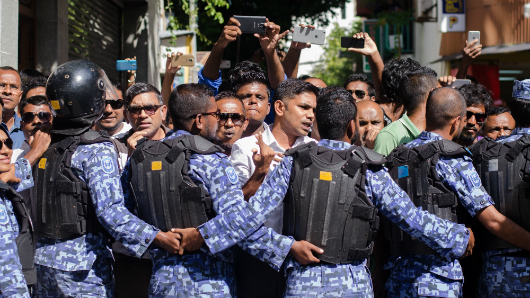
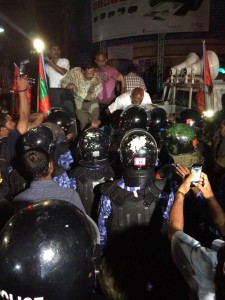
Nasheed arrived at the Justice Building at 4:00pm under a heavy Specialist Operations (SO) police guard. Journalists attempted to question the opposition leader, but SO officers surrounded and manhandled Nasheed, shoving journalists and cameramen aside.

Nasheed’s shirt was torn in the process and he fell to the ground.

He repeatedly urged police officers to allow him to walk inside the court building, but SO officers dragged the former president inside the building by force.

Court officials locked the door afterwards.

When a three judge bench commenced the trial at 4:40pm, Nasheed stood up and said: “Honourable judge, I have been shoved to the ground and my arm has been broken. I want to see a doctor. As you can clearly see, I am hurt.”

He added: “I’ve been waiting for a while now. Take me to a doctor and then you can issue your verdict.”

However, Judge Abdulla Didi – presiding over the case along with Abdul Bari Yoosuf and Sujau Usman – said the judges had received reports suggesting that Nasheed had staged a fall, caused his own injuries and refused to enter the court building.

Nasheed replied: “What evidence are you basing this on? Check the videos.”

State Prosecutor Abdulla Rabiu said Nasheed was charged under Article 2(b) of the Prevention of Terrorism Act and that as commander-in-chief the former president was responsible for the military’s detention of Criminal Court Chief Judge Abdulla Mohamed.

Asked to respond to the charges, Nasheed repeated his request for medical attention and asked to be allowed to appoint a lawyer.

When Judge Didi said Nasheed had allegedly refused to enter the court, he replied: “I’ve never given an excuse not to enter a courtroom.”

Nasheed also noted that he had been kept in detention for more than 24 hours without being brought before a judge.

State Prosecutor Aishath Fazna Ahmed then read out a letter from the Prosecutor General requesting an order to hold Nasheed in remand detention on the grounds that his previous conduct during proceedings at the Hulhumale’ Magistrate Court suggested the former president might abscond from trial.

Fazna also cited a police intelligence report to support the request, and requested for a continuous trial.

Judge Didi gave Nasheed three days to appoint a lawyer and answer the charges of terrorism and ordered police to hold the former president in pre-trial detention until the conclusion of the trial.

Didi said the Criminal Court would order the police to provide the former president with medical care.

Judge Abdulla Mohamed has meanwhile taken a leave of absence until the end of the trial.

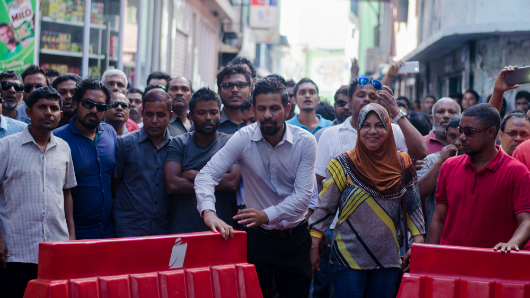
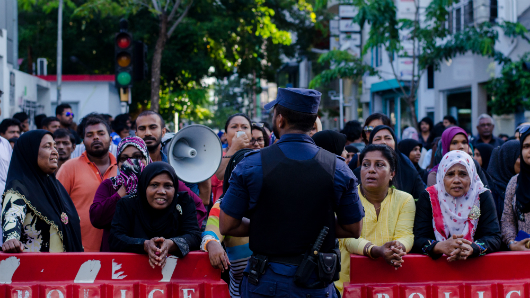
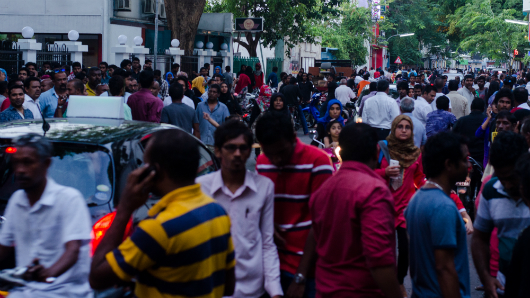
Outside, the police had cordoned off the area encompassing the Criminal Court, the adjoining Supreme Court and the Vice President’s residence. Supporters had been gathering behind barricades from 3:00pm onwards.

Photo: Nasheed manhandled by police outside the Justice Building
Manhandling

Condemning the police’s unlawful use of force and brutality, the Human Rights Commission of the Maldives has called on the police to provide Nasheed with medical attention immediately and ensure he is afforded all constitutional rights.

In response to a question today, Syed Akbaruddin, official spokesperson at the Indian Ministry of External Affairs, expressed concern over the developments in the Maldives, “including the arrest and manhandling of former President Nasheed.”

“We urge all concerned to calm the situation and resolve their differences within the constitutional and legal framework of Maldives.​

“The Government of India reiterates its commitment to supporting the people and the Government of Maldives in their quest for peace, development, prosperity and democracy,” the spokesperson said.

The Maldivian Democracy Network, meanwhile, said Nasheed had been denied constitutional rights, including the right to legal counsel and appeal.

In a statement detailing several alleged irregularities, the human rights group called on the Maldives Police Services and the Prosecutor General to work within the ambit of the Constitution.

“We urge the authorities to release Nasheed and all peaceful protesters as we are of the view that these persons have been detained unlawfully without adherence to due process,” the statement read.

Photo: Protesters outside ADK Hospital


Related to this story

Nasheed denied right to appoint lawyer and appeal “arbitrary” arrest warrant, contend lawyers

Police arrest former President Mohamed Nasheed ahead of terrorism trial

MDP, JP rally supporters ahead of mass February 27 march

Two JP MPs and 15 councilors defect to PPM

Likes(3)Dislikes(0)

Comment: Why we must object to the farce of a ‘trial’ against Nasheed

This article first appeared on DhivehiSitee.com. Republished with permission

On Sunday, former President of Maldives, Mohamed Nasheed, was arrested. The arrest warrant issued by Criminal Court stated “terrorism charges brought against the subject and fears that he may not attend the Court or go into hiding” as reason for arrest.

The evidence and substantiation for Court decision was given as, “how matters had transpired when a case against subject was heard at the Hulhumale’ Magistrate Court, and Police Intelligence reports”. The arrest warrant was provided on the request of the Prosecutor General who was according to the arrest warrant, “investigating case”.

Till then, there had been no mention of terrorism charges against Nasheed by any authority nor had an investigation into terrorist activities by Nasheed taken place.

Local media soon reported the trial has been scheduled in Criminal Court for 4pm today, and it emerged that the Prosecutor General had filed new terrorism charges in Criminal Court after withdrawing the case against Nasheed pending in Hulhumale’ Magistrate Court for over two years as Nasheed challenged the cherrypicking of his trial bench by the Judicial Service Commssion and the procedural appeals dragged on without decision.

As the new trial begins in a couple of hours, there is more reason than ever before to object to the farce.

  1. The current Prosecutor General Muhthaz Muhsin is a former Criminal Court judge, who worked as a junior judge under Criminal Court chief Judge Abdulla Mohamed who is himself the subject in the case against Nasheed.
  1. Media reports the Criminal Court has selected a bench of three judges – Judge Abdulla Didi, Judge Ahmed Rasheed and Judge Shujau Usman – for the case.

The first two are both former members of the Judicial Service Commission (JSC) who played crucial roles within JSC in both re-appointing Abdulla Mohamed as judge despite him not meeting criteria and pending serious misconduct issues, and in covering up misconduct after re-appointment.

Moreover, both carry bias against Nasheed evident in JSC records, especially in discussions of misconduct allegations against Judge Abdulla Mohamed filed with the JSC by the President’s Office in 2009 when Nasheed was in office.

Judge Didi served on the JSC from it’s establishment as an interim commission in 2008 till 2015 as the lower courts appointee. Ahmed Rasheed elected by the law community served on the JSC from 2009 to 2015 and was appointed a Criminal Court judge by the JSC just days ago.

The third, Shujau Usman, was re-appointed a Magistrate by JSC despite a criminal record and was one of three magistrates cherry-picked by the JSC for the Hulhumale’ Magistrate Court bench for Nasheed’s case.

Nasheed’s trial then is not simply political persecution by the government of President Yameen but an already orchestrated trial, managed by the JSC, with the Prosecutor General and the Criminal Court bench already set against Nasheed and ready to avenge Abdulla Mohamed.

Meanwhile, heading the JSC today is Supreme Court Justice Ali Hameed infamous for his white underpants and sex tapes gone viral on the internet.

Aishath Velezinee sat on the Judicial Services Commission from 2009-2011.

All comment pieces are the sole view of the author and do not reflect the editorial policy of Minivan News. If you would like to write an opinion piece, please send proposals to [email protected]

Likes(10)Dislikes(0)

Nasheed denied right to appoint lawyer and appeal “arbitrary” arrest warrant, contend lawyers

Former President Mohamed Nasheed is being denied the constitutional right to appoint a lawyer as well as the right to appeal the Criminal Court’s “arbitrary” arrest warrant ahead of a surprise terrorism trial due to commence today, contends the opposition leader’s legal team.

At a press conference this afternoon, Nasheed’s legal team revealed that the Criminal Court informed the lawyers this morning that they had to register at the court two days in advance despite being unaware of the trial until the former president’s arrest less than 24 hours ago.

“How can we submit forms two days ahead for a trial we did not know would take place two days before? It is clear to any sane person, this is absolute nonsense,” said Hisaan Hussain.

Nasheed was arrested at 2:30pm from his residence Yagoothuge yesterday (February 22). The warrant issued by the Criminal Court stated that Nasheed was being arrested on suspicion that he may abscond from trial.

Prosecutor General (PG) Muhthaz Muhsin filed terrorism charges against the former president yesterday over the military’s controversial detention of Criminal Court Chief Judge Abdulla Mohamed in January 2012.

The court first informed Nasheed’s lawyers – Hisaan Hussain, Hassan Latheef and Ibrahim Riffath – that they could not advocate at the Criminal Court as neither were officially registered.

Hassan Latheef noted that the Criminal Court’s registrar also refused to meet the lawyers before 1:30pm.

Two other lawyers from the five-member legal team – Abdulla Shaairu and Ahmed Abdulla Afeef, prominent criminal defence lawyers who are both registered at the Criminal Court – were then told that they must register again to represent Nasheed.

However, the court subsequently informed the pair that according to court regulations they must submit registration forms two days in advance to be authorised to represent Nasheed at today’s trial.

“We only found out charges had been filed by the Prosecutor General yesterday. There is no way we could have submitted forms ahead of that two day period,” said Shaairu.

“The constitution clearly affords all citizens the right to legal counsel, from the moment they are first accused to the moment the suspicion is resolved. Here, we are speaking of a man who is a former president, a man who has the majority support of the public. If he is not treated justly, what hope is there for the ordinary man?”

Right to appeal

Under new regulations enacted by the Supreme Court this month outlining the appeal process, Nasheed’s lawyers explained that appeal forms must be sent through the trial court to the appellate court.

In order to appeal the arrest warrant, the lawyers explained, the appeal must be filed at the Criminal Court, which would then forward the case to the High Court within a seven day period.

However, the Criminal Court informed Nasheed’s lawyers this morning that the new appeal forms had not been provided to the court.

Hisaan noted that the Criminal Court was unlikely to expedite the process of appealing its own rulings, “especially in cases of unlawful arrest.”

The new regulations deny citizens the constitutional right to appeal court decisions, she asserted.

Ahmed Abdulla Afeef meanwhile suggested that the Criminal Court could use the sample form provided by the Supreme Court and copy the trial court’s letterhead, adding that the legal team was ready with all the paperwork to submit the appeal as soon as possible.

“Arbitrary”

Nasheed’s lawyers also expressed concern over “several irregularities” in the warrant signed by Judge Abdul Bari Yoosuf at 12:30pm yesterday, noting the absence of  key information such as place and time period of detention.

Despite the Criminal Court scheduling the first hearing of the terrorism trial for 4:00pm today, the warrant does not state that Nasheed must be brought to trial today.

Moreover, under normal procedure, police request arrest warrants to detain a suspect in an investigation.

However, in Nasheed’s case, PG Muhsin personally went to the Criminal Court yesterday and obtained the warrant, the lawyers revealed.

“We have always noted the state in prosecuting President Nasheed, has previously acted unlawfully. In this instance, we see the Prosecutor General so clearly and publicly flouting the law for political motives. We call on the PG to show independence and to act within the constitution,” said Hisaan.

The legal team also revealed that the Criminal Court has issued a new warrant ordering police to present Nasheed at for the terrorism trial due to begin at 4:00pm.

The lawyers noted the lack of continuity between the warrants, arguing that Nasheed must be released immediately if yesterday’s warrant is now outdated.

“I think police themselves are not clear what to do next. There is no time period in the warrant, so should he be brought before court in 24 hours? But that is done when an individual is arrested in an ongoing investigation, if there is no court order,” explained Hisaan.

“And if there is a court warrant, then the time period in the warrant expires. This case, however, is not an ongoing investigation.
It is not clear to anyone what they are trying to do. All we know is that there’s been serious and several violations of the constitutions, law and norms in issuing this warrant and in arresting the former president.”

“Abscond from trial”

Nasheed was arrested on the grounds that he had attempted to abscond trial during proceedings at the Hulhumalé Magistrate Court last year. A police intelligence report was also submitted as evidence to obtain the arrest warrant.

But the lawyers insist Nasheed cannot be held in detention because he “had never absconded from court, nor have taken the opportunity to flee or go into hiding, during numerous opportunities he had in the past few weeks to travel abroad, and that he had expressly informed the judiciary and Prosecutor General that he does not have any intention to abscond from Court or avoid charges being brought against him.”

PG Office Spokesperson Adam Arif told Minivan News that Nasheed’s arrest warrant was different from those issued in instances where an individual refuses to appear at court.

Nasheed had not previously been informed he would be prosecuted on terrorism charges.

Meanwhile, the PG office insisted in a statement yesterday that there was no legal “obstacle” to raising charges against former President Nasheed as a court had not ruled that the case submitted to the Hulhumalé Magistrate Court on September 1, 2012 could not be heard.

After withdrawing the case for further review on February 15, the Prosecutor General decided “the best way [forward] in this case is to change the charges raised against Mohamed Nasheed and the court in which it was filed”.

The PG pressed terrorism charges against the former president under authority granted by the constitution, the Prosecutor General’s Act, and High Court rulings, the statement added.

“Therefore, as the case against Mohamed Nasheed is in the court process, we note that it is not desirable for politicians, some members of the public, political parties, and some media to talk in a way that both creates anxiety among the public about verdicts issued by courts and causes loss of confidence in independent institutions created by the constitution,” reads the PG’s statement.

Likes(3)Dislikes(0)