Handcuffed corpse found off Vaavu Fohthela

A handcuffed corpse with injuries was found in the sea near the island of Fohthela in Vaavu Atoll yesterday, police have said.

Sub-Inspector Ahmed Shiyam told Minivan News today that the body appeared to have been in the water “for a long time” and was found handcuffed.

As the man was not circumcised and based on appearance, complexion and size, said Shiyam, police believed it was a foreigner.

“We believe he might have been killed because of the injuries, and the body is being kept at the mortuary [in the Galolhu cemetery] for investigation,” he said.

A crowd of people gathered outside the Galolhu cemetery around 11pm last night while the opposition Progressive Party of Maldives (PPM) called for a post-mortem to be conducted.

“We allowed a member from each media to see the body” to clarify rumors, said Shiyam, but added that media members were asked to turn off their phones and cameras.

Newspaper Haveeru reported that severe injuries were visible on the left ankle and the left arm of the corpse.

After allowing journalists into the mortuary to observe the body, police reportedly used pepper spray to disperse the protesters.

Likes(0)Dislikes(0)

New7Wonders runs into controversy: Guardian

The four-year long competition to name the seven wonders of the natural world has run into controversy after governments accused the organisers of asking for millions of dollars in marketing costs, reports the UK’s Guardian newspaper.

The New7Wonders of Nature poll, its organisers claim, has attracted millions of voters choosing the final seven from a shortlist of 28 natural landscapes which include the Great Barrier Reef, the Amazonian rainforest and the Maldives.

After initially paying a registration fee of $199 (£125) to enter, each country was then asked to take part in a high-profile global marketing campaign that included a world tour.

In May, the Maldives government moved to withdraw from the competition after receiving a “surprise” demand for half a million dollars. They were followed in August by the Indonesian government, representing Komodo Island national park, who said the organisers wanted $10m dollars in licensing fees and $47m dollars to host the closing ceremony.

Full story

Likes(0)Dislikes(0)

Retreat for leaders’ spouses held in Fuvamulah

A Maldivian musical on water and a cultural village perched high on the beach were the highlights of the spousal retreat held in Fuvamulah today.

Fuvamulah, co-host of the 17th SAARC summit along with Addu City, has been the venue of activities for the SAARC Festival since the start of November.

These have included a kite festival, bashi competition (a game played exclusively by women using a badminton racket and tennis balls), and the ‘Cricket 20Twenty Cup Tournament’ among seven SAARC member nations. Beach volleyball and futsal tournaments meanwhile took place in Addu City.

“We are very happy to be part of this SAARC summit as this will open Fuvamulah to the world. Our famed thundi (southern beach) and the beauty of this island will be visible for all to see” said Ali Zaeed, Fuvamulah Councillor, ahead of today’s events.

Fuvamulah is located in the south of Maldives near Addu City, which together makes up the Southern Province. Fuvamulah is both an atoll and an island and is geographically considered to be one of the most unique islands in the Maldives, with two fresh water lakes and beaches lined with black stones, white flat pebbles, white sand and rocks located on different sides of the island.

“Indian prime minister Mr Manmohan Singh’s wife and Sri Lankan president’s wife along with spouses of foreign ministers present…is expected to come to Fuvamulah in the afternoon tomorrow” said Zaid last week. Though preparations for the spousal retreat were in full swing during the week, Zaid expected the preparations to be completed on schedule.

The spouses flew into Fuvamulah on the day that the first scheduled flights started in the newly built domestic airport.

A musical

200 secondary students performed a welcome dance near the tarmac of the domestic airport. A rehearsal of the events took place on Tuesday with first lady Laila Ali in attendance.

The dance choreographed by Munko featured a traditional dance to the song ‘Rashu Vehi’ (Island environment). The song is the first three couplets of an old Fuvamulah poem extolling the virtues of the island and its uniqueness.

After arrival the spouses proceeded to the biggest lake in Fuvamulah ‘Bandaara Kulhi.’ A newly built platform offered a splendid view of the lake where a romantic Maldivian musical was displayed.

“Performers in 11 boats in traditional attire, will depict a love story, which will show a couple falling in love, the pain of separation, before finding each other again,” said Mifraah (Mifu) Abdul Muhaimin, Fuvamulah coordinator for the official event, speaking to Minivan News last week.

“Fuvamulah has been isolated for very long, so once the hero leaves, he can’t come back easily,” Mifu said.

Coordinating rowing boats for a performance was not an easy task, though the performers from all walks of life, and ages were very enthusiastic about the musical. Though the one thing they all have in common is that they know how to swim, essential for a performance over water.

The musical takes inspiration from the story of Dhonhiyala and Alifulhu, Maldivian equivalent of Romeo and Juliette.

The soundtrack was a fusion of Maldivian songs and old forms of poetry. Among them Raivaru, a form of poetry that takes place as a dialogue between two or more people and that was used in the past to woo prospective partners.

Apart from the hero and heroine, the performers on the other boats showcased Fuvamulah handicraft, like rope weaving, weaving thatch, and making kasabu (the neckline of traditional Maldivian garment made using gold stitches)

“We have made sure that we use traditional garments and authentic stuff for all the events,” said Mifu.

Cultural display

The southern beach of Fuvamulah was the last stop for the spouses. The wide beach famous for its beauty is made up of small flat white pebbles in contrast to the white sandy beaches commonly found in Maldives.

The cultural village is on the high end of the beach with eight thatch roof huts that depicts Maldivian life of yesteryears.

“We did a lot of research to get the authentic look of each hut,” said Ali Amir, who did the concept and design of the village. MNDF created the village based on a detailed sketch of the village. Research consisted of reading what little written account was available and in reference to oral history.

“We talked to elderly people in this island. This required a lot of patience as some of them are very old and sick in some cases, so we had to meet them at times convenient to them” said Amir.

The antique furnishings inside the huts, like ashi (bench beds), swings and a 200-year-old farivalhu (container decorated with lacquer work used to serve food) among others, were sourced from different houses in the island.

The village consists of hut of fisherman, farmer, blacksmith, island chief, edhuruge (house of the only teacher) and places like a boat building hut, a yam storage place and hut of a Vaaruveriyaa (governor from central government). The latter vaaruveriya was the person charged with governing individual islands for a brief time in history until Maldives became a republic in 1953.

“The sultan would send an edict to a person he chooses appointing him as the Vaaruveriya of that island” said Ali Didi, the consultant for the project and Fuvamulah island’s resident history expert.

From that moment the Vaaruveriyaa would take charge of the running of the affairs of the island and trade from the comfort of his own house. All produce of the island, be it vegetables or fruits from trees in islander’s own backyard, had to be presented to him.

“He would not have a fixed income, but would get to keep 1/10 of all items he trades,” Didi explained.

“Most of us live in a concrete jungle now, it’s a respite to go back to the days of the past, and see the simple life again” said Amir.

The retreat come to an end with evening tea served Shiranthi Wikremasinghe, soaking in the simplicity of Maldivian lifestyle in a cultural village in one of the most beautiful spots in a unique island atoll.

Likes(1)Dislikes(0)

South Asia’s ability to shape its future never stronger: leaders address SAARC

The 17th SAARC Summit was opened this afternoon in Addu City by Prime Minister of Bhutan, Lyonchhen Thinley.

The leaders of Nepal, Pakistan, Sri Lanka, Afghanistan, Bangladesh, Bhutan and India arrived at the purpose-built Equatorial Convention Centre in motorcades, escorted by police outriders in ceremonial uniform, dozens of bodyguards and an ambulance.

The Maldives National Defence Force (MNDF)’s Rehendi helicopter hovered overhead, while arriving heads of state emerged from their vehicles to be greeted by President of the Maldives Mohamed Nasheed and First Lady Laila Ali. They entered the convention hall to the sound of bodu beru drums and the sight of local girls waving paper garlands.

“South Asia is more powerful and prominent than any other time in its history. The future is ours to shape,” President Mohamed Nasheed said, in his inaugural address as the new Chairman of SAARC.

“Our economies are booming. Our political influence is growing. And our ability to shape the course of world affairs has never been stronger. Our populations are youthful and energetic. Our thinkers, researchers and scientists are globally renowned. Our culture is internationally acclaimed. Our private sector companies are some of the world’s largest and most profitable,” Nasheed said.

Citizens in SAARC countries had similar aspirations, he noted: “They want to live in societies based on the rule of law, in which basic freedoms are protected. They want the chance to succeed in our region’s economic miracle. They want what everyone wants: a decent life to live in dignity.”

Nasheed raised three key areas of focus: trade, transport and economic investment, security against piracy and climate change, and good governance.

However climate change, he said, was the greatest long-term threat affecting the region, “causing havoc, threatening our development and prosperity. But the solution to climate change is not cutting back. Rather, it is investing in the new, clean technologies that not only reduce pollution, but also improve energy security and provide long term economic growth.”

President Nasheed also noted the potential for a human rights mechanism in SAARC, “not to point fingers, or open historic and painful wounds, but because we have a duty to improve the lives of citizens.”

Nasheed welcomed the proposal to set up a SAARC Independent Commission on Gender, commenting that South Asian women “suffer from a wide range of disadvantages and discrimination. Women in our region have some of the world’s lowest rates of property ownership and political representation.”

He finished on an optimistic note: “The fundamentals of our region are strong. We have young, energetic populations. We live in a region of vibrant democracies, with strong civil societies.”

“As our economies race ahead, our political importance increases ever more. Let us not be held back by history or convention. Let us be the leaders our people want us to be. Let us change our region for the better. Let us change the world,” Nasheed said.

Leaders address SAARC

In his address to the SAARC delegates, Prime Minister of Nepal Baburam Bhattarai observed that SAARC nations were situated “in the cradle of human civilisation, with abundant natural and human resources. But despite this, our potential is unfulfilled. We face widespread poverty, unemployment and inequality.”

The largest number of world’s poor “live in our region”, Bhattarai said, but the “flow of growth, people and ideas has been hindered and our potential remains unfulfilled.”

Pakistani Prime Minister Yousaf Raza Gilani congratulated Nasheed on hosting the first SAARC Summit in the southern hemisphere.

In bilateral talks on Thursday morning with Indian Prime Minister Manmohan Singh, the historically tense relationship between the two nuclear-armed nations lightened after the two leaders took measures to ease trade limitations. Singh even described Gilani as a “man of peace” following the meeting.

In his speech to the assembled delegates, Gilani emphasised that Economic development was linked to the availability of energy at a reasonable price, an and urged investment “in harnessing indigenous energy sources such as solar, wind, biomass and hydro power.”

President of Sri Lanka, Mahinda Rajapaksa, meanwhile prioritised education in his speech, stating that as leaders, “we have a sacred duty to develop our people.”

“In Sri Lanka we believe in social mobility. Education, communications and healthcare must be made available to all,” said Rajapaksa, adding that “ignorance, deceit, and poverty” were “common evils” facing SAARC nations.

“Social equality goes hand-in-hand with economic progress,” he stated, emphasising that this could only be achieved through peace and security.

President of Afghanistan, Hamid Karzai, also highlighted the importance of education in his address.

“Despite the progress we have made, lack of education and unemployment is a vicious cycle that is creating fertile ground for extremism,” he said.

A stable Afghanistan would enable its use as a land bridge between many countries and greatly improve trade links in the region, he said.

While terrorism was the biggest cause of suffering for the Afghan people, he said, the violence was not only limited to Afghanistan, but also affected Pakistan and India.

“We need to overcome the trust deficit that exists and learn to cooperate,” Karzai said.

He noted that Afghanistan was pursuing a strategic long term partnership with the United States, but said he wished to “reassure our neighbours that such a partnership is no threat to the region.”

The theme of education was continued slightly differently by Prime Minister of Bangladesh, Sheikh Hasina, who in her address emphasised the need for SAARC countries to promote cross-border educational cooperation by institutions such as universities. Bangladesh was interested in opening a university in the Maldives, she added.

Like the Maldives, Bangladesh was also very vulnerable to climate change, Sheikh Hasina said.

“Along with the global economic crisis, we are vulnerable to factors beyond our region,” she said. “Increases in fuel and food prices due to climate change jeopardise a sustainable way of life for our people.”

Another priority for Bangladesh was the expansion of the SAARC convention of the prevention and combat of trafficking in women and children.

“We want to ensure our migrant labour is well treated when working in other countries,” Sheikh Hasina said.

Prime Minister of Bhutan, Lyonchhen Thinley, expressed hope for “youth and dynamism” now the chairmanship of SAARC had been passed to President Mohamed Nasheed and the role of Secretary General to Fathimath Dhiyana Saeed, both the first female and youngest person to assume the role in the organisation’s history.

Despite the distance between the Maldives and Bhutan, the two countries had a surprising number of similarities, Thinley said – and not just because they were the two smallest SAARC nations.

“Rising temperature is a threat to our ecology, and while our GDP is improving, we need to diversify our economy,” he said.

As former SAARC Chairman Thinley was among the most vocal about the effectiveness of SAARC, warning against empty rhetoric and noting “that there is a feeling that cooperation should yield more concrete results.”

“There has been a failure to resolve geopolitical realities, and we have allowed ourselves to be guided by the politics of the past. Good intentions have been foiled, or remain only in documents. Progress has stalled, depriving South Asia of the opportunity to flourish as a peaceful region with people free of poverty,” he said.

Intra-region trade was not more than five percent of the total volume, and cultural interaction between countries was limited, he said.

Furthermore, antagonists such as the “mischevious media” confined goodwill to symbolic gestures.

“We have half the world’s poor. We need be bigger and bolder than those who are holding us back,” he said.

“At the same time, mankind is hurtling toward self-annihilation, and the planet’s capacity to provide for a growing population is declining day by day. We extract, sell, consume, waste and pollute, while our financial system is unravelling.

“We need to act before global order is compromised and a frightened world falls into disarray. We cannot allow natural resources to fall to a level where there is a violent struggle for control.”

GDP was adopted as an indicator of social progress 70 years ago, Thinley said, and was an ineffective measure of human happiness. Bhutan had shifted its perspective towards sustainable development and was taking a more holistic approach, he said.

Indian Prime Minister Manmohan Singh was among the most direct of the leaders, reeling off initiatives India was pursuing.

He announced India’s willingness to facilitate the development of a regional telecommunications infrastructure and promote broadcasting exchanges.

Singh offered India’s scientific and technological base to assist SAARC countries in their development, “and above all our young population who will drive consumption and investment in the years ahead.”

India also proposed establishing a travelling exhibition on the ancient history of South Asia, with pieces drawn from each SAARC member country, hosted in each country’s national museum for three months.

Singh announced the doubling of scholarships offered to post-graduate courses in South Asian University, from 50 to 100, and a further 10 scholarships for doctoral studies in forestry.

“We have to learn to trust each other and to learn from each other. The security of our countries are closely interlinked,” Singh said. “None of us can prosper in isolation. We cannot afford to allow the many problems we face to stand in the way of our ambitions and dreams.”

The Summit is being observed by Australia, China, the European Union, Iran, Japan, South Korea, Mauritus, Myanmar and the United States, as well as many international institutions.

Eighty percent of Commonwealth in SAARC

Outside the convention centre following the meeting, Commonwealth Secretary General Kamalesh Sharma observed to Minivan News that 80 percent of the population of the Commonwealth live in SAARC countries.

“Five of the eight SAARC countries are in the Commonwealth,” he noted.

While acknowledging that this meant there was “a lot of overlap” between the two organisations, the Commonwealth could offer its experience in developing areas such as the rule of law.

“For me it has been very useful to meet the leaders in person. This year is pioneering – this is the first time the head of the Commonwealth has been invited to SAARC,” Sharma said.

Many of the goals of SAARC countries, expressed by their leaders during their respective addresses, boiled down to “a better deal for their people”.

“One remark that particularly stuck me was that ‘no country is working in isolation’,” Sharma said, adding that in developing as a regional body SAARC could learn from the “bitter lessons learned in Europe.”

“As for speed, you can’t change the facts on the ground. There are competing ideologies, and pace is determined by politics,” he acknowledged.

There was space within SAARC for a human rights mechanism, he said, and while many of its concerns related to trade, once the vehicle existed it could be used to talk about human rights as well.

“If SAARC wanted help with this, we would provide it,” he said.

On Friday the Heads of State will attend a Summit Retreat at the Shangri La resort, while their spouses are entertained in Fuvahmulah, before the Summit resumes in the afternoon.

Statements will be made by SAARC observer nations, and agreements will be signed. President Nasheed will present his concluding address, and the delegates will depart in the evening.

Likes(0)Dislikes(0)

Protesters knock over “idolatrous” Pakistani SAARC monument

A group of protesters on Wednesday night knocked over the SAARC monument designed by Pakistan, during a demonstration over that “idolatrous” carvings engraved on the monument.

The monument, which was erected at Hithadhoo in Addu City ahead of the SAARC Summit and features pagan symbols of ancient civilisation of Pakistan and a bust of the country’s founder Mohamed Ali Jinah, was removed by the Addu City Council on Tuesday night but placed back with a cover the next day ahead of today’s unveiling ceremony.

An eyewitness to Wednesday night’s incident told Minivan News that two men from the protesting group ran up to the monument near the Power Park in Hithadhoo and knocked it over.

One of the men was reportedly taken into custody. A police media official in Addu City however could not confirm the arrest but said the incident was being investigated.

The eyewitness claimed the group was led by an opposition Dhivehi Rayyithunge Party (DRP) member, who tried to restrain the protesters.

The group was protesting the engravings of pagan symbols, he explained, which they contended could be considered objects of worship and demanded its immediate removal.

He added that there were two police officers stationed at the monument when it was knocked over, who were later reinforced by riot police. The monument was placed back and covered shortly after the incident.

Opposition parties, including the religious conservative Adhaalath Party, have condemned the government for over the incident and accused the current administration of pursuing an agenda to introduce freedom of religion in the Maldives.

Meanwhile, two opposition MPs were arrested last night at Ibrahim Nasir International Airport while attempting to take down SAARC banners featuring allegedly Christian imagery.

The monument, designed and approved by the Pakistani government, was officially unveiled by Prime Minister Yousuf Raza Gilani at 6pm today. A sizable crowd of Hithadhoo residents gathered at the area with Maldivians and Pakistani flags and took photographs after the event.

Monuments representing the culture and religion of the eight SAARC nations have been placed across Addu City for the summit, which were unveiled by the heads of state and government over the past two days.

Likes(0)Dislikes(0)

Comment: SAARC summit should make a bridge to face climate change

“I had five houses but only one is left, all are destroyed by cyclone Ayla. We were not poor, we had everything but now we are street beggar. It happened within a few seconds. Water flows up to the eight feet over the embankment. Now it looks like sea. In every tide saline water flows over the land so we have no way to grow here anything. How shall we get food, shelter and education now? Some people are going to Dhaka and other city but we cannot dare to do this, ultimately we have no choice. We have to leave this place.”

That is a statement of one of Ayla’s victims (at Khulan, a southern part of Bangladesh), made to the UK’s Guardian newspaper.

They are waiting to leave Khulan. 200,000 people have already migrated from the area.

People in Bangladesh are already living with the effects of climate change. Bangladesh is trapped between the Himalayas in the north and the encroaching Bay of Bengal to the south, and is the most vulnerable country in the world to natural disasters due to the frequency of extreme climate changes, and its high population density.

At the 16th summit of  the South Asian Association of Regional Cooperation (SAARC), Nobel Laureate and chairperson of the International Panel for Climate Change (IPCC), Dr Rajendra Kumar Pachaur, said that the Summit would provide an opportunity for SAARC countries to discuss common problems related to climate change that will affect all the countries of SAARC.

However, the slogan of the 17th SAARC summit of the Maldives is`Building Bridge’. The effects of the climate change should be the main focus and SAARC countries should build bridges to face these effects.

All the eight SAARC countries  are facing the effects of climate change: Bangladesh is facing internal migration of its people. Climate change has affected agriculture, so every day large number of people are migrating from village to capital and they are living an unhygienic life, with no sanitation facilities or drinking water. A World Bank study says that in the near future 700 million people in India will migrate to urban areas due to the impact of climate change on agriculture.

The 17th SAARC Summit is being held in the Maldives. Eighty percent of its 1,200 islands are no more than one metre above sea level, and scientists fear the sea may rise up to 0.9cm a year. If the world does not fight against climate change, within 100 years the Maldives could become uninhabitable.

The country’s 360,000 citizens would be forced to evacuate. In Kandholhudhoo in the Maldives, tidal surges already flood homes every fortnight.

Sri Lanka is also vulnerable country to the effects of climate change. Once it used to be said that that climate change in Sri Lanka was more dangerous than civil war – major part of Jaffna and other northern areas of Sri Lanka will be submerged when the sea level rises.

Climate change in Sri Lanka will have dire consequence for water, agriculture, health and coastal regions. Already there are early signs of impact, which will reach serious proportions by 2025.

Melting glaciers could affect 500 million people in South Asia, alongside rising sea level, changing rainfall patterns and scarcity of drinking water. Like Bangladesh, rural Nepalese are already living in poverty due to this effect, and winter wheat crops have been failed due to the warmer climate. Indian wheat is also facing that problem.

Nepal, Bhutan and the Himalayan mountainous region are a few of the most vulnerable areas in the world to climate change. Pakistan has suffered from dangerous floods for a long time.

Thus all the South Asian countries are facing the effects of climate change. Bangladesh is the among most vulnerable of these while the 17th SAARC host country, the Maldives, is no less vulnerable than Bangladesh. Sri Lanka is also in the same condition.

So we hope that the Prime Minister of Bangladesh, Sheikh Hasina, and the President of the Maldives, will take the lead to make a bridge to face the climate change. Other affected countries: Sri Lanka, India, Nepal, Bhutan, Pakistan and Afghanistan should also help to make this bridge. The richest country in the world, the USA, is an observer of SAARC now. Their representative is joining the summit. They have a duty to fight together with the worst climate-affected countries like Bangladesh, the Maldives, Sri Lanka and others.

Swadesh Roy is Executive Editor of the The Daily Janakantha, Bangladesh.

All comment pieces are the sole view of the author and do not reflect the editorial policy of Minivan News. If you would like to write an opinion piece, please send proposals to [email protected]

Likes(1)Dislikes(0)

Council of Foreign Ministers agrees to inaugurate Indian Ocean ferry service

The Council of Foreign Ministers concluded its meeting today, with a draft of the SAARC declaration to be sent for approval by Heads of State and Government on Friday.

The Ministers “reached a consensus” on the main agenda items, Foreign Minister Ahmed Naseem said today.

Speaking to press at the Equatorial Convention Center (ECC) in Addu City, Naseem, who chaired the meeting, explained that the draft proposed by the Maldives was endorsed by the foreign ministers with some amendments while the format has been “completely changed” from previous summits.

“We have very swiftly concluded our deliberations at the foreign minister’s council,” he said. “We have reached consensus on all the main agenda items we deliberated on. There’s obviously certain issues that will be discussed by the heads of state.”

Among the decisions made today, said Naseem, the council agreed to inaugurate an ‘Indian Ocean Cargo and Passenger Ferry Service’ before the end of the year.

The council agreed to conduct feasibility studies and submit proposals in six months, he added.

On the South Asia Free Trade Agreement (SAFTA), Naseem said the foreign ministers were in agreement that cross-border free trade and connectivity were “the most important issues for SAARC today.”

“The theme for SAARC this year is building bridges,” he said. “We believe that through these bridges we can improve the lot for the people in the SAARC region.”

Naseem observed that the implementation of the regional free trade agreement had been “delayed over the years,” adding that the council decided to “re-emphasize” the importance of implementation.

“Domestic issues” were an impediment to successful implementation, he suggested, and the Maldives as chair would be seeking consensus at the next foreign minister’s meeting due to take place in six months.

The foreign ministers also decided to hold next year’s SAARC Trade and Tourism Fairs in Kulhudhufushi in Haa Dhaal Atoll, Naseem revealed, which is the largest population hub to the north of the capital Male’.

The council also deliberated “strengthening the administrative framework of SAARC” to improve its functions, he said, including granting “more powers to the SAARC secretariat.”

“As Maldives is the chair, we feel that without strengthening the secretariat, progress we make in SAARC will always be hampered by administrative difficulties,” he said, adding that studies would be undertaken to identify reforms.

Asked if China had proposed becoming a member of SAARC, Naseem said he did not “know if China has requested full membership.”

Likes(0)Dislikes(0)

SAARC Heads of State arrive in Addu Atoll

Heads of State from SAARC countries have begun arriving in the Maldives.

Prime Minister of Bhutan Jigme Thinley arrived early this morning, followed by President of Sri Lanka Mahinda Rajapaksa and First Lady Shiranthi Rajapaksa, and Prime Minister of Nepal Baburam Bhattarai.

The leaders of Pakistan, Bangladesh and Afghanistan are due to arrive this afternoon, ahead of the opening ceremony tomorrow.

Roads around Addu Atoll have been closed during the arrival of the Heads of State, and boat traffic in the atoll halted by the Maldives National Defence Force (MNDF) coastguard.

Likes(0)Dislikes(0)

Scale of the SAARC Summit

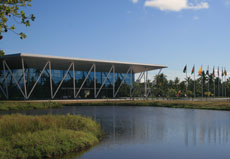
Addu’s new convention centre, purpose-built for the SAARC Summit, looms out of a deserted patch of swampy marshland in Hithadhoo like some kind of spaceship, thoroughly incongruous with the background.

When Minivan News first visited yesterday, a large crowd of local residents stood by the road leading to the giant building, staring at it dumbfounded as if waiting for extraterrestrials to emerge.

Past the polished lobby, the cavernous chamber inside is warmly lined with wood and resembles a modern concert hall. Opposition media outlets have ungenerously suggested the structure is sinking into the swamp, while assorted government officials were quick to attribute this to political jealousy.

Addu is a fiercely independent atoll, neglected by successive governments following an abortive attempt to secede from the Maldives alongside Huvadhu Atoll and Fuvahmulah as the United Suvadive Republic in 1959. This was brutally crushed in 1962 by then-President Ibrahim Nasir using a gunboat borrowed from Sri Lanka, and the entire island of Havaru Thinadhoo was depopulated and its inhabitants dispersed, killed or imprisoned.

The presence of the British airbase at Gan ensured steady employment, English proficiency and free medical treatment. Even today a disproportionate number of the country’s most successful businessmen are from Addu.

The departure of the RAF in 1976 hit the atoll’s independence hard, and the tourism boom beginning to take hold in other parts of the Maldives was slow to develop in Addu despite the presence of an airport and some of the country’s best dive spots.

President Mohamed Nasheed’s decision to declare Addu Atoll a city prior to the local council elections, the declaration that it would be hosting the SAARC Summit, and the building of the convention centre has played to the atoll’s independent sentiment and given it unprecedented political recognition.

There are 30,000 votes in that sentiment – and an additional 8000 with the opening of the new airport at Fumuvalah, a single-island atoll and the country’s most isolated, surrounded by rough and inhospitable seas.

As a domestic political strategy, SAARC appears to be working. Driving along the link road from Gan to Hithadhoo yesterday, Minivan News observed amid the country flags of SAARC nations an abundance of yellow buildings, the colour of President Nasheed’s Maldivian Democratic Party (MDP).

A local woman, sweeping up weeds with a rake under a large billboard, described her work as a “national duty”. The billboard read: “Thank you President Nasheed, you led us to believe in dreams.”

Development after SAARC

Speaking to Minivan News in between juggling mobile phones, Foreign Minister Ahmed Naseem observed that conferencing and event tourism had “huge potential” in the Maldives, given the country’s already “five star personality”. It would shift the Maldives from its reliance on beach and sun tourism, he suggested.

There were, he noted, some “tabloid” opinions about the centre, but said there was already interest in the tender for running the centre post-SAARC and the construction of a nearby hotel from hoteliers around the country and region.

“The infrastructure has been developed and people have been trained to run this kind of event,” he said.

SAARC dignitaries have been staying at the upmarket Shangri-La Villingili resort, while journalists around the world from London to Bangladesh have taken over Equator Village, the former RAF Sergeant’s mess, moaning about the sporadic shuttle bus and opportunistic US$10 taxi fares.

The locals have meanwhile launched a campaign of parades and evening entertainment, with music performances and enough fairy lighting along the link road as to give the place a festive feel. Participation was initially muted, acknowleged one official – “everyone still seems surprised. It hasn’t sunk in yet.”

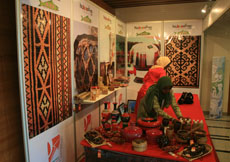
Among the most successful local operations is the Hubasaana 2011 Arts, Crafts and Food festival, which has set up stalls at major venues and been doing a brisk trade in T-shirts, local handicrafts, and peppery Adduan short-eats and banana-leaf wrapped medicines all made by local producers. Trails of foreign journalists crunching their way through packets of homemade spicy gulha are a common sight.

Stalls have been selling local foods and handicrafts to visitors

SAARC Summit

The key day of the Summit is November 10, the opening ceremony during which SAARC heads of state will give their address. During the two-day Summit all traffic in the atoll will be stalled, divers pulled out of the water, and travel on the link road restricted. Last night checkpoints backed up as police logged the registration of every passing vehicle.

During the presence of the world leaders mobile communications around the centre will be jammed; foreign journalists became flustered after being told they would be unable to take laptops or phones into the convention centre during the opening and closing ceremonies due to tight security.

Foreign Minister Ahmed Naseem told Minivan News the most important objective of the Summit was to improve and promote trade in the region, and remove existing barriers and impediments: “only three percent of trade among SAARC countries is regional.”

“We should adopt SAFTA (South Asian Free Trade Area) as soon as possible,” he said.

Economically, the Maldives is most concerned about developing ferry transport connections with countries in the region, reducing its dependence on air travel, and on the climate change front, “promoting renewable energy investment”.

Naseem also raised the prospect of introducing a human rights mechanism into SAARC, but acknowledged that it was ambitious and that SAARC had “an embedded system.”

There was, however, “a lot of good will on all sides”, he said. SAARC would be a success “even if we can agree on the issues to be solved.”

For Addu, the outcome of SAARC has already been assured.

Likes(0)Dislikes(0)