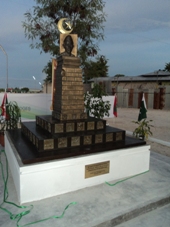
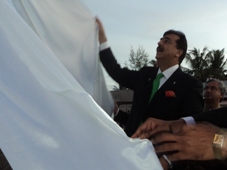
The 17th SAARC Summit was opened this afternoon in Addu City by Prime Minister of Bhutan, Lyonchhen Thinley.
The leaders of Nepal, Pakistan, Sri Lanka, Afghanistan, Bangladesh, Bhutan and India arrived at the purpose-built Equatorial Convention Centre in motorcades, escorted by police outriders in ceremonial uniform, dozens of bodyguards and an ambulance.
The Maldives National Defence Force (MNDF)’s Rehendi helicopter hovered overhead, while arriving heads of state emerged from their vehicles to be greeted by President of the Maldives Mohamed Nasheed and First Lady Laila Ali. They entered the convention hall to the sound of bodu beru drums and the sight of local girls waving paper garlands.
“South Asia is more powerful and prominent than any other time in its history. The future is ours to shape,” President Mohamed Nasheed said, in his inaugural address as the new Chairman of SAARC.
“Our economies are booming. Our political influence is growing. And our ability to shape the course of world affairs has never been stronger. Our populations are youthful and energetic. Our thinkers, researchers and scientists are globally renowned. Our culture is internationally acclaimed. Our private sector companies are some of the world’s largest and most profitable,” Nasheed said.
Citizens in SAARC countries had similar aspirations, he noted: “They want to live in societies based on the rule of law, in which basic freedoms are protected. They want the chance to succeed in our region’s economic miracle. They want what everyone wants: a decent life to live in dignity.”
Nasheed raised three key areas of focus: trade, transport and economic investment, security against piracy and climate change, and good governance.
However climate change, he said, was the greatest long-term threat affecting the region, “causing havoc, threatening our development and prosperity. But the solution to climate change is not cutting back. Rather, it is investing in the new, clean technologies that not only reduce pollution, but also improve energy security and provide long term economic growth.”
President Nasheed also noted the potential for a human rights mechanism in SAARC, “not to point fingers, or open historic and painful wounds, but because we have a duty to improve the lives of citizens.”
Nasheed welcomed the proposal to set up a SAARC Independent Commission on Gender, commenting that South Asian women “suffer from a wide range of disadvantages and discrimination. Women in our region have some of the world’s lowest rates of property ownership and political representation.”
He finished on an optimistic note: “The fundamentals of our region are strong. We have young, energetic populations. We live in a region of vibrant democracies, with strong civil societies.”
“As our economies race ahead, our political importance increases ever more. Let us not be held back by history or convention. Let us be the leaders our people want us to be. Let us change our region for the better. Let us change the world,” Nasheed said.
Leaders address SAARC
In his address to the SAARC delegates, Prime Minister of Nepal Baburam Bhattarai observed that SAARC nations were situated “in the cradle of human civilisation, with abundant natural and human resources. But despite this, our potential is unfulfilled. We face widespread poverty, unemployment and inequality.”
The largest number of world’s poor “live in our region”, Bhattarai said, but the “flow of growth, people and ideas has been hindered and our potential remains unfulfilled.”
Pakistani Prime Minister Yousaf Raza Gilani congratulated Nasheed on hosting the first SAARC Summit in the southern hemisphere.
In bilateral talks on Thursday morning with Indian Prime Minister Manmohan Singh, the historically tense relationship between the two nuclear-armed nations lightened after the two leaders took measures to ease trade limitations. Singh even described Gilani as a “man of peace” following the meeting.
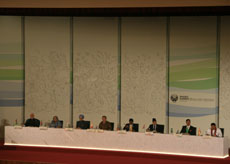 In his speech to the assembled delegates, Gilani emphasised that Economic development was linked to the availability of energy at a reasonable price, an and urged investment “in harnessing indigenous energy sources such as solar, wind, biomass and hydro power.”
President of Sri Lanka, Mahinda Rajapaksa, meanwhile prioritised education in his speech, stating that as leaders, “we have a sacred duty to develop our people.”
“In Sri Lanka we believe in social mobility. Education, communications and healthcare must be made available to all,” said Rajapaksa, adding that “ignorance, deceit, and poverty” were “common evils” facing SAARC nations.
“Social equality goes hand-in-hand with economic progress,” he stated, emphasising that this could only be achieved through peace and security.
President of Afghanistan, Hamid Karzai, also highlighted the importance of education in his address.
“Despite the progress we have made, lack of education and unemployment is a vicious cycle that is creating fertile ground for extremism,” he said.
A stable Afghanistan would enable its use as a land bridge between many countries and greatly improve trade links in the region, he said.
While terrorism was the biggest cause of suffering for the Afghan people, he said, the violence was not only limited to Afghanistan, but also affected Pakistan and India.
“We need to overcome the trust deficit that exists and learn to cooperate,” Karzai said.
He noted that Afghanistan was pursuing a strategic long term partnership with the United States, but said he wished to “reassure our neighbours that such a partnership is no threat to the region.”
The theme of education was continued slightly differently by Prime Minister of Bangladesh, Sheikh Hasina, who in her address emphasised the need for SAARC countries to promote cross-border educational cooperation by institutions such as universities. Bangladesh was interested in opening a university in the Maldives, she added.
Like the Maldives, Bangladesh was also very vulnerable to climate change, Sheikh Hasina said.
“Along with the global economic crisis, we are vulnerable to factors beyond our region,” she said. “Increases in fuel and food prices due to climate change jeopardise a sustainable way of life for our people.”
Another priority for Bangladesh was the expansion of the SAARC convention of the prevention and combat of trafficking in women and children.
“We want to ensure our migrant labour is well treated when working in other countries,” Sheikh Hasina said.
Prime Minister of Bhutan, Lyonchhen Thinley, expressed hope for “youth and dynamism” now the chairmanship of SAARC had been passed to President Mohamed Nasheed and the role of Secretary General to Fathimath Dhiyana Saeed, both the first female and youngest person to assume the role in the organisation’s history.
Despite the distance between the Maldives and Bhutan, the two countries had a surprising number of similarities, Thinley said – and not just because they were the two smallest SAARC nations.
“Rising temperature is a threat to our ecology, and while our GDP is improving, we need to diversify our economy,” he said.
As former SAARC Chairman Thinley was among the most vocal about the effectiveness of SAARC, warning against empty rhetoric and noting “that there is a feeling that cooperation should yield more concrete results.”
“There has been a failure to resolve geopolitical realities, and we have allowed ourselves to be guided by the politics of the past. Good intentions have been foiled, or remain only in documents. Progress has stalled, depriving South Asia of the opportunity to flourish as a peaceful region with people free of poverty,” he said.
Intra-region trade was not more than five percent of the total volume, and cultural interaction between countries was limited, he said.
Furthermore, antagonists such as the “mischevious media” confined goodwill to symbolic gestures.
“We have half the world’s poor. We need be bigger and bolder than those who are holding us back,” he said.
“At the same time, mankind is hurtling toward self-annihilation, and the planet’s capacity to provide for a growing population is declining day by day. We extract, sell, consume, waste and pollute, while our financial system is unravelling.
“We need to act before global order is compromised and a frightened world falls into disarray. We cannot allow natural resources to fall to a level where there is a violent struggle for control.”
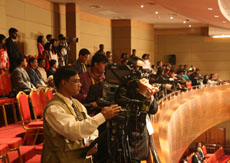 GDP was adopted as an indicator of social progress 70 years ago, Thinley said, and was an ineffective measure of human happiness. Bhutan had shifted its perspective towards sustainable development and was taking a more holistic approach, he said.
Indian Prime Minister Manmohan Singh was among the most direct of the leaders, reeling off initiatives India was pursuing.
He announced India’s willingness to facilitate the development of a regional telecommunications infrastructure and promote broadcasting exchanges.
Singh offered India’s scientific and technological base to assist SAARC countries in their development, “and above all our young population who will drive consumption and investment in the years ahead.”
India also proposed establishing a travelling exhibition on the ancient history of South Asia, with pieces drawn from each SAARC member country, hosted in each country’s national museum for three months.
Singh announced the doubling of scholarships offered to post-graduate courses in South Asian University, from 50 to 100, and a further 10 scholarships for doctoral studies in forestry.
“We have to learn to trust each other and to learn from each other. The security of our countries are closely interlinked,” Singh said. “None of us can prosper in isolation. We cannot afford to allow the many problems we face to stand in the way of our ambitions and dreams.”
The Summit is being observed by Australia, China, the European Union, Iran, Japan, South Korea, Mauritus, Myanmar and the United States, as well as many international institutions.
Eighty percent of Commonwealth in SAARC
Outside the convention centre following the meeting, Commonwealth Secretary General Kamalesh Sharma observed to Minivan News that 80 percent of the population of the Commonwealth live in SAARC countries.
“Five of the eight SAARC countries are in the Commonwealth,” he noted.
While acknowledging that this meant there was “a lot of overlap” between the two organisations, the Commonwealth could offer its experience in developing areas such as the rule of law.
“For me it has been very useful to meet the leaders in person. This year is pioneering – this is the first time the head of the Commonwealth has been invited to SAARC,” Sharma said.
Many of the goals of SAARC countries, expressed by their leaders during their respective addresses, boiled down to “a better deal for their people”.
“One remark that particularly stuck me was that ‘no country is working in isolation’,” Sharma said, adding that in developing as a regional body SAARC could learn from the “bitter lessons learned in Europe.”
“As for speed, you can’t change the facts on the ground. There are competing ideologies, and pace is determined by politics,” he acknowledged.
There was space within SAARC for a human rights mechanism, he said, and while many of its concerns related to trade, once the vehicle existed it could be used to talk about human rights as well.
“If SAARC wanted help with this, we would provide it,” he said.
On Friday the Heads of State will attend a Summit Retreat at the Shangri La resort, while their spouses are entertained in Fuvahmulah, before the Summit resumes in the afternoon.
Statements will be made by SAARC observer nations, and agreements will be signed. President Nasheed will present his concluding address, and the delegates will depart in the evening.
Likes (0)Dislikes
 (0)
(0)